Search This Blog

De Omnibus Dubitandum - Lux Veritas

Showing posts with label Great Depression. Show all posts

Wednesday, November 20, 2024

Blame Washington for the Great Depression, Part II

November 19, 2024 by Dan Mitchell @ International Liberty

With regards to economic policy, Herbert Hoover and Franklin Roosevelt were two peas in a pod. They both responded to an economic downturn by dramatically expanding the size and scope of government. As a result of those mistakes, they turned a recession into the Great Depression.

But that statement doesn’t come close to capturing the terrible consequences of their statism. So I went to the Maddison database and created two charts that illustrate the utter failure of Hoover’s interventionism and FDR’s New Deal.

The first chart is very straightforward, showing that there was almost zero growth in per-capita GDP between 1929 and 1940.
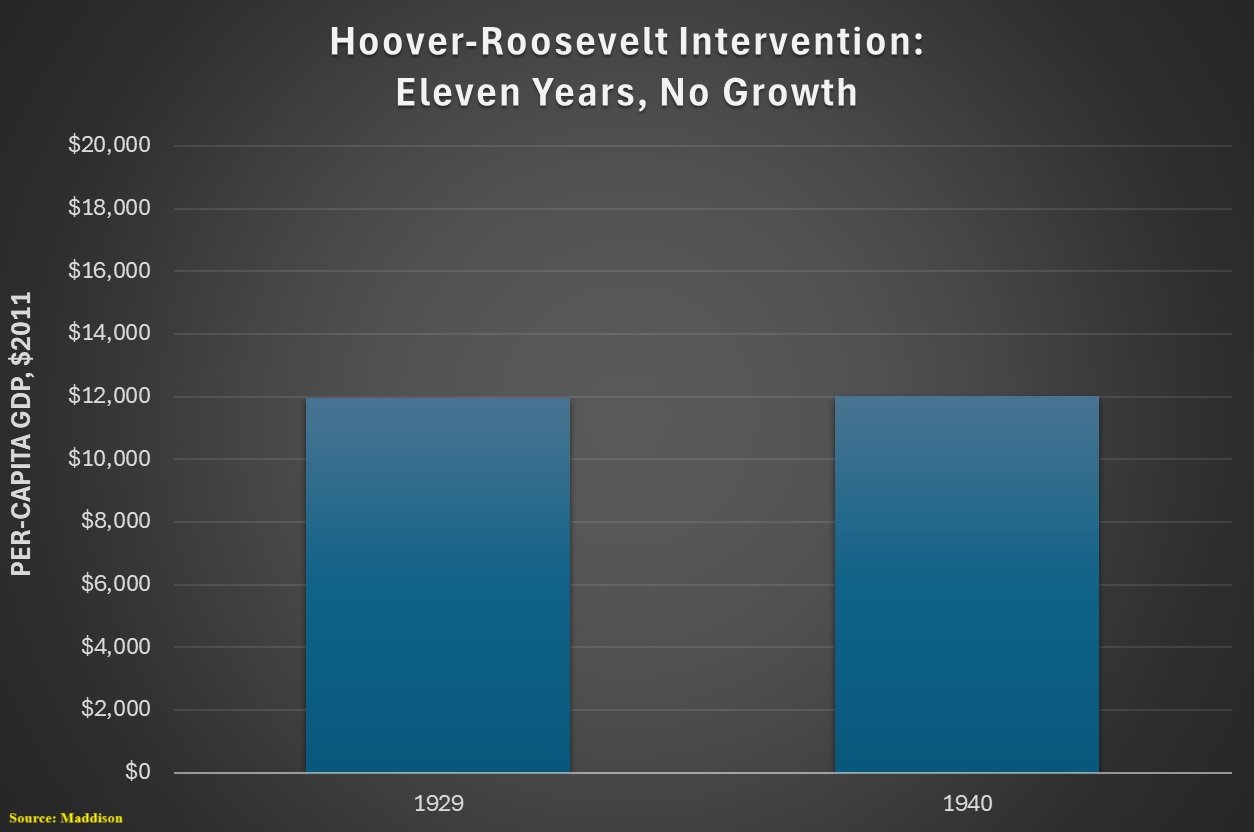
That’s a miserable performance, and it is also is a massive historical anomaly.

Here’s another chart comparing the 11-year change in per-capita GDP during the Hoover-Roosevelt era of statism with the average of every other 11-year period from the end of the Civil War until today.
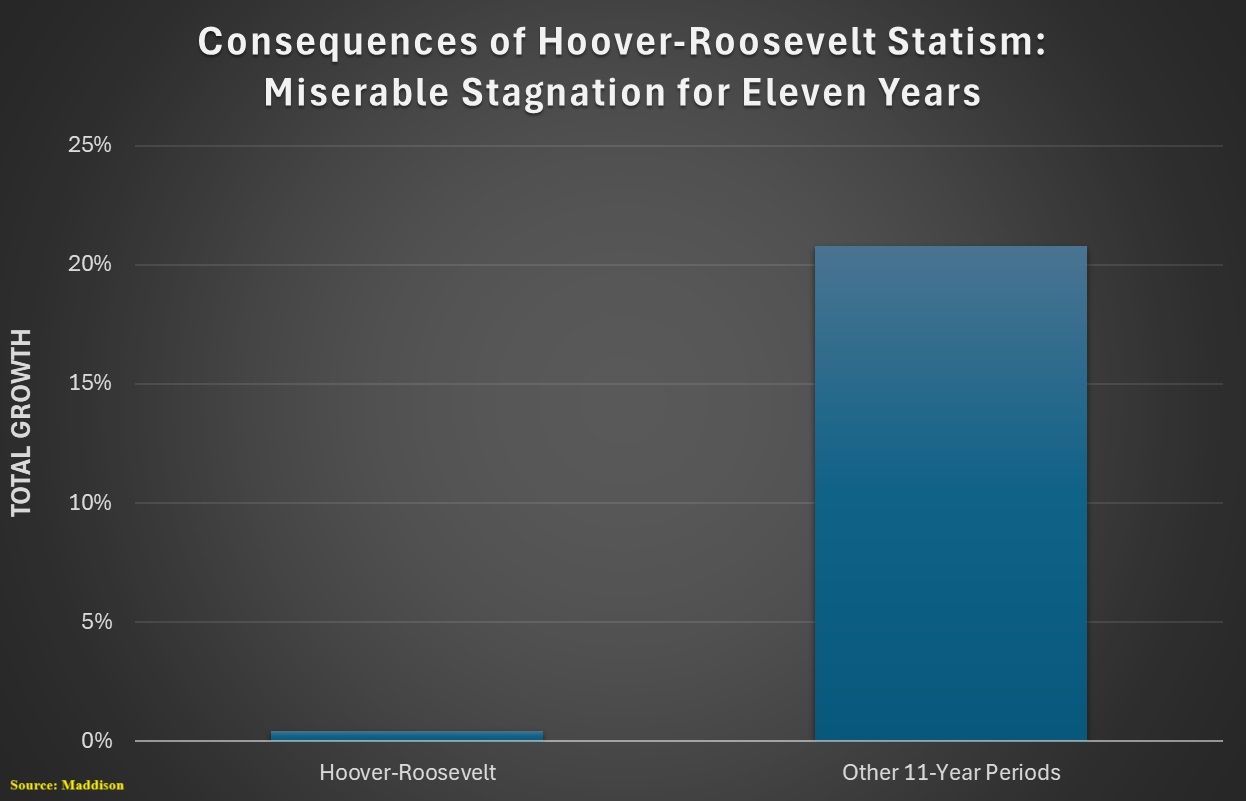
The bottom line is that there have been plenty of recessions in American history, but they usually have not lasted very long and they’ve been more than offset by periods of growth.
 

It was only when Hoover and Roosevelt delivered 11 years of statism that America suffered 11 years of stagnation. Let’s now augment GDP data with some analysis. In a column for Law & Liberty, Amity Shlaes wrote about how the Hoover-Roosevelt policies were a failure that deepened and lengthened the Great Depression.

If you’re in a rush, these excerpts summarize her findings.

…many historians have been unwilling to probe the effect of Roosevelt’s multi-year recovery program, the New Deal. …Why did recovery not return after five years, or after seven? …It was the duration that made the Depression great. …These days, politicians routinely invoke the New Deal as a model of inspiration…even though the New Deal never…“put America back to work.” …other factors, well documented by the extensive studies of the early years, exacerbated the subsequent downturn: the young Fed’s missteps, an international crisis, the collapse of vulnerable small banks across the land. …

Historian Robert Higgs has developed a useful thesis to explain this lost decade: “regime uncertainty,” the notion that an erratic, aggressive government can terrify businesses into slowdown. …the downturn after 1929 would not have become the Great Depression had Presidents Hoover and Roosevelt replayed the restrained federal policy of the early 1920s: reduce uncertainty and allow the market to take the lead.

She documents some of Hoover’s failures.

Congress passed, and President Herbert Hoover went along with, a damaging tariff, Smoot-Hawley. …Hoover, unlike Harding or his successor Calvin Coolidge, was inclined to action. …Hoover therefore turned to measures his “do less” predecessors would have eschewed. …

Hoover loaded burdens on business with a large tax hike, raising the top income tax rate to 63% from 25%. Even Hoover’s smaller interventions today look perverse: At a time when transactions were difficult, Hoover threw sand in the gears by introducing a tax on checks. …Hoover likewise tried to manage prices in another new area: labor. …Under a then-novel theory, higher wages would prompt recovery because they would invigorate workers and enable workers to spend more, stimulating the economy.

Amity then explains that Roosevelt delivered more of the same.

Like Hoover before him, …Roosevelt promised..new interventions. …With his New Deal, the President claimed that license. In the famous 100 Days, his first legislative drive, Roosevelt established dozens of large programs to oversee or alter virtually every sector of the economy. The National Recovery Administration, tasked with managing the industry, became the centerpiece of the New Deal. …

Under statutes bearing visible traces of Benito Mussolini’s syndicalism, the NRA assigned large firms and industry leaders, to draft codes to promote efficiency in their markets. These codes spelled out in magnificent detail right down to what price a cleaner might charge to press pants, or which chicken a butcher must kill first — every aspect of daily business. …the NRA’s corollary agency in agriculture, the Agricultural Adjustment Administration both forced and paid farmers to destroy their crops, again on the principle that less product would drive up prices. …Though Hoover had raised taxes, Roosevelt boosted them yet again, specifically targeting those who were most likely to create jobs through investment: top earners.

Amen. Amity is right (and historians are wrong) about the destructive policies of the 1930s.

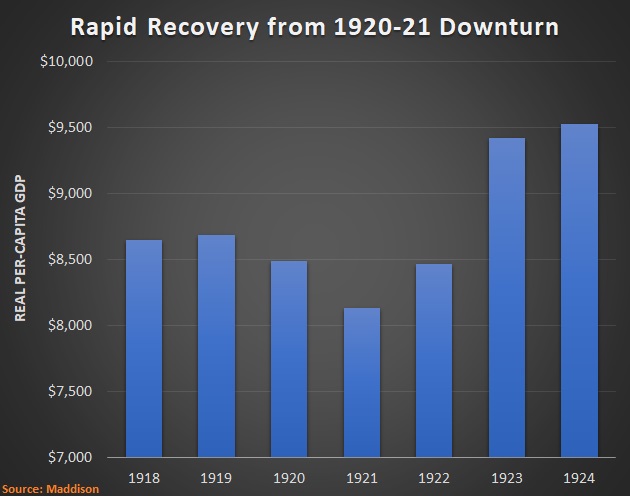
P.S. Amity also includes some discussion of what happened during the “Forgotten Depression” shortly after the end of World War I. Harding did the opposite of Hoover and Roosevelt and got infinitely better results.

In the early 1920s, …Washington and the young Fed addressed a severe downturn by halving federal spending and raising interest rates. These moves would today be considered counterintuitive, to put it politely. …a new president, Warren Harding, sent a signal: there was no need for grand reform from the government, despite the downturn. …

Assailing the heavy burden of taxes postwar, Harding, once elected, made it clear to the public that he intended to reduce taxes wherever and whenever he could. Fewer burdens would free the private sector to pull the country forward. It did. Indeed, the economy recovered so rapidly that the early 1920s downturn is today known as The Forgotten Depression. Stock prices rose dramatically, more than tripling over the decade. Jobs materialized, and most importantly, the standard of living increased. Productivity gains meant the old six-day work week could drop to five days. That gave America a gift we still enjoy: Saturday.

P.P.S. Fortunately, FDR was not able implement his “Second Bill of Rights” or his proposal for a 100 percent tax rate.

P.P.P.S. Some claim that World War II spending shows that Keynesian economics can work, but proponents of that view have never been able to explain why the economy didn’t fall back into depression when the war ended.




Thursday, February 17, 2022

Myths about the Depression and Franklin Roosevelt's program

Much mischaracterization surrounds the greatest economic crisis in American history.  For starters, I'm going to skip ahead to the election of 1932, where Franklin Roosevelt defeated the otherwise popular Herbert Hoover to become only the third Democrat to be elected president since the Civil War.  The mythology concerns the why of Roosevelt's superior popularity.  Most folks you might ask would say FDR had a grander vision of what it would take to end the Depression — and they would be wrong.

First off, the stock market crash of 1929 had not yet fully morphed into the Great Depression by 1932.  Paul Johnson, in Modern Times, makes the case that FDR won because he campaigned on ending Prohibition.  He was a "Wet" and Hoover was a "Dry."  I posed this to my mother, who voted for the first time in that election.  She was shocked and amazed — and then realized that she really did vote to end Prohibition, not the Depression. 

Johnson does still blame the Depression on Hoover — not as president, but rather as secretary of commerce under Coolidge.  Hoover sent boat-loads of money to Latin American nations to stimulate markets for American exports.  The recipient regimes were often soon overthrown, and the money was embezzled, damaging the liquidity of the US government...........To Read More.....

My Take - It was Hoover who set the ground work for the Great Depression but it wasn't while he was in the Coolidge administration, although this didn't help, and Coolidge thought Hoover was an idiot.   He was right.  Also, FDR ran criticizing Hoover's efforts to end the depression, and then out Hoovered Hoover when he became president, and that turned it into the Great Depression.  Let's put the blame where it properly belongs, FDR.  Please view my

Tuesday, March 16, 2021

Blame Washington for the Great Depression

There are several false narratives about economic history, involving topics ranging from the recent financial crisis to 19th-century sweatshops.

But probably the biggest falsehood, as explained in this video by Prof. Lee Ohanian, is the notion that big government saved us from the Great Depression.

The only shortcoming of Ohanian’s video is that he’s analyzing just one of President Roosevelt’s mistakes.

Yes, it is very important to explain why FDR’s corporatism was profoundly misguided, but we also should recognize that he had terrible fiscal policy as well. 

 https://i0.wp.com/freedomandprosperity.org/wp-content/uploads/2017/11/Cartoon-Mitchells-Law.jpg

Roosevelt had two competing camps of advisers on the budget, one of which wanted to borrow and spend, while the other wanted to tax and spend. Sadly, both groups enjoyed plenty of victories.

With so many policy mistakes, we shouldn’t be surprised that the economy remained mired in a depression for an entire decade.

What’s tragic is that most of that suffering could have been avoided if FDR and his appointees simply remembered how President Harding a dozen years earlier had cut taxes and spending to rescue the economy from a deep downturn.

Let’s look at some additional analysis.

Writing for CapX, Tim Worstall explains how FDR’s blundering made things worse, especially compared to what happened in the United Kingdom.

…what caused the Great Depression was a series of bad political choices… The British…government cut spending and things turned out rather better than that in the US. …the much worse American experience was a direct result of the huge expansion of government. Far from saving the US economy, Roosevelt’s various interventions actually prolonged the agony. …The Depression was over in the UK by 1934. …the American disaster toiled on rather longer. So, what were the big differences? …the UK cut state spending… FDR boosted the role of the federal government in many ways. …the National Recovery Administration, which was a disastrous attempt at managing prices. …the imposition of cartels upon both business and agriculture. This suite of ill-advised measures delayed the recovery.

The only good news is that we didn’t get a resuscitation of those policies after World War II, which meant the economy had a chance to finally recover.

So what’s the moral of the story?

As Larry Reed wrote for the Foundation for Economic Education, the Great Depression was caused by a series of foolish interventions by politicians in Washington, and we need to remember that lesson so we don’t repeat the mistakes of history.

The history of the Great Crash and subsequent Depression provides a sad litany of policy blunders in Washington. Altogether, they needlessly caused and prolonged the pain; roller coaster monetary policy, sky-high tariff hikes, massive tax increases, government-supervised destruction of foodstuffs, gold seizures, price-fixing regulations, soaring deficits and debt, special favors to organized labor that stifled investment and boosted unemployment. …myths and misconceptions about our most calamitous economic episode abound. Fortunately, recent scholarship is slowly changing that. The simplistic, error-filled assumption that free markets failed and government rescued us—once conventional “wisdom”—no longer gets by unquestioned.

For further information on the Great Depression and bad government policy, you can watch other videos here and here.

P.S. Walter Williams and Thomas Sowell both have written on the issue as well.

P.P.S. With regards to economic policy, FDR was an awful president. And he would have been even worse had he succeeded in pushing through his plan for a 100 percent top tax rate and his proposal for a so-called economic bill of rights.


Friday, August 7, 2020

Warren Harding’s Anti-Keynesian Solution to a Deep Economic Downturn August 6, 2020 by Dan Mitchell

August 6, 2020 by Dan Mitchell @ International Liberty

 We did not get good policy during the economic crisis of the 1930s. Indeed, it’s quite likely that bad decisions by Herbert Hoover and Franklin Roosevelt deepened and lengthened the Great Depression.
Likewise, George Bush and Barack Obama had the wrong responses (the TARP bailout and the faux stimulus) to the economic downturn of 2008-09.

But people in government don’t always make mistakes. If we go back nearly 100 years ago, we find that Warren Harding oversaw a very rapid recovery from the deep recession that occurred at the end of Woodrow Wilson’s disastrous presidency.
In a column for the Foundation for Economic Education, Robert Murphy has a very helpful tutorial on what happened.
…the U.S. experience during the 1920–1921 depression—one that the reader has probably never heard of—is almost a laboratory experiment …the government and Fed did the exact opposite of what the experts now recommend. We have just about the closest thing to a controlled experiment in macroeconomics that one could desire. To repeat, it’s not that the government boosted the budget at a slower rate, or that the Fed provided a tad less liquidity. On the contrary, the government slashed its budget tremendously… If the Keynesians are right about the Great Depression, then the depression of 1920–1921 should have been far worse. …the 1920–1921 depression was painful. The unemployment rate peaked at 11.7 percent in 1921. But it had dropped to 6.7 percent by the following year and was down to 2.4 percent by 1923. …the 1920–1921 depression “purged the rottenness out of the system” and provided a solid framework for sustainable growth. …The free market works. Even in the face of massive shocks requiring large structural adjustments, the best thing the government can do is cut its own budget and return more resources to the private sector.
Writing for National Review, David Harsanyi points out that there are many reasons why Warren Harding should be celebrated over Woodrow Wilson.
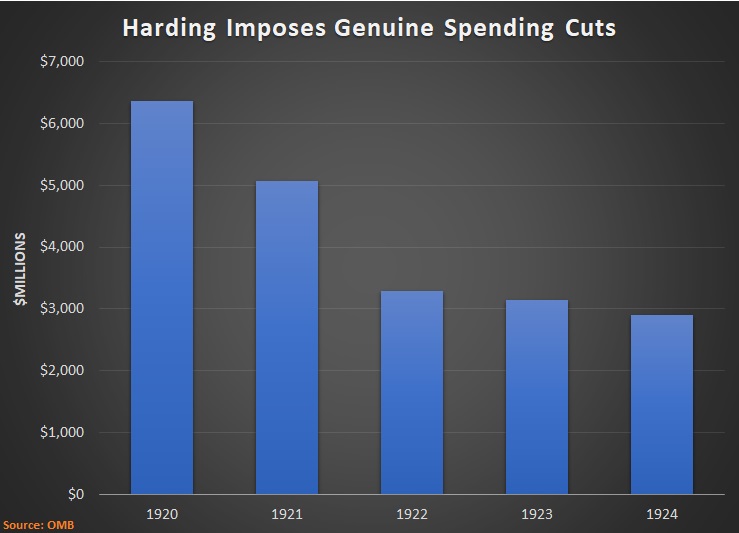
Wilson was one of the most despicable characters in 20th-century American politics: a national embarrassment. The Virginian didn’t merely hold racist “views;” he re-segregated the federal civil service. He didn’t merely involve the United States in a disastrous war in Europe after promising not to do so; he threw political opponents and anti-war activists into prison. Wilson, the first president to show open contempt for the Constitution and the Founding, was a vainglorious man unworthy of honor. Fortunately, we have the perfect replacement for Wilson: Warren Harding, the most underappreciated president in American history… Harding, unlike Wilson — and most of today’s political class, for that matter — didn’t believe politics should play an outsized role in the everyday lives of citizens. …Where Wilson had expanded the federal government in historic ways, creating massive new agencies such as the War Industries Board, Harding’s shortened term did not include any big new bureaucracies… Wilson left the country in a terrible recession; Harding turned it around, becoming the last president to end a downturn by cutting taxes, and slashing spending and regulations. Harding cut spending from $6.3 billion in 1920 to $3.3 billion by 1923.
Walter Block, in an article for the Mises Institute, explains that what happened almost 100 years ago can provide a good road map if President Trump wishes to restore prosperity today (especially when compared to the disastrous policies of Hoover and Roosevelt).
…let us look back a bit at some economic history regarding recessions and depressions… The depression in 1921 was short lived—maybe not a V, but at least a very narrow U. …Happily, during the 1921 depression, the government of President Warren G. Harding did not intervene…and the entire episode was over not in a matter of weeks (the V) or years (a fattish U), but months (a narrow U). The Great Depression, which stretched from 1929–41 (a morbidly obese U) stemmed from identical causes. …But Presidents Herbert Hoover and Franklin D. Roosevelt “fixed” this by propping up heavy industries whose extent was overblown by the previous artificially lowered interest rates, in an early “too big to fail” paroxysm. The Smoot-Hawley Tariff added insult to injury, and put the kibosh on any early recovery. …I now predict the sharpest of Vs, but if and only if, all other things being equal, the Trump administration cleaves to market principles. …So, Mr. President, embrace the free enterprise system, attain a V, a very narrow and sharp one, and the prognostication for November will be significantly boosted.
Professor Block’s analysis is very sound…except for the part where he speculates that Trump will do the right thing and copy Harding.  Given Trump’s awful track record on spending, it would be more accurate to speculate that I’ll be playing in the outfield for the Yankees when they win this year’s World Series. 

(Editor's Note: The President doesn't control spending, Congress does, and Trump isn't facing loyal Americans who merely disagree, as Harding and Coolidge did.  He's facing radical leftists who want to destroy America, and there's no compromising with them.  If Trump survives into a second term, I expect to see a turn around in his approach.  RK)

Suffice to say, though, that it would be great to find another Warren Harding. Here’s a chart based on OMB data showing that he actually cut spending (and we’re looking at genuine spending cuts, not the make-believe spending cuts that happen in DC when politicians boost the budget by less than previously planned).


According to fans of Keynesian economics, these spending cuts should have tanked the economy, but instead we got a boom.

P.S. By the way, something similar happened after World War II.

P.P.S. Back in 2012, I shared some insightful analysis from Thomas Sowell about Harding’s economic policy.

P.P.P.S. Harding also lowered tax rates.


Thursday, May 2, 2019

Lessons from the 1920s and 1930s about Growth vs Equality

May 1, 2019 by Dan Mitchell @ International Liberty
 
I have a very low opinion of leftist politicians, in large part because I suspect most of them privately understand their policies don’t work, but they don’t care because their main goal is the accumulation of political power (Crazy Bernie is an exception since he seems to genuinely believe in socialism).

But I don’t dislike ordinary people with statist views. They have good intentions.

All that’s wrong is that they think government intervention and redistribution can improve the lives of the less fortunate. Presumably because they incorrectly assume the economy is a fixed pie and that some people must be poor if some people are rich.

One of my main goals is to help them understand why this is wrong.

A rising tide can lift all boats, which is why I write so often about growth in general and comparative growth between nations in particular.

And it also helps to share evidence about historical growth within a nation.

Amity Shlaes addresses this issue in a must-read article about U.S. growth in the City Journal. She starts with a pessimistic observation about malpractice by historians.
Free marketeers…are not winning U.S. history. …No longer is American history a story of opportunity, or of military or domestic triumph. Ours has become, rather, a story of wrongs, racial and social. …an axiom is taking hold: equal incomes lead to general prosperity and point toward utopia. Teachers, book review editors, and especially professors withhold any evidence to the contrary. …Decades in which policy endeavored or managed to even out and equalize earnings—the 1930s under Franklin Roosevelt, the 1960s under Lyndon Johnson—score high. Decades where policymakers focused on growth before equality, such as the 1920s, fare poorly.
This is upside down, Amity explains.
…progressives have their metrics wrong and their story backward. The geeky Gini metric fails to capture the American economic dynamic: in our country, innovative bursts lead to great wealth, which then moves to the rest of the population. Equality campaigns don’t lead automatically to prosperity; instead, prosperity leads to a higher standard of living and, eventually, in democracies, to greater equality. …growth cannot be assumed. Prioritizing equality over markets and growth hurts markets and growth and, most important, the low earners for whom social-justice advocates claim to fight. …a review trip through the decades is useful because the evidence for growth is right there, in our own American past.
The article looks at several periods, but I want to focus on what she wrote about the 1920s and 1930s.
We’ll start with the 1920s, which began with a deep downturn.
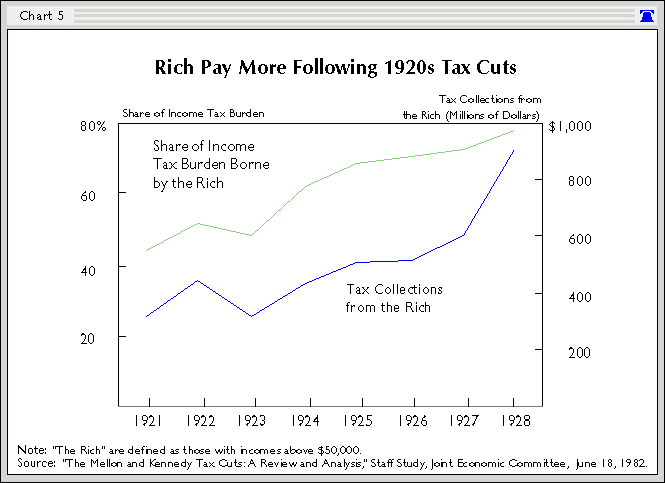
…the early 1920s experienced a significant recession. …the top rate was still high, at 73 percent. …In response, Wall Street and private companies mounted a “capital strike,” dumping cash not into the most promising inventions but into humdrum municipal bonds. …The high tax rates, designed to corral the resources of the rich, failed to achieve their purpose. In 1916, 206 families or individuals filed returns reporting income of $1 million or more… By 1921, just 21 families reported to the Treasury that they had earned more than a million. ….Against this tide, Harding and Coolidge made their choice: markets first. …Harding and Mellon got the top rate down to 58 percent. …In a second round, stewarded by Coolidge, …Mellon and conservatives would get a (somewhat) lower tax rate of 46 percent…in 1924, Coolidge joined Mellon, and Congress, in yet another tax fight, eventually prevailing and cutting the top rate to the target 25 percent. …the tax cuts worked—the government did draw more revenue than predicted, as business, relieved, revived. The rich earned more than the rest—the Gini coefficient rose—but when it came to tax payments, something interesting happened. …the rich now paid a greater share of all taxes. Tax cuts for the rich made the rich pay taxes. …the United States did average 4 percent real growth. …the 1920s economy gave workers something far more important than notional wage equality: a job. Unemployment averaged 5 percent or lower.
Excellent points about overall economic policy and lots of good information about fiscal policy.

The tax cuts were a big success, just like the Kennedy tax cuts in the 1960s and the Reagan tax cuts in the 1980s.

Moreover, the recovery from the 1920-21 recession deserves a lot of attention because it shows that spending reductions are good for prosperity.

Sadly, that lesson was almost immediately forgotten.

Here’s some of what Amity wrote about the many policy mistakes of the 1930s.
The 1930s tell the opposite story. …Hoover responded differently from the way predecessors had responded to previous crashes: he intervened. …Hoover changed policy to focus on social equality… Hoover hauled business leaders to Washington and bullied them…he cajoled Congress into passing laws…the Davis-Bacon Act of 1931…raising the top rate to 63 percent. …Hoover thoroughly intimidated business and markets… Franklin Roosevelt…sent an even clearer signal that in his presidency, equality would come first. …the New Deal’s equality measures prolonged and deepened the Depression. …For ten years, joblessness stuck stubbornly in the double digits. This mattered far more to families than any theoretical envy index. With the coming of World War II, Roosevelt pushed the top tax rate to 94 percent.
From the perspective of economic policy, the 1930s was a trainwreck. Hoover imposed terrible policy. Then FDR takes office and does more of the same.

Let’s now get to the main point of today’s column. Which decade was better for poor people:

Did poor people enjoy better results in the 1920s, when government did less and policy was more focused on growth and opportunity?
 
Did poor people enjoy better results in the 1930s, when government did more and policy was more focused on equality of outcomes?

The answer should be obvious.

It was better to be a poor person in the 1920s rather than the 1930s.

Just like poor people did better in the laissez-faire 1980s than they did in the statist 1970s. Just like poor people today do better in Chile than in Venezuela. Just like poor people did better in West Germany than East Germany. Just like poor people….well, you get the idea.

P.S. Today’s column is another reminder that Calvin Coolidge was one of America’s greatest presidents.

Sunday, November 19, 2017

Everything You Need to Know about Assigning Blame for the Great Depression, Captured by a Cartoon

November 18, 2017 by Dan Mitchell @ International Liberty

The Great Depression was an unimaginably miserable period in American history. Income fell, unemployment rose, and misery was pervasive.


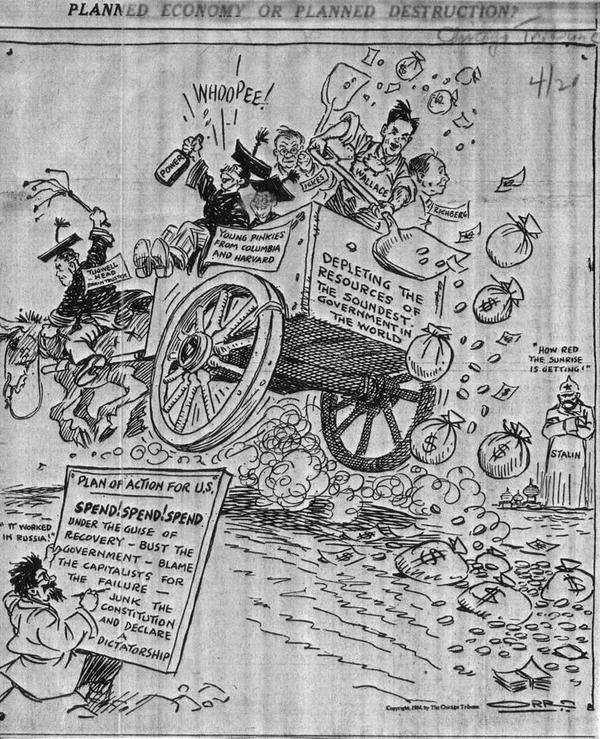
But there was still room for political satire in the 1930s. Here’s a cartoon that I shared back in 2012. Based on the notations in the upper right, I gather it’s from the Chicago Tribune, though I don’t know if that’s actually true. And I also don’t know the year.

But I certainly sympathized with the message since Hoover and Roosevelt were big-spending interventionists.

Hoover saddled the economy with taxes (an increase in the top tax rate from 25 percent to 63 percent!), spending, protectionism, regulation, and intervention. Roosevelt then doubled down on almost all of those bad policies, with further tax rate increases (up to 79 percent, and he even pushed for a 100 percent tax rate in the early 1940s!!), more spending, and lots of additional regulation and intervention.

And here’s a cartoon I posted the previous year.


Since I don’t know whether public opinion was on the right side, I don’t know if it accurately captures the mood of taxpayers.

But it’s 100-percent accurate about the instinctive response of politicians. For “public choice” reasons, the crowd in Washington has an incentive to buy votes with other people’s money. One might even say they spend like drunken sailors, but that’s actually an understatement.

But I’m beginning to digress, as is my wont. Let’s get back to satire and the Great Depression.

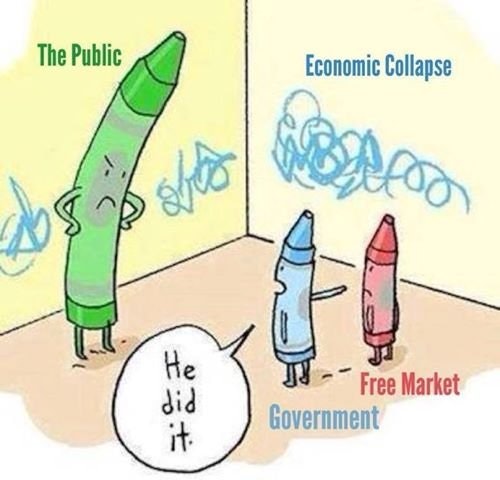
And I’m going to be creative. That’s because I saw a cartoon on Reddit‘s libertarian page that makes a very general point about government causing a mess and politicians then blaming the private sector. But because I’m a goofy libertarian policy wonk, I immediately thought that this is a perfect summary of what happened in the 1930s.  Hoover and Roosevelt hammered the economy with bad policy, the economy stayed in the dumps for an entire decade, yet the political class someone convinced a lot of people it was all the fault of capitalism.


While I will always view this cartoon as the spot-on depiction of what happened in the 1930s, it obviously applies much more broadly.

Consider the recent financial crisis, which was the result of bad monetary policy and corrupt Fannie Mae/Freddie Mac subsidies. Yet countless politicians blamed greedy capitalism.

Maybe what we have is the cartoon version of Mitchell’s Law. That’s because when politicians cause a problem and blame the free market, they inevitably then claim that the problem justifies giving them more power and control. Lather, rinse, repeat.

Wednesday, November 21, 2012

2013 Looks a Lot Like 1937 in Four Fearsome Ways

Amity Shlaes

Will 2013 be 1937? This is the question many analysts are posing as the stock market has dropped after the U.S. election. On Nov. 16, they noted that industrial production, a crucial figure, dropped as well.  In this case, ’1937′ means a market drop similar to the one after the re-election of another Democratic president, Franklin D. Roosevelt, in 1936.  Top Read More….

My Take – This is an important article since Amity Shlaes wrote the definitive work on the Great Depression called, The Forgotten Man: A New History of The Great Depression, which I strongly recommend reading.  It isn’t easy reading, but nothing I read anymore is and shouldn’t be for you either…..provided you really want to know the truth because everything you see on the news; everything you read in the newspaper is a lie!

I have read it and I will tell you that all of what we see happening has happened in the past.  All the names and events keep popping up in other books on this subject and I will absolutely say this, and say it most emphatically.  There is no way that those in power can’t see what is happening and what the end result will be.  We have the events; we have the history; we know the causes; we know who did what and why; we know what the end result will be, and we are repeating all the mistakes of the past.  We are living in times far more scary than you believe.  I am frightened for us all because the insane are in charge of the asylum.