Search This Blog

De Omnibus Dubitandum - Lux Veritas

Showing posts with label Libertarians. Show all posts

Monday, May 26, 2025

Libertarians and Reality

By Rich Kozlovich

Libertarians have much to offer that I find absolutely true and totally appealing, much of it I find irrational, such as open borders, illegal drugs, and  prostitution, all predicated on and absolute right to individual liberty.  Sounds good, but there are consequences for which they have no answers.

Libertarian thinking reminds me very much like military strategies.  Did you know that every military strategy ever devised was perfect? At least until they met the enemy. It turns out the enemy also had a "perfect" plan in place. That's when everything starts to fall apart and that's when perfect plans are so often found to be seriously flawed.

The one most able to recognize the lack of perfection in their “perfect plan”, and quickly adapts it to whatever difficulties the enemies “perfect plan” has, is the one who will be the victor.

Libertarianism is basic fundamental morality, a morality that's foundational to the human makeup. It is a reality that is imprinted in our makeup and governed by a force we call - conscience!

The trouble with conscience as an absolute arbiter of right and wrong is that the conscience can be changed, adjusted…..or…lets just say the conscience can be “trained”, and even seared "as with a branding iron', and scarred to be unfeeling with continuous acts that violate it. And what molds the conscience? Time and circumstance!

If the entire world practiced libertarianism as outlined as:

"moral premises and intuitions that in principle are shared by virtually everyone, including children, that being, don't hurt anyone. Don't steal from anyone, and mind your own business".

That would be very nice. At least until someone desired those things others have. Then what?

In spite of the governing morality imprinted on our conscience, The Ten Commandments apparently needed to be outlined as the ten "commandments", not the ten "recommendations". Why? Because people will always be people, and people will always find ways to rationalize their views to their own benefit.

While reading this start to think about the Jews as they entered the Promised Land. What form of government did they have? None to speak of! The land was broken up into tribal areas and those tribal areas were broken up into homesteads that became hereditary holdings. Even if they sold the land it was returned at some point in the future. But people were pretty much able to “do that which was right in their own eyes”.

What happened? It didn't work, and they eventually demanded a king to rule over them, judge them, and defend them against foreign enemies.

Libertarianism is a nice foundational philosophy that will be a moving force for conservatives, but it holds little appeal as a lasting, effective stand alone governing philosophy that will stand the test of time.

Why?

Because for libertarianism to work it would require people to become much more introspective and less self serving, and always be that way, and that just ain't gonna happen.

A Catholic priest once said:

"If you ever find the perfect organization, join it. However, once you have joined it; it is now become somewhat less than perfect!”

I have yet to find any flaw in that thought, because people will always be people, and the foundational social foundations, many times centuries old, will be the controlling force in societies.

Muslim controlled nations are nothing more than Medieval tribal cultures with modern trappings and military hardware. After you scrap away the surface horsepucky you begin to realize these countries are still tribal societies that are still fighting the same wars they have been fighting for centuries, and not a one of them are good guys.

They hate everyone except their own. They only love their own tribal members, their own brand of Islam, their own financial interests and their own power. All else, and everyone else is the enemy and in their minds their enemies deserve death delivered in any way that works best. 

Conclusion?  Libertarianism is a dream if put into practice becomes a nightmare.

Thursday, November 7, 2024

Tariffs: We Don't Need Them, They Need Us!

Trump gets that!

By Rich Kozlovich 

Dan Mitchell is a Libertarian and one of the economic wonks at the Cato Institute, which if you read his history, it's impressive.  Dan has allowed me to publish his work for a number of years, and he's prolific.  Having been heavily involved with economic policy in America he clearly understands the ins and outs of government economics, which is an unending slight of hand game. I like much of his work, so I publish his articles.... unless I don't agree with them.   

I know, I can hear it now.   Who does this bugman think he is to disagree with a man with Mitchell's vast experience and knowledge?  Well, I will admit, much of the economics I read makes my eyes roll up into the back of my head, and truth be told, I think economists make it that complicated deliberately.  

I've been a history buff and an avid reader for all of my life, and I have some qualities I think are important in order to understand anything.  First, life is all about patterns, and the patterns of life repeat over and over again.  The natural function of the human mind is to see those patterns, but that means striving to attain as much knowledge, on as many subjects as there are, filling your mind with a lot of seemingly extraneous information.  But as your doing this your mind will unconscionably be filing, collating, and correlating that information into useful patterns, ultimately giving you worthwhile insights.  

I see patterns more quickly than most and I see things farther, deeper, and wider than most, and the fact is, most economists have no idea what they're talking about.  Here are four of my commentaries dealing with economics, I especially like number four.

  1.  The E-Myth
  2.  What is the Proper Definition for "Opportunity Economics"? Capitalism! 
  3.  When An Accident is Waiting to Happen, It Eventually Does
  4.  Preconceptual Economics

His article goes on to offer five suggestions on how the GOP can fix government, and it's clear some of his suggestions are good ones, until he comes to number three, saying: 

I am terrified about the prospect of more protectionism. If Trump merely targeted China, it might be possible to justify his actions because of national security. But he wants to be “Tariff Man” for all cross-border commerce. Didn’t work for Hoover. Won’t work for Trump."

What he's citing is the Smoot/Hawley Tariff bill, and he's not alone in that, as John Hinderaker called Trump's efforts, Smoot-Hawley II saying:

I don’t suppose many people care, but Donald Trump’s latest venture into trade policy is idiotic. Trump’s tariff plan is so dumb that for once, the Washington Post is actually right: “Trump vows massive new tariffs if elected, risking global economic war.” ........ Protectionism has never been politically unpopular. Trump apparently is going for the lowest common denominator, appealing to the least informed voters. I guess we shouldn’t be surprised.

Why do I object to that? Because when Hoover signed the Smoot/Hawley Tariff bill in 1930 the world's economy was far different than today.   Entirely too many think in terms of the Smoot-Hawley tariff, which triggered a trade war that was an important instrument in starting the Great Depression, as the lesson we need to take seriously today.  Wrong!  

America's economy and the world’s economies in 1930 were far different then than now. We needed them and they needed us in proportion.   Now?   We don’t need them, they need us, and the point that we have a major trade deficit with these nations makes us stronger in such a battle is critical. If we stop buying their products they collapse.  

We have five criteria that makes us the winner in any trade war.   

  1. We can feed ourselves
  2. Fuel ourselves
  3. Arm ourselves
  4. Defend ourselves 
  5. We can create our own internal market.

We don't need them....they....need ...us!  

To save our allies after WWII, economically and militarily, we created the Bretton Woods hegemony, where we opened our markets to our allies and we protected them militarily since they were totally broke even before the war's end.  The only time in world history where a nation created an hegemony that was for the benefit of others.  As a result capitalism became redefined as meaning America would go on forever letting our trading partners impose tariffs and trade protections while not protecting American workers and our industrial base with tariffs.      

A philosophy that predicated one of the worst economic and political decisions ever made by a President of the United States, Nixon opening China up to world trade, and western civilization has been funding it's own destruction ever since. 

Those days are over!

One last point.  Dan admits Libertarians like him who are all in on open borders but have no idea what to do about the consequences of open borders.   in so many ways, and so very often, are just like economists.  They have no idea what they're talking about.  

Update, 10:55 AM:   This just appeared at American Thinker, Trump’s tariffs will contribute to the US economic boom, November 7, 2024 by Howard Richman,

U.S. stock markets anticipate Trump’s upcoming economic boom, but few economists realize that it will be partly due to his tariff plans.  Among those few are Peter Navarro, Trump’s adviser and author of 20 economics books; Art Laffer, America’s premier supply-side economist; and Oren Cass, author of several recent commentaries.

Trump’s tariffs (coupled with his reduction in the corporate income tax for American producers) would encourage businesses to build new factories in the United States.  In his commentary “Trump’s Most Misunderstood Policy Proposal,” Cass pointed out that Americans, not foreign workers, get the wages when products are produced in the United States.  He also pointed out that manufacturing drives long-term growth:.....

Wednesday, July 17, 2024

Are Libertarianism and Conservatism Totally Different?

By Jon J. Ray 12/22/2013  @ Dissecting Leftism

We occasionally see some rather poorly informed claims to the effect that libertarianism and conservatism are totally different -- e.g. an article by Walter Block here.  I think therefore that a little clarification is required.  The truth can be very simply put:  

Libertarianism is ONE ELEMENT in conservative thinking.  More precisely, Libertarians and conservatives share an attachment to individual liberty.

Libertarians are in some ways like Leftists.  Leftists tend to have very simple formulas for what is wrong with the world.  Ask them and they will say:  inequality, poverty and (more amusingly) intolerance.  When you realize that leading Leftists are usually well-off and are totally intolerant of dissent, you can see how uninsightful and oversimplified leftist reasoning is.   And aside from being mostly poor, libertarians are like that too.  They oversimplify enormously:  Get government out of the way and a new Eden will dawn.

Conservatives, on the other hand see everything as complex.  They see that there can be other influences on human welfare than freedom.  For instance, when a country seems threatened by foreign aggression (as Britain was in WWII) a conservative may see national security as an important consideration that may need balancing against individual liberty  - hence conservative governments may introduce a whole range of "wartime measures" that reduce the liberties of citizens to some extent.  Conservatives try to balance competing principles.

Another revelatory case is immigration.  Since libertarians dislike governments and their restrictions, they usually favour open borders.  If libertarians had their way, most of Mexico would end up in the USA.  But conservatives see other issues as being involved -- such as pressure on welfare programs and other systems,  and the importation of the dumb political ideologies that have kept most of the Americas South of the Rio Grande mired in poverty.  What the immigrants have in their heads is important, not just the fact that they are a person. And conservatives also see it as a matter of property rights. If I have the right to say whom I will have living with me in my own home, surely groups of people (nations) also have the right to say who will live among them?

Libertarians also tend to ignore genetics.  When proposing remedies for poverty,  Leftists will say: "give the poor more money" while libertarians will say "Give the poor no money".  Neither system will usually be practical so conservatives tend to say:  "The poor ye always have with you".  With no ideology to explain everything, conservatives can simply accept reality.  As one of Britain's most prominent Conservatives recently said, some people are equipped mentally to do well and some are not.  Leftists usually cry "racism" when genetics are mentioned so the conservative response is usually implicit rather than explicit these days.  That people are born different underlies a lot of conservative thinking even though it can be risky to say that out loud.

Similarly with homosexual "marriage".  Leftists see it simply as an equality issue, libertarians see it simply as a liberty issue while conservatives see it as impacting on many other things  -- such as morality and the family and a general devaluation of marriage.

So conservatives try to align their thinking with the complexity of reality while libertarians have a "one size fits all" explanation and solution for all problems.  Conservatives value liberty but don't think it is the answer to everything.  And the only liberty Leftists value is your liberty to do what they say

Monday, June 17, 2024

Notwithstanding my WSJ Quiz Results, I Am Not a Conservative

June 16, 2024 by Dan Mitchell @ International Liberty

Editor's Note:  I'm publishing this piece to amplify my own views on what it means to be Libertarian.   Dan's work on taxes, spending, borrowing, economic policy is usually quite good, and other than tariffs.  I like the idea of free trade, but it's not free, that's a delusion, which along with other libertarian delusions I explain in . RK

Some online quizzes and tests about policy and philosophy produce very accurate results.

Some tests, however, produce illogical results.

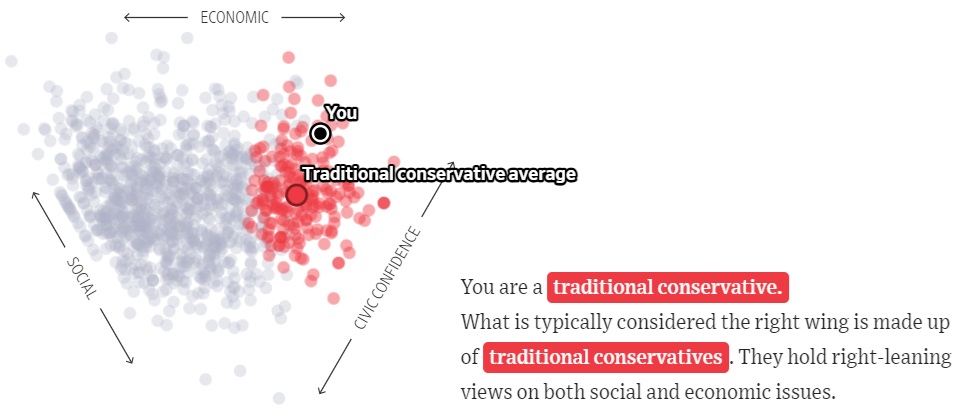
Today, I’m going to share some more results that are not very logical. The Wall Street Journal posted a quiz a few days ago to ask “What Kind of Voter Are You?”

To may dismay, they decided that I’m a traditional conservative rather than a libertarian.

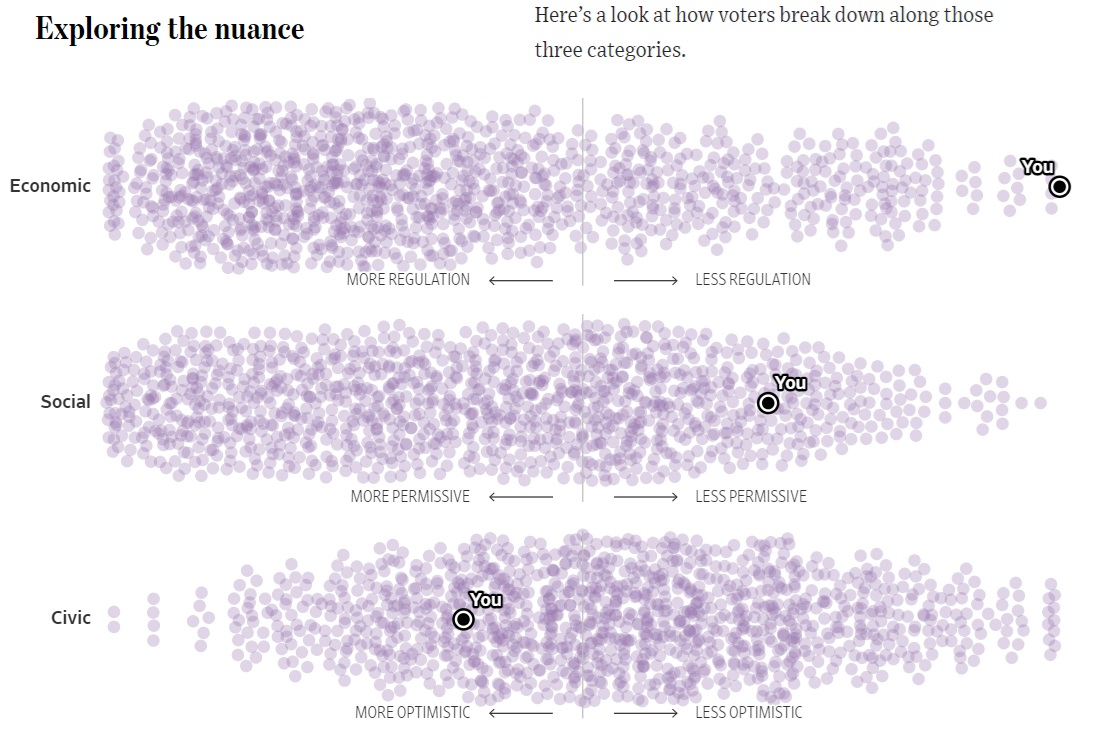
Here’s a breakdown of my results.

As far as I can tell, I’m as pro-free market as possible. Which makes sense since another quiz labelled me a “minarchist.”

But if you look at the second category, the quiz thinks I’m a social conservative.

Since I’m largely abstemious in my personal life (the boring kind of libertarian), I would not object if someone concluded I’m a social conservative as a person.

But I firmly believe I’m a libertarian with regards to policy and philosophy.

So why did the WSJ decide I was a social conservative?

I would argue that some of their questions are poorly worded.

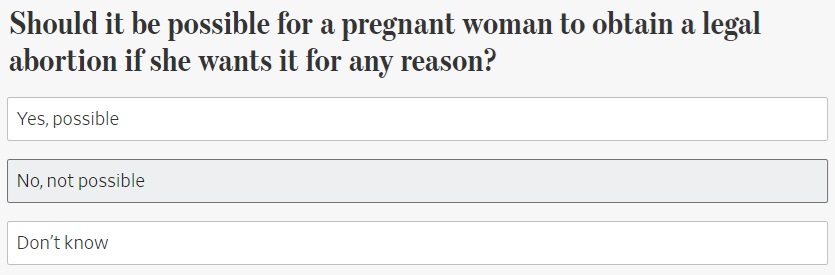
For instance, they apparently think the libertarian view is that any and all abortions should be legal. I’m sure some libertarian have that point of view, but there are also lots of pro-life libertarians.

I based my answer on the fact that I would not favor unlimited and unrestricted abortions way past the point of viability. Call me crazy, but I don’t think that makes me non-libertarian.

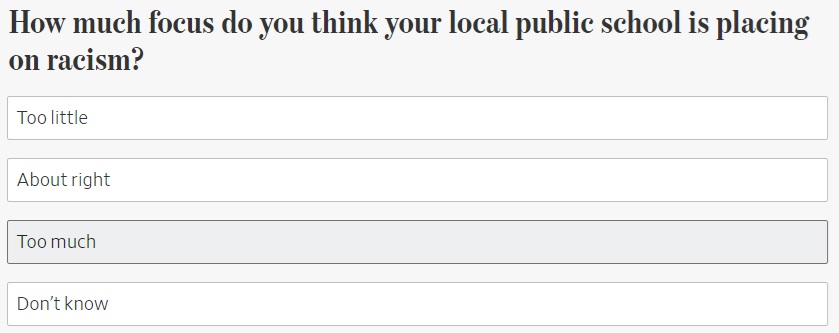
Here’s another question that struck me as strange and may have led the WSJ to label me as conservative rather than libertarian.

I answered “too much” on this question because of my concern that government schools push factually flawed narratives such as the 1619 project rather than the color-blind vision of Martin Luther King.

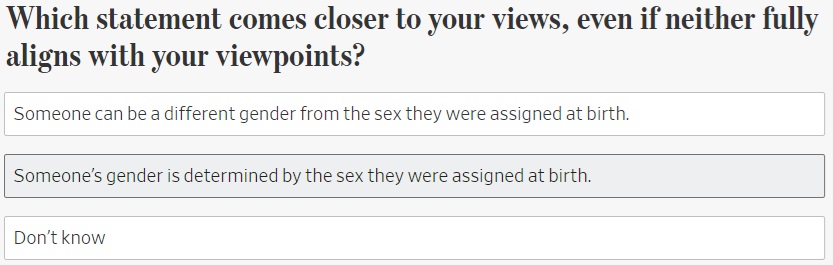
Last but not least, I don’t lose any sleep if a man wants to present as a woman, or vice-versa.

All adults should have full rights to live as they choose, so long as they are not infringing on the rights of others.

But if you’re asking me whether I agree that men can be woman simply because of how they self-identify, that seems like Orwellian thought control.

Though I guess my view would change if the definition of gender evolves so that it primarily means how people present and/or identify themselves.

Speaking of self-identification, I will not relinquish my libertarian bona fides, regardless of the WSJ‘s quiz.

Monday, June 10, 2024

Libertarians and Groucho Marx

Those are my principles. If you don't like them I have others. - Groucho Marx

By Rich Kozlovich

I really do think that statement by Groucho Marx defines Libertarianism, as over the years I've been impressed, amused, but mostly confused by libertarians.  Are they conservatives? Are they liberals? Are they leftists?   Yes, they are, and where they fall on an issue depends on the issue.  That's what drives everyone crazy.   Their consistent lack of consistency, so if you consider Libertarians conservatives that's understandable as here's what Libertarians believe in:

"('freedom') is a political philosophy that upholds liberty as a core value. Libertarians seek to maximize autonomy and political freedom, emphasizing equality before the law and civil rights to freedom of association, freedom of speech, freedom of thought and freedom of choice."

"Libertarianism is a political stance generally known as about the idea of individual liberties, responsibility/self-ownership, and free choice. It says the government should have less control over the lives of its citizens and should let them be responsible for themselves without the involvement of the government."

"The Libertarian Party (LP) is a political party in the United States that promotes civil liberties, non-interventionism, laissez-faire capitalism, and limiting the size and scope of government."

Sounds conservative doesn't it?  If you think that makes them conservatives, then stop it, they're not, they're merely like a stopped clock that's right twice a day.  Libertarians are as dangerous as Wokesters.  

They don't believe there should be any restrictions of drug use, claiming people should be able to use whatever they want as long as they don't harm anyone but themselves, and claiming the damage they do to themselves will in itself limit such behavior.   

That's a load of horsepucky.  

The world of illicit drugs isn't a harmless world!  Not only do they destroy themselves, they destroy the lives of many around them, and then the bleeding hearts who support this clabber demand we "help" them.  Give them money.  Give them food.  Give them free health care.  Give them housing.  But most importantly, never judge them.   That's not a harmless outcome, and the problem gets bigger.

Tolerance becomes a crime when applied to evil. - Thomas Mann (1875 - 1955)

Make no mistake, these drug addicted people absolutely do not care about the delusional thinking of Libertarians.  Violence, prostitution, and criminal activity is part and parcel of their lives.  The association between drug abuse, social unrest, economic failure, and violence, including domestic violence is an undeniable reality.

That's history and that history incontestable.  Aren't Libertarians aware of that? 

Libertarians don't believe there should be any restrictions on travel and immigration,  

"Libertarians believe that people should be able to travel freely as long as they are peaceful. We welcome immigrants who come seeking a better life. The vast majority of immigrants are very peaceful and highly productive. Indeed, the United States is a country of immigrants, of all backgrounds and walks of life…"

Well, the only problem with that that's a logical fallacy, because it's only partially true.  Unrestricted immigration breeds crime, since a huge number of these people are criminals, and even those who are not are bringing their cultures with them, and doing so to end the American culture, and they're bringing their diseases with them.    

We're seeing the results of unrestricted immigration from Africa, and the Middle East has done to Europe, and we already know Europe is doomed economically, socially, culturally, and will soon be violent beyond anything we've seen, and make no mistake about it, if Islamists take over a nation, there will be no freedom to do anything that violates the Muslim conscience.   And the penalty for those violations will be death.   

That's history and that history incontestable.  Aren't Libertarians aware of that?

When it comes to taxes, regulations, free speech, education, and a host of conservative issues, they're right on, but when it comes to free trade, they're living in an intellectual light bulb...a vacuum.    They present all sorts of charts and figures that assure us free trade is an economic boon, and it can be, but in reality that "free trade" dream world where free trade is free....welllll.... it isn't! 

India just recently put tariffs on "imported goods, such as cellphones, so that firms that make money in India get additional protected profits from selling into the Indian market".......and  "offer large subsidies to manufacturing companies that set up shop in India." 

While restricting trade may impact large international corporations profits negatively, we need to ask ourselves, are trade restrictions good or bad for small privately owned companies, and America as a whole? 

Libertarians have no workable policy.  What they have is nice sounding rhetoric that's amounts to philosophy without form and so they just talk, talk, talk, talk, which is their speciality by the way.  In the end, they stand for everything, and they offer for nothing.  Even Libertarians can't properly identify who and what they are, a problem they share with Republicans. 

The Democrats are the party that says government will make you smarter, taller, richer, and remove the crabgrass on your lawn. The Republicans are the party that says government doesn't work and then they get elected and prove it.  P.J. O'Rourke

Accepting their Pollyanna view of how the world should work would destroy any society that embraces their delusional world. Because once you get past the rhetoric, we find what they really want is to be able make up their own rules to suit themselves as they go along, and without consequence for their actions. Delusion!   There is no sound, rational, or stable moral position or foundation for Libertarianism.   It's philosophy without form!

"Libertarians, we seek a world of liberty: a world in which all individuals are sovereign over their own lives and are not forced to sacrifice their values for the benefit of others."

Trump recently spoke to Libertarians, attempting to get their support, and was booed by them, in spite of the fact he's as close to a Libertarian President as they're ever going to have.  That effort was silly, and he should fire whoever recommended that move. 

Libertarians as a whole will mostly likely vote for Trump anyway because they don’t have a choice. Does anyone really believe the sane members of their group are going to support the lunatic the Libertarian party has chosen to run?  All their high highfalutin rhetoric is in rality defined by who they've chosen as their candidate for President, Chase Oliver, a radical leftist who supports Black Lives Matter, Drag Queen Story Hour and big tech censorship. These are the nitwits that booed Trump. 

"Unlimited tolerance must lead to the disappearance of tolerance. If we extend unlimited tolerance even to  those who are intolerant, if we are not prepared to defend a tolerant society against the onslaught of the  intolerant, then the tolerant will be destroyed, and tolerance with them" - Karl Popper, in "The Open Society and its Enemies" (1945)

Libertarianism is an ill defined philosophy that can be a moving intellectual and emotional force for some conservatives, but not a stable force.  Libertarianism holds little appeal as a lasting, effective stand alone governing philosophy, one that will stand the test of time.  For libertarianism to work it would require people to become much more introspective and much less self serving, and that would have to be "the"  accepted universal social paradigm, and that just ain't gonna happen.   

So what do Libertarians believe in that works as a societal construct?  Nothing. 

Tuesday, May 9, 2023

Latin America and Socialist Suicide

May 7, 2023 by Dan Mitchell @ International Liberty  

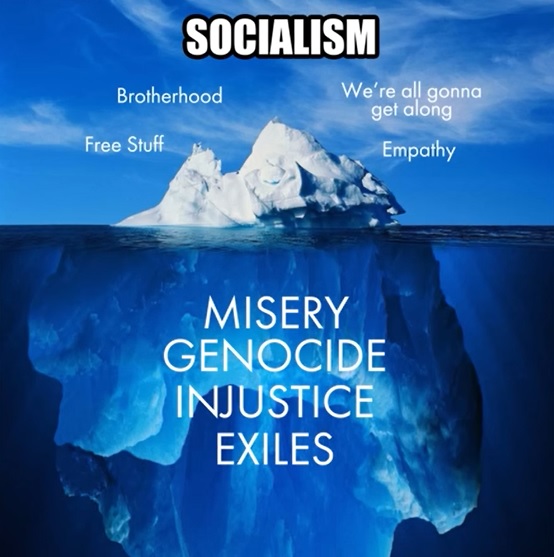
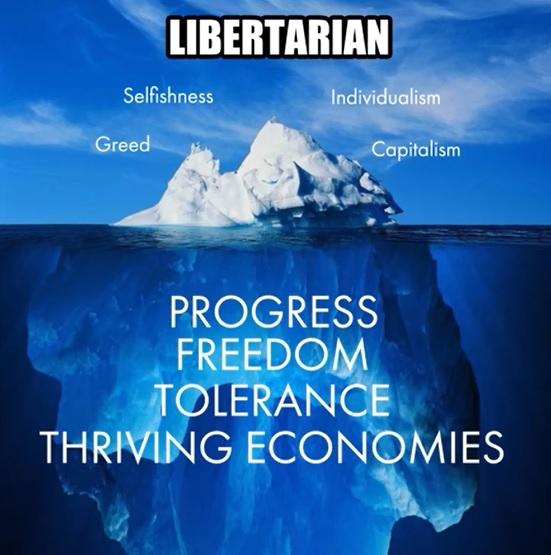
Editor's Note:  While the first picture is positively true, the second is only partially true.  We know conservative societies practicing real capitalism are successful, but there has never been a true libertarian society that I'm aware of, or any society that claims to be such. So where's the evidence? While much of what libertarians espouse is attractive, there is much that seems irrational to me, especially dealing with drugs, open immigration, no tariffs, and more.   RK   

I wrote a few days ago about Latin America’s “pink tide” and how statist policies are driving away jobs and investment.

Today, let’s look at John Stossel’s interview with Gloria Alvarez about the grim future of the region.

I especially like the part about 9:00 and 21:00 when she talks about the failure of supposed right-wing governments that continue with socialism – or even make it worse (we have the same problem in the United States).

But the best part of the 25-minute video, in my humble opinion, is her explanation of why statism is seductive and liberty is not.

She uses an iceberg analogy. With socialism, people see good things above the surface but are blind to the horrible consequences beneath the water.

By comparison, the libertarian iceberg is superficially less appealing.

The small part above the water seems cold and heartless. All the good stuff is hidden underneath.

In some sense, these two images are a different way of showing what’s captured in this cartoon.

Needless to say, there’s a big difference between superficial and real. In the video, Ms. Alvarez cites Margaret Thatcher’s famous observation about the inevitable problem with socialism.

Rate this:

Friday, April 8, 2022

The Libertarian Paradox

By Rich Kozlovich
Let me start out by saying there is much in this presentation that I find true and appealing, but unworkable.  Demographics and time will always work against it. Libertarians are really big on maximizing individual autonomy, seriously reducing the size of government, freedom of choice in all things including association, largely unrestricted immigration, and unrestricted use of drugs.   As I said, I find much to like in their views, but I find their views are somewhat childlike. 
I have libertarian writers who allow me to publish their work, and very often that work is excellent, and very appealing to conservatives.  However, when it comes to some of those positions, I find their conclusions untenable.  I think this article, The Libertarian Paradox by Llewellyn H. Rockwell Jr. is a good demonstration of that. 
Libertarian thinking reminds me very much like military strategies. Did you know that every military strategy ever planned was perfect? At least until they met the enemy, who also had a "perfect" plan in place. That's when everything starts to fall apart.  It's the one who is most able to recognize the lack of perfection in their “perfect plan”, and quickly adapt it to whatever difficulties the enemies “perfect plan” is causing, is the one who wins. 
Libertarianism is basic fundamental morality; a morality that is foundation to the human makeup.  It is a reality that is imprinted in our makeup and governed by a force we call - conscience!
The trouble with conscience as an absolute arbiter of right and wrong is that the conscience can be changed, adjusted…..or…lets just say the conscience can be “trained”, and it can be scarred to insensitivity.  All the atrocities committed by governments in the 20th century is evidence of that.
What molds the conscience?  Time and circumstance!  If the entire world practiced the form of libertarianism as outlined to some extent here…and this isn’t the only intellectual outline for this philosophy….it would be very nice.   
At least until someone desired those things others have.  Immigration changes a society, massive illegal immigration destroys the society it invades.  I published this piece, War's Not the Answer! Well Then, What's the Question?, asking:
What if someone - let's call them barbarians - wants to have a war with you?  A real war?  The fact of the matter is war can be avoided on each and ever occasion.... Just surrender. Of course you realize once you surrender, you're no longer allowed to spout stupid stuff, because barbarians are now in charge of your life. And since they think war really is the answer, no matter the question, you'll be required to support their wars, or be shot! Remember, barbarians really think war, which is killing, destruction and mayhem, is the answer.  Do you really think they'll care what you think?   So then, that bodes well the question:  Does anyone want to guess just how many "war isn't the answer snowflakes" will decide to be shot instead of going to war?
I had one cartoon in my office years ago that showed Moses holding the Ten Commandments saying:  It's the Ten Commandments, not the Ten Recommendations. 
In spite of the governing morality imprinted on our conscience, The Ten Commandments apparently needed to be outlined as the ten "commandments", not ten "recommendations".  Why?  Because people will always find ways to rationalize their views to their own benefit.  
As I read this article I started to think about that cartoon and the Jews as they entered the Promised Land.  What form of government did they have?  None to speak of!  The land was broken up into tribal areas and those tribal areas were broken up into homesteads that became hereditary holdings.  
Even if they sold the land it was returned at some point in the future.  But people were pretty much able to “do that which was right in their own eyes”.  What happened?  They eventually demanded a king to rule over them, judge them, and defend them against foreign enemies.     
Libertarianism is a nice foundational philosophy that will be a moving force for conservatives, but it holds little appeal as a lasting, effective stand alone governing philosophy that will stand the test of time.   
Why?  
Because for libertarianism to work it would require people to become much more introspective and less self serving, and be that way forever.  A Catholic priest once said:
 "If you ever find the perfect organization, join it.  However, once you have joined it; it has now become somewhat less than perfect!”   
I have yet to find any flaw in that thought, because people will always be people. 


Thursday, June 10, 2021

The Libertarian Paradox

Mises Daily: Thursday, July 25, 2013 by Llewellyn H. Rockwell Jr.

As libertarians attempt to persuade others of their position, they encounter an interesting paradox. On the one hand, the libertarian message is simple. It involves moral premises and intuitions that in principle are shared by virtually everyone, including children. Do not hurt anyone. Do not steal from anyone. Mind your own business.
A child will say, “I had it first.” There is an intuitive sense according to which the first user of a previously unowned good holds moral priority over latecomers. This, too, is a central aspect of libertarian theory.
Following Locke, Murray Rothbard, and other libertarian philosophers sought to establish a morally and philosophically defensible account of how property comes to be owned. Locke held the goods of the earth to have been owned in common at the beginning, while Rothbard more plausibly held all goods to have been initially unowned, but this difference does not affect their analysis. Locke is looking to justify how someone may remove a good from common ownership for his individual use, and Rothbard is interested in how someone may take an unowned good and claim it for his individual use.   And here is the libertarian paradox.......Why is it so difficult to persuade people of what they implicitly believe already?
The reason is not difficult to find. Most people inherit an intellectual schizophrenia from the state that educates them, the media that amuses them, and the intellectuals who propagandize them.....the conception of the intellectual and the politician as the sculptors, and the human race as so much clay.....To Read More....
My Take - You may wish to read my commentary, What Do Libertarians Believe In That Works?

Sunday, June 6, 2021

What Do Libertarians Believe In That Works?

https://blogger.googleusercontent.com/img/b/R29vZ2xl/AVvXsEgDdJXy3OAHLJn_MpiNbbpiEfmKMk5o52EaM_ErYTz_AQiD3zo-sQWOUuwWSVBiV4IJ3FlQV6T-I03A9NYvk-Cw_z_XUAGBaqiTjOITYXOGIJAACqAjGX9XDktXKqx-gc3w6FR9l1Ki6Us/w41-h54/My+Picture+2.jpg By Rich Kozlovich
Over the years I've been impressed, amused, but mostly confused by libertarians.  Are they conservatives? Are they liberals? Are they leftists?   Yes, they are, and where they fall on an issue depends on the issue.  That's what drives everyone crazy.   Their consistent lack of consistency. 

  • They're conservative on economics.
  • They're really big on individual freedom.
    •  That freedom isn't predicated on any absolute solid moral foundation other than you should be able to live your life as you see fit.  But that lifestyle doesn't include crime and violence against others.  That would be strictly prohibited.  
  • They don't want to be forced to pay for your lifestyle, nor do they wish to pay for the consequences of your life style if it should turn out negatively.   Your choice, your responsibility.
  • They believe our conscience should be our guide.
  • Liberal on social issues, including abortion. They want government out of that matter entirely feeling it should be a conscience matter whether or not to murder their unborn children.
  • As far as I can tell they want to legalize all drugs. (Drug Legalization Is A Disaster)
  • Other than all that, for the most part it all can be refined as " if you leave me alone and I will leave you alone", and government should only fix the roads.  
Admittedly, that part about the roads is an over simplification, but intellectually and emotionally, that's pretty much where they stand. 

One thing I've gleaned historically about these people who are economically conservative and socially liberal is this: Social issues will outweigh economic conservatism every time, and as long as they support all these leftist social issues conservative economics will go out the door.    

Let me throw in the usual obligatory caveat by saying there's much in their views I find emotionally appealing.  Intellectually and historically, not so much.   

Libertarian thinking reminds me very much of military strategies. Did you know that every military strategy ever planned was perfect?  Yes, it's true!  At least until they met the enemy.  And guess what?  The enemy also had a "perfect" plan in place. From that point on everything starts to fall apart for both of them.

The one most able to recognize the lack of perfection in their “perfect plan” and quickly adapts it to whatever difficulties the enemies “perfect plan” is causing, is the one who wins.

Libertarianism thinks in terms of basic fundamental morality; a morality that is foundation to the human makeup, hence their view, "let our conscience be our guide".  There's a reality imprinted in our makeup and governed by that force we call - conscience!    There are some universal values all humans throughout all the ages have shared, with instinctual prohibitions against stealing and violence.   However, people throughout the ages still robbed, stole, raped and murdered anyway.  So the only conclusion we can draw is the conscience is a stunningly imperfect guide.

The trouble with conscience as an absolute arbiter of right and wrong is the conscience can be changed, adjusted…..or…lets just say the conscience can be “trained”, for good or ill, and it can even be scarred by vile practices until it becomes so unfeeling there are no longer any boundaries on behavior.  Time and circumstance molds the conscience! 

If the entire world practiced the form of libertarianism as freedom to be left alone it would be very nice.  But what happens when someone decides they don't want to leave you alone because they just don't like you.  Or they won't leave you alone because they desire those things you or others may have that they don't, and they don't like the idea of working for them?

In spite of the governing morality imprinted on our conscience, The Ten Commandments apparently needed to be outlined as the ten "commandments", not ten "recommendations". Why? Because people will always find ways to rationalize their views to their own benefit.

As I started this I began to think about the Jews as they entered the Promised Land. What form of government did they have? None to speak of! The land was broken up into tribal areas, with tribal leaders.  Tribal areas were broken up into homesteads that became hereditary holdings. All predicated on the 613 commandments laid out in the Mosaic Law.  Sounds like a lot of law, but compared to federal regulations, it's chump change.

Even if they sold the land it was returned at some point in the future. But people were pretty much able to “do that which was right in their own eyes”.  What happened? They eventually demanded a king to rule over them, judge them, and defend them against foreign enemies, so they could be "like the nations around them."  Why?  Because everyone doing what was right in their own eyes isn't a formula for stability. 

Libertarianism is a philosophy that will be a moving intellectual and emotional force for conservatives, but not a stable force.  Libertarianism holds little appeal as a lasting, effective stand alone governing philosophy that will stand the test of time.  For libertarianism to work it would require people to become much more introspective and much less self serving.  That would have to be a universal social paradigm, and that ain't gonna happen.  

A Catholic priest once said:

"If you ever find the perfect organization, join it. However, once you have joined it; it is now become somewhat less than perfect!”

I have yet to find any flaw in that thought, because people will always be people.  

So what do Libertarians believe in that works as a societal construct?  Nothing. 

Sunday, May 24, 2020

Are there Innate Differences between Right and Left (and Where Do Libertarians Fit)?

May 23, 2020 by Dan Mitchell @ International Liberty

I sometimes wonder why libertarians aren’t more persuasive given that there’s so much evidence for our economic and social views.

The answer may have something to do with matters such as psychology. Let’s take a closer look at this issue, starting with a video from Johan Norberg. Johan’s point is that the real gap is between classical liberals (i.e., libertarians) and statists.  Though most of the research and analysis is based on potential differences between conservatives and liberals, as conventionally defined.  For instance, in a column for the U.K.-based Guardian, Arlie Hochschild writes about differences in awareness on the right and left.
…what’s startling is the further finding that higher education does not improve a person’s perceptions – and sometimes even hurts it. In their survey answers, highly educated Republicans were no more accurate in their ideas about Democratic opinion than poorly educated Republicans. For Democrats, the education effect was even worse: the more educated a Democrat is, according to the study, the less he or she understands the Republican worldview. “This effect,” the report says, “is so strong that Democrats without a high school diploma are three times more accurate than those with a postgraduate degree.” …Even more than their Republican counterparts, highly educated Democrats tend to live in exclusively Democratic enclaves. The more they report “almost all my friends hold the same political views”, the worse their guesses on what Republicans think. …Although in principle more tolerant of political diversity, highly educated – and mostly urban – Democrats live, ironically, with less of it.
And here’s a tweet about educated folks on the left being more likely to live in a bubble.

Regarding the issue of how different ideologies respond to external threats (supposedly a major driver of philosophical differences), Ross Douthat analyzed how conservatives responded to coronavirus in a column for the New York Times.
…an influential body of literature has attempted to psychologize the partisan divide — to identify conservative and liberal personality types, right-wing or left-wing minds or brains… In its crudest form this literature just amounts to liberal self-congratulation, with survey questions and regression analyses deployed to “prove” with “science” that liberals are broad-minded freethinkers and conservatives are cramped authoritarians. But…Haidt argues that conservatives actually have more diverse moral intuitions than liberals, encompassing categories like purity and loyalty as well as care and fairness, and that the right-wing mind therefore sometimes understands the left-wing mind better than vice versa. …the political responses to the pandemic have put these psychological theories to a very interesting test.
He then applies this analysis to the coronavirus.
If there was ever a crisis tailored to the conservative mind-set, surely it would be this one, with the main peril being that conservatives would wildly overreact to such a trigger. …As the disease spread and the debate went mainstream, liberal opinion mostly abandoned its anti-quarantine posture and swung toward a reasonable panic, while conservative opinion divided, with a large portion of the right following the lead of Trump himself, who spent crucial weeks trying to wish the crisis away. …figures like Rush Limbaugh and Sean Hannity manifested a conservatism of tribal denial, owning the libs by minimizing the coronavirus threat. …one might say that the pandemic illustrates the power of partisan mood affiliation over any kind of deeper ideological mind-set. Or relatedly, it illustrates the ways in which under the right circumstances, people can easily swing between different moral intuitions. (This holds for liberals as well as conservatives: A good liberal will be as deferential to authority as any conservative when the authority has the right academic degrees…) …what we call “American conservatism” is probably more ideologically and psychologically heterogeneous than the conservative mind-set that social scientists aspire to measure and pin down. In particular, it includes an incredibly powerful streak of what you might call folk libertarianism… This mentality, with its reflexive Ayn Randism and its Panglossian hyper-individualism, is definitely essential to understanding part of the American right. But…I’m doubtful that it corresponds to any universal set of psychological tendencies that we could reasonably call conservative.
By the way, a new study by four social scientists, published in Nature, casts doubt on the earlier research regarding ideological differences in threat perception
About a decade ago, a study documented that conservatives have stronger physiological responses to threatening stimuli than liberals. This work launched an approach aimed at uncovering the biological roots of ideology. Despite wide-ranging scientific and popular impact, independent laboratories have not replicated the study. We conducted a pre-registered direct replication (n = 202) and conceptual replications in the United States (n = 352) and the Netherlands (n = 81). Our analyses do not support the conclusions of the original study, nor do we find evidence for broader claims regarding the effect of disgust and the existence of a physiological trait.
And another study by three social scientists in the Personality and Social Psychology Bulletin also casts doubt on the earlier research.
One consistent finding is that conservatives show higher disgust sensitivity than liberals. This finding, however, is predominantly based on assessments of disgust to specific elicitors, which confound individuals’ sensitivity and propensity to the experience of disgust with the extent to which they find specific elicitors disgusting. Across five studies, we vary specific elicitors of disgust, showing that the relations between political orientation and disgust sensitivity depend on the specific set of elicitors used. We also show that disgust sensitivity is not associated with political orientation when measured with an elicitor-unspecific scale. Taken together, our findings suggest that the differences between conservatives and liberals in disgust sensitivity are context dependent rather than a stable personality difference.
So maybe there’s not a meaningful difference between right and left with regards to matters such as disgust and threats. But there seems to be plenty of evidence that there are differences in other areas.  Depending on political affiliation, Americans shop differently, as reported by Suzanne Kapner and Dante Chinni in the Wall Street Journal.
Consumer research data show Democrats have become more likely to wear Levi’s than their Republican counterparts. The opposite is true with Wrangler, which is now far more popular with Republicans. There is no simple explanation behind those consumer moves. Some of it is due to social and political stances companies are taking, such as Levi’s embrace of gun control. …the country is becoming more polarized along political lines, which is having an effect on brands that choose to stay out of the political fray. …Nearly 60% of 1,000 Americans surveyed by Edelman last year said they would choose, switch, avoid or boycott a brand based on its stand on societal issues. That is up from 47% in 2017.
Some of this makes sense to me. I have dramatically reduced my purchases at Dick’s, for example, because of the company’s opposition to the 2nd Amendment.  Here’s a graphic from the story. The self-selection of Fox and CNN viewers is especially noteworthy.


Folks on the right and left may even sleep differently, according to research published in the Journal of Politics by Aleksander Ksiazkiewicz at the University of Illinois.
This article proposes that chronotype (a person’s time-of-sleep preference) is a previously unidentified psychological correlate of political ideology. Chronotype may lead to political ideology through a motivated social cognitive process, ideology may shape sleep patterns through a desire to align with social norms, or ideology and chronotype may arise from common antecedents, such as genetics, socialization, or community influences. Analyses demonstrate a link between a morningness and conservatism in seven American samples and one British sample. This relationship is robust to controls for openness, conscientiousness, and demographics, including age, sex, income, and education.
Last but not least, Justin Lehmiller of the Kinsey Institute, in a column for Politico, says Republicans and Democrats have different fantasies.
I surveyed 4,175 adult Americans from all 50 states about what turns them on…one of the more intriguing things I uncovered was the political divide in our fantasy worlds. While self-identified Republicans and self-identified Democrats reported fantasizing with the same average frequency—several times per week—I found that Republicans were more likely than Democrats to fantasize about a range of activities that involve sex outside of marriage. Think things like infidelity, orgies and partner swapping… By contrast, self-identified Democrats were more likely than Republicans to fantasize about almost the entire spectrum of BDSM activities, from bondage to spanking to dominance-submission play. The largest Democrat-Republican divide on the BDSM spectrum was in masochism, which involves deriving pleasure from the experience of pain. …What connects Republicans and Democrats, I believe, is that their fantasies are at least partly driven by what they can’t have. …Interestingly, the single most commonly fantasized-about politician among both parties was the same: Sarah Palin (though Republicans were much more likely to have Palin fantasies than Democrats). Following Palin, the next most frequently mentioned politicians in Republicans’ fantasies were John F. Kennedy, Bill Clinton and Nikki Haley. While, after Palin, Democrats fantasized about Barack Obama, Bill Clinton and Hillary Clinton.
Maybe I’m strange, but I’ve never met or seen an American politician that piqued my interest.
Though I will confess to occasionally having quirky libertarian fantasies, one of which does involve sex. Speaking of quirky, folks on the left appear to have more issues with mental health.  Since I’ve asserted that folks on the left are “neurotic” and “guilt-ridden,” part of me agrees with these findings.  Though, to be fair, maybe they’re just more likely to visit healthcare providers.  I’ll conclude with what I will conveniently characterize as the most insightful research.  Three scholars, in an article for Current Psychology, find that libertarians are the smartest.
Previous studies consistently showed that analytic cognitive style (ACS) is negatively correlated with social conservatism, but there are mixed findings concerning its relation with economic conservatism. Most tests have relied on a unidimensional (liberal-conservative) operationalization of political orientation. Libertarians tend not only to identify themselves as conservative on this scale but also to score higher on ACS than liberals and conservatives.

Here’s the relevant chart from the study, courtesy of Rolf Degen.


Liberals can take some solace in that they score above conservatives, though there’s not much that can be said for self-identified moderates.

P.S. I started this column by noting that I want to understand how to be a more persuasive advocate for liberty. I don’t know if that will ever happen, but at least I can take comfort in that I will never be as deluded as this columnist who thinks he has discovered a way of becoming a more persuasive advocate for statism.

P.P.S. If you like this type of research, my previous columns on supposedly innate differences across ideologies can be found here, here, and here.

P.P.P.S. And here’s the research on the differences between libertarians and conservatives.

P.P.P.P.S. Here’s a humorous look at the difference between conservatives, liberals, and Texans.


Monday, January 20, 2020

Starling Mumerations and American Politics

By Rich Kozlovich

If you're like me you're never really sure where Libertarians will come down on an issue, and quite frankly, I don't think they know where they will are stand either, although I do think they're less conflicted among themselves than the Republicans, or even those who profess to be conservatives.  In fact, those professing to be "conservatives" seem to be the most conflicted of all.  

As we have seen since Trump has become President "conservatives", now known as "Never Trumpers", like George Will, Jonah Goldberg, William Kristol, and John Kasich have all been exposed as something different than what most conservatives consider conservative,  They're not only finding themselves isolated among real conservatives, but in more harmony with Democrats than Republicans. 

Do I see a Third Party in the making? 

(Editor's Note:  If they disagree with me they're not "real" conservatives.  Get over it.  RK

Leftist however, are completely consistent.  They're move philosophically like starling mumerations, flying in mass without any seeming direction, or leader.


As you watch this video you can't help but notice the mumerations by flocks of starlings and the mumerations performed by Democrats have a lot in common.  Due to external pressures, even slight inconvenient pressures, they move in harmony to the latest leftist narrative, which might change daily.  No matter how insane that narrative may be.  Even if it means moving in opposition to a previously held position.

As for Libertarians: They're not consistently on the right, and they're not consistently on the left.  However, wherever they come down on an issue they always seem to come down at the extreme end of those divergent philosophies.

Dan Mitchell, a well known Libertarian from the CATO Institute, who allows me to publish is work, wrote the article, A Two-Part Quiz on Libertarianism and Patriotism, on July 4, 2010, saying this picture reflected his sentiments and was his definition of patriotism. I'm inclined to think that may be a sentiment shared by more Americans than just Libertarians, especially conservatives.

However, I also think this picture and the article are an oversimplification of the views of Libertarians overall.

While I find myself in harmony with their view of the size and overreach of government, taxes, and regulations.  However, I find their views on legalization of drugs, open borders and open trade more than uncomfortable. 

It's my view all those positions are detrimental to the health and welfare of the nation, to our families, the economy, and the Constitution. 

It seems to me they've lost sight of one all important fact.  The Constitution isn't a suicide pact. 


Friday, October 4, 2019

Why Libertarians Are Unwitting Enablers of Socialism

Libertarians have become pawns of the progressive Left in America, and in an ironic twist, both of them have been co-opted by globalist corporate interests. When everything is privatized, rationed and metered, corporate rent seekers gain new revenue streams.

Edward Ring October 2nd, 2019

“There are two novels that can change a bookish fourteen-year old’s life: The Lord of the Rings and Atlas Shrugged. One is a childish fantasy that often engenders a lifelong obsession with its unbelievable heroes, leading to an emotionally stunted, socially crippled adulthood, unable to deal with the real world. The other, of course, involves orcs.”– John Rogers, “Ephemera 2009,” Kung Fu Monkey

Libertarians are handing America over to socialists. That’s not what they want, but that’s what’s happening. How can this be? After all, if you want limited government, you’re a libertarian. So where’s the problem?   The problem, as John Rogers suggests in his unforgettable quote, is with the “real world.”

In the real world, America is a two party system, and if a strong libertarian candidate shows up, he take votes away from other candidates who also—despite all their other impurities according to libertarian lights—oppose socialist candidates.

When the anti-socialist vote is split, the socialist wins.........To Read More....

Wednesday, September 11, 2019

How the World Views Libertarianism


Ask ten libertarians for a definition of libertarianism, and one is likely to receive about ten different answers.  Indeed, libertarians have something of a reputation for internecine battles over who the "real" libertarians are.  Most of the world, however, couldn't possibly care less about these battles over how to correctly slice and dice the different types of libertarians.

When it comes to use of the term libertarian out "in the wild" among mainstream, non-libertarian pundits, the use of the term is surprisingly consistent. It nearly always refers to an ideology that pushes for greater economic freedom in the form of less regulation of economic life, lower taxes, and freedom in trade.

Most writers on political and public policy matters, however, are not friendly to this sort of ideology so the term "libertarian" is also often expressed with an air of disapproval..........To Read More...

Thursday, November 1, 2018

A Bridge to Sell You

John Stossel Oct 31, 2018

"Libertarians believe that you should be as conservative or as liberal as you want to be as long as you don't want to force yourself on others," says Larry Sharpe, Libertarian candidate for governor of New York.  Sharpe is an unusual Libertarian candidate because he's doing well in some polls.  One found Sharpe getting 13 percent, and after people heard his campaign pitch, 25 percent. That would put him in second place, ahead of the Republican.  So of course the establishment shuts him out -- he and other third-party candidates weren't allowed in the one gubernatorial debate.

Sharpe wins fans by arguing that it would be good if individuals make their own decisions without government spending constantly getting in the way..........To Read More.....

Saturday, May 19, 2018

The Political Compass Test

May 16, 2018 by Dan Mitchell @ International Liberty
 
I’ve taken several tests and quizzes on political philosophy. Not surprisingly, I usually wind up being some type of libertarian.
But sometimes I get odd results. For instance, the Political Left/Right Test, put me exactly in the middle, and another political quiz pegged me as a “moderate.”

The former might be reasonable since libertarians have some right-wing views and some left-wing views. But the latter quiz concluded that I had “few strong opinions,” which is a nonsensical result.
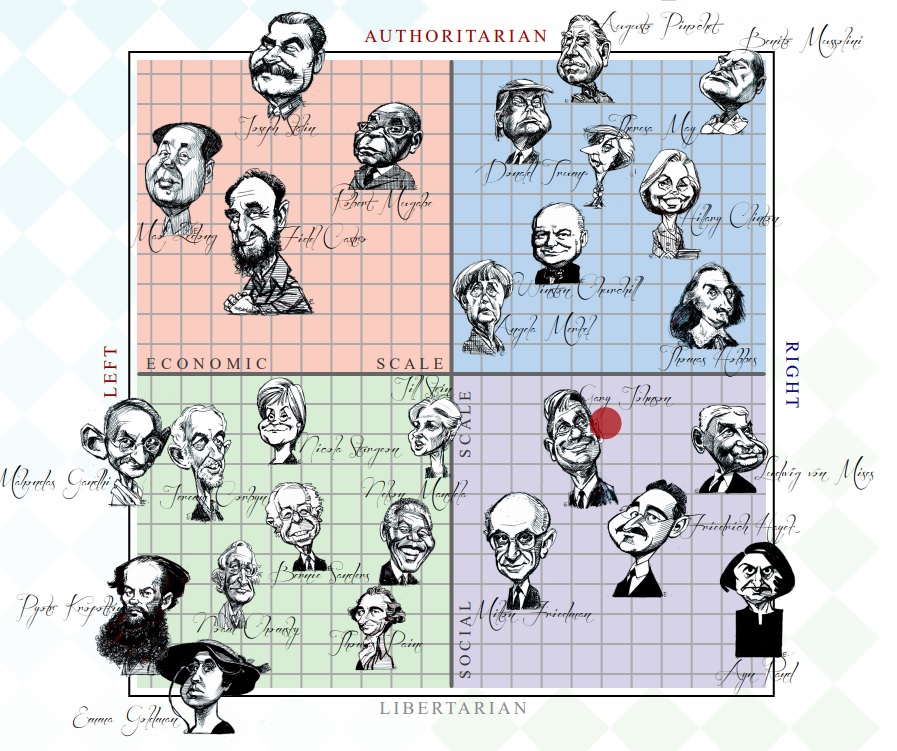
Anyhow, I found another test. This new survey is called the Political Compass Test, and it’s based on the theory that the traditional left-right economic spectrum is insufficient.
…the social dimension is also important in politics. That’s the one that the mere left-right scale doesn’t adequately address. So we’ve added one, ranging in positions from extreme authoritarian to extreme libertarian.
And here’s the four quadrants that are created by their two lines.


While no system will capture everything, I have no objection to their theoretical construct.
But I think two of the examples they provide are somewhat crazy.

First, Hitler was the head of the National Socialist Workers Party and he belongs on the left side of the horizontal axis. Second, it’s absurd to have Thatcher anywhere near Stalin and Hitler on the vertical axis.


I also think Friedman should be moved more in the libertarian direction, but at least they have him in the correct quadrant.

Now let’s look at my results. I’m somewhat disappointed because I’m not way on the right for economic issues. And I’m even more irked that I’m barely on the libertarian side for social issues.


For what it’s worth, some of the questions were more about attitude and outlook rather than policy. And since I’m the boring kind of libertarian, perhaps that’s why I don’t get a strong score.

Let’s close by looking at my score compared to various famous people. I’m closest to Gary Johnson, which strikes me as a reasonable result.


But some of the other results are very bizarre. First of all, Milton Friedman magically moved. Now he’s very libertarian on social issues, but squishy on economics. Needless to say, that’s nonsense.

But not nearly as nonsensical as Benito Mussolini being on the far right for economic policy. That’s crazy. He was a strident opponent of capitalism.

Likewise, they have Hillary Clinton on the right side of the spectrum for economic policy. The person who did that must have been on some crazy drugs at the time.

And I’m not a Trump fan, but I think it’s laughable to have him ranked as more authoritarian than Mugabe, Mao, and Castro.

Friday, March 9, 2018

Switzerland: Home to Practical Libertarians rather than Ideological Libertarians

March 7, 2018 by Dan Mitchell @ International Liberty

The Swiss people are normally very sensible when asked to vote in national referendums. Here are some recent results.
Though my favorite referendum result occurred several years before I started writing on this site.
Given all these results, you won’t be surprised to learn that Switzerland is near the top in rankings of economic freedom, trailing only Hong Kong, Singapore, and New Zealand.

But this does not mean that Switzerland is a libertarian nation. At least not in an ideological sense. And we have two new referendum results that underscore this point.

This past weekend, Swiss voters had an opportunity to get rid of the central government’s value-added tax, personal income tax, and corporate income tax.

Ending those taxes would be a libertarian fantasy, but the initiative to extend the levies was easily approved.
More than 84% of voters have renewed the government’s right to tax its citizens and companies for another 15 years. This is a unique feature of Switzerland’s political system of direct democracy and federalism.  …rejection would have been a nightmare for the government. …said Finance Minister Ueli Maurer in January. “If voters were to say no, the Swiss government wouldn’t have enough funds and there’s no way we could find another source of revenue or introduce spending cuts of the same order.”
Voters were swayed by arguments that a no vote would cause too much fiscal disruption. Slashing the central government’s budget by 60 percent might appeal to ideological libertarians, but it didn’t fly with don’t-rock-the-boat Swiss voters.
The direct federal tax and the sales tax together contributed about two-thirds of the Swiss central government’s budget, bringing in around 43.5 billion Swiss francs ($44.25 billion) in 2016. …Should voters reject the measure, the government would have to slash spending by more than 60 percent practically overnight or find new sources of revenue, Maurer told reporters.
Here’s a pie chart showing the revenue sources for the central government.


I would have voted no, of course, and I wish more Swiss voters had lined up against the initiative.

Not because I would have thought that an immediate 60-percent reduction in the size of the central government was feasible. But a larger share of no votes at least would have sent a signal to politicians in Bern that frugality is a good idea.

There was another referendum over the weekend that also produced an unfortunate result. Swiss voters approved continuing subsidies for state-run media.
The Swiss Broadcasting Corporation, Switzerland’s public broadcaster is largely funded by a broadcasting fee. This fee, known colloquially as Billag, the name of the agency that collects it, is paid by most companies and essentially every household. The No Billag initiative, is a bid to do away with fee. …the No Billag vote was rejected by 71.6% of voters.
The margin of defeat is especially disappointing since libertarians actively campaigned for this initiative.
Switzerland, like many European nations, has certain television and radio channels that are run by the government. …Together with other classical liberals in Switzerland, Frédéric Jollien is fighting against the royalties imposed by the government for media consumption. 450 Swiss Francs, the equivalent of €382 or $456, is the annual fee that consumers are required to pay, regardless if they want state-run TV and radio channels or not. …Journalists (who, by the way, are exempt from paying this fee) are releasing heavy verbal fire on the campaigners. They claim it would cause massive unemployment in the media sector, that it is anti-democratic, and that it would enable big foreign companies to take over the Swiss market.
Alas, the fear campaign succeeded.

But I hasten to add that this doesn’t mean Switzerland is turning towards statism. I suspect the real story is that the Swiss are content with the status quo.

And the status quo (especially by European standards) is a practical form of libertarianism.
Here’s some of what Dan Hannan wrote last year.
I have always loved Switzerland…its devolved decision-making, its entrenched Euroskepticism. …I am a Helvetophile for many of the same reasons as America’s Founders. James Madison was fascinated by the way Switzerland had “no concentered authority, the Diets being only a Congress of Delegates from some or all of the Cantons.” …George Mason was entranced by the militia system: “Every Husbandman will be quickly converted into a Soldier, when he knows & feels that he is to fight for his own. It is this which preserves the Freedom and Independence of the Swiss Cantons, in the midst of the most powerful Nations.” …Switzerland has stubbornly retained its sovereignty, despite being surrounded by the EU. …Swiss democracy is direct, decentralized and devolved. Most fiscal decisions are taken locally. Result? Swiss voters are the happiest in Europe, their economy is the freest, and their state budget the smallest.
And let’s not forget that Switzerland is still a bright spot on gun rights.
In February 2011, Swiss citizens voted in a referendum that called for a national gun registry and for firearms owned by members of the military to be stored in public arsenals. …Hermann Suter, who at the time was vice president of the Swiss gun-rights group Pro Tell, told the BBC then. “The gun at home is the best way to avoid dictatorships—only dictators take arms away from the citizens.” Apparently many of his fellow Swiss agreed. The referendum was easily defeated. Gun ownership in the country has deep historic roots… guns are popular… Children as young as 12 are taught how to shoot…and are encouraged to participate in highly popular target-shooting competitions. The country’s cultural attachment to firearms resembles America’s in some ways…it has the third-highest rate of private gun ownership in the world… The Swiss Defense Ministry estimates that there are 2 million privately owned weapons in the country of 8.3 million people.
Yet there’s almost no gun-related crime.
Switzerland has a low rate of gun crime, and hasn’t seen a mass shooting since 2001.
And let’s not forget that the fiscal burden of government in Switzerland is comparatively modest.
Not by libertarian standards. Not by historical standards.

But compared to other European nations, Switzerland is a fiscal Shangi-La. The tax burden is lower, and spending consumes a smaller share of economic output.

And this translates into lower levels of red ink.

P.S. I find Switzerland to be a very interesting case study, for reasons noted above and also on issues such as decentralization, privacy rights, gun rights, and private retirement savings. But I’m a policy wonk, so I’m drawn to unusual examples. What does surprise me is that other people must be interested in the country as well. My 2011 column comparing Switzerland and the United States is the 7th-most-viewed piece in the history of this site.