Search This Blog

De Omnibus Dubitandum - Lux Veritas

Showing posts with label Latin America. Show all posts

Tuesday, September 17, 2024

The Economic Record Of Socialism -- Cuba And Latin America

@ Manhattan Contrarian

With a radical far-leftist in serious contention for the presidency in our upcoming election, it is worthwhile to check in on the record of leftism and socialism in other countries.

It so happens that pretty much every country to our South in the Western Hemisphere has a long history of some variety of leftist/socialist politics. With a few exceptions here and there, when there has been an election in Latin America in my lifetime, the winning strategy has been to run against the “Yanqui imperialists” and advance a program of “social justice” and redistribution. Particular policies vary from country to country, but the usual playbook includes such things as massive government intervention in the economy, government ownership of major companies (starting with the energy industry), central planning, requirements of multiple licenses and permits to start any business, and many more such.

Recent elections have continued or returned leftists to power in all but one of the most important countries — Brazil, Mexico, Colombia, Chile. (The exception is Argentina, which elected a non-leftist President in late 2023; it is too early there to see any meaningful economic results, so I will leave it out of this discussion.) The next tier of countries has it as bad or worse. In Venezuela the current head of a 25 year old socialist regime apparently just lost an election by a 2-1 margin, but he refuses to release the vote tallies, and hangs on to power while his opponent has fled into exile. In Bolivia a socialist party (MAS) has hung on since 2006 through a disputed election and getting the courts to abolish term limits. There are many other such examples from smaller countries. And then, of course, there is Cuba.

How has all of this worked out?

Overall, the countries of Latin America have a shockingly bad and indeed inexcusable record of economic failure. The best (admittedly flawed) measure we have to compare economic success among countries is per capita GDP. Three international organizations — the IMF, World Bank, and UN — put out lists of per capita GDP by country, and Wikipedia compiles those lists here. The most recent data cited to the UN are from 2021, and to the World Bank from 2023, so I’ll use the IMF numbers, which are from 2024, when available.

The IMF gives 2024 U.S. per capita GDP as $85,373, which is far and away the highest of any country in the world with population of 10 million or more. Here are the comparable 2024 IMF figures for the most important countries of Latin America, all currently run by leftist regimes: Brazil, $11,352; Mexico, $15,249; Colombia, $7,327; Chile, $16,616. But at least all of those have had some periods of non-leftist rule over the past several decades. Then there are the countries in the grip of the most serious socialism for the longest unbroken periods of time: Venezuela, $3,867; Nicaragua, $2,791; Bolivia, $4014.

And now let’s come to Cuba. Fidel Castro came to power in Cuba in 1959, and imposed a strict socialist regime. There hasn’t been a real election since. Castro’s successors remain in firm control. The latest guy, who succeeded Fidel brother Raul in 2018, is named Miguel Diaz-Canel.

Unfortunately, there are no credible economic statistics that come out of Cuba. Unlike for all the other countries cited above, the IMF does not provide a 2024 per capita GDP figure for Cuba. The World Bank and UN provide per capita GDP statistics for Cuba for, respectively, 2021 and 2020. Those figures are $9500 and $11,255. You can accept them if you wish, but I think they have no credibility at all.

Meanwhile, there is much qualitative information coming out of Cuba to indicate that its long-time terrible economy has recently become much worse and entered a crisis stage. The idea that there is a crisis comes not from the regime’s critics, but rather from the regime itself. Don’t expect to find this information in our mainstream press, but you can find it if you look around.

On July 2, the large Spanish newspaper El Pais had a piece with the headline, “The government of Cuba declares itself in a ‘war-time economy.’” Excerpt:

At a recent meeting of the Council of Ministers, Mildrey Granadillo de la Torre, First Deputy Minister of Economy and Planning, said that the measures seek to adjust the 2024 Plan and Budget to the conditions of a “war-time economy,” a term that is often used in extreme situations, and which the authorities now apply to a country that ended 2023 with an inflation of 30%, an economy contracted by 2% and a depreciation of the Cuban currency of more than 50% against the dollar and the euro in the informal market.

El Pais followed up with a further piece on July 8. Excerpt:

Cuba is living in a “war-time economy.” The island’s own authorities said it a week ago. That is to say, the food shortages that the population has been dealing with for years, the insufficient wages, the soaring prices — that whole bleak scenario resembles that of a country thrown into the battlefield. . . . Cubans have been suffering for years from a crisis that began in the 1990s with the loss of economic aid from the defunct Soviet Union and from which they never recovered. People have simply been told that the permanent scarcity in which they live has a new, more dramatic name.

The Economist weighed in on July 21. The article is behind paywall except for the first paragraph, from which this is taken:

Cubans used to look back at what Fidel Castro called the “special period” after the end of the Soviet Union and its largesse and think that was as bad as things could get. They were too optimistic. Today officials talk of a “war economy”. The consensus on the street in Havana, the capital, is that shortages are worse than in the early 1990s. Cuba produces little in sufficient quantity: not sugar, which it once supplied to the world; not eggs, which it recently imported from Colombia; not milk powder, which it gets from the un; not power, as worsening blackouts reveal. The government lacks foreign currency for imports.

Perhaps most revealing is an article by Jon Lee Anderson in the New Yorker of September 12. The article is titled “Lula, Maduro, and a New Cold War in Latin America,” and is mostly about how issues like the recent stolen election in Venezuela are causing rifts among Latin America’s current crop of leftist rulers. Anderson is clearly a man of the Left, among other things having written a biography of Che Guevara. But he reports, with evident sadness, that Latin American leftism appears to have come to a dead end. At the end of his piece, Anderson discusses Cuba:

Eight years after the death of Fidel Castro, and three years since the retirement of his younger brother, Raúl, who succeeded him in power, Cuba’s long-term leadership of the region’s political left is effectively no more. Under the uninspired leadership of the Castros’ successor, Miguel Díaz-Canel, a sixty-four-year-old Communist Party official, the island has suffered a precipitous economic decline. . . . 

What it all comes down to is the end of the revolutionary dream in Latin America. A generation ago, Chávez came to power and revived Fidel Castro’s hopes of keeping the revolutionary flame going—and effectively managed to do so for about a dozen years. But then oil prices dropped and Chávez died, followed by Castro, and the money that had flooded into Cuba to fund Revolution 2.0 was gone, largely misspent and stolen. . . . Maduro and Ortega and Díaz-Canel may still speak the old language of revolution and antiyanquismo, but their economies survive from remittances from their fleeing citizens, who have left in droves to seek employment wherever they can, ideally in the Empire itself.

And finally, this incredible statistic:

Since 2022, Cuba has seen the largest exodus of its citizens since the earliest days of the Revolution, with as many as 1.8 million people fleeing the island for better lives elsewhere, contributing to an eighteen-per-cent decrease of the population.

I can’t find confirmation of that number elsewhere, but the New Yorker is (supposedly) known for its fact-checking. And even if the loss of population were half what Anderson reports, 9% instead of 18% (in two years!), it would still be extraordinary.

Could U.S. voters really be stupid enough to elect someone cut from this cloth?

Tuesday, May 9, 2023

Latin America and Socialist Suicide

May 7, 2023 by Dan Mitchell @ International Liberty  

Editor's Note:  While the first picture is positively true, the second is only partially true.  We know conservative societies practicing real capitalism are successful, but there has never been a true libertarian society that I'm aware of, or any society that claims to be such. So where's the evidence? While much of what libertarians espouse is attractive, there is much that seems irrational to me, especially dealing with drugs, open immigration, no tariffs, and more.   RK   

I wrote a few days ago about Latin America’s “pink tide” and how statist policies are driving away jobs and investment.

Today, let’s look at John Stossel’s interview with Gloria Alvarez about the grim future of the region.

I especially like the part about 9:00 and 21:00 when she talks about the failure of supposed right-wing governments that continue with socialism – or even make it worse (we have the same problem in the United States).

But the best part of the 25-minute video, in my humble opinion, is her explanation of why statism is seductive and liberty is not.

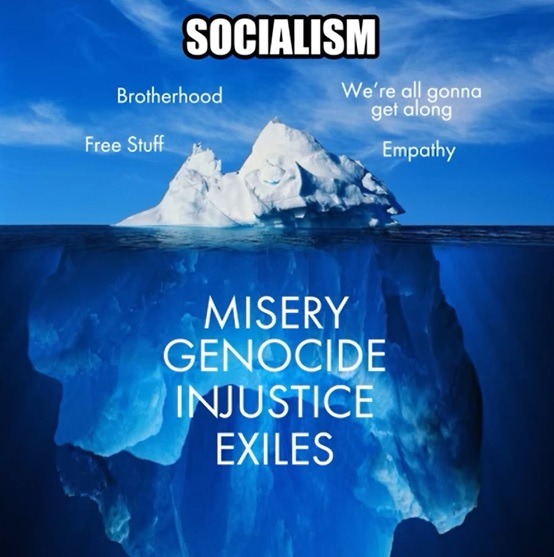
She uses an iceberg analogy. With socialism, people see good things above the surface but are blind to the horrible consequences beneath the water.

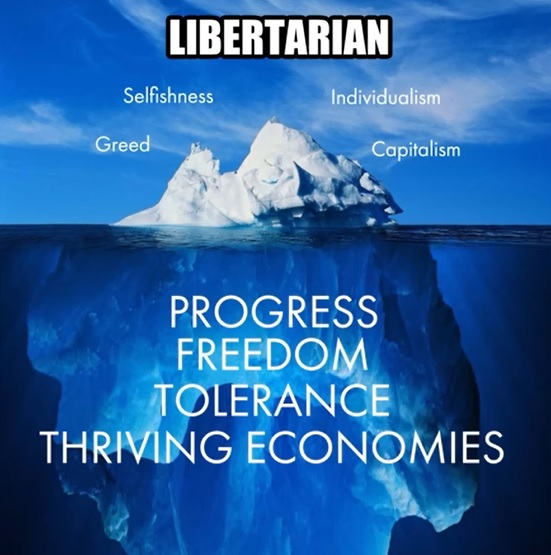
By comparison, the libertarian iceberg is superficially less appealing.

The small part above the water seems cold and heartless. All the good stuff is hidden underneath.

In some sense, these two images are a different way of showing what’s captured in this cartoon.

Needless to say, there’s a big difference between superficial and real. In the video, Ms. Alvarez cites Margaret Thatcher’s famous observation about the inevitable problem with socialism.

Rate this:

Friday, May 5, 2023

Latin America and Fiscal Suicide

May 2, 2023 by Dan Mitchell @ International Liberty

The economic policy lessons from Latin America are very clear.

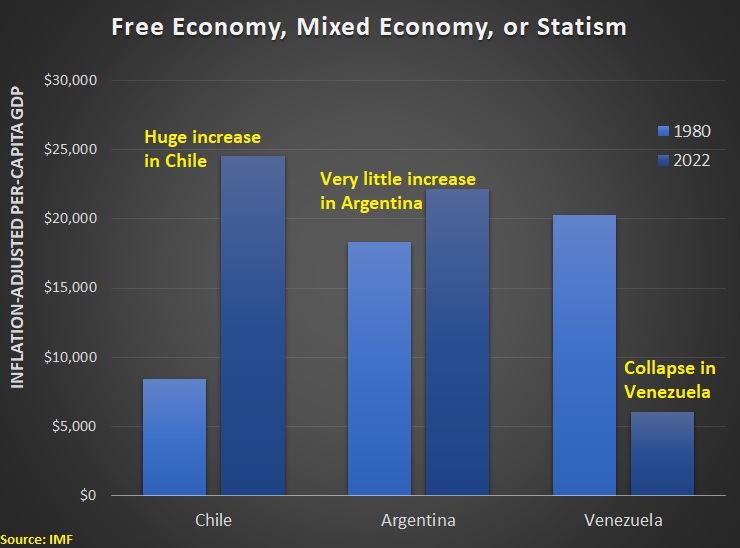
There’s one unambiguous success story (at least until the past couple of years), one semi-decent success story, and then a bunch of utter failures.


What’s interesting (and tragic) is that the failures teach different lessons.

  • We learn about long-run socialist suffering from Cuba.
  • We learn about rapid socialist collapse from Venezuela.
  • We learn about gradual socialist collapse from Argentina.

And if we pay attention to the region, we can expect more collapse.

Why? Because left-wing governments are now in charge and sensible people are moving their money where it can’t be confiscated.

In an article for Bloomberg, Ezra Fieser and Andrea Jaramillo report on people taking their money out of Latin America.


As every major country in Latin America shifts to the left…, capital is flying out of the region. Wealthy and, increasingly, middle-class investors are looking for a Plan B… People and corporations in the region’s five largest economies pulled roughly $137 billion out of their countries in 2022. That number—preliminary data from the Institute of International Finance, a group of banking institutions—is 41% higher than the 2021 figure and the most since 2010. …popular destinations include the Dominican Republic, Panama, Spain and the US. …Each time a leftist gets elected, money pours into South Florida, says Raul Henriquez, chairman of Insigneo Financial Group LLC, a wealth manager in Miami. …Often called a “pink tide,” this shift toward socialism dates to 2018, when Andrés Manuel López Obrador swept into power in Mexico. Leftists prevailed in Argentina in 2019, Chile and Peru in 2021, and Brazil and Colombia last year. “This is a historic event we’ve never before seen—the entire region has gone pink on us,” says Talbert Navia… Mauricio Cárdenas, a former Colombian finance minister, says capital flight is playing a role and could make it difficult to enact socialist policies.

If you want to know why people and/or their money are escaping, read this article from Americas Quarterly by José Antonio Ocampo, who is now Colombia’s Finance Minister.


Latin America can return, of course, to the path of growth, employment, and improvement in social conditions. But this implies a significant increase of fiscal resources… A key barrier is the generally weak level of tax revenue obtained by Latin American countries. In 2018, the average tax revenues in the region were 23.1% of GDP… One of the problems is the lack of income tax regimes with significant redistributive effects… supports the proposal for the introduction of a global minimum effective corporate tax rate of 25%. …countries should…adopt effective progressive wealth taxes on their residents.

By the way, Senor Ocampo used to be at the United Nations, where he enjoyed a tax-free salary while urging higher tax burdens on everyone else.

Also, I can’t resist pointing out that tax burdens in Latin America are already far too high. Ocampo wants a “path to growth,” but he apparently does not understand that today’s rich nations all became rich when the burden of government was very small.

Last but not least, the tax-free bureaucrats at the Organization for Economic Cooperation and Development in Paris continue to push for bad policies.

Here is some of the nonsense included in the bureaucracy’s latest Economic Outlook for the region.


…a fiscal sustainability framework focused on strengthening public revenues will be required… In the medium term, the region will have to focus on generating more progressive and greener fiscal pacts, with the aim of increasing tax collection and strengthening direct income and property revenues. …it is essential that social protection systems have funding sources that will ensure their financial sustainability. This can be achieved, in part, by increasing tax revenues… Innovative income support policies could be worth exploring to increase progressivity… A set of tax policy options are available in LAC that could help increase revenues… These include measures to…increase the progressivity of personal income taxes.

While the OECD should be condemned for pushing bad policy on poor nations, at least they deserve credit for consistency.

Wednesday, May 3, 2023

Moochers and Looters

John Stossel John Stossel  May 03, 2023

There's a socialist wave in Latin America. Mexico, Chile, Peru, Bolivia and Brazil recently elected leftists. These politicians at least distance themselves from thugs like Hugo Chavez and Fidel Castro, but all propose socialism-lite policies giving government more control over more people. Why don't people in Latin America learn from the mistakes of the past? Gloria Alvarez, a social media star from Guatemala, is running for president of her country to try to educate people about the damage socialism does.  People do need educating.

"It's like Stockholm syndrome," says Alvarez in my new video. "When you ask people, 'Who should take care of health, education, football, arts, whatever?' They always answer, 'government.' How are you going to not have corruption if you leave everything in the hands of the government?"..........People push for socialism because they don't study it."............One survey found that most millennials support socialism. But "when they were asked to define or describe socialism, none of them could!" says Alvarez. "They don't know socialism's massive failures.".....To Read More...

Monday, June 13, 2022

Market-Driven Growth and the Asian Tigers

June 11, 2022 by Dan Mitchell @ International Liberty

I’m currently in Tanzania as part of a speaking tour in Africa. My remarks today largely repeated the message I gave to an audience last week in Nigeria.

So I won’t bother sharing anything from my presentation. Instead, I want to highlight some numbers from a presentation by Professor Ken Schoolland.

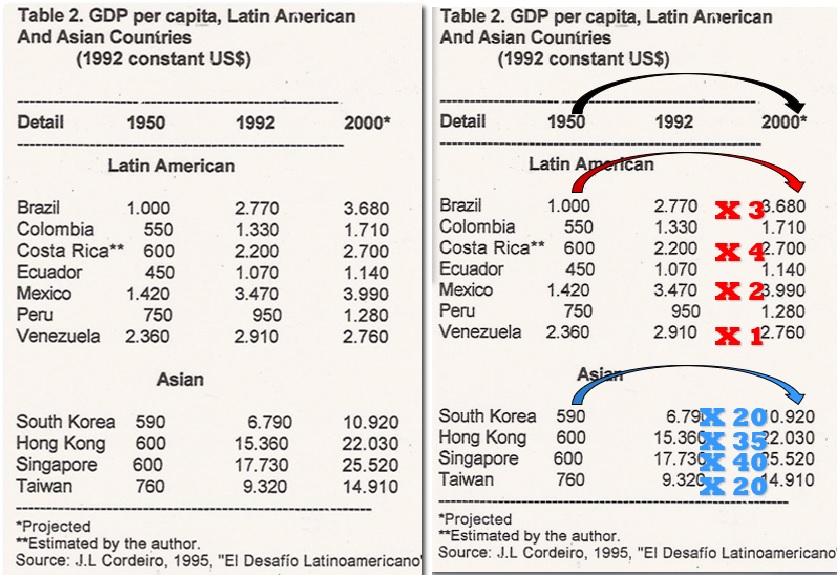
He shared some data showing how the “Asian Tigers” grew far faster than major Latin American nations between 1950 and 2000.

These are very impressive examples of convergence (as the Asian Tigers caught up with Latin America) followed by divergence (as the Tigers then continued to grow much faster).

I’ll be adding this data to my “anti-convergence club.”

But I also noticed that Professor Schoolland was sharing some old data from 1995.

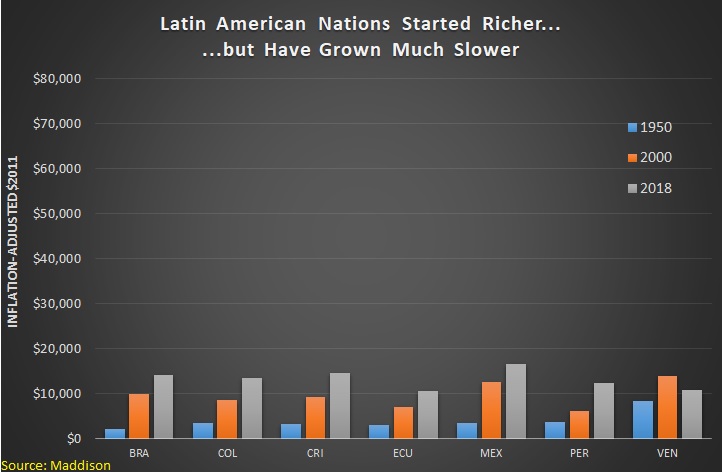
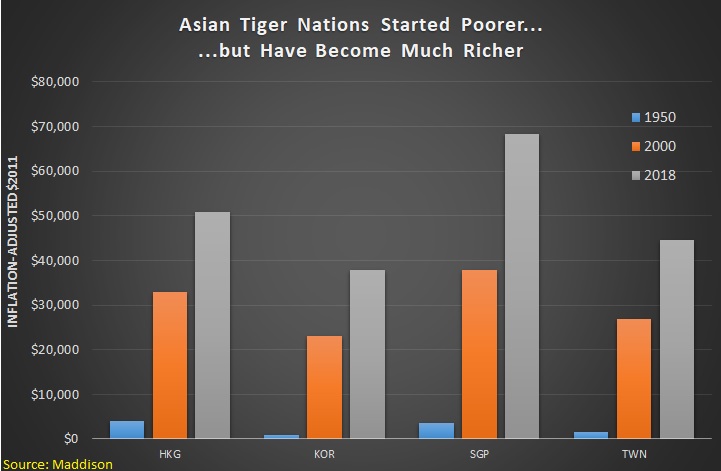
So I went to the Maddison website and created some new charts based on the latest-available data.

As you can see, the Latin American nations were richer in 1950, but they have not enjoyed fast growth in the past 70 years.

By contrast, the Asian Tigers have enjoyed spectacular growth since 1950.

So not only are these nations much more prosperous than nations in Latin America, in most cases they have even surpassed European countries and Singapore is now richer than the United States.

Since I’m writing about the success of the Asian Tigers, let’s address the myth that they became rich because of industrial policy.

Sam Gregg of the Acton Institute examined this controversy in an article for Law & Liberty.


…what about some of the East Asian Tiger countries? Aren’t they proof that, when devised and implemented by wise governments guided by even cleverer experts, industrial policy can work? …There is, however, a wealth of evidence indicating that these policies produced similarly pedestrian outcomes in these countries. As for the Tigers, what primarily took them from the status of economic backwaters to first-world economies was economic liberalization and especially trade openness… 

Even the most devoted industrial policy advocates hesitate to present two of the Tigers, Singapore and Hong Kong, as industrial policy successes. They do nevertheless regard South Korea and Taiwan’s postwar histories as demonstrating why industrial policy should play a major role.

Gregg takes a close look at what actually happened in South Korea.

Beginning in 1954 and until about 1963, Korea’s government focused upon import-substitution industrialization policies… however,…economic growth in Korea only began taking off between 1963 and 1973 following a decisive shift towards export-orientated development and trade openness. … 

Industrial policy assumed a larger place in Korea’s economy in the mid-1970s. …Korea’s turn towards industrial policy in this period does not appear to have produced spectacular results. Economic growth during this period—whether in terms of GDP, trade, employment, manufacturing output, or exports in goods and services—was actually lower than what had been realized in the 1960s. …These results may help explain why Korea’s drift towards industrial policy was reversed, beginning in the late-1970s. … 

The overall result was a return to high growth throughout Korea’s economy.

And here’s his analysis of what happened in Taiwan.

…the Kuomintang government adopted an import-substitution approach to trade characterized by high tariffs and import quotas. The Taiwan Production Board oversaw the extensive use of industrial policy, especially through preferential loan-treatment… In the mid-1950s, key Taiwanese officials and their American advisors recognized that Taiwan could not keep going down this path. 

Hence in the late-1950s, decisions were made that re-orientated Taiwan’s economy towards competition and trade openness by, among other things, liberalizing imports and foreign investment rules as well as beginning a process of steadily removing export controls and gradually giving more and more exporters what amounted to a free trade status. 

As in Korea’s case, growth in Taiwan took off. …the general direction of Taiwan’s economy from 1958 onwards was away from industrial policy and tariffs and towards increasing integration into global markets. Like Korea, Taiwan underwent a limited return to interventionist policies in the mid-1970s, but, again, like Korea, this did not last.

The bottom line is that South Korea and Taiwan are not as rich as Hong Kong and Singapore and one reason they are lagging is that their governments tried to pick winners and losers.

But both those nations largely have abandoned industrial policy, so at least they recognized their mistakes.

P.S. A big issue at the conference is whether the “China Model” should be emulated. I shared some data showing why that would be a big mistake.


Saturday, November 28, 2020

Big Government Enables Big Corruption

November 24, 2020 by Dan Mitchell @ International Liberty

Most readers care about economic developments and economic comparisons involving the United States.

https://i0.wp.com/freedomandprosperity.org/wp-content/uploads/2019/08/Aug-27-19-Just-Facts-Chart.jpg

Some readers also care about what’s happening in other major nations, such as China, Germany, Italy, France, Japan, and the United Kingdom.  Relatively few readers, by contrast, care about economic developments in nations with comparatively small economic footprints, such as Peru. That’s understandable, but I want to cite Mary Anastasia O’Grady’s recent column in the Wall Street Journal because she focuses attention on the very important – and very unsavory – relationship between big government and corruption.

Her column is about political turmoil in Peru, but what she writes applies everywhere in the world.

…it’s hard to see how an electorate that so often votes for populism at the polls can extricate itself from the grasp of crooked politicians. The hard left’s solution, which is to rewrite the 1993 constitution and give the state a larger role in the economy, would make things worse. …Peruvians are frustrated. They have been told that by voting they can secure an honest government. But elected officials repeatedly turn out to be self-interested and corrupt. …Yet as fast as they throw the bums out and bring in new ones, more scandals arise. At the core of this dysfunction is a state with vast powers to redistribute wealth. …Even voters who say they want less corruption may find that change conflicts with their self-interest. The siren song of populism draws them to politicians who can hand out plenty of government jobs and other goodies in a world of weak institutional checks.

Amen.

I made the same point, for instance, in this 2009 video from the Center for Freedom and Prosperity. And I was focusing on the United States.  Simply stated, when politicians have more power over the allocation of a nation’s resources, the greater their incentive to abuse that power.  To be sure, it’s not a linear relationship.

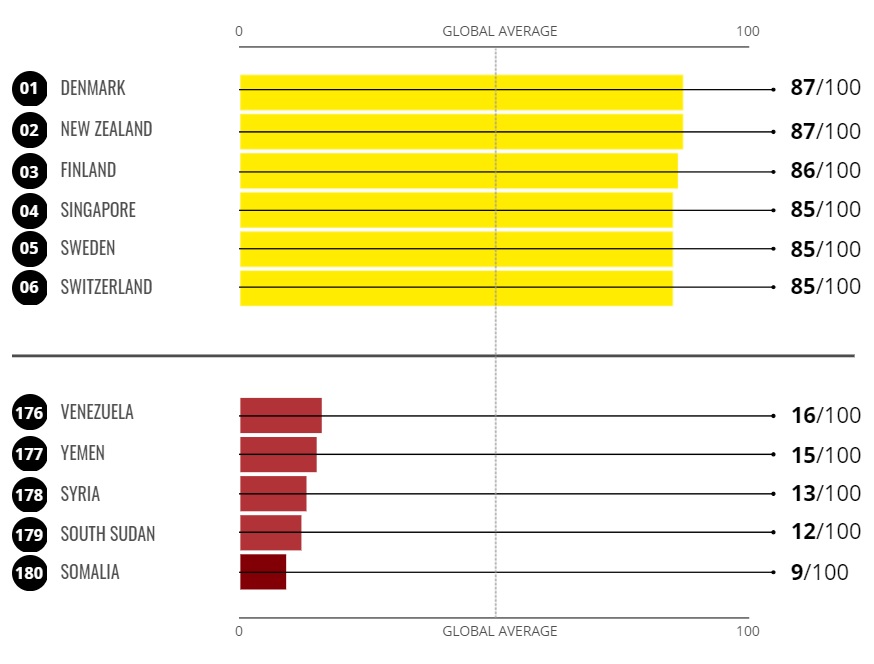
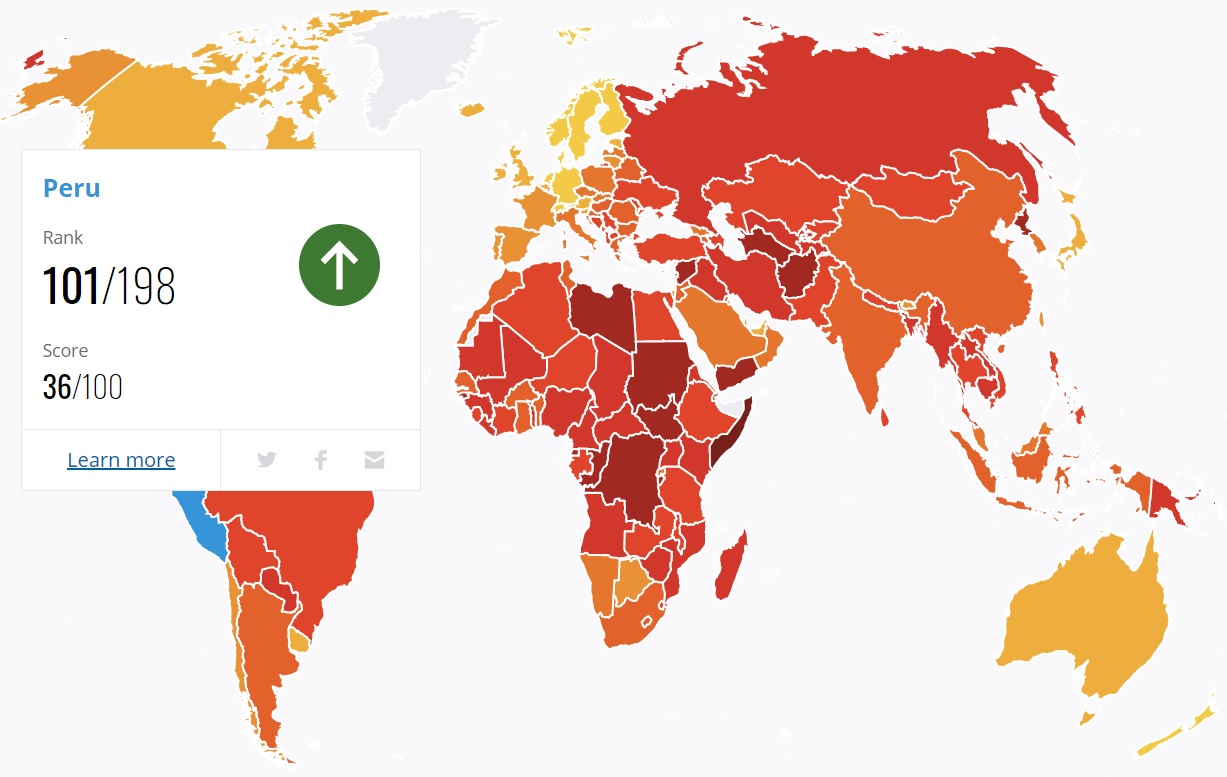
A country’s political culture also matters. Some nation’s have developed very low levels of tolerance for corruption, so there’s not a strong relationship between corruption and the size of government.  As you can see from Transparency International’s Corruption Perceptions Index, the Nordic nations are among the countries that are especially good in this regard.

But nation’s from the developing world, including the perennial bottom-dweller Venezuela, tend to get poor scores. The moral of the story is that it’s especially important to limit government (and therefore limit opportunities for corruption) in countries that don’t have high scores. I’m including this data because Peru, unfortunately, is in the bottom half of nations.

Not a terrible score when compared to Venezuela, but weak compared to Chile.  That being said, I want to close with a dose of optimism about Peru.

Today’s final visual is a chart showing how economic freedom in the country dramatically increased starting in the mid-1980s when the “Washington Consensus” was ascendant. And, just as Prof. William Easterly found in his research, this eventually kick-started much better economic performance.

P.S. It is worrisome that Peruvian economic policy stopped improving beginning about 2005. And based on Ms. O’Grady’s column, it seems unlikely that policy will get better in the near future.

P.P.S. Chile remains (at least for now) the big economic success story of Latin America, though Panama deserves a bit of attention as well.


Sunday, August 18, 2019

Why Some Nations are Rich and Others are Poor

Thomas Jackson, American Renaissance, August 1993

Why are Europe and the United States rich while Africa and Latin America are poor? How a person answers this question is an almost fool-proof indication of his politics. Until recently, the most common view was that white countries grew rich by exploiting poor, non-white ones. On university campuses there are still Marxists who roar about imperialism and neo-colonialism, but most people have begun to realize that economics is not thievery.

Lawrence Harrison, author of Who Prospers?, confesses that in 1962, when he first went to work for USAID, he thought that Latin America was poor because of American “neglect.” He also recalls that when President John Kennedy launched the Alliance for Progress in 1961 nearly everyone believed that Latin America would blossom as quickly and gratifyingly as Europe did under the Marshall Plan.

Mr. Harrison now believes that the reason poor countries stay poor is not because rich ones squeeze them but because they are hobbled by unhelpful mores and folkways, which he rather grandly calls “cultures.” In an era in which it is fashionable to pretend that all “cultures” are equally valid, it is a minor milestone to point out that the folkways of certain peoples are inferior to others.

Mr. Harrison’s analysis suffers from his unwillingness to violate certain taboos, but to speak of “culture” is an enormous improvement over blaming imperialism. Many of the foolish ideas that have influenced our immigration and foreign policies have grown out of the myth that overseas squalor is somehow all our fault. Mr. Harrison tries to avoid blaming anyone for anything, but a vital message gets through despite his scruples: We are not responsible for the failures of others............To Read More.....

Thursday, May 16, 2019

Latin America is Collapsing and Taking America With It

Posted by Daniel Greenfield 0 Comments Tuesday, May 14, 2019 @ Sultan Knish Blog

Long before the current scenes of thousands of migrants showing up in New Mexico or Arizona, the northward migration was fueled by a combination of Latin American instability and American greed for cheap labor going back over a century to the Mexican Revolution.

Venezuela’s spectacular collapse may be dominating the news cycle now, but a Latin American country usually implodes in a spectacular fashion every few years. Even now, there is political chaos in Nicaragua, with major protests demanding the ouster of Sandinista leader Daniel Ortega, and brewing scandals in Argentina, Brazil and Peru that could expand and tear any or all of the three countries apart.

Political instability, sharp swings from the far left to the far right, from Marxist terrorists to military warlords, are not a temporary aberration that can be fixed with our foreign aid or military intervention. They’re an enduring feature of political life that are as much a part of Latin America as the Declaration, the Constitution and the Founding Fathers are a part of the United States of America.

Political and civic institutions in Latin America are sources of instability. What little stability there is comes from the legal economy of oligarchs and the shadow economy of organized crime. The oligarchs work national economies and provide opportunities for educated professionals and trained workers. The crime lords, cartels and gangs offer security and economic opportunity for those nearer to the bottom.

America is not going to Americanize the countries south of the border. Instead America is being remade along a more Latin American model with radical politics, gang violence and a loss of civic confidence.

Latin American revolutions delivering cheap labor to America is not a new phenomenon. The real life Joads of Grapes of Wrath wouldn’t have been able to find agricultural work because the jobs were filled by Mexicans. The Cristero War’s Mexican migrants had been protected from the Immigration Act’s quotas because then, as now, agribusiness insisted that they couldn’t run farms without them.

Even in the Dust Bowl era, the same old interests insisted that there were jobs Americans wouldn’t do.

A century later the same Mexican workers that helped build California agriculture, decimated it by voting in Democrats whose environmental policies starved farms of water and strangled them with countless regulations. The workers have moved on to water-hungry cities where they don’t pick fruit, they provide services to a wealthy population of professionals, and then pass the bill to social services.

American taxpayers are being taxed to death so that blue state urban professionals can have cheap nannies, housekeepers and gardeners working off the books and making their lifestyles possible. The hospital visits, prison terms and welfare of that shadow population is financed by onerous taxes.

Despite the partisan tilt of migration, it took a revolution in the GOP to try and do something about it.

The wall is an important symbol not only of American sovereignty, but of the recognition that we are not going to fix the rest of the continent. When President Trump pulled foreign aid from migrant countries, he was not only sending them a message, but tossing out the swamp talking point that the best way to stop migration wasn’t a wall, but nation building in El Salvador, Honduras and Guatemala.

No amount of foreign aid is going to change the reality on the ground in the homeland of MS-13.

The impact of southern migration on America isn’t just about the charged demographic debates or the shift of red states to blue states. Demographic change is not going to eliminate Republicans. There are plenty of right-wing parties south of the border. The nature of what being on the right means will change in a majority-minority country. The end result won’t be conservative: it will be fascist.

Mass migration won’t end the GOP or the right. It will however eliminate American conservatism.

Leftists accuse Republicans of being fascists for opposing open borders. But open borders are the surest formula for fascism. Conservatism with its constitutional foundation of individual rights, limited government, and separation of powers will become a historical footnote. Instead, America will ricochet between socialists and national socialists, the way that some of our southern neighbors already do.

The crisis is already upon us.

A Democrat movement untethered from the middle class has come to be defined by the Obama alliance of radical white lefties and minority voters. With no further reason to be moderate, it is rapidly embracing any political extreme that is put forward, from packing the Supreme Court to letting the Boston Bomber vote to slavery reparations. Political stability requires respect for civic institutions and a secure middle class. America used to have those. Latin America never did. Now we’re losing them too.

The media has made much of the alt-right. While it describes this as a white nationalist problem, many prominent members of the alt-right are second generation Latin American immigrants. Nazism was never popular in America. Fascism and Nazism have more significant followings south of the border. The rise of the alt-right is not a reaction to a more diverse country. It is a product of that very diversity.

Gun violence is another major lefty talking point. But most of the gun violence in this country is gang-related. The problem isn’t the guns. It’s that gangs are flooding into this country and fighting over territory. We don’t have a Second Amendment problem. We have a border security crisis.

The pro-crime movement disempowers police so that ordinary people turn to criminal organizations for protection, replicating the existing model in many of the countries the migrants are coming from. As political radicals destroy civic institutions in their battle for power, gang leaders emerge as rivals to elected officials. That’s already the case in Chicago. It will become the norm in cities across the country.

Most of the vices controlled by organized crime, from gambling to drugs to prostitution to illegal migration, have already been legalized or are on the way to being legalized. This will not, contrary to some optimistic libertarian predictions, result in the destruction of organized crime. Instead, organized crime will thrive in the social chaos of the broken families, shattered communities and lost values.

The Prohibition analogy was wrong. Legalizing crimes doesn’t get rid of organized crime. Men with guns and no morals can always find ways to make money. Especially in a society losing its own morals.

Policies don’t stop crime. Social cohesion does. As a society breaks down, it tries to fight the most obvious symptoms of social breakdown with violence, before embracing the breakdown until there is no longer a distinction between law and criminality, between cops and gangs, and politicians and bosses.

Mass migration breaks down social cohesion. Immigration transformed major cities a hundred years ago, and then took a breather, allowing them to develop their own culture and identity. The organized crime that they brought with them faded as the next generation assimilated and became Americans.

That’s where the New York City, Boston or Philly we know came from. But there are no more geographic restrictions and no breathers. Not when hordes of Somalis are crossing the border on the way to Maine.

America can absorb new immigrants. But it needs time, space and control over the process. And, most of all, it needs to have a culture to absorb them into. Constant mass migration deprives us of the time, space and control. And the Left has deprived us of a culture, leaving nothing but vapidity and guilt.

The collapse of social cohesion wrecks the middle class leading to political radicalism and gang power. Political instability and social instability form a violent cycle which drive each other. The migrants heading north carry their radical politics with them. And the organized criminals who accompany them set up shop and quickly transform political instability into social instability.

That is what is tearing apart America.

Mexico began the great tradition of dumping its social problems in America over a century ago. These days it’s become an extremely profitable endeavor with billions in remittances pouring back in. Latin American countries export unskilled labor and gang members, and get back billions of dollars.

It’s a great deal for them. And a terrible deal for us.

Honduras and El Salvador don’t care if Trump cuts off its foreign aid. Not when remittances make up a fifth of their GDPs. The more of their citizens they get across the border and onto our social services, the more money their countries have. It’s not just the migrants who are exploiting the United States to avoid the social collapse of their countries. Latin American countries are exploiting America wholesale.

And, like a drowning swimmer, they are dragging us down with them even while we try to rescue them.

Latin America is collapsing. But, like the Leaning Tower of Pisa, it’s always collapsing. Its people have learned to live like that. If we don’t secure our borders, we’ll have to learn to live that way too.


Daniel Greenfield is a Shillman Journalism Fellow at the David Horowitz Freedom Center. This article originally appeared at Front Page Magazine.

Click here to subscribe to my articles. And thank you for reading.

Wednesday, May 15, 2019

Latin America is Collapsing and Taking America With It

Posted by Daniel Greenfield 0 Comments Tuesday, May 14, 2019 @ Sultan Knish Blog

Long before the current scenes of thousands of migrants showing up in New Mexico or Arizona, the northward migration was fueled by a combination of Latin American instability and American greed for cheap labor going back over a century to the Mexican Revolution.

Venezuela’s spectacular collapse may be dominating the news cycle now, but a Latin American country usually implodes in a spectacular fashion every few years. Even now, there is political chaos in Nicaragua, with major protests demanding the ouster of Sandinista leader Daniel Ortega, and brewing scandals in Argentina, Brazil and Peru that could expand and tear any or all of the three countries apart.

Political instability, sharp swings from the far left to the far right, from Marxist terrorists to military warlords, are not a temporary aberration that can be fixed with our foreign aid or military intervention. They’re an enduring feature of political life that are as much a part of Latin America as the Declaration, the Constitution and the Founding Fathers are a part of the United States of America.

Political and civic institutions in Latin America are sources of instability. What little stability there is comes from the legal economy of oligarchs and the shadow economy of organized crime. The oligarchs work national economies and provide opportunities for educated professionals and trained workers. The crime lords, cartels and gangs offer security and economic opportunity for those nearer to the bottom.

America is not going to Americanize the countries south of the border. Instead America is being remade along a more Latin American model with radical politics, gang violence and a loss of civic confidence.

Latin American revolutions delivering cheap labor to America is not a new phenomenon. The real life Joads of Grapes of Wrath wouldn’t have been able to find agricultural work because the jobs were filled by Mexicans. The Cristero War’s Mexican migrants had been protected from the Immigration Act’s quotas because then, as now, agribusiness insisted that they couldn’t run farms without them.

Even in the Dust Bowl era, the same old interests insisted that there were jobs Americans wouldn’t do.

A century later the same Mexican workers that helped build California agriculture, decimated it by voting in Democrats whose environmental policies starved farms of water and strangled them with countless regulations. The workers have moved on to water-hungry cities where they don’t pick fruit, they provide services to a wealthy population of professionals, and then pass the bill to social services.

American taxpayers are being taxed to death so that blue state urban professionals can have cheap nannies, housekeepers and gardeners working off the books and making their lifestyles possible. The hospital visits, prison terms and welfare of that shadow population is financed by onerous taxes.

Despite the partisan tilt of migration, it took a revolution in the GOP to try and do something about it.

The wall is an important symbol not only of American sovereignty, but of the recognition that we are not going to fix the rest of the continent. When President Trump pulled foreign aid from migrant countries, he was not only sending them a message, but tossing out the swamp talking point that the best way to stop migration wasn’t a wall, but nation building in El Salvador, Honduras and Guatemala.

No amount of foreign aid is going to change the reality on the ground in the homeland of MS-13.

The impact of southern migration on America isn’t just about the charged demographic debates or the shift of red states to blue states. Demographic change is not going to eliminate Republicans. There are plenty of right-wing parties south of the border. The nature of what being on the right means will change in a majority-minority country. The end result won’t be conservative: it will be fascist.

Mass migration won’t end the GOP or the right. It will however eliminate American conservatism.

Leftists accuse Republicans of being fascists for opposing open borders. But open borders are the surest formula for fascism. Conservatism with its constitutional foundation of individual rights, limited government, and separation of powers will become a historical footnote. Instead, America will ricochet between socialists and national socialists, the way that some of our southern neighbors already do.

The crisis is already upon us.

A Democrat movement untethered from the middle class has come to be defined by the Obama alliance of radical white lefties and minority voters. With no further reason to be moderate, it is rapidly embracing any political extreme that is put forward, from packing the Supreme Court to letting the Boston Bomber vote to slavery reparations. Political stability requires respect for civic institutions and a secure middle class. America used to have those. Latin America never did. Now we’re losing them too.

The media has made much of the alt-right. While it describes this as a white nationalist problem, many prominent members of the alt-right are second generation Latin American immigrants. Nazism was never popular in America. Fascism and Nazism have more significant followings south of the border. The rise of the alt-right is not a reaction to a more diverse country. It is a product of that very diversity.

Gun violence is another major lefty talking point. But most of the gun violence in this country is gang-related. The problem isn’t the guns. It’s that gangs are flooding into this country and fighting over territory. We don’t have a Second Amendment problem. We have a border security crisis.

The pro-crime movement disempowers police so that ordinary people turn to criminal organizations for protection, replicating the existing model in many of the countries the migrants are coming from. As political radicals destroy civic institutions in their battle for power, gang leaders emerge as rivals to elected officials. That’s already the case in Chicago. It will become the norm in cities across the country.

Most of the vices controlled by organized crime, from gambling to drugs to prostitution to illegal migration, have already been legalized or are on the way to being legalized. This will not, contrary to some optimistic libertarian predictions, result in the destruction of organized crime. Instead, organized crime will thrive in the social chaos of the broken families, shattered communities and lost values.

The Prohibition analogy was wrong. Legalizing crimes doesn’t get rid of organized crime. Men with guns and no morals can always find ways to make money. Especially in a society losing its own morals.

Policies don’t stop crime. Social cohesion does. As a society breaks down, it tries to fight the most obvious symptoms of social breakdown with violence, before embracing the breakdown until there is no longer a distinction between law and criminality, between cops and gangs, and politicians and bosses.

Mass migration breaks down social cohesion. Immigration transformed major cities a hundred years ago, and then took a breather, allowing them to develop their own culture and identity. The organized crime that they brought with them faded as the next generation assimilated and became Americans.

That’s where the New York City, Boston or Philly we know came from. But there are no more geographic restrictions and no breathers. Not when hordes of Somalis are crossing the border on the way to Maine.

America can absorb new immigrants. But it needs time, space and control over the process. And, most of all, it needs to have a culture to absorb them into. Constant mass migration deprives us of the time, space and control. And the Left has deprived us of a culture, leaving nothing but vapidity and guilt.

The collapse of social cohesion wrecks the middle class leading to political radicalism and gang power. Political instability and social instability form a violent cycle which drive each other. The migrants heading north carry their radical politics with them. And the organized criminals who accompany them set up shop and quickly transform political instability into social instability.

That is what is tearing apart America.

Mexico began the great tradition of dumping its social problems in America over a century ago. These days it’s become an extremely profitable endeavor with billions in remittances pouring back in. Latin American countries export unskilled labor and gang members, and get back billions of dollars.

It’s a great deal for them. And a terrible deal for us.

Honduras and El Salvador don’t care if Trump cuts off its foreign aid. Not when remittances make up a fifth of their GDPs. The more of their citizens they get across the border and onto our social services, the more money their countries have. It’s not just the migrants who are exploiting the United States to avoid the social collapse of their countries. Latin American countries are exploiting America wholesale.

And, like a drowning swimmer, they are dragging us down with them even while we try to rescue them.

Latin America is collapsing. But, like the Leaning Tower of Pisa, it’s always collapsing. Its people have learned to live like that. If we don’t secure our borders, we’ll have to learn to live that way too.


Daniel Greenfield is a Shillman Journalism Fellow at the David Horowitz Freedom Center. This article originally appeared at Front Page Magazine.

Click here to subscribe to my articles. And thank you for reading.

Wednesday, December 26, 2018

Tiny Ecuador demonstrates world's stupidest idea: Dumping America to become China's running dog

December 25, 2018 By Monica Showalter

If there was ever an example for nations worldwide of What Not To Do, take a look at what socialist Ecuador has done to itself in dumping the U.S. and turning to align its interests to China. The New York Times has a superb (albeit stomach-churning) report about how Ecuador sold itself out as a vassal of China, getting for itself a junk dam that is already collapsing, and turning over 80% of its oil production to the communist behemoth in order to pay its massive, massive debts from it. That, in exchange for scrapping its military ties to the U.S. and skipping out on its tab with western banks.

According to the Times report:
“The Chinese put the hook in,” said Steve Hanke, a Johns Hopkins economist. “At the end of the day, what do these countries have? A pig in a poke.” ................
He loudly kicked the U.S. out of its tiny air base in Manta by 2009, and at the same time embraced China, which got it on the hook for billions in loans for junk infrastructure projects, in exchange for pretty much all of Ecuador's oil. As for the oil-is-king strategy, well, we all know how that worked out for Venezuela............. They sure taught gringo a lesson, didn't they?........

And the Times notes that Ecuador is not the only country out there with this kind of strangling embrace from China. According to the Times: China, now South America’s top trading partner, has seeded the region with infrastructure and a staggering trail of loans.

It has reaped political benefits, too, getting Latin American nations to sever diplomatic relations with Taiwan. Pakistan is reportedly in similar straits over Chinese debt, and so is much of Africa, again, another case of the capture of the resources. There are likely other places, too.........To Read More.....

My Take - All, and I mean all, of our Southern neighbors will have to look North to get out of this mess, and they'll not get good terms, but the terms will be better than what the Chicoms have duped them with.  Socialists are going down the tubes everywhere and that includes China. 

What?  China's going down the tubes?  Yes! 

They don't have the money they're loaning, and those borrowing don't have the money to repay them.  Time isn't on their side, it's on America's side, so don't get all worked up over this because the more they do this kind of thing the sooner they all go broke.

Tuesday, April 18, 2017

The Trump Administration’s Latin American Opportunity

By José Azel

The Trump administration, with its business acumen, intuitively understands that a Latin America that is entrepreneurial, prosperous, and free market oriented is in the national interest of the United States on multiple fronts: it limits the influence in the region of hostile foreign powers such as Iran or Russia; it begins to address the economic root causes of the migration problem; it enhances markets and opportunities for American companies; and, it promotes democratic governance.........Read More