Search This Blog

De Omnibus Dubitandum - Lux Veritas

Showing posts with label United States. Show all posts

Monday, June 13, 2022

Market-Driven Growth and the Asian Tigers

June 11, 2022 by Dan Mitchell @ International Liberty

I’m currently in Tanzania as part of a speaking tour in Africa. My remarks today largely repeated the message I gave to an audience last week in Nigeria.

So I won’t bother sharing anything from my presentation. Instead, I want to highlight some numbers from a presentation by Professor Ken Schoolland.

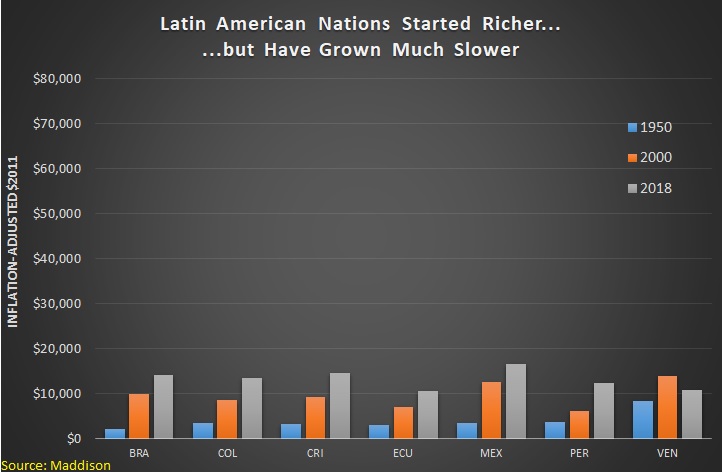
He shared some data showing how the “Asian Tigers” grew far faster than major Latin American nations between 1950 and 2000.
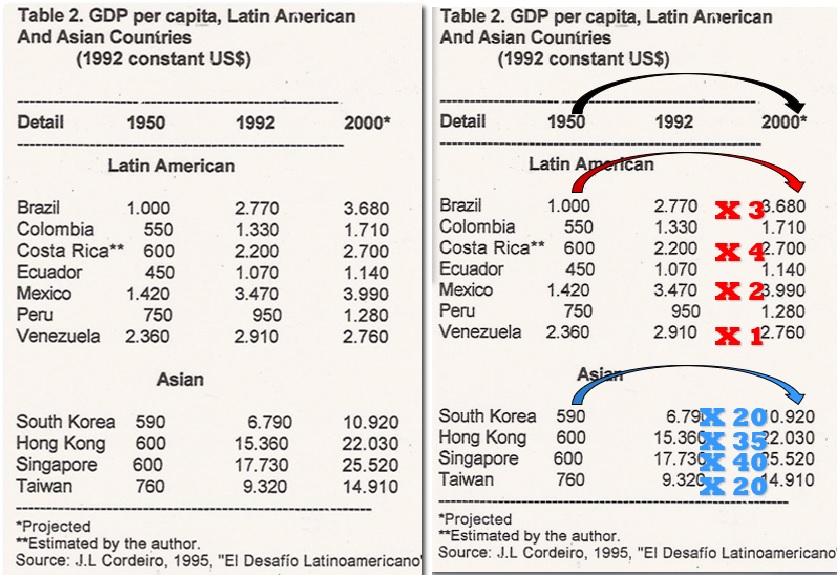
These are very impressive examples of convergence (as the Asian Tigers caught up with Latin America) followed by divergence (as the Tigers then continued to grow much faster).

I’ll be adding this data to my “anti-convergence club.”

But I also noticed that Professor Schoolland was sharing some old data from 1995.

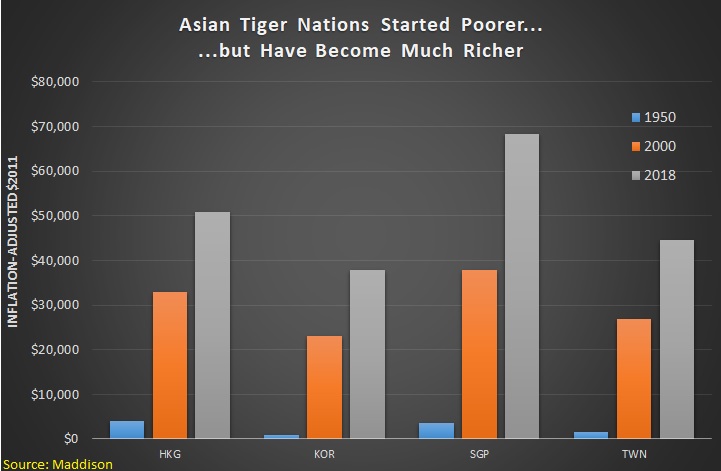
So I went to the Maddison website and created some new charts based on the latest-available data.

As you can see, the Latin American nations were richer in 1950, but they have not enjoyed fast growth in the past 70 years.
By contrast, the Asian Tigers have enjoyed spectacular growth since 1950.

So not only are these nations much more prosperous than nations in Latin America, in most cases they have even surpassed European countries and Singapore is now richer than the United States.
Since I’m writing about the success of the Asian Tigers, let’s address the myth that they became rich because of industrial policy.

Sam Gregg of the Acton Institute examined this controversy in an article for Law & Liberty.


…what about some of the East Asian Tiger countries? Aren’t they proof that, when devised and implemented by wise governments guided by even cleverer experts, industrial policy can work? …There is, however, a wealth of evidence indicating that these policies produced similarly pedestrian outcomes in these countries. As for the Tigers, what primarily took them from the status of economic backwaters to first-world economies was economic liberalization and especially trade openness… 

Even the most devoted industrial policy advocates hesitate to present two of the Tigers, Singapore and Hong Kong, as industrial policy successes. They do nevertheless regard South Korea and Taiwan’s postwar histories as demonstrating why industrial policy should play a major role.

Gregg takes a close look at what actually happened in South Korea.

Beginning in 1954 and until about 1963, Korea’s government focused upon import-substitution industrialization policies… however,…economic growth in Korea only began taking off between 1963 and 1973 following a decisive shift towards export-orientated development and trade openness. … 

Industrial policy assumed a larger place in Korea’s economy in the mid-1970s. …Korea’s turn towards industrial policy in this period does not appear to have produced spectacular results. Economic growth during this period—whether in terms of GDP, trade, employment, manufacturing output, or exports in goods and services—was actually lower than what had been realized in the 1960s. …These results may help explain why Korea’s drift towards industrial policy was reversed, beginning in the late-1970s. … 

The overall result was a return to high growth throughout Korea’s economy.

And here’s his analysis of what happened in Taiwan.

…the Kuomintang government adopted an import-substitution approach to trade characterized by high tariffs and import quotas. The Taiwan Production Board oversaw the extensive use of industrial policy, especially through preferential loan-treatment… In the mid-1950s, key Taiwanese officials and their American advisors recognized that Taiwan could not keep going down this path. 

Hence in the late-1950s, decisions were made that re-orientated Taiwan’s economy towards competition and trade openness by, among other things, liberalizing imports and foreign investment rules as well as beginning a process of steadily removing export controls and gradually giving more and more exporters what amounted to a free trade status. 

As in Korea’s case, growth in Taiwan took off. …the general direction of Taiwan’s economy from 1958 onwards was away from industrial policy and tariffs and towards increasing integration into global markets. Like Korea, Taiwan underwent a limited return to interventionist policies in the mid-1970s, but, again, like Korea, this did not last.

The bottom line is that South Korea and Taiwan are not as rich as Hong Kong and Singapore and one reason they are lagging is that their governments tried to pick winners and losers.

But both those nations largely have abandoned industrial policy, so at least they recognized their mistakes.

P.S. A big issue at the conference is whether the “China Model” should be emulated. I shared some data showing why that would be a big mistake.

 

Saturday, February 5, 2022

The Shifting Politics Of The So-Called "Green" Energy Transition

February 04, 2022 @ The Manhattan Contrarian

When I began this blog back in 2012, I had already studied up on the “climate change” issue. And I had already come to the conclusions that not only was the science of human-caused catastrophic global warming hogwash, but also that the proposed solution of replacing energy from fossil fuels with the wind and sun could never work at reasonable cost. My first post on the subject was on December 4, 2012.

But at that time there was almost no organized political opposition to the program to “save the planet” by transitioning to “green” energy. Here in the U.S., the Democrats were unanimous in their plans to replace fossil fuels, and Republicans mostly went along — some enthusiastically, others perhaps trying to slow things down a little. Indeed, when I began the blog, I had only recently attended a fundraiser for Republican candidate Mitt Romney in the 2012 presidential election (yes, I gave the guy money) where he chose to make his speech mostly about how he would fix the environment by promoting green energy. And over in Europe it was even crazier, with essentially no major political party in any country taking a position in opposition to the forced elimination of fossil fuels. The so-called “Energiewende” in Germany had kicked off in 2010, with essentially no significant political opposition.

I have long thought that the political situation would change, perhaps suddenly, when the costs and unworkability of the intermittent energy sources started to become more obvious. Meanwhile the Democrats have only become more zealous and extreme in their plans (now known as the “Green New Deal”), with loud support from the megaphones in the media and academia.

But meanwhile, after a long wait, the costs are bubbling to the surface, and the opposition is growing rapidly and headed toward critical mass. Today, some developments from the UK and US.

United Kingdom

The headline from today’s Times of London is “Britons facing biggest drop in living standards.” The lede:

In a bleak assessment of the year ahead, the Bank of England warned people that take-home pay would fall by five times the amount it did during the financial crisis of 2008. It will be the worst hit to real incomes since comparable records began in 1990.

And what is the main cause of the drop in living standards? Soaring energy costs. The government had tried to conceal the costs of suppressing fossil fuels by imposing price caps on household energy bills, but that only resulted in dozens of the local suppliers going out of business. Now, the authorities are unable to hold to the price caps:

Ofgem, the energy regulator, announced yesterday that the price cap on energy bills for 22 million households would rise by 54 per cent from April. For most households the increase will be £693 to £1,971 a year, whereas the costs for 4.5 million with prepayment meters will rise by £708 to £2,017 on average.

The conservative newspapers, particularly the Daily Telegraph and the Daily Mail, have completely figured out that soaring energy prices are a self-inflicted consequence of failed government fossil-fuel-suppression policies. Excerpts from an editorial in the Daily Mail today:

Successive governments ignored warnings about the insanity of having no long-term strategy to safeguard energy security. Now the chickens have come home to roost. How unnecessary this is. For Britain sits on an energy goldmine. We have vast unexploited reserves of oil, gas and shale. And we had the chance to expand nuclear power. But hypnotised by the apocalyptic alarmism of eco-activists, our politicians have pursued an aggressive green agenda, shunning these abundant power sources. It means we are left at the mercy of unreliable renewables and importing high-priced energy to stop the lights going out.

And from the Daily Telegraph, also today:

The big political question is whether the country is prepared to pay for net zero now that people can see the implications of a policy that will do nothing to combat global climate change for as long as the world’s biggest CO2 producers refuse to change their own practices.

Of course, the insane energy policies, at least for the moment, are being inflicted on the people by the Conservative Party, led by Prime Minister Boris Johnson. But by now many of the Tory back benchers have figured this out, and the demands to stop the insanity have even begun to seep up to the cabinet level. From another article in today’s Daily Telegraph:

A number of ministers have expressed concern that the pace of the planned switch to renewable energy is too fast and is increasing costs for consumers. They believe Britain should use more of its own gas in the short-term. . . . Cabinet ministers are increasingly uneasy about Downing Street’s focus on its net zero target and have warned that the cost of living crisis should be given more priority in the coming years.

OK, I have some news for these cabinet ministers: so-called “green” energy isn’t going to get any cheaper or more affordable or more useful if you merely slow down the transition. The problems of intermittency and need for full backup and/or storage are intractable and are not going to go away. But at least the effort to slow things down is a start. Next up: replacing Johnson. With all the other major UK parties having gone all in for “green” energy, the only route to rescue the country is via a Tory Party led by someone other than Johnson that puts an end to the “green” energy madness..

United States

In a post last week, I reported on how the insane push for “green” energy had infested even the major money managers in the U.S., led by Larry Fink of Black Rock, who were using their voting power to attempt to force large public companies to make “net zero” pledges. For years this trend has proceeded without significant pushback. But today a post at RealClearPolitics by Andy Puzder and Stephen Soukup reports that “Larry Fink’s Crusade Runs Into Resistance.” (You may remember Puzder as Trump’s first nominee for Labor Secretary, who did not get Senate confirmation.) Excerpt:

By year’s end, the resistance to ESG and woke capital had increased in size and variety. Everyone from shareholder activists to U.S. senators, state treasurers, legislators, and governors, as well as the former director of “sustainable investing” for BlackRock itself – were charting various forms of pushback against the newly woke masters of the financial universe.

Leading the charge are elected official in Republican-led states, with Texas, West Virginia and Florida in the forefront:

State officials, in particular, have started resisting. . . . Texas has enacted legislation banning companies that engage in political vendettas against oil and gas or gun companies from doing business with the state. Lt. Gov. Dan Patrick has asked the state’s comptroller to place BlackRock on this list of banned companies. West Virginia Treasurer Riley Moore announced that the Board of Treasury Investments, which manages the state’s roughly $8 billion operating funds, will cease doing business with BlackRock because it embraces “‘net zero’ investment strategies” that harm the energy sector, “while increasing investments in Chinese companies.” “[T]o combat woke corporate ideology,” Florida Gov. Ron DeSantis and the trustees for the State Board of Administration voted to “clarify the state’s expectation that all fund managers should act solely in the financial interest of the state’s funds” and revoked “all proxy voting authority of outside fund managers,” including BlackRock.

It’s fair to say that at this point almost the entire Republican Party in Congress and state governments has caught on to the “green” energy scam. I say “almost” because I’m sure there are a few — like Romney — who have not. But unlike ten years ago, it’s no longer so easy for the left to intimidate potential opponents into silence with accusations that fossil fuels are “dirty” or that anyone questioning progressive climate dogma is a “denier.” As the enormous costs become patent, the politics are shifting rapidly.

Comparing Economic Growth: United States vs. Europe

A key principle of economics is convergence, which is the notion that poorer nations generally grow faster than richer nations.

For instance, battle-damaged European nations grew faster than the United States in the first few decades after World War II.

But, starting in the 1980s, that convergence stopped. And not because Europe reached American levels of prosperity. Even the nations of Western Europe never came close to U.S. levels of per-capita economic output.

Moreover, European countries then began to lose ground for the rest of the 20th century.

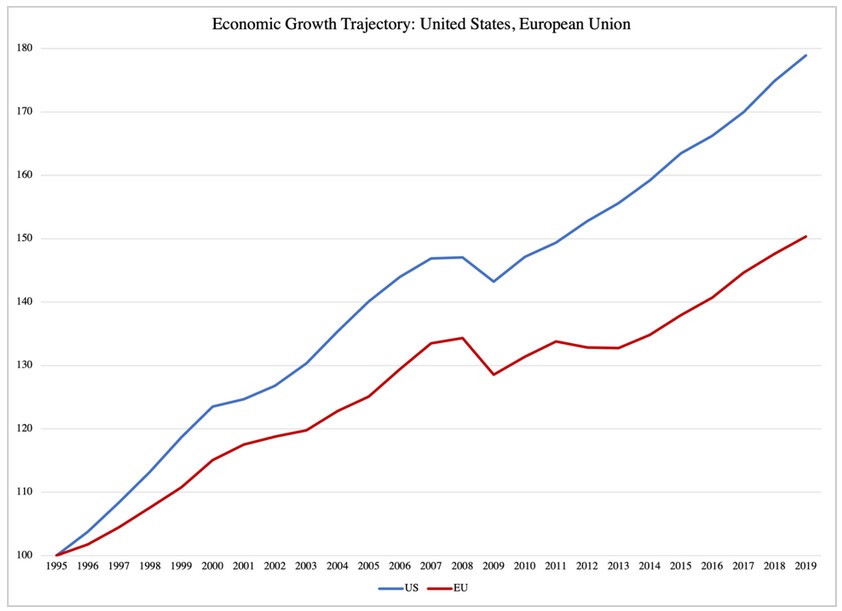
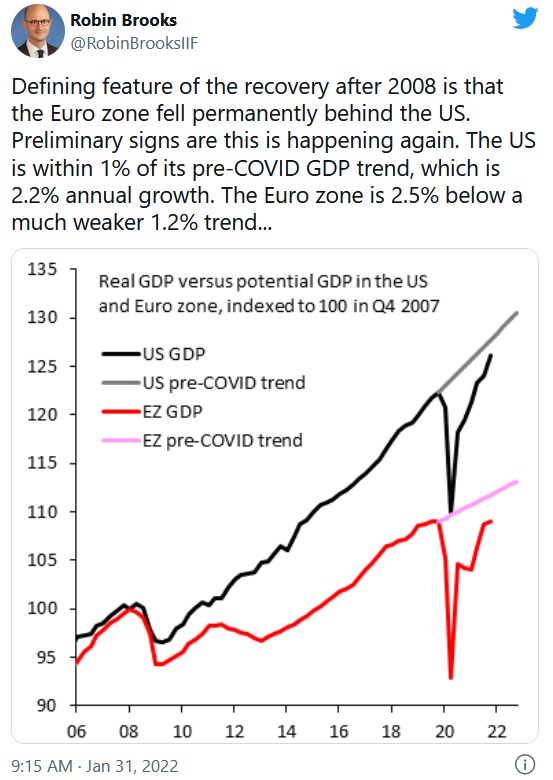
And that process is continuing. Here’s a recent tweet from Robin Brooks, the Chief Economist of the Institute of International Finance, which shows that the United States was growing faster than Europe before the pandemic and is now growing faster than Europe after the pandemic.

In other words, we’re seeing divergence.

Sven Larson addressed this same issue in a new article on this topic for European Conservative.

Over the 20 years from 2000 to 2019, the U.S. economy outgrew the 27-member European Union by a solid 19%, adjusted for inflation. These numbers…are quite impressive, especially considering that during President Obama’s eight years in office, annual growth in gross domestic product, GDP, never reached 3%. …From 2010 to 2019, U.S. unemployment averaged 6.3%, dropping below 3.7% in the last year before the pandemic. By contrast, the EU economy never dropped below 6.7% unemployment (in 2019) with an average of 9.5% for the entire decade. …These differences between America and Europe are significant, and should be the subject of debate in Europe: what is it that the Americans are doing that Europeans could do better? Over time, even small differences in economic growth compound into large differences in the standard of living.

Here’s his chart showing the divergence.

So why is Europe falling behind the United States when it should be growing faster because of lower living standards?

Sven has a very good explanation.

There are many candidates for explaining this difference, but there is one that stands out compared to all the others: the size of government. Between 2010 and 2019, government spending in the European Union was equal to 48.3% of GDP, on average, compared to 37.1% in the U.S. economy. …The most hard-hitting impact does not come through taxes, as conventional wisdom suggests, but through spending. …government operates under a form of central economic planning. Its outlays are not based on the mechanisms and prices of free markets: instead, its spending is governed by ideological preferences… While government spending inflicts the most damage on the economy, taxes are not insignificant. Here, again, the U.S. comes out more competitive than its European counterpart, and it is not a new problem. …For the past 20 years, European governments in general have taxed their economies 10-12 percentage points higher, as a share of GDP, than is the case in America.

Having crunched the data from Economic Freedom of the World, I think Sven is correct.

With regards to factors other than fiscal policy, European nations have just as much economic liberty (or, if you’re a glass-half-empty type, just as little economic liberty) as the United States. Heck, many of them rank above the United States when just considering factors such as trade, red tape, monetary policy, and rule of law.

Yet the United States nonetheless earns a better overall score.

Why? Because the United States does much better on fiscal policy (or, to be more accurate, doesn’t do as poorly).

P.S. Both Europe and the United States are moving in the wrong direction with regard to fiscal policy. Almost as if there’s a contest to see who can be the most profligate. Let’s call it the Keynesian Olympics. Whoever wins a gold medal is the first to suffer a fiscal crisis.


Saturday, March 27, 2021

Why Putin's pipeline is welcome in Germany

Pat Buchanan: Merkel obviously doesn't see Russia as the military threat it was in the Cold War

Patrick J. Buchanan By Patrick J. Buchanan March 25, 2021 

During a joint interview with Jens Stoltenberg, the Norwegian secretary-general of NATO, Secretary of State Antony Blinken, fresh from his bout with the Chinese in Anchorage, took on Angela Merkel and the Germans.  Issue: Nord Stream 2, the Baltic Sea pipeline Vladimir Putin is building to complement his Nord Stream 1 and carry more natural gas from Russia to Germany, and from there to other NATO nations.  The original Nord Stream pipeline, also consisting of two strands of pipe along the Baltic Sea floor, was completed in 2011.

"President Biden has been very clear in saying that he believes the pipeline is a bad idea; it's bad for Europe, bad for the United States," said Blinken, adding, U.S. law "requires us to sanction companies participating in the efforts to complete the pipeline."

What is behind American opposition to Russian natural gas going to Germany, and from there to NATO Europe?...........To Read More.....


Wednesday, March 24, 2021

Russia, China and the United States: First Shots

By George Friedman March 23, 2021

Any time there is a new U.S. president, major powers set out to test him and lay the groundwork for future bargaining in potential conflicts. Occasionally, the United States opens the bidding. Such was the case when Washington, through its new secretary of state, Antony Blinken, accused Beijing of human rights violations in Xinjiang and Hong Kong and of various cybercrimes. Beijing responded by calling Washington an enormous human rights violator, adding that it does not speak for the world and should not claim to. This is the tone for a showdown, not for a pleasant introduction.............Russia’s and China’s options are obviously more complicated than what I lay out here, but they are also hemmed in by these realities. The meetings held by the U.S. prior to the meeting with China were meant to remind the Chinese of as much, that it should not overestimate its strength or underestimate its strategic isolation. Calling Putin a killer was meant to warn Putin against covert operations, and to let him know that Washington knows how weak Russia is and doesn’t care what Russia thinks...........To Read More....


Tuesday, March 9, 2021

Comparing Prosperity: The United States vs. Europe

March 8, 2021 by Dan Mitchell

I periodically write about the importance of long-run growth and about the importance of convergence (whether poorer countries are catching up with richer countries, as suggested by theory).

This is because such data, especially over decades, teaches us very important lessons about the policies that are most likely to generate prosperity.

I’m revisiting these issues today because John Cochrane, a Senior Fellow at the Hoover Institution and a former professor of economics at the University of Chicago, recently wrote a column that contains a must-see chart showing how some of the major European nations have been losing ground to the United States over the past several decades...........To Read More....


Sunday, June 21, 2020

Slavery Studies: Should Canada and the USA apologize for slavery and “systemic racism”?

Lloyd Billingsley 38

“It should be clear with these recent events that African Canadians deserve an apology for slavery from the Canadian Government immediately. The systemic racism in Canada is a direct result of slavery in this country. African Canadians have been denied genuine equity in economic growth, social standing, legislative justice and proper regard for our health and well-being throughout Canada’s history.”

The writer is Elise Harding-Davis, an “African Canadian Heritage Consultant,” from Harrow, Ontario, in an open letter to Prime Minister Justin Trudeau published in the June 15 Windsor Star.  In Canada and around the world, people might wonder what the consultant is talking about.

Canada officially became a nation in 1867, a full 34 years after the 1833 Slavery Abolition Act that freed more than 800,000 slaves in British colonies. In 1815, only 18 years before the Act, Islamic Barbary pirates snatched 158 people from Sardinia................  Denunciations of existing slavery are hard to find in the United States, which abolished slavery 157 years ago in 1863, and in Canada, where slavery never existed. Much easier to find, in two of the freest, most affluent countries on earth, are claims of slavery as the driver of “systemic racism.” If those now enslaved in Libya or Mauritania thought that was uninformed, and even perverse, it would be hard to blame them........... To Read More....

Tuesday, June 9, 2020

The Unfortunate Decline of Federalism in the United States

September 12, 2015 by Dan Mitchell  @ International Liberty

Last week, I participated in a webinar with IES Europe. The program covered a wide range of issues, including tax competition, Social Security reform, and the recipe for national prosperity.
Here’s what I said on the topic of federalism.


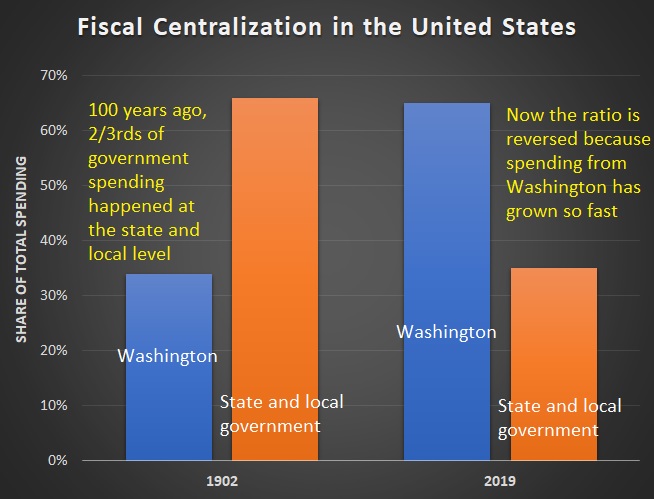
To add some hard data to the discussion, let’s compare the degree of fiscal decentralization in the United States in both 1902 and 2019, based on numbers from the Census Bureau (click on Govt_Finances) and the Office of Management and Budget (click on Table 14.3). As you can see from the chart, Washington now accounts for a much bigger share of overall government spending.


By the way, these numbers should not be misinterpreted. There’s been no reduction in the burden of state and local government outlays. Indeed, there’s been a steady increase in such spending, even after adjusting for inflation.

 http://freedomandprosperity.org/wp-content/uploads/2015/09/Federal-Spending-GDP-1790-2014.jpg

 But the federal government has grown far more rapidly. Indeed, the fiscal history of the United States is a sad story about the loss of almost all constraints and limits that America’s Founders put in the Constitution in hopes of controlling the size and scope of Washington. The bottom line is we now have much bigger government and it’s more remote because of centralization.

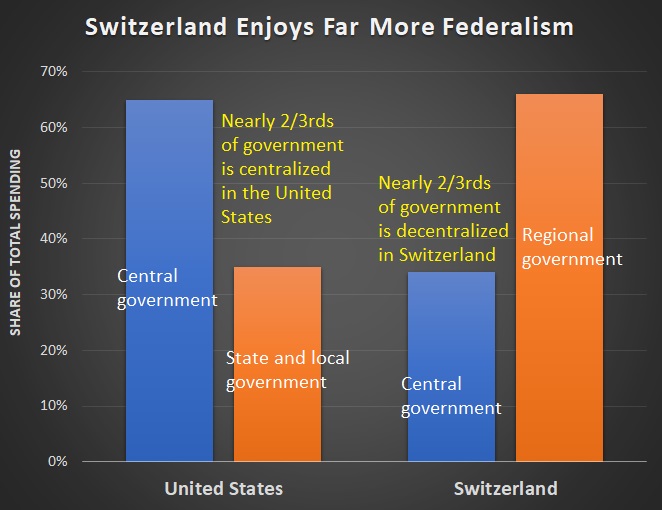
I mentioned Switzerland in the latter part of my answer.  Here’s the data comparing Switzerland and the United States. As you can see, Switzerland has been more successful in retaining genuine federalism.


Indeed, the two countries are mirror images, with nearly 2/3rds of government spending in the U.S. coming from Washington and nearly 2/3rds of government in Switzerland taking place a the level of cantons and municipalities.

P.S. Here’s what scholars from the Austrian School have said about federalism.

P.P.S. Here’s my two cents on federalism in the context of issues such as welfare, natural disasters, transportation, coronavirus, infrastructure, and Medicaid,

P.P.P.S. Because there’s strong evidence that decentralization produces better outcomes, I’m even willing to accept bad examples of federalism.

Thursday, May 21, 2020

The U.S. Must Stand with Australia against China

By

We owe as much to our long-time ally as it faces threats from a nearby adversary.  The mega-trend in U.S. foreign policy in the past decade is the consensus view that the post–Cold War continuation of the Nixon/Kissinger policy of engagement with and accommodation of the People’s Republic of China has failed.

Successive presidents of both parties extended the policy in the hope that the U.S. could help China as it lurched forward from the Maoist revolutionary era to a modern, engaged, liberal market economy.

The Cold War policy had endured despite the growing awareness across the U.S. political spectrum of the PRC’s role in the first rank of global human-rights abusers, its increasing appetite for regional military confrontation, its bullying of democracies across Asia and the Indo-Pacific, and its abuse of the privileges afforded it through membership in global forums such as the United Nations, the World Trade Organization, the World Health Organization, and others.

During this accommodationist era, many U.S. policymakers largely ignored or downplayed China’s boorish and abusive behavior because of perceived economic opportunities its market offered and the hope that economic engagement would lead to political reforms.

That perception is changing. U.S. supply chains are being diversified away from China, with some returning to the United States’ own shores. China’s own economy is fragile, unstable, and in constant need of government intervention. There is skepticism about — if not downright hostility toward — Chinese direct foreign investment in the U.S. and in U.S. companies.

And there is a lack of confidence in China’s public companies — such as Huawei — because of their relationship with the Chinese government. The recent push by the Trump administration not to permit the federal employee defined-benefit program to include an emerging-market benchmark fund that included Chinese equities reflects these facts...........To Read More....

Wednesday, October 3, 2018

The hidden agenda behind 'climate change'

By John Eidson October 2, 2018

In comments that laid bare the hidden agenda behind global warming alarmism, Christiana Figueres, executive secretary of the U.N.'s Framework Convention on Climate Change, let slip during a February 2015 press conference in Brussels that the U.N.'s real purpose in pushing climate hysteria is to end capitalism throughout the world:

This is the first time in human history that we are setting ourselves the task of intentionally changing [getting rid of] the economic development model that has reigned since the Industrial Revolution.

The economic model to which she referred is free-market capitalism. A year earlier, Figueres revealed what capitalism must be replaced with when she complained that America's two-party constitutional system is hampering the U.N.'s climate objectives. She went on to cite China's communist system as the kind of government America must have if the U.N. is to impose its environmental will on the world's most free and prosperous capitalist nation. In other words, for the U.N. to have its way, America must somehow be transformed into a communist nation.

Let that sink in for a moment............In a Nov. 14, 2010 interview with the Swiss newspaper Neue Zürcher Zeitung, Edenhofer, co-chair of the U.N. IPCC's Working Group III, made this shocking admission: One must free oneself from the illusion that international climate policy is environmental policy. [What we're doing] has almost nothing to do with the climate. We must state clearly that we use climate policy to redistribute de facto the world's wealth. ..........Read more