Search This Blog

De Omnibus Dubitandum - Lux Veritas

Showing posts with label Federalism. Show all posts

Wednesday, July 13, 2022

Federalism Is The Key To Demonstrating The Disaster Of Green Central Planning

July 11, 2022 @ Manhattan Contrarian

Central planning always fails, but the utopian visionaries implementing the plans cannot admit that they are at fault. A scapegoat must be found. As a leading example, when Soviet dictator Josef Stalin’s collectivization of agriculture led to mass starvation, the official blame was placed on “saboteurs” and “wreckers.”

Our current-day analog is the centrally-planned replacement of our very large, inexpensive and highly functional energy system, mostly based on fossil fuels, with the alternatives of intermittent wind and sun-based generation, as favored by incompetent government regulators who don’t understand how these things work or how much they will cost. Prices of energy to the consumer — from electricity to gasoline — are soaring; and reliability of supply is widely threatened.

All of which brings our President forth to blame the current price and supply issues in the energy markets on anything but his own administration’s intentional efforts to suppress the functional fossil fuel energy. One day the scapegoat is Vladimir Putin; another it is “companies running gas stations,” who stand accused of price gouging.

Unfortunately, a wide swath of the electorate is only too ready to believe that the failure of central planning is correctly blamed on the saboteurs or the wreckers or the price gougers or the Rooskies or whoever, rather than on the incompetent central planners. And the central planners can generally maintain their narrative, as long as they can impose their control widely enough to keep their subjects from becoming aware of successful alternatives.

And thus the maintenance of federalism in energy policy is crucial to avoiding the disaster of green energy central planning. And it is why the recent Supreme Court decision of West Virginia v. EPA is so important in the ongoing energy battles. West Virginia v. EPA struck down a centralized federal effort to dictate the structure of the electricity generation system nationwide, on the ground that the Congress had not explicitly authorized such a sweeping exercise of authority by an executive agency.

With federalism in energy policy, we can have New York forging ahead with its “Climate Leadership and Community Protection Act,” and California doing the same with its SB 100 — both of them seeking to eliminate fossil fuels from the generation of electricity, and then to force all energy consumers to use only electricity for their supply. Will that work? If New York and California are successful, they will be a model for the rest of the country to follow. Congratulations will be in order. If they fail relative to other states — that is, if they see energy prices soar, or frequent blackouts or shortages of needed energy — then it will be obvious to all that it was the green energy that failed, and not that there were “saboteurs” or “wreckers” or “price gougers,” who after all could have attacked the other states as well.

The federal bureaucracies will do everything they can to force all the states into a federal energy straightjacket, so that the (inevitable) failures of green energy cannot be blamed on the perpetrators. In Friday’s post I took note of two new federal initiatives, post-West Virginia, to seek national suppression of fossil fuels, one by imposing “ozone” emission limitations in Texas, and the other by declining to conduct offshore leasing auctions.

Yet another such initiative was announced on Thursday July 7: a so-called “Transportation Greenhouse Gas Emissions Reduction Framework” from the Federal Highway Administration. This one takes administrative audacity to a whole new level. Under the proposed rule, states must set declining greenhouse gas emissions targets for highway traffic that must align with the Net-Zero target as directed by the President in two Executive Orders and agreed at the international “Leaders Summit on Climate.” The federal Net Zero targets have not been enacted or authorized by Congress in any way, and exist only by virtue of a press release issued by President Biden on April 22, 2021. In other words, the administration and the FHA are thumbing their noses at the Supreme Court’s West Virginia decision.

Fortunately, the red states are not just going along with this kind of thing any more. This will be a critical battleground over the next five to ten years. I’m betting on victory for the red states, and the cratering of green energy.


Friday, May 7, 2021

The Federalism Fix

How to bring peace to Washington’s partisan wars 

Brian Riedl May 5, 2021 @ City Journal. Published with permission.  I recommend subscribing, it's free.  
 
Imagine a world in which your favorite policy proposals are no longer blocked by Nancy Pelosi, Mitch McConnell, Bernie Sanders, or Ted Cruz. In this world, Washington’s longstanding partisan warfare no longer paralyzes action on health care, welfare, education, and infrastructure.

Impossible? Not at all. The simple solution is federalism. Rather than watch lawmakers in Washington fight for the right to impose a one-size-fits-all solution on America, we can let state governments, which are closer to the people, tailor local solutions to local problems.

We’ve already seen what happens when Washington calls the shots for everyone. Take health care. Thirty years of partisan fights have raised billions in campaign contributions for both sides, flipped control of Congress in 1994 and again between 2010 and 2014, and brought several high-profile Supreme Court cases. Yet in all this time there have been just two transformational health reforms: the creation of the Medicare prescription drug benefit in 2003 and the 2010 Affordable Care Act. The ACA then saw a disastrous rollout, followed by a repeal fight that dominated domestic politics for the next decade. Much of the debate in the 2020 Democratic presidential primary centered on whether to support Medicare For All—a policy with no chance of passing in Congress anytime soon.

Similar patterns of partisan conflict play out on other issues: welfare, taxes, the minimum wage, transportation, and education. So much fighting for so little progress.

Why does Washington have to decide all these issues for the states? Did Vermont voters elect Bernie Sanders to the Senate to impose his socialist vision on Texas? Did Texas voters send Ted Cruz to Washington to bring conservative policies to Vermont? True, the Framers intended the U.S. Constitution to create a degree of gridlock, but they also wanted to empower state and local governments to provide their own solutions for their populations.

Surveys show that voters trust their governors and mayors to solve problems. A 2016 Gallup poll revealed that 55 percent of respondents preferred power to be concentrated in state governments; 37 percent preferred the federal government. A group of surveys also shows that Americans strongly prefer state and local governments to lead on health insurance (62 percent, versus 38 percent preferring federal leadership), welfare (68/31 percent), unemployment (55/26 percent), education (75/25 percent), pre-kindergarten education (71/25 percent), transportation (78/22 percent), law enforcement (73/20 percent), job training (75/20 percent), housing (83/18 percent), and paving roads (77/9 percent). These preferences reflect the widely shared belief that state and local governments are more competent, fairer, and less wasteful than the federal government.

Decades of geographic partisan sorting also make empowering states more important than ever. Americans have divided themselves into deep red and deep blue states and communities. As far as presidential and Senate elections are concerned, 35 states are essentially one-party states, and 80 percent of counties are considered “landside counties,” with regular partisan splits of more than 20 points. At the same time, both parties are growing more ideologically homogeneous and extreme.

Though America has sorted itself into communities with shared values and political views, Washington has increasingly imposed one-size-fits-all solutions. This has led to political warfare. Lawmakers from California and Alabama battle over which side gets to impose its solution nationwide. Centralization has also encouraged poor policies: there are few good reasons that Brooklyn and Alaska should adopt similar approaches on poverty or education policy. Nor is there any good for reason Hawaii and South Dakota to have similar health-care systems. And why is Washington deciding which local roads to expand?

Many American states have economies, populations, and geographical footprints comparable to those of European countries. If all states were divided into separate countries, California would be the world’s fourth-largest economy, while Texas would be ninth, and New York the eleventh. Virginia’s economy is roughly as big as Poland’s, Louisiana’s matches Finland, Montana’s matches Serbia, and Vermont’s economy—the smallest among the states—is about as big as that of the Baltic states of Latvia and Estonia. If those countries are large enough to determine their own policies, why aren’t U.S. states?

Surely not all federal policies should be devolved to the states. Those policies with significant spillover effects to other states—dealing with, for example, pollution, interstate communications, and interstate crime—should remain federal. Washington should also maintain control of obvious national policies such as defense, international relations, homeland security, macroeconomic stabilization, broad financial regulation, health and safety regulation, and federal research. Constitutional and civil rights must be enforced.

But that leaves vitally important functions like highways, roads, K-12 schools, the welfare system, and health care ripe for more state control. Leave it to states to tailor local solutions to local problems. A failed approach will harm one state instead of 50; over time, states will copy those that succeed.

There is room in America for both red and blue. Do we want 30 more years of paralysis as Republicans and Democrats in Washington fight to impose their vision on everyone? America is too large and diverse for such centralization. Let Vermont try single-payer health care, let Texas try free-market solutions—and we can all stop being held hostage by Nancy Pelosi, Mitch McConnell, Bernie Sanders, and Ted Cruz.


Saturday, August 8, 2020

OECD Research Acknowledges Big Benefits from Federalism

August 7, 2020 by Dan Mitchell @ International Liberty

Largely because of my support for jurisdictional competition, I’m a big fan of federalism.
Simply stated, our liberties are better protected when there’s decentralization since politicians are less like to over-tax and over-spend when they know potential victims of plunder have the option of moving across a border.

Indeed, I cited some academic research back in 2012 which showed that there as less economy-weakening redistribution in nations with genuine federalism (see, for instance, how Vermont politicians were forced to backtrack when they try to impose government-run healthcare).

Now let’s look at some additional scholarly evidence. A study published by the OECD, authored by Hansjörg Blöchliger, Balázs Égert and Kaja Fredriksen, investigates the impact of federalism on outcomes in developed nations. Here are the key findings from the abstract.
This paper presents empirical research on the potential effects of fiscal decentralisation on a set of outcomes such as GDP, productivity, public investment and school performance. The results can be summarised as follows: decentralisation, as measured by revenue or spending shares, is positively associated with GDP per capita levels. The impact seems to be stronger for revenue decentralisation than for spending decentralisation. Decentralisation is strongly and positively associated with educational outcomes as measured by international student assessments (PISA). While educational functions can be delegated either to sub-central governments (SCG) or to schools, the results suggest that both strategies appear to be equally beneficial for educational performance. Finally, investment in physical and – especially – human capital as a share of general government spending is significantly higher in more decentralised countries.
Here’s some detail from the body of the paper about the pro-growth impact of decentralization (especially when sub-national governments are responsible for raising their own funds).
Across countries, sub-central fiscal power, as measured by revenue or spending shares, is positively associated with economic activity. Doubling sub-central tax or spending shares (e.g. increasing the ratio of sub-central to general government tax revenue from 6 to 12%) is associated with a GDP per capita increase of around 3%. …Revenue decentralisation appears to be more strongly related with income gains than spending decentralisation. This empirical finding may reflect that “true” fiscal autonomy is better captured by the sub-central revenue share, as a large part of sub-central spending may be mandated or regulated by central government. … the estimated relationship never becomes negative and is not hump-shaped, i.e. “more decentralisation always tends to be better”.
The part of “more decentralisation always tends to be better” is a good result.
But it’s also a sad result since the United States has moved in the wrong direction in recent decades.
Though we’re still less centralized than most nations, as you can see from this chart from the OECD study.


Kudos to Canada and Switzerland for leading the world in federalism.
Here are some additional details from the study. I’m especially interested to see that the authors acknowledge how jurisdictional competition helps to explain why nations with federalism perform better.
Decentralised fiscal frameworks can raise TFP through an increase in the efficiency and productivity of the public sector… Public sector productivity is influenced by competition between SCGs and inter-jurisdictional mobility. Most SCGs aim at attracting and retaining mobile production factors, in order to promote investment and economic activity. They can do so by using fiscal policy, among other instruments. Since firms are choosing their location based on where they expect the highest returns on investment, and since returns depend (partly) on public inputs, SCGs have an incentive to raise the productivity of their public sector. SCGs may also try to improve the relationship between taxation and public service levels, by lowering taxes… The more decentralised a country, the stronger these competitive forces could be. Competition and inter-jurisdictional mobility could be weakened by large intergovernmental transfer systems, in particular fiscal equalisation.
As a aside, it’s rather ironic that that the professional economists at the OECD produce rigorous studies (here’s another one) showing the benefits of jurisdictional competition while the political appointees push for anti-growth policies such as tax harmonization.  Let’s close by looking at the study’s estimates of how nations would enjoy more prosperity by shifting in the direction of decentralization.
…an assessment of what a country might gain in terms of higher GDP if it moved to the benchmark of the most decentralised country. To be more specific, the gains were calculated for each federal country if it moved tax decentralisation to the level of Canada, and for each unitary country if it moved tax decentralisation to the level of Sweden (Figure 6). Further decentralisation could potentially be associated with an average increase of GDP of around 1% to 2% for federal countries and 3% to 4% for unitary countries, with values for more centralised countries being larger.
Here’s the accompanying chart.  Since the U.S. still has some federalism, our gain isn’t very large, but nations such as Austria, Belgium, Slovakia, Ireland, Luxembourg, and the United Kingdom could get big boosts.


P.S. I didn’t focus on the findings about better educational outcomes in decentralized nations. But I can’t resist pointing out that this is an additional reason to abolish the Department of Education.

P.P.S. Here’s a video discussing how Switzerland benefits from federalism.

P.P.P.S. And here’s what scholars from the Austrian school of economics wrote about federalism.

Tuesday, June 9, 2020

The Unfortunate Decline of Federalism in the United States

September 12, 2015 by Dan Mitchell  @ International Liberty

Last week, I participated in a webinar with IES Europe. The program covered a wide range of issues, including tax competition, Social Security reform, and the recipe for national prosperity.
Here’s what I said on the topic of federalism.


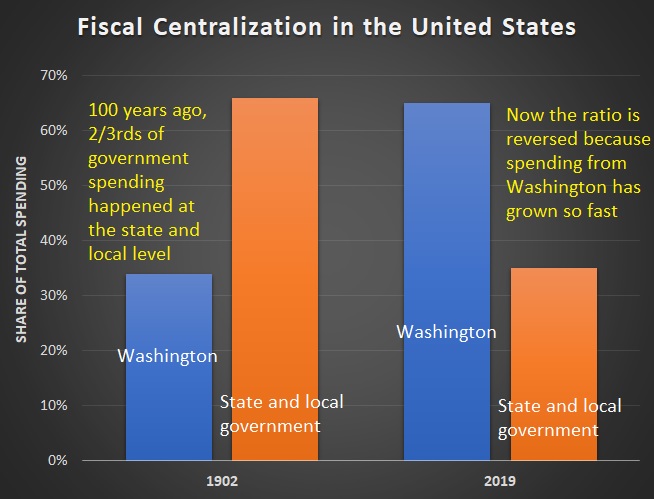
To add some hard data to the discussion, let’s compare the degree of fiscal decentralization in the United States in both 1902 and 2019, based on numbers from the Census Bureau (click on Govt_Finances) and the Office of Management and Budget (click on Table 14.3). As you can see from the chart, Washington now accounts for a much bigger share of overall government spending.


By the way, these numbers should not be misinterpreted. There’s been no reduction in the burden of state and local government outlays. Indeed, there’s been a steady increase in such spending, even after adjusting for inflation.

 http://freedomandprosperity.org/wp-content/uploads/2015/09/Federal-Spending-GDP-1790-2014.jpg

 But the federal government has grown far more rapidly. Indeed, the fiscal history of the United States is a sad story about the loss of almost all constraints and limits that America’s Founders put in the Constitution in hopes of controlling the size and scope of Washington. The bottom line is we now have much bigger government and it’s more remote because of centralization.

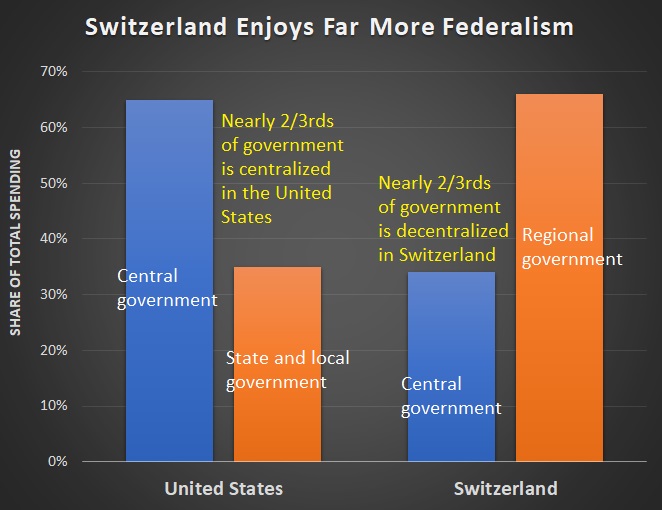
I mentioned Switzerland in the latter part of my answer.  Here’s the data comparing Switzerland and the United States. As you can see, Switzerland has been more successful in retaining genuine federalism.


Indeed, the two countries are mirror images, with nearly 2/3rds of government spending in the U.S. coming from Washington and nearly 2/3rds of government in Switzerland taking place a the level of cantons and municipalities.

P.S. Here’s what scholars from the Austrian School have said about federalism.

P.P.S. Here’s my two cents on federalism in the context of issues such as welfare, natural disasters, transportation, coronavirus, infrastructure, and Medicaid,

P.P.P.S. Because there’s strong evidence that decentralization produces better outcomes, I’m even willing to accept bad examples of federalism.

Monday, April 20, 2020

Trump Rewrites the Book on Emergencies

By Christopher DeMuth April 17, 2020

Washington’s response to the Covid-19 pandemic is upending one of the most durable patterns of American politics. Throughout history, national emergencies have led to a more powerful and centralized federal government and to the transfer of federal power from Congress to the executive branch. This time, the federal response rests largely on state and local government and private enterprise, with a wave of deregulation clearing the way. The Trump administration has seized no new powers, and Congress has stayed energetically in the game.

The historical pattern is powerful and might have seemed inevitable. In times of war, natural disaster and economic upheaval, action is king. The president and his officials and agencies can act with much greater dispatch than Congress can. They may be forgiven for crossing statutory or even constitutional boundaries—in a crisis, the test of legitimacy is perceived effectiveness. But emergency actions often set precedents for normal times.

Moreover, crises generate proposals for preventing their recurrence. These typically take the form of an agency that, with the benefit of hindsight, could have nipped the crisis in the bud. Positing an omnicompetent government authority is political misdirection: It elides the profound problems of uncertainty and conflicting information and interpretation that precede every catastrophe. That is a sure recipe for highly concentrated, discretionary power.

These tendencies were dramatically on display in the first two national emergencies of the 21st century, 9/11 and the 2008 financial collapse. In response to the 9/11 attacks, the Bush administration and Congress created two gigantic agencies with extraordinary powers and insulation from congressional control, the Department of Homeland Security and the Office of the Director of National Intelligence. Intelligence was centralized and bureaucratized; federal police powers were extended down to driver’s licenses and much else; the administration established wide-ranging surveillance programs.

In response to the 2008 crisis, the administration arranged corporate mergers and bailouts with only fig leaves of statutory authority. It spent hundreds of billions of dollars without congressional appropriation. These crisis expedients provided the template for the Obama administration’s unilateral responses to mere political frustrations—congressional inaction on its climate change, immigration and other legislative proposals. At the same time, the Dodd-Frank Act of 2010 commissioned an army of new regulatory authorities with unprecedented discretion and autonomy.........To Read More....

Sunday, April 19, 2020

Coronavirus and Federalism

I’ve written that policy makers need to consider both the human toll of the coronavirus and the human toll of a depressed economy.  And, as you can see from this tweet, even the United Nations has acknowledged that a weak economy leads to needless death.

Since I don’t have any expertise on epidemiology, I’m not arguing that the economy should be opened immediately. I’m simply stating that the people who do make such decisions should be guided by the unavoidable tradeoff that exists between lives lost from disease and lives lost from foregone prosperity.

Which then raises the question of who should make such decisions.

As reported by the New York Post, President Trump claims he has all the authority.
President Trump on Monday said the decision to reopen the country’s ailing economy ultimately rests with him, not state leaders, as he feuds with governors over when to allow Americans to return to work. …Trump is now looking at reopening the economy by May 1, putting him on a collision course with state leaders who are pushing back, saying it would be dangerous to “take our foot off of the accelerator” in the war against the virus. …Rebuffing the president’s claims Monday, constitutional experts say it is state leaders who have the power to police their citizens under the 10th Amendment.
Trump is wrong.

He’s wrong in part because the Constitution limits the powers of the central government.

But he’s also wrong because – as explained by scholars from the Austrian School of Economics – we’re far more likely to get better choices when they’re decentralized.

In some cases, that means allowing individuals to make informed choices about how much risk to take.

But, to the extent government must be involved, it makes more sense to have state and local officials make choices rather than the crowd in Washington.

Opining for the Wall Street Journal, Walter Olson explains why federalism is the right approach.

Public-health merits aside, the president can’t legally order the nation back to work. The lockdown and closure orders were issued by state governments, and the president doesn’t have the power to order them to reverse their policies. In America’s constitutional design, …the national government is confined to enumerated powers. It has no general authority to dictate to state governments. Many of the powers government holds, in particular the “police power” invoked to counter epidemics, are exercised by state governments and the cities to which states delegate power. …Modernizers have long scoffed at America’s federalist structure as inefficient and outdated, especially in handling emergencies. …Today you won’t find these critics scoffing at the states or overglamorizing Washington. One federal institution after another, including the Food and Drug Administration and Centers for Disease Control and Prevention, has been caught flat-footed by Covid-19. …State governments, by contrast, with some exceptions here and there, have responded to the emergency more skillfully and in a way that has won more public confidence. …The record of federal systems—some of the best known are in Canada, Germany and Switzerland—suggests there’s a lot of resilience packed into the model.
Michael Brendan Dougherty elaborates in an article for National Review.
Writer Molly Jong-Fast complains, “So the states are basically governing themselves because our president doesn’t know how to president at all?” Well, no. It’s simple: Our president doesn’t have dictatorial powers, even in a national emergency. The president doesn’t have authority to shut down your local gin joint. Your state governor does have this power, in extraordinary circumstances. That so many governors have done so, often responding to popular demand for shutdowns, demonstrates America’s genuine practice of federalism — a system that is allowing us to respond to this crisis even faster than the states of Europe… One of the reasons federalism can act faster is that it allows decentralization. It is less politically risky to impose measures in one state than on an entire nation. You can respond where the hotspots are, rather than imposing costs evenly across an undifferentiated mass of the nation where the overall average risk may be low.
Professor Ilya Somin wrote on this same topic for Reason. He noted limitations on federalism in a pandemic, but also pointed out the benefits of decentralization.
The US is a large and diverse nation, and it is unlikely that a single “one-size-fits-all” set of social distancing rules can work equally well everywhere. In addition, state-by-state experimentation with different approaches can increase our still dangerously limited knowledge of which policies are the most effective. Moreover, if one policymaker screws up, his or her errors are less likely to have a catastrophic effect on the whole nation. …There is, in fact, a long history of state and local governments taking the lead in battling the spread of contagious disease. During the 1918-19 flu pandemic, state and local restrictions were the primary means of inhibiting the spread of the virus, while the federal government did very little.
John Daniel Davidson of the Federalist echoes the benefits of having choices made at the state and local level.
The founders wisely chose a federal republic for our form of government, which means sovereignty is divided between states and the federal government. The powers of the federal government are limited and enumerated, while all powers not granted to the feds are reserved for the states, including emergency police powers of the kind we’re seeing states and localities use now. …Much of the media seems wholly unaware of this basic feature of our system of government. …Trump explained that many governors might have a more direct line on this equipment and if so they should go ahead and acquire it themselves, no need to wait on Washington, D.C. This is of course exactly the way federalism is supposed to work. …We should expect the government power that’s closest to affected communities to be the most active, while Washington, D.C., concern itself with larger problems.
And those “larger problems” are the ones enumerated in Article 1, Section 8.

The bottom line is that we should always remember the Third Theorem of Government, which helps to explain one of the reasons why it’s generally a bad idea to give the folks in Washington more power and authority.

Instead, we should try to be more like Switzerland, which is one of the world’s best-governed nations in large part because of a very decentralized approach.

Which may be why economists at the (normally statist) International Monetary Fund found a clear link between federalism and quality governance.

Let’s hope Donald Trump realizes that federalism is the right approach.

P.S. My favorite example of federalism came from Vermont.
 

Friday, November 18, 2016

Secession, Federalism, and National Comity (Plus more Intentional and Unintentional Election-Related Humor)

November 17, 2016 by Dan Mitchell @ International Liberty
The concept of secession (part of a jurisdiction breaking away to become independent) has a bad reputation in the United States because it is linked to the reprehensible institution of slavery.
But, as Walter Williams has explained, secession today may be an effective way of protecting liberty from ever-expanding centralized government.


And I’ve favorably written about secessionist movements in Sardinia, Scotland, and Belgium, largely because the historical data shows that better policy is more likely when there are many jurisdictions competing with each other.

So it was with considerable interest that I saw an article in Fortune about a secessionist movement in California.
“Calexit” didn’t start with Donald Trump, but his victory on Election Day certainly sparked more interest in the idea. A play on “Brexit,” it’s the new name for the prospect of California seceding from the U.S. The movement…seems to have gained steam in the past six months, thanks in part to the U.K.’s recent Brexit vote and Donald Trump being elected president. …The group’s goal is to hold a referendum in 2018 that, if passed, would transition California into its own independent country. …the movement has even grabbed the attention of some potential Silicon Valley bankrollers.
I like this idea, though I’m not sure it’s good for California since the state faces very serious long-run challenges.

Though this is one of the reasons I like secession. As an independent nation, California no longer would have any hope of getting a bailout from Washington, so the politicians in Sacramento might start behaving more responsibly.

And there are examples of secession in the modern world, such as Slovakia and the Czech Republic emerging from Czechoslovakia. That was a very tranquil divorce, unlike what happened in the former Yugoslavia.

As is so often the case, we can learn a lot from Switzerland. There is a right of secession, albeit dependent on a nationwide vote of approval. Municipalities also can vote to switch cantons, as happened in 1996 when Vellerat left Bern and became part of Jura. By the way, villages in Liechtenstein have the unilateral right to secede from the rest of the nation (though that seems highly unlikely since it is the second-richest nation in the world).

Notwithstanding these good role models, the secessionist movement in California presumably won’t get very far.

But maybe full-blown secession isn’t necessary. If Californians don’t like what’s happening in Washington (or, for that matter, if Texans aren’t happy with the antics in DC), that should be an argument for genuine and comprehensive federalism.

In other words, get rid of the one-size-fits-all policies emanating from the central government and allow states to decide the size and scope of government.


California can decide to do crazy things (such as regulate babysitters and give bureaucrats too much pay) and Texas can choose to do sane things (such as no income tax), but neither state could dictate policy for the entire nation.

This also happens to be the system envisioned by America’s Founding Fathers.

Think of federalism as a live-and-let-live system. New York doesn’t have to become North Dakota and Illinois doesn’t have to become Alabama. Red states can be red and blue states can be blue. And we can add all the other colors in the rainbow as well. Let a thousand flowers bloom, and all that.

And consider how well federalism works in Switzerland, a nation that doesn’t have a single language, culture, or religion.

Now, perhaps, you’ll understand why I even suggested federalism as a solution to the mess in Ukraine.

P.S. If California actually chooses to move forward with secession, the good news is that we already have a template (albeit satirical) for a national divorce in the United States.

P.P.S. Here’s an interesting historical footnote. There’s a small part of Germany that is entirely surrounded by Switzerland. This enclave wanted to become part of Switzerland many decades ago, but there was no right of secession notwithstanding overwhelming sentiment for a shift of nationality.
A whopping 96 percent of the inhabitants voted for annexation by Switzerland. The people had spoken loud and clear, but their voices were ignored. As the Swiss were unable to offer Germany any suitable territory in exchange, the deal was off. Büsingen would remain, somewhat reluctantly, German.
Since Germany is a reasonably well-run nation, I guess we shouldn’t feel too sorry for the people of Büsingen (unlike, say, the residents of Menton and Roquebrune in France, who used to be part of a tax haven but now are part of a tax hell).

P.P.P.S. Let’s close with some additional election-related humor.

(Editor's Note: There's a picture here I can't reproduce for some reason so go to the original for that.  RK)

And here’s another Hitler parody to add to our collection.


And here’s Michelle Obama feeling sad about what’s about to happen.


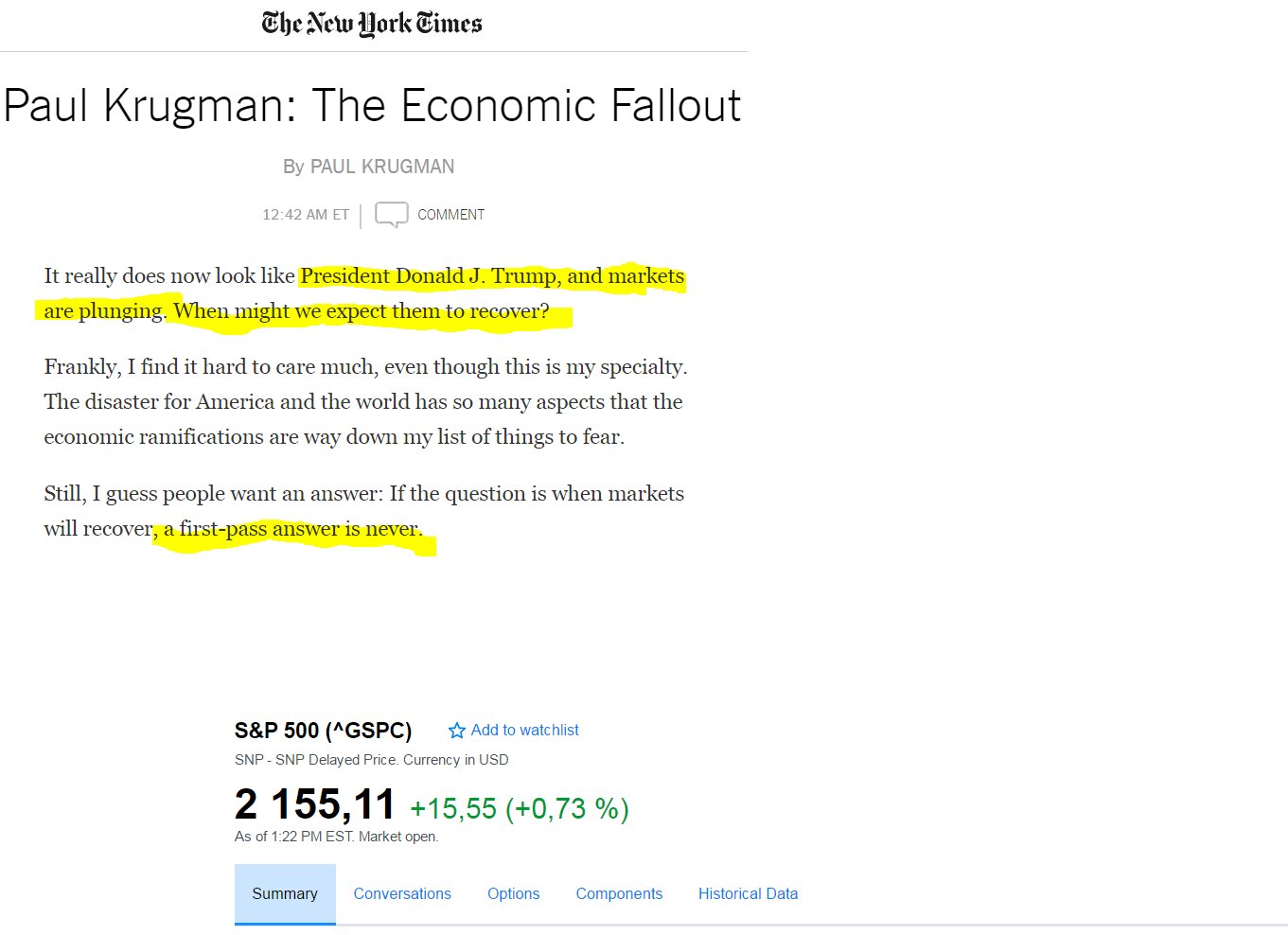
P.P.P.P.S. We also have some unintentional humor. When Trump prevailed, Paul Krugman couldn’t resist making a prediction of economic doom.


Since markets have since climbed to record highs, Krugman’s forecasting ability may be even worse than all the hacks who predicted Brexit would result in economic calamity for the United Kingdom.

Thursday, November 10, 2016

A Startling Election and a Looming Challenge for Advocates of Limited Government

November 9, 2016 by Dan Mitchell @ International Liberty

Wow.

I don’t know what else to say.

Almost all the experts said Trump couldn’t win the GOP nomination. Then the expert consensus was that Trump had virtually no chance of winning the White House.

Now, for better or worse, he’s going to be America’s next President.

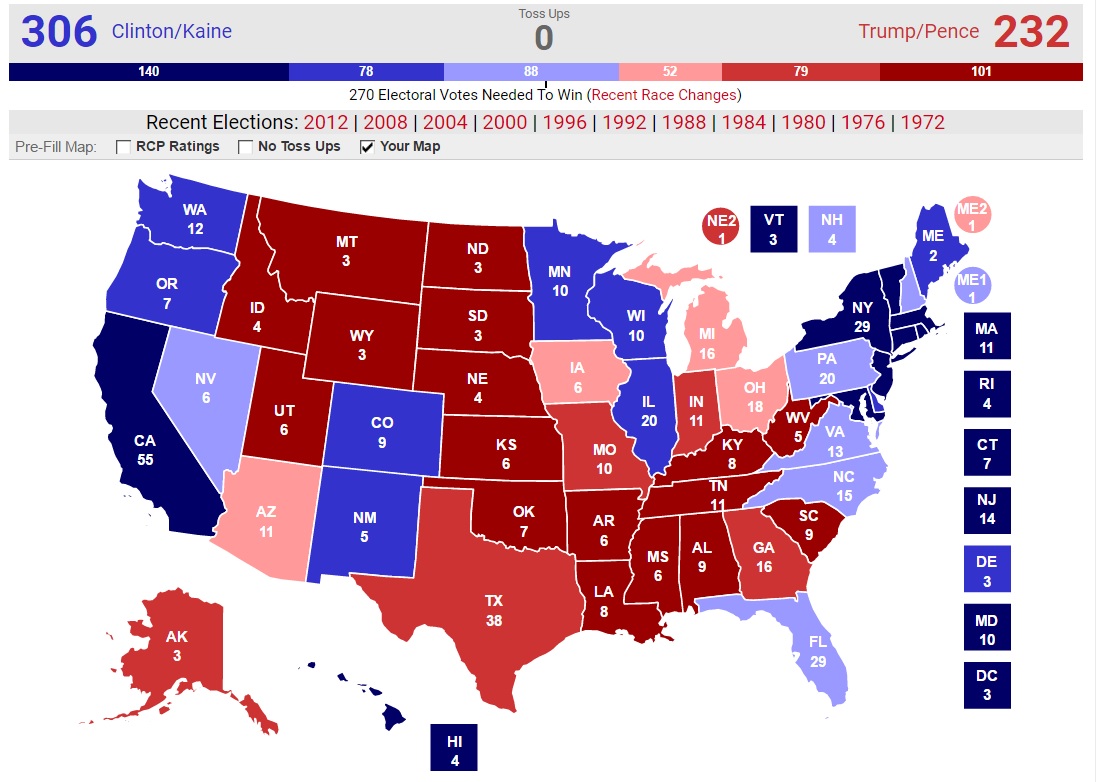
What about my 2016 prediction? Well, other than my guess that Michigan might go for Trump (outcome still not confirmed), I don’t look very prescient. At the very least, I missed Pennsylvania, Florida, Wisconsin, and North Carolina.

For what it’s worth, I did better with Congress. Depending on the outcome of the Senate contest in New Hampshire, my prediction for a 51-49 GOP majority may be spot on (though I generally wasn’t right about the seats that would change hands). But who cares about my prediction. It’s downright remarkable that Republicans held on to the Senate, something that seemed improbable considering that the GOP was defending more than twice as many seats as Democrats.. Moreover, the leading Tea Party-type Senators from the 2010 election – Marco Rubio, Rand Paul, Ron Johnson, and Pat Toomey – were all reelected.

And we may not know the final number for a few days, but my guess that there would be 239 House Republicans also will be very close. Again, the accuracy of my prediction is trivial compared to the fact that the GOP will have lost fewer than 10 seats when they were defending their largest majority in almost 90 years. A stunning outcome.

So what does the election mean? The political answer is that Barack Obama has been a disaster for Democrats. I joked back in 2010 that Libertarians should name him as “Man of the Year” for restoring interest in the ideas of limited Government. Republicans should turn that joke into reality since Obama turned a dominant Democrat Party (majority of senators, representatives, governors, and state legislators) into a hollow shell.

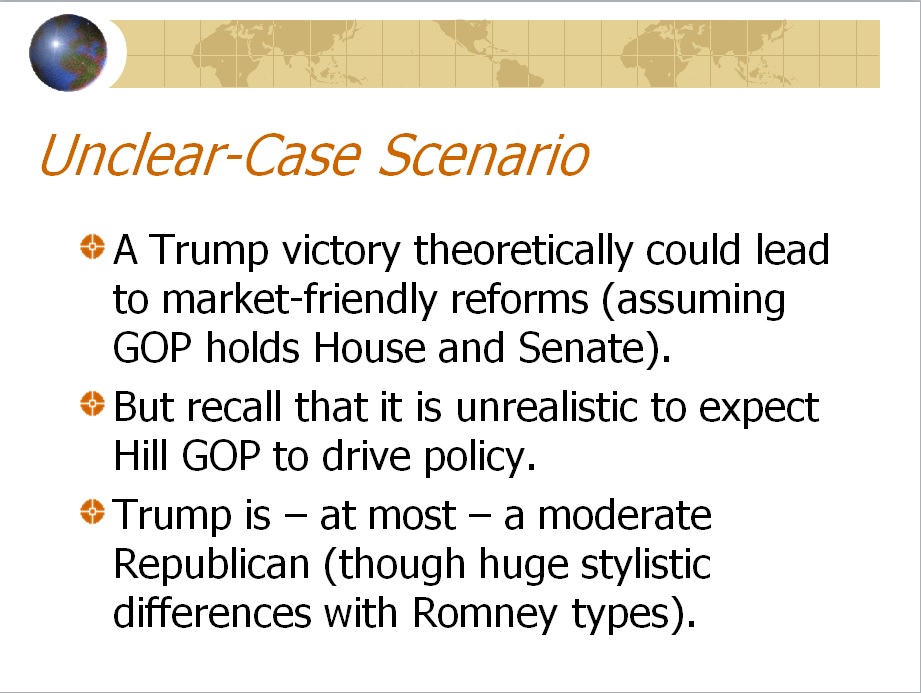
The policy answer is a bit more difficult. I’ve fretted many times that Trump doesn’t believe in economic liberty. Some folks say that doesn’t matter since House and Senate Republicans can drive the agenda. But, as indicated by this slide that I shared in several recent European speeches, I don’t think that’s realistic.
A Republican Congress almost certainly isn’t going to push policies unless they get some sort of positive signal from the White House (remember how the Bush years led to lots of statism, notwithstanding a supposedly conservative House and Senate).

The real mystery is predicting the signal Trump will send. Here’s what I hope for – and what I’m afraid of – in the next four years.

My fantasy outcome – Given his disappointing rhetoric, it’s highly unlikely that Trump will embrace comprehensive entitlement reform. It’s especially doubtful that he will touch the programs (Social Security and Medicare) that provide benefits to seniors. But it’s plausible to think he might be open to reforming the “means-tested” programs. Even if he simply decided to support the block-granting of Medicaid, that would be a big achievement. And repealing Obamacare would be great as well. He did propose a rather attractive tax plan as part of his campaign, though I didn’t get too excited since a large tax cut seemed unrealistic in the absence of a concomitant plan to limit the growth of spending. But if Trump can get one or two of the big provisions approved, most notably a lower corporate rate and death tax repeal, that would be a very positive step in the right direction. And if he actually gets serious about the “Penny Plan,” that would give him a lot more leeway for big tax cuts. Needless to say, I also hope  his protectionist campaign rhetoric doesn’t translate into actual proposals for higher taxes on trade.
My feared outcome – In his acceptance speech, Trump focused on two policies. More infrastructure spending and helping veterans. This is not a good sign. Regarding infrastructure, my nightmare scenario is that he pushes a giant stimulus-type scheme that would increase the federal government’s role in transportation. On the issue of veterans. I’m not aware of any specific plans, but my fear is that he will simply throw more money at the failed VA system. Let’s also not forget he has endorsed a higher capital gains tax on “carried interest.” And if he does decide to push protectionist legislation, that could wreak a lot of havoc. In the long run, I’m also worried that Trump will commit a “sin of omission” by leaving entitlements untouched. And if we wait another four – or eight – years to address the problem, the slow-motion train wreck may turn into an about-to-happen train wreck. Last but not least, what if Trump gets to the White House and feels that all his big plans for tax cuts and new spending aren’t feasible because the numbers don’t add up? Will he then decide that he needs a big revenue plug like a value-added tax? Sounds crazy, right, but don’t forget that Rand Paul and Ted Cruz were seduced into adding VATs to their plans, so why wouldn’t Trump be susceptible to the same mistake? A horrifying, but not implausible, scenario.
 
Now perhaps you understand why, in yesterday’s column, I focused on the potential silver lining of a Hillary victory. It’s because I don’t like to dwell on the potential downside of a Trump victory.

Let’s close with a quick review of the major ballot initiatives I highlighted last month.
  • The Good – The biggest slam-dunk of the night was the overwhelming 80-20 rejection of single-payer health care in Colorado. Voters in the state also rejected a tax hike on tobacco. A pro-gun control initiative in Maine is narrowly failing. In other news, a sales tax increase was defeated in Oklahoma, as was the gross receipts tax in Oregon and the carbon tax in Washington. Also, lots of state legalized pot (although voting to tax it as well).
  • The bad – Voters appear to have approved class-warfare tax hikes in Maine and California. Maine voters also hiked the minimum wage, as did voters in Colorado, and California voters approved higher cigarette taxes. Soda taxes were approved in a handful of locations.
  • The ugly – The defeat of charter school expansion in Massachusetts is a crippling blow to the hopes of poor families for a better education.
As you can see, a mixed bag. Some good results, but also some bad choices.

But this is why I like federalism. States can innovate and experiment, constrained by the fact that really crazy policies will eventually lead to California-style decline. And I’d rather have a couple of states in a death spiral rather than the entire nation.