Search This Blog

De Omnibus Dubitandum - Lux Veritas

Showing posts with label Central Planning. Show all posts

Monday, July 15, 2024

America’s Shrinking Farmland Threatens Food Security

Solar panel fields have been reclassified as farms. 

ByJul 13, 2024 @ Liberty Nation News, Tags: Articles, Climate Change, Opinion

Around the world, farmland is being converted to residential and industrial uses as farms consolidate, urban populations strain land resources, and narrow profit margins discourage would-be farmers. This shrinkage of agricultural acreage has been underway in America and Western Europe for a century. Climate change policies under the Biden administration have flushed renewable manufacturing industries with a trillion dollars in taxpayer funds, stimulating land price inflation, rewarding a handful of “stakeholders,” and pummeling local farms. The nation’s future food security is endangered.

Indiana’s Farmland Shrinkage

A study commissioned by the Indiana legislature in 2023 determined the state had lost 345,682 acres of farmland from 2010 to 2022. The detailed analysis states: “The results show that agricultural land was most likely to be lost in areas around the edges of cities and suburban areas.” The legislature notes in its recommendations:

“Consider what is an alarming level of lost farmland acres as it pertains to food security. When should a county, state or the country be concerned? Task the legislature to consider the threshold in which the lost number of acres significantly reduces access to food.”

Addressing the 2022 US Census of Agriculture data showing the nation’s farmland had shrunk by 2% since 2017, and the number of farmers had declined 7%, USDA Secretary Tom Vilsack recently expressed this ominous query: “Are we okay with losing that much farmland or is there a better way?”

Finding a ‘Better Way’

There is, of course, a better way – but farmers and local food production are eclipsed in Washington by corporate lobbyists, animal rights activists, climate cultists, conservationists, and environmentalists. The Biden administration has increased endangered species regulations that requires 30% of all American land be preserved as wild and launched a massive spending spree on renewable energy manufacturing. All that competes for space with prime farmland across the nation.

Indiana’s investigation reports that overall agricultural productivity for the state increased over the same period, likely attributable to advances in GMO (genetically modified organisms) technologies in corn and soy crops. However, 39% of the nation is currently farmland. If social justice ideologues attack cows as destructive to the climate, vegans condemn omnivores as barbarians, factories and swimming pools replace pastures, vast areas are eminently domained into “rewilding,” and solar panel arrays eclipse renewable grass blades, where exactly will the nation’s food be produced?

Perhaps yet more gleaming factories will be constructed on once-productive farmland to grow synthetic meats from calf fetuses in stainless-steel tanks or house billions of roaches, worms, or spiders for processing into bug-burgers. That is the globalist way.

Greenhouse gases and alleged climate change have been leveraged to wage war on farmers and rural Americans for a quick gorging at the government’s pig trough. These same policies would afford nearly limitless power to national or globalist authorities to dominate what humanity eats, drinks, drives, and thinks. The world is told that not only cows and land but also the entire food chain must be taken over to stave off global warming!

The foundation of liberty has always been local food supplies, which are now rapidly consolidated and regulated. As American novelist and poet Wendell Berry cautioned, “Small-scale, diverse farms are the best defense against a dangerous concentration of power.”

The power is concentrating, and it aspires to control food. Farmland isn’t just for Bill Gates and Mark Zuckerberg anymore. As the number of American-owned family farms declines, foreign ownership of US farmland has escalated. A USDA Farm Service Agency Report of foreign land holdings through December 31, 2020, reflected this accelerating trend:

“Foreign persons held an interest in nearly 37.6 million acres of U.S. agricultural land as of December 31, 2020. This is 2.9 percent of all privately held agricultural land and 1.7 percent of all land in the United States … This is an increase of over 2.4 million acres from the December 31, 2019 report.

Farming Solar Panels in Lieu of Food

Ironically, the Indiana study included solar panel arrays as farmland in its calculations: “Agriculture officials relied on data from the state Department of Local Government Finance [DLGF] and the U.S. Department of Agriculture to create its findings. The report stated that the DLGF includes uses like renewable energy in its counting for farmland.” This is par for the fraudulent renewables course. The Department of Energy boasts:

“Since President Biden took office, across the nation, companies have announced more than 500 planned investments in at least 450 new or expanded clean energy manufacturing facilities totaling over $160 billion in announced private and public sector investments into solar; electric vehicle assembly, components, and chargers; battery; and offshore wind manufacturing.”

Donald Trump was widely mocked for references to “clean coal.” Yet, clean energy manufacturing facilities for solar, EV components, batteries, and wind turbines all generate massive amounts of toxic chemical pollution, including innumerable “forever chemicals.”

These allegedly climate-saving factories and the suburban sprawl they seed eat up farmland, sparing the landscape the supposed scourge of grazing cows but intruding ever more between consumers and the soil microbiome that sustains them.

 
Read More From John Klar

Thursday, June 27, 2024

Europe’s Economic Woes: Right Description, Wrong Prescription

June 15, 2024 by Dan Mitchell @ International Liberty

Economic freedom has been declining in the United States in recent decades. But it’s also been declining in Western Europe over the same period.


It’s almost as if politicians on both sides of the Atlantic are having a race to see who can do the most damage to prosperity.

Perhaps because they started with more statism, it appears that European politicians are winning. Which means that the European people are losing.

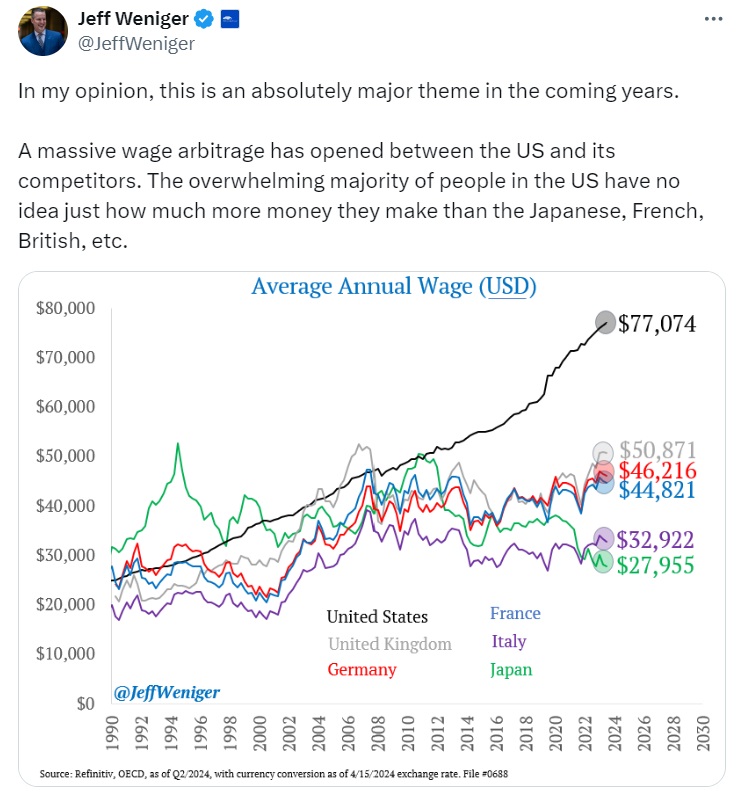
Two months ago, I wrote about the widening gulf between the United States and Europe and shared a chart about a growing wage gap between the U.S. and other major nations.

And that builds upon the two columns I wrote in 2023 (here and here) and the three columns I wrote in 2022 (here, here, and here), all of which show America out-performing Europe.

Today, let’s revisit the issue.

Here are some excerpts from a Washington Post column by Fareed Zakaria. Here’s his comparison of the U.S. and Europe.


In Europe, the talk is all about how Europe has been unable to keep up with the U.S. powerhouse. …In 2008, the United States and the euro-zone economies were roughly the same size. Today, the American economy is nearly twice the size of the euro zone. And it’s not just one measure. Average European income is now 27 percent lower than in the United States, and average wages are 37 percent lower. …The U.S. economy towers above Europe’s these days. The United States’ technology companies dominate the continent.

U.S. banks are far more profitable than European ones. U.S. energy production has created a boom in manufacturing which is luring many European companies to the United States. As one German CEO said to me. “America is an easier place to do business, has fewer regulations, and now has much lower energy costs. How do I rationally invest in Europe?” ……every year 300 billion euros is diverted to overseas markets to find superior investments, most of them in the United States.

I think it’s a gross overstatement for him to call the United States a powerhouse. After all, inflation-adjusted wages and household income numbers in America have been quite dismal.

But Zakaria is correct to say that Europe is in much worse shape.

Where he goes astray is in his proposed solution. He thinks more centralized power in Brussels (the headquarters of the European Union) is the key to faster growth.

The solution to Europe’s woes can be summarized in one line — a deeper, more united, more strategic Europe. But that solution means, inevitably, more power to the European Union.

This is completely backwards. Europe needs more federalism and jurisdictional competition, not more centralization and harmonization.

To be fair, there are plenty of good things about the European Union, particularly the goal of free trade among the member nations.

But the E.U. also is a major source of bad policy, such as carbon protectionism and tax harmonization.

The bottom line is that more power for Brussels means expanding the cost of supranational government in Europe while doing nothing to fix the primary problem of bad policy by national governments.

Tuesday, April 2, 2024

Government Project: The Eternal Folly of Central Planning

Mark Pulliam April 1, 2024 @ American Institute for Economic Research

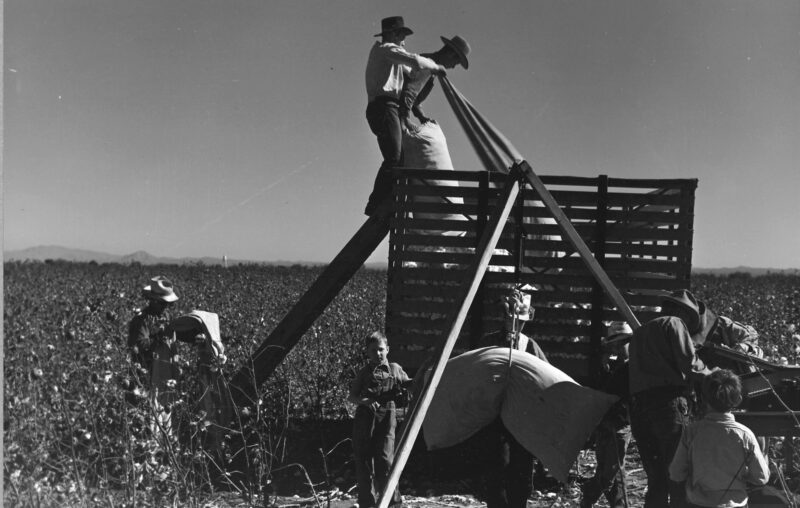
Members of the Casa Grande cooperative farm pick cotton near Coolidge, Arizona, November, 1940. Department of Agriculture.

The American Enterprise Institute has reprinted Edward C. Banfield’s little-known 1951 book, Government Project, which was a post-mortem of a defunct, quasi-socialist New Deal-era agricultural project in drought-prone Pinal County, Arizona. The Foreword to the 2024 edition, written by Kevin Kosar, spouse of Banfield’s eldest granddaughter, asks, “Why would [the AEI] republish a 1951 book about a failed New Deal experiment that has been out of print for decades?” This is a good question, to which there are several answers.

First, Banfield (who died in 1999) was a pioneering political scientist and longtime Harvard faculty member who was, according to Charles Kesler, the editor of Claremont Review of Books, “one of the greatest social scientists of the twentieth century.” Banfield’s best-known book, the 1970 bestseller The Unheavenly City, was an influential — and contrarian — examination of America’s “urban crisis.” His blunt indictment of lower-class culture as the root of most urban ills was controversial and led to campus protests and undeserved pariah status in academia.

Second, Government Project, based on Banfield’s PhD dissertation at the University of Chicago, is an equally insightful analysis of the Casa Grande Valley Farms cooperative, which was created by the Farm Security Administration (FSA) in 1938 at the height of the Great Depression to provide economic security to distressed tenant farmers and migrant farm workers — many of them “Okies” displaced by the Dust Bowl. Banfield’s careful case study of the Casa Grande project, based on his review of the detailed government records (including extensive interviews with the participants) and his own experience as a “public information officer” for the FSA, is a sobering critique of government planning and social engineering.

Third, the original Foreword by Rexford Tugwell (nicknamed “Rex the Red” by his detractors due to his utopian infatuation with Soviet-style schemes), a member of FDR’s “Brain Trust” and the architect of FSA’s predecessor agency, the Resettlement Administration, is alone worth the modest cost of the book as an exercise in bureaucratic hubris. Tugwell lauds Government Project as “the full case history” of Casa Grande, and acknowledges that “We can see in it many lessons if we will” — while conveniently shifting the blame for the fiasco to others.

Finally, Banfield had a long association with AEI, dating back to 1963 (when Milton Friedman served on AEI’s advisory board), and one of Banfield’s students at Harvard, Christopher DeMuth, was AEI’s president from 1986 to 2008. For all these reasons, Banfield, now largely forgotten, deserves to be remembered, as do the lessons of Casa Grande.

What was Casa Grande and why did it fail? The FSA was a New Deal relief program that sought to provide employment and housing — and, ultimately, economic self-sufficiency — to destitute farm laborers such as sharecroppers and itinerant cotton-pickers then living in squalid shacks. Sixty families were selected to live in newly constructed brick homes featuring modern amenities such as electricity, indoor plumbing, flush toilets, water heaters, refrigerators, gas ranges, and washing machines. At great expense (more than $1 million in 1938 dollars), the federal government (via the WPA) built the homes, acquired 3,600 acres of farmland, and provided the necessary agricultural infrastructure (wells, irrigation ditches, roads, fences, outbuildings, and the like).

Unlike the earlier — but equally disastrous — Matanuska Colony Project in what is now Palmer, Alaska, Casa Grande did not rely on a model of individual homesteads of 40 acres for the participants to clear and farm; it was to be a “collective” farm on an industrial scale, permitting efficient mechanization and more scientific agricultural techniques, such as crop rotation. Small farms in the Arizona desert were deemed to be economically untenable. Accordingly, the 60 settlers chosen to participate would own the farm on a communal basis, responsible for cooperatively operating the farm profitably and reimbursing the federal government for its substantial up-front investment. Eventually, the Casa Grande settlers would repay their debt to the FSA, share the profits, and build equity as owners. Casa Grande — an untested experiment in quasi-socialist agriculture — was to be the largest cooperative farm ever established in the United States.

The problems with this model were — or should have been — obvious. The Casa Grande farm was a complex enterprise, dependent on irrigation, with multiple crops (cotton, alfalfa, grain), livestock (cattle, hogs, sheep), dairy, and poultry, and a complement of horses, mules, tractors, hay balers, and other equipment. The settlers, some of whom had limited (or no) farming experience, were ill-equipped to manage such a complicated operation on their own. To protect its investment, the federal government appointed an experienced farm manager to oversee operations. The farm would not immediately turn a profit, so the settlers were initially paid a nominal monthly stipend. From the beginning, this arrangement generated conflict.

The settlers, who viewed themselves as “owners” (albeit communally) resented the FSA’s management despite their own lack of experience as independent farmers. The settlers’ duties were strictly structured by the FSA foreman. Because of the FSA’s operational supervision and their modest monthly remuneration, the settlers behaved as hired hands, often threatening to strike — against their own cooperative! — if they didn’t get their way. “Sharing” the workload led to disputes over perceptions regarding the settlers’ differing roles and levels of effort. Needless to say, the operational arrangement was contrary to the ostensible goal of cooperative self-governance, which frustrated and confused the poorly educated and inexperienced settlers.

The Casa Grande participants, few of whom were native Arizonans, were haphazardly chosen from widely disparate backgrounds, in terms of age, education, family composition, religious beliefs, life experience, and other characteristics. The only trait they shared was destitution. Any random assortment of humans will include moochers, loafers, troublemakers, and complainers, and the quarrelsome Casa Grande settlers were no exception. With time on their hands (thanks to the mechanized farm operations), the settlers quickly divided into competing cliques and factions. Internal governance amidst these differences degenerated into petty feuds, incessant bickering, jealousy, resentment, and recrimination. The “cooperative” was wracked with discord.

Naïve FSA managers were dismayed that the independent-minded settlers did not adapt to communal life; “economic democracy” was, after all, the ultimate goal of establishing a cooperative farm. To the New Deal architects of Casa Grande, enlightened communal living was a moral imperative. Alas, no amount of tinkering and prodding by the FSA’s social engineers was able to turn Casa Grande into a kibbutz. Adding to the tension, neighboring communities viewed the WPA-built collective farm with distrust and suspicion, nicknaming the project “Little Russia.”

Despite the cajolery of FSA social workers, in 1943 the fractious (and short-sighted) settlers insisted by a two-thirds vote on liquidating Casa Grande — after it became profitable! — squandering their equity on legal fees, and walking away with next to nothing. Most returned to destitution and squalor as migrant farm workers, leaving the federal government $100,000 in the hole (in 1946 dollars).

The lessons? Americans do not readily embrace government-imposed collectivization. “Community,” in the Tocquevillian sense — voluntary associations which comprise the fabric of civil society — cannot be manufactured or externally imposed; civic cooperation must be organic Good intentions are not enough. In a free society, dealings among citizens are based on “private ordering”: consensual free-market transactions based on perceived individual self-interest. Property rights demarcate separate economic interests. The potential for personal financial success provides incentives for hard work and self-discipline. All these elements were absent in a government-planned “cooperative” with federal supervision and competing factions among the randomly-chosen participants — all of whom were strangers before being thrust into an unfamiliar communal society.

Original foreword author Tugwell was an FDR confidante who helped create, and then led, the Agricultural Adjustment Administration that was declared unconstitutional in 1936, when he’d moved on to be Administrator of the Resettlement Administration. A champion of central planning in industry, housing, and agriculture, Tugwell believed that government bureaucrats could “fix” social problems by moving poor people into utopian planned communities. Despite the manifest failures of the numerous New Deal programs that he designed and oversaw, he steadfastly refused to accept any blame. In his 1951 Foreword, Tugwell conceded that Casa Grande was a “noble failure,” not because “the conception was bad,” but because “the people there could not rise to the challenge.”

Tugwell disingenuously condemned the “character” of the “unfortunate” settlers, who succumbed to “a general sickness which was at work,”including “deplorable exhibitions of selfishness” and “maleficent” opposition to cooperation by “very powerful forces” opposed to FDR. Despite the best efforts of the federal planners, he lamented, “We are far from being fundamentally accustomed to the projections necessary to finding our duty and doing it in modern society” (emphasis added). In other words, Americans were to blame for refusing to adapt to Soviet-style communal farming!

Casa Grande was one of four cooperative farm projects sponsored by the FSA. Believe it or not, it was the most successful. The others, also torn by factionalism, fared far worse. Government Project is a powerful lesson — in economics and human nature: Socialism doesn’t work.

Postscript: The difference between then and now is that Congress recognized the failure of resettlement projects and cooperatives, and in 1943 cut off their funding. Today, such self-restraint is entirely absent.

Mark Pulliam

Mark Pulliam is an attorney and commentator living in Austin, Texas. He is a graduate of the University of Texas School of Law. Mark is a contributing editor to Law and Liberty, and his writing has appeared in the Wall Street Journal, City Journal, National Review, and many other publications.  Get notified of new articles from Mark Pulliam and AIER. SUBSCRIBE

Tuesday, March 7, 2023

15-Minute Cities – Socialism on Steroids

City planning or planned control? What could possibly go wrong?  

Leesa K. Donner March 06, 2023 @ Liberty Nation News

COVID may be waning, but the ease with which government authorities were able to control citizens’ movements during the height of the pandemic has breathed new life into old utopian concepts. One such construct gaining traction is 15-minute cities, which appear harmless on the surface. But tyrants being what they are, liberty-minded people are more than a bit concerned about this rapidly growing movement.

What are 15-minute Cities?

City planners suggest society should be rearranged so life’s necessities lie within a 15-minute radius of a person’s home. This is not a new concept. At the turn of the 20th century, hundreds of “company towns” existed. They sprang up as jobs became available during the industrial revolution. Places like Clairton and Braddock, PA (of John Fetterman fame) were the norm rather than the exception. In the case of Western Pennsylvania, these were known as steel towns. These small municipalities had everything a resident could want. There was the town bank, the clothing store, and the local doctor and pharmacist. Folks walked to Main Street to get a loaf of fresh bread or an ice cream cone from the soda fountain in the drugstore. Sounds idyllic, right?

But then the steel mills went silent, and these small localities went to rack and ruin. The same happened in North Carolina when the textile mills shut down. These 15-minute cities became ghost towns – many of which remain to this day.

Now governments want to get involved and artificially create such living spaces. Science publication PHYS.ORG defined the movement by saying, “The concept, which originated from the French-Colombian urbanist Carlos Moreno, is the current zeitgeist in planning and calls for city design centered on people and their needs rather than being designed for cars.”

So, What’s the Problem?

Why would anyone be against getting rid of the long commute and working from home? Who could object to strolling down to the village to buy fresh fruits and vegetables from local farms? Well, the issue lies with a matter called freedom of choice. To make the 15-minute city work, everyone must participate. Thus, local governments are in the business of limiting when people are permitted to drive their cars giving authorities the right to monitor citizen movement.

In the UK, residents in Oxford went bat guano when local authorities introduced new traffic filters, including automatic license plate readers. The purpose of the filters is to “fine drivers from outside the county of Oxfordshire who entered central areas during high-traffic periods,” according to Bloomberg, which also noted, “Oxford residents will be allowed fine-free peak-hour access for 100 days per year, with residents of the wider county able to apply for a 25-day fine-free access permit.”

How generous of them. Those rules are for the proletariat – party members get free driving access. That’s a little hyperbole and sarcasm, but is it? The people of Oxford were so incensed that 2,000 demonstrators took to the street to protest their lack of mobility, and five people were arrested.

Fear Not, Conspiracy Theorists!

If your interest in discovering more about this new “pedestrian and climate change friendly” movement is piqued by this article, take a moment to hit your favorite search engine and explore the topic of 15-minute cities. You will likely read story after story of the “crazy conspiracy theorists” anxious and needlessly worried about 15-minute city planning. After all, it’s only a traffic reduction scheme, right?

Moreover, what you will discover is a massive media campaign being waged against those who find this move to promote “planet-saving” community ghettos abhorrent to their liberty – Don’t forget, it’s better for your health, too! Those who believe this might be personally intrusive are being labeled “far-right conspiracy theorists,” “paranoid” and “fringe.” One can already see the day when speaking against 15-minute cities will be banned from social media due to “violating community standards.”

European cities are at the vanguard of this movement in Copenhagen, Amsterdam, and Oslo. Meanwhile, plans for a 20-minute city in Detroit, MI, are underway, and a similar program known as the Complete Neighborhood concept is in place in Portland, OR. Our neighbors to the north also initiated a 15-minute cities program in Ottawa. “To achieve its ambition, the city is aiming to have residents make significantly more than 50 per cent of their trips by foot, bicycle, public transit or by carpooling,” according to a senior city planner quoted by the CBC. One wonders how Canadians will feel about such travel alternatives when it’s 15 below and snowing.

Limiting travel has always been the hallmark of communism, and it doesn’t take a conspiracy theorist to recognize the pitfalls of traveling down the 15-minute cities highway. It is, after all, a road paved with good intentions, but most of us already know where that road ends.

Read More From Leesa K. Donner

Wednesday, November 30, 2022

Dreaming of America's Future

After the indecisive midterm election, it is time for everyone to be doing thumbsucker pieces. Former President Trump had a couple of thinkers over to Mar-a-Lago -- Ye West and Nick Fuentes -- for a chat. Nick Fuentes? But he's a faaar-right conspiracy theorist last seen at Charlottesville! OMG! You should see the outrage on lefty Twitter. Roger Kimball is more worried about "Highways to Utopia" such as the destructive dynamism of the Marxists and Wokists, the possibilities of technological Armageddon, and the ever-present threat of genetic engineering.  Yep, with all that stuff, there's no doubt it's the end of the world -- particularly when a far-right conspiracy theorist gets into range of Trump.

But my imagination sees three things that are going to affect traffic in the near to middle-distant future...............To Read More..


Monday, October 31, 2022

Michael Walsh Explains the World Economic Forum’s Vision for the “Great Reset”: Live in a Box, Don’t Move, Be Surveilled, Shut Up, Eat Bugs

Michael Walsh, author of Against the Great Reset: Eighteen Theses Contra the New World Order, noted on Wednesday’s edition of SiriusXM’s Breitbart News Daily with host Alex Marlow that the World Economic Forum’s [WEF] Great Reset program seeks to reduce the human population while restricting freedoms under the auspices of what the leftist organization describes as “climate change” and “public health” pursuits.

Walsh recalled how the WEF’s Great Reset operation was widely dismissed by leftists as a “conspiracy theory,” despite the WEF regularly promoting its Malthusian vision on its website, at its hosted discussion panels, and on its podcast titled The Great Reset. “[The Great Reset] is a conspiracy that’s actually on the website of the people who are conspiring,” Walsh remarked. He described the WEF as “a consortium of plutocrats, fascists, and governmental apparatchiks.”.........To Read More....

Industrial Policy on Parade

Veronique de RugyVeronique de Rugy  – October 23, 2022 @ American Institute for Economic Research

It’s no longer news that industrial policy is making a comeback. Too bad, that. In the zombie parade of bad policies that the left and the new right are now staging, this one is particularly baffling. Industrial policy has been tried on large scales – think the Soviet Union – and on smaller scales, including in the US and many other countries.

The fact that past industrial policy attempts were abandoned due to grotesque failure to achieve their goals seems to make no difference to those who are intent on reviving this practice. Indeed, we need not look as far back as the 1980s for evidence of the folly of trusting government to guide industrial development; we have a contemporary example. And this example is detailed by none other than the New York Times, which recently reported that, after years and billions of dollars, California’s effort to build a high-speed train has been a disaster.  A tidbit:

Now, as the nation embarks on a historic, $1 trillion infrastructure building spree, the tortured effort to build the country’s first high-speed rail system is a case study in how ambitious public works projects can become perilously encumbered by political compromise, unrealistic cost estimates, flawed engineering and a determination to persist on projects that have become, like the crippled financial institutions of 2008, too big to fail.

This effort qualifies as industrial policy because the government claims to know better than private markets what is the best means of transportation and worth high-jacking resources to produce bureaucrats’ preferred outcome. But as usual, government officials – spending other people’s money – miss the obvious.

There’s a reason why trains in the U.S. trains are far less popular than planes. There’s a reason why travel by rail make more sense in small countries, and along the densely populated northeastern coast of the U.S. But politicians and intellectuals, enamored of the notion that trains are more friendly to the planet than are planes, ignore these realities in pushing for an industrial outcome that will likely never be profitable. For a walk down failed-rail-project memory lane see this piece by Phil Klein.

Building a high-speed rail connecting Los Angeles and San Francisco was always going to be challenging due to California’s geography. And of course, most of you will not be surprised to learn that this large-scale government project is in fact failing, in large part because of the perverse incentives that pervade such a government project. From conception to planning to building, the incentives consistently encourage waste and error. Again, legislators aren’t funding this boondoggle with their own money. Nor will they be personally accountable for cost overruns, failure to deliver, or what are certain to be many technical problems.

The cost overruns here are almost comical for something that literally hasn’t been built yet. In 2008, the train’s cost was projected to be $33 billion. Fourteen years later the final plan is projected to cost $113 billion – a mere 242 percent more than the sum used to peddle the scheme to the general public.

In addition, decisions on construction are unduly – but not unsurprisingly – influenced by special interests rather than by good economic sense. As the Times writes: “political deals created serious obstacles in the project from the beginning.” Here’s more:

A review of hundreds of pages of documents, engineering reports, meeting transcripts and interviews with dozens of key political leaders show that the detour through the Mojave Desert was part of a string of decisions that, in hindsight, have seriously impeded the state’s ability to deliver on its promise to create a new way of transporting people in an era of climate change.

As if the project wasn’t difficult enough to deliver on, legislators decided to create costly detours to serve political friends:

Political compromises, the records show, produced difficult and costly routes through the state’s farm belt. They routed the train across a geologically complex mountain pass in the Bay Area. And they dictated that construction would begin in the center of the state, in the agricultural heartland, not at either of the urban ends where tens of millions of potential riders live….

Mike Antonovich, a powerful member of the Los Angeles County Board of Supervisors, was among those who argued that the train could get more riders if it diverted through the growing desert communities of Lancaster and Palmdale in his district, north of Los Angeles.

Even the SNCF engineers from France who came to work on the project eventually gave up:

There were so many things that went wrong,” Mr. McNamara said. “SNCF was very angry. They told the state they were leaving for North Africa, which was less politically dysfunctional. They went to Morocco and helped them build a rail system.

Morocco’s bullet train has been in service since 2018.

The report is worth reading in its entirety. It is the most ridiculous and clichéd story of why industrial policy fails. Such projects are often taken over by special interest groups (remember Alaska’s bridge to nowhere) that bloat the cost, and in extreme cases lead the project to failure.

This experience is commonplace. My colleague Jack Salmon told me about the plans for HS2, a high-speed rail project in the U.K., that started in 2009 to link London to Birmingham, Manchester, and Leeds. The high-speed train was promised to reduce the time of the journey by 30 minutes. Salmon sent me the following information:

The first stage was predicted to be completed by 2020, and with a further connection to Scotland operating by 2030. In 2010, the new conservative-led coalition amended 50% of the planned route after rural conservative MPs made a fuss about noise pollution and property values. At the time, the cost was estimated at about £30 billion. In 2013, the cost of the project was revised up to £50 billion. In 2014, the cost was revised to £57 billion. By 2019, the Oakervee review estimated that the projected cost, in 2019 prices, had increased to £88 billion. Lord Berkley, deputy chair of the review, said that these estimates were very optimistic and could actually be as high as £170 billion. The route is now estimated to be completed by 2045, although this will likely be pushed back. By that time, this £30 billion gravy train could end up costing £1 trillion.

That’s the problem with industrial policy, and such gravy train projects. Politicians can’t help themselves and these projects are always highjacked by special interests.


Veronique de Rugy

Veronique de Rugy

Veronique de Rugy is a former writer with AIER. She is a Senior Research Fellow at the Mercatus Center at George Mason University and a nationally syndicated columnist.

Her primary research interests include the US economy, the federal budget, homeland security, taxation, tax competition, and financial privacy.

She received her MA in economics from the Paris Dauphine University and her PhD in economics from the Pantheon-Sorbonne University.

Follow her on Twitter @veroderugy

Get notified of new articles from Veronique de Rugy and AIER.


Wednesday, July 13, 2022

Federalism Is The Key To Demonstrating The Disaster Of Green Central Planning

July 11, 2022 @ Manhattan Contrarian

Central planning always fails, but the utopian visionaries implementing the plans cannot admit that they are at fault. A scapegoat must be found. As a leading example, when Soviet dictator Josef Stalin’s collectivization of agriculture led to mass starvation, the official blame was placed on “saboteurs” and “wreckers.”

Our current-day analog is the centrally-planned replacement of our very large, inexpensive and highly functional energy system, mostly based on fossil fuels, with the alternatives of intermittent wind and sun-based generation, as favored by incompetent government regulators who don’t understand how these things work or how much they will cost. Prices of energy to the consumer — from electricity to gasoline — are soaring; and reliability of supply is widely threatened.

All of which brings our President forth to blame the current price and supply issues in the energy markets on anything but his own administration’s intentional efforts to suppress the functional fossil fuel energy. One day the scapegoat is Vladimir Putin; another it is “companies running gas stations,” who stand accused of price gouging.

Unfortunately, a wide swath of the electorate is only too ready to believe that the failure of central planning is correctly blamed on the saboteurs or the wreckers or the price gougers or the Rooskies or whoever, rather than on the incompetent central planners. And the central planners can generally maintain their narrative, as long as they can impose their control widely enough to keep their subjects from becoming aware of successful alternatives.

And thus the maintenance of federalism in energy policy is crucial to avoiding the disaster of green energy central planning. And it is why the recent Supreme Court decision of West Virginia v. EPA is so important in the ongoing energy battles. West Virginia v. EPA struck down a centralized federal effort to dictate the structure of the electricity generation system nationwide, on the ground that the Congress had not explicitly authorized such a sweeping exercise of authority by an executive agency.

With federalism in energy policy, we can have New York forging ahead with its “Climate Leadership and Community Protection Act,” and California doing the same with its SB 100 — both of them seeking to eliminate fossil fuels from the generation of electricity, and then to force all energy consumers to use only electricity for their supply. Will that work? If New York and California are successful, they will be a model for the rest of the country to follow. Congratulations will be in order. If they fail relative to other states — that is, if they see energy prices soar, or frequent blackouts or shortages of needed energy — then it will be obvious to all that it was the green energy that failed, and not that there were “saboteurs” or “wreckers” or “price gougers,” who after all could have attacked the other states as well.

The federal bureaucracies will do everything they can to force all the states into a federal energy straightjacket, so that the (inevitable) failures of green energy cannot be blamed on the perpetrators. In Friday’s post I took note of two new federal initiatives, post-West Virginia, to seek national suppression of fossil fuels, one by imposing “ozone” emission limitations in Texas, and the other by declining to conduct offshore leasing auctions.

Yet another such initiative was announced on Thursday July 7: a so-called “Transportation Greenhouse Gas Emissions Reduction Framework” from the Federal Highway Administration. This one takes administrative audacity to a whole new level. Under the proposed rule, states must set declining greenhouse gas emissions targets for highway traffic that must align with the Net-Zero target as directed by the President in two Executive Orders and agreed at the international “Leaders Summit on Climate.” The federal Net Zero targets have not been enacted or authorized by Congress in any way, and exist only by virtue of a press release issued by President Biden on April 22, 2021. In other words, the administration and the FHA are thumbing their noses at the Supreme Court’s West Virginia decision.

Fortunately, the red states are not just going along with this kind of thing any more. This will be a critical battleground over the next five to ten years. I’m betting on victory for the red states, and the cratering of green energy.

Wednesday, June 22, 2022

The Ripples of Government Intervention

Vincent GelosoVincent GelosoJune 21, 2022 @ American Institute for Economic Research


In one of his early works, Ludwig von Mises argued that mixed economies, those that can neither bear the labels of laissez-faire capitalism or socialism, were inherently unstable. His claim was that once a government intervention began, it foiled economic calculation in ways that altered behavior. Once unforeseen consequences of the intervention start revealing themselves, policy-makers must either intervene once more or roll back the policy. In the end, an economy can be free or it can be centrally planned. It cannot be a mixture of both.

This key insight, later extended by Mises himself and refined by scholars such as Sanford Ikeda and Robert Higgs, has become known as the “dynamics of interventionism.” It has become a key element in the literature, emphasizing the necessary conditions for the creation and preservation of a liberal-democratic order (i.e. open political competition combined with a limited state). Simply put, it says that government interventions cause ripples in the economy.

The problem is this body of theory comes up against another, one that is well-accepted in economics: the theory of regulatory capture. While this theory had many early prototypes, its first formal elaboration was produced by George Stigler in the 1970s. It has a deceptively simple point: The creation of regulation itself requires economic calculation. In that view, not only are the regulations desired and understood by economic actors, but the consequences of those regulations are also fully understood. This means that a group asking for a price ceiling is aware that rationing will occur (and that coupons will be issued). The adjustments that people make become permanent and economies need not continue down the path to socialism or be forced to reverse by deregulating. Under that view, there are no ripples.

These views conflict at first glance. In a recent paper with Germain Belzile and Rosolino Candela published in Public Choice, however, we argue that they are actually complementary. The main difference between them is whether the consequences of government interventions have effects that can be fully predicted by regulators. If regulators can predict, then interventions need not debilitate the economy. If not, then unforeseen consequences emerge causing the need for reaction. The ability to predict is largely tied to how bureaucrats and politicians benefit from crafting interventions. As they are not residual claimants to the full profits or losses of their decisions, both are unable (or unincentivized) to access the knowledge necessary to anticipate the long-run consequences of their actions. More importantly, the cost of acquiring knowledge increases the further ahead in time one looks.

The result is that the timing of the unforeseen consequences will vary. Immediate or short-run consequences may well be fully understood, while long-run consequences will not (which begins the process of the dynamics of interventionism).

In the paper, my co-authors and I propose a case study based on the economic history of electricity in Canada. In the early 1900s, the populous province of Ontario began nationalizing its electrical industry. The goal was to provide cheap electricity to manufacturers far-removed from the large city of Toronto and to farmers in rural communities. By 1921, the process was complete. Until the mid-1920s, the government’s policy of providing electricity at below-market prices had the effects understood and desired by politicians, bureaucrats, manufacturers and farmers. They understood that subsidization meant that extra capacity had to be added, and that taxes needed to be raised to finance these additions. What they did not expect, however, was that the demand for electricity was as elastic as it was. The increase in quantity demanded was much greater than expected. Politicians and bureaucrats scrambled for a solution. Rationing was out of the question for political reasons. New generating stations to cover the unexpected surge were too expensive relative to those they had planned. This meant raising taxes, something that was also out of the question for political reasons. The only option left was to build high-voltage transmission lines to the neighboring province of Quebec and import from there.

Quebec, Canada’s second largest province, had a burgeoning (and entirely private) electrical industry, with low costs due to its extensive network of wide and fast-running rivers. Private firms were more than happy to sign contracts for large purchases from the Ontario crown corporation,  as long as they could charge the market price. From 1926 to 1932, the largest utilities in western Quebec (those that bordered Ontario) signed massive provision contracts to the Ontario crown corporation. Between the completion of the first interprovincial high-voltage transmission line in 1928 and 1934, Quebec’s exports of electricity to Ontario went from 4 percent of total output to 19 percent, a sizable increase.

The rub is that the higher demand from Ontario meant higher prices in Quebec markets that were connected to Ontario. My co-authors and I found that the causal effect of being connected to Ontario by high-voltage transmission lines after 1928 was that prices surged from between 13 percent and 21 percent.

These higher prices in Quebec caused a political backlash in the province. Prior to 1928, Quebec had bucked the trend of the rest of North America. Whereas the rest of the subcontinent had been moving toward greater public ownership, most of the few cities in Quebec that had initially opted for public ownership were in the process of privatizing their utilities. After 1928, some cities began to consider greater regulation and outright public ownership. Some large cities reneged on deals they had made with private firms. By 1935, the Quebec Liberal Party (which had been continuously in power since the late 1890s) split in part over the question of nationalizing electrical utilities. In the 1936 election the Liberals opposed nationalization (tepidly at best), and were decimated by the Union Nationale (a merger of the derelict Conservative Party and the liberals who had bolted from the party). The swing against liberal candidates was strongest in constituencies that were connected to Ontario by the high-transmission lines, suggesting that the price increases fueled the nationalization movement. In the late 1930s, extra layers of price regulations were added and, by 1944, the largest electrical utility had been nationalized.

The story here is simple: Nationalization in Ontario from the early 1900s to the 1920s caused regulation and nationalization in Quebec during the 1930s and 1940s. The dynamics of interventionism at play!

No Ontario bureaucrat could have anticipated such a policy development in the neighboring province when nationalization was completed. Yes, they anticipated some of the effects of intervention – the short-run ones. However, the failure to anticipate the long-run consequences meant that some bureaucrats and politicians (not those in Ontario) were forced to add some extra layer of government interventions decades later to deal with the consequences of earlier rounds of intervention.

This example is not banal. It is crucially important. It means that, when someone says “what could go wrong” after proposing a policy intervention, the reply should be “a lot that we will only comprehend many years from now.” The damaging ripples of government intervention may be very far in the future – it does not mean they do not exist.

Vincent Geloso

Vincent Geloso, senior fellow at AIER, is an assistant professor of economics at King’s University College. He obtained a PhD in Economic History from the London School of Economics.

Get notified of new articles from Vincent Geloso and AIER.


Friday, September 24, 2021

Economic Backsliding by China, Part II

September 23, 2021 by Dan Mitchell @ International Liberty

Two years ago, I wrote that China needed to choose between “Statism and Stagnation or Reform and Prosperity.”  Sadly, as I noted last month in Part I of this series, it seems that President Xi is opting for the former.


Which is unfortunate since China needs a lot more growth to get anywhere near U.S. levels of prosperity.  Yet that’s not very likely when the United States is ranked #6 and China is ranked #116 for economic liberty.  For what it’s worth, China’s score is likely to drop in future years rather than rise, and I’m certainly not the only one to notice that China has economic problems.

Writing for the Atlantic, David Frum looks at the country’s shaky economic outlook.


China’s economic, financial, technological, and military strength is hugely exaggerated by crude and inaccurate statistics. Meanwhile, U.S. advantages are persistently underestimated. The claim that China will “overtake” the U.S. in any meaningful way is polemical and wrong… China misallocates capital on a massive scale. More than a fifth of China’s housing stock is empty—the detritus of a frenzied construction boom that built too many apartments in the wrong places. China overcapitalizes at home because Chinese investors are prohibited from doing what they most want to do: get their money out of China. …More than one-third of the richest Chinese would emigrate if they could, according to research by one of the country’s leading wealth-management firms.

David mentioned “inaccurate statistics,” which is a big problem in China.  But I also worry about bubble statistics, which is an issue the Wall Street Journal editorialized about earlier this year.


…credit has exploded, with total public and private debt expected to exceed 270% of GDP in 2020, up 30 points in one year. Most of that has gone to state-owned firms and exporters. Smaller, more productive private companies that serve the domestic market report credit shortages. This undermines long-term growth… Unless China can unlock and expand its productive private economy, it will never be able to manage the burden of the debt Beijing has created.. China’s unbalanced recovery represents an enormous lost opportunity for the Chinese people.

David Ignatius of the Washington Post opines on President Xi’s embrace of bad policy.


President Xi Jinping has moved down a Maoist path this year toward tighter state control of the economy — including “self-criticism” sessions for Chinese business and political leaders whose crime, it seems, was being too successful. Xi’s leftward turn represents a major change… The result is a severe squeeze on what Xi views as “undisciplined” entrepreneurs. …Xi’s crackdown has rocked the Chinese economy. The top six technology stocks have lost more than $1.1 trillion in value over the past six months… Xi is animated by what he has called his “China Dream,” of a nation of unparalleled wealth and power — and also the egalitarian ideals of socialism.

In a column for the Wall Street Journal, Dennis Kwok and Johnny Patterson warn that private investors should not trust the Chinese government.


Beijing’s crackdown on private businesses has wiped out hundreds of billions of dollars in market value in the past two months. Under the policies of “advancement of the state, and retreat of private enterprises” and “common prosperity,” the state’s tightening of control will increase. …Beijing assails “foreign forces” for seeking to curb China’s rise as a great nation. That refrain is constantly pushed by state media… Investors and shareholders of Wall Street firms must understand that there has been a paradigm shift in Mr. Xi’s China. Long gone are the days of pragmatism. What the Chinese state wants, the Chinese state gets.

In an article for the Atlantic, Michael Schuman explains how China’s heavy subsidies for electric cars haven’t produced vehicles that can compete with Tesla and other western  vehicles.


Do Chinese state programs actually work? …bureaucrats have never stopped meddling with markets. State direction, state money, and state enterprises remain core features of the Chinese economic model. President Xi Jinping has even reversed the trend toward greater economic freedom, notably with a hefty dose of state-led programs aimed at accelerating the progress of specific sectors. …China’s industrial program has resulted in a lot of production, but only questionable competitiveness. Even Beijing’s spendthrift bureaucrats seem to have awoken to that—sort of. They’ve been rolling back direct subsidies to carmakers, with an eye on eliminating them.

In other words, industrial policy is backfiring on China. The former Prime Minister of Australia, Kevin Rudd, opined for the Wall Street Journal about China’s resurgent statism


In recent months Beijing killed the country’s $120 billion private tutoring sector and slapped hefty fines on tech firms Tencent and Alibaba. Chinese executives have been summoned to the capitol to “self-rectify their misconduct” and billionaires have begun donating to charitable causes in what President Xi Jinping calls “tertiary income redistribution.” China’s top six technology stocks have lost more than $1.1 trillion in value in the past six months… Mr. Xi is executing an economic pivot to the party and the state… Demographics is also driving Chinese economic policy to the left. The May 2021 census revealed birthrates had fallen sharply to 1.3—lower than in Japan and the U.S. China is aging fast. The working-age population peaked in 2011… While the politics of his pivot to the state may make sense internally, if Chinese growth begins to stall Mr. Xi may discover he had the underlying economics very wrong.

That final sentence is key.

Free enterprise is only tried-and-true recipe for economic prosperity. Chinese leaders are wrong to think they can get faster growth with more intervention.  Simply stated, China appears to be moving further left on this spectrum when it desperately needs to move to the right.

The bottom line is that I’m not optimistic about the future of China.  The country needs a Reagan-style agenda (the approach used by Singapore, Hong Kong, and Taiwan) to achieve genuine convergence.

P.S. Amazingly, both the IMF and OECD are encouraging more statism in China.

P.P.S. I used to be hopeful about China. During the 1950s, 1960s, and 1970s, China was horrifically impoverished because of socialist policies. According to the Maddison database, the country was actually poorer under communism than it was 1,000 years ago. But there was then a bit of economic liberalization starting in 1979, which generated very positive results. As a result, there was a significant increase in living standards and a huge reduction in poverty. But that progress has ground to a halt.

Thursday, August 19, 2021

Nixonomics in Retrospect: Devaluation and Wage-Price Controls, August 15, 1971

Alan ReynoldsAlan Reynolds  – August 18, 2021 @ American Institute for Economic Research


Fifty years ago, July 1971, I wrote “The Case Against Wage and Price Control” and sent it to National Review. I was early because I could see it coming. Sure enough, on August 15, President Nixon announced a 90-day freeze on wages, prices, and rents. One year earlier, Congress had granted the President a blanket power to sabotage the price system, micromanage business and labor contracts, and replace free markets with frozen markets. 

Helped by good timing, the second article I had written (the first was about Milton Friedman in Reason) was quickly accepted as a cover feature. Soon after, editor William F. Buckley Jr. invited me to lunch in San Francisco and hired me. 

Barron’s publisher Robert Bleiberg later shared the following exquisite example from Pierre Rinfret of the maniacal cheerleading that greeted Nixon’s economic coup d’état: 

“On August 15, 1971, Richard Nixon introduced a daring, dynamic, and delightful economic program. With one broadside blast, he attacked the international problem of the dollar, the domestic problem of inadequate capital investment, the problem of jobs in the industrial cities, the inflation, the technological problem, the problem of lagging consumer demand, and last but not least, the confidence problem. No one could ask for more. I praise the program. I support the program. I applaud the program. I have a sense of joy and elation. I am proud of a President who had the courage, stamina, and strength to move forward vigorously.”

President Nixon and his Cost of Living Council spent the next three years trying to dictate to workers what their work was worth and to businesses how their products must be priced. This bossy task soon proved as impossible as it was hubristic and tyrannical. 

The whole endeavor was quixotic. American price czars could not possibly regulate prices of international traded commodities, priced in dollars, which were bound to soar with a deliberately devalued dollar. They could not possibly police millions of deals for services bought with cash. They couldn’t control prices of used goods. They couldn’t control prices of new goods either: If something is new, there is no way to tell if its price has increased. 

Behind the distractive smokescreen of price controls, President Nixon abandoned the Bretton Woods pledge to redeem official foreign holdings of dollars for gold, and levied a temporary 10% tariff. The dollar was first officially devalued against gold from $35 to $38 and then $42.22 an ounce in 1972, with that gold/dollar ratio later invited to sink (“float”) ceaselessly to $183 by the end of 1973 and $675 by September 1980. 

The Administration welcomed the closely related devaluation of the dollar against more stable currencies, arguing that a cheapened dollar would make U.S. goods more “competitive.” They imagined a feeble dollar would “improve” the real terms of trade (other countries would take more of our products in exchange for fewer of theirs). They did not foresee that deep devaluation would inflate dollar prices of both imports and exports.

In January 1971 a dollar would buy more than 3.6 German marks and 357 Japanese yen in January 1971, but by December 1979 a dollar was worth only 1.7 marks and 240 yen. 

Since internationally traded commodities are priced in dollars, the falling dollar made stockpiling metals, grains and oil appear cheaper to foreigners who bid their prices up in dollars. That demand-side effect inflated commodity prices so long as the dollar fell, which meant many years. But it also had a big supply-side impact on the sellers of commodities, because it encouraged suppliers of storable commodities such as oil and crude oil to withhold supplies until they got more dollars per barrel (or per ounce) to compensate for the dollar’s shrinking buying power. 

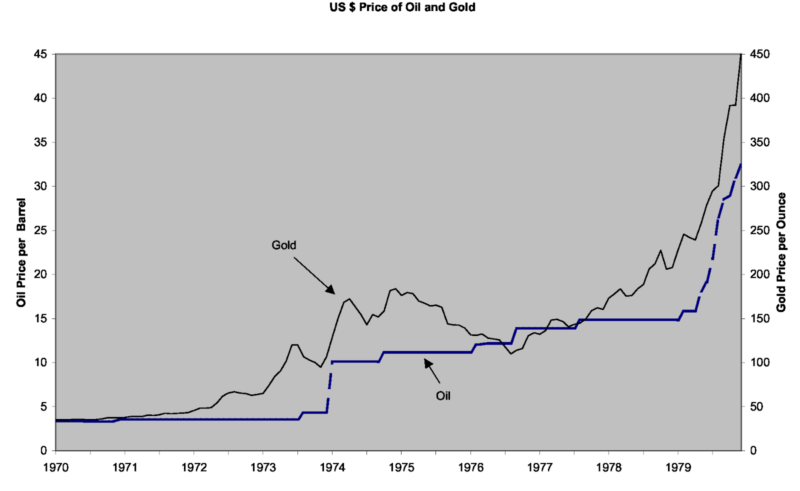
The first Graph “U.S. $ Price of Oil and Gold” is from a crucial 2003 study –”Black Gold: The End of Bretton Woods and the Oil Price Shocks of the 1970s“– by David Hammes and Douglas Wills, who persuasively argued that, “The conditions that brought about the demise of Bretton Woods also made the increases in the US dollar price of oil inevitable. Furthermore, the two dramatic US dollar price increases, in 1973 and then in 1979, only brought the ‘real’ or gold price of oil back within its historical range. 

As Boston Fed economist Michael Corbett explained, “The devaluation of the dollar that was experienced in the early 1970s was also a central factor in the price increases instituted by OPEC. Since the price of oil was quoted in dollar terms, the falling value of the dollar effectively decreased the revenues that OPEC nations were seeing from their oil. OPEC nations resorted to pricing their oil in terms of gold and not the dollar. Due to the ending of the Bretton Woods agreement, which had pegged gold to a price of $35, the price of gold rose to $455 an ounce by the end of the 1970s. This drastic change in the value of the dollar is an undeniably important factor in the oil price increases of the 1970s.”

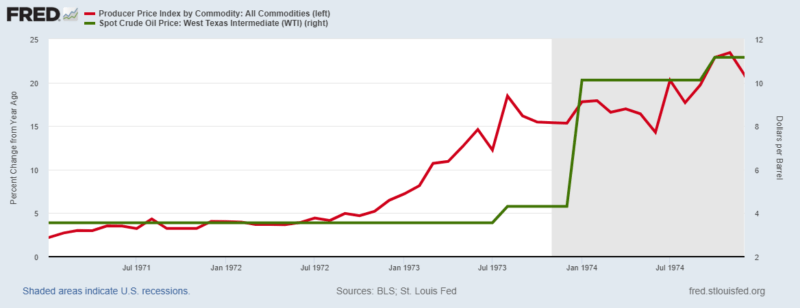
Many economic journalists and economists still try to excuse Presidents Nixon, Ford, and Carter for debasing the dollar with assistance from politicized Fed Chairmen like Arthur Burns. They try to blame a prolonged general inflation in the average of dollar prices on spurts in just one price – the price of crude oil. But the second graph clearly shows that most commodity prices (not just gold) began rising in late 1972 – long before sticky oil price contracts belatedly caught up. 


How could a U.S. President surrounded by ostensibly intelligent advisers end up debauching the dollar and trying to disguise the effects with wage and price controls? Most likely that happened because terrible theories encourage and excuse terrible policies. 

Determined to blame inflation on anything except fiscal or monetary policy, media pop stars like Rinfret and Galbraith fell back on primitive fallacies about most prices rising because some prices rose (cost-push), or because wages rose (wage-push), or because people simply expected most prices to rise and were somehow willing and able to keep paying more and more for everything without growing transfer payments and/or a reckless Fed giving everyone more and more money to spend. 

Even Fed Chairman Arthur Burns testified in June 1971 that because “a substantial increase of unemployment has failed to check the rapidity of wage advances. . . I have therefore come to believe that our Nation must supplement monetary and fiscal policy with specific policies to moderate wage and price increases.” If you don’t like the message the price system is sending, shoot the messenger. 

Herb Stein once confessed that before he came chairman of the Nixon’s CEA in 1972, he and other Nixon advisers simply bowed to Fed and media pressure to “do something,” even something stupid. The Council of Economic Advisers, he wrote, “found itself involved in helping devise measures that would meet the rising demand to do something— which meant incomes policy.” But by 1972, he lamented, “we were living in a new world of price and wage controls and a devalued dollar.” 

That poisonous policy stew was doomed to fail horribly. Artificially low prices boost demand and discourage supply, resulting in apparent shortages of everything but money. As Schuettinger and Butler documented, wage and price controls have been repeatedly inflicted for 4,000 years and always ended in disaster. 

President Nixon unleashed an inflationary hurricane in 1971 by letting the dollar collapse in terms of gold and relatively sound currencies. Inflation remained frighteningly high from 1973 to 1982, with unemployment often much higher than before the price control fiasco. The Fed put the Fed funds rate up from 9% in June 1980 to 19% in January 1981 when President Reagan took office. A 30-year mortgage rate topped 18.6% that October. It took until 1983 (when Reagan tax rate relief really started) to start getting things back to normal. 

Many costly tax and other economic policy mistakes were made in the seventies, but the worst problems of the 1973-82 stagflationary era by far were the legacy of terrible monetary and regulatory blunders made in 1971.

Alan Reynolds

Alan Reynolds

Economist Alan Reynolds is a senior fellow at the Cato Institute, and former vice president of the First National Bank of Chicago. He served as research director with Jack Kemp’s 1995-96 Tax Reform Commission, and with Larry Kudlow and Alan Greenspan as a member of President Reagan’s 1981 transition team. He is a former columnist with Forbes, Reason, and Creators Syndicate. He is also a past member of the Blue Chip and Wall Street Journal forecasters.

Author of the 2006 book Income and Wealth, Alan Reynolds has written for countless publications since 1971, including the Wall Street Journal, New York Times, Harvard Business Review, The Public Interest, National Review, Regulation and The Cato Journal.

Get notified of new articles from Alan Reynolds and AIER.