Search This Blog

De Omnibus Dubitandum - Lux Veritas

Showing posts with label Government Interference. Show all posts

Wednesday, June 22, 2022

The Ripples of Government Intervention

Vincent GelosoVincent GelosoJune 21, 2022 @ American Institute for Economic Research

 

In one of his early works, Ludwig von Mises argued that mixed economies, those that can neither bear the labels of laissez-faire capitalism or socialism, were inherently unstable. His claim was that once a government intervention began, it foiled economic calculation in ways that altered behavior. Once unforeseen consequences of the intervention start revealing themselves, policy-makers must either intervene once more or roll back the policy. In the end, an economy can be free or it can be centrally planned. It cannot be a mixture of both.

This key insight, later extended by Mises himself and refined by scholars such as Sanford Ikeda and Robert Higgs, has become known as the “dynamics of interventionism.” It has become a key element in the literature, emphasizing the necessary conditions for the creation and preservation of a liberal-democratic order (i.e. open political competition combined with a limited state). Simply put, it says that government interventions cause ripples in the economy.

The problem is this body of theory comes up against another, one that is well-accepted in economics: the theory of regulatory capture. While this theory had many early prototypes, its first formal elaboration was produced by George Stigler in the 1970s. It has a deceptively simple point: The creation of regulation itself requires economic calculation. In that view, not only are the regulations desired and understood by economic actors, but the consequences of those regulations are also fully understood. This means that a group asking for a price ceiling is aware that rationing will occur (and that coupons will be issued). The adjustments that people make become permanent and economies need not continue down the path to socialism or be forced to reverse by deregulating. Under that view, there are no ripples.

These views conflict at first glance. In a recent paper with Germain Belzile and Rosolino Candela published in Public Choice, however, we argue that they are actually complementary. The main difference between them is whether the consequences of government interventions have effects that can be fully predicted by regulators. If regulators can predict, then interventions need not debilitate the economy. If not, then unforeseen consequences emerge causing the need for reaction. The ability to predict is largely tied to how bureaucrats and politicians benefit from crafting interventions. As they are not residual claimants to the full profits or losses of their decisions, both are unable (or unincentivized) to access the knowledge necessary to anticipate the long-run consequences of their actions. More importantly, the cost of acquiring knowledge increases the further ahead in time one looks.

The result is that the timing of the unforeseen consequences will vary. Immediate or short-run consequences may well be fully understood, while long-run consequences will not (which begins the process of the dynamics of interventionism).

In the paper, my co-authors and I propose a case study based on the economic history of electricity in Canada. In the early 1900s, the populous province of Ontario began nationalizing its electrical industry. The goal was to provide cheap electricity to manufacturers far-removed from the large city of Toronto and to farmers in rural communities. By 1921, the process was complete. Until the mid-1920s, the government’s policy of providing electricity at below-market prices had the effects understood and desired by politicians, bureaucrats, manufacturers and farmers. They understood that subsidization meant that extra capacity had to be added, and that taxes needed to be raised to finance these additions. What they did not expect, however, was that the demand for electricity was as elastic as it was. The increase in quantity demanded was much greater than expected. Politicians and bureaucrats scrambled for a solution. Rationing was out of the question for political reasons. New generating stations to cover the unexpected surge were too expensive relative to those they had planned. This meant raising taxes, something that was also out of the question for political reasons. The only option left was to build high-voltage transmission lines to the neighboring province of Quebec and import from there.

Quebec, Canada’s second largest province, had a burgeoning (and entirely private) electrical industry, with low costs due to its extensive network of wide and fast-running rivers. Private firms were more than happy to sign contracts for large purchases from the Ontario crown corporation,  as long as they could charge the market price. From 1926 to 1932, the largest utilities in western Quebec (those that bordered Ontario) signed massive provision contracts to the Ontario crown corporation. Between the completion of the first interprovincial high-voltage transmission line in 1928 and 1934, Quebec’s exports of electricity to Ontario went from 4 percent of total output to 19 percent, a sizable increase.

The rub is that the higher demand from Ontario meant higher prices in Quebec markets that were connected to Ontario. My co-authors and I found that the causal effect of being connected to Ontario by high-voltage transmission lines after 1928 was that prices surged from between 13 percent and 21 percent.

These higher prices in Quebec caused a political backlash in the province. Prior to 1928, Quebec had bucked the trend of the rest of North America. Whereas the rest of the subcontinent had been moving toward greater public ownership, most of the few cities in Quebec that had initially opted for public ownership were in the process of privatizing their utilities. After 1928, some cities began to consider greater regulation and outright public ownership. Some large cities reneged on deals they had made with private firms. By 1935, the Quebec Liberal Party (which had been continuously in power since the late 1890s) split in part over the question of nationalizing electrical utilities. In the 1936 election the Liberals opposed nationalization (tepidly at best), and were decimated by the Union Nationale (a merger of the derelict Conservative Party and the liberals who had bolted from the party). The swing against liberal candidates was strongest in constituencies that were connected to Ontario by the high-transmission lines, suggesting that the price increases fueled the nationalization movement. In the late 1930s, extra layers of price regulations were added and, by 1944, the largest electrical utility had been nationalized.

The story here is simple: Nationalization in Ontario from the early 1900s to the 1920s caused regulation and nationalization in Quebec during the 1930s and 1940s. The dynamics of interventionism at play!

No Ontario bureaucrat could have anticipated such a policy development in the neighboring province when nationalization was completed. Yes, they anticipated some of the effects of intervention – the short-run ones. However, the failure to anticipate the long-run consequences meant that some bureaucrats and politicians (not those in Ontario) were forced to add some extra layer of government interventions decades later to deal with the consequences of earlier rounds of intervention.

This example is not banal. It is crucially important. It means that, when someone says “what could go wrong” after proposing a policy intervention, the reply should be “a lot that we will only comprehend many years from now.” The damaging ripples of government intervention may be very far in the future – it does not mean they do not exist.

Vincent Geloso

Vincent Geloso, senior fellow at AIER, is an assistant professor of economics at King’s University College. He obtained a PhD in Economic History from the London School of Economics.

Get notified of new articles from Vincent Geloso and AIER.


Friday, August 6, 2021

Coronavirus: Free Market to the Rescue, Part II

August 5, 2021 by Dan Mitchell @ International Liberty 

As I’ve repeatedly pointed out, capitalism (oops, I mean free enterprise) is far superior than the various forms of statism. Just last month, I shared a video with 20 example of market-friendly jurisdictions growing much faster than government-dominated nations.

But markets aren’t just superior at producing mass prosperity. Or at reducing mass poverty (the normal state of human existence).  Free enterprise also is the best option for dealing with a pandemic.  I wrote back in March about how free markets saved the day after the coronavirus struck.  In a column for the Wall Street Journal, Walter Russell Mead further elaborates on this theme.


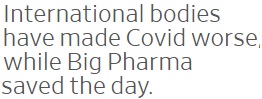
The World Health Organization has been a shame and a disgrace, from its initial silence over China’s coverup of early data on the outbreak through its unreasoning hostility toward Taiwan and its collusion with Beijing’s efforts to discredit the lab-leak hypothesis. The premier international health agency has failed. Covax, the much-touted international program aimed at providing vaccines to citizens of countries too poor to purchase adequate supplies on the open market, has also fallen abysmally short. …What’s worked in the pandemic so far has been the dog everyone wants to kick: Big Pharma. Pfizer, Moderna, AstraZeneca and Johnson & Johnson succeeded where the internationalists failed. Scientists in free societies working with the resources that capitalism provides have given the world hope. The WHO, Covax, the Chinese and Russian vaccines, and the “global community,” not so much.

Amen. Let’s be thankful for pharmaceutical companies. Their pursuit of profit is what led to the vaccines that have saved millions of lives.

By contrast, the WHO has been very unhelpful.  And America’s domestic bureaucracies, the FDA and CDC, have arguably been harmful.  Notwithstanding this track record, the Biden Administration wants to weaken the private sector.


The Biden administration…seems to believe that the best response…is to sabotage the American pharmaceutical industry. The U.S. development bank—the International Development Finance Corp.—will provide billions of dollars to firms based in countries like Brazil, Rwanda, Senegal, South Africa and South Korea that agree to manufacture Covid-19 vaccines. Meanwhile, the State Department’s coordinator for global Covid response, Gayle Smith, said last week that she wants to push Big Pharma to share its technology with its new government-subsidized foreign competitors. …one wonders exactly how President Biden squares subsidizing cheap overseas competition for one of the most successful industries in the U.S. with promoting jobs for the American middle class.

This proposal is nuts.  Only curmudgeonly libertarians will get upset about an effort to subsidize vaccines for the developing world.  But every rational person should be horrified about a plan that would weaken one of America’s most successful industries.

P.S. Moreover, we should reject short-sighted policies such as European-style price controls on drug companies. Such an approach would undermine our ability to deal with future pandemics and also reduce the likelihood of new and improved treatments for things such as cancer, dementia, and heart disease.

P.P.S. I like pharmaceutical companies when they are being honest participants in a free market. I don’t like them when they get in bed with big government.


Tuesday, May 12, 2020

Public Health Agencies Care More About Controlling You Than Prepping For Pandemics

What were public health officials at every level of government doing last year? Were they preparing for a pandemic? Or were they using their office to meddle with your lifestyle choices?

By Jeff Stier The Federalist May 11, 2020

The partisan political sniping over Covid-19 is completely predictable and counter-productive. There's plenty of fault to go around, but the blame-gaming should be ignored or discounted for what it is: self-aggrandizing grandstanding.

It is, however, worthwhile to examine a tension that has been brewing in the public health world for decades. That dichotomy is: should we focus on communicable diseases, as has long been the mission of public health institutions, or do we have enough bandwidth and resources to venture out into the much more controversial area of non-communicable diseases (NCDs)?

To get to the answer, think about this. What were public health officials at every level of government doing last year? Five years ago? Were they first ensuring that their track and trace systems were in place for a pandemic? Or were they using their office to meddle with your lifestyle choices?

The discipline of public health has long been rooted in fighting contagious diseases. For the most part, it has done very well. Notwithstanding the current Covid-19 pandemic, sanitation, vaccines and therapies—mainly drugs—have dramatically reduced the toll of communicable diseases.

That success has led many in public health agencies, especially in the United States, to argue that we must now use our limited resources to combat NCDs, and that we can address both effectively. It isn't exactly working out that way.

Efforts to fight non-contagious diseases such as heart disease and diabetes frequently raise questions about individual liberty, including the freedom to make poor choices. All too often, the politicized debate causes both sides to overstate or manipulate the science supporting their viewpoints.

When former New York City Mayor Michael Bloomberg, the biggest booster of today's public health movement, campaigned against sugary drinks like soda, it landed the city's health department in hot water. For instance, a taxpayer-funded ad campaign created by the Department of Health showed a photo of a man purportedly with amputated legs. The city's ad agency had Photoshopped his legs out of the photo to support the valid claim that Type 2 diabetes can lead to amputations.

The Bloomberg administration's antics, which even elicited criticism from within the health department, indicates the degree to which his wing of the public health movement has lost sight of its most primary and unifying functions: preparedness.

This lack of preparedness is not partisan. It exists in the current Republican administration, as it did in the prior Democrat administration. Cities, counties, and states long governed by each party were equally ill-prepared for a pandemic.

Commentators on the left and the right have referred to Coronavirus and Covid-19 as a "black swan
event." But it doesn't meet the definition. A pandemic of this type was not only predictable, it was something communicable disease experts have warned about rather specifically for many years. The warning signs were ignored, and we were ill-prepared.

A 2007 review article in the American Society for Microbiology's publication, Clinical Microbiology Reviews, entitled, "Severe Acute Respiratory Syndrome Coronavirus as an Agent of Emerging and Reemerging Infection," concluded: "Coronaviruses are well known to undergo genetic recombination, which may lead to new genotypes and outbreaks. The presence of a large reservoir of SARS-CoV-like viruses in horseshoe bats, together with the culture of eating exotic mammals in southern China, is a time bomb. The possibility of the reemergence of SARS and other novel viruses from animals or laboratories and therefore the need for preparedness should not be ignored."

Rather than marshal finite resources towards preparedness for a coming communicable disease, lots of public health resources, including taxpayer dollars, media attention, and legislative priorities, were deployed to address non-communicable diseases, from domestic violence to gun regulation.

Think back to a different time not so long ago. During the second half of 2019, federal, state and city health officials throughout the country were busy confronting a new and scary lung disease. The health reporters covering them churned out news articles, regularly garnering front-page placement.

Major charities such as Bloomberg Philanthropies were making large public health grants. So it should come as no surprise that the American public and political leaders were keenly focused on this emerging health threat.

The disease wasn't Covid-19, of course. It was a something the Centers for Disease Control called e-cigarette or vaping product use-associated lung injury, or EVALI.

At the time, public health activists were, for years, calling for bans on the types of e-cigarettes used to quit smoking. Despite strong evidence that nicotine e-cigarettes are 95 percent less harmful than smoking and can help smokers quit, public health agencies treated e-cigarettes as the most important threat to public health. Yet they still failed to convince policymakers to institute widespread bans on the most popular e-cigarettes.

But as consciousness of EVALI reached a crescendo, states began to ban most flavored e-cigarettes, and the FDA further tightened the regulatory screws on nicotine-containing e-cigarettes.

It turned out that none of these nicotine e-cigarettes were ever responsible for the lung disease that bears their name. It took until late December for the Centers for Disease Control to (partly) acknowledge that the lung injuries were caused not by vaping liquid nicotine e-cigarettes such as Juul, but by the use of THC oil contaminated with vitamin E acetate.

Public health agencies were so ideologically opposed to e-cigarettes as a tool for tobacco harm reduction that they sowed panic, promulgated misinformation, and actually caused a failure to identify the true culprit in a life-saving and timely way. Still, nobody has been held accountable.

So, back to the question about communicable and non-communicable disease: Has public health been able to "do both" well? It turns out, that when purportedly trying to do both, public health hasn't been able to do either effectively.

I'm not suggesting that public health's EVALI scandal was the only or even primary culprit for the failure of public health departments around the country to ensure that their communities had an adequate supply of personal protective equipment in the event of a predictable communicable disease outbreak, or that the CDC was otherwise preoccupied. Instead, the EVALI episode was more of a symptom of something wrong in public health.

The institution of public health has largely been co-opted by those with a desire to control individual choices to such a degree that it has largely lost sight of its fundamental role of pandemic preparedness. At this point, taxpayers should realize that we are giving the keys to the public health car to people who have long been driving in the wrong direction.

Jeff Stier is a senior fellow at the Taxpayers Protection Alliance.
 receive the latest by email: subscribe to jeff stier's free mailing list

Thursday, August 29, 2019

Labor Union 'Grab Bag' Bill Takes Away Worker Choice, Greases Wheels for Unions

August 27, 2019 Competitive Enterprise Institute

Workers should have the right and freedom to decide for themselves whether to join a union. But a proposed bill, the “Protecting the Right to Organize Act of 2019” (H.R. 2472), would diminish that right if passed into law, warns a new Competitive Enterprise Institute report.

“Instead of balancing the interests of workers, employers and unions, the PRO Act promotes union priorities above all else,” explained Trey Kovacs, a CEI labor policy analyst.

“The legislation is a union ‘grab bag’ bill that undermines worker privacy, provides workers little time to educate themselves on unionization, and forces individuals to pay for union representation they do not want.

“Aimed at radically overhauling labor relations law, the PRO Act eliminates state right-to-work laws, discourages flexible work arrangements and franchising, and under certain circumstances takes away workers’ right to a secret-ballot election,” said Kovacs.

The report delves into the worst provisions of the PRO Act, which would:..........To Read More...

Friday, August 9, 2019

Two Outstanding Leftist Qualities: Insanity and Hubris

You will never understand bureaucracies until you understand that for bureaucrats procedure is everything and outcomes are nothing.  Thomas Sowell

By Rich Kozlovich

On Wednesday, August 7, 2019 Victor Morton posted an article in the Washington Times entitled,  "Twitter locks Mitch McConnell account over protest video", saying:
The reelection campaign of Senate Majority Leader Mitch McConnell posted a video of protesters yelling obscenities and making threats toward “Massacre Mitch” at his Kentucky home. Twitter then locked the account, claiming the tweet violated its policy on violent threats. A Twitter spokesman told Politico on Wednesday night that the @Team_Mitch account was “temporarily locked out of their account for a Tweet that violated our violent threats policy, specifically threats involving physical safety.”
The arrogance and stupidity of this action boggles the mind.  Now in order for his account to be unlocked Mitch McConnell has to eliminate the video exposing those who are threatening he and his family at his home because it's a public safety issue?  Really?  You've got to be kidding!  Right?

So who exactly was McConnell threatening?   McConnell isn't threatening anyone!  It's he and his family who are the ones being threatened, at their home no less.  So exposing that is a public threat?  Really?  To whom? To the insane and violent leftist loons who are threatening him?

But one thing this action makes clear, the more they act in this manner the more clear it becomes how corrupt they are.  This will come back to haunt them in the near future.  As for now - Mitch  McConnell needs to sue them, if for no other reason than to have a huge expose about who and what they are. 

It isn't  violent threats they're concerned about, it's the truth that scares them.  Heaven forbid the public should see these misfits for who and what they are, and at some point the government is going to step in and impose rules or even break up these businesses. 

I've not been in favor of government oversight of the big tech social media oligarchs, and I'm not all that crazy about monopoly busting because these companies have become too big or too successful.  But we have to see this clearly. If we, as a society, can justify government interference in busting up businesses because they're too big, or preventing businesses from becoming bigger, at some point we will have to come to the conclusion public safety outweighs economics. 

The downside is government bureaucrats will become even more ridiculous than are the big tech oligarchs when they start making the rules.  They call these rules regulations, which carries the force of law, and before you know it, these unelected bureaucrats are out of control. 

The housing bubble that crashed the economy in 2008 was a direct result of the Community Reinvestment Act.  Here's the story.

 In 1977 the media discovered the word “redlining” and they used it like a whip. Redlining was supposed to be a racist action by the banks who wanted to prevent poor people and minorities, primarily black, from owning houses. Sounds insane doesn’t it? It is! Especially when a study came out showing that there was no redlining, that in fact these people were denied these loans because they were bad credit risks.

Yet redlining is what they had everyone believing, so in 1977 Congress, under the Carter administration, demanded that lending institutions pay attention to the “credit need” of the community and not on their ability to repay the loan and passing the Community Reinvestment Act of 1977.

Under this act the banks would be graded on how many of these bad loans they gave out. If they did business in this manner they received a high score. The score was directly proportionate to how easy it was to do a merger or an acquisition or even open a new branch and their ability to borrow money from the government. All of which the government controlled!

Under this act if some community activists, like the group ACORN, didn’t like the way you did business, they could cause all sorts of problems.  Stan J. Liebowitz, economics professor at the University of Texas at Dallas writes:
 "Home mortgages have been a political piñata for many decades. Greedy lenders aren’t the real reason for this mess. “In a nutshell, Liebowitz contends that the federal government over the last 20 years pushed the mortgage industry so hard to get minority homeownership up, that it undermined the country's financial foundation to achieve its goal."
Everyone was happy.  Everyone basked in the blaze of self congratulations. All of these bad loans were now declared to be “innovation lending” and they were praised by the regulators, academics and activists and because so much pressure was put on the lending institutions in the 90’s by the Clinton administration home ownership among minorities surged.

The media called this “one of the hidden success stories” of that administration. At one point the Federal Reserve Bank of Boston is supposed to have “produced a manual in the early '90s that warned mortgage lenders were to no longer deny urban and lower-income minority applicants on such "outdated" criteria as credit history, down payment or employment income.”

It was a real catch-22. If they continued giving out these bad loans, they would go out of business. If they didn’t comply there were real financial penalties, and if they raised interested rates they were accused of “predatory lending”.

Unfortunately this was undermining an entire economic system and the inevitable happened.

Jeff Jacoby notes:
"Trapped in a no-win situation entirely of the government's making, lenders could only hope that home prices would continue to rise, staving off the inevitable collapse. But once the housing bubble burst, there was no escape. Mortgage lenders have been bankrupted, thousands of subprime homeowners have been foreclosed on, and countless would-be borrowers can no longer get credit. The financial fallout has hurt investors around the world. And all of it thanks to the government, which was sure it understood the credit industry better than the free market did, and confidently created the conditions that made disaster unavoidable.”
That economic disaster was a direct response to government interference.   Interference caused by people with a political agenda who were totally unqualified to make decisions about anything involving banking, and probably much of anything else for that matter.  And they didn't care about the consequences because they had a mission.  

Leftists always have a mission, and mostly that mission involves getting conservatives to sign on to their power plays in the name of "public good".  So, now picture what happens when both the left and the right decide  the government should be deciding who can post on social media, and what can be posted.  Do we really think they'll be better than the big tech oligarchs in the long term?

Busting them up will only be a band aid fix.  What needs to happen is for a new social media platform come to the fore.  Let the market handle this, and even if it takes some time, which it will, that is the best fix possible. 

Competition!  Capitalism!  Everyone wants perfection, but the best we can hope for is the most acceptable imperfection.  The market is the most acceptable imperfection. 

Let's not let the emotions of the moment impact our long range thinking.  We need to see farther, deeper and wider than everyone else and recognize government interference in the social media will cause - not may cause, will cause - a long term problem that will not be fixable.