Mark Pulliam –
April 1, 2024 @ American Institute for Economic Research
Mark Pulliam –
April 1, 2024 @ American Institute for Economic Research
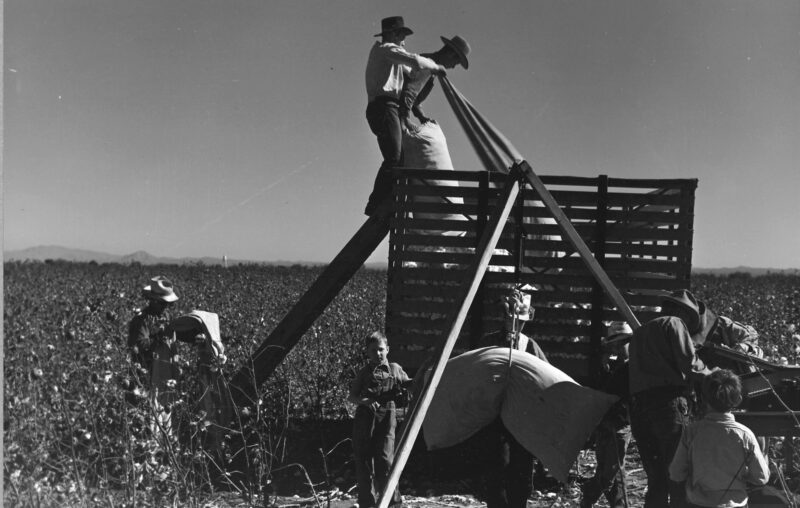
The American Enterprise Institute has reprinted Edward C. Banfield’s little-known 1951 book, Government Project, which was a post-mortem of a defunct, quasi-socialist New Deal-era agricultural project in drought-prone Pinal County, Arizona. The Foreword to the 2024 edition, written by Kevin Kosar, spouse of Banfield’s eldest granddaughter, asks, “Why would [the AEI] republish a 1951 book about a failed New Deal experiment that has been out of print for decades?” This is a good question, to which there are several answers.
First, Banfield (who died in 1999) was a pioneering political scientist and longtime Harvard faculty member who was, according to Charles Kesler, the editor of Claremont Review of Books, “one of the greatest social scientists of the twentieth century.” Banfield’s best-known book, the 1970 bestseller The Unheavenly City, was an influential — and contrarian — examination of America’s “urban crisis.” His blunt indictment of lower-class culture as the root of most urban ills was controversial and led to campus protests and undeserved pariah status in academia.
Second, Government Project, based on Banfield’s PhD dissertation at the University of Chicago, is an equally insightful analysis of the Casa Grande Valley Farms cooperative, which was created by the Farm Security Administration (FSA) in 1938 at the height of the Great Depression to provide economic security to distressed tenant farmers and migrant farm workers — many of them “Okies” displaced by the Dust Bowl. Banfield’s careful case study of the Casa Grande project, based on his review of the detailed government records (including extensive interviews with the participants) and his own experience as a “public information officer” for the FSA, is a sobering critique of government planning and social engineering.
Third, the original Foreword by Rexford Tugwell (nicknamed “Rex the Red” by his detractors due to his utopian infatuation with Soviet-style schemes), a member of FDR’s “Brain Trust” and the architect of FSA’s predecessor agency, the Resettlement Administration, is alone worth the modest cost of the book as an exercise in bureaucratic hubris. Tugwell lauds Government Project as “the full case history” of Casa Grande, and acknowledges that “We can see in it many lessons if we will” — while conveniently shifting the blame for the fiasco to others.
Finally, Banfield had a long association with AEI, dating back to 1963 (when Milton Friedman served on AEI’s advisory board), and one of Banfield’s students at Harvard, Christopher DeMuth, was AEI’s president from 1986 to 2008. For all these reasons, Banfield, now largely forgotten, deserves to be remembered, as do the lessons of Casa Grande.
What was Casa Grande and why did it fail? The FSA was a New Deal relief program that sought to provide employment and housing — and, ultimately, economic self-sufficiency — to destitute farm laborers such as sharecroppers and itinerant cotton-pickers then living in squalid shacks. Sixty families were selected to live in newly constructed brick homes featuring modern amenities such as electricity, indoor plumbing, flush toilets, water heaters, refrigerators, gas ranges, and washing machines. At great expense (more than $1 million in 1938 dollars), the federal government (via the WPA) built the homes, acquired 3,600 acres of farmland, and provided the necessary agricultural infrastructure (wells, irrigation ditches, roads, fences, outbuildings, and the like).
Unlike the earlier — but equally disastrous — Matanuska Colony Project in what is now Palmer, Alaska, Casa Grande did not rely on a model of individual homesteads of 40 acres for the participants to clear and farm; it was to be a “collective” farm on an industrial scale, permitting efficient mechanization and more scientific agricultural techniques, such as crop rotation. Small farms in the Arizona desert were deemed to be economically untenable. Accordingly, the 60 settlers chosen to participate would own the farm on a communal basis, responsible for cooperatively operating the farm profitably and reimbursing the federal government for its substantial up-front investment. Eventually, the Casa Grande settlers would repay their debt to the FSA, share the profits, and build equity as owners. Casa Grande — an untested experiment in quasi-socialist agriculture — was to be the largest cooperative farm ever established in the United States.
The problems with this model were — or should have been — obvious. The Casa Grande farm was a complex enterprise, dependent on irrigation, with multiple crops (cotton, alfalfa, grain), livestock (cattle, hogs, sheep), dairy, and poultry, and a complement of horses, mules, tractors, hay balers, and other equipment. The settlers, some of whom had limited (or no) farming experience, were ill-equipped to manage such a complicated operation on their own. To protect its investment, the federal government appointed an experienced farm manager to oversee operations. The farm would not immediately turn a profit, so the settlers were initially paid a nominal monthly stipend. From the beginning, this arrangement generated conflict.
The settlers, who viewed themselves as “owners” (albeit communally) resented the FSA’s management despite their own lack of experience as independent farmers. The settlers’ duties were strictly structured by the FSA foreman. Because of the FSA’s operational supervision and their modest monthly remuneration, the settlers behaved as hired hands, often threatening to strike — against their own cooperative! — if they didn’t get their way. “Sharing” the workload led to disputes over perceptions regarding the settlers’ differing roles and levels of effort. Needless to say, the operational arrangement was contrary to the ostensible goal of cooperative self-governance, which frustrated and confused the poorly educated and inexperienced settlers.
The Casa Grande participants, few of whom were native Arizonans, were haphazardly chosen from widely disparate backgrounds, in terms of age, education, family composition, religious beliefs, life experience, and other characteristics. The only trait they shared was destitution. Any random assortment of humans will include moochers, loafers, troublemakers, and complainers, and the quarrelsome Casa Grande settlers were no exception. With time on their hands (thanks to the mechanized farm operations), the settlers quickly divided into competing cliques and factions. Internal governance amidst these differences degenerated into petty feuds, incessant bickering, jealousy, resentment, and recrimination. The “cooperative” was wracked with discord.
Naïve FSA managers were dismayed that the independent-minded settlers did not adapt to communal life; “economic democracy” was, after all, the ultimate goal of establishing a cooperative farm. To the New Deal architects of Casa Grande, enlightened communal living was a moral imperative. Alas, no amount of tinkering and prodding by the FSA’s social engineers was able to turn Casa Grande into a kibbutz. Adding to the tension, neighboring communities viewed the WPA-built collective farm with distrust and suspicion, nicknaming the project “Little Russia.”
Despite the cajolery of FSA social workers, in 1943 the fractious (and short-sighted) settlers insisted by a two-thirds vote on liquidating Casa Grande — after it became profitable! — squandering their equity on legal fees, and walking away with next to nothing. Most returned to destitution and squalor as migrant farm workers, leaving the federal government $100,000 in the hole (in 1946 dollars).
The lessons? Americans do not readily embrace government-imposed collectivization. “Community,” in the Tocquevillian sense — voluntary associations which comprise the fabric of civil society — cannot be manufactured or externally imposed; civic cooperation must be organic Good intentions are not enough. In a free society, dealings among citizens are based on “private ordering”: consensual free-market transactions based on perceived individual self-interest. Property rights demarcate separate economic interests. The potential for personal financial success provides incentives for hard work and self-discipline. All these elements were absent in a government-planned “cooperative” with federal supervision and competing factions among the randomly-chosen participants — all of whom were strangers before being thrust into an unfamiliar communal society.
Original foreword author Tugwell was an FDR confidante who helped create, and then led, the Agricultural Adjustment Administration that was declared unconstitutional in 1936, when he’d moved on to be Administrator of the Resettlement Administration. A champion of central planning in industry, housing, and agriculture, Tugwell believed that government bureaucrats could “fix” social problems by moving poor people into utopian planned communities. Despite the manifest failures of the numerous New Deal programs that he designed and oversaw, he steadfastly refused to accept any blame. In his 1951 Foreword, Tugwell conceded that Casa Grande was a “noble failure,” not because “the conception was bad,” but because “the people there could not rise to the challenge.”
Tugwell disingenuously condemned the “character” of the “unfortunate” settlers, who succumbed to “a general sickness which was at work,”including “deplorable exhibitions of selfishness” and “maleficent” opposition to cooperation by “very powerful forces” opposed to FDR. Despite the best efforts of the federal planners, he lamented, “We are far from being fundamentally accustomed to the projections necessary to finding our duty and doing it in modern society” (emphasis added). In other words, Americans were to blame for refusing to adapt to Soviet-style communal farming!
Casa Grande was one of four cooperative farm projects sponsored by the FSA. Believe it or not, it was the most successful. The others, also torn by factionalism, fared far worse. Government Project is a powerful lesson — in economics and human nature: Socialism doesn’t work.
Postscript: The difference between then and now is that Congress recognized the failure of resettlement projects and cooperatives, and in 1943 cut off their funding. Today, such self-restraint is entirely absent.
Mark Pulliam

Mark Pulliam is an attorney and commentator living in Austin, Texas. He is a graduate of the University of Texas School of Law. Mark is a contributing editor to Law and Liberty, and his writing has appeared in the Wall Street Journal, City Journal, National Review, and many other publications. Get notified of new articles from Mark Pulliam and AIER. SUBSCRIBE