Search This Blog

De Omnibus Dubitandum - Lux Veritas

Showing posts with label Singapore. Show all posts

Monday, August 25, 2025

The Singapore Model, Part II

In Part I of this series, I explained that Singapore’s pro-market policies allowed it to catch up – and then surpass – the United States.

Let’s start Part II with a video explaining the country’s climb to prosperity.  I’m motivated to write about Singapore today after seeing a chart showing how Singapore is doing dramatically better than its former colonial master, the United Kingdom.

As you can see, we definitely have a new example for the Anti-Convergence Club. So why has Singapore been so successful? The answer is that the nation enjoys very high levels of economic liberty. It ranks #1 in the Index of Economic Freedom and ranks #2 in Economic Freedom of the World (and almost surely will be #1 when the new edition is released).

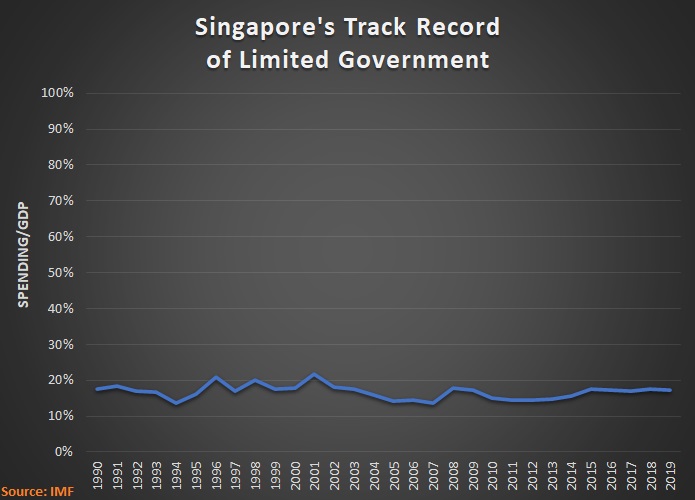
Given my background as a fiscal policy economist, I often cite Singapore’s fiscal policy when explaining why it is richer than the United States or United Kingdom.  Simply stated, it has a small-sized public sector. Here’s a chart based on IMF data showing a much-lower burden of government spending in Singapore.

While Singapore’s economic policy is admirable, it is not perfect. Indeed, it may even be exaggerated and not as good as conservatives and libertarians sometimes believe. Here are some excerpts from an analysis by Pradyumna Prasad.


Singapore from the statistics looks as if it is one of the least interventionist states in the world. Tax rates are low, and it is extremely easy to set up a business in the city-state. …But this focus on taxes and government spending as the measure of the size of government obscures an important fact in understanding Singapore’s government: it owns several companies… 

Out of the 25 largest companies listed on the Singapore Exchange (as of 26th June 2023, excluding real estate investment trusts) 9 companies were started by the government. It still maintains at least a minority stake in all of them and a majority stake in Singapore Airlines and ST Engineering. For most of them, it is still the largest shareholder. …Along with this, the government of Singapore owns the vast majority of land in Singapore… Nearly 80% of Singaporeans live in government built housing.

And even the good parts of Singapore’s fiscal policy data might not stay good forever. I warned about slippage in 2019, and there was an unfortunate tax increase a couple of years ago. Here are some excerpts from a report by Kok Xinghui in the South China Morning Post.


Singapore will roll out its long-delayed 2 percentage point increase in sales tax next year. …the goods and services tax (GST) hike would take place in two steps – with an increase from the current 7 percent to 8 percent on 1 January 2023, and subsequently to 9 percent on 1 January 2024. Alongside this rate hike, Wong also announced plans to increase personal income, property and vehicle taxes – measures aimed at the ultra-wealthy. …The country’s current S$% per tonne carbon tax also will rise fivefold in 2024, and subsequently be increase until in reaches S$80 per tonne by 2030.

Since the top income tax rate is now 24 percent, it would be wrong to call Singapore a class-warfare jurisdiction. But it’s still bad news that taxes are trending in the wrong direction.  In a 2022 column for National Review, Jacob Hjortsberg wrote about Singapore’s imperfect capitalism.


There are three main elements of the Singaporean system that…demonstrate that the country is far from a free-market paradise. 

Element 1: …a National Wages Council was…founded — a tripartite organization consisting of labor representatives, employer representatives, and representatives from the government, tasked with formulating central wage guidelines for the Singaporean labor market. … 

Element 2: …the second element of Singapore’s social democracy was in place: a corporatist class compromise according to which zero-sum class struggle was exchanged for positive-sum cooperation, with the one-party state taking it upon itself to subordinate the interests of capital and labor to the unified “national interest.” … 

Element 3: …we get to the heart of Singaporean social democracy. Rather than being based on taxation, Singaporean social democracy is based on getting the citizens invested as shareholders in the state as a profitable corporation, with each citizen gaining access to the welfare services provided by the state based on their individually accumulated savings.

For what it’s worth, I think the above article mostly shows paternalism rather than statism. Though it certainly is true that Singapore is not a libertarian society. Speaking of which, let’s close with some passages from Mike Rigg’s 2021 article for Reason.


Singapore has combined classical liberal policies such as free trade, an open port, and low taxes with an authoritarian single-party government that centrally plans large swaths of the island’s economy and infrastructure, plays the role of censor in practically every media sector, canes petty criminals, and executes drug offenders. … 

Are there practical policies that Americans broadly and libertarians specifically can adopt from a country that combines free markets with forced collectivism? …Singapore is complex, but its core tension comes from the pairing of highly effective public and private institutions that take into account how people respond to incentives while engaging in shocking incursions on personal liberty… 

George Mason’s Garett Jones…asks readers whether they would “be willing to support longer terms for politicians, tightened voter eligibility, and a single, hegemonic political party in exchange for a 300% raise.” Jones later points out that a majority of Singaporeans have done just that. They’re 23 times richer per person today than they were six decades ago; the country’s GDP exploded from just under $1 billion in 1960 to $372 billion in 2019. 

“It’s worthy to discuss how to get to Denmark,” Jones writes of the Nordic nation, which funds a massive welfare state with high taxes and a market economy, “but it’s wise to discuss how to get to Singapore.”

For those who read my column last December about the Human Freedom Index, it’s hardly a surprise to see that Singapore is not a libertarian paradise. The purpose of today’s column is to observe that it’s not a free-market paradise either. But it’s still very good by global standards.

My final two cents is that Singapore’s biggest strength is low tax rates and the absence of a western-style welfare state. Those are the policies that other nations should be emulating.

P.S. Singapore’s retirement system is better than the U.S. Social Security system, but it would be better to copy the approach used by nations such as Australia and Chile.

Monday, June 13, 2022

Market-Driven Growth and the Asian Tigers

June 11, 2022 by Dan Mitchell @ International Liberty

I’m currently in Tanzania as part of a speaking tour in Africa. My remarks today largely repeated the message I gave to an audience last week in Nigeria.

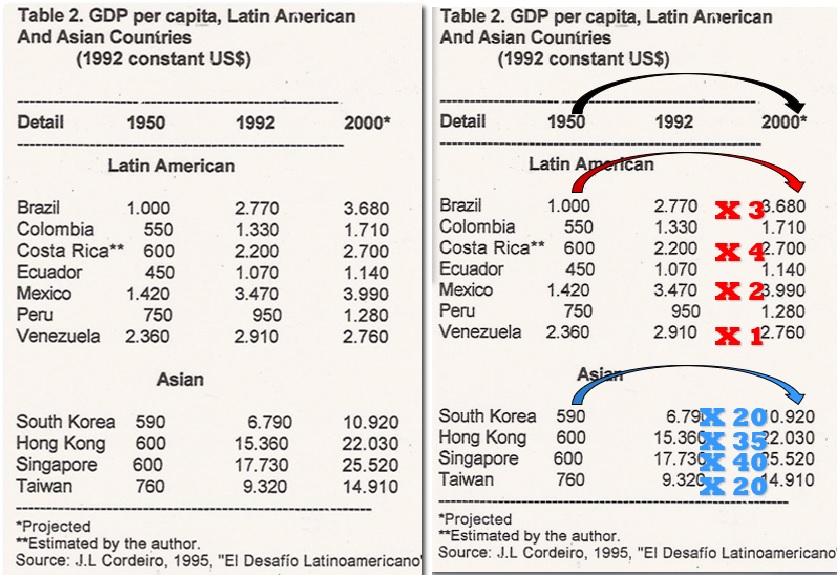
So I won’t bother sharing anything from my presentation. Instead, I want to highlight some numbers from a presentation by Professor Ken Schoolland.

He shared some data showing how the “Asian Tigers” grew far faster than major Latin American nations between 1950 and 2000.

These are very impressive examples of convergence (as the Asian Tigers caught up with Latin America) followed by divergence (as the Tigers then continued to grow much faster).

I’ll be adding this data to my “anti-convergence club.”

But I also noticed that Professor Schoolland was sharing some old data from 1995.

So I went to the Maddison website and created some new charts based on the latest-available data.

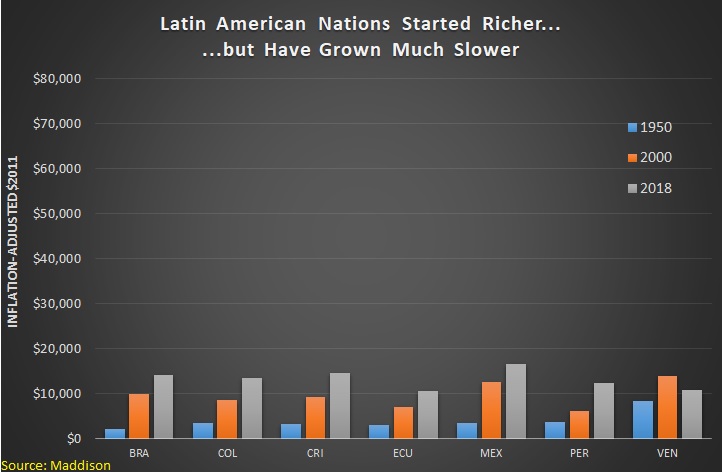
As you can see, the Latin American nations were richer in 1950, but they have not enjoyed fast growth in the past 70 years.

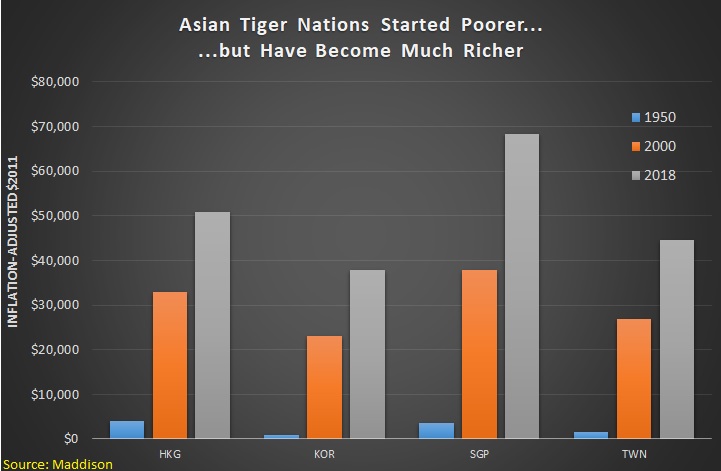
By contrast, the Asian Tigers have enjoyed spectacular growth since 1950.

So not only are these nations much more prosperous than nations in Latin America, in most cases they have even surpassed European countries and Singapore is now richer than the United States.

Since I’m writing about the success of the Asian Tigers, let’s address the myth that they became rich because of industrial policy.

Sam Gregg of the Acton Institute examined this controversy in an article for Law & Liberty.


…what about some of the East Asian Tiger countries? Aren’t they proof that, when devised and implemented by wise governments guided by even cleverer experts, industrial policy can work? …There is, however, a wealth of evidence indicating that these policies produced similarly pedestrian outcomes in these countries. As for the Tigers, what primarily took them from the status of economic backwaters to first-world economies was economic liberalization and especially trade openness… 

Even the most devoted industrial policy advocates hesitate to present two of the Tigers, Singapore and Hong Kong, as industrial policy successes. They do nevertheless regard South Korea and Taiwan’s postwar histories as demonstrating why industrial policy should play a major role.

Gregg takes a close look at what actually happened in South Korea.

Beginning in 1954 and until about 1963, Korea’s government focused upon import-substitution industrialization policies… however,…economic growth in Korea only began taking off between 1963 and 1973 following a decisive shift towards export-orientated development and trade openness. … 

Industrial policy assumed a larger place in Korea’s economy in the mid-1970s. …Korea’s turn towards industrial policy in this period does not appear to have produced spectacular results. Economic growth during this period—whether in terms of GDP, trade, employment, manufacturing output, or exports in goods and services—was actually lower than what had been realized in the 1960s. …These results may help explain why Korea’s drift towards industrial policy was reversed, beginning in the late-1970s. … 

The overall result was a return to high growth throughout Korea’s economy.

And here’s his analysis of what happened in Taiwan.

…the Kuomintang government adopted an import-substitution approach to trade characterized by high tariffs and import quotas. The Taiwan Production Board oversaw the extensive use of industrial policy, especially through preferential loan-treatment… In the mid-1950s, key Taiwanese officials and their American advisors recognized that Taiwan could not keep going down this path. 

Hence in the late-1950s, decisions were made that re-orientated Taiwan’s economy towards competition and trade openness by, among other things, liberalizing imports and foreign investment rules as well as beginning a process of steadily removing export controls and gradually giving more and more exporters what amounted to a free trade status. 

As in Korea’s case, growth in Taiwan took off. …the general direction of Taiwan’s economy from 1958 onwards was away from industrial policy and tariffs and towards increasing integration into global markets. Like Korea, Taiwan underwent a limited return to interventionist policies in the mid-1970s, but, again, like Korea, this did not last.

The bottom line is that South Korea and Taiwan are not as rich as Hong Kong and Singapore and one reason they are lagging is that their governments tried to pick winners and losers.

But both those nations largely have abandoned industrial policy, so at least they recognized their mistakes.

P.S. A big issue at the conference is whether the “China Model” should be emulated. I shared some data showing why that would be a big mistake.


Thursday, March 12, 2020

Singapore Is a Role Model for Prosperity

March 11, 2020 by Dan Mitchell @ International Liberty
 
Brexit was a battle over whether the United Kingdom would:
  1. Be a component part of the European Union
  2. Be a self-governing democracy
Now that British voters have chosen the second option, there’s a secondary debate about what path to choose.

Many Brexit supporters hope that the United Kingdom will use its newly restored independence to chart a more laissez-faire path, including lower taxes and less red tape.

Critics fret that this approach would mean the U.K. becoming a European version of Singapore.
My former colleague Marian Tupy explains for CapX that this would be a very desirable outcome.
Earlier this month Guy Verhofstadt, the Belgian MEP…, tweeted that…”We will never accept ‘Singapore by the North Sea’!” What exactly is wrong with being Singapore? …Back in 1755 Adam Smith observed that “little else is requisite to carry a state to the highest degree of opulence from the lowest barbarism, but peace, easy taxes, and a tolerable administration of justice” – that certainly holds true for Singapore, which has become one of the world’s most prosperous countries by following Smith’s formula… In the last few decades, Singapore’s economy grew at a faster pace than that of the UK and the EU… Singapore’s GDP per capita, which amounted to 72 percent of the EU’s GDP per capita in 1950, amounted to 219 percent of the EU’s GDP per capita in 2019. …Life expectancy at birth is the best proximate measure of the overall health of the population. …life expectancy in Singapore trailed the EU and UK in 1960. In 2017, Singaporeans lived, on average, longer than Europeans.
Marian is right.

Singapore is an amazing example of a nation that broke through the middle-income trap, as I noted back in 2014 and 2017.

I’m particularly fond of the country because of the very modest burden of government spending. This chart, based on numbers in the IMF’s world economic outlook database, shows that the public sector consumes less than 20 percent of the economy’s output.


To put the above chart in context, government spending in the United States consume nearly 40 percent of GDP in the United States and more than half of economic output in some European nations.

Why does this matter?

Because good public policy is a recipe for more prosperity (and Singapore is very good in areas other than fiscal policy as well).

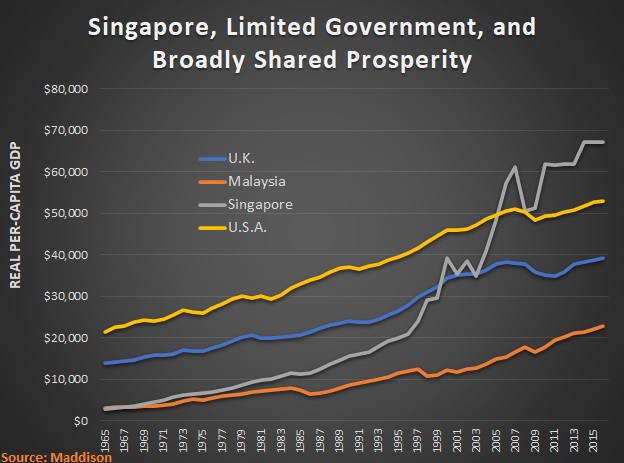
Building on Marian’s analysis, I’ve used the Maddison database to to see how Singapore compares to the United States, the United Kingdom (the former colonial master), and Malaysia (it was part of Malaysia until 1965).


This isn’t just convergence. Singapore caught up with the U.K., then caught up to the U.S.A., and now has a comfortable advantage.

Seems like a good model for the U.K. to follow. Though Hong Kong also is a very good option (though it’s unclear if that will be true in the future).

P.S. To be sure, Singapore is not a libertarian paradise. There are some strict laws governing private behavior, including the death penalty for certain drug offenses and a ban on the import and sale of chewing gum. More worrisome (given my focus on economic policy) is that officials have contemplated class-warfare tax policies.

Wednesday, October 24, 2018

Singapore Edges Hong Kong for the Top Score in the Laissez-Faire Index

By Dan Mitchell

My favorite publication every year is Economic Freedom of the World. It's filled with data on fiscal policy, regulatory policy, trade policy, monetary policy, and quality of governance for 162 jurisdictions, and it provides an unbiased way of gauging the degree to which they allow economic liberty. It also allows readers to slice and dice data, which is very helpful for doing analysis.......To Read More....