Search This Blog

De Omnibus Dubitandum - Lux Veritas

Showing posts with label Government Spending. Show all posts

Thursday, September 7, 2023

Actually, Joe Biden has doubled the deficit

September 7, 2023 By Chris Talgo

Over the past two years, President Joe Biden has made numerous statements suggesting that he is a deficit hawk on par with past presidents such as Calvin Coolidge or Andrew Jackson. For instance, earlier this year, Biden claimed, “In my first two years, I reduced the debt by $1.7 trillion. No President has ever done that.” In reality, Biden was half right. No president, including Biden, has ever done anything close to reducing the national debt by such a gigantic amount in his first two years or any two-year period, for that matter. Here are the facts. When Biden entered the White House, the national debt stood at $27.7 trillion. Two years later, the national debt stands at $32.9 trillion. Using simple arithmetic, the national debt has increased by $5.2 trillion under Biden. That is a big difference from a $1.7 trillion reduction. Over the past two years, President Joe Biden has made numerous statements suggesting that he is a deficit hawk on par with past presidents such as Calvin Coolidge or Andrew Jackson. ...........To Read More

Interest on National Debt on Pace to Eclipse Entitlements, Defense Spending Amid Funding Battles

Ben Whedon 

Criticism of sustained deficit spending prompted house Republicans earlier this year to pressure the White House to make budgetary concessions in the Fiscal Responsibility Act that aimed to address the nation's runaway spending. The debt service may soon exceed that of major allocations.  Sustained deficit spending by the U.S. government helped push the national debt up to a jaw dropping $31.38 trillion in 2023, according to U.S. Treasury data. Fiscal watchdogs are now predicting that the interest alone on that debt will soon eclipse both entitlements and defense spending as a major component of the annual budget................To Read More....

Monday, December 5, 2022

Mitch McConnell: Leadership Wants Lame-Duck Congress to Pass Omnibus Spending Bill

Nick Gilbertson

  On Tuesday, McConnell, Senate Majority Leader Chuck Schumer, House Speaker Nancy Pelosi, and House Minority leader Kevin McCarthy met with President Joe Biden and discussed legislative priorities for the remainder of the year.  We’re going to work together, to fund, I hope, work together to fund the government, COVID, and war in Ukraine,” Biden said. “All controversial and consequential issues.”...........To Read More....

Our Republican Leaders Have Failed Us Jack Gleason GOP leadership broke their own rules by meddling in primaries, accepting donations from hostile parties, and may be embroiling the GOP in an embarrassing scandal with their ties to FTX................ More

Thursday, November 10, 2022

America’s Fiscal Problem Is Excessive Government Spending

November 6, 2022 by Dan Mitchell @ International Liberty

I don’t spend much time worrying about why the United States has a big budget deficit. I’m much more concerned about the fact that the federal government is too big and that it is spending too much.

Moreover, there’s plenty of evidence that we can quickly get rid of deficits with some long-overdue spending restraint. In other words, deal with the underlying disease of excessive government and the symptom of red ink goes away.

But since many people focus first and foremost on fiscal balance, let’s take a look at why budget surpluses at the turn of the century have turned into big budget deficits.

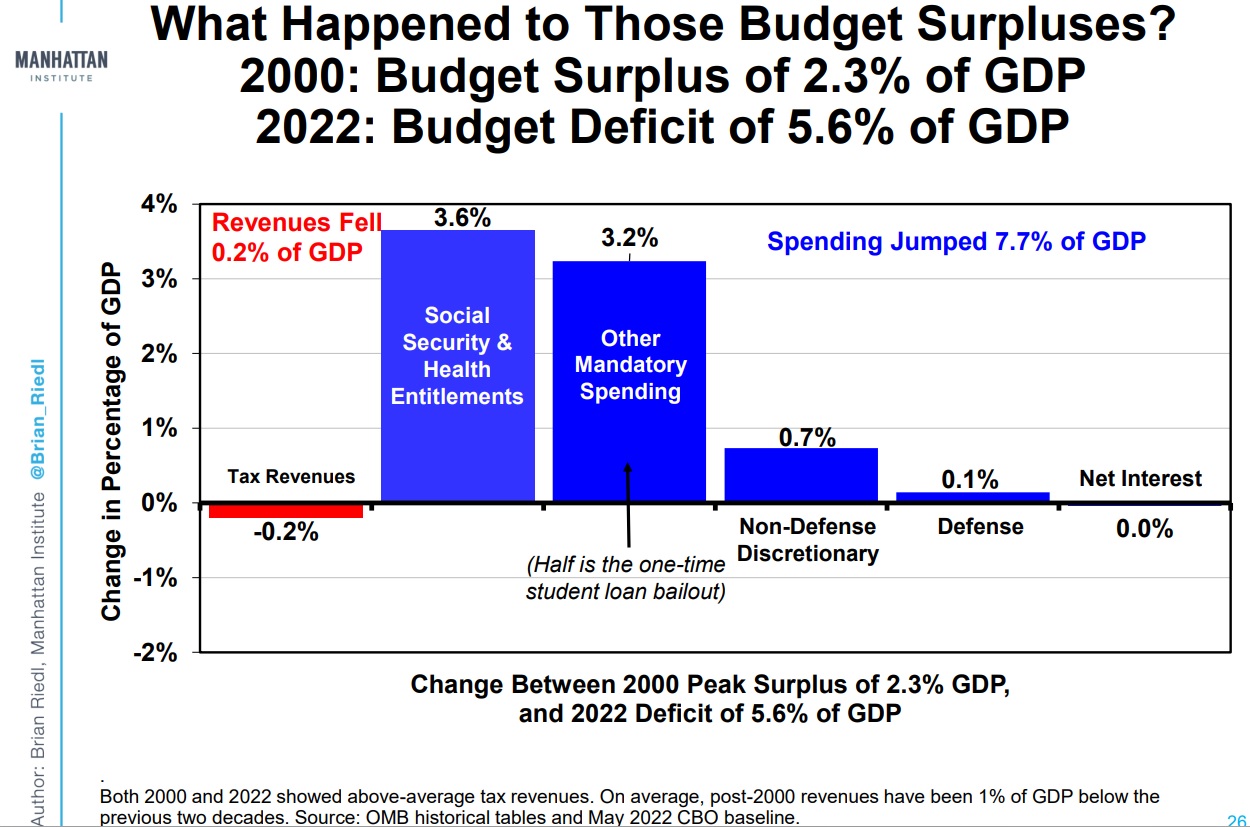
I’m motivated to address this issue because of this chart from Brian Riedl’s impressive collection. It shows spending increases are responsible for 97.5 percent of the shift.

Some of you may be wondering if the chart is accurate. I can easily imagine my friends on the left exclaiming, “What about the Bush tax cuts and the Trump tax cuts?!?”

Those tax cuts did happen, but they were mostly offset by Obama’s “fiscal cliff” tax increase and real bracket creep (the tax burden tends to increase over time since even small increases in economic growth will push households into higher tax brackets).

So the net result of all these factors is that there has been a very small reduction (0.2 percentage points) in tax revenue as a share of economic output.

Others of you may be wondering if the spending numbers may be exaggerated because of pandemic-related spending.

That is a fair question since the crowd in Washington used the opportunity to spend a couple of trillion dollars. But the silver lining to that dark cloud is that it was almost entirely one-time spending that took place in 2020 and 2021 (for what it’s worth, budget experts have mocked Biden’s claim of deficit reduction this year since it is simply a result of expiring emergency outlays).

There is some one-time spending in 2022. As noted in the chart, Biden’s reckless student loan bailout is a big chuck of the increase in “other mandatory spending.”

As such, I suppose I should say that higher spending is “only” responsible for 96.8 percent of today’s higher deficits, not 97.5 percent.

The bottom line is that all 21st-century presidents (and Congresses) have been big spenders.

P.S. According to the long-run forecast from the Congressional Budget Office, a bad situation will get even worse over the next 30 years. And more than 100 percent of that future decline will be the result of excessive spending (something that’s been true for many years).


Tuesday, June 21, 2022

A Trillion Here, a Trillion There…

John Mauldin Thoughts from the Frontline  June 10, 202 View PDF

Complaining about federal debt is a time-honored American tradition. Remember Ross Perot and his hockey-stick charts? Then there was Harry Figgie’s 1992 best-selling book, Bankruptcy 1995. It was quite a sensation at the time.

Not only did the US government not go bankrupt in 1995, but a few years later it achieved the unimaginable feat of a balanced budget. The 2001 recession, some unwise tax and especially spending choices plus a couple of wars ended that happy trend. The debt kept rising and is still doing so today.

Perot and Figgie weren’t wrong; they were early. Imposing debt on future generations is essentially a tax on future growth and prosperity. We are shifting consumption forward in time, which will mean lower consumption later. And with inflation, consumption at higher prices which means fewer goods and services per dollar spent as compared to earlier years, unless wages and income keep up with costs and inflation, which they don’t.

Pandemic-driven fiscal and monetary policies have changed the debt situation considerably, and for the worse. At some point this becomes unsustainable, and we will have a painful reckoning, which I call the Great Reset.

For the last six years, I have done occasional analyses of the debt situation. I gave you an update on the numbers back in September 2020. Today we’ll review them again, with the benefit of the Congressional Budget Office’s latest forecast.

Before we start, I recommend you reread that 2020 letter, or at least skim through it. You may want to open it in another browser tab. Below I’ll show you refreshed versions of that same data and you will want to look back at how it’s changed.

A lot has happened since then............A Trillion Here, a Trillion There…


Monday, June 6, 2022

In the Red

Our glidepath to insolvency.

When Ross Perot won an impressive 19% of the popular vote as an independent candidate for president in 1992, his main issue was the national debt. In one of his unusual, half-hour-long campaign ads, Perot declared, “Just this year, we ran up $341 billion in new debt…. That’s our legislators and our president trying to buy our vote, this year, with what used to be our money.”

Three decades later, our national debt—which reached $4 trillion the year that Perot ran—has hit $30 trillion. If our debt were to keep rising at that rate over the next 60 years, it would increase more than 50-fold and surpass $1.5 quadrillion (a quadrillion, which sounds like a made-up number, is a thousand trillions)..............To Read More.


Monday, January 31, 2022

How Can People Protect Themselves from Bad Monetary Policy?

January 26, 2022 by Dan Mitchell @ International Liberty

In the libertarian fantasy world, we would have competing private currencies. In the real world, we have a government central bank.  And central banks have a track record of bad monetary policy, so here’s my two cents on how people can try to protect their household finances.


............I focused on explaining the risks of bad monetary policy, especially the way that central banks (and other government policies) create boom-bust cycles in the economy. If I had more time, I could have talked about additional threats, such as the crackpot idea of “modern monetary theory.”..........To Read More...


Saturday, May 29, 2021

Will the Pandemic Promote Political Power in Perpetuity?

James Bovard James Bovard  – May 26, 2021 @ America Institute for Economic Research


“It’s like we created another industry in our state. The amount of money is staggering,” Andrew Schaufele, director of Maryland’s Bureau of Revenue Estimates, happily declared last week. The Biden stimulus plan is deluging governments across America with hundreds of billions of dollars of extra revenue that will allow politicians to stretch their power in ways that vex citizens long after the pandemic is over. 

One year ago writing for AIER, I asked, “Will the Political Class Be Held Liable For What They’ve Done?” Lockdowns at that point had already destroyed more than ten million jobs without thwarting the virus – a debacle that “should be a permanent black mark against the political class and the experts who sanctified each and every sacrifice.” No such luck. The article warned that “sovereign immunity… almost guarantees that no politician will face any personal liability for their shutdown dictates.”

The political class is coming out of the pandemic with far more power and prerogatives. Biden’s stimulus windfalls for lockdown governors is like giving $100,000 bounties to drunk drivers who crashed their cars. Government employees have been the ultimate privileged class during Covid-19, collecting full paychecks almost everywhere while many of them stayed home and did little or no work.  

Maryland will receive between $55 billion to $60 billion in federal stimulus funds – equal to “11 percent of the state’s entire economy.” The Maryland legislature “celebrated” by giving bonuses to government employees and by funding many new programs. Many other states have similarly used federal windfalls to launch new initiatives. 

Biden and his Democratic congressional allies are exploiting the pandemic to change the reality of work in America. Biden’s stimulus package included a $300 per week bonus for unemployment compensation that means that anyone who earned less than $32,000 is better off on the dole than taking a job. The unemployment bonuses were provided even while many states had canceled any requirement for claimants to actively seek a job. Alexa Tapia, the unemployment insurance campaign coordinator at the National Employment Law Project, a worker advocacy group, derided work search requirements as “just another barrier being put to claimants, and it can be a very demoralizing barrier.” To assume that people are too fragile to look for a job sounds like a vast expansion of the Americans with Disabilities Act. Federal “generosity” to individuals who choose not to work is devastating small businesses unable to hire employees. 

Schools are some of the biggest beneficiaries of Biden’s handout bonanza. Biden’s Education Department is stocked with zealots who will likely exploit federal funding to dictate new curricula and mandate “equity” rules that could undermine local control of education. The same thing happened during the Obama administration when federal aid was used to bribe states into adapting “Common Core” standards that undermine students’ math competence. 

Teachers’ unions used their clout to keep schools shut down long after it was clear that reopening was safe. The Chicago Teachers Union declared, “The push to reopen schools is rooted in sexism, racism, and misogyny,” while the president of the United Teachers of Los Angeles declared that reopening schools “is a recipe for propagating structural racism.” But many teachers are collecting windfall bonuses thanks to the profusion of federal aid regardless of their unions blocking schoolhouse doors. 

Politicians are also exploiting the pandemic to seek to abolish fares for public transit. The Washington Post noted last week, “Transit systems for decades have been saddled with an obligation to partly support themselves through chasing ridership to increase revenue.” “Chasing ridership” is a euphemism for persuading people to voluntarily pay for a service. Sen. Edward Markey (D-Mass.) is pushing the Freedom to Move Act for federal subsidies to end local transit fares. But this is simply “Freedom to Move At Other People’s Expense.” 

Free fares could quickly become a Trojan horse. Turning riders from customers into beggars would remove some of the last incentives to provide reliable service. If public transit is made “free,” then the only people that transit officials will need to please are federal bureaucrats, members of Congress, and transit union bosses. Transit systems won’t need to worry about keeping travelers safe; a survey of lapsed New York subway riders found that “nearly 90%… said crime and harassment were important factors in determining whether they return to the system.” 

Making subway rides free would also distract attention from the miserable performance of public transit systems that were losing ridership long before the pandemic. When the Washington Metropolitan Area Transit Authority received a huge boost in subsidies from the Maryland and Virginia state governments a few years ago, it promptly responded by shutting down many subway stations for seemingly eternal maintenance since it no longer needed fare revenue. Many of the same activists who want to make public transit zero cost for users also want to sharply curtail the use of private transit: citizens who refuse to abandon their cars for “free” transit could be next on the enemies list.  

The Biden administration is sparing no expense to make parents grateful to Washington. Beginning July 15, the feds will begin delivering up to $300 per child to Americans’ bank accounts and mailboxes. The Washington Post noted that the administration “estimates 88 percent of all American children are slated to receive new monthly payments — with no action required.” Congress enacted a temporary program scheduled to end after December. But a temporary handout shifts the argument: instead of debating whether a program that deluges non-needy families with cash, the question will be whether needy children can be thrown into the street by cutting off aid. The Post noted that the handouts could “have significant political consequences as the White House seeks to reshape the U.S. economy.” Actually, this is an attempt to vastly change the relationship of the federal government to the American people. 

Throughout history, rulers have used cash to buy submission. “Money is my most important ammunition in this war,” said Gen. David Petraeus, the supreme U.S. commander in Iraq. Presidents and members of Congress have long relied on “money as a weapon system” to buy votes or undermine resistance to Washington. 

Government restrictions almost always follow government handouts. In 1942, the Supreme Court ruled, “It is hardly lack of due process for the government to regulate that which it subsidizes.” Because the Roosevelt administration had decided to drive up wheat prices, the Secretary of Agriculture acquired veto power over the use of every acre of cropland in the nation. In 1991, in a case involving federal subsidies, Chief Justice William Rehnquist declared that “when the Government appropriates public funds to establish a program, it is entitled to define the limits of that program.” 

Every subsidy creates a power vacuum that will eventually be filled by bureaucratic or political ambition. The more things are financed by subsidies, the more activities become dependent on bureaucratic approval and political manipulation. To depend on government subsidies means either to be currently restricted – or to be only one Federal Register notice away from being restricted. Subsidies are the modern method of humane conquest: slow political coups d’etat over one swath of American life after another. The only way to assume that subsidies are compatible with individual liberty is to assume that politicians and bureaucrats do not like power. 

Biden’s profusion of new handouts put a halo over his tax hike proposals and, perhaps more importantly, his plans to unleash the IRS to be far more aggressive against Americans. The more politicians promise to give some people, the more they entitle themselves to seize from everyone else. French philosopher Bertrand de Jouvenal wrote, “Redistribution is in effect far less a redistribution of free income from the richer to the poorer, than a redistribution of power from the individual to the state.” “Reciprocal plunder,” in economist Frederic Bastiat’s phrase, becomes the soul of political life.

Post-pandemic policies are far more perilous because few Americans yet recognize how badly their rulers failed them. Instead, “temporary” programs will be extended and further divide Americans into two classes—those who work for a living and those who vote for a living. The more people who view government as their personal savior, the easier it becomes for politicians to demagogue to ever greater power. But as economist Warren Nutter warned, “The more that government takes, the less likely that democracy will survive.”

James Bovard

James Bovard

James Bovard is the author of ten books, including Public Policy Hooligan, Attention Deficit Democracy, The Bush Betrayal, and Lost Rights: The Destruction of American Liberty. He has written for the New York Times, Wall Street Journal, Playboy, Washington Post, New Republic, Reader’s Digest, and many other publications. He is a member of the USA Today Board of Contributors, a frequent contributor to The Hill, and a contributing editor for American Conservative

Get notified of new articles from James Bovard and AIER.


Monday, March 29, 2021

Bigger Government Will Reduce Living Standards According to New CBO Research

March 23, 2021 by Dan Mitchell @ International Liberty
 
 I've been warning that the United States should not copy Europe’s fiscal policy, largely because living standards are significantly lower in nations with large welfare states. That’s true if you look at average levels of consumption in different nations, but the most compelling data is the fact that lower-income people in the United States generally enjoy living standards that are equal to or even higher than those for middle-class people in most European countries.

A bigger burden of government is not just a theoretical concern. President Biden has already pushed through a $1.9 trillion spending bill that includes some temporary provisions – such as per-child handouts – that, if made permanent, could add several trillion dollars to the burden of government spending.

And the White House has signaled support for $3 trillion of additional spending for items such as infrastructure, green energy, and other boondoggles. This doesn’t even count the cost of other schemes, such as the “public option” that would strangle private health insurance and force more people to rely on an already-costly-and-and bankrupt government program.

So what will it mean for America if our medium-sized welfare state morphs into a European-style large welfare state?  The answer to that question is rather unpleasant, at least if some new research from the Congressional Budget Office is any indication. The study, authored by Jaeger Nelson and Kerk Phillips, considers the impact on growth based on six different scenarios (based on how much the spending burden increases and what taxes are increased).........To Read More....

Sunday, October 4, 2020

Milton Friedman on Spending

October 3, 2020 by Dan Mitchell @ International Liberty 

 I identified four heroes from the “Battle of Ideas” video I shared in late August – Friedrich Hayek, Milton Friedman, Ronald Reagan, and Margaret Thatcher. Here’s one of those heroes, Milton Friedman, explaining what’s needed to control big government.

For all intents and purposes, Friedman is pointing out that there’s a “public choice” incentive for government to expand.

To counteract that disturbing trend, he explains that we need a high level of “societal capital.” In other words, we need a self-reliant and ethical populace – i.e., people who realize it’s wrong to use the coercive power of government to take from others.

Sadly, I don’t think that’s an accurate description of today’s United States.

So how, then, can we get control of government?

Since politicians are unlikely to control spending in the short run (their time horizon is always the next election), our best hope is to get them to agree to a rule that constrains what can happen in the future.


I’ve repeatedly argued in favor of a spending cap. Such a policy has a proven track record, and is far more effective than a balanced budget requirement.

That’s what should happen.

Now let’s focus on what shouldn’t happen. As Milton Friedman famously observed in 2001, tax increases are never the solution because politicians will simply spend any additional revenue (and the tax increases also will hurt the economy and cause Laffer-Curve feedback effects).

P.S. You can enjoy more wisdom from Friedman on issues such as the role of the firm, spending other people’s money, and so-called Robber Barons.

P.P.S. On the issue of spending other people’s money, here’s an example of Jay Leno channeling Friedman.


Thursday, September 10, 2020

The Democrats Will Wreck Everything

September 9, 2020  By Steve Feinstein

The cliché currently floating around is, “This is the most important election in the nation’s history.” That was said last time and the time before that, and it will be said next time too. Over the last 20 years or so, they have all been extremely important elections. As the chasm between the opposing parties widens and the governing philosophies diverge to an ever-greater degree, presidential elections have greater consequence in all areas: social, economic and tax policy, military readiness, high court judicial matters, and the environment and/energy.

In every single area, the quality of day-to-day life in America will decline precipitously if the Democrats regain control. (Note I didn’t say, “If Joe Biden wins the presidency.” That was intentional. If “Biden” wins, everyone knows he will be a figurehead, an inert surrogate of unseen, unelected Democratic operatives working behind the scenes, implementing Leftist policy, creating Leftist legislation, while Diminished Joe smiles and nods unknowingly.)

Let’s look at the major areas that the Democrats will ruin:.........If the Democrats assume power in this country, life will never be the same again. Every aspect of daily life will be worse..........To Read More....

Saturday, September 5, 2020

Even after the Coronavirus Spending Spree, It’s Simple to Balance the Budget Without Tax Increases

September 4, 2020 by Dan Mitchell @ International Liberty

There are two reasons why I generally don’t write much about government debt.
  • First, red ink is not desirable, but it’s mostly just the symptom of the far more important problem of excessive government spending.
  • Second, our friends on the left periodically try to push through big tax increases by hypocritically exploiting anxiety about red ink.
The one thing I can state with full certainty, however, is that tax increases are guaranteed to make a bad situation worse. We’ll get a weaker economy (perhaps much weaker since the left is now fixated on pushing for the kinds of tax increases that do the most damage).
https://i2.wp.com/freedomandprosperity.org/wp-content/uploads/2019/02/Feb-25-19-Principles2.jpg?zoom=2

Equally worrisome, the biggest impact of a tax increase is that politicians won’t feel any need to control spending or reform entitlements. Indeed, it’s quite likely that they’ll respond to the expectation of higher revenue by increasing the spending burden.

To complicate matters further, any tax increase probably won’t generate that much additional revenue because of the Laffer Curve. All of which explains why budget deals that include tax increases usually lead to even higher budget deficits. This analysis is very timely and relevant since advocates of bigger government somehow claim that the new fiscal forecast from the Congressional Budget Office is proof that we need new taxes.

So I’m doing the same thing today I did back in January (and last August, and in January 2019, and many times before that starting back in 2010). I’ve crunched the numbers to see what sort of policies would be needed to balance the budget without tax increases.

Lo and behold, you can see from this chart that we wouldn’t need draconian spending cuts. All that’s needed for fiscal balance is to limit spending so that it grows slightly less than 1 percent per year (and this analysis even assumes that they get to wait until 2022 before imposing a cap on annual spending increases).

 https://i0.wp.com/freedomandprosperity.org/wp-content/uploads/2020/09/Sep-4-20-Balance-chart.jpg?zoom=2

To be sure, politicians would not want to live with that kind of limit on their spending. So I’m not optimistic that we’ll get this type of policy in the near future.  Especially since the major parties are giving voters a choice between big-spender Trump and big-spender Biden.  But the last thing that we should do is worsen the nation’s fiscal outlook by acquiescing to higher taxes.

P.S. It’s worth noting that there was a five-year nominal spending freeze between 2009 and 2014 (back when the Tea Party was influential), so it is possible to achieve multi-year spending restraint in Washington.

Wednesday, September 2, 2020

The Economic Benefits of Spending Restraint

September 1, 2020 by Dan Mitchell @ International Liberty

If Donald Trump wins the 2020 election, I don’t expect any serious effort to rein in the burden of government spending.

And if Joe Biden wins the 2002 election, I don’t expect any serious effort to rein in the burden of government spending.

At the risk of understatement, this is rather unfortunate since fiscal policy in the United States is on a very worrisome path.

Thanks to demographic changes and poorly designed entitlement programs, the federal budget – assuming it is left on autopilot – is going to consume an ever-larger share of the nation’s economic output. And that means fewer resources for the economy’s productive sector.  In a new study from the Hoover Institution, Professor John F. Cogan, Daniel L. Heil, and Professor John B. Taylor investigate the potential consequences of bigger government – and the potential benefits of spending restraint.
In this paper we consider an illustrative fiscal consolation proposal that restrains the growth in federal spending. The policy is to hold federal expenditures as a share of GDP at about the 20 percent ratio that prevailed before the pandemic hit. We estimate the policy’s impact using a structural macroeconomic model with price and wage rigidities and adjustment costs. The spending restraint avoids a potentially large increase in future federal taxes and prevents the outstanding debt relative to GDP from rising from its current level. The simulations show that the consolidation plan boosts short-run annual GDP growth by as much as 10 percent and increases long-run annual GDP growth by about 7 percent.
The authors believe that there will be some tax increases over the next few decades – an assumption that I fear will be accurate.
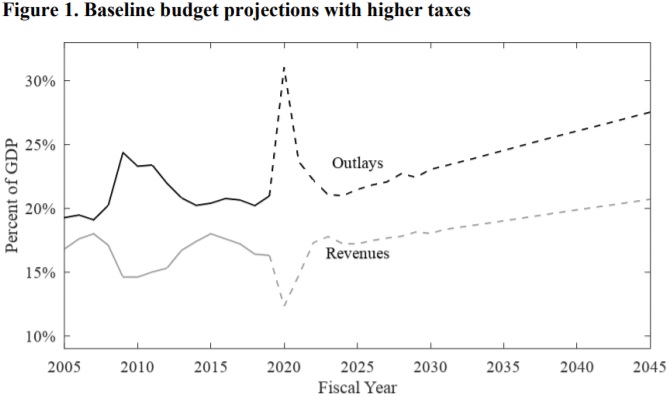
…our baseline assumes that future Congresses will enact tax increases to finance a portion of rising future federal spending. Specifically, we have assumed that Congress will finance half of the projected higher baseline outlays with higher tax rates. The tax rate increases are assumed to be gradually phased-in and are in the form of equi-proportionate increases in personal income tax rates, corporate income tax rates, and social insurance tax rates. Under these assumptions, tax rates will be about 20 percent higher in 2045 than in 2022.
Here are their projection over the next 25 years.


The authors then create an alternative scenario based on spending restraint, including entitlement reform.
To illustrate the potential positive impact of a fiscal consolidation plan on economic growth, we have chosen a stylized long-term budget policy that reduces the growth in federal spending, maintains federal tax rates at their current levels, and limits the outstanding federal debt relative to GDP to its pandemic high level. …the spending side of the plan has three essential elements. One, reductions in government spending from the baseline which come exclusively from permanent changes in entitlement programs; the principal source of the federal government’s long-term fiscal imbalance. …Two, the plan contains an immediate one-time reduction in entitlement program spending that permanently lowers the overall level of government spending. Three, the plan permanently reduces the growth in entitlement spending thereafter from this lower level.
They then estimate what happens to the fiscal burden of government if policy makers choose spending restraint instead of bigger government and tax increases.
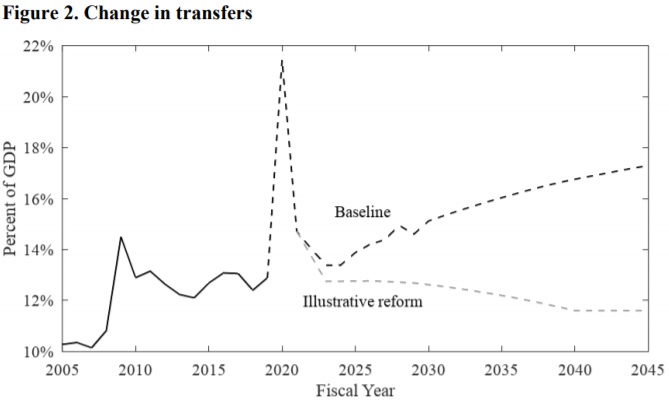
In 2033, ten years from the initiation of the policy, total federal spending as a percent of GDP, including interest on the debt, would be 3.3 percent lower than baseline expenditures. In twenty years, it would be 5.7 percent lower. …the consolidation plan would maintain all federal tax rates.at their current statutory levels. …revenue as a share.. of GDP would rise slightly over time due to real bracket creep. Thus, the plan is designed to prevent the approximately 15 percent tax rate increases that are presumed in the budget baseline.
Here’s a chart from the study that shows how the burden of redistribution spending and social insurance programs is significantly smaller with the restraint approach.


Now we get to key results.

Cogan, Heil, and Taylor use a model of the U.S. economy to estimate what happens if there is spending restraint instead of bigger government.  Unsurprisingly, there’s more prosperity when there’s a smaller burden of spending.
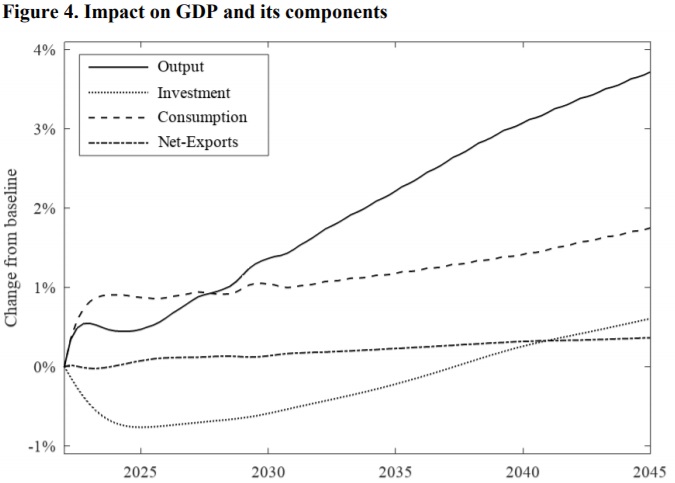
The impact of the consolidation strategy is shown in Figure 4. Observe that there is a substantial increase in real GDP in the short run, and that this positive change occurs throughout the simulation through 2045. The short-run increase of about 0.5 percent in the first two years following the policy’s implementation amounts to about a 10 percent increase in the real GDP growth rate. Over the longer-term, GDP increases by about 3.7 percent after 25 years. This is equivalent to a 7 percent increase in the economy’s real growth rate.
This chart from the study shows the economic benefits of spending restraint.


These results are consistent with what other economists have produced.  Heck, even economists at left-leaning international bureaucracies such as OECD, World Bank, and IMF have acknowledged that smaller government is better for prosperity.

P.S. The unanswered question, of course, is how to convince self-interested politicians to choose spending restraint instead of buying votes with other people’s money. A spending cap is probably a necessary but not sufficient condition (it’s an approach that has been very successful in Switzerland, Hong Kong, and Colorado – and which was recently adopted in Brazil).

P.P.S. Even small differences in economic growth have a significant long-run impact on living standards.


Saturday, August 1, 2020

Understanding “Public Goods”


I wrote last month about “anarcho-capitalists” who think we don’t need any government because markets can provide everything.

Most people, though, think that there are certain things (such as national defense and the rule of law) that are “public goods” because they won’t exist if they’re not provided by government.


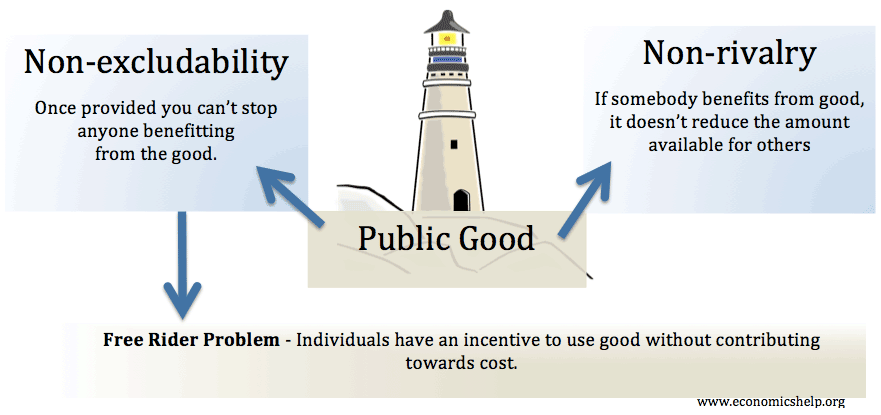
Academics tell us, if we want to be rigorous, that there are two characteristics that define public goods.
  1. They are goods that people won’t buy because they can reap the benefit without paying (economists say this means the good is “non-excludable” while normal people refer to this as the free-rider problem).
  2. They are goods that can be universally shared since one person’s consumption of the good doesn’t limit another person’s consumption of the good (economists say such goods are “non-rival”).
That’s a bit wonky, so let’s consider the example of national defense.

In a world with bad countries (or, to be more accurate, a world with nations governed by bad people), there’s a risk or external aggression. Since most people wouldn’t want to be conquered – and presumably mistreated – by foreign aggressors, national defense is valuable.

But how would it be provided in the absence of government? Maybe Bill Gates and Jeff Bezos would have an incentive to cough up some cash since they have a lot of wealth to protect, but most people (including most rich people) might figure that someone else would cover the cost and they could enjoy protection for free.

This two-part series from Marginal Revolution University explains public goods, using the example of asteroid defense. Here’s an introductory video.

And here’s a follow-up version that has a bit more detail.

I’m writing about this wonky issue because the debate over public goods, at least in some quarters, also is a debate about the size of government.

Consider this image of supposed public goods.


It shows all sorts of activities where governments today play a role, but most of those things aren’t actually public goods since they can be – and sometimes are – privately provided (see examples for fire protection, money, roads, education, health, air traffic control, and parks).

In other words, as Professor Tabarrok noted in the second video, something isn’t a public good just because it’s currently being handled by government.

Indeed, let’s look at the classic example of lighthouses, which often are cited as an example of something that absolutely must be provided by government. Yet scholars have found that the private sector led the way (before being supplanted by government).

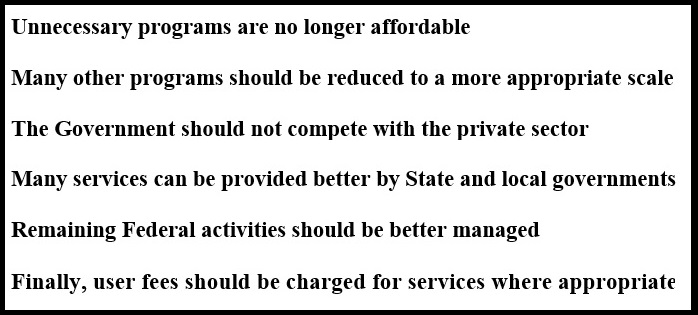
For a more prudent view of public goods, Ronald Reagan’s FY1987 budget included a set of principles to help guide whether the federal government should play a role in various areas.

Those six principles could even be boiled down to one principle: Always opt for the private sector whenever possible.

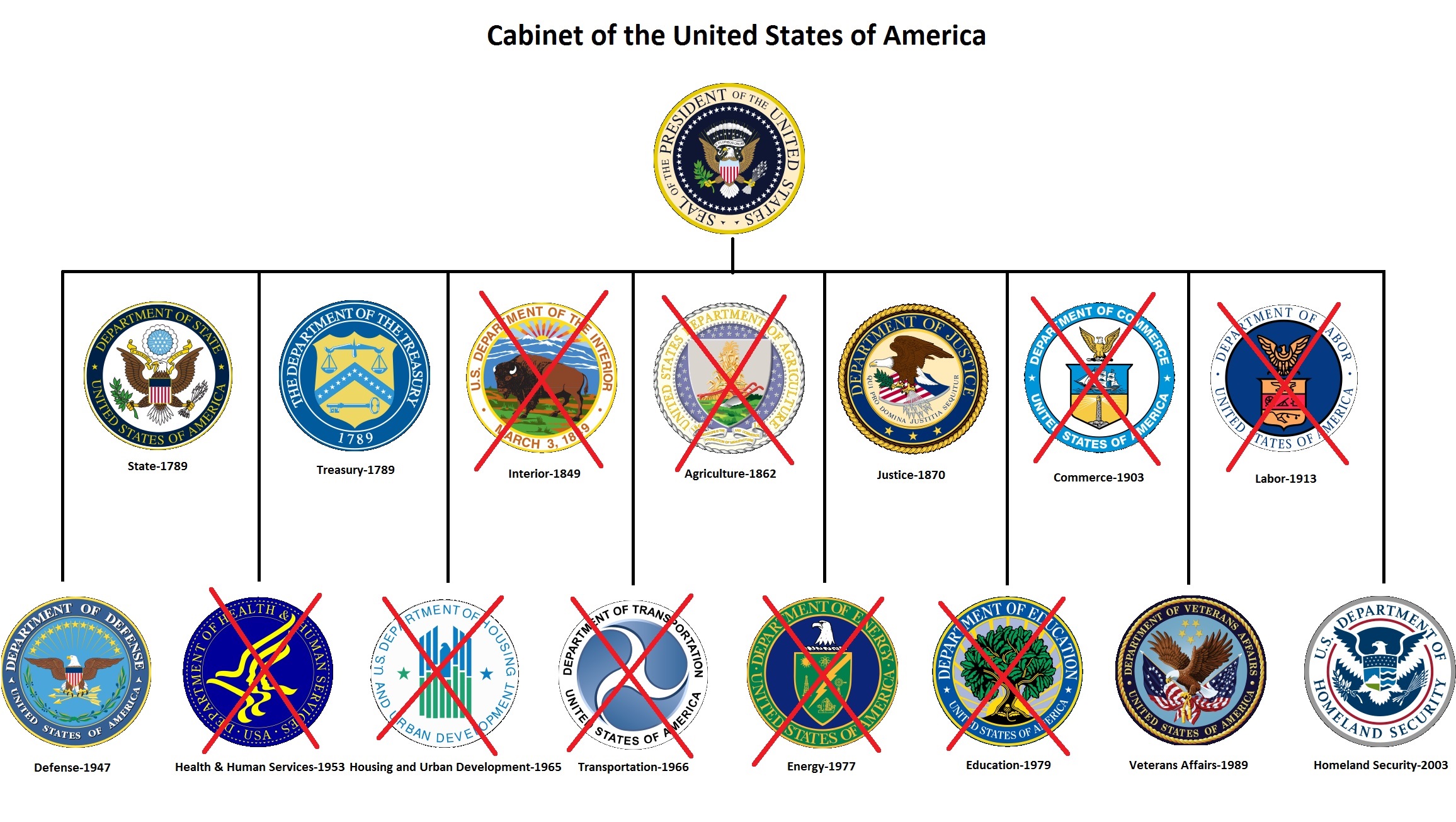
I’ll close by identifying the bureaucracies in Washington that provide genuine public goods. As you can see, much of the federal government (Department of Housing and Urban Development, Department of Education, Department of Energy, Department of Agriculture, Department of Transportation, etc) doesn’t qualify.
To be sure, I’m using a broad-brush approach with this image. Some of the bureaucracies that I crossed out do a few things that qualify as public goods (such as nuclear weapons research at the Department of Energy), and the bureaucracies that didn’t get crossed out do lots of things (such at veterans health care) that should be in the private sector.

The bottom line is that much of the federal government isn’t needed, based on what’s a genuine public good. And for much of America’s history, at least prior to the 1930s, Washington was only a tiny burden because it was only involved in a few areas, such as national defense.

Though it’s worth noting that government could – and should – be much smaller even using an expansive definition of public goods and the role of government.

Thursday, July 30, 2020

Canada’s Fiscal Policy Has Been Deteriorating Under Trudeau, even Before Coronavirus

July 28, 2020 by Dan Mitchell

Back in 2011, the Center for Freedom and Prosperity released this video citing four nations – Canada, Ireland, Slovakia, and New Zealand – that achieved very good results with multi-year periods of genuine spending restraint.


Today, let’s focus on what’s been happening with government spending in Canada. As explained in the video, America’s northern neighbor enjoyed a five-year period in the 1990s when government spending increased by an average of just 1 percent annually, with most of that progress occurring when the Liberal Party was in charge.

This fiscal probity – an example of my Golden Rule before I even invented the concept – paid big dividends. The overall burden of government spending, measured as a share of economic output, declined substantially. And because Canadian lawmakers dealt with the underlying problem of too much spending, that automatically solved the symptom of red ink. That’s the good news..........To Read More....

Wednesday, June 24, 2020

Stop the Madness of Congressional Spending

Stephen Moore Jun 23, 2020
The coronavirus shutdown has flattened multiple industries across America -- everything from airlines and manufacturers to hospitals, retailers, oil and gas producers, and restaurants. Many of the 30 million small and large businesses in the country have reported a 30% reduction in revenues. Amid the carnage, one sector of the economy is thriving like never before in the history of the republic: the government.

Congress has already spent more than $2 trillion on phases one, two, three and 3 1/2 of coronavirus relief packages. The irresponsible bill from House Speaker Nancy Pelosi would raise that spending total to $5 trillion, which is on top of the $4.71 trillion that Congress already authorized. We are getting very close to an unfathomable $10 trillion federal budget, which is more money in one single year, adjusted for inflation, than the nation devoted to fighting the Revolutionary War, the Civil War, World War I, World War II and the Vietnam War combined.

The problem is that the White House thinks that more debt spending by Uncle Sam will be a "stimulus" to the economy and will help President Donald Trump win reelection. The administration has put out the word that another $2 trillion, phase-four package with aid to states, payments to individuals and infrastructure spending -- a "compromise" -- is in the works. It is a prosperity-killing redistribution scheme, not an economic revival plan, Mr. President.

If Trump and the Republicans in Congress were to agree to another multitrillion-dollar spending plan, the government in 2020 would grow to its most substantial level and percentage of our economy in history. Do Republicans want that to be their legacy?

Including state and local expenditures, the government would, for the first time in the history of the United States, consume 52% of our $20.4 trillion gross domestic product. Government would be more significant than all of the output of every business and every private sector worker in America. Even the GOP "compromise" would push us close to the tipping point of government, more than 50% of GDP. It is nothing more than a road to financial ruin.

All we are doing here is "stimulating" the government and crowding out private spending and investment. Policies such as paying millions of people (more than 60% of workers, according to the Congressional Budget Office) more money to stay unemployed than to go back to work, and paying states more money to enable them to remain shut down, will inhibit the fast recovery we want in jobs and incomes, not stimulate it.

The offer of more federal money to Democratic mayors and governors enables them to keep their businesses shuttered and their commerce at a standstill because the feds will write them $50 billion checks.

One way to put the Washington spending blitz in historical perspective is to consider what happened during the Great Depression in the 1930s. Even at the height of what many at the time called Franklin Roosevelt's "socialist New Deal," government spending never eclipsed 20% of GDP. Pelosi has said that these times require a "Rooseveltian" response, but what we are doing now is 2 1/2 times the New Deal in size relative to the private economy.

The phase-four spending bill would bring total government spending to nearly $80,000 per U.S. household, or $20,000 more than the median per-household income in 2019 of roughly $60,000. If all this government spending were the magical solution to all our economic woes, we would all be feeling wealthy right now, but somehow, despite all the government "aid," we are all feeling much poorer.

Last week, a coalition of conservative leaders and organizations under the banner of "Save Our Country" signed a letter asking the White House and Senate Republicans to "stop the madness of runaway spending." The letter, signed by several dozen prominent conservatives such as economist Arthur Laffer, former Reagan Cabinet members Ed Meese and James C. Miller, and former Sen. Jim DeMint, argues that "runaway government spending is the new virus afflicting our economy. The best way to supercharge a jobs recovery would be to repeal the payroll tax so that every working American would receive a 7.5% raise in (their) paycheck immediately, and every small business would see a reduction in their payroll costs of an equal amount. This incentivizes hiring and work. The economy desperately needs more of both of these and less debt spending."
Recommended
Sen. Elizabeth Warren of Massachusetts tweeted out in response to the "stop the spending" letter that Republicans who want to stop government spending and debt lack compassion. But government spending isn't compassionate. It is wasteful, inefficient and counterproductive. Let's hope the Republicans rediscover their fiscal conservative credentials before they join Pelosi and Warren in their crusade to spend us into financial ruin.

Stephen Moore is a senior fellow at the Heritage Foundation and an economic consultant with FreedomWorks. He is the co-author of "Trumponomics: Inside the America First Plan to Revive the American Economy." To find out more about Stephen Moore and read features by other Creators Syndicate writers and cartoonists, visit the Creators Syndicate website at www.creators.com.


Thursday, May 28, 2020

Margaret Thatcher’s Message to Washington’s Big Spenders


Margaret Thatcher was the British version of Ronald Reagan, a leader who resuscitated a nation by rolling back the size and scope of government.  She also is famous for one of the most accurate observations ever made about fiscal policy.


Her warning proved prophetic when the Soviet Bloc collapsed. Her wise words also could be applied to what happened about a decade ago in Greece. And what’s about to happen in Italy. But let’s not forget that the United States isn’t immune to the problem of excessive government. The Wall Street Journal has a sobering editorial on the pro-spending sentiment that dominates the nation’s capital.
…in Washington the politicians are debating how to spend another few trillion dollars in the name of virus relief. …Mrs. Pelosi’s House bill promises another $3 trillion for her various constituencies on top of the $2.7 trillion or so Congress has already spent on the pandemic. The goal is income redistribution… This political strategy may work since Republicans, as usual, are divided and defensive. …Mr. Trump…seems torn about what to support and is thinking only as far as November. This is a recipe for another deal on Democratic terms… Sooner or later the pandemic will end. The question is what kind of economy will be left. A second Cares Act would leave a legacy of vastly larger government that would mean slower growth and take years to overcome.
Yes, the spending binge will mean slower growth. But I’m even more worried about what will happen in the future. Here are three things to keep in mind.
  • Largely because of Bush, Obama, and Trump, the federal budget has tripled since 1980 (Reagan and Clinton were comparatively frugal). Keep in mind that the increase in the accompanying chart shows the growth in spending after adjusting for inflation.


  • However, politicians are spending more money. A lot more.  As shown in the accompanying chart, this has caused a huge spike in per-capita outlays. And the crowd in Washington wants to make the red portion much bigger.
Given all this bad news, does Thatcher’s warning about running out “of other people’s money” apply to the United States?

As bad as the numbers are, my two cents is that the U.S. won’t suffer a fiscal crisis anytime soon. As I noted at the end of this interview, Washington can probably continue with business-as-usual fiscal policy for several more decades (Adam Smith observed that it usually takes a lot of bad policy over a long period of time to cause economic ruin).

But that doesn’t mean it’s a good idea to travel down that path.

Here’s an analogy. Smoking three packs of cigarettes a day presumably won’t kill someone within the first 10 years, but it’s definitely not a recipe for long-run health and vitality. Sooner or later, there will be consequences.

A mature and sensible people (like the Swiss) take steps to avoid the fiscal version of those bad consequences.

For what it’s worth, similar reforms have been proposed for the United States. Unfortunately, too many American politicians and consumed by self-interest and don’t think past the next election.

Thursday, May 7, 2020

New Ideas for Regaining Control over Mandatory Spending

Posted by Craig Eyermann

Now that four years of falling budget deficits have officially come to an end, how can the U.S. Congress regain control over federal spending?

Previously, we looked at one basic common sense proposal that could slow the spending for the U.S.’ fastest growing mandatory expenditure, Medicaid, but what tools does the U.S. Congress have to deal with all of the federal government’s other mandatory expenditures that will dominate the nation’s budget deficits for the foreseeable future?

That’s an interesting question posed and answered by Rudolph Penner and Eugene Steurle in a recent paper sponsored jointly by the Mercatus Center and the Urban Institute. Penner and Steurle recognize that mandatory spending will be responsible for virtually all of the projected increases in U.S. government spending over the next 10 years......To Read More....

My Take - This is all very interesting but the only way to really fix this is:
  1. Repeal the 16th Amendment.  This is the income tax amendment.  A few years ago when in Washington someone asked the speaker, Bob Dole, (right after he lost the election for President) if it was still true the income tax collected from our pay checks still only pays for the IRS.  I snickered thinking that was silly.  Dole paused and then said - I'm not sure, but I think so.  Wow!  Was I stunned.  Is that really true?  I don't know, but that's what was said.  If so - eliminating the income tax will probably save the nation money, but if more really is needed then pass a national sales tax with no exemptions or exceptions.  That way everyone will have skin in the game. 
  2. Repeal the 17th Amendment. This is the Amendment that changed how Senators are chosen.  The founding fathers wanted to make sure there was a permanent balance of power between the states and the central government, so originally Senators were appointed by their states to represent them.  In effect - they were the state's ambassadors to the federal government to represent the intrests of their states and keep the central government in check. 
  3. Pass a 28th Amendment to create age and term limits on the federal judiciary, and I've decided it was time to add the members of Congress to that Amendment also. 
To fix the federal government we need to starve it, bind it and purge it.  From that point on everything will start to fall into place with the natural contraction of the federal government and it's bureaucracies.

Tuesday, May 5, 2020

The End of Cost


By Peter Zeihan on May 4, 2020

In the past five weeks the United States has thrown $3 trillion in new government spending at coronavirus-related bailouts, relief and economic stimulus. In total the US has already spent more on coronavirus-related actions than the rest of the world combined, tripled. Strangest of all, not one dime of it is backed up by new government revenue streams; every bit is deficit spending.

Nor is the United States likely to overly suffer from the expansion of its debt burden. Of that $3 trillion in new spending, the Federal Reserve’s total purchases of US debt is “only” $1.3 trillion. The rest of the debt bulk has been absorbed by other investors, mostly foreign investors. Such is the scare globally that many are eager to get a zero rate of return on an American government asset rather than risk their money at home.

Nor is the United States even remotely done. At least another $1.5 trillion is on deck for May, with another batch likely during the summer. None of this includes any of the monetary policy actions from the Federal Reserve, nor does it include likely inducements for American firms to relocate from China to literally anywhere else.

The feeling in the United States is that coronavirus is not only a crisis, but it is the type of crisis which necessitates heretofore unprecedented government action. And since government action isn’t free, everyone is willing to go along with big price tags. This feeling is strikingly bipartisan. In the first two week of the coronavirus crisis, Congress passed more legislation of substance than in the previous ten years. I’m not suggesting for a moment that American politics have entered a kumbaya moment, but instead that the very concept that price means anything has passed into myth. And if my broad forecasts for the future of Europe and China hold true, it will stay there for years to come.

There’s a political side to this willingness to throw a bottomless pot of money at the problem as well.

America’s political parties are in flux. Factions rise and fall in the hierarchies, and sometimes drop out of party structures or vanish altogether. Sometimes, leadership can move such transitions along much faster. In the case of America’s fiscal conservatives, Trump’s transformation of the Republican Party into his personal vehicle excised the fiscal conservatives (along with the business conservatives and national security conservatives) from the Republican coalition altogether. It is entirely reasonable to expect the fiscal conservatives to eventually find a new home, but for now the brake that they have institutionally imposed upon government spending is simply not present.

Which makes the next few years a time for big-ticket ideas. There are plenty of them bouncing around in the American political space. Many are near-and-dear to the Left, who at their core see the government as a change-agent which has the right and duty to uproot and remake society. Yet these days the Right is hardly aghast at big spending either. After all, America’s biggest (pre-COVID) budget deficits happened under the Trump administration. Let’s take a look at the most likely culprits:

Infrastructure spending:

This one is not only a perennial favorite, but its time has finally come. Typically, hang ups have included pork barrel politics, general ideological clashes over the nature and goals of this or that piece of infrastructure, state v federal decision-making authority and fund sourcing. But mostly it has been about cost. If you disagree with someone’s infrastructure plan on any non-cost point, you can always oppose it as being “wasteful”. That argument just vanished. And since everyone agrees in general that infrastructure spending is good (it’s just the other guys’ specific ideas that are kooky) expect a lot of it in the not-so-distant future.

Updating America’s interstate road, rail and water infrastructure would run a cool $3 trillion. A nationwide 5G effort would add another trillion. And that doesn’t even touch municipal infrastructure which could easily add another $2 trillion.

Universal basic income:

The concept of UBI is that government should provide every citizen with a monthly or weekly payment for “basic” expenses such as rent and food and power. As the argument goes, as automation erases more and more job categories, some sort of universal payout is the least disruptive and cheapest-to-administer method of wealth redistribution.

Many criticize the very concept because it would denigrate the work ethic. Others like the fact that it would introduce a sharp class distinction between earners who pay taxes and a loafing class that simply subsists (many of these folk in this second camp assume – probably correctly – that over time UBI would introduce different tiers of political rights, with those who do not pay into the system losing full voting rights).

One of the biggest reasons no one has really tried UBI is that it is expensive to attempt, and no one knows if it’ll work because no one has ever really tried it at scale. Well, as part of the coronavirus stimulus and bailout packages, most citizens received a $1200 check and anyone on unemployment gets another $600 per week on top of their standard benefits (meaning many on unemployment are now making more than they did while working). More cash payments are all but certain for the next couple of months, and an extension of unemployment benefits are pretty much baked in as well.

Functionally, the United States is trying UBI out right now. A few months from now we’ll finally have a real-world, at-scale example of how UBI works. And if it works well, expect a massive push to implement it on a permanent basis.

Defense expansion:

I’ve always found the process of deciding defense spending fascinating. Even in the days after the Sept 11 attacks, it was ridiculous to think that Islamic terror posed a more existential threat to the United States than the Soviet nuclear arsenal. And yet US defense spending today – with the Global War on Terror largely wound down – is higher than it ever was during the Cold War. Defense specialists are bracing for what they see as the inevitable spending drawdown. I simply don’t think it is going to happen.

Today the annual budget of the Defense Department is just shy of $750 billion, plus another $52 billion for Homeland Security and $63 billion for the intelligence agencies. If there is going to be a budget reduction, it will come from American forces being fully brought home. Although, honestly, closing America’s overseas bases means future deployments likely will cost more because the military will need to launch from the homeland rather from a foreign footprint closer to the action.

A partial solution to that imbroglio? Don’t cut funding at all. In fact, invest in more long-range deployment capacity.

Universal health care:

America’s health care system is the world’s most expensive, but from the quality of the care provided (not to mention the system more or less falling on its face during COVID) you wouldn’t guess it. The smart conversation would be how to institute real health care reform (as opposed to Obamacare which simply introduced health care payment reform), but that unfortunately isn’t the conversation that’s starting.

Instead, the passion from politicians such as Bernie Sanders is for free health care for all, based on the Medicare model, which is by far the least efficient, lowest quality, most expensive option possible. Leaving aside both the financial estimates of the Sanders crowd and their detractors, most independent estimates put the cost for Medicare for All at least $2 trillion. Per year. Normally, such proposals would founder on the rocks of cost. Not anymore.

Green New Deal:

Contrary to much rhetoric (which I guess is the case with all these ideas), the GND is less a well thought out plan and more an ideological grab bag of Green/socialist concepts. That has been enough of a deal killer to turn most moderate Democrats against it, as well as those within the Green movement who think that math needs to be part of the discussion (which would include me). Bottom line? There really isn’t a real plan yet, but with Americans shifting into a price-as-myth mindset, I bet there will be one soon.

Any meaningful GND would need to require the near-complete overhaul of nearly every economic sector ranging from automotive to construction to power to agriculture to raw materials. We haven’t even invented many of the technologies that would be required, which, at present, makes any brass-tacks budget proposal impossible. But suffice to say if it could be done for $10 trillion, that would be really, really cheap.

It doesn’t take much imagination to foresee a potential political alignment in Congress to dump a few supertankers of twenties on this or that Green-friendly policy. At a minimum, I expect much increased subsidies for this or that greentech, even if (especially if) they haven’t yet proven to be market ready.

Industry bailouts:

While I expect much of the country to be returned to work by mid-July, there is much about the coronavirus we do not yet know. For example, if it turns out that everyone who gets it can be re-infected a few weeks down the road, then the fundamental structure of the American economy will have to adapt to a fundamentally new reality. Such changes in circumstance will not impact all sectors or firms equally, generating scads of winners and losers. Without financial assistance, some sectors will shrivel and firms within those sectors will simply die.

But with a bottomless supply of funding available? Not so much.

Some of these are pretty obvious. Just off the top of my head, tourism, aerospace, child-care, education and restaurants look particularly endangered. The question is where to draw the line.

Consider air travel. Of course, we’ll bail out the airlines. What about airports? What about aircraft manufacturers like Boeing, or aircraft maintenance firms? Do we bail out all their hundreds of component manufacturers as well? What if key components are manufactured in other countries? Are those firms rescued? Normally, the fear of not knowing when to stop establishes a natural firebreak on bailouts. But that fear is rooted in the fear of cost. That fear no longer applies.

State and municipal bailouts:

Most American states have balanced budget amendments, and most gain their income from sales and income taxes which have pretty much gone to shit during the coronavirus crisis. Add in that many have wildly out-of-control pension funding issues and many states faced financial catastrophe before COVID. With COVID its more like financial Armageddon.

So far Congress has only extended the states and cities very limited assistance, with Senate Majority Leader Mitch McConnel (R-Ky) dead-set against any sort of broad-based bailout program. It isn’t simply about ideology. Some states are actually doing ok (all things considered), so rewarding states who have failed to reform their systems does bring up issues of fairness and moral hazard.

But the fact remains that the single biggest reason not to do some sort of federal bailout – cost – just doesn’t mean as much as it used to. (It is also worth mentioning that the sort of financial power and flexibility which enables the federal government to spend as much as it wants does not extend to the states and municipalities. They are not sovereign powers with their own currencies.) Some sort of federal fund designed to provide at least bridge funding is probably inevitable.

All these possible programs have multiple policy, strategic and cultural implications.
  • If the federal government bails out a firm, does the government take shares? If the bailouts are big enough and last long enough does that mean the US government becomes the majority owner? We have a word for that: nationalization. Can you nationalize a city? A state?
  • An America that doesn’t right-size its military for a new era, and expands its budget to make it very easy to reach out and slug someone, is a country that is perfectly willing to level any country anywhere for nearly any reason.
  • Massive infrastructure programs are not simply about building roads and bridges, they are designed to rewire economies for decades (my adopted home state of Colorado has a 100-year infrastructure plan). Decisions made now will guide the country’s development, literally for generations. There will be winners and losers.
  • An America on UBI is one that faces a wide array of utopian and dystopian futures. Consult Andrew Yang for the utopian, and the sci-fi series The Expanse for a good example of the other one.
There are those who would argue that none of these – let alone a few, much less all of these – would ever creak past the shrieks and performative rage of the Senate’s erstwhile fiscal hawks.

Ha! There are few things politicians of any political stripe care about more than getting reelected. And as the Trumplicans’ central rally cry – a booming national economy – crumbles, you can be sure that if not Senate Majority Leader Mitch McConnell, then President Trump’s survival instincts are going to go into overdrive.

Trump’s populist tendencies coupled with the very real economic pain being felt across broad swathes of the American electorate provides the current administration with an obvious path forward to electoral success: absolutely massive soci al spending.


If you enjoy our newsletters, please consider showing your appreciation through a donation to Feeding America if you are able to do so. One of the biggest problems the country faces at present is food dislocation: pre-COVID, nearly 40% of all foods were not consumed at home. Instead they were destined for places like restaurants and college dorms. Shifting the supply chain to grocery stores takes time and money, but people need food now. Some 23 million students used to be on school lunches, for example. That servicing has evaporated. Feeding America helps bridge the gap between America's food supply (which remains robust) and its demand (which coronavirus has shifted faster than the supply chains can keep up).

A little goes a very long way. For a single dollar, FA can feed one person for three days.

DONATE HERE