Search This Blog

De Omnibus Dubitandum - Lux Veritas

Showing posts with label Government Bailouts. Show all posts

Sunday, August 11, 2024

The High Cost of Short-Run Political Decision-Making

August 10, 2024 by Dan Mitchell @ International Liberty

Why do politicians such as Donald Trump and Kamala Harris show no interest in fixing Social Security and other entitlement programs?

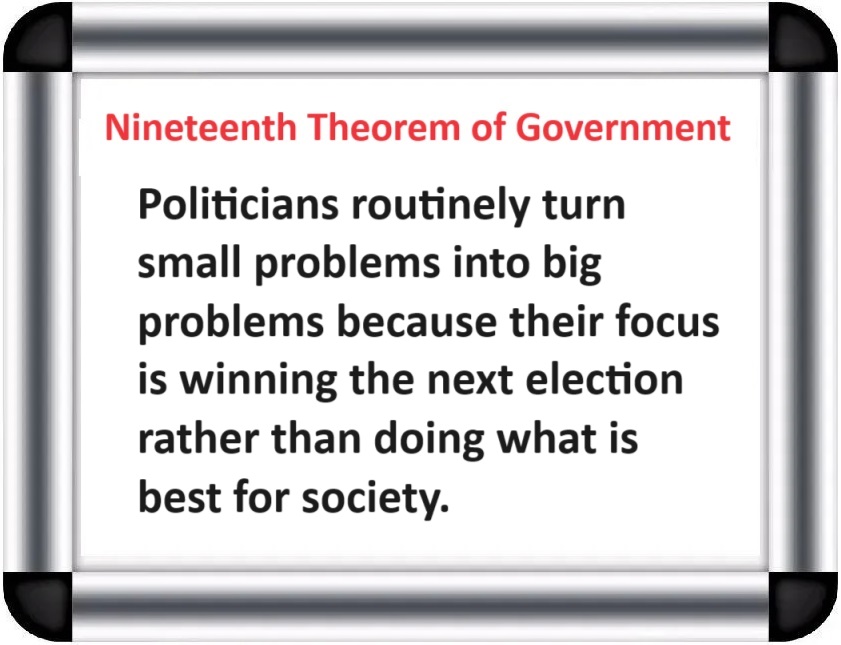
The answer is “public choice.” They are focused on maximizing votes and power in the short run rather than doing what’s best for the country in the long run.

This is a pervasive problem and deserves its own theorem.

I’m motivated to share this new theorem because of a George Will column in the Washington Post.

But he’s not writing about fiscal policy. He has another example of how we get bigger problems because of short-term thinking by people in Washington.

With frequent references to Thomas Hoenig, the former head of the Kansas City Federal Reserve, he’s writing about bad monetary policy. Here are some excerpts.


How high will be the cost of interest rates, having been too low for too long? Events might be teaching a tutorial on the steep price of cheap money. …One purpose of the low rates was to send a flood of money into the increasingly frothy stock market… The Fed’s balance sheet of government and government-guaranteed assets, by which it nudges down interest rates, grew from $900 billion in 2007 to nearly $9 trillion in March 2022. …whenever the Fed has tried to “normalize its balance sheet and interest rates, the market has become unstable.” …

The question now…is will the Fed properly allow rates to come down only as inflation falls to the Fed’s 2 percent target, or will it aggressively try to fend off unwanted, but necessary, corrections — necessary for “better long-run outcomes?”

…Monday’s stock sell-off…ignited worried chatter about whether the Fed should have cut rates the week before, or might have to do so as an “emergency” measure before its scheduled meeting next month. This is not what panicky markets need: yet another government entity declaring yet another emergency.

What Hoenig correctly worries about (and what George Will is writing about) is the problem of a boom-bust monetary policy.

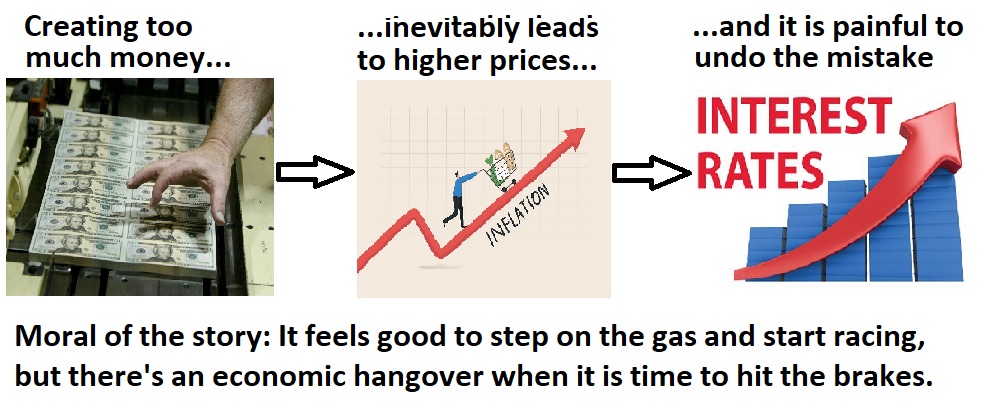
Politicians like the sugar high the economy gets when the central bank creates excess money.


But that excess money creation inevitably causes bad things such as higher prices and asset bubbles.

The best thing is not to make the mistake in the first place. But if the mistake is made, the obvious solution is to “normalize” policy by withdrawing the excess money from the system.

However, this is painful in the short run, so politicians and the central bankers they appoint often don’t have the fortitude and integrity to do the right thing (Ronald Reagan was an exception to the rule).

I started this column with a fiscal policy example. I then cited a monetary policy example. Let’s now close with a bailout example.

Here’s a tweet making the point that propping up profligate nations is a recipe for more profligacy.

The tweet is about a central bank (the ECB) subsidizing bad behavior with bailouts, but it applies also to fiscal bailouts (like TARP) or international bureaucracy bailouts (like the IMF).

The bottom line is that bailouts produce moral hazard. Reward bad behavior and you get more bad behavior.

That make no sense, but politicians and their appointees are drawn to such policies because they want to minimize pain in the short run even though they are creating the conditions for far more pain in the long run.

P.S. Debt limit fights are an example of some people supporting short-run pain in order to reduce the likelihood of much greater long-run pain.

Tuesday, September 12, 2023

Can Argentina Be Rescued, Part II

September 11, 2023 by Dan Mitchell @ International Liberty

Last month, a plurality of Argentinians voted for a libertarian in their nation’s presidential primary. This shocking result may be an sign that voters have sobered up and realized that they have “run out of other people’s money.”

This video from The Economist explains the country’s economic challenges

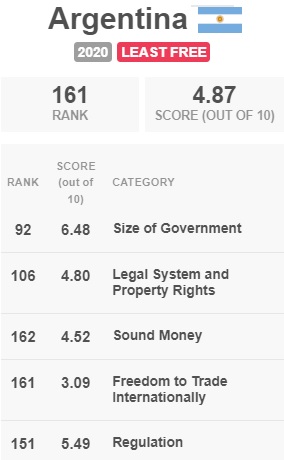
For what it’s worth, The Economist is not a libertarian-friendly publication. So it is especially remarkable and noteworthy that the video clearly explains that Argentina’s problems are the result of statism (the country has the world’s fifth-lowest score for economic liberty).


Argentina’s economic misery is not a surprise to anyone who has paid attention, as I explained in Part I of this series.

The situation is tragic. Argentina used to be one of the world’s richest nations. Unfortunately, it has suffered from varying degrees of Peronism since World War II (occasional right-of-center governments often are just as bad as the Peronists).

As a result, Argentina has suffered a massive decline in relative living standards.

One reason for decades of bad policy is that the bureaucrats at the International Monetary Fund have a terrible track record of rewarding Argentina when it gets in fiscal trouble (22 bailouts so far!).

The IMF’s bureaucrats seem to think that “moral hazard” is a good thing rather than a bad thing.

So what’s the main lesson to be learned? In part, it will be good if Argentinian voters reject Peronism later this year in their presidential election. But I worry that won’t be enough if international bureaucracies like the IMF continue to play a malignant role.

 Editor's Note:  Please take some time and review My Argentina File, which goes back to 2012.  RK

Tuesday, September 6, 2022

A Trillion Dollar Bailout for the Idiot Machine

September 05, 2022 @ Sultan Knish Blog 

Government institutions are in the business of making things worse in order to collect more money to make them better. We declared war on poverty and impoverished ourselves. After promising to fix homelessness, the streets are covered in needles and human waste.

Nowhere is this truer than in education.

Education results are inversely proportional to the amount of money spent on them. New York has the highest per pupil spending at $25,645 and the second lowest literacy rate in the country. Utah has the lowest per pupil spending in the nation and a 90% literacy rate.

Good thing the education market is set to hit almost $2 trillion by 2025. At 10% of GDP, we will spend far more than China (4% of GDP) with much worse outcomes to show for it. But Educrats will claim that if we only spent 25% of our GDP, Johnny would finally be able to read. All that’s holding him back is that Chicago public school teachers with an MA only make $89,083.

The American Federation of Teachers put out a study claiming that funding levels should cause New York school districts to "perform well above average on national fourth and eighth grade math and reading exams." They did not. And no matter how much money is wasted, they never will. You can’t buy literacy with subsidies for a broken education system. At any level.

Ever since Bill Clinton told working class people that manufacturing jobs weren’t coming back, so they all better go to college and learn to write lesbian feminist poetry, the number of college enrollees and graduates has shot up. So have their illiteracy rates.

1 in 3 American adults with a job and a BA lack minimum skills in ‘numeracy’ and 1 in 5 "lacks minimum skills in literacy". The college grads with the highest literacy and numeracy rates worked in engineering, math and science and the lowest worked in Dr. Jill Biden's noble calling of education. Those who can’t learn are tasked with teaching so no one else will know anything.

A recent Gallup survey found that college graduates now read six fewer books than in 2002 or even 2016. Those numbers were just another swoosh on the long downhill slide of academia. The Department of Education's own literacy survey had found that prose proficiency among college graduates had dropped from 40% in 1992 to 31% in 2003.

The number of college graduates increased from 27% in 2005 to 32% in 2019. Are we any smarter for it? Current numbers suggest that “half of U.S. adults, aged 16 to 74 years old — 54% or 130 million people — lack literacy proficiency” while “the average American reads at the 7th- to 8th-grade level”. College for everyone is only making everyone dumber.

Having failed to teach basic literacy at the elementary school, middle school and then high school levels, they’re trying and failing to teach basic literacy at the college level.

"40% to 60% of first-year college students need remediation in English, math, or both" at a cost of $7 billion. In California community colleges, 80% of students go into remediation. Even with remediation, they're much less likely to graduate. Students who were promoted through a failed public school system get to college only to discover that they’re not actually ready for college.

One story describes a student named Latasha Gandy responding to a placement test showing she needed remedial classes by asking, “How is that possible that I'm not ready for college when I graduated with a 4.2 GPA?”

In response to the cries of racism, universities are jettisoning remedial classes. California State Universities dumped theirs, putting more pressure on adjuncts to pass illiterate students. That fits into the larger destandardization movement of getting rid of grades, expectations and tests. Hiding standards makes it a little less obvious how worthless the entire educational system is.

If you can’t see the numbers, you can pretend that they aren’t there.

Biden’s illegal trillion dollar bailout shows that the real customer of the educational industry is the government. And what the government wants are woke illiterates who know party dogma but can’t make their way through a simple sentence or handle cash register addition.

Free college is worth every penny.

Education is about everything except basic skills and competencies. A college degree is a mark of cultural affiliation, a badge of political allegiance and a warning sign of basic illiteracy. The institutions of higher education are employment agencies for political activists, think tanks for leftist sand castle wonks, and community organizing centers for the next generation of rioters.

Like their former Soviet counterparts, their only real subject is party dogma which is dumbed down to a level that even the dimmest dolt can repeat back for a passing grade. Much as Marxism-Leninism pervaded every subject at a Soviet university, wokeness has spread from the social sciences and humanities into actual science, from engineering to medicine.

Biden’s trillion dollar student loan bailout services his base constituency at the expense of the country, but the educational system long ago sold out the country for political radicalism. When it comes to learning competencies and skills, any functional first world country leaves us in the dust. But that’s not what our education system is for. Educrats assert that education is for conveying societal “values”, teaching “tolerance” and promoting “activism on issues such as racism and climate change”. It doesn’t matter if Johnny can’t read: it’s best if he never does.

Reading enables the literate to compare sources, analyze language and find their own answers. Math skills offer independence and the ability to understand where the tax money is going. Neither are desirable competencies in the United States of Woke where ideas are best conveyed in TikTok videos by influencers and in the classroom through oral invective.

The idiot machine of education is doing exactly what it’s supposed to, making idiots, at a premium price, most of which goes to various elements of the leftist machine from unions to consultants to academics to publishers to the politicians they all subsidize with their donations.

And the politicians send our money back to them.

American education isn’t broken because a $1.4 trillion educational industry employing millions can’t figure out how to convey the basic skills that 17-year-old girls teaching in frontier one-room schoolhouses were able to a century ago. Even a dunce like Dr. Jill Biden, never mind somewhat smarter educators, would be capable of teaching basic skills to first graders.

They’re choosing not to because they’re working on pulling off a much more challenging feat.

Anyone can teach basic skills, it takes a lot more work not to teach them, and to poison the well and salt the earth so that students never learn anything and are ready, overnight, to believe that the founders of the country were evil monsters or that women don’t exist. Call it anti-teaching.

Anti-teaching is much more expensive because it requires spending enormous amounts of effort distracting parents, other educators, the electorate and various relevant organizations from the reality that students aren’t learning anything except that fat shaming and the constitution are evil. All sorts of destructive stunts, racism, school shutdowns, common core, virtual learning, attacks on standardized testing, and graphic sexual materials are used to divert their attention.

And our educational system, the worst outside of Somalia, does it year after year. Property taxes are raised, lotteries are gamed and all sorts of revenue is hijacked with promises that another $1,000 per pupil, more benefits for teachers or free college will finally fix things.

So the suckers never figure out that the game isn’t fixing education: it’s destroying it.

We could spend a million dollars per student and the illiteracy rate would be far worse. Every classroom could be made out of solid gold and every man, woman or child could be gifted with a free pass to Harvard, Yale or the Fashion Institute of Twin Falls, Idaho with even more catastrophic outcomes for a functional society and adults capable of adding 2 + 2

Biden’s trillion dollar bailout for the idiot machine.is a forced contribution by taxpayers to the grand scheme of indoctrinating foot soldiers for the leftist revolutions tearing apart the country.

It’s not about the money, it’s about destroying America.

Daniel Greenfield is a Shillman Journalism Fellow at the David Horowitz Freedom Center. This article previously appeared at the Center's Front Page Magazine. Click here to subscribe to my articles.  Thank you for reading.
 

Friday, May 27, 2022

For Rich Universities, Billions in Bailouts

May 26, 2022 By Patrick Nelson 

When the first global pandemic in more than a century began spreading around the world in early 2020, the U.S. government mounted a shock and awe response worth trillions of dollars.

The inflationary and market-warping effects of this spending binge will reverberate for years, as will the debt payments -- U.S. government debt just surpassed $30 trillion for the first time in our history. That is a growth-sucking 130% of annual GDP.

For a preview of the effects of a huge sum of government money flooding any market, look at higher education. My firm, Nelson Partners, manages 23 investor-owned apartment complexes near 15 campuses in 13 states.

The COVID crisis produced a windfall of billions of dollars for colleges and universities, even as they shut down most of their operations and taught courses online -- and kept charging full-boat tuition. My company lost $12 million and managed to get a $1.2 million loan.

In the 15 years since I formed Nelson Partners, tuition at public four-year schools is up 180%; at private universities, the cost is up 124%. In fact, college costs have risen more than four times as fast as the inflation rate for fifty years!............To Read More...


Wednesday, March 10, 2021

Stephen Moore: Here's How Red States Can Fight the 'Blue-State Bailout'

By Stephen Moore | March 9, 2021 @CNSNews

Congressional Democrats are a runaway train with a drunk-on-power conductor in House Speaker Nancy Pelosi. No matter how much evidence pours in that the economy doesn't need $1.9 trillion more in debt spending, the Pelosi locomotive keeps crashing down the track toward the financial cliff. Generations will have to pay for the joyride.

One of the worst features of the bill is the "blue-state bailout." Twenty-one Republican governors and one Democrat are protesting the "biased" formula for allocating some $400 billion to the states. South Carolina Gov. Henry McMaster complained that the bill "punishes" states that did the right thing by keeping their economies and businesses open during the pandemic.

Florida Gov. Ron DeSantis said the bill "loots" the red states to pay for Democratic governors who have locked down their economies.

DeSantis has good reason to complain. Florida has a slightly higher population than New York, but New York gets $2,799 per person, or twice as much money as the $1,355 per person that Florida receives. In other words: Floridians are paying for New York Gov. Andrew Cuomo's incompetence. That is precisely what is happening because the main factor in determining how much money each state gets is not its population but how high its unemployment rate has risen.

The three states that get the most significant share of the money are New York, California, and New Jersey. These are three of the most liberal states with Democratic governors. That's not a coincidence.

Blue Pennsylvania gets more per person than red Ohio. Blue Massachusetts and red Tennessee are about the same size, but somehow, Massachusetts receives $1.5 billion more in handouts. Connecticut gets twice as much bailout money as Utah, despite the fact that they are about the same size in population.

The governors' joint statement declares: "A state's ability to keep businesses open and people employed should not be a penalizing factor when distributing funds. If Congress is going to provide aid to states, it should be on an equitable population basis."

But it isn't. The way Congress passes out money is akin to assigning the highest performing students an F and the lowest performers an A. Maybe this is what the left means by "equity." The last shall be first.

Most red states have already balanced their budgets. So how will Republican governors use their free money?

Here's a better idea: Rather than squander the money with more bureaucratic spending and the risk of inflating a financial bubble in their state budgets in the years ahead, devote every penny of these funds to finance tax reform and relief. Eight states have no state income tax. Those states are Alaska, Nevada, South Dakota, Washington, Florida, Wyoming, Tennessee, and Texas.

It would be rough justice for the blue-state bailout. If Democrats take the red states' money, Republican governors should make their states income-tax-free havens and steal the blue states' families and businesses. The states without income taxes create twice as many jobs as the high-tax blue states.

If you think California, Illinois, New Jersey, and New York are melting down now, wait until they have to compete against regions of the country in the South and the mountain states with no income taxes.

Will the last person in New York please turn out the lights?

Stephen Moore is a senior fellow at the Heritage Foundation and an economic consultant with FreedomWorks. He is the co-author of "Trumponomics: Inside the America First Plan to Revive the American Economy."


Saturday, October 10, 2020

Democrats Want You to Pay the Media’s Bills

While small businesses go under, Democrats are bailing out the media.

Daniel Greenfield @ Sultan Knish Blog

The media is dying. Its business model is defunct. Its bias has alienated most of the country. In the latest Pew survey, the only group that still trusts the media are Democrats.

And while so many millions are out of work, Democrats are bailing out the media.

The wave of consolidations and bankruptcies is sweeping like a fire through major papers. Cable news will be a casualty of demographics and the end of bundling. The end of network television is less than a decade away. Brand names like CNN and MSNBC will soon be where Time, Newsweek, and other news magazines ended up once subscriptions collapsed.

The media is dying, but it’s not about to die gracefully. It just needs to find money. Lots of it.

Big Tech billionaires have bought classic newspapers and magazines like Time, The Washington Post, and The New Republic, but those are vanity projects and even Jeff Bezos doesn’t have enough money to subsidize the entire ossified infrastructure of the media.

But the only people who have more money than the Amazon CEO are the American people.

The media’s Plan A has been sponging off Big Tech companies like Google and Facebook, pressuring them to pour hundreds of millions of dollars into its operations. Its Plan B is blurring the line between lefty activist non-profits and its newsrooms with organizations like Report for America being funded by Facebook and Google to embed activists into local newspapers.

Is that going to pay the media’s bills? No. That’s why there’s Plan C. And Plan C is you.

H.R. 7640: The Local Journalism Sustainability Act was introduced in Congress, backed by a coalition that includes Report for America and the National Newspaper Association, and would offer tax credits for newspaper subscriptions and tax credits for paying the salaries of the radical activists working there. There's also a $5,000 tax credit for advertising in newspapers.

At a time when millions of Americans are out of work, when families are faced with losing their homes and businesses, Democrats have decided that they should aggressively subsidize a dying industry at the expense of everyone else whose jobs are seen as “non-essential”.

The countless stores, gyms, bars, salons, and other small businesses going out of business in the epidemic of Democrat lockdowns and lootings could use this kind of bailout. But the Democrats insist that their media messaging operations are vital and should be subsidized.

While Rep. Ann Kirkpatrick, who introduced the bill, claims that it will fund “local newspapers”, those local newspapers are largely owned by national operations and hedge funds. While actual local businesses go out of business, Democrats are proposing a bailout for media investors.

Rep. Kirkpatrick’s press release touts support from from the News Media Alliance whose board is stacked with the heads of McClatchy and USA Today, huge national chains with a combined thousands of papers, not to mention the CFO of the New York Times, and a VP at the Washington Post. Are these the local small businesses Democrats want to subsidize?

The Local Journalism Sustainability Act has over 40 Democrat sponsors and nearly 20 Republican sponsors. Democrat sponsors include some of the House's most extreme figures like Rep. Ted Lieu, Rep. Raul Grijalva, Rep. Eric Swalwell, and Rep. Andre Carson.

H.R. 7640 would be an outrage at any time, it’s a particular outrage when so many Americans are out of work and so many small businesses are going under that Democrats and some Republicans want to provide a $250 tax credit for newspaper subscriptions, a tax credit covering half of $50,000 salaries for media hacks, and $5,000 credits for advertising in newspapers.

Companies that own dozens, hundreds, and thousands of papers are lobbying Congress.

They keep claiming that the bill will help save “local journalism”. But how does the Local Journalism Sustainability Act define local journalism? Not based on the paper, but the readers. As long as 51% of the paper’s readers live in the same state, it’s considered a local paper. Even if the paper is a subsidiary of a national chain whose real headquarters is in New York or D.C.

Or alternatively, they live within 200 miles of each other. Depending on how you measure, Washington Post readers in New York and New York Times readers in D.C. would be “local”.

That’s some “local” journalism. And it’s no accident that it was written this way.

There’s nothing local about this bailout. It will mostly go to subsidize the huge newspaper chains that are lobbying for it, while bribing businesses and readers to fund their failed business model.

Even while Democrats are destroying businesses with viable business models, they’re trying to keep the media alive by exclusively offering tax credits for their political allies.

It’s sleazy, it’s slimy, and it’s just the beginning.

Democrat organizations like Acronym’s Courier Newsroom have been setting up fake local papers while Report for America has been hollowing out papers by embedding radical activists into newsrooms. The Local Journalism Sustainability Act is testing the business model for converting the media into a bunch of political non-profits backed by taxpayers and lefty donors.

Beyond media associations, backing for the Local Journalism Sustainability Act comes from Report for America, and the American Journalism Project, which is advocating the transformation of the media to a non-profit model. Report for America is an initiative of the GroundTruth Project which is backed by the Knight Foundation, the MacArthur Foundation, and the Ford Foundation. The Ford Foundation is a leading backer of Black Lives Matter.

While these donors already back a network of radical messaging operations, proposals like the Local Journalism Sustainability Act allow the media to ease into the transition by having it both ways, maintaining corporate ownership, while having their operations subsidized by tax credits.

As the Left sets up new complex interplays between corporate media and its non-profits, the line between journalism and political advocacy blurs into a strange twilight zone in which non-profits subsidize media operations and taxpayers subsidize corporate chains as if they were non-profits, while creating something that looks very much like a state media operation.

The internet has been slowly digesting the separate parts of the media, and it doesn’t pay the bills. The ads and subscriptions that funded local newspapers were wiped out by the internet. Streaming dooms cable channels and local news, leaving behind a lot of online video. But even digital media is being crushed by social media. Vox, Vice, the Huffington Post, and all the digital lefty outlets were hit with layoffs after facing the impossibility of actually turning a profit.

The media can’t survive on its own terms. Its business model is defunct. Its shakedown strategies aimed at Google and Facebook have silenced countless conservative voices, while pushing social media to spam its content, but won’t preserve the media as a viable institution. The hedge funds and private equity firms that own the media will cut costs, consolidate, and dump. The tech and communications firms that come into possession of media outlets will shrink and then dispose of them. That doesn’t mean that the media will die. It will ‘Pravdaize’.

CNN, MSNBC, and the Huffington Post will be deemed “essential” forms of journalism that must be protected by subsidizing their operations, much as newspapers would be subsidized.

The media will become a public institution. Its funding will come from taxpayers in a thousand different ways and the Local Journalism Sustainability Act is the least of it. Media activists have been cooking up a large package of tax credits, subsidies, law changes, tax code restructurings, and assorted proposals to transform the media from corporate properties into state media.

Imagine PBS and NPR multiplied by a million.

Congress should not be bailing out media tycoons while Americans go hungry. If Americans want local papers, they can buy them. And if they aren’t, maybe it’s time that the big chains asked why they’re losing subscribers and why Americans aren’t buying what they’re selling.

A majority of Americans don’t like and don’t trust the media. They’ve divested from it. The Local Journalism Sustainability Act wants to bribe Americans to read the paper with their own money.

A better idea might be to have the media pay its taxes and let Americans keep their money.


Daniel Greenfield, a Shillman Journalism Fellow at the Freedom Center, is an investigative journalist and writer focusing on the radical Left and Islamic terrorism.

Monday, July 13, 2020

No Bailout for California

July 11, 2020 by Dan Mitchell

I’ve already written that state governments shouldn’t get a bailout from Washington.  Today, let’s specifically focus on California, a beautiful state that – as explained in this video – is being ruined by an even-worse-than-average collection of politicians.  This video was produced in 2018, so it goes without saying that California is in even worse shape today, in part because of a coronavirus-caused economic downturn.

But the Golden State also is in trouble because the politicians in Sacramento have been spending like drunken sailors (with apologies to drunken sailors for that unfair comparison).
That’s only part of the problem. California also imposes onerous taxes, an approach that is causing a steady exodus of households and business to states with better policy.  And when you consider other policies, the net result is that the Golden State is ranked only #48 out of 50 for overall economic freedom.

Should this bad track record be rewarded?

Writing yesterday in the Wall Street Journal, Gerald Parsky is willing to give a bailout if strings are attached.
California is facing a $54 billion budget deficit… To help address the shortfall, Gov. Gavin Newsom wants billions of federal dollars. Not so fast. Any bailout should come with strings attached. Washington should tie assistance to tax reform… California’s finances are too dependent on the personal income tax, which is the most volatile form of taxation. California’s revenues from personal income taxes amount to about 67% of all state revenues (up from 11% in 1950). Moreover, less than 1% of taxpayers contribute more than 50% of the tax revenue. The result is that when the economy softens and people earn less—or move out of the state—tax revenue plunges. …A survey of California residents showed that 53% of them are considering leaving.
Here’s Mr. Parsky’s specific proposal.
…these developments underscore the need for dramatic tax reform. …the California Legislature created a bipartisan commission, which I chaired… The commission recommended that California reduce its dependence on the personal income tax by…dropping the top rate from 9.3% to 6.5% and reducing or eliminating many deductions. The commission also recommended eliminating the corporate and sales-and-use taxes, replacing them with a broad new “business net receipts tax.” …A few years later, Gov. Jerry Brown and state policy makers did the opposite…they put forward a statewide initiative that raised the top marginal rate to 13.3%, thus making state revenues even more dependent on a volatile tax and California’s income-tax rate the highest in the nation. …there is an opportunity for the Trump administration to link any federal assistance to an overhaul of the way California taxes its residents.
For all intents and purposes, the author wants to extort California into adopting better (or less-worse) tax policy.  And if Trump (being a big spender) decided to bail out the states, it would be good to attach requirements so that there would be a silver lining to that dark cloud.  But here’s a better approach: Tell the politicians in Sacramento that they caused the mess and it’s their responsibility to fix it. Taxpayers elsewhere in America shouldn’t have to cough up cash to keep California from committing suicide.

Especially since it would simply be a matter of time before the Golden State’s politicians reneged on the deal and re-imposed class-warfare tax policy.  The bottom line, as illustrated by this cartoon from Michael Ramirez, is that California is on a downward trajectory and I don’t see any feasible way of reversing the trend.

P.S. Ramirez has a comfortable lead (as of today) in the best-political-cartoonist contest.

P.P.S. Paul Krugman attacked me a few years ago for being pessimistic about California. He was wrong then and he’s even more wrong today.

P.P.P.S. Some leftists in California have advocated for secession. I wonder if they still have that view.

Tuesday, May 5, 2020

The End of Cost


By Peter Zeihan on May 4, 2020

In the past five weeks the United States has thrown $3 trillion in new government spending at coronavirus-related bailouts, relief and economic stimulus. In total the US has already spent more on coronavirus-related actions than the rest of the world combined, tripled. Strangest of all, not one dime of it is backed up by new government revenue streams; every bit is deficit spending.

Nor is the United States likely to overly suffer from the expansion of its debt burden. Of that $3 trillion in new spending, the Federal Reserve’s total purchases of US debt is “only” $1.3 trillion. The rest of the debt bulk has been absorbed by other investors, mostly foreign investors. Such is the scare globally that many are eager to get a zero rate of return on an American government asset rather than risk their money at home.

Nor is the United States even remotely done. At least another $1.5 trillion is on deck for May, with another batch likely during the summer. None of this includes any of the monetary policy actions from the Federal Reserve, nor does it include likely inducements for American firms to relocate from China to literally anywhere else.

The feeling in the United States is that coronavirus is not only a crisis, but it is the type of crisis which necessitates heretofore unprecedented government action. And since government action isn’t free, everyone is willing to go along with big price tags. This feeling is strikingly bipartisan. In the first two week of the coronavirus crisis, Congress passed more legislation of substance than in the previous ten years. I’m not suggesting for a moment that American politics have entered a kumbaya moment, but instead that the very concept that price means anything has passed into myth. And if my broad forecasts for the future of Europe and China hold true, it will stay there for years to come.

There’s a political side to this willingness to throw a bottomless pot of money at the problem as well.

America’s political parties are in flux. Factions rise and fall in the hierarchies, and sometimes drop out of party structures or vanish altogether. Sometimes, leadership can move such transitions along much faster. In the case of America’s fiscal conservatives, Trump’s transformation of the Republican Party into his personal vehicle excised the fiscal conservatives (along with the business conservatives and national security conservatives) from the Republican coalition altogether. It is entirely reasonable to expect the fiscal conservatives to eventually find a new home, but for now the brake that they have institutionally imposed upon government spending is simply not present.

Which makes the next few years a time for big-ticket ideas. There are plenty of them bouncing around in the American political space. Many are near-and-dear to the Left, who at their core see the government as a change-agent which has the right and duty to uproot and remake society. Yet these days the Right is hardly aghast at big spending either. After all, America’s biggest (pre-COVID) budget deficits happened under the Trump administration. Let’s take a look at the most likely culprits:

Infrastructure spending:

This one is not only a perennial favorite, but its time has finally come. Typically, hang ups have included pork barrel politics, general ideological clashes over the nature and goals of this or that piece of infrastructure, state v federal decision-making authority and fund sourcing. But mostly it has been about cost. If you disagree with someone’s infrastructure plan on any non-cost point, you can always oppose it as being “wasteful”. That argument just vanished. And since everyone agrees in general that infrastructure spending is good (it’s just the other guys’ specific ideas that are kooky) expect a lot of it in the not-so-distant future.

Updating America’s interstate road, rail and water infrastructure would run a cool $3 trillion. A nationwide 5G effort would add another trillion. And that doesn’t even touch municipal infrastructure which could easily add another $2 trillion.

Universal basic income:

The concept of UBI is that government should provide every citizen with a monthly or weekly payment for “basic” expenses such as rent and food and power. As the argument goes, as automation erases more and more job categories, some sort of universal payout is the least disruptive and cheapest-to-administer method of wealth redistribution.

Many criticize the very concept because it would denigrate the work ethic. Others like the fact that it would introduce a sharp class distinction between earners who pay taxes and a loafing class that simply subsists (many of these folk in this second camp assume – probably correctly – that over time UBI would introduce different tiers of political rights, with those who do not pay into the system losing full voting rights).

One of the biggest reasons no one has really tried UBI is that it is expensive to attempt, and no one knows if it’ll work because no one has ever really tried it at scale. Well, as part of the coronavirus stimulus and bailout packages, most citizens received a $1200 check and anyone on unemployment gets another $600 per week on top of their standard benefits (meaning many on unemployment are now making more than they did while working). More cash payments are all but certain for the next couple of months, and an extension of unemployment benefits are pretty much baked in as well.

Functionally, the United States is trying UBI out right now. A few months from now we’ll finally have a real-world, at-scale example of how UBI works. And if it works well, expect a massive push to implement it on a permanent basis.

Defense expansion:

I’ve always found the process of deciding defense spending fascinating. Even in the days after the Sept 11 attacks, it was ridiculous to think that Islamic terror posed a more existential threat to the United States than the Soviet nuclear arsenal. And yet US defense spending today – with the Global War on Terror largely wound down – is higher than it ever was during the Cold War. Defense specialists are bracing for what they see as the inevitable spending drawdown. I simply don’t think it is going to happen.

Today the annual budget of the Defense Department is just shy of $750 billion, plus another $52 billion for Homeland Security and $63 billion for the intelligence agencies. If there is going to be a budget reduction, it will come from American forces being fully brought home. Although, honestly, closing America’s overseas bases means future deployments likely will cost more because the military will need to launch from the homeland rather from a foreign footprint closer to the action.

A partial solution to that imbroglio? Don’t cut funding at all. In fact, invest in more long-range deployment capacity.

Universal health care:

America’s health care system is the world’s most expensive, but from the quality of the care provided (not to mention the system more or less falling on its face during COVID) you wouldn’t guess it. The smart conversation would be how to institute real health care reform (as opposed to Obamacare which simply introduced health care payment reform), but that unfortunately isn’t the conversation that’s starting.

Instead, the passion from politicians such as Bernie Sanders is for free health care for all, based on the Medicare model, which is by far the least efficient, lowest quality, most expensive option possible. Leaving aside both the financial estimates of the Sanders crowd and their detractors, most independent estimates put the cost for Medicare for All at least $2 trillion. Per year. Normally, such proposals would founder on the rocks of cost. Not anymore.

Green New Deal:

Contrary to much rhetoric (which I guess is the case with all these ideas), the GND is less a well thought out plan and more an ideological grab bag of Green/socialist concepts. That has been enough of a deal killer to turn most moderate Democrats against it, as well as those within the Green movement who think that math needs to be part of the discussion (which would include me). Bottom line? There really isn’t a real plan yet, but with Americans shifting into a price-as-myth mindset, I bet there will be one soon.

Any meaningful GND would need to require the near-complete overhaul of nearly every economic sector ranging from automotive to construction to power to agriculture to raw materials. We haven’t even invented many of the technologies that would be required, which, at present, makes any brass-tacks budget proposal impossible. But suffice to say if it could be done for $10 trillion, that would be really, really cheap.

It doesn’t take much imagination to foresee a potential political alignment in Congress to dump a few supertankers of twenties on this or that Green-friendly policy. At a minimum, I expect much increased subsidies for this or that greentech, even if (especially if) they haven’t yet proven to be market ready.

Industry bailouts:

While I expect much of the country to be returned to work by mid-July, there is much about the coronavirus we do not yet know. For example, if it turns out that everyone who gets it can be re-infected a few weeks down the road, then the fundamental structure of the American economy will have to adapt to a fundamentally new reality. Such changes in circumstance will not impact all sectors or firms equally, generating scads of winners and losers. Without financial assistance, some sectors will shrivel and firms within those sectors will simply die.

But with a bottomless supply of funding available? Not so much.

Some of these are pretty obvious. Just off the top of my head, tourism, aerospace, child-care, education and restaurants look particularly endangered. The question is where to draw the line.

Consider air travel. Of course, we’ll bail out the airlines. What about airports? What about aircraft manufacturers like Boeing, or aircraft maintenance firms? Do we bail out all their hundreds of component manufacturers as well? What if key components are manufactured in other countries? Are those firms rescued? Normally, the fear of not knowing when to stop establishes a natural firebreak on bailouts. But that fear is rooted in the fear of cost. That fear no longer applies.

State and municipal bailouts:

Most American states have balanced budget amendments, and most gain their income from sales and income taxes which have pretty much gone to shit during the coronavirus crisis. Add in that many have wildly out-of-control pension funding issues and many states faced financial catastrophe before COVID. With COVID its more like financial Armageddon.

So far Congress has only extended the states and cities very limited assistance, with Senate Majority Leader Mitch McConnel (R-Ky) dead-set against any sort of broad-based bailout program. It isn’t simply about ideology. Some states are actually doing ok (all things considered), so rewarding states who have failed to reform their systems does bring up issues of fairness and moral hazard.

But the fact remains that the single biggest reason not to do some sort of federal bailout – cost – just doesn’t mean as much as it used to. (It is also worth mentioning that the sort of financial power and flexibility which enables the federal government to spend as much as it wants does not extend to the states and municipalities. They are not sovereign powers with their own currencies.) Some sort of federal fund designed to provide at least bridge funding is probably inevitable.

All these possible programs have multiple policy, strategic and cultural implications.
  • If the federal government bails out a firm, does the government take shares? If the bailouts are big enough and last long enough does that mean the US government becomes the majority owner? We have a word for that: nationalization. Can you nationalize a city? A state?
  • An America that doesn’t right-size its military for a new era, and expands its budget to make it very easy to reach out and slug someone, is a country that is perfectly willing to level any country anywhere for nearly any reason.
  • Massive infrastructure programs are not simply about building roads and bridges, they are designed to rewire economies for decades (my adopted home state of Colorado has a 100-year infrastructure plan). Decisions made now will guide the country’s development, literally for generations. There will be winners and losers.
  • An America on UBI is one that faces a wide array of utopian and dystopian futures. Consult Andrew Yang for the utopian, and the sci-fi series The Expanse for a good example of the other one.
There are those who would argue that none of these – let alone a few, much less all of these – would ever creak past the shrieks and performative rage of the Senate’s erstwhile fiscal hawks.

Ha! There are few things politicians of any political stripe care about more than getting reelected. And as the Trumplicans’ central rally cry – a booming national economy – crumbles, you can be sure that if not Senate Majority Leader Mitch McConnell, then President Trump’s survival instincts are going to go into overdrive.

Trump’s populist tendencies coupled with the very real economic pain being felt across broad swathes of the American electorate provides the current administration with an obvious path forward to electoral success: absolutely massive soci al spending.


If you enjoy our newsletters, please consider showing your appreciation through a donation to Feeding America if you are able to do so. One of the biggest problems the country faces at present is food dislocation: pre-COVID, nearly 40% of all foods were not consumed at home. Instead they were destined for places like restaurants and college dorms. Shifting the supply chain to grocery stores takes time and money, but people need food now. Some 23 million students used to be on school lunches, for example. That servicing has evaporated. Feeding America helps bridge the gap between America's food supply (which remains robust) and its demand (which coronavirus has shifted faster than the supply chains can keep up).

A little goes a very long way. For a single dollar, FA can feed one person for three days.

DONATE HERE
Monday, May 4, 2020

Coronavirus and the Risky Mix of Bailouts, Big Business, and Big Government

April 29, 2020 by Dan Mitchell @ International Liberty


Since government officials have imposed severe restrictions on economic activity, I’m sympathetic to the notion that businesses should be compensated.

But, as I warn in this CNBC interview, I have major concerns about big government and big business getting in bed together.


As is so often the case with interviews on live TV, there are many issues that didn’t get appropriate attention (either because there was too little time or because I failed to address a key point).

  • A major risk of bailouts is that politicians will insist on having a say in how companies operate. Indeed, that’s what Christian Weller was calling for in the final part of the interview. I should have pointed out the huge economic downside of having government in the boardroom.
  • There’s a rationale for short-run emergency legislation, but we should be very concerned that self-interested politicians and power-hungry bureaucracies will use the coronavirus crisis as an excuse to permanently expand their power and control over the economy’s productive sector.
P.S. I usually try to avoid making predictions (economists are lousy forecasters), but I feel confident in asserting that my friends on the left – once the coronavirus crisis has ended – will be complaining about big businesses having too much power.

I’m not against large companies, per se. But I don’t want bigger firms to gain an advantage over small companies by getting in bed with government.

If we want fair and honest competition, we need separation of business and state. No bailouts, no cronyism, no subsidies, and no favoritism.

That’s the part folks on the left don’t understand.

P.S. If you want more information on the economic damage caused by bailouts, watch this video and this video.

P.P.S. Speaking of videos, here’s some satire about the toys that politicians get for their children.

P.P.P.S. I wish this was satire, but American taxpayers are helping to underwrite cronyism in other countries.

Friday, May 1, 2020

Coronavirus and the States: Spending Restraint, Bailouts, Default, or Bankruptcy?

May 1, 2020 by Dan Mitchell @ International Liberty

A Supreme Court Justice pointed out in 1932 that “a state may, if its citizens choose, serve as a laboratory; and try novel social and economic experiments without risk to the rest of the country.”

Well, we’ve had several experiments in higher taxes and higher spending, and they don’t work.

States with heavier fiscal burdens are accumulating ever-higher levels of debt (especially unfunded liabilities) while also causing an ever-greater exodus of taxpayers to other states.

In the long run, this is a recipe for fiscal crisis since it’s hard to give away lots of money if there aren’t enough taxpayers to finance that profligacy (as illustrated by this set of cartoons).

Well, with the help of the coronavirus, the long run may have arrived.

But the pandemic only exposed a problem that already existed.

Mitch Daniels, the former governor of Indiana, wrote two years ago in the Washington Post that poorly manged states like Connecticut shouldn’t be bailed out by taxpayers in better-run states.
…several of today’s 50 states have descended into unmanageable public indebtedness. …in terms of per capita state debt, Connecticut ranks among the worst in the nation, with unfunded liabilities amounting to $22,700 per citizen. Each profligate state is facing its own budgetary perdition for different reasons, but most share common factors. The explosion of Medicaid spending, even before Obamacare, has devoured state funds… In parallel, public pensions of sometimes grotesque levels guarantee that the fiscal strangulation will soon get much worse. In California, some retired lifeguards are receiving more than $90,000 per year. A retired university president in Oregon received $76,000 per month — and no, that’s not a typo. These are the modern-day welfare queens… More and more desperate tax increases haven’t cured the problem; it’s possible that they are making it worse. When a state pursues boneheaded policies long enough, people and businesses get up and leave, taking tax dollars with them.
In a remarkably prescient passage, Daniels speculates about a future emergency that will lead to pressure for a federal bailout.
Sometime in the next few years, we are likely to go through our own version of the recent euro-zone drama with, let’s say, Connecticut in the role of Greece and maybe a larger, “too big to fail” partner such as Illinois as Italy. Adding up the number of federal legislators from the 15 or 20 fiscally weakest states, one can count something close to half the votes in the House.
Which brings us to the current situation.

The crowd in Washington has already funneled several hundred billion dollars to state and local governments.

But politicians like Governor Cuomo in New York and Governor Pritzker in Illinois view all that money as an appetizer and now they want the fiscal equivalent of an all-you-can-eat buffet.
The editors of the Wall Street Journal are not sympathetic to these fiscal pyromaniacs.
The question to ask is why taxpayers in Appleton and Sarasota should rescue politicians and unions in Albany and Springfield? …states like New York were already in trouble from their own mismanagement. …take Illinois, where Gov. J.B. Pritzker…raised taxes in 2019 and wants to make the state’s current flat tax progressive… Yet he and the unions who own the state house have blocked pension or spending reforms. They’ve long bet on a federal bailout, and they see Covid-19 as their main chance. …President Trump has signaled he’s open to a state bailout because, well, he’s open to anything these days. But Senate Majority Leader Mitch McConnell caused a stir…when he said states should consider bankruptcy rather than get a bailout. …Mr. McConnell’s larger point is that states shouldn’t get more no-strings cash. Private companies that borrow from the Fed and Treasury have to meet stiff conditions, including limits on compensation, and the same should apply to state governments. Bailout conditions should include cuts in nonessential spending, immediate and permanent reductions in public pension benefits.
Kevin Williamson explains in National Review that the problem is a pre-existing penchant for over-spending and vote-buying.
Bailing out the Illinois state pension system is the worst idea from a week in which we were discussing the health benefits of mainlining Lysol. Irresponsible state and local governments are attempting to exploit the fear and disruption of the coronavirus epidemic to push off the consequences of their decades of reckless and culpably dishonest policies onto the federal government. … One of the largest problems facing state and local governments, from Illinois to Oklahoma and from Los Angeles to Dallas, is “unfunded liabilities,” meaning the differences between the promises governments have made to their employees and the money they have set aside to pay for those things. …Government workers are a powerful political constituency — they run California — and they want the same thing everybody else does: more. …If Washington were to dump a few billion dollars into the lap of the feckless cartwheeling goobers who run Illinois, the underlying problem of chronic underfunding of future pension liabilities would remain, and Illinois would be right back where it is today in a year or two. A bailout would not solve the problem — it would keep the problem from being solved.
Adam Michel of the Heritage Foundation explains how bailouts create the wrong incentives.
The prospect of federal tax dollars creates an incentive for state legislatures to both expand existing programs beyond sustainable levels, and to simultaneously underfund those programs in hopes of further federal support. …One example is how states often delay needed infrastructure projects (for which funds are locally available) in hopes of one day receiving federal funds to cover the project costs. …An unrestricted bailout of the states could be highly unequal, forcing taxpayers in well-run states to subsidize those who have systematically underfunded their pensions and rainy day funds, or those states who have particularly volatile revenue systems. …Federal aid tends to expand state budgets and make them less resilient during future crises. Simply moving state funding to the federal government does little more than redistribute local costs to federal taxpayers across all 50 states.
Senator Rick Scott of Florida opines for the Wall Street Journal that taxpayers in his state shouldn’t pick up the tab for New York’s profligate politicians.
…one thing we absolutely shouldn’t do is shield states from the consequences of their own bad budgetary decisions over the past few decades. …Democrats’ true aim: using federal taxpayer dollars to bail out poorly run states—typically, states controlled by Democrats. …Florida is well-positioned to address the coming shortfall in revenue without a bailout. The state may need to make some choices, which is what grown-ups do in tough economic times. And if we need to borrow a small amount in the short term to get us through this economic crisis, that borrowing will be cheaper thanks to our AAA bond rating and the reduction in state debt. New York Gov. Andrew Cuomo said it was “irresponsible” and “reckless” not to bail out states like his, a state with two million fewer people than Florida and a budget almost double the size of ours.
Well stated. Any comparison of Florida and New York shows the benefit of limited government.
Jonathan Williams and Lee Schalk of the American Legislative Exchange Council, opining for the Hill, argue against a bailout.
A growing chorus of governors is calling on Congress to “bail out” state governments. …Their plea comes on the heels of the $2 trillion CARES Act, which included a general $150 billion COVID-19 relief fund, a $30 billion education costs fund, a $45 billion disaster relief fund and more for state and local governments. …History suggests that federal bailouts…incentivize future fiscal irresponsibility and create a moral hazard problem. Bailouts reward fiscally reckless states at the expense of fiscally responsible ones. Academic research from the Mercatus Center at George Mason University shows that federal bailouts could even lead to higher state level taxes. According to their research, every dollar of federal aid to states drives state taxes higher by 33 to 42 cents. …State and local governments do not lack revenue. They lack spending restraint. Over the past 40 years, after fully accounting for increases in population and inflation, state and local direct general spending has grown by 88 percent.
The last sentence in the excerpt is key. State politicians have been violating fiscal policy’s Golden Rule by letting spending grow too fast.

What’s needed is TABOR-style spending restraint, as Williams pointed out in a 2015 speech.
So if a bailout is the wrong solution, what’s the right solution? There are three potential options.
Ramesh Ponnuru writes that states should have a process for declaring bankruptcy.
Some states have made exorbitant promises to their employees over the years without providing adequate funding. They made up the difference, on paper, by projecting unrealistically high returns on pension investments. The Federal Reserve, applying a better projection of returns, estimates that pensions are underfunded by $4 trillion. McConnell is right to think that it would be unfair to make Florida’s teachers and firefighters pay for benefits for their counterparts in Illinois, and unwise to create an incentive for further irresponsibility by state officials. …Federal law currently makes no provision for states to re-organize their commitments through bankruptcy proceedings. Creating one would not keep the coronavirus from crushing state budgets. It could, however, prevent, or at least limit, future federal bailouts for state mismanagement of pensions.
His colleague at National Review, Kevin Williamson, has a different perspective. His article argues that default is better than a Washington-dictated process for bankruptcy.
The several states are not administrative subdivisions of the federal government. They are powers in their own right, superseded by the U.S. government only in certain matters that involve more than one state: Washington can declare war or write immigration law, but it cannot tell Austin how to run the Texas Rangers or Sacramento how to prioritize its finances. Because bankruptcy law is federal law, putting states into bankruptcy reorganization would upend our basic constitutional arrangement, making state governments answerable to federal bankruptcy judges and, behind them, to Congress. …Sovereigns don’t go bankrupt. Sovereigns default. And that is what is likely to happen with the pension crisis, at least as far as states’ creditors are concerned. It is what should happen. …we should not use the coronavirus as an excuse to federalize the consequences of culpably irresponsible and fundamentally dishonest governance at the state and local level. …If we want debt markets to work, then investors have to pay the price for bad investments. (Lending money to an organization run by Bill de Blasio is a bad decision.) Making creditors take a painful haircut creates incentives to discourage such willy-nilly lending and profligate spending in the future. …Government debt should in this respect be treated like any other debt — and we should change the law to strip municipal bonds of their tax-free status, which creates a subsidy for debt.
And Andrew Biggs of the American Enterprise Institute argues in the Wall Street Journal that – if a bailout is offered – it should be accompanied by strict conditions.
Congress may want to offer assistance, but it should come with strict conditions: Any state looking for a pension handout must either live by the stricter accounting rules federal law imposes on private pension plans or freeze its pension and shift all employees to defined-contribution retirement plans. Private-sector plans must assume more-conservative investment returns than public-sector plans and address unfunded liabilities more rapidly. As a result, private pensions today have set aside more than twice as much funding per dollar of promised future benefits than have state and local pensions. …Freezing a pension doesn’t make its unfunded liabilities go away. But it caps existing liabilities while shifting employees to plans in which the government’s funding obligation is clearly defined and can’t be evaded using actuarial or accounting tricks.
Of these options, a conditional bailout is not a good idea, even though it is the best way of doing the wrong thing.

Either bankruptcy or default would be a much better choice, and I lean in the direction of default (the same view I have when contemplating Europe’s failing welfare states).

But the right option is to avoid getting in trouble in the first place.

And that means low taxes, spending restraint, and other market-friendly policies.

I’ll simply note that the states most anxious for bailouts are near the bottom in rankings of small government and economic liberty.

If Washington provides a bailout, that’s a reward for statism and irresponsibility (sort of like foreign aid subsidizing bad policy overseas).

P.S. One month ago, I wrote that the worst coronavirus-related proposal would be restoring the federal tax deduction for state and local tax payments.

I still think that is a terrible idea, of course, but a big bailout from Washington would be even worse.