“Consider this letter a litigation hold
notice,” Republican leadership in the Arizona legislature told National
Association of Attorneys General (NAAG) executive director Brian Kane
after Breitbart News revealed the group’s ESG (environmental, social, and governance) investments..............To Read More.....Investments
Showing posts with label States. Show all posts
Showing posts with label States. Show all posts
Friday, March 3, 2023

Thursday, July 16, 2020
The State With the Greediest Politicians, Part III
July 15, 2020 by Dan Mitchell @ International Liberty
Two days ago, I looked at top income tax rates for the various states.
Yesterday, I shared the data for the states on sales tax rates. The big takeaway from those two sources of data is that California politicians are very greedy.
But are they the greediest politicians in the country? What if we also measure other sources of tax revenue (property taxes, excise taxes, severance taxes, etc)? And what about the various fees and charges that also are imposed by state and local governments?

To account for all these factors, we obviously need a comprehensive measure. And since the real cost of government is how much it is spending (regardless of whether the outlays are financed by taxes or borrowing), the most accurate approach is to calculate the relative spending burdens imposed by state and local governments.
The Census Bureau actually collects that data (albeit with a lag, so the most-recent data is for 2017).
But you don’t simply want to look at total spending by state and local governments. You also want to adjust for population (specifically, the population data for 2017) so we can calculate the per-capita burden of state spending.
Moreover, it’s also important to understand that some states have varying levels of income (for historic reasons, policy reasons, and difference in the cost of living). So if you want to calculate the economic burden of state and local spending, you also need data on state personal income for 2017.
So I put all these numbers into an excel file and crunched the numbers to see how the 50 states (plus Washington, DC) compare based on these two ways of showing fiscal burdens.
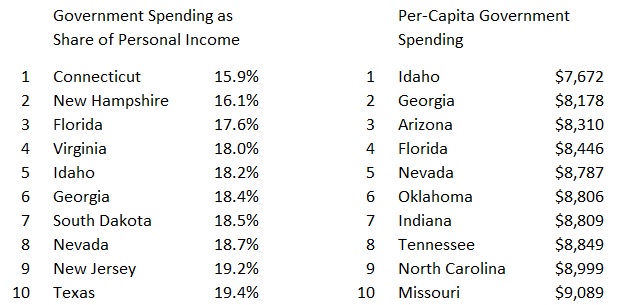
The following table shows the good states, at least relatively speaking. I’m amazed to see Connecticut and New Jersey in the top 10 for spending as a share of personal income. This merits further investigation, but one obvious takeaway is that it’s good to be a high-income state.
The goal, of course, should be to appear on both lists. On that basis, Idaho, Florida, and Nevada deserve praise.

But this three-part series isn’t designed to highlight the good states. We want to know which states have the greediest politicians. And greed is being measured by their propensity to buy votes by spending other people’s money. Once again, we’ll show the spending data both as a share of personal income and as a per-capita calculation. On this basis, Alaska is terrible (the politicians spend oil money with reckless abandon), as is the District of Columbia.

Wyoming also is a state with profligate politicians. It has no income tax and a modest sales tax, but lawmakers (just like in Alaska) can’t resist buying votes with all the money generated by energy taxes (which is why I penalized the state when writing about good state tax systems back in 2015).
This explains why North Dakota is on both lists as well.
If we focus on states that don’t get lots of money from energy taxes, than New York and Oregon deserve special scorn for appearing in both columns.
P.S. One area that requires further exploration (partially explained by the Third Theorem of Government) is the impact of 1,386 federal transfer programs that subsidize/encourage more spending by state and local governments.
Two days ago, I looked at top income tax rates for the various states.
Yesterday, I shared the data for the states on sales tax rates. The big takeaway from those two sources of data is that California politicians are very greedy.
But are they the greediest politicians in the country? What if we also measure other sources of tax revenue (property taxes, excise taxes, severance taxes, etc)? And what about the various fees and charges that also are imposed by state and local governments?
To account for all these factors, we obviously need a comprehensive measure. And since the real cost of government is how much it is spending (regardless of whether the outlays are financed by taxes or borrowing), the most accurate approach is to calculate the relative spending burdens imposed by state and local governments.
The Census Bureau actually collects that data (albeit with a lag, so the most-recent data is for 2017).
But you don’t simply want to look at total spending by state and local governments. You also want to adjust for population (specifically, the population data for 2017) so we can calculate the per-capita burden of state spending.
Moreover, it’s also important to understand that some states have varying levels of income (for historic reasons, policy reasons, and difference in the cost of living). So if you want to calculate the economic burden of state and local spending, you also need data on state personal income for 2017.
So I put all these numbers into an excel file and crunched the numbers to see how the 50 states (plus Washington, DC) compare based on these two ways of showing fiscal burdens.
The following table shows the good states, at least relatively speaking. I’m amazed to see Connecticut and New Jersey in the top 10 for spending as a share of personal income. This merits further investigation, but one obvious takeaway is that it’s good to be a high-income state.
The goal, of course, should be to appear on both lists. On that basis, Idaho, Florida, and Nevada deserve praise.
But this three-part series isn’t designed to highlight the good states. We want to know which states have the greediest politicians. And greed is being measured by their propensity to buy votes by spending other people’s money. Once again, we’ll show the spending data both as a share of personal income and as a per-capita calculation. On this basis, Alaska is terrible (the politicians spend oil money with reckless abandon), as is the District of Columbia.
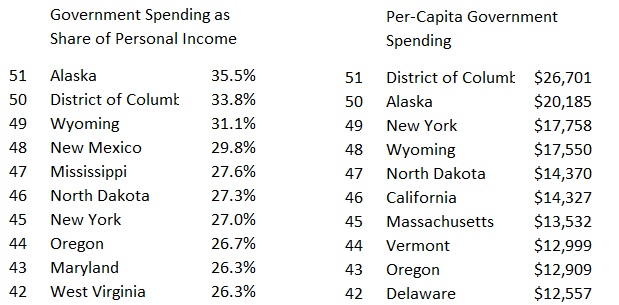
Wyoming also is a state with profligate politicians. It has no income tax and a modest sales tax, but lawmakers (just like in Alaska) can’t resist buying votes with all the money generated by energy taxes (which is why I penalized the state when writing about good state tax systems back in 2015).
This explains why North Dakota is on both lists as well.
If we focus on states that don’t get lots of money from energy taxes, than New York and Oregon deserve special scorn for appearing in both columns.
P.S. One area that requires further exploration (partially explained by the Third Theorem of Government) is the impact of 1,386 federal transfer programs that subsidize/encourage more spending by state and local governments.
Friday, May 1, 2020
Coronavirus and the States: Spending Restraint, Bailouts, Default, or Bankruptcy?
May 1, 2020 by Dan Mitchell @ International Liberty
A Supreme Court Justice pointed out in 1932 that “a state may, if its citizens choose, serve as a laboratory; and try novel social and economic experiments without risk to the rest of the country.”
Well, we’ve had several experiments in higher taxes and higher spending, and they don’t work.
 States with heavier fiscal burdens are accumulating ever-higher levels of debt (especially unfunded liabilities) while also causing an ever-greater exodus of taxpayers to other states.
In the long run, this is a recipe for fiscal crisis since it’s hard to give away lots of money if there aren’t enough taxpayers to finance that profligacy (as illustrated by this set of cartoons).
Well, with the help of the coronavirus, the long run may have arrived.
But the pandemic only exposed a problem that already existed.
Mitch Daniels, the former governor of Indiana, wrote two years ago in the Washington Post that poorly manged states like Connecticut shouldn’t be bailed out by taxpayers in better-run states.
The crowd in Washington has already funneled several hundred billion dollars to state and local governments.
But politicians like Governor Cuomo in New York and Governor Pritzker in Illinois view all that money as an appetizer and now they want the fiscal equivalent of an all-you-can-eat buffet.
The editors of the Wall Street Journal are not sympathetic to these fiscal pyromaniacs.
Jonathan Williams and Lee Schalk of the American Legislative Exchange Council, opining for the Hill, argue against a bailout.
What’s needed is TABOR-style spending restraint, as Williams pointed out in a 2015 speech.
So if a bailout is the wrong solution, what’s the right solution? There are three potential options.
Ramesh Ponnuru writes that states should have a process for declaring bankruptcy.
 Of these options, a conditional bailout is not a good idea, even though it is the best way of doing the wrong thing.
Either bankruptcy or default would be a much better choice, and I lean in the direction of default (the same view I have when contemplating Europe’s failing welfare states).
But the right option is to avoid getting in trouble in the first place.
And that means low taxes, spending restraint, and other market-friendly policies.
I’ll simply note that the states most anxious for bailouts are near the bottom in rankings of small government and economic liberty.
If Washington provides a bailout, that’s a reward for statism and irresponsibility (sort of like foreign aid subsidizing bad policy overseas).
P.S. One month ago, I wrote that the worst coronavirus-related proposal would be restoring the federal tax deduction for state and local tax payments.
I still think that is a terrible idea, of course, but a big bailout from Washington would be even worse.
A Supreme Court Justice pointed out in 1932 that “a state may, if its citizens choose, serve as a laboratory; and try novel social and economic experiments without risk to the rest of the country.”
Well, we’ve had several experiments in higher taxes and higher spending, and they don’t work.
States with heavier fiscal burdens are accumulating ever-higher levels of debt (especially unfunded liabilities) while also causing an ever-greater exodus of taxpayers to other states.In the long run, this is a recipe for fiscal crisis since it’s hard to give away lots of money if there aren’t enough taxpayers to finance that profligacy (as illustrated by this set of cartoons).
Well, with the help of the coronavirus, the long run may have arrived.
But the pandemic only exposed a problem that already existed.
Mitch Daniels, the former governor of Indiana, wrote two years ago in the Washington Post that poorly manged states like Connecticut shouldn’t be bailed out by taxpayers in better-run states.
In a remarkably prescient passage, Daniels speculates about a future emergency that will lead to pressure for a federal bailout.…several of today’s 50 states have descended into unmanageable public indebtedness. …in terms of per capita state debt, Connecticut ranks among the worst in the nation, with unfunded liabilities amounting to $22,700 per citizen. Each profligate state is facing its own budgetary perdition for different reasons, but most share common factors. The explosion of Medicaid spending, even before Obamacare, has devoured state funds… In parallel, public pensions of sometimes grotesque levels guarantee that the fiscal strangulation will soon get much worse. In California, some retired lifeguards are receiving more than $90,000 per year. A retired university president in Oregon received $76,000 per month — and no, that’s not a typo. These are the modern-day welfare queens… More and more desperate tax increases haven’t cured the problem; it’s possible that they are making it worse. When a state pursues boneheaded policies long enough, people and businesses get up and leave, taking tax dollars with them.

Sometime in the next few years, we are likely to go through our own version of the recent euro-zone drama with, let’s say, Connecticut in the role of Greece and maybe a larger, “too big to fail” partner such as Illinois as Italy. Adding up the number of federal legislators from the 15 or 20 fiscally weakest states, one can count something close to half the votes in the House.Which brings us to the current situation.
The crowd in Washington has already funneled several hundred billion dollars to state and local governments.
But politicians like Governor Cuomo in New York and Governor Pritzker in Illinois view all that money as an appetizer and now they want the fiscal equivalent of an all-you-can-eat buffet.
The editors of the Wall Street Journal are not sympathetic to these fiscal pyromaniacs.
Kevin Williamson explains in National Review that the problem is a pre-existing penchant for over-spending and vote-buying.The question to ask is why taxpayers in Appleton and Sarasota should rescue politicians and unions in Albany and Springfield? …states like New York were already in trouble from their own mismanagement. …take Illinois, where Gov. J.B. Pritzker…raised taxes in 2019 and wants to make the state’s current flat tax progressive… Yet he and the unions who own the state house have blocked pension or spending reforms. They’ve long bet on a federal bailout, and they see Covid-19 as their main chance. …President Trump has signaled he’s open to a state bailout because, well, he’s open to anything these days. But Senate Majority Leader Mitch McConnell caused a stir…when he said states should consider bankruptcy rather than get a bailout. …Mr. McConnell’s larger point is that states shouldn’t get more no-strings cash. Private companies that borrow from the Fed and Treasury have to meet stiff conditions, including limits on compensation, and the same should apply to state governments. Bailout conditions should include cuts in nonessential spending, immediate and permanent reductions in public pension benefits.

Adam Michel of the Heritage Foundation explains how bailouts create the wrong incentives.Bailing out the Illinois state pension system is the worst idea from a week in which we were discussing the health benefits of mainlining Lysol. Irresponsible state and local governments are attempting to exploit the fear and disruption of the coronavirus epidemic to push off the consequences of their decades of reckless and culpably dishonest policies onto the federal government. … One of the largest problems facing state and local governments, from Illinois to Oklahoma and from Los Angeles to Dallas, is “unfunded liabilities,” meaning the differences between the promises governments have made to their employees and the money they have set aside to pay for those things. …Government workers are a powerful political constituency — they run California — and they want the same thing everybody else does: more. …If Washington were to dump a few billion dollars into the lap of the feckless cartwheeling goobers who run Illinois, the underlying problem of chronic underfunding of future pension liabilities would remain, and Illinois would be right back where it is today in a year or two. A bailout would not solve the problem — it would keep the problem from being solved.

Senator Rick Scott of Florida opines for the Wall Street Journal that taxpayers in his state shouldn’t pick up the tab for New York’s profligate politicians.The prospect of federal tax dollars creates an incentive for state legislatures to both expand existing programs beyond sustainable levels, and to simultaneously underfund those programs in hopes of further federal support. …One example is how states often delay needed infrastructure projects (for which funds are locally available) in hopes of one day receiving federal funds to cover the project costs. …An unrestricted bailout of the states could be highly unequal, forcing taxpayers in well-run states to subsidize those who have systematically underfunded their pensions and rainy day funds, or those states who have particularly volatile revenue systems. …Federal aid tends to expand state budgets and make them less resilient during future crises. Simply moving state funding to the federal government does little more than redistribute local costs to federal taxpayers across all 50 states.

Well stated. Any comparison of Florida and New York shows the benefit of limited government.…one thing we absolutely shouldn’t do is shield states from the consequences of their own bad budgetary decisions over the past few decades. …Democrats’ true aim: using federal taxpayer dollars to bail out poorly run states—typically, states controlled by Democrats. …Florida is well-positioned to address the coming shortfall in revenue without a bailout. The state may need to make some choices, which is what grown-ups do in tough economic times. And if we need to borrow a small amount in the short term to get us through this economic crisis, that borrowing will be cheaper thanks to our AAA bond rating and the reduction in state debt. New York Gov. Andrew Cuomo said it was “irresponsible” and “reckless” not to bail out states like his, a state with two million fewer people than Florida and a budget almost double the size of ours.

Jonathan Williams and Lee Schalk of the American Legislative Exchange Council, opining for the Hill, argue against a bailout.
The last sentence in the excerpt is key. State politicians have been violating fiscal policy’s Golden Rule by letting spending grow too fast.A growing chorus of governors is calling on Congress to “bail out” state governments. …Their plea comes on the heels of the $2 trillion CARES Act, which included a general $150 billion COVID-19 relief fund, a $30 billion education costs fund, a $45 billion disaster relief fund and more for state and local governments. …History suggests that federal bailouts…incentivize future fiscal irresponsibility and create a moral hazard problem. Bailouts reward fiscally reckless states at the expense of fiscally responsible ones. Academic research from the Mercatus Center at George Mason University shows that federal bailouts could even lead to higher state level taxes. According to their research, every dollar of federal aid to states drives state taxes higher by 33 to 42 cents. …State and local governments do not lack revenue. They lack spending restraint. Over the past 40 years, after fully accounting for increases in population and inflation, state and local direct general spending has grown by 88 percent.

What’s needed is TABOR-style spending restraint, as Williams pointed out in a 2015 speech.
So if a bailout is the wrong solution, what’s the right solution? There are three potential options.
Ramesh Ponnuru writes that states should have a process for declaring bankruptcy.
His colleague at National Review, Kevin Williamson, has a different perspective. His article argues that default is better than a Washington-dictated process for bankruptcy.Some states have made exorbitant promises to their employees over the years without providing adequate funding. They made up the difference, on paper, by projecting unrealistically high returns on pension investments. The Federal Reserve, applying a better projection of returns, estimates that pensions are underfunded by $4 trillion. McConnell is right to think that it would be unfair to make Florida’s teachers and firefighters pay for benefits for their counterparts in Illinois, and unwise to create an incentive for further irresponsibility by state officials. …Federal law currently makes no provision for states to re-organize their commitments through bankruptcy proceedings. Creating one would not keep the coronavirus from crushing state budgets. It could, however, prevent, or at least limit, future federal bailouts for state mismanagement of pensions.
And Andrew Biggs of the American Enterprise Institute argues in the Wall Street Journal that – if a bailout is offered – it should be accompanied by strict conditions.The several states are not administrative subdivisions of the federal government. They are powers in their own right, superseded by the U.S. government only in certain matters that involve more than one state: Washington can declare war or write immigration law, but it cannot tell Austin how to run the Texas Rangers or Sacramento how to prioritize its finances. Because bankruptcy law is federal law, putting states into bankruptcy reorganization would upend our basic constitutional arrangement, making state governments answerable to federal bankruptcy judges and, behind them, to Congress. …Sovereigns don’t go bankrupt. Sovereigns default. And that is what is likely to happen with the pension crisis, at least as far as states’ creditors are concerned. It is what should happen. …we should not use the coronavirus as an excuse to federalize the consequences of culpably irresponsible and fundamentally dishonest governance at the state and local level. …If we want debt markets to work, then investors have to pay the price for bad investments. (Lending money to an organization run by Bill de Blasio is a bad decision.) Making creditors take a painful haircut creates incentives to discourage such willy-nilly lending and profligate spending in the future. …Government debt should in this respect be treated like any other debt — and we should change the law to strip municipal bonds of their tax-free status, which creates a subsidy for debt.

Congress may want to offer assistance, but it should come with strict conditions: Any state looking for a pension handout must either live by the stricter accounting rules federal law imposes on private pension plans or freeze its pension and shift all employees to defined-contribution retirement plans. Private-sector plans must assume more-conservative investment returns than public-sector plans and address unfunded liabilities more rapidly. As a result, private pensions today have set aside more than twice as much funding per dollar of promised future benefits than have state and local pensions. …Freezing a pension doesn’t make its unfunded liabilities go away. But it caps existing liabilities while shifting employees to plans in which the government’s funding obligation is clearly defined and can’t be evaded using actuarial or accounting tricks.
 Of these options, a conditional bailout is not a good idea, even though it is the best way of doing the wrong thing.
Either bankruptcy or default would be a much better choice, and I lean in the direction of default (the same view I have when contemplating Europe’s failing welfare states).
But the right option is to avoid getting in trouble in the first place.
And that means low taxes, spending restraint, and other market-friendly policies.
I’ll simply note that the states most anxious for bailouts are near the bottom in rankings of small government and economic liberty.
If Washington provides a bailout, that’s a reward for statism and irresponsibility (sort of like foreign aid subsidizing bad policy overseas).
P.S. One month ago, I wrote that the worst coronavirus-related proposal would be restoring the federal tax deduction for state and local tax payments.
I still think that is a terrible idea, of course, but a big bailout from Washington would be even worse.
Friday, April 24, 2020
Mitch McConnell is right about refusing to bail out bloated blue-state pensions
April 23, 2020 By Monica Showalter
Senate majority leader Mitch McConnell is taking tons of flak, even from members of his own party, for telling free-spending blue city and state governments, which were already reeling under massive unfunded pension liabilities, that they weren't going to get bailouts under the pretext of coronavirus stimulus............Like Puerto Rico in the wake of its recent hurricanes, it was bankrupt to start with, not bankrupt in the wake of the unforeseen hurricanes, and the reason was mismanagement. In the private sector, such mismanagement has consequences, and it's called "bankruptcy." The Puerto Rican governments, who had mismanaged not only their finances, but their massive aid packages, too, had been insistent on getting a bailout for their own baseline mismanagement on the pretext of disaster relief.
That's what these blue city and state one-party Democratic governments are trying to pull now: a get-out-of-bankruptcy-free card to cover up for the consequences of their bad economic decisions and a license to go right on doing what they have been doing, which is hiring bureaucrats and spending lavishly on them, always making the private sector pay.
We already know that most of these civil servants are drawing six-figure salaries way out of proportion to their education, talents, or academic achievements, such as they are found in the private sector..............
McConnell is right to see the dynamics of these blue city bailout demands and call a stop to them. Because if he doesn't, they will never learn that if you want to run a place where productive people want to live, you need to lower taxes and get serious about improving the quality of life for the private sector, not prioritize the interests of the campaign-donating bureaucrat class. If these places get bailed out, a message will be sent that they can go right back to doing what they had been doing and spend as though there is no tomorrow............To Read More.....
Subscribe to:
Posts (Atom)