Search This Blog

De Omnibus Dubitandum - Lux Veritas

Showing posts with label Fiscal Policy. Show all posts

Sunday, August 11, 2024

The High Cost of Short-Run Political Decision-Making

August 10, 2024 by Dan Mitchell @ International Liberty

Why do politicians such as Donald Trump and Kamala Harris show no interest in fixing Social Security and other entitlement programs?

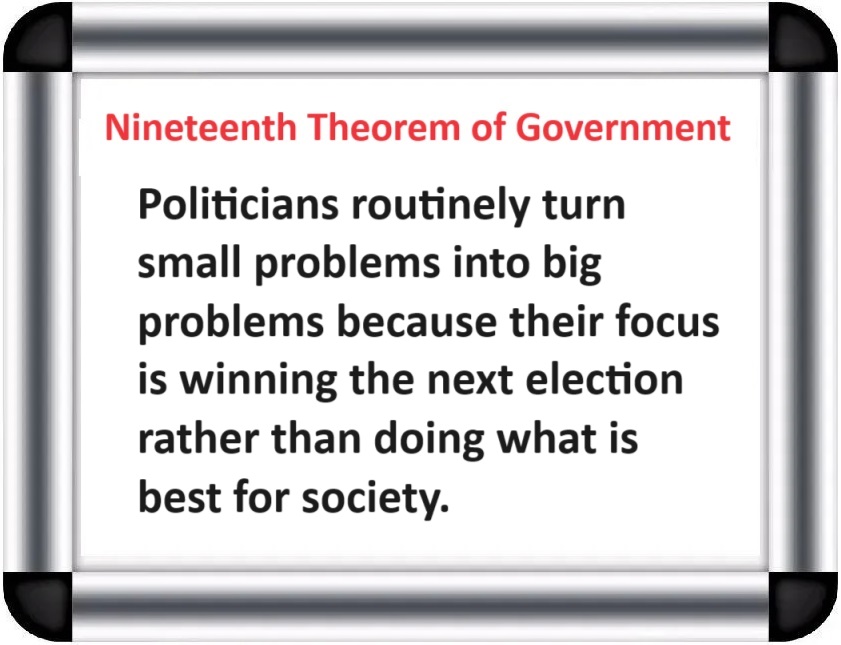
The answer is “public choice.” They are focused on maximizing votes and power in the short run rather than doing what’s best for the country in the long run.

This is a pervasive problem and deserves its own theorem.

I’m motivated to share this new theorem because of a George Will column in the Washington Post.

But he’s not writing about fiscal policy. He has another example of how we get bigger problems because of short-term thinking by people in Washington.

With frequent references to Thomas Hoenig, the former head of the Kansas City Federal Reserve, he’s writing about bad monetary policy. Here are some excerpts.


How high will be the cost of interest rates, having been too low for too long? Events might be teaching a tutorial on the steep price of cheap money. …One purpose of the low rates was to send a flood of money into the increasingly frothy stock market… The Fed’s balance sheet of government and government-guaranteed assets, by which it nudges down interest rates, grew from $900 billion in 2007 to nearly $9 trillion in March 2022. …whenever the Fed has tried to “normalize its balance sheet and interest rates, the market has become unstable.” …

The question now…is will the Fed properly allow rates to come down only as inflation falls to the Fed’s 2 percent target, or will it aggressively try to fend off unwanted, but necessary, corrections — necessary for “better long-run outcomes?”

…Monday’s stock sell-off…ignited worried chatter about whether the Fed should have cut rates the week before, or might have to do so as an “emergency” measure before its scheduled meeting next month. This is not what panicky markets need: yet another government entity declaring yet another emergency.

What Hoenig correctly worries about (and what George Will is writing about) is the problem of a boom-bust monetary policy.

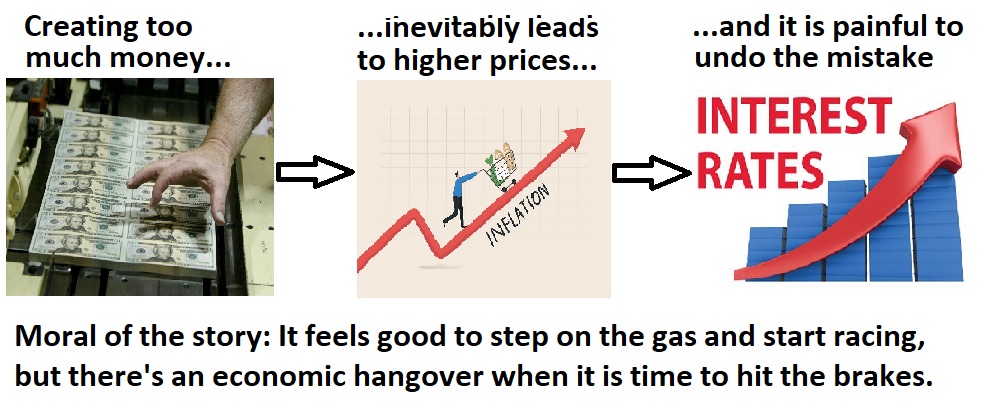
Politicians like the sugar high the economy gets when the central bank creates excess money.


But that excess money creation inevitably causes bad things such as higher prices and asset bubbles.

The best thing is not to make the mistake in the first place. But if the mistake is made, the obvious solution is to “normalize” policy by withdrawing the excess money from the system.

However, this is painful in the short run, so politicians and the central bankers they appoint often don’t have the fortitude and integrity to do the right thing (Ronald Reagan was an exception to the rule).

I started this column with a fiscal policy example. I then cited a monetary policy example. Let’s now close with a bailout example.

Here’s a tweet making the point that propping up profligate nations is a recipe for more profligacy.

The tweet is about a central bank (the ECB) subsidizing bad behavior with bailouts, but it applies also to fiscal bailouts (like TARP) or international bureaucracy bailouts (like the IMF).

The bottom line is that bailouts produce moral hazard. Reward bad behavior and you get more bad behavior.

That make no sense, but politicians and their appointees are drawn to such policies because they want to minimize pain in the short run even though they are creating the conditions for far more pain in the long run.

P.S. Debt limit fights are an example of some people supporting short-run pain in order to reduce the likelihood of much greater long-run pain.

Monday, November 7, 2022

Government Is Largely Guesswork

Donald J. Boudreaux Donald J. Boudreaux  – October 24, 2022 @ American Institute for Economic Research

Arnold Kling, with his characteristic deep insight, recently described “the straw-man argument against libertarianism and for technocracy.” This straw-man argument has, Kling explains, the following steps:

1. Libertarianism relies on markets.

2. Markets are optimal only under conditions of perfect competition.

3. The conditions for perfect competition are rarely satisfied. 

4. There are many instances of market failure.

5. Therefore, libertarianism does not work.

Kling then adds:

Step (2) is a swindle. It sneaks in the assumption that markets have to be optimal in order to be preferable to government intervention.

Instead, long ago I offered the aphorism “Markets fail. Use markets.” That is, I readily concede that the market economy is not at some theoretical optimum. The question is what will lead to improvement. I believe that government intervention will often make things worse. Meanwhile, entrepreneurial innovation and creative destruction tends to solve economic problems, including market failures.

One of the commenters on Kling’s post, Matt Gelfand, then offered the following:

Let’s flip Arnold’s line of reasoning around to examine the merits of government action.

1. Government action relies on government actors behaving in the public interest.

2. Governments are optimal only under conditions of perfect altruism of government actors.

3. The conditions for perfect government are rarely satisfied.

4. There are many instances of government failure.

5. Therefore, government does not work.

There are many examples of market failure that cannot be overcome by libertarian market processes, and I believe libertarians would agree with at least some of them. They usually involve “public goods” where competitive actors would be duplicative and inefficient. Thus, a system of laws, the justice system, national defense, public safety (police, fire firefighters), airline safety, and numerous other examples are more efficiently handled through the polity rather than markets.

Despite at least one of commenter Gelfand’s examples of ‘good’ government actions (namely, regulation of airline safety) being highly dubious, my purpose here isn’t to challenge the listed examples of ‘good’ government action. Instead, I’ll argue that Mr. Gelfand, like many others, mistakenly assumes that the market and government are symmetrical to each other in a way that they are not.

Of course, any desired outcome can, in principle, be pursued either with voluntary action (the market, broadly conceived) or with coercive action (government). In this simple way the market and government are indeed symmetrical to each other. But there the symmetry ends. The logic of the market’s operation differs categorically from the logic of government’s operation. These differences are rooted in, but extend beyond, the fact that only in markets is all action voluntary.

The single most important difference separating market action from government action is this: Unlike decision-makers in government, decision-makers in markets have access to detailed and reasonably reliable information about the net effects that any of their decisions are likely to have on all affected parties. In addition, decision-makers in markets also are uniquely incited to take those actions, and only those actions, that produce the largest possible positive net effects on affected parties.

The fact that the information available in markets is imperfect is indisputable. Also indisputable is the fact that even well-informed market actors often err. But equally indisputable, if not as widely recognized, is the reality that markets have (as an essential feature of their operation) a built-in process for detecting and correcting error, and thus taking into account over time as much relevant knowledge as possible. No such process exists in government. Because of this categorical difference, any supposed substantive symmetry between market action and government action is imaginary.

The foundational (if not the only) advantage of relying upon markets rather than upon government to supply, say, shoes is that only in markets is there a reliable source of information about which varieties of shoes to produce and how to produce these varieties efficiently – that is, how to produce these varieties of shoes in ways that leave as many resources as possible available for the production of goods and services other than shoes.

The amounts of their incomes that consumers choose to spend on Crocs, Nike sneakers, and Gucci loafers registers the intensity of consumers’ demands for each of these kinds of shoes relative not only to consumers’ demands for other kinds of shoes but also relative to their demands for all other goods and services available for sale.

The prices of each of the different varieties of shoes convey at least two critical pieces of information. First, the prices of Crocs tell entrepreneurs just how much consumers are willing to pay for Crocs compared to how much consumers are willing to pay for sneakers and loafers, and compared also to how much consumers are willing to pay for hamburgers, honey, housing, books, bananas, baseballs, and every other good or service currently for sale on the market. Second, the prices of Crocs relative to the prices of the inputs that might be used to produce Crocs tell entrepreneurs both if consumers’ desire for Crocs is high enough to justify using resources to produce Crocs, and, if so, just how many pairs of Crocs to produce.

If, as is usual, there is some unexpected change in the market (for example, consumers suddenly lose their taste for Crocs), consumers today will not be served as well as possible. Ditto if entrepreneurs as a group commit some error (for example, fail to notice the high consumer demand for blue suede shoes). Too many resources today will be devoted to producing Crocs while too few resources are used to manufacture shoes of blue suede. As a result, the prices of Crocs will fall relative to the prices of other goods and services, while that of blue suede shoes will surely soon be noticed by profit-seeking entrepreneurs to be high enough to justify increased production of this particular style of footwear. Such price changes, and more accurate recognition of existing prices, render what might be described as today’s inefficiencies (or market ‘failures’) as, also, today’s profit opportunities. Guided by prices, entrepreneurs will profit by shifting resources out of the production of Crocs and into the production of other items, including blue suede shoes.

Entrepreneurs who are insufficiently alert to market realities as revealed in the prices of both inputs and outputs, or entrepreneurs who are too incompetent to act profitably on market information, suffer losses. These entrepreneurs thus wind up ‘controlling’ fewer resources, with greater amounts of resources coming to be ‘controlled’ by entrepreneurs who are more alert or more competent.

The self-interest of entrepreneurs combines in the market with the self-interest of consumers and input suppliers – and also with the ability of consumers and input suppliers each to say ‘no!’ to offers they judge to be unattractive – to cause opportunities for improving the allocation of resources to be revealed in market prices. Again, such information is never revealed perfectly. Nor is it ever acted on with only unalloyed expertise. But the very essence of the market process is to reveal such information and to incite everyone in the market to act on it.

No such process of information revelation is available for government action. Precisely because government intervention into markets is intended to disregard or to override market signals, government officials, if they are to improve the welfare of citizens, must have access to information that is superior to that which is available on markets. But government officials, in fact, not only have no superior source of information, they have no good source of information at all. The best they can do is guess.

This absence of information available to government officials is an especially acute problem for those officials who fancy themselves able to improve the economy’s performance by nationalizing industries, by using subsidies and protective tariffs, and by imposing ‘corrective’ taxes here and there. But this absence of information is ubiquitous throughout all government affairs. No matter which projects government undertakes as a government, its officials cannot really know, in the way that market participants know, just what to produce, how much to produce, and how best to produce it.

Even the local government that supplies policing services paid for with tax dollars has no solid information about just how much policing to supply and how best to supply these services. Consumers don’t express their demands for government-supplied policing by voluntarily spending money for it, with the ability to change the amounts they spend in response to changes in the quality of, or the desire for, the service provided. While grotesque government incompetence on this front might prompt changes for the better, through the ballot box or through people voting with their feet to move to other jurisdictions, for many compelling reasons the sorts of information revealed in elections or by moving from jurisdiction to jurisdiction have none of the details, nuance, richness, or timeliness that characterize the information conveyed in markets. Politically conveyed information is so thin, noisy, and out-of-date – and, hence, so unreliable – as to differ categorically from market-conveyed information.

As the policing example suggests, the lack of reliable information available to government actors to use to carry out various tasks doesn’t imply that there are no tasks appropriate for government to undertake. Sometimes political instinct tells us that this or that task, if left to private market forces, would likely be performed even worse than if it is assigned to government. And sometimes this instinct might be correct, although there’s no way to verify this conclusion.

Whatever is the case offered in support of government action, a respect for honesty should compel those who make this case to admit that government officials who carry out the prescribed action are neither guided nor incited by the kinds of detailed information that guides and incites market actors. Unlike actions taken in markets, even the best government actions carried out in the most appropriate circumstances are guided by little more than guesswork. 

Donald J. Boudreaux

Donald J. Boudreaux

Donald J. Boudreaux is a senior fellow with American Institute for Economic Research and with the F.A. Hayek Program for Advanced Study in Philosophy, Politics, and Economics at the Mercatus Center at George Mason University; a Mercatus Center Board Member; and a professor of economics and former economics-department chair at George Mason University. He is the author of the books The Essential Hayek, Globalization, Hypocrites and Half-Wits, and his articles appear in such publications as the Wall Street Journal, New York Times, US News & World Report as well as numerous scholarly journals. He writes a blog called Cafe Hayek and a regular column on economics for the Pittsburgh Tribune-Review. Boudreaux earned a PhD in economics from Auburn University and a law degree from the University of Virginia.

Get notified of new articles from Donald J. Boudreaux and AIER.
Thursday, August 27, 2020

“Stakeholder Capitalism”: When Big Business Curries Favor from Big Government

August 25, 2020 by Dan Mitchell @ International Liberty

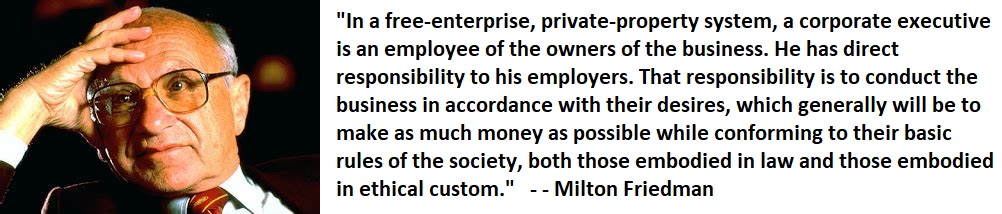
 Milton Friedman was one of the the 20th century’s greatest defenders of capitalism and individual freedom.  He had marvelous insights on issues such as fiscal policy, Sweden, tax competition, and other people’s money, but one of my favorite Friedman quotes is about the role of business.


This should be non-controversial, but we need to remember that big companies are not necessarily strong proponents of free enterprise.  Yes, they like lower tax rates and a few other market-oriented policies, but many large firms are more than happy to climb into bed with big government so they can gain special advantage from subsidies, handouts, bailouts, and protectionism.  So we shouldn’t be surprised to learn that the trade association for corporate CEOs of has disavowed Friedman.
Business Roundtable is modernizing its principles on the role of a corporation. Since 1978, Business Roundtable has periodically issued Principles of Corporate Governance that include language on the purpose of a corporation. Each version of that document issued since 1997 has stated that corporations exist principally to serve their shareholders. …We therefore provide the following Statement on the Purpose of a Corporation, which supersedes previous Business Roundtable statements and more accurately reflects our commitment… This statement represents only one element of Business Roundtable’s work to ensure more inclusive prosperity.
You can read the new language here. There’s only one pages of text and you’ll notice that it’s a lot of vapid jargon without any measurable commitments.  Indeed, the letter is so vague that some observers think it’s irrelevant.  In a column for the Washington Post, James Copland of the Manhattan Institute points out that profit-maximizing companies already consider the interests of so-called stakeholders.


Critics and supporters of business alike have characterized the statement as a major shift away from “shareholder” capitalism toward an alternative “stakeholder” model pushed by some progressive academics and policymakers. It isn’t.
The Business Roundtable’s statement unequivocally states that “the free-market system is the best means of generating good jobs, a strong and sustainable economy, innovation, a healthy environment and economic opportunity for all.”
To be sure, it proclaims that each of the chief executives signing on shares “a fundamental commitment to all of our stakeholders” — including customers, suppliers, employees and the broader community. But that’s a truism. No business can long survive without meeting such stakeholders’ needs. …The corporate signatories do not suggest in any way weakening the fiduciary duties of the boards and managers of ordinary for-profit shareholder corporations to manage such companies’ affairs for shareholders’ benefit.
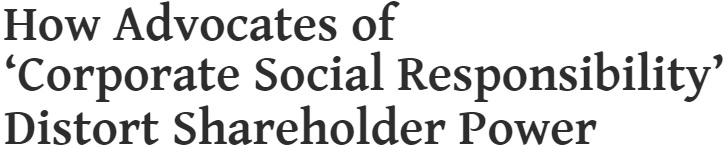
…there is a big difference between saying that a for-profit shareholder corporation should be sensitive to varying constituencies’ concerns and saying that its principal purpose is something different from the traditional view. One needn’t be an expert in public-choice economics or corporate governance to understand that politicizing corporate decision-making would be inefficient.
Lucian Bebchuk and Roberto Tallarita of Harvard Law School, in a column for the Wall Street Journal, share some real-world evidence that the CEOs are engaging in empty posturing.
Although the Roundtable described the statement as a radical departure from shareholder primacy, observers have been debating whether it signaled a significant shift in how business operates or was a mere public-relations move. …
We contacted the companies whose CEOs signed the Business Roundtable statement and asked who was the highest-level decision maker to approve the decision. Of the 48 companies that responded, only one said the decision was approved by the board of directors. …The most plausible explanation for the lack of board approval is that CEOs didn’t regard the statement as a commitment to make a major change in how their companies treat stakeholders. …
a review of the board-approved corporate governance guidelines of the companies whose CEOs joined the statement…mostly reflect a clear “shareholder primacy” approach. …The evidence is clear: Notwithstanding statements to the contrary, corporate leaders are generally still focused on shareholder value.
I think these two columns are accurate.  The vast majority of the CEOs who signed the Business Roundtable’s letter presumably have no intention of making unprofitable decisions solely to curry favor with the broader community.  That being said, the letter is still bad news because it basically acquiesces to the left’s misguided view that profits are somehow bad for society.  The Wall Street Journal made this point in an editorial in defense of the Friedman position.
The mucky-mucks of the Business Roundtable are tweeting in unison how “proud” they are to have abandoned the corporate purpose of serving shareholders for the more politically au courant “stakeholder” model. …media cheerleaders seem especially pleased that the CEOs have thrown the late, great economist Milton Friedman over the side. …The attempt to smear Friedman’s counsel as amoral is false. His point was that profitable businesses serve the common good better than executives who spend money on “social responsibility” but preside over business failure. The second point is Friedman’s warning that CEOs who put social responsibility above shareholders will find it redounds to their detriment. They feed the public belief that free markets and business are “wicked and immoral” and must be curbed by “external forces,” which typically means politicians.
In a column for National Review, Andrew Stuttaford also fears that the letter gives a green light to those who want more regulation by government.
The executives who retool a company’s mission to suit a particular conception of “social responsibility” are spending shareholders’ money on a moral agenda… Often repackaged as a demand that corporations be measured by the extent to which they match arbitrary and ever-tightening E (environmental), S (social), and G (governance) standards, it is now a way of corralling private enterprise without the bother of legislation. …
the flourishing (and profitable) ecosystem that ESG investing has created…encompasses consultancies, advocacy organizations, “chief sustainability officers,” and many, many more rent-seekers besides. ESG is bad news for investors, but it is not a bad way of filling the wallets of those that feed off it. …
In effect, therefore, many companies…will be forced to change the way they do business as they try to keep up with ever-more-stringent rules set not by democratically elected legislators but by the unaccountable, the ambitious, the greedy, and the fanatical.
Speaking of unaccountable and greedy, that’s a good description of Elizabeth Warren’s legislation to give Washington greater control of major companies.  Professor Greg Mankiw of Harvard opined about this issue last month for the New York Times.
If you open any standard economics textbook, such as one of mine, you will be told that a firm’s objective is to maximize profit. …Given the vast range of economic and political problems the world faces, this approach is often said to be too narrow....former Vice President Joseph R. Biden Jr.,…joined in the criticism.
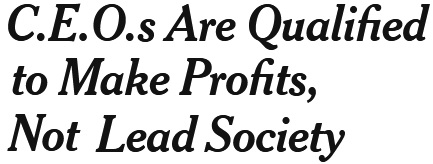
“It’s way past time we put an end to the era of shareholder capitalism, the idea the only responsibility a corporation has is with shareholders… They have a responsibility to their workers, their community, to their country.” …In forsaking a mandate of narrow self-interest for one of broad social welfare, this approach to corporate management sounds noble, perhaps even obvious. But it is more problematic under closer scrutiny. …this approach to corporate management expects executives to be broadly competent social planners rather than narrowly focused profit maximizers.
It’s unlikely that corporate executives, with their business training and limited experience, have the skills to play this role well. …One lesson of Econ 101 is that the self-interested behavior of consumers and businesses, directed by market forces and constrained by competition, can lead to desirable outcomes.
In an op-ed earlier this year for the Wall Street Journal, Vivek Ramaswamy opined that he and his fellow CEOs should not have a special role in determining economic policy.
‘Stakeholder capitalism” is…the fashionable notion that companies should serve not only their shareholders, but also other interests and society at large. …
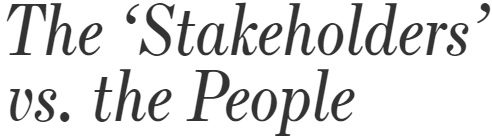
My main problem with stakeholder capitalism is that it strengthens the link between democracy and capitalism at a time when we should instead disentangle one from the other. …Managers of corporations gain their positions by maximizing profits and minimizing losses. …But these business leaders have no special standing to decide whether a minimum wage for American workers is more important than full employment, or whether minimizing society’s carbon footprint is more important than raising prices on consumer goods. …
I have no special standing to legislate my morals because I am a CEO. I do, however, make the final decision about our company’s research-and-development budget. …the reason many corporate executives are speaking up in favor of stakeholder capitalism is that they think they will gain popularity at a time when it is unpopular to be perceived as a pure capitalist. …
Some may argue that companies will be more successful in serving shareholders over the long run if they also serve societal interests. If that’s true, then classical capitalism should do the job, since only companies that serve society will ultimately thrive, and “stakeholder capitalism” would be superfluous.
But some CEOs can’t resist the temptation.  The Wall Street Journal opined about the social-justice posturing of one of the the CEOs who signed the Business Roundtable’s letter.
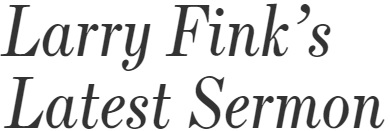
BlackRock CEO Larry Fink…has assumed a role as self-styled conscience of the business world in telling CEOs how to run their companies. …BlackRock is the world’s largest asset manager, with some $7.43 trillion in client assets.
He is now threatening to vote against corporate directors and management if they don’t do what he says, and he is especially exercised about climate change. …Corporations in which BlackRock invests will also have to comply with the rules from a “Sustainability Accounting Standards Board” on issues such as labor practices and workforce diversity.
…Like his friends at the Business Roundtable, Mr. Fink is big on “stakeholder” capitalism. …If he means serving employees, customers, suppliers and communities, he is merely saying what any successful company already does. But our guess is that by stakeholders Mr. Fink really means regulators and politicians. …We can’t help but wonder if Mr. Fink, after a profitable life in business, is auditioning to be Treasury Secretary.
In an article for the Foundation for Economic Education, Professor T. Norman Van Cott makes the all-important point that successful companies automatically generate benefits for people other than shareholders.
The marketplace is an arena where buyers and sellers both win. Do buyers and sellers really care about each other? …I sure am grateful that I don’t have to depend on the good-heartedness of Florida orange producers to send oranges to Indiana.
It’s not that the orange producers and I aren’t well-meaning, just that oranges would not find their way to Indiana if good-heartedness were the motivation for commerce.
…Microsoft provides a wonderful example…the shareholder value of Microsoft, as large as it is, surely pales in comparison to what its customers around the world gain.
…Microsoft has achieved its immense shareholder value not because its customers, workers, suppliers, and communities are poorer. Indeed, nothing could be further from the truth. Its stakeholders have been enriched immeasurably by its pursuit of maximum shareholder value.
Writing for USA Today, Professor Steve Hanke is very critical of the Business Roundtable.
…the Business Roundtable launched a major attack on property rights, the bedrock of capitalism. …the Roundtable, which represents nearly 200 of America’s blue-chip companies, downgraded shareholders.
According to the Roundtable, the purpose of a corporation will no longer be to conduct business with the sole objective of generating profits for shareholders. Owners of corporations (read: shareholders) will now just be one of five “stakeholders”… The Roundtable’s new anti-capitalist mission statement promises to dilute and muffle shareholders’ voices and further politicize corporate governance. …
The great Austrian economist Joseph Schumpeter concluded in his 1942 classic “Capitalism, Socialism and Democracy” that businessmen would “never put up a fight under the flag of their own ideals and interest.” …Schumpeter concluded that businessmen, through their ignorance and cowardice, would assist those who wished to destroy capitalism.
Megan McArdle also is skeptical. Here’s some of what she wrote for the Washington Post.
…business leaders have no right to do charity on someone else’s dime. You might admire plumbers who donate fixtures to needy families, but not if they donated the fixtures you’d purchased for your own bathroom. That is essentially what stakeholder capitalists are demanding of chief executives: Take the money and power that shareholders have entrusted to you and divert those resources to benefit someone else.
…if “stakeholder capitalism” means anything, it must mean companies doing things that make shareholders at least somewhat worse off. …Corporate social responsibility…can be even less accountable than good old-fashioned shareholder capitalism. Money is relatively easy to measure: Shareholders have more of it at the end of the quarter, or they don’t, and either way you know how the boss is doing.
But if the chief executive pours that cash into better-upholstered offices, more-generous fringe benefits and a slew of charitable causes, who’s to say whether the company’s goals are being met? …As Harvard health-care economist Amitabh Chandra noted on Twitter after the Business Roundtable’s announcement, “appealing to an amorphous ‘social mission’ ” has allowed nonprofit hospitals “to foil regulators, acquire their competition, and increase market power.” Beware of any proposal that might make the rest of the economy look more like the health-care sector.
Robert Samuelson’s column in the Washington Post points out that previous episodes of “corporate social responsibility” did not yield good outcomes.
…we’ve already been here. In the first decades after World War II, large U.S. corporations adopted a social and political model very much like the model recommended by the Roundtable.
There was much talk of “stakeholders,” not shareholders. Companies were supposed to attend to their social responsibilities. “Capitalism” as a term went out of style… The corporate responsibility fad of the 1950s and 1960s was premised on the belief that…companies could achieve both their traditional financial goals as well as the less traditional agenda of providing higher living standards and employment security. …
What we know with hindsight is that this confidence was a conceit of a moment in time. …These lessons of history have been either forgotten or ignored. But they have not gone away. Rather than heap endless new responsibilities on companies, we’d be better off having them tend to their traditional tasks — including maximizing profits.
By the way, the problem of big business rejecting capitalism isn’t limited to the CEOs of the Business Roundtable.  Writing for Project Syndicate, Klaus Schwab of the World Economic Forum (the folks who put on the Davos conference for the establishment’s high flyers) argues for a middle ground between free markets and Chinese-style cronyism.
What kind of capitalism do we want? …we have three models to choose from. The first is “shareholder capitalism,” embraced by most Western corporations, which holds that a corporation’s primary goal should be to maximize its profits.
The second model is “state capitalism,” which entrusts the government with setting the direction of the economy, and has risen to prominence in many emerging markets, not least China. …the third has the most to recommend it. “Stakeholder capitalism,” a model I first proposed a half-century ago, positions private corporations as trustees of society… We should seize this moment…
To that end, the World Economic Forum is releasing a new “Davos Manifesto,” which states that companies should pay their fair share of taxes, show zero tolerance for corruption, uphold human rights throughout their global supply chains, and advocate for a competitive level playing field…a new measure of “shared value creation” should include “environmental, social, and governance” (ESG) goals as a complement to standard financial metrics. …
Business leaders now have an incredible opportunity. By giving stakeholder capitalism concrete meaning, they can move beyond their legal obligations and uphold their duty to society.
Given that per-capita living standards are much lower in China than they are in the United States, I’m baffled that Schwab thinks it’s a good idea to move halfway toward the decrepit Chinese model of cronyism and industrial policy.  Does he think that people in North America and Western Europe should only be twice as rich as people in China instead of four-to-six times richer?  Let’s wrap up. The president of the Business Roundtable just wrote a one-year anniversary review of his group’s campaign for so-called stakeholder capitalism.
It’s been a year since 181 CEOs of America’s largest companies overturned a 22-year-old policy statement that defined a corporation’s principal purpose as maximizing shareholder return. …
Companies have held to their commitments. …many Roundtable companies were making substantial investments in worker training, better wages and benefits, and support for struggling communities. They called for increases in the federal minimum wage and paid family medical leave. …
In recent weeks, CEOs have made new commitments to promote racial equality and diversity in their own companies. …Far from undermining shareholders or capitalism, the many actions major corporations are taking to support all stakeholders will pay dividends… Business Roundtable CEOs reject…quick-hit, short-term capitalism. They agree with many of the nation’s largest investors that the health of both companies and capitalism depends on investments in all stakeholders.
Sounds very noble and caring, at least for the folks who don’t understand economics.  Which is why I almost laughed out loud when I saw this tweet, which is based on this article published by the Atlantic. The Roundtable is trying to curry favor with statists, but some folks on the left are smart enough to see that it’s all empty posturing.


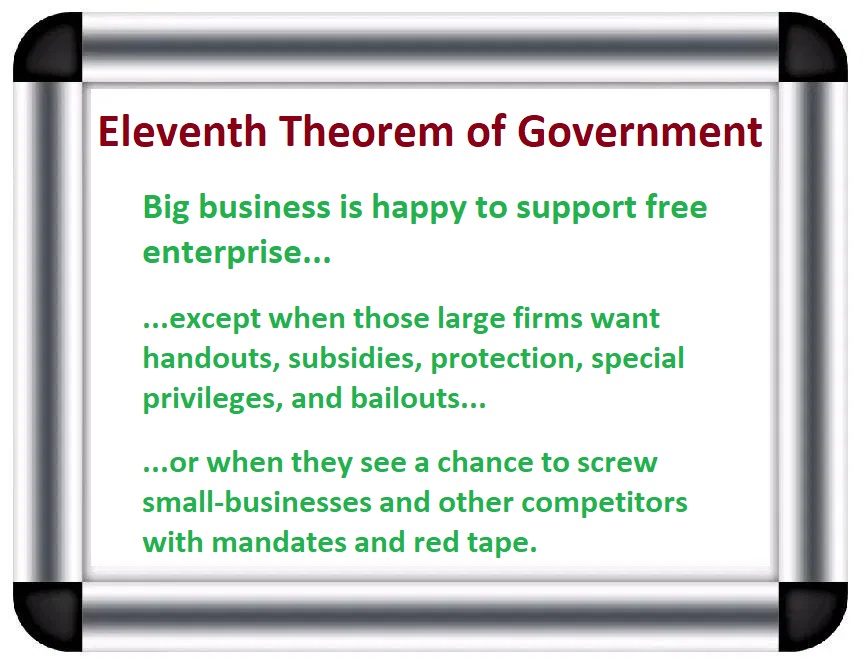
So what’s my contribution to this debate? Most of what I would say is captured in the excerpts above. Simply stated, it’s not a good idea to mix big business with big government. But I will take this opportunity to unveil another one of my theorems.

P.S. Back in 2012, I criticized the Business Roundtable for embracing tax increases on small businesses, so you can see that the Eleventh Theorem of Government is way overdue.

P.P.S. You can peruse the other ten theorems of government by clicking here.