Search This Blog

De Omnibus Dubitandum - Lux Veritas

Showing posts with label Italy. Show all posts

Wednesday, April 30, 2025

Taxes and Incentives: The Italian Version

April 29, 2025 by Dan Mitchell  @ International Liberty

Basic economy theory, depicted by supply-and-demand curves, tells us that taxes will cause “deadweight loss.” 
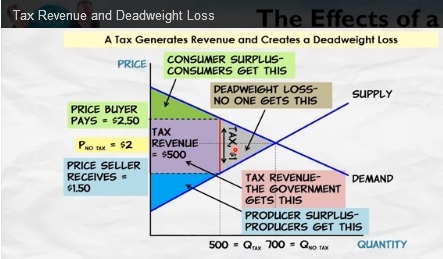
This is the economic activity that no longer occurs because taxes creates a wedge between buyers and sellers.

And this analysis applies whether we’re looking at taxes on income, taxes on consumption, taxes on trade. or taxes on investment. And “sin taxes” as well, for those who want to discourage certain behaviors.

That’s a good segue to today’s topic, which involves how taxes are being used to discourage a particular kind of tourism in Italy.

Here are some excerpts from a story by Colleen Barry for the Associated Press.


Venice is charging day-trippers to the famed canal city an arrivals tax for the second year starting Friday, a measure aimed at combating…overtourism… Visitors who download a QR code at least three days in advance will pay 5 euros ($5.69) — the same amount charged last year throughout the pilot program.

But those who make last-minute plans pay double. …2.4 million euros…is the amount Venice took in during a 2024 pilot program for the tax. The city’s top budget official, Michele Zuin, said last year the running costs for the new system ran to 2.7 million euros, overshooting the total fees collected.

This year, Zuin projects a surplus of about 1 million euros to 1.5 million euros, which will be used to offset the cost of trash collection and other services for residents.

I’m sharing this story because it illustrates that politicians understand tax policy when they want to.

Venice wants to reduce the number of tourists, so they’re following Ronald Reagan’s insight about how you get less of something.

What frustrates me, however, is that the same politicians conveniently forget this lesson when they push for class-warfare tax policies and pretend those taxes won’t discourage work, saving, investment, and entrepreneurship.

And since Italy ranks next-to-last for tax competitiveness among developed nation, that’s a lesson that desperately needs to be heeded.

P.S. I can’t resist making one final observation about Venice spending more money to administer the tax (2.7 million euros) than they actually collected (2.4 million euros). Sounds like their foolish German cousins (who have some weird tax policies, as seen here, here, and here).

Friday, May 3, 2024

Recovery for the PIGS?

May 2, 2024 by Dan Mitchell @ International Liberty

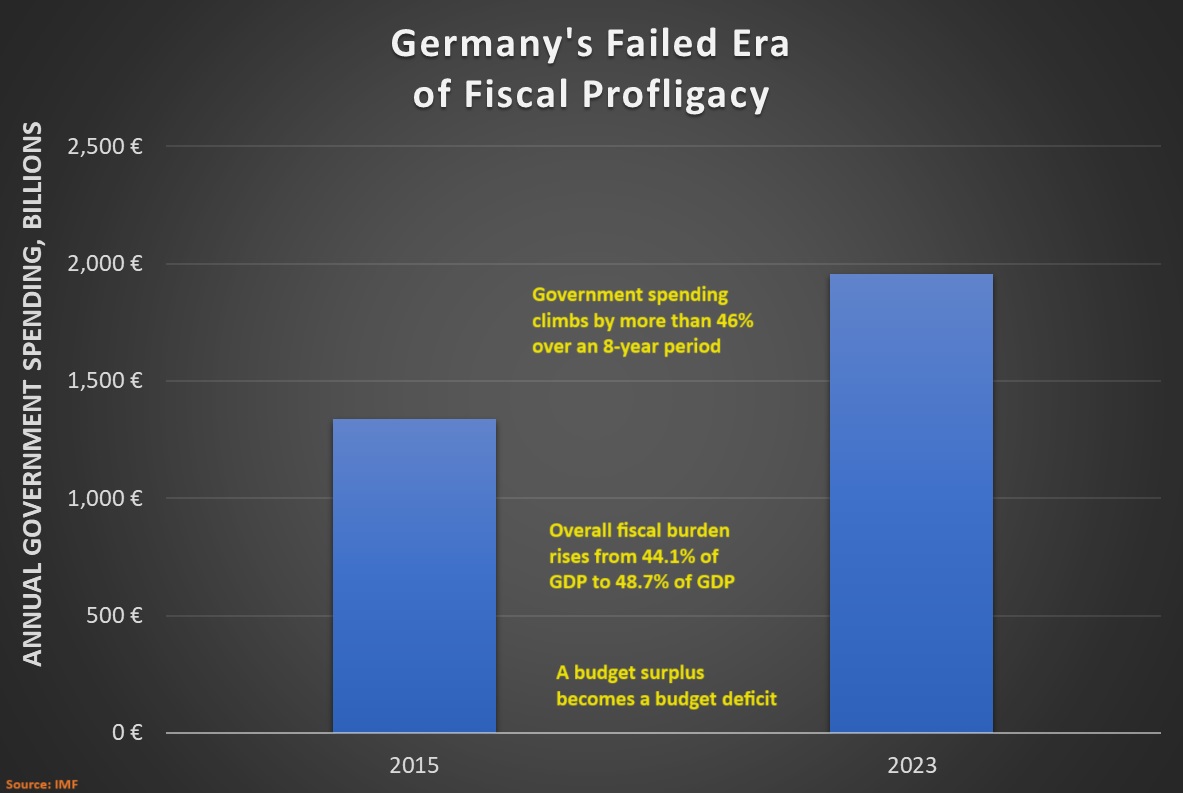
Just a few months ago, I wrote about Germany’s fiscal decay.


Over the past eight years, government spending has grown much faster than the private sector, thus violating the Golden Rule of fiscal policy.

Given the shift to bad policy in Germany, I was very interested to see that the New York Times has a report by Liz Alderman and that explains how Germany no longer is the economic engine in Europe.

Here are some excerpts.


Something extraordinary is happening to the European economy: Southern nations that nearly broke up the euro currency bloc during the financial crisis in 2012 are growing faster than Germany… In a reversal of fortunes, the laggards have become leaders. Greece, Spain and Portugal grew in 2023 more than twice as fast as the eurozone average. Italy was not far behind. …southern European countries made crucial changes that have attracted investors, revived growth and…reversed record-high unemployment. Governments cut red tape and corporate taxes to stimulate business and pushed through changes to their once-rigid labor markets, including making it easier for employers to hire and fire workers.

It’s encouraging to read about some pro-market reforms in Southern Europe.

It’s also encouraging that the New York Times seems to be acknowledging that free markets are the way to achieve more growth.

That being said, I’m not ready to declare that the PIGS (Portugal, Italy, Greece, and Spain) are the new role models for economic policy.

For instance, the NYT story is based on just one year of economic data. And I’ve warned that it is risky to draw big conclusions without seeing decades of evidence.

But a journey of a thousand miles begins with a first step. Given my interest in fiscal policy, I looked at the IMF data to see which countries have been most responsible over the past few years.

Lo and behold, Greece and Italy have been doing a decent job.

Three years of fiscal restraint may not seem like much, but it’s worth noting that the burden of government spending in Greece has declined by more than 10 percentage points of GDP.

And the spending burden in Italy has been reduced by nearly 7 percentage points of GDP.

Keep that up for 5-10 more years, and those countries could become Switzerland.

Do it for 10-20 years, and they can become Singapore or Taiwan.

Wednesday, May 1, 2024

Italy’s Absurd Boondoggle Giveaway

April 30, 2024 by Dan Mitchell @ International Liberty

I wrote a two-part series (here and here) in 2022 predicting that Italy was at risk of suffering a fiscal crisis.

If and when it occurs, it will be because investors decide that Italy’s government might default (i.e., be unable to make payments on its debt). Interest rates would spike, financial markets would get shaky, banks would be a risk, and there would be a lot of pressure for a Greek-style bailout.

Should that happen, my role will be to point out that the real problem is that the burden of government spending in Italy is excessive (same message I delivered a dozen years ago).

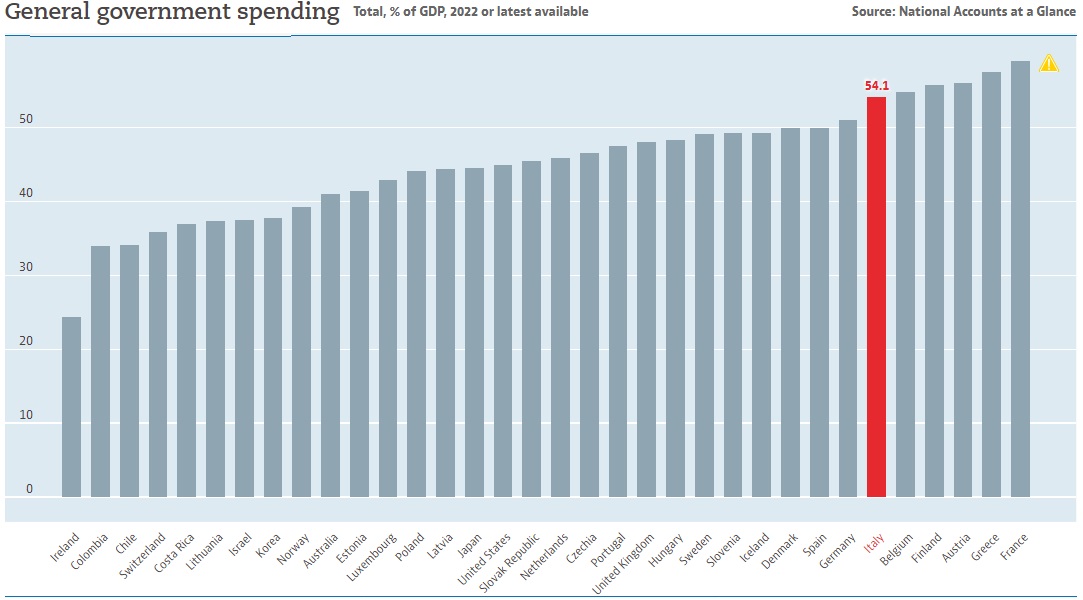
As shown by OECD data, it’s one of the most profligate nations in Europe.

And I suppose it’s worth mentioning that Italy’s demographic outlook is very grim, thus increasing medium- and long-run fiscal risks.

That’s the macro outlook.

Now let’s look at a specific example of why Italy is a fiscal mess. The Economist recently reported on a government giveaway that has become a nightmare.

…a home-improvements subsidy…has turned into the fiscal equivalent of King Kong: a monster running amok, wreaking havoc…

Mr Giorgetti revealed that claims of the subsidy, known as the “superbonus”, made in the four years that the scheme has been running, together with claims of another that offsets the cost of renovating façades, would eventually drain the treasury of €219bn ($233bn).

That is almost 10% of Italy’s GDP last year. …a left-populist coalition…introduced the superbonus in 2020… The idea was to stimulate the stricken economy… The government offered to pay homeowners 110% of the price of energy-saving renovations. …The cash was not to be reimbursed directly, but in the form of tax credits that could be sold on …the superbonus has proved wildly popular. That should not have been a surprise: what is not to like about being repaid more than you have spent?  Or not spent: since the tax credits are tradeable, many homeowners simply passed them on to their builders without having to part with a euro.

A second reason is outright fraud. Last August Giorgia Meloni, Italy’s prime minister, said that contracts falsified to claim the subsidies constituted the biggest-ever rip-off of the Italian state.

That was when they amounted to a mere €12bn; since then, the figure has risen to €16bn. A third problem is overpricing. Because the superbonus refund is greater than the outlay, actual or theoretical, it is in the interests of both the builder and the homeowner to inflate the cost of the work.

At the risk of understatement, this is one of the dumbest spending programs I’ve ever read about.

To put this in an American context, it’s sort of like adding together the fraud of the Trump-Biden pandemic spending, the perverse incentives created by Fannie Mae and Freddie Mac, and the third-party payer problem caused by government in the health sector.

Monday, April 1, 2024

Islamic Migrants in Italy Warn: 'With Our Numbers, We Are Going to Conquer the World, First We Take Italy and Will Kick Out the Jews'

Amy Mek March 31, 2024 9 comments 

 Italian news program “Fuori dal Coro” boldly uncovers the dark undercurrents of immigrant Muslim communities in Italy, revealing a landscape rife with radicalization, cultural tensions, and the rise of jihadi “child gangs,” shedding light on the alarming reality of no-go zones and the looming threat of Islamization.

In a recent broadcast, the Italian news program Fuori dal coro delved into the underbelly of immigrant Muslim communities in Italy, shedding light on concerns over radicalization and cultural tensions. Titled “Immigrants and Violence, The Muslims Who Hate Italy,” the program aired a detailed investigation into the dynamics surrounding illegal mosques and the rise of Islamic “child gangs” in major Italian cities.

The program took viewers on a journey through the streets of Milan, starting with Via Padova, home to one of the city’s illegal mosques. The report addressed the climate in Milan during the days when Ramadan began. There, reporters encountered Italian residents living in fear, with one anonymous resident recounting threats of death for merely observing the activities around the mosque. “I live upstairs. Look, they have already threatened me with death twice,” the resident revealed.... To Read More....

Sharia Italy: Mayor's Battle Against Islamization and Death Threats, Living Under Police Protection (Video)  Amy Mek April 1, 2024 -  “Integration, as advocated by the Left, has clearly failed. The current situation serves as a stark demonstration of this failure. Those who arrive without our invitation show no inclination to even respect Italian law, especially when it conflicts with Quranic law. This disregard sometimes results in criminal behavior, as seen in cases like child brides, unfortunately.” – Mayor Anna Cisint  In a disturbing interview with Italian television, Anna Cisint, the Mayor of Monfalcone, Italy, disclosed the violent threats she has been facing from Islamic migrants. Cisint, who has been living under police protection due to these threats, expressed her concerns about the challenges she faces in ensuring the safety and security of Monfalcone, an Italian town with the highest percentage of foreigners.........


Friday, January 5, 2024

My Gazette: Islam and Western Cultural Suicide, Italy

By Rich Kozlovich

Major Scandal Rocks the Italian Catholic Church: Bishops Accused of Funding Illegal Immigration Amy Mek December 30, 2023 -  The Catholic Church, akin to George Soros, is now under scrutiny for its involvement in financing the illegal invasion of Europe. A significant scandal has recently emerged within the Italian Catholic Church, implicating high-ranking church officials, including cardinals and archbishops, in a scheme of organizing and financing illegal migration from Africa to Europe. Investigations led by the prosecutor’s office in Ragusa, Sicily, have uncovered troubling connections between several Italian dioceses and the George Soros-tied NGO “SOS Mediterranea,” accused of aiding and abetting human trafficking under the guise of refugee aid...............

Thursday, December 21, 2023

New Argentine Prez Milei Makes Stunning Political About-Face

Popular populist candidate now embraces globalist climate-change agenda.

by | Dec 20, 2023 @ Liberty Nation News

Anti-establishment advocates around the world hailed the victory of self-described “anarcho-capitalist” Javier Milei in Argentina’s presidential runoff on Nov. 19. Milei ran on a central message of pending economic disaster. He openly mocked leftist policies he excoriated as tyrannical and communist. To the delight of his backers, he prominently included the internationalist climate-change agenda as part of this verbal assault. “All these politicians who blame the human race for climate change are fake and are only looking to raise money to finance socialist bums who write fourth-rate newspapers,” Milei had thundered. Then he was elected.

“Argentina under incoming President Javier Milei will remain part of the Paris Agreement on climate change, the country’s new top climate diplomat [Marcia Levaggi] told Reuters on Sunday, despite the leader’s past comments that global warming is a hoax,” the wire service reported Dec. 10.

“This is why I came to this COP, to reassure our party stakeholders and people following the process that Argentina will stay committed to the Paris Agreement,” Levaggi declared at the UN COP28 climate talks in Dubai. “We will honor all our environmental agreements.”

Liberal Milei

She went on: “Milei is a liberal, he’s a libertarian, and he believes in market forces. And the market demands to include measures to address climate change.”

What makes Milei’s abrupt about-face even more galling to his Argentine supporters is that he has entered office telling the country to brace itself for painful austerity measures as he deals with the financial mess he has inherited.

GettyImages-1843526451 Javier Milei

Javier Milei (Photo by Guido Piotrkowski/picture alliance via Getty Images)

On Dec. 11, Argentina devalued its currency by 50%. “Argentina is suffering 143% annual inflation, its currency has plunged, and four in 10 Argentines are impoverished,” CBS News reported. “The nation has also a yawning fiscal deficit, a trade deficit of $43 billion, plus a daunting $45 billion debt to the International Monetary Fund, with $10.6 billion due to the multilateral and private creditors by April.”

“If we continue as we are, we are inevitably heading towards hyperinflation,” Economy Minister Luis Caputo said in a televised message to the nation. “Our mission is to avoid a catastrophe.”

As part of his program, Milei has also vowed to substantially reduce the social welfare net so familiar to South American countries. All in the name of dealing with the harsh economic crisis. But the climate-change spending must go on.

‘This Is Super Pragmatic Behavior’

Milei’s embrace of that which he so recently abhorred is reminiscent of events in Italy. Giorgia Meloni was elected prime minister in September 2022 by constantly speaking out against massive unchecked immigration, which she termed a threat to the country’s survival.

As with Milei, Meloni’s populist appeal earned her the “far-right” label affixed to anyone who stands against the ruling progressive establishment status quo. Meloni was castigated as the one who could singlehandedly bring fascism back to Italy. Then she was elected.

Over the summer, Meloni issued a broad and expansive legal migration decree. The new policy “estimates Italy needs 833,000 new migrants over the next three years to fill in the gap in its labor force. It opens the door to 452,000 workers over the same period to fill seasonal jobs in sectors like agriculture and tourism as well as long-term positions like plumbers, electricians, care workers and mechanics,” Politico Europe reported Aug. 30. Meloni had not even been in office one full year.

The European Swamp was quick to pin a new label on that totalitarian dress.

“This is a super pragmatic behavior,” Matteo Villa, “a migration expert at the ISPI think tank in Italy,” told the news site. “There has been a change in narrative.” Is it a case of lying to the people who voted for you? No, it is apparently sensible, realistic, practical.

Play Video
Will Hillary Save Biden?

And it works equally well on both sides of the Atlantic. “Madman or pragmatist? Milei’s sudden transformation has Argentines puzzled,” read the headline to a Dec. 17 article by British business newspaper Financial Times on Milei.

There’s a comfortable air to that P-word, isn’t there? Almost as if it was expected to happen.

“Milei the firebrand, surrounded only by his loyalists and playing to his aggrieved base, would not have lasted a month in office,” Benjamin Gedan, “director of the Argentina Project” at globalist DC think tank the Wilson Center, told Agence France-Presse in a Dec. 9 article. “Milei 2.0 will still face an uphill climb, but he appears to have adopted a more pragmatic agenda and sought the advice of more experienced political figures.”

Milei 2.0? He was voted in just a couple of weeks before this statement was made.

The game plan is unmistakable. Populism is to be considered a blank check for flagrant deceit of the electorate in the eyes of a ruling elite that believes it still holds all the cards.

She “talks tough on immigration, and for those ingesting quick soundbites, many may not be fully aware of the true state of affairs in Italy,” rightist Hungarian site Remix News wrote of Meloni in August. “This has kept her popular with low-information conservatives while at the same time protecting her from the wrath of Brussels and the liberal establishment in Europe, which have made various threats in the past if she should step out of line.”

This formula is now being played to the hilt in populist nationalist circles.

As Argentina heads into a wrenching period of stark financial austerity, its new “gonzo” president is about to do something quite customary for politicians in his position. Milei will be flying to Davos in January as a featured speaker at the 2024 World Economic Forum annual conference.

Tags: Articles, Climate Change, Good Reads, Opinion

 
Read More From Joe Schaeffer


Monday, September 25, 2023

Redistribution Undermines Prosperity: Evidence from Italy

September 22, 2023 by Dan Mitchell @ International Liberty 

periodically explain that redistribution is bad for prosperity, mostly because it encourages sloth and dependency among recipients.

Though it is important to realize that the taxes needed to fund redistribution also are harmful (the magnitude of the problem can be viewed here and here).

I also periodically share new scholarly research on these issues.

And that’s our topic for today since the U.K.-based Centre for Economic Policy Research has published some new research about Italy.

The study, which looks at why Northern Italy is much more prosperous than Southern Italy, was authored by Jesús Fernández-Villaverde, Dario Laudati, Lee Ohanian, and Vincenzo Quadrini.

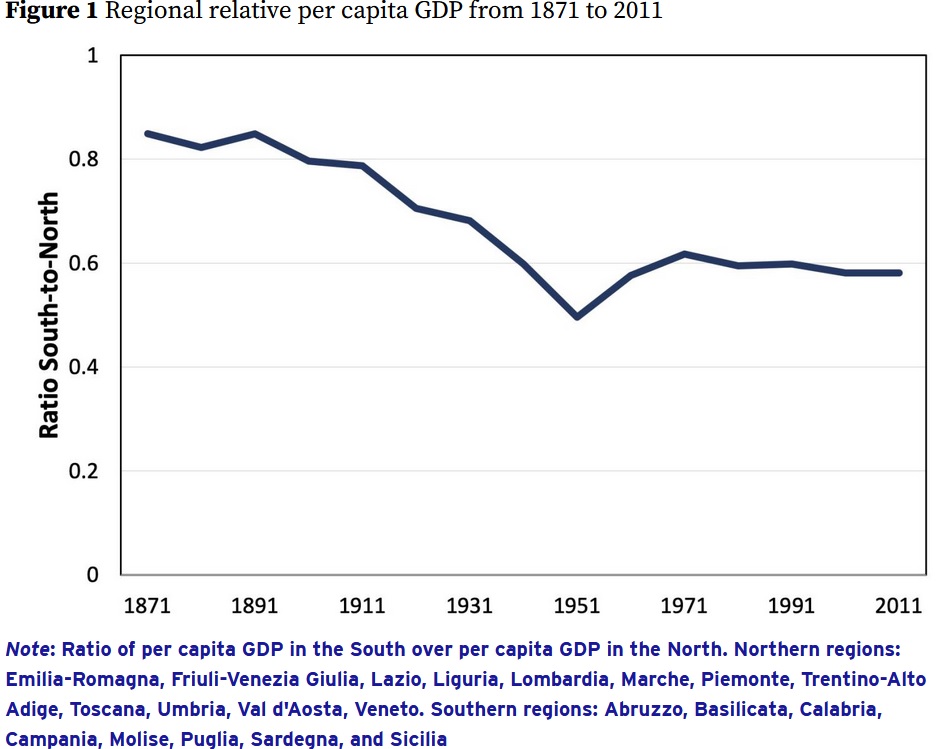
We’ll start by confirming there is a big difference in relative living standards. As you can see from this chart, this gap has existed ever since Italian unification in the 1800s and is bigger now than it was 100 years ago.

Here are some key findings, most notably the harmful impact of redistribution..


In a new paper (Fernández-Villaverde et al. 2023), we seek to identify the major drivers of the regional income differences in Italy using the macroeconomic approach based on the measurement of various wedges… The model consists of two integrated regions. The first is representative of the Northern and Central regions. The second is representative of the Southern and Island regions. …our goal is to understand which of the measured wedges are especially important for generating lower income in the South. …

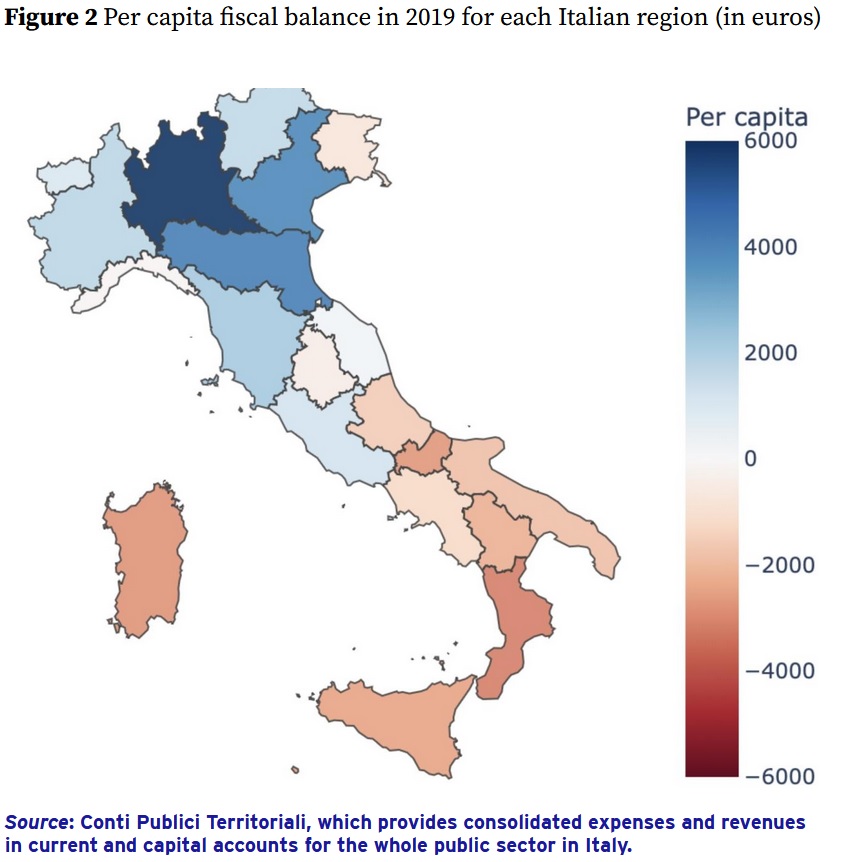
We…find that inter-regional fiscal transfers contribute significantly to regional income differences (see Figure 2). The combined contribution of productivity differences and inter-regional fiscal transfers accounts for more than 70% of the income gap between Southern and Northern regions. The finding that inter-regional fiscal transfers contribute to regional income disparities is the most interesting finding, and the intuition is straightforward. First, inter-regional fiscal transfers are large. …In the counterfactual steady-state equilibrium without fiscal transfers, the output gap between the South and the North is reduced by one-fourth.

That’s remarkable. One-fourth of the gap between Northern Italy and Southern Italy could be eliminated simply by getting rid of redistribution.

Here’s the aforementioned Figure 2, which also is a good depiction of the dramatic difference between north and south.

There’s one other aspect of the study that is worth mentioning.

In their research on regional prosperity, the authors find that funds for “regional development” are not helpful.

And that is true regardless of whether the handouts come from Rome or Brussels.

Italy has invested large funds in regional development for decades. Were these monies well spent? …Nowadays, the European Structural and Investment Funds account for more than one-third of the whole budget of the EU, with a forecasted expenditure of €392 billion in 2021-2027. Will these funds make a difference? Our paper’s results cast doubt on the efficacy of these regional policies per se

I’m shocked, shocked.

P.S. The good news for Italy is that policy is not getting worse over time, but that also can be bad news since the country needs some shock therapy to avert a rather grim future (elaborated on here and here).

P.P.S. Not only does Italy provide some good evidence on the damage caused by redistribution, it also has led to research showing the harm of red tape.

Friday, May 12, 2023

Italy Looking to Leave China’s ‘Belt and Road’

Kurt Zindulka

The Italian government of Giorgia Meloni is reportedly preparing to leave Communist China’s Belt and Road global domination scheme within the coming months. In 2019, under the stewardship of then-technocratic Prime Minister Giuseppe Conte, Italy became the first, and so far only, G7 nation to sign up to Xi Jinping’s Belt and Road Initiative, which Beijing uses to ensnare nations throughout the world under its boot through debt trap diplomacy tactics.  Now the populist-minded government of Prime Minister Giorgia Meloni faces a decision on Italy’s continued participation in the Chinese scheme, with the country’s membership set to automatically renew itself in March of next year unless Rome decides to pull out before then.............To Read More....


Monday, May 1, 2023

The Federal Reserve and “Fiscal Dominance”

April 26, 2023 by Dan Mitchell @ International Liberty

Appearing on Vance Ginn’s Let People Prosper, I discussed spending caps, entitlement reform, past fiscal victories, and potential future defeats.

For today, I want to highlight what I said about monetary policy.

The above segment is less than three minutes, and I tried to make two points.

First, as I’ve previously explained, the Federal Reserve goofed by dramatically expanding its balance sheet (i.e., buying Treasury bonds and thus creating new money) in 2020 and 2021. That’s what produced the big uptick in consumer prices last year.

And it’s now why the Fed is raising interest rates. Part of the boom-bust cycle that you get with bad monetary policy.

Second, I speculate on why we got bad monetary policy.

I’ve always assumed that the Fed goofs because it wants to stimulate the economy (based on Keynesian monetary theory).

But I’m increasingly open to the idea that the Fed may be engaging in bad monetary policy in order to prop up bad fiscal policy.

To be more specific, what if the central bank is buying government bonds because of concerns that there otherwise won’t be enough buyers (which is the main reason why there’s bad monetary policy in places such as Argentina and Venezuela).

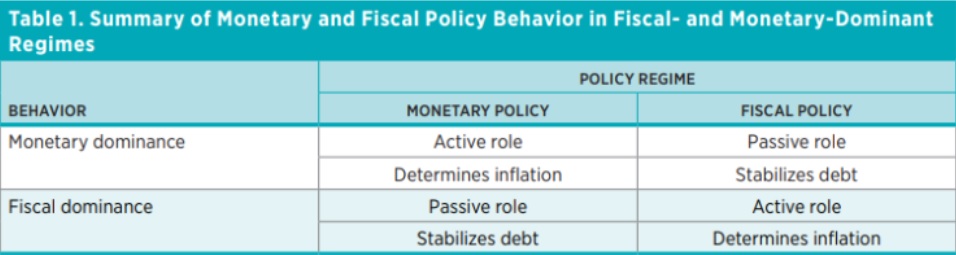
In the academic literature, this is part of the discussion about “fiscal dominance.” As shown in this visual, fiscal dominance exists when central banks decide (or are forced) to create money to finance government spending.

The visual is from a report by Eric Leeper for the Mercatus Center. Here’s some of what he wrote.


…a critical implication of fiscal dominance: it is a threat to central bank success. In each example, the central bank was free to choose not to react to the fiscal disturbance—central banks are operationally independent of fiscal policy. But that choice comes at the cost of not pursuing a central bank legislated mandate: financial stability or inflation control. Central banks are not economically independent of fiscal policy, a fact that makes fiscal dominance a recurring threat to the mission of central banks and to macroeconomic outcomes. …why does fiscal dominance strike fear in the hearts of economists and financial markets? Perhaps it does so because we can all point to extreme examples where fiscal policy runs the show and monetary policy is subjugated to fiscal needs. Outcomes are not pleasant. Germany’s hyperinflation in the early 1920s may leap to mind first. …The point of creating independent central banks tasked with controlling inflation…was to take money creation out of the hands of elected officials who may be tempted to use it for political gain instead of social wellbeing.

A working paper from the St. Louis Federal Reserve Bank, authored by Fernando Martin, also discusses fiscal dominance.


In recent decades, central banks around the world have gained independence from fiscal and political institutions. The proposition is that a disciplined monetary policy can put an effective brake on the excesses of political expediency. This is frequently achieved by endowing central banks with clear and simple goals (e.g., an inflation mandate or target), as well as sufficient control over specific policy instruments… Despite these institutional advances, the resolve of central banks is chronically put to the test. … the possibility of fiscal dominance arises only when the fiscal authority sets the debt level.

The bottom line is that budget deficits don’t necessarily lead to inflation. But if a government is untrustworthy, then it will have trouble issuing debt to private investors.

And that’s when politicians will have incentives to use the central bank as a printing press.

P.S. Pay attention to Italy. The European Central Bank has been subsidizing its debt. That bad policy supposedly is coming to an end and things could get interesting.

Wednesday, November 2, 2022

Europe Isn't Our Problem, Nor Our Responsibility

By Rich Kozlovich

On September 27th, George Friedman, owner of Geopolitical Futures, a site to which I recommend subscribing, posted an article entitled, Immigration, the Economy and the Italian Election.  This is a subscription article so I can't link it.  But, among other things, it's about the Italian election of a "hard-right" party in their parliamentarian election.  And Italy just recently elected Giorgia Meloni, a conservative who the media defines as "far right".  Being that Italian government is so far left, being far right in Italy would only mean being one foot to the right of the rest. 

He goes on to explain how economic polices in the EU are designed to help Germany, and Italy's needs and wants are different, and this issue is causing big problems for the EU, which is a mess, and immigration is one of the biggest messes Europe faces, both economically and socially. 

George is an immigrant himself and describes the difficulties for those who immigrated and lived in NYC, and I understand his view, which I will address later.   Yet he recognizes the immigration problems for Europe are far more divisive, and I think will become violent in the future.

Italy has had it with immigration from the Middle East and Africa, and want these Muslim immigrants to go to Germany, and since they keep promoting all this divisive immigration to Europe, Italy wants them to have them.

George wrote the book,  The Storm Before the Calm: America's Discord, the Crisis of the 2020s, and the Triumph Beyond, which dealt with the impact immigration waves have on the social and domestic structure of a society, but specifically he dealt with America. And remember, these were immigrants who came to the United States with very similar moral and ethical foundations, and yet the changes in America were significant.

Christians of all denominations, along with Jews share a commonality, and while there was violence and poverty for those immigrants in NYC and elsewhere, all those people pretty much became Americans in one generation because of their shared values. 
 
Those migrating to Europe, who are from African and Middle East countries have values totally antithetical to Europe's, and worse yet, they desire to destroy Europe as we know it.  There is no cultural commonality!
 
I was raised by my grandparents, who were immigrants, so for all practical purposes I'm a second generation immigrant, with no connection or desire to the "old country", and neither did any other members of my family, including those who immigrated here.  In fact all my grandparents were immigrants, and they all suffered,  but did so gladly since they "knew" no matter what they had to endure their children were going to have opportunities that would have never existed in Europe. 
 
The Protestants, the Orthodox, the Catholics and the Jews all had their prejudices and preferences, but no matter what problems existed, America was their melting pot to success, and they came here to be Americans, not some ethnic group who just happened to live in America.
 
Western Europe is doomed.  The EU is doomed, and in the past I predicted the fall would come by 2025, and it's looking like I might right on, but I'm convinced by 2030 for sure.  Some parts of Europe have already demographically gone past the point of no return for ethnic Europeans, and even Eastern Europe, which will not accept these Muslim immigrants, will suffer economically from Europe's collapse.
 
I do wish everyone would get this, say this, and act on this.  Islam isn't a religion.  It's a political criminal movement masquerading as a religion.  Once that's accepted, then all this is fixable.  But it won't be accepted.  Even in centuries past the European "Christian" kings would support the Ottoman Empire's military efforts against other European Christian nations if they saw some benefit to themselves. France and Venice were two of the biggest offenders.  
 
Europe is at best a leaky vessel, and if they sink, so be it.  America over the last 120 years has shed staggering amounts of American blood and obscene amounts of American money saving Europe, and it's time we stopped.  Let them fix their own problems..... or not ......but either way, leave us out of it.   


Wednesday, October 26, 2022

European Fiscal Policy Week, Part II: The Right Response to Italy’s Fiscal Crisis

October 25, 2022 by Dan Mitchell @ International Freedom 

I wrote yesterday to speculate about a possible fiscal crisis in Italy.

Today, here are my thoughts on why there should not be a bailout if/when a crisis occurs. 

I have moral objections to bailouts, but let’s focus in this column on the practical impact.

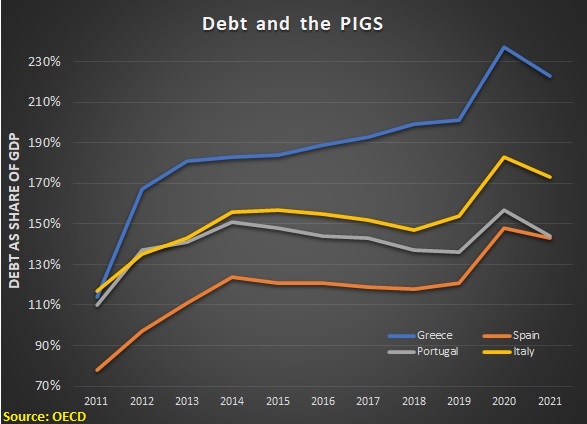
And let’s start with this chart, which shows debt levels in Portugal, Italy, Greece, and Spain (the so-called PIGS) ever since the misguided bailout of Greece about a dozen years ago.

As you can see, OECD data reveals that there’s been no change in these poorly governed nations. They have continued to over-spend and accumulate ever-higher levels of debt.

This certainly seems like evidence of failure, in part because of Greece’s continued bad policy.

But I’m equally concerned about how other Mediterranean nations did not change their behavior.

So why did those nations accumulate more debt, even though they had an up-close look at Greece’s fiscal collapse?

I suspect they figured they could get bailouts, just like Greece. In other words, the IMF and others created a system corrupted by moral hazard.

Defenders of bailouts assert that Greece was forced to engage in “austerity” as a condition of getting a bailout.

I have two problems with that argument.

 http://freedomandprosperity.org/wp-content/uploads/2019/09/Sep-17-19-Greek-Fiscal-OECD.jpg

  • First, notice how Greece’s debt has continued to go up. If that’s a success, I would hate to see an example of failure.
  • Second, the main effect of the so-called austerity is a much higher tax burden and a somewhat higher spending burden.

If there’s a bailout of Italy (or any other nation), I suspect we’ll see the same thing happen. Higher taxes, higher spending, and higher debt.

I’ll close by acknowledging that there are costs to my approach. If Italy is not given a bailout, the country may have a “disorderly default,” meaning the government simply stops honoring its commitments to pay bondholders.

That is bad for individual bondholders, but it also could hurt – or even bankrupt – financial institutions that foolishly decided to buy a lot of Italian government bonds.

But there should be consequences for imprudent choices. Especially if the alternative is bailouts that misallocate global capital and encourage further bad behavior.

The bottom line is that the long-run damage of bailouts is much great than the long-run damage of defaults.

P.S. Just like it’s a bad idea to provide bailouts to national governments, it’s also a bad idea to provide bailouts to state governments. Or banks. Or student loan recipients.


Tuesday, October 25, 2022

European Fiscal Policy Week, Part I: Italy’s Looming Fiscal Crisis

October 24, 2022 by Dan Mitchell @ International Liberty

I’m in Europe to give a couple of speeches about fiscal policy, so I’m going to spend all week commenting on the continent’s (mostly miserable) fiscal policy.

Let’s start with comments about Italy, the nation most likely to suffer a crisis.

Normally, I tell people to focus on government spending rather than red ink. After all, the economy is hurt whether spending is financed by taxes or borrowing (or printing money).

But I’ve also noted that governments sometimes spend so much money and incur so much debt that investors decide it is very risky to buy or hold debt from those governments. In other words, they begin to fear default.

When investors (sometimes known as “bond vigilantes”) reach that stage, they probably try to get rid of their holdings and definitely refuse to buy more debt. The net result is that profligate governments have to offer much higher interest rates to compensate for the risk of a possible default.

That happened earlier this century in Greece.

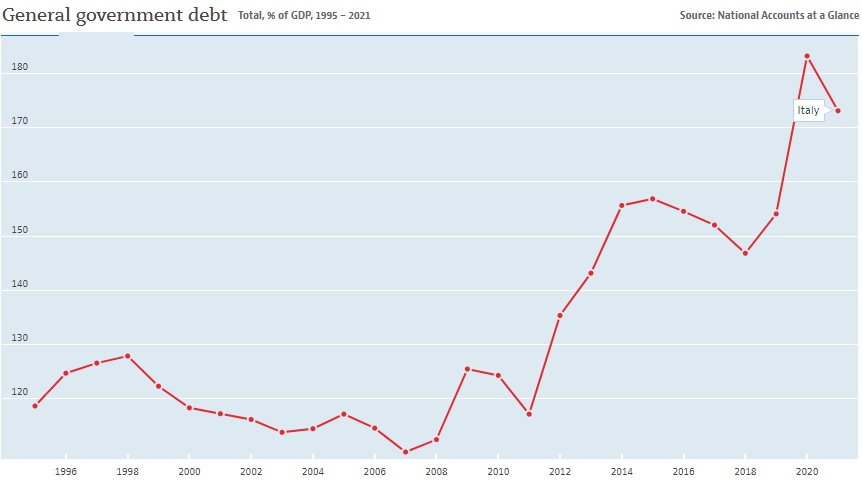
And if peruse this data from the OECD, you find that Italian government debt has jumped to levels that may be unsustainable.

So why has Italy avoided a crisis?

As noted in this article by Desmond Lachman, published by Inside Sources, the nation is being propped up by the European Central Bank.


In Europe, when the European Central Bank (ECB) soon dials back its bond-buying program, we are likely to find out that it is the Italian economy that has been swimming naked. This should be of deep concern for the Eurozone and world economies. While the Italian economy might be too large for its Eurozone partners to allow it to fail, it also might prove to be too large for them to bail it out. …The main factor that has allowed the Italian government to finance its ballooning budget deficit on favorable terms has been the ECB’s massive government bond-buying…the ECB used its emergency bond-buying program to more than fully finance the Italian government’s borrowing needs. …it must be only a matter of time before we have another round of the Italian sovereign debt crisis. …no longer being able to count on ECB bond-buying, the Italian government will have to increasingly finance itself in the market. It will have to do so with its public finances in a worse state than they were in during the 2012 debt crisis.

In the article, Lachman thinks a crisis is all but inevitable because the ECB is unwinding its pandemic-era money creation.

I agree about the ECB’s harmful role, but I fear the central bankers in Frankfurt will continue to do the wrong thing.

P.S. I mentioned demographics at the start of the video. Here’s some more information about how aging populations are contributing to fiscal meltdown.

P.P.S. Italy can solve its problems, but I doubt it will choose the only effective solution.


Sunday, November 7, 2021

When will the CDC correct its COVID death counts, as Italy just did?

November 6, 2021 By Andrea Widburg 

The Summit caught a fascinating story out of Italy: The Italian Higher Institute of Health decided it had miscounted COVID deaths. Instead of looking at people who died with COVID, as it once did, it looked only at people who died from COVID—leading to a 97% decrease in Italy’s COVID death count. So far, though, the CDC shows no signs of following suit.

According to The Summit:

The Italian Higher Institute of Health has drastically reduced the country’s official COVID death toll number by over 97 per cent after changing the definition of a fatality to someone who died from COVID rather than with COVID.

Italian newspaper Il Tempo reports that the Institute has revised downward the number of people who have died from COVID rather than with COVID from 130,000 to under 4,000.

“Yes, you read that right. Turns out 97.1% of deaths hitherto attributed to Covid were not due directly to Covid,” writes Toby Young.

Sunday, April 25, 2021

Preventing Fiscal Meltdowns with a Spending Cap

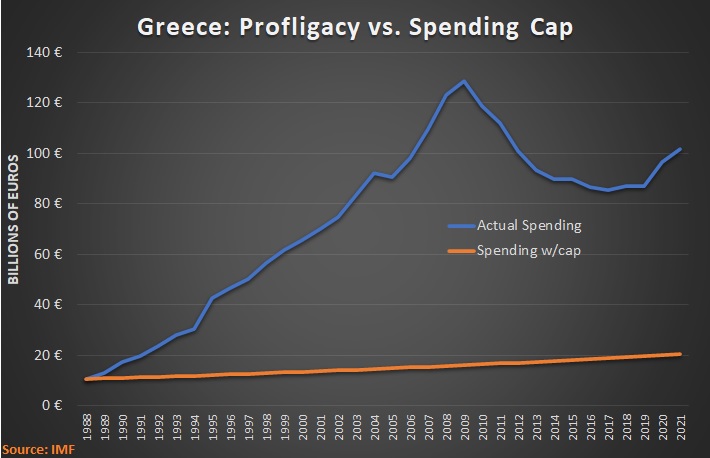
As part of my recent interview about European economic policy with Gunther Fehlinger, I pontificated on issues such as Convergence and Wagner’s Law.  I also explained why a Swiss-style spending cap could have saved Greece and Italy from fiscal crisis. Here’s that part of the discussion.


For those not familiar with spending caps, this six-minute video tells you everything you need to know.  Simply stated, this policy requires politicians to abide by fiscal policy’s Golden Rule, meaning that – on average – government spending grows slower than the private economy.

And that’s a very effective recipe for a lower burden of spending and falling levels of red ink.

One of the points I made in the video is that spending caps would prevented the fiscal mess in Greece and Italy.

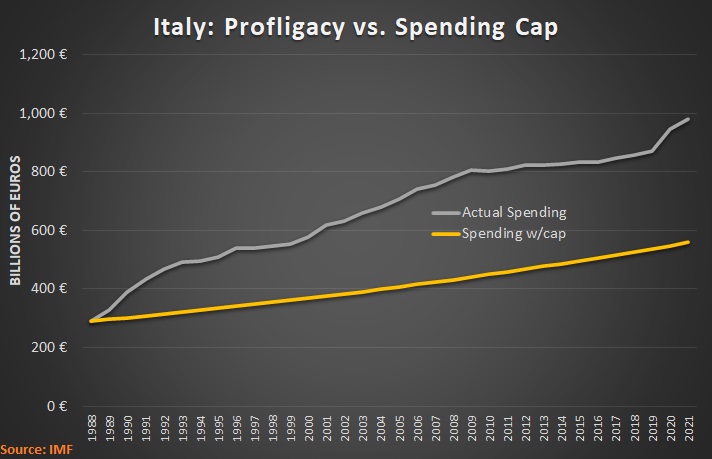
To show what I mean, I went to the International Monetary Funds World Economic Outlook database and downloaded the historical budget data for those two nations. I then created charts showing actual spending starting in 1988 compared to how much spending would have grown if there was a requirement that the budget could only increase by 2 percent each year.

Here are the shocking numbers for Greece.

The obvious takeaway is that there never would have been a fiscal crisis if Greece had a spending cap.

That also would be true even if the spending cap allowed 3-percent budget increases starting in 1998.

And it would be true if the 2-percent spending cap didn’t start until 2000.

There are all sorts of ways of adjusting the numbers. The bottom line is that any reasonable level of spending restraint could have prevented the horrible misery Greece has suffered.

Here are the numbers for Italy.

As you can see, the government budget has not increased nearly as fast in Italy as it did in Greece, but the burden of spending nonetheless has become more onerous – particularly when compared to what would have happened if there was a 2-percent spending cap.

I’ve written many times (here, here, here, and here) about Italy’s looming fiscal crisis. As I said in the interview, I don’t know when the house of cards will collapse, but it won’t be pretty.

And tax reform, while very desirable, is not going to avert that crisis. At least not unless it is combined with very serious spending restraint.

P.S. For those who want information about real-world success stories, I shared three short video presentations back in 2015 about the spending caps in Switzerland, Hong Kong, and Colorado.

P.P.S. It’s also worth noting that the United States would be in a much stronger position today if we had enacted a spending cap a couple of decades ago.


Tuesday, August 4, 2020

Italy’s Grim Outlook

July 23, 2020 by Dan Mitchell
 
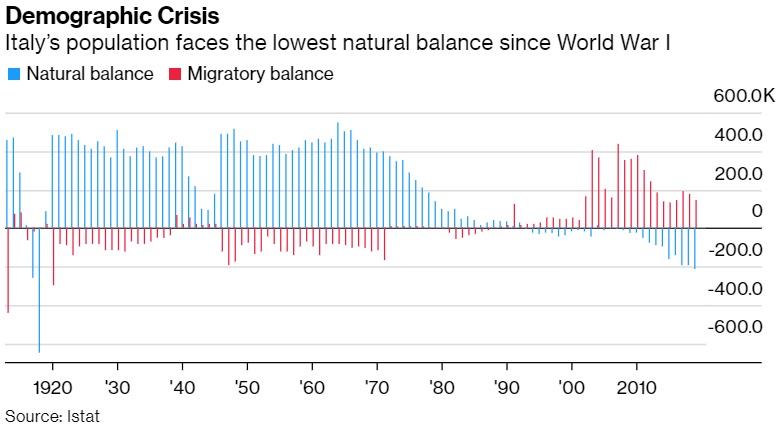
There are many reasons to be depressed about Italy. Bad policy is part of the problem, of course, but this chart shows that the country also is facing a demographic crisis. The blue lines show that there are now more deaths than births.

The chart comes from a Bloomberg column by Flavia Rotondi and Giovanni Salzano, and they explain some of the adverse consequences of this demographic change.
Italy isn’t just in an economic slump, its population is also sagging, pushing the country into its biggest demographic crisis in more than a century. The number of people in the country fell for a fifth year in 2019, and deaths exceeded births by almost 212,000, the biggest gap since 1918. …Italy already has huge long-term economic challenges, and the population trends, if they continue, are going to make surmounting them even harder. Italy won’t have enough young workers, and funding a rapidly aging population will strain an already stretched fiscal situation. Pension costs now amount to almost 17% off the economy. …“With an aging population and a consistent decrease of workers who pay taxes, our retirement system may go haywire” said Pietro Reichlin, a professor of economics.
Politicians naturally will want to compensate for these changes by raising the tax burden.  But Italy already is at a breaking point because of punitive taxation. Writing for the Foundation for Economic Education, Daniel Di Martino discusses his nation’s dirigiste system..........To Read More....

Saturday, March 14, 2020

For Italy, multilateral globalism, plus socialism, equals death

March 13, 2020 By Monica Showalter

Italy's in dire need of help. Its health care system is collapsing. The coronavirus has put the whole country in quarantine. There are now 15,000 cases, along with 1,018 deaths, the last 24 hours bringing in 188 more. The casualty count is the highest outside China. And it's spreading fast. Until a few days ago, the problem as concentrated in the north. Now, it has spread throughout the whole country. Anyone with a heart can feel pity and an urge to help them. They need help, bad. But don't go asking the European Union. Turns out the open-borders globalist set-up is stiffing the Italians in their hour of need:

First, the EU created the problem by failing to shut down their borders with China, enabling its spread into Italy in the first place. While President Trump was acting swiftly to protect America from the lethal virus, the European Union was saying there was no crisis and calling Trump a xenophobe.

Now, with Italy hit hard based on that hate-Trump 'logic', its medical system is overwhelmed. Its doctors and nurses are exhausted. There's not enough equipment or supplies, and the patients keep coming. Health care is being doled out by triage, old people being told 'no health care for you.' The Italians are appealing for help with masks, surgical equipment, doctors, anything that will enable them to get through it and save human lives -- and the EU is not giving it.

David Freddoso of the Washington Examiner has a must-read column on how the EU is leaving Italy to fend for itself in its hour of need.............And as Freddoso notes, all they are getiting is empty EU words, nothing more. So much for all that 'sharing.'..............Globalism, as it turns out, seems absolutely lethal when combined with socialism. Italy has socialized medicine,...........The central planners don't have enough beds. There's not enough staff. There's no free market to step in and pick up the slack, it's not allowed............Imagine paying for high taxes for socialist health care all your life only to be told in your hour of need 'too bad, you're too old, no health care for you'?............To Read More.....

Tuesday, June 18, 2019

Dictator in exile, Medici edition: Is Obama secretly meeting with Italy's Renzi to get their stories straight?

June 17, 2019 By Monica Showalter

Former President Obama's weird careening around Europe is starting to have the look of a spygate rationale.

Following his earlier meetings,, publicly known, with President Emmanuel Macron of France, and Chancellor Angela Merkel of Germany, he's now meeting secretly with Italian Prime Minister Matteo Renzi, in what might just be a bid for the two of them to get their stories straight. Italy, recall, is the nation that elected a Trump-like new government, following the deep state collaborations of the earlier government, and the new government has fired four Italian intelligence officials, apparently over a spygate bid to pin Russian collusion charges, falsely, on President Trump via planted emails, in a Machiavellian bid to get him thrown out of office.

That's the suggestion from Joe Hoft over at GatewayPundit, which has a long and involved piece about the former president's latest travels, citing quite a few open sources. He begins: ,,,,,,,,,, To Read More

Tuesday, December 11, 2018

As Paris burns, 50,000 in Rome rally in support of populist government defying EU mandarins

Saturday saw a new tale of two cities. Paris, in the throes of a popular revolt against the globalist,warmist, high-tax regime of Emmanuel Macron, was exploding in another weekend of violence that saw "1,385 arrests, setting a record for a single day in postwar France. Meanwhile, in Rome, a buoyant crowd of at least 50,000 celebrated six months of power for the populist coalition that won power in Italy.

CNN reports:.............Read more

Friday, October 26, 2018

The EU is Coming Apart

By Rich Kozlovich

Today Ryan Bridges posted the article The EU Goes to Battle Over Italy’s Budget, at Geopolitical Futures, which is a subscription site.  I thought it played into Dan Mitchell's article, A Helpful Solution to Italy’s Budget Standoff with the European Commission.

Bridges notes that Brussels has to look strong and the only solution is a market based solution because they don't have the tools to enforce any of their demands on Italy's budget, which is bankruptcy in the wings. 

But the reality is the EU is doomed, and that should be obvious to the most casual observers.  The EU is facing the exit of the United Kingdom and they're trying to impose sanctions of some kind against Poland and Hungary.  The Eastern European members of the EU aren't impressed with Brussels, or afraid, and now that the EU has rejected Italy's budget draft, they're facing what I believe is just one more unresolvable crisis. 

As Bridges notes, the EU now fears an exit of the EU by Italy.  It's the fourth largest economy in Europe, but it's debt load is staggering and this budget has spending at levels that will triple their deficit spending.   But who will lend them the money if they've become so deranged to believe they can spend unendingly and still be a viable economic power? 

He rightly observes the EU wants to end this problem as swiftly as possible, but the fact of the matter is - this is just one of many problems that will not go away swiftly or otherwise. 

To understand this whole EU mess is to understand Europe is a patchwork quilt of unending ethnic variations.   In so many of Europe's nations they're broken up into their own social paradigms and languages.  As Bismarck, the Iron Chancellor of Germany once noted, Europe is nothing more than a geographic designation.  Unlike the United States, Europe doesn't share the same language or the same culture.

The rest of the article goes on to explain - quite well I think - the different strategies being used by both sides to each get their way, but all this is nothing more than fighting to sit at the Captain's table for dinner while the ship is sinking. 

This is just one more plug being pulled out of the ship's hull.  When just one of these nations defaults, and it's going to happen, the rest of Europe will be flushed down the toilet economically, taking many of the world's banks with them, along with Russia and China, both of who's banking systems are a complete and fraudulent mess. 

Tuesday, June 5, 2018

New Italian Interior Minister to Illegals: 'Pack your bags'

June 4, 2018 Matteo Salvini

If the European Union didn't think Italy's new populist government was serious about getting tough on illegal immigration, new Interior Minister Matteo Salvini disabused them of that idea.
"The party is over for illegal immigrants," Salvini said at a June 2 rally in Vicenza. "They will have to pack their bags, in a polite and calm manner, but they will have to go. Refugees escaping from war are welcome, but all others must leave."
No government official from western europe has spoken so openly about dealing with the hundreds of thousands of economic refugees from North Africa who have arrived in Italy in the last 5 years. Salvini's words must have been a splash of cold water for the rest of the EU................. More