Search This Blog

De Omnibus Dubitandum - Lux Veritas

Showing posts with label Spending Caps. Show all posts

Monday, May 22, 2023

A Spending Cap Amendment Is Far Better than a Balanced Budget Amendment

May 20, 2023 by Dan Mitchell @ International Liberty

The Swiss Debt Brake and Colorado’s TABOR work because they limit spending. Balanced budget requirements, by contrast, have a weak track record

My point in the above discussion with the Soul of Enterprise is mostly based on economics.

Our fiscal challenge in the United States is excessive government spending. And the problem is projected to worsen in coming decades because of demographic change and poorly designed entitlement programs.

So it makes sense to directly address the problem with a spending cap.

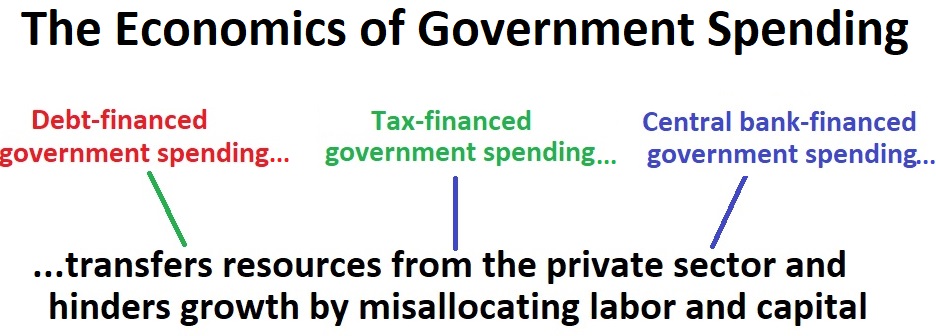
By contrast, a balanced budget amendment is merely designed to inhibit debt-financed spending. That’s a good goal, but it won’t lead to good results if politicians react by simply increasing tax-financed spending. Or if they finance spending with bad monetary policy.
As I point out in the video, balanced budget requirements and anti-deficit rules have not produced good results in American states or EU nations.

The takeaway is that good policymakers should push for spending caps for theoretical reasons and practical reasons.

P.S. I was very pleasantly surprised when the German government recently endorsed EU-wide spending caps.

P.P.S. Remarkably, there are pro-spending-cap studies from left-leaning bureaucracies such as the International Monetary Fund (here and here) and the Organization for Economic Cooperation and Development (here and here). There are also similar studies from the European Central Bank (here and here).

P.P.P.S. It should go without saying, but I’ll say it anyhow, that a spending cap should be set at a level that actually results in less government.

Tuesday, October 25, 2022

European Fiscal Policy Week, Part I: Italy’s Looming Fiscal Crisis

October 24, 2022 by Dan Mitchell @ International Liberty

I’m in Europe to give a couple of speeches about fiscal policy, so I’m going to spend all week commenting on the continent’s (mostly miserable) fiscal policy.

Let’s start with comments about Italy, the nation most likely to suffer a crisis.

Normally, I tell people to focus on government spending rather than red ink. After all, the economy is hurt whether spending is financed by taxes or borrowing (or printing money).

But I’ve also noted that governments sometimes spend so much money and incur so much debt that investors decide it is very risky to buy or hold debt from those governments. In other words, they begin to fear default.

When investors (sometimes known as “bond vigilantes”) reach that stage, they probably try to get rid of their holdings and definitely refuse to buy more debt. The net result is that profligate governments have to offer much higher interest rates to compensate for the risk of a possible default.

That happened earlier this century in Greece.

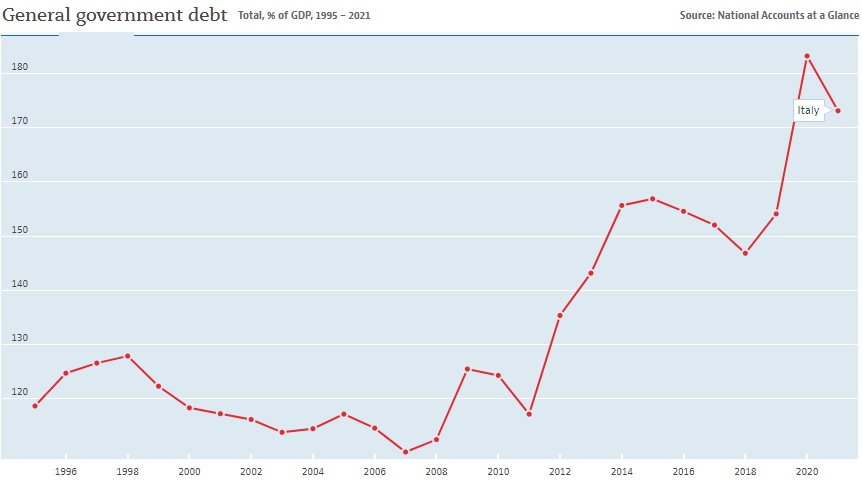
And if peruse this data from the OECD, you find that Italian government debt has jumped to levels that may be unsustainable.

So why has Italy avoided a crisis?

As noted in this article by Desmond Lachman, published by Inside Sources, the nation is being propped up by the European Central Bank.


In Europe, when the European Central Bank (ECB) soon dials back its bond-buying program, we are likely to find out that it is the Italian economy that has been swimming naked. This should be of deep concern for the Eurozone and world economies. While the Italian economy might be too large for its Eurozone partners to allow it to fail, it also might prove to be too large for them to bail it out. …The main factor that has allowed the Italian government to finance its ballooning budget deficit on favorable terms has been the ECB’s massive government bond-buying…the ECB used its emergency bond-buying program to more than fully finance the Italian government’s borrowing needs. …it must be only a matter of time before we have another round of the Italian sovereign debt crisis. …no longer being able to count on ECB bond-buying, the Italian government will have to increasingly finance itself in the market. It will have to do so with its public finances in a worse state than they were in during the 2012 debt crisis.

In the article, Lachman thinks a crisis is all but inevitable because the ECB is unwinding its pandemic-era money creation.

I agree about the ECB’s harmful role, but I fear the central bankers in Frankfurt will continue to do the wrong thing.

P.S. I mentioned demographics at the start of the video. Here’s some more information about how aging populations are contributing to fiscal meltdown.

P.P.S. Italy can solve its problems, but I doubt it will choose the only effective solution.