Search This Blog

De Omnibus Dubitandum - Lux Veritas

Showing posts with label TABOR. Show all posts

Monday, November 11, 2024

More Evidence for the TABOR Spending Cap

November 9, 2024 by Dan Mitchell @ International Liberty

Last April, I shared some data showing that Colorado’s Taxpayer Bill of Rights had forced politicians in the Centennial State to return $8.2 billion of tax revenue.


The state’s politicians did not want to return the money. But TABOR is a spending cap and the rules require that any extra tax revenue (above and beyond what would finance allowed levels of spending) has to be returned to taxpayers.

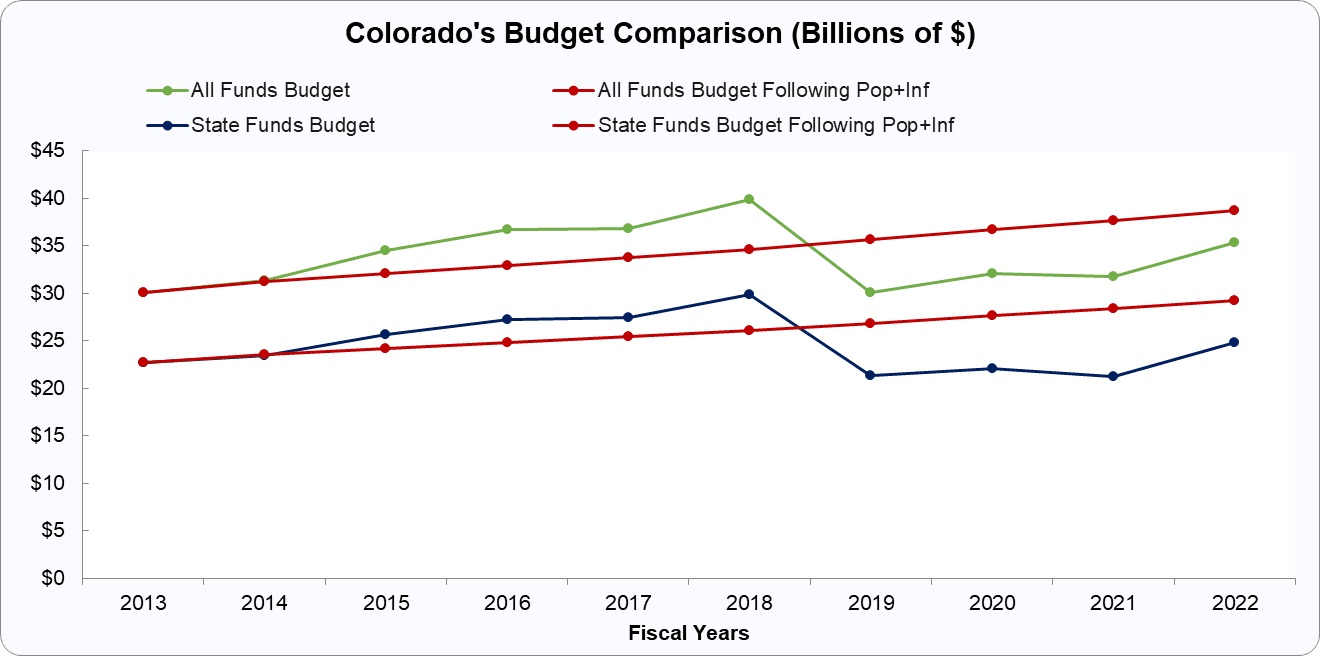
This spending cap has been good news for the state’s economy, as illustrated by the chart.

But I now need to update the benefits of TABOR.

That’s because we have another year of data. And, as explained in this report from Center Square, taxpayers are getting another refund. This time, their savings will be more than $1 billion.


…the Office of the State Auditor confirmed this week that Colorado taxpayers have a refund coming their way. The refund comes because the state collected $1.4 billion more in revenue in Fiscal Year 2024 than the Taxpayer’s Bill of Rights allows, according to the Office of the State Auditor. Colorado voters added TABOR to the state constitution in the November 1992 general election. TABOR reins in government spending by limiting the growth of state revenues to the sum of inflation and the percentage change to the state’s population to create a TABOR growth rate. The state must return any money beyond that amount to its taxpayers.

But I’m going to argue that the big benefit is not the $1 billion-plus refund.

Yes, that’s nice, but what really matters is that the refund means that Colorado politicians could not spend the money.

To elaborate, a spending cap produces more prosperity because government is limited and more resources are therefore in the productive sector of the economy.

I’ll close by recycling my argument in favor of a spending cap in Washington. If that kind of policy existed, and politicians were handcuffed, the current fiscal mess would not exist


To illustrate the importance of a spending cap, let’s shift from Colorado’s TABOR and look at some numbers I calculated when looking at Switzerland’s “Debt Brake” back in March of last year.

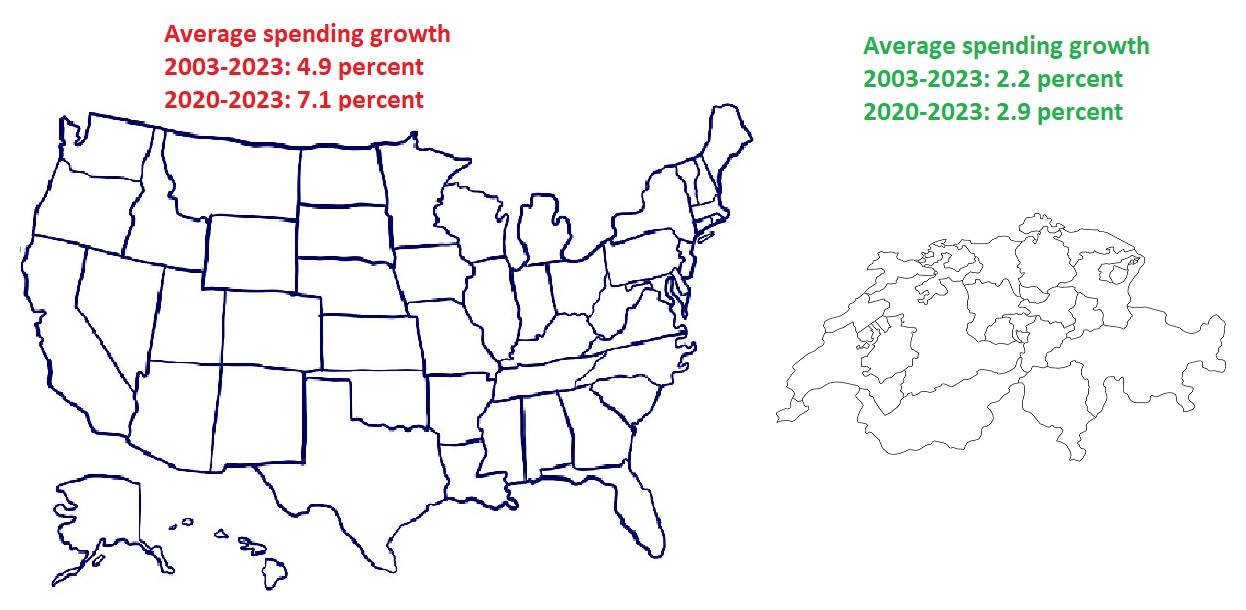
Since that spending cap was imposed by voters more than 20 years ago, the overall burden of government spending in Switzerland has grown by 2.2 percent annually, a far better performance than in the United States, where the fiscal burden has expanded by an average of 4.9 percent per year.

Friday, March 29, 2024

More Good News Thanks to Colorado’s TABOR Spending Cap

March 25, 2024 by Dan Mitchell @ International Liberty

Colorado has the best fiscal rule in the United States. The Taxpayer Bill of  Rights (TABOR) limits state government spending so that it cannot grow faster than inflation plus population.

https://freedomandprosperity.org/wp-content/uploads/2023/12/image-16.jpg

Does Colorado’s spending cap work perfectly? Of course not.

Politicians in the Centennial State have spent decades coming up with ways evade and avoid TABOR’s restrictions.

But let’s not make the perfect the enemy of the good.

A study published last year shows that TABOR has saved taxpayers $8.2 billion.

And taxpayers in Colorado may soon keep even more of their money according to an article by Brian Eason in the Colorado Sun. Here are the relevant excerpts.


…the budget will be squeezed primarily by two seemingly minor factors. One, U.S. Census estimates now say the state’s population grew by less than the state’s demographer had anticipated. That means the state revenue cap under the Taxpayer’s Bill of Rights, which tracks inflation and population growth, can only increase by 5.8% this budget year rather than the 6.1% legislative forecasters were expecting. Two, the state is now expected to collect $185 million more in road usage fees and retail delivery charges this year than last, under the legislative staff estimates. Taken together, the two forecast changes mean state lawmakers could have to issue larger than expected TABOR refunds to Coloradans next year, leaving the state with fewer General Fund tax dollars to spend… That would translate to a nearly $400 refund for the average single-filer in 2025 under the current refund formula, which is tiered based on income.

I’m tempted to call this the feel-good story of 2024. Politicians get less money to waste and taxpayers get more of their money returned.

No wonder TABOR is the gold standard for good fiscal policy at the state level. And Switzerland shows that spending caps also are very effective at the national level.

By contrast, there is very little evidence that balanced-budget rules produce good results.

P.S. Perhaps the best evidence for TABOR is that the pro-spending lobbies in Colorado are always trying to trick voters into approving ballot initiatives that would allow more spending. But as we saw in 2013, 2019, and 2023, the voters of left-leaning Colorado keep voting to to maintain their spending cap.

Wednesday, January 3, 2024

Even More Evidence Against Minimum Wage Laws

December 29, 2023 by Dan Mitchell @ International Liberty 

As explained by public intellectuals such as Milton Friedman, Johan Norberg, John Stossel, and Orphe Divougny, the argument against minimum wage requirements is very simple.  If politicians dictate that people can’t be employed unless they receive, say, $15 per hour, then workers who are worth less than than amount (because of low skills, no experience, etc) won’t get hired.  And if a worker is worth $17 per hour and a government now says that worker must get $20 per hour, that’s a recipe for getting laid off.  Which is exactly what is happening in California. Here are some excerpts from a Wall Street Journal editorial........To Read More....

Milei's Best Proposal? - December 30, 2023 by Dan Mitchell -  I sometimes joke about living in a libertarian fantasy world, maybe even a libertarian nation with a libertarian anthem.  Amazingly, that is basically what Argentina’s new president, Javier Milei, is trying to create.  At least the libertarian nation part. He has all sorts of proposals that I like, including smaller government, deregulation, and free trade.  But Articulo 209 is my favorite. He wants to prohibit the government from saying that goodies from the government are “free.”  Here’s a tweet describing his proposal................

The Best and Worst News of 2023 - December 31, 2023 by Dan Mitchell - Time for the annual “best and worst” column, which has been a long-standing tradition (2022, 2021, 202020192018etc).  We actually saw some major good news in 2023. Here are my top 3 developments.

President Milei in Argentina – The most important election of the year took place in the long-suffering nation of Argentina, which amazingly elected a hard-core libertarian in its presidential election. 

School choice revolution – The past few years have been great for education policy, with state after state adopting some form of universal or near-universal school choice.

Landslide victory for TABOR in Colorado – If Milei’s victory was the best global election news of 2023, the defeat of Proposition HH was the best domestic election news of the year. Pro-spending lobbies have repeatedly tried to get rid of the TABOR spending cap.

Honorable mention goes to the state tax-cutting wave.............


Thursday, November 9, 2023

Great Election Result

November 8, 2023 by Dan Mitchell @ International Liberty

Since I care about policies rather than politicians, yesterday’s most important election was a referendum that took place in Colorado.

The big-spending lobbies once again tried to weaken the state’s spending cap, known as TABOR, or the Taxpayer Bill of Rights.

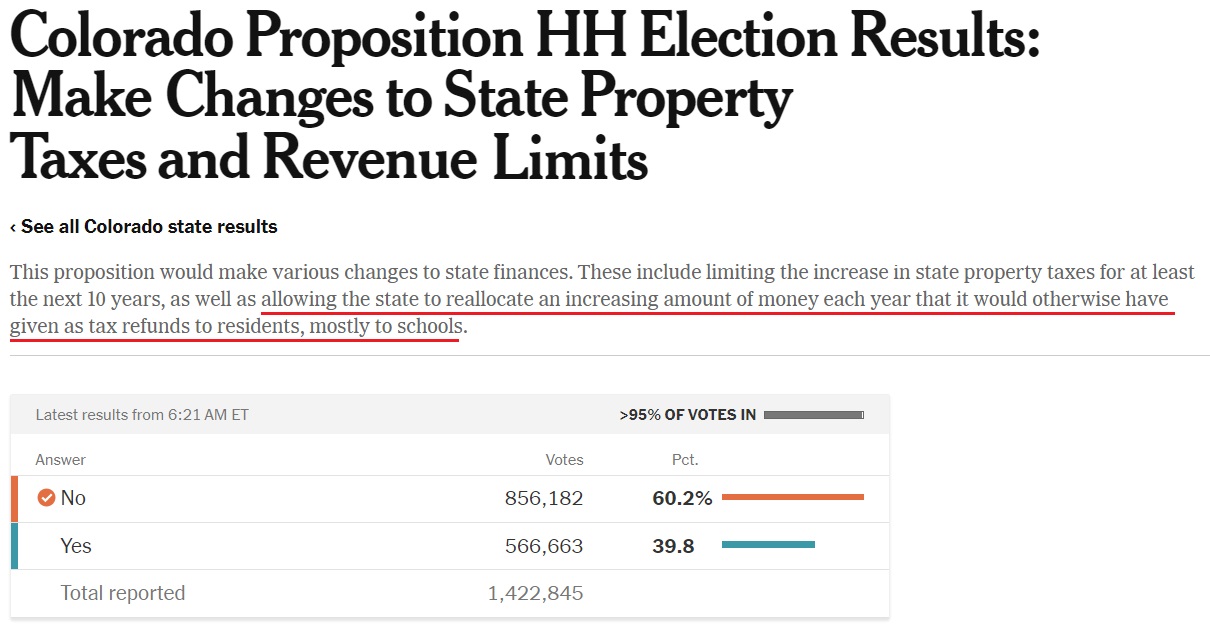
Yet even though Colorado voters lean to the left, they overwhelmingly rejected Proposition HH. Here are the results.

I underlined the most important part of the above description because the anti-TABOR crowd tried to deceive voters by portraying Prop HH as a measure to lower property taxes.

As I wrote last month, “Will Colorado voters be tricked by Proposition HH? Will they be distracted by the shiny bauble of lower property taxes while politicians grab a greater amount of income tax revenue?”

Fortunately, the voters saw through the ruse.

Here’s how Nick Coltrain and Seth Klamann of the Denver Post described the outcome.


Colorado’s wide-ranging Proposition HH, a property tax relief and education-funding measure pressed by the state’s Democratic leaders, went down in defeat Tuesday night as voters were rejecting it by 20 percentage points. More than 60% of voters rejected Proposition HH…voters in all but a handful of counties were on track to reject the major policy proposal put forth by Gov. Jared Polis and legislative Democrats…

It was the second time in four years that voters rebuffed an attempt by state Democrats to raise spending limits under the Taxpayer’s Bill of Rights, or TABOR. …Proposition HH marked the latest defeat as Democrats attempted to leverage their trifecta in state government to hold onto more tax money. On the 2019 ballot, they ran Proposition CC, which proposed to retain all taxes collected beyond the TABOR cap, ending refunds, in a bid to shore up the budget. Voters rejected Prop. CC.

If you want to track the history of anti-TABOR initiatives, I wrote about Prop CC in 2019. And I also wrote about an anti-TABOR initiative that failed back in 2013.

If Republicans were smart (don’t laugh), they would push TABOR-style spending caps in other states.

Monday, May 22, 2023

A Spending Cap Amendment Is Far Better than a Balanced Budget Amendment

May 20, 2023 by Dan Mitchell @ International Liberty

The Swiss Debt Brake and Colorado’s TABOR work because they limit spending. Balanced budget requirements, by contrast, have a weak track record

My point in the above discussion with the Soul of Enterprise is mostly based on economics.

Our fiscal challenge in the United States is excessive government spending. And the problem is projected to worsen in coming decades because of demographic change and poorly designed entitlement programs.

So it makes sense to directly address the problem with a spending cap.

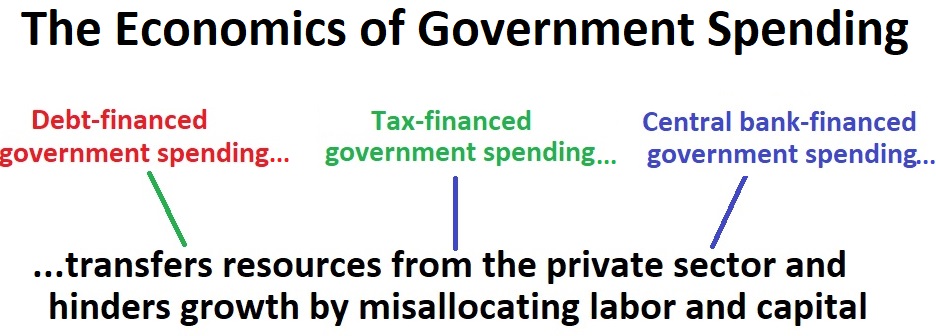
By contrast, a balanced budget amendment is merely designed to inhibit debt-financed spending. That’s a good goal, but it won’t lead to good results if politicians react by simply increasing tax-financed spending. Or if they finance spending with bad monetary policy.

As I point out in the video, balanced budget requirements and anti-deficit rules have not produced good results in American states or EU nations.

The takeaway is that good policymakers should push for spending caps for theoretical reasons and practical reasons.

P.S. I was very pleasantly surprised when the German government recently endorsed EU-wide spending caps.

P.P.S. Remarkably, there are pro-spending-cap studies from left-leaning bureaucracies such as the International Monetary Fund (here and here) and the Organization for Economic Cooperation and Development (here and here). There are also similar studies from the European Central Bank (here and here).

P.P.P.S. It should go without saying, but I’ll say it anyhow, that a spending cap should be set at a level that actually results in less government.

Thursday, April 27, 2023

TABOR’s Track Record: $8.2 Billion in Taxpayer Savings

April 25, 2023 by Dan Mitchell @ International Liberty

The Center for Freedom and Prosperity has a video on spending caps that focuses on international evidence, such as Switzerland’s debt brake.

Here’s a video from the American Legislative Exchange Council that that looks at a successful domestic spending cap – Colorado’s Taxpayer Bill of Rights.

 
Here’s the short and simple explanation of how the Taxpayer Bill of Rights (TABOR) constrains spending.

Under the constitutional provision, state tax revenue cannot grow faster than population plus inflation. Any revenues above that amount have to be returned to taxpayers

Do And since the state has a requirement for a balanced budget, that means that spending also can only grow as fast as population plus inflation.

Has TABOR been successful?

Colorado has out-performed other states, as measured by the growth of personal income, which presumably is a key variable.

Another key variable is the amount of money that TABOR has returned to taxpayers. Here are some excerpts from a new study, authored by Professor Barry Paulson and published by the American Legislative Exchange Council.


This year, the Colorado General Assembly announced a taxpayer rebate of $3.6 billion in surplus revenue. …These rebates are mandated by TABOR, a fiscal rule that limits the growth of revenue and spending at all levels of government and requires that surplus revenue be rebated to taxpayers. …It is important to understand why TABOR has been successful and resilient. TABOR is designed to limit the rate of growth in state revenue and spending to the sum of inflation plus the rate of growth in population while allowing a majority of voters to increase the revenue and spending limit when needed. This prevents many new taxes increases. If the state government collects more tax dollars than TABOR allows, the money is returned to taxpayers as a TABOR refund. …As a result, the state has not incurred deficits or accumulated debt as much as other states, like California. …tax rebates…totaling $8.2 billion since TABOR passed in 1992, has strengthened Colorado citizens confidence in the TABOR Amendment over the years.

The last sentence is key. TABOR has resulted in $8.2 billion in tax rebates. More important, it has prevented Colorado politicians from spending $8.2 billion.

Taxpayers seem to understand that TABOR is a very important protection against over-taxing and over-spending.

Here are some excerpts from a column by Ben Murrey of Colorado’s Independence Institute.


Every time voters speak on key issues related to TABOR, they send the same unambiguous message: “Leave TABOR alone and let us keep our money!” …In 2019 after voters gave Democrats unified control over state government, legislators thanked them by sending Proposition CC–which would have permanently ended TABOR refunds–to the November ballot, where Coloradans soundly rejected it. …In 2020, voters had the choice between two competing citizen-led ballot initiatives. One would have raised taxes and repealed TABOR’s requirement that Colorado maintains the same income tax rate for all taxpayers. The other, put on the ballot by my organization, Independence Institute, reduced the state’s income tax rate from 4.63 to 4.55 percent. The latter passed with a wide margin. The former failed even to gather enough signatures to appear on the ballot. …Fast forward to 2022. …Initiative 63 would have taken TABOR refunds from taxpayers and given the money back to the state to spend on public education. Like the tax increase measure from 2020, the initiative failed even to make the ballot. Conversely, Independence Institute worked to put Proposition 121 on the ballot. The measure won with more than a 30-point margin and lowered the state income tax rate from 4.55 to 4.4 percent, saving taxpayers over $400 million per year.

Colorado voters don’t always reject tax increases. At the local level, such measures often are approved.

But Murrey’s article shows that voters want to preserve TABOR and don’t want to give state politicians a blank check for more taxes and more spending.

Needless to say, a TABOR-style spending cap would be very helpful in other states. And at the national level as well.

P.S. The ALEC study looked at 30 years of evidence. There’s also a study that looked at the first 20 years of evidence.

Thursday, January 19, 2023

Washington’s Fake Spending Cut Charade

January 18, 2023 by Dan Mitchell @ International Liberty

Two days ago, I dug into the C-Span archives to share a 15-year old clip of me explaining the theoretical virtues of a national sales tax.

Let’s now go back more than 30 years for this segment from a 1990 interview.

So why am I sharing my thoughts on Washington’s use of misleading budget rhetoric?

Because while I’ve pontificated about this issue in the past (three times in 2011 and two times in 2012), it’s definitely time for a refresher course.

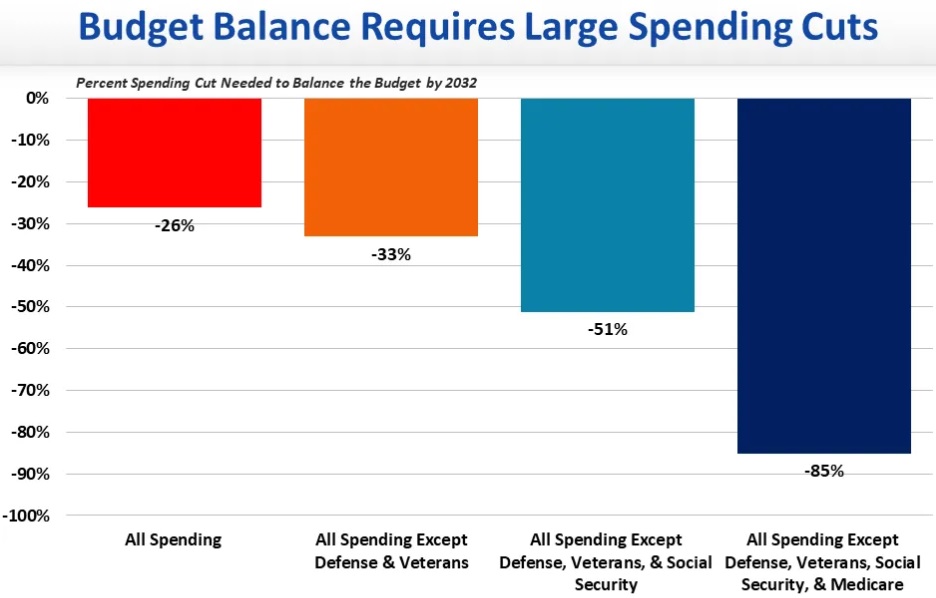
I’m motivated by this chart from the folks at the Committee for a Responsible Federal Budget. They want readers to believe that balancing the budget over the next 10 years would require drastic spending cuts.

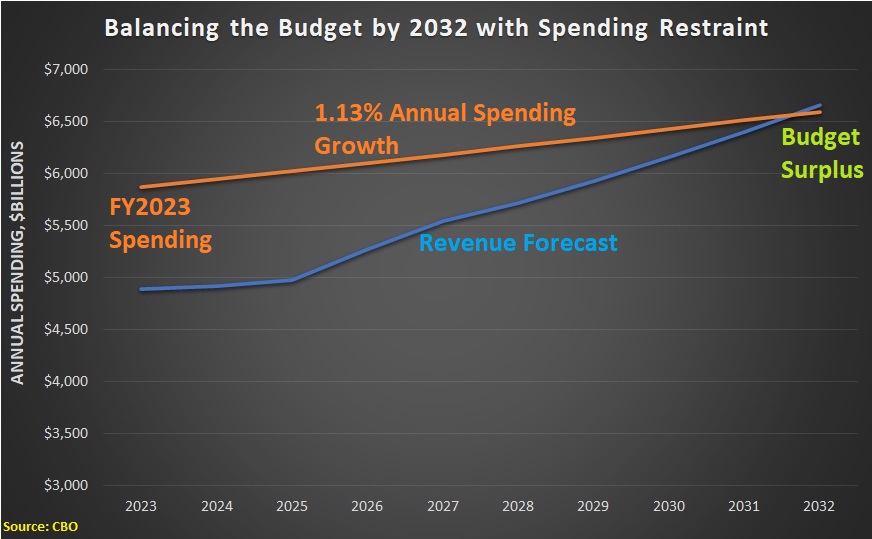
To understand what’s wrong with this CRFB chart, let’s go to the latest 10-year forecast from the Congressional Budget Office.

You’ll notice that this year’s federal budget is $5.87 trillion. And you’ll also notice that revenues in 2032 are projected to climb above $6.66 trillion.

At the risk of showing off my amazing math skills, $6.66 trillion is more than $5.87 trillion. Indeed, nearly $800 billion higher.

And what does that mean? Well, it means that we can balanced the budget by 2032 so long as spending does not increase by more than $800 billion between now and 2032. As illustrated by this chart.

To be fair to the CRFB crowd, they didn’t use make-believe numbers.

Their estimate is based on what would happen if the federal budget is left on autopilot, which means the budget grows every year because of factors such as inflation, demographic change, and previously legislated program expansions.

They then compared that artificial “baseline” to projected revenues. That’s how they came up with an estimate of a 26 percent budget cut.

In reality, though, government would be spending more than 13 percent more in 2032 when compared to 2023.

Here’s the bottom line: If CRFB or anyone else wants to argue that the budget should grow by more than 13 percent over the next nine years, they can make that argument. They can say that various programs are important and that overall spending should increase because of inflation. Or demographics.

Heck, they can even say spending should grow at a rapid pace because AOC and Bernie want bigger government.

We can then have an honest and fair debate. I’ll argue we need a TABOR-style spending cap and they can argue we should be like Greece or Italy.

Sunday, December 2, 2018

Did Colorado Just Become a Blue State?


After the midterm elections, Colorado voters woke up to an electoral map as blue as the sky. Democrats won almost all competitive races, including every state office. They now control both houses of the state legislature. But before we permanently paint Colorado blue, we should consider the outcomes of a few statewide ballot measures.
In fact, Centennial State residents rejected most of the thirteen ballot measures at the state level. All the ballot measures proposing increased taxes and/or debt were defeated by a wide margin, including measures to fund schools and transportation. However, citizens approved a majority of the state’s local school bond issues and funding packages. 
The results of these ballot measures continue a trend that began when the Taxpayer’s Bill of Rights Amendment (TABOR) was ratified in 1992. TABOR requires voter approval for any increase in taxes or debt, and has proven to be the most effective state tax and spending limit in the country.  Since TABOR was adopted, very few state ballot measures calling for increased taxes or debt have been approved. However, at the local level the majority of these ballot measures have passed.

Colorado voters continue to send a clear message to elected officials and special interests in Denver. They have more confidence that tax dollars can be spent wisely at the local level, but very little confidence in the various proposals to tax and spend at the state level...............Read more