Search This Blog

De Omnibus Dubitandum - Lux Veritas

Showing posts with label Civil Asset Forfeiture. Show all posts

Tuesday, May 2, 2023

Nauseating Government Thuggery

May 1, 2023 by Dan Mitchell @ International Liberty

It’s hard to pick the worst government policy since there are so many options.

  • Death tax – The IRS penalizing saving and investment by grabbing money just because someone dies.
  • Fannie Mae and Freddie Mac – Government entities that helped give us the 2008 financial crisis.
  • OECD subsidies – American tax dollars flowing to a Paris-based bureaucracy that pushes for bigger government.
  • Asset forfeiture – When bureaucrats steal money or property because they think a crime may have occurred.

Normally, I might argue that asset forfeiture is the worst policy. It is reprehensible that government officials seize property without ever convicting someone of a crime.

Of sometimes without even charging someone with a crime.

But there’s a version of asset forfeiture that represents an impossible level of government depravity.

Here’s what George Will wrote for the Washington Post about a state government’s mistreatment of an elderly woman.


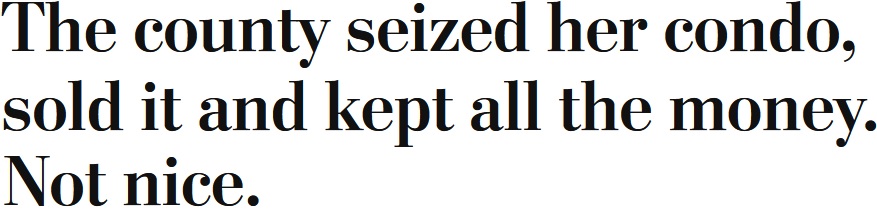
“Minnesota nice…” expires when grasping government wants to steal your house. Just ask Geraldine Tyler, 94, the Black grandmother… In 2010, alarmed by neighborhood disorder, Tyler, retired and living alone, moved from her Minneapolis condominium to a senior living center. She neglected to pay taxes on her one-bedroom condominium, and by 2015 the $2,300 due in back taxes — combined with penalties, interest and fees — brought her liability to $15,000. The county seized and sold her property for $40,000. Tyler is not challenging the propriety of the seizure or sale, but of the county’s home equity theft. Instead of returning $25,000 to her, the government, in a common act of legalized self-dealing, kept $25,000… Such predatory forfeiture is done by a dozen states and the District of Columbia, which took a $200,000 home from a man with dementia and a $133 tax debt.

Fortunately, the Supreme Court has an opportunity to end this odious practice.

Billy Binion of Reason shared some thoughts about the legal case.


The Supreme Court…heard arguments in a consequential case. The query before the justices: Was it unconstitutional when the government seized a woman’s home over an unpaid tax bill, sold it for more than the amount of the debt, and then kept the profit? …Multiple federal courts ruled against Tyler, who is now 94 years old, prior to her case’s ascension to the Supreme Court… Christina M. Martin, a senior attorney at the Pacific Legal Foundation…said…”the county should have taken the property, sold it, paid the debts from the proceeds, and refunded the remainder to Ms. Tyler. Instead, the county took everything.” It’s a line of thinking the Court appeared receptive to.

Let’s keep our fingers crossed that the Supreme Court rules against the Minnesota bureaucrats who are trying to steal money from an old woman.

I know Clarence Thomas is skeptical of this abusive practice. Let’s hope all of the other Justices join him in voting to return Ms. Tyler’s money.

And, in a just world, hopefully they will issue a broad ruling ending all versions of “policing for profit.”

Friday, March 24, 2023

The FBI seized this woman’s life savings—but doesn’t actually suspect her of a crime

Thursday, January 12, 2023

Civil Asset Forfeiture

By Rich Kozlovich   


Earlier today I posted this piece, Innocence Doesn’t Matter When the Government Wants to Steal Your Money by Joe Setyon and I wanted to link more pieces on this, and while I know I had followed this for some time, I must not have tagged them, so I couldn't use them.  

I'm again purging my draft files, and unending task these days, which is why I'm having an evening edition of P&D for a few days, but I came across these articles dealing with this.  

Starting with this:

Quote of the Day! "James Madison warned (in Federalist 48) that government power “is of an encroaching nature.” If unresisted, it produces iniquitous sharing of other people’s property."- George Will

Taken - By Sarah Stillman August 12, 2013 

Issue…..Jennifer Boatright..…drove with her two young sons and her boyfriend….to buy a used car…. officer named Barry Washington pulled them over……The county’s district attorney, a fifty-seven-year-old woman with feathered Charlie’s Angels hair named Lynda K. Russell, arrived an hour later. Russell, who moonlighted locally as a country singer, told Henderson and Boatright that they had two options. They could face felony charges for “money laundering” and “child endangerment,” in which case they would go to jail and their children would be handed over to foster care. 

Or they could sign over their cash to the city of Tenaha, and get back on the road. “No criminal charges shall be filed,” a waiver she drafted read, “and our children shall not be turned over to CPS,” or Child Protective Services…… Later, she learned that cash-for-freedom deals had become a point of pride for Tenaha, and that versions of the tactic were used across the country. “Be safe and keep up the good work,” the city marshal wrote to Washington, following a raft of complaints from out-of-town drivers who claimed that they had been stopped in Tenaha and stripped of cash, valuables, and, in at least one case, an infant child, without clear evidence of contraband…… you needn’t be found guilty to have your assets claimed…..in some states, suspicion on a par with “probable cause” is sufficient. Nor must you be charged with a crime, or even be accused of one……To Read More…..  

Stopping the abuse of civil forfeiture - By Tim Walberg September 4, 2014 

Imagine you are driving down the highway on your way to buy a car. You spent months researching years, makes and models, and you finally found somebody who was selling the exact ride you were looking for at a reasonable price. Suddenly, police pull you over for allegedly going 37 mph in a 35 mph zone. Upon discovering the $8,500 in cash you have on hand, the officers take you to jail and threaten to charge you with money laundering unless you turn over the money. Frightened, you give it to them. This may sound like something out of a Hollywood movie, but it’s a true story, and incidents like it happen all too often across the country because of our civil forfeiture laws. 

Fortunately, the victim in the above story, Roderick Daniels, had his property returned by officials due to media attention and legal pressure. But the power to take property without due process continues to be abused by local, state and federal law enforcement officials. In my state of Michigan, grocery store owner Terry Dehko had his bank account seized by the IRS because it suspected him of being a money launderer. Dehko would make cash deposits in the bank across the street every night to reduce the threat of robbery and because of coverage limits on his store’s insurance policy. Charges were never filed, but Dehko had to fight in court to prove that his money was not being used in a criminal enterprise. ….To Read More….  

When government is the looter - By George F. Will May 18, 2012   

Russ Caswell, 68, is bewildered: “What country are we in?” He and his wife, Pat, are ensnared in a Kafkaesque nightmare unfolding in Orwellian language.  This town’s police department is conniving with the federal government to circumvent Massachusetts law — which is less permissive than federal law — to seize his livelihood and retirement asset. In the lawsuit titled United States of America v. 434 Main Street, Tewksbury, Massachusetts, the government is suing an inanimate object, the motel Caswell’s father built in 1955. The U.S. Department of Justice intends to seize it, sell it for perhaps $1.5 million and give up to 80 percent of that to the Tewksbury Police Department, whose budget is just $5.5 million.   

The Caswells have not been charged with, let alone convicted of, a crime. They are being persecuted by two governments eager to profit from what is antiseptically called the “equitable sharing” of the fruits of civil forfeiture, a process of government enrichment that often is indistinguishable from robbery........ “Equitable sharing” — the consensual splitting of ill-gotten loot by the looters — reeks of the moral hazard that exists in situations in which incentives are for perverse behavior. To see where this leads, read IJ’s scalding report “Policing for Profit: The Abuse of Civil Asset Forfeiture” (http://ow.ly/aYME1), a sickening litany of law enforcement agencies padding their budgets and financing boondoggles by, for example, smelling, or imagining to smell, or pretending to smell, marijuana in cars they covet......To Read More.... 

Policing for Profit: The Abuse of Civil Asset Forfeiture - March 2010 By Marian R. Williams, Ph.D., Jefferson E. Holcomb, Ph.D., Tomislav V. Kovandzic, Ph.D., Scott Bullock 

Civil forfeiture laws represent one of the most serious assaults on private property rights in the nation today. Under civil forfeiture, police and prosecutors can seize your car or other property, sell it and use the proceeds to fund agency budgets—all without so much as charging you with a crime. Unlike criminal forfeiture, where property is taken after its owner has been found guilty in a court of law, with civil forfeiture, owners need not be charged with or convicted of a crime to lose homes, cars, cash or other property. Americans are supposed to be innocent until proven guilty, but civil forfeiture turns that principle on its head. With civil forfeiture, your property is guilty until you prove it innocent.

P olicing for Profit: The Abuse of Civil Asset Forfeiture chronicles how state and federal laws leave innocent property owners vulnerable to forfeiture abuse and encourage law enforcement to take property to boost their budgets. The report finds that by giving law enforcement a direct financial stake in forfeiture efforts, most state and federal laws encourage policing for profit, not justice.

Policing for Profit
also grades the states on how well they protect property owners—only three states receive a B or better. And in most states, public accountability is limited as there is little oversight or reporting about how police and prosecutors use civil forfeiture or spend the proceeds.

Federal laws encourage even more civil forfeiture abuse through a loophole called “equitable sharing” that allows law enforcement to circumvent even the limited protections of state laws. With equitable sharing, law enforcement agencies can and do profit from forfeitures they wouldn’t be able to under state law.

It’s time to end civil forfeiture. People shouldn’t lose their property without being convicted of a crime, and law enforcement shouldn’t be able to profit from other people’s property.


Innocence Doesn’t Matter When the Government Wants to Steal Your Money

Joe Setyon –January 11, 2023 @ American Institute for Economic Research

 

There’s a fault line permeating America’s criminal justice system—a built-in defect that the government can use to steal your property, even if you’re innocent. And many Americans don’t even know about it.

Hardworking sisters Vera and Apollonia Ward didn’t either, until it happened to them. A California county government used a civil asset forfeiture law to seize $17,500 of their hard-earned money and treat them like criminals without a shred of evidence. County officials did their best to intimidate these two law-abiding Americans into relinquishing their claim on what was rightfully theirs, railroading these two sisters who were pursuing the American Dream, and who hadn’t done a single thing wrong. 

“It was nothing short of terrifying — and it’s a lesson for every law-abiding citizen in America,” the Wards wrote recently in The Orange County Register.

Tragically, Vera and Apollonia aren’t alone. Far from it. In fact, federal, state, and local governments seize countless Americans’ property using a law called civil asset forfeiture, which allows government agencies to take, keep, and profit from someone’s money and other possessions without even charging them with a crime, much less convicting them of one. The Wards got their money back with the pro-bono legal aid of my organization, the Goldwater Institute, a nonprofit group that sues the government to protect innocent victims of civil asset forfeiture. But many law-abiding citizens aren’t as fortunate.

Vera, of Fredericksburg, Virginia, and Apollonia, of Redondo Beach, California, are the furthest thing from criminals. They’re law-abiding Americans, entrepreneurs who run a thriving dog-breeding business. Late last year, they were looking to expand, so they sent $17,500 via FedEx to someone they’d hired to find and purchase two new dogs. But the cash never made it to its final destination. Instead, the San Joaquin County Sheriff’s Office seized it, and tried to bully the Wards into abandoning their claim on their money.

“To me, it felt like being treated like a criminal, even though you’re not. It makes you question everything,” Vera said in a Goldwater Institute video where she and her sister shared their story publicly for the first time.

The Ward sisters had everything they should have needed to prove they were telling the truth, including documentation showing the money had come out of Apollonia’s account and records related to the purchase of their first dog, Luna.

But the San Joaquin County government didn’t care one bit. Their innocence, their rights, the truth—none of it mattered. 

It gets worse. Not only did county officials refuse to give them their money back, but they tried intimidating the Wards by wrongfully accusing the sisters of drug trafficking.

“The government had all the power, and we had no idea what to do,” the Wards say. “They gave us a choice. We could either cave in to the government’s demands, say that the money wasn’t our money, and let them keep it, or we could stand up for our rights and risk our freedom.”

San Joaquin County officials were attempting to circumvent California law, which is supposed to require a criminal conviction before anyone loses their property for good. First, they tried the false claim of “drug trafficking” to coerce the Wards into dropping their claim of ownership. But the Ward sisters had zero intention of caving. So when that tactic failed, the county government initiated legal proceedings that it knew would only be successful if the Wards couldn’t find an attorney to challenge the forfeiture.

In search of legal assistance, Vera contacted multiple lawyers, but no one returned her calls. Eventually, she sent an email to the Goldwater Institute, which quickly took the case and made it crystal clear to the government that there wasn’t any evidence of illegal activity. The San Joaquin County government had no choice but to give the money back and leave the Wards alone.

Of course, the quick reversal demonstrates that the civil forfeiture was conducted only because it was allowed to happen by law, not because the Ward sisters actually broke any laws. Had the Wards been unable find legal help, as county officials hoped, their money would likely still be in the government’s grip.

“We got our money back, but we’re the lucky ones,” the Wards say. After all, according to a 2020 report, the median currency forfeiture was $1,276, a sizable amount for most people, but less than half of the $3,000-plus in legal costs that it usually takes to fight an unjust seizure.

“For many Americans,” the Wards add, “it’s simply not worth the fight.”

Unfortunately, this shameful guilty-until-proven-innocent scheme is all too common, to the tune of more than $68 billion seized since 2000. It’s an inversion of our justice system, and it targets innocent Americans all across the country.

The same practice targeted Malinda Harris, an innocent Massachusetts grandmother whose car was stolen by the Berkshire County government, even though it never even suspected her of wrongdoing. County officials kept Malinda’s car for six long years, and they would have held onto it longer if the Goldwater Institute hadn’t taken the case and gotten it back. Something similar happened to Kevin McBride, an Arizona handyman whose Jeep was seized by Pima County officials because they suspected his girlfriend of a $25 crime. Had the Goldwater Institute not stepped in, the county would have forced him to pay $1,900 just to get his own property back.

Unfortunately, these cases are outliers only in that they had happy endings.

“It always made sense to us that police can seize criminals’ money when it’s being used for wrongdoing. We’re pro-law enforcement, and we think it’s important to equip police with the tools they need to crack down on crime,” the Wards explain. “But we also believe in being innocent until proven guilty…that’s not what’s happening with these laws.”

Innocent people shouldn’t need legal help just so a government office will return property that it stole. That’s why it’s important for state lawmakers to adopt commonsense legislation to address this issue, like the bill that the Goldwater Institute helped pass last year in Arizona, requiring state and local government agencies to obtain a criminal conviction before forcing citizens to forfeit their property. The law shifts the burden of proof from the accused, back onto accusers.

If we truly believe that Americans should be considered innocent until proven guilty, not guilty until proven innocent, then we need to end the scourge of civil asset forfeiture entirely. The government should not be in the business of stealing its citizens’ property.

Law-abiding Americans deserve better.

Joe Setyon

Joe Setyon is the Communications Manager at the Goldwater Institute, a free market think tank dedicated to empowering Americans to live freer, happier lives. Prior to joining Goldwater, he worked in journalism as deputy managing editor at The Western Journal, and before that as an assistant editor at Reason magazine.

A native of Brooklyn, New York, Joe graduated in 2017 from Grove City College in Pennsylvania with a BA in Communication Studies.

Get notified of new articles from Joe Setyon and AIER.
Thursday, January 6, 2022

Hopes and Fears for 2022

January 1, 2022 by Dan Mitchell @ International Liberty

It’s an annual tradition (2021, 2020, 2019, 2018, etc) to list a handful of things that I hope might happen in the upcoming year, as well as the things I fear may happen.

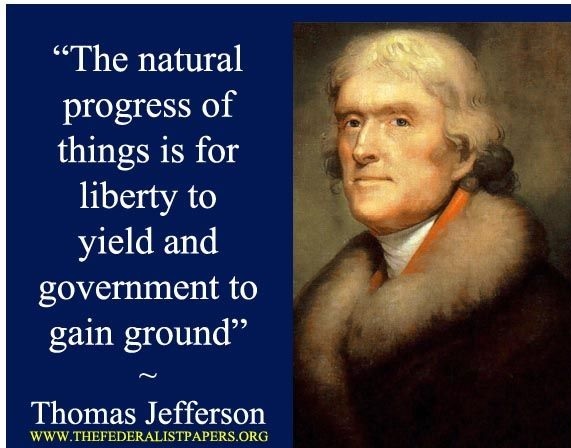
Sadly, since I understand the economics of “public choice” (something Thomas Jefferson also implicitly understood) it’s always easier to envision the latter category.

But it’s good to begin a new year with optimism, so here are the good things that hopefully will happen in 2022.

Biden’s So-Called Build Back Better Stays Dead – The President squandered money on a fake stimulus and an infrastructure boondoggle, but we dodged the biggest bullet when Democrats couldn’t get all 50 of their Senators to support a multi-trillion dollar, growth-sapping expansion in taxes and spending.

The Supreme Court Ends Civil Asset Forfeiture – This was on my list last year, but the odious practice of “theft by government” continues. That being said, I still think it won’t survive if the Supreme Court has a chance to make a ruling (especially since America’s best Justice is very aware of the problem).

Republicans Win Congress in 2022 – I don’t have much faith in Republicans to do the right thing (especially when a Republican is in the White House), but I hope they win the House and Senate in November because they will oppose big tax increases while Democrats control the White House – even if only for partisan reasons.

In the “honorable mention” or “runner-up” category, I also hope to see further progress for school choice in 2022.

And I used to list a collapse of Venezuela’s reprehensible socialist government as one of my annual “hopes,” but I’ve largely given up (particularly since Latin Americans seem foolishly susceptible to “leftist saviors“).

Now let’s shift to the bad things that I fear will happen over the next 365 days.

Biden’s BBB Budget Plan Springs Back to Life – The President’s “Build Back Better” plan may be on life support, but sadly it’s not quite dead. I fear a scaled-down (but still horrible) version of the legislation may get approved this year. Senator Manchin of West Virginia, for instance, says he is willing to support a $1.5 trillion package and I fear the left eventually will decide that 50 percent of a (moldy and weevil-ridden) loaf is better than none. (Editor's Note:  Supposedly Manchin has said since then he will not support it. RK)

Biden’s Remains a Protectionist – I hoped last year that Biden would reduce government trade taxes. Not because he believes in economic liberty, but simply because he wouldn’t want to continue a Trump-era policy. But that didn’t happen, and I now fear he’ll continue with protectionism in 2022. I don’t even have much hope that he’ll resuscitate the World Trade Organization.

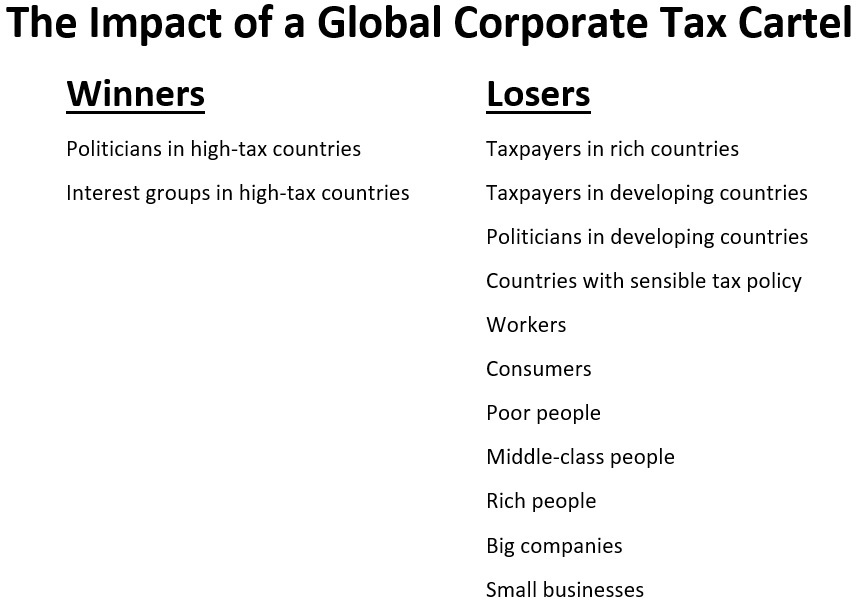
New Tax Cartels – One of last year’s big defeats was the creation of a global tax cartel by governments. 


Barring some sort of miracle that prevents implementation, greedy politicians have set up a system that will require all nations to have a minimum corporate tax of 15 percent. That’s very bad news for workers, consumers, and shareholders, but I’m even more worried about the precedent it creates for additional tax cartels and ever-higher tax rates.

I’ll close by noting that last year’s list included the possibility of Kamala Harris becoming president.

But Biden has been so bad that it’s unclear that Harris would make things worse.

P.S. For the “fears” category, I could – and probably should – list entitlements every single year. Simply stated, the country is in deep long-run trouble because of an aging population and poorly designed tax-and-transfer programs. Years ago, I was semi-hopeful that we would get Medicaid and Medicare reform.

Now that seems like a distant dream and the real battle is preventing further entitlement expansions such as Biden’s per-child handout.

Rate this:


Sunday, December 5, 2021

Man Gets Back $30,000 the Government Stole from Him—11 Months after Drug Agents Seized It without Cause

Patrick Carroll  – December 5, 2021 @ America Institute for Economic Research

When Kermit Warren and his son Leo lost their hotel jobs in mid 2020 as a result of COVID-related layoffs, things were not looking great for them. Though they had some money saved, they needed to find new jobs quickly in their hometown of New Orleans before their money ran out. Fortunately, Kermit had a longtime side gig of hauling scrap metal, and they decided to turn it into a full-time, father-son enterprise.

To scale up their new venture they needed a bigger truck, and they eventually connected with a seller in Columbus, Ohio. So in November 2020, they booked a flight to Columbus, planning to drive the truck back after buying it. Kermit was carrying roughly $30,000 in cash—his life savings—since he was planning to use the cash to buy the truck.

Unfortunately, the trip didn’t go exactly as planned. First, since they were inexperienced travelers, they mistakenly flew to Cleveland. Then, after the two-hour drive to the seller’s lot in Columbus, they found that the lot was closed, and with no motels in the area and no car, they had to spend the night outdoors in the cold.

Early the next morning they were able to look at the truck, but they realized it was too big for their needs, so they went to the Columbus airport and booked flights back to New Orleans. The TSA raised some eyebrows when they discovered Kermit’s cash, but they let him go without any hassle. Kermit and Leo proceeded to their gate and waited for their flight to board.

That’s when agents from the Drug Enforcement Administration (DEA) showed up, having been tipped off by the TSA.

Suspicious of drug trafficking, the DEA began questioning Kermit about the cash. Kermit and Leo tried to offer evidence of their truck purchasing plans, but the agents were becoming increasingly hostile and refused to review the evidence. Panicking, Kermit lied by telling the agents that he was a former cop, hoping that would deter them. However, with more questioning, he quickly admitted the truth, and in hindsight he realized that his lie was a mistake and lapse in judgement.

Even more suspicious after the lie, the DEA took all of Kermit’s money, despite having no evidence the cash was connected to criminal activity. Kermit and Leo then returned home with no truck and no cash.

Six months later, the government filed a civil forfeiture complaint in federal court, which would let them keep the cash permanently because they suspected the money was involved in a drug crime. Though Kermit was never charged with a crime, let alone convicted, the burden was now on him to prove his innocence if he ever wanted to get his money back.

Fortunately, the Institute for Justice (IJ) agreed to represent Kermit back in August, and they documented the legitimate purpose of his trip. Finally, on October 29, IJ announced that prosecutors had agreed to dismiss the case with prejudice (permanently). After 11 months, Kermit would finally be getting his money back.

“I’m relieved that I will finally get my hard-earned savings back after a year of suffering,” Kermit said. “But what happened to me was wrong. The officers and prosecutors treated me like a criminal when all I was trying to do was improve my business and my life. For a year, they’ve left me struggling to survive a pandemic and a hurricane without my savings.”

IJ Senior Attorney Dan Alban also commented on the good news. “We’re relieved that Kermit is getting his hard-earned money back, but it’s outrageous that he was left destitute for an entire year for no good reason due to the callous, profit-driven actions of DEA and federal prosecutors,” he said. “Kermit’s case highlights how the federal government abuses civil forfeiture. It seizes cash on the flimsiest of pretexts—traveling with cash at an airport—and effectively forces people to prove their own innocence to get their money back. And even in a best-case scenario, it can take over a year for them to get their property back.”

Sadly, Kermit’s experience is not uncommon. Every year, thousands of Americans have their cash and other assets seized through civil forfeiture, and many never get their money and property back.

What’s more, forfeiture has been increasing in recent years. In 2001, civil and criminal forfeitures brought in a combined $473 million in revenue, but in recent years that number has been consistently over $2 billion, largely driven by an increase in civil forfeitures.

Airports seem to be particularly lucrative locations for this practice, as Kermit’s story highlights. Indeed, an investigation by USA Today found that DEA units in 15 of the nation’s busiest airports seized over $209 million in cash from at least 5,200 drug suspects from 2006 to 2016.

But while the expedience offered by this practice may be alluring, the reality is that civil forfeiture is fundamentally unjust and has no place in a free society. For one, most of the “crimes” that are targeted with this practice, like drug trafficking, shouldn’t even be considered crimes in the first place. Second, this practice effectively turns the presumption of innocence on its head, forcing people to prove that they did nothing wrong if they ever want to get their property back. And third, civil forfeiture encourages “policing for profit,” whereby the legal system is used to raise revenue for police agencies rather than fight crime.

Writing in his 1850 treatise The Law, Frédéric Bastiat commented on these kinds of practices. In particular, he noted the irony that while the law is supposed to uphold property rights, it’s often used to violate them.

“Under the pretense of organization, regulation, protection, or encouragement,” Bastiat wrote, “the law takes property from one person and gives it to another.” Bastiat called this practice “legal plunder,” since it’s essentially a form of theft that is authorized by the law.

“But how is this legal plunder to be identified?” Bastiat continued. “Quite simply. See if the law takes from some persons what belongs to them, and gives it to other persons to whom it does not belong. See if the law benefits one citizen at the expense of another by doing what the citizen himself cannot do without committing a crime.”

The point is, government agents should have no more rights than any other citizen. If they forcibly take money or property that isn’t theirs, they have committed theft. And theft doesn’t become okay just because it’s done by someone with a badge and a uniform.

Sadly, the laws that currently exist endorse this double standard on morality. Government agents are allowed to steal with impunity, even though ordinary citizens would be rightly prosecuted for the same actions. As a result, the world we live in is a world of precarious property rights, one where innocent people like Kermit Warren are regularly victimized by law enforcement agents.

It’s a harsh reminder of just how far we still have to go in the fight to defend civil liberties.

Reprinted from the Foundation for Economic Education

Patrick Carroll

Patrick Carroll has a degree in Chemical Engineering from the University of Waterloo and is an Editorial Fellow at the Foundation for Economic Education.

Get notified of new articles from Patrick Carroll and AIER.


Wednesday, November 10, 2021

One Story that Tells Us Everything We Need to Know about Government

November 9, 2021 by Dan Mitchell

Civil asset forfeiture occurs when bureaucrats literally steal a person’s property when the person hasn’t been convicted – or perhaps not even charged – of any wrongdoing.   Citing a nauseating example of this odious practice, I wrote back in 2014 that all decent and moral people should be libertarians.

I was exaggerating, of course, so allow me to share a different statement that is completely accurate: Supporters of civil asset forfeiture (also known as “policing for profit“) are neither decent nor moral.  Indeed, they are bad people who support thuggish and unfair mistreatment of their fellow citizens.  If you think I’m being too dogmatic about this issue, here are some excerpts from a story in the New York Times by Michael Levenson............To Read More....

Wednesday, October 6, 2021

People Have Few Protections Against Law Enforcement Civil Asset Forfeiture Practices

Dan GreenbergDan Greenberg  – October 1, 2021 @ American Institute for Economic Research


Imagine a world where police officers regularly confiscate property from civilians, based only on officers’ accusations of criminal conduct. Imagine that these allegations are never examined by a judge and that charges of criminal conduct are often never even filed.

Unfortunately, you don’t have to imagine anything, because that is the world we live in.

This is the topsy-turvy world of civil seizure and asset forfeiture – where just the suspicion of criminal conduct by a law enforcement officer is enough for the seizure of property. Just an accusation can be sufficient proof to seize, for example, a car, a house, or a purse containing currency – and for the property’s eventual forfeiture to the government.

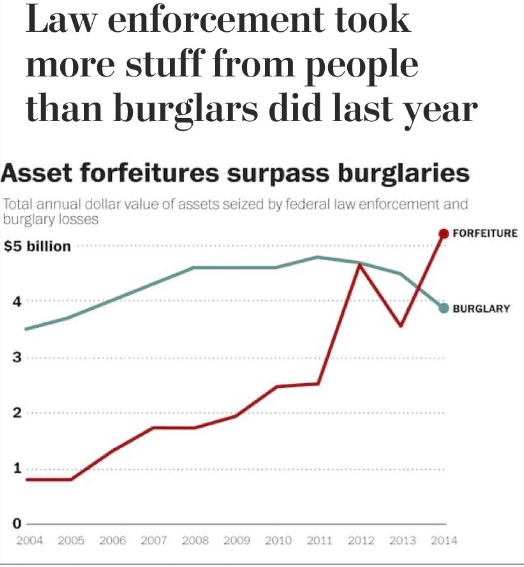
The scope of this confiscation has become so large that, in recent years, the value of the property seized just by the federal government outweighs the value of property stolen by burglars.

Protections against seizure and forfeiture are so fragile that they encourage law enforcement officers to treat every roadside encounter like an interaction with a career criminal. The law encourages the investigation, detention, and search of motorists for crimes that have nothing to do with automobile travel. The possession of cash, for instance, serves as sufficient evidence that the cash is related to crime and therefore justifies its confiscation.

Why are police encouraged to pursue seizure and forfeiture of currency and other valuable goods? Because a big portion of that confiscated property gets funneled into law enforcement budgets. Street-level officers are praised by their commanding officers when they execute cash seizures. Predictably, this practice drives a wedge between law enforcement officers and honest, law-abiding citizens. Some motorists will start viewing officers as predators, while some law enforcement officers will start to see those whom they are sworn to protect and serve as prey.

Where are our public officials who are supposed to look out for justice? They must balance budgets and are constantly on the lookout for new sources of revenue. Law enforcement agencies can lighten their budget burdens by increasing the take from seizure and forfeiture. That makes policymakers resistant to good-government types who call for reforms to seizure and asset forfeiture – reforms that would squeeze the bottom lines of government budgets.

Compounding the problem, advocates of seizure and forfeiture have pulled the wool over the eyes of policymakers, convincing them that a typical seizure involves hundreds of thousands of dollars taken from drug dealers. The truth is that the typical cash seizure is actually less than a thousand dollars.

That leaves the typical currency owner out of luck. If the victim of a cash seizure wants his or her money back, to retake possession, that person must demonstrate in court that it is unrelated to criminal conduct. Imagine the victim trying to find a lawyer who will represent him or her in court. Legal representation costs several thousand dollars. Even if you won in court, you’d still be a net loser. Most people whose cash is seized can’t afford to appear in court and argue for the return of their own property. This means they lose.

It doesn’t have to be this way. A few states – Maine, Nebraska, North Carolina, and New Mexico – have abolished civil forfeiture entirely. Perhaps more states will someday pass reforms to protect the property of their citizens.

Reprinted from Inside Sources

Dan Greenberg

Dan Greenberg

Dan Greenberg is a lawyer, former state legislator, and author of a new report for the Competitive Enterprise Institute on civil asset forfeiture.

Get notified of new articles from Dan Greenberg and AIER.

Friday, September 3, 2021

The Odious and Abusive Practice of Civil Asset Forfeiture

September 2, 2021 by Dan Mitchell @ International Liberty 

When people ask me why I’m a libertarian, I rarely mention high taxes and wasteful spending. Nor do I make philosophical arguments about the non-aggression principle. And it’s also unlikely that I’ll cite Ayn Rand.

Instead, I point out that all decent human beings should be libertarian because unconstrained government has the power to abuse people and wreck their lives.

Consider “civil asset forfeiture,” as described in this video.

When I read about some of the real-world cases involving asset forfeiture, it gets my blood boiling.


No wonder I’ve described it as “Venezuelan-style thuggery” and written that the practice is “disgusting, nauseating, reprehensible, and despicable.”

And, if that doesn’t get my point across, I have used other phrases to characterize asset forfeiture.

Let’s look at two odious examples of asset forfeiture that took place this year.

First, the Wall Street Journal editorialized earlier this year about a case in California, in which the FBI decided that it had the right to steal assets from safe deposit boxes simply because the financial institution was charged with crimes.


…the FBI raided U.S. Private Vaults in Beverly Hills in March, it did so after the business had been indicted for conspiring to launder money, sell drugs and other crimes. But the FBI also took control of $86 million in cash and valuables it found in the safe deposit boxes of people who haven’t been accused of a crime. Some of these folks have sued… The Institute for Justice is representing seven plaintiffs in this case. Their argument is that they have done nothing wrong and should not have to go through the cumbersome civil forfeiture process to prove that their cash, jewelry or precious metals are legitimately theirs. …the Fifth Amendment guarantees the right to due process before property can be taken. …The FBI forfeiture list on the contents of the seized boxes reports 14 that each held more than $1 million. Perhaps some of this comes from illegal sources, but the mere possession of cash is not proof of guilt. If the FBI and U.S. Attorney have proof of wrongdoing, bring it on. But the burden for depriving an American of property is on the government to prove guilt, not on the targeted to prove innocence.

Amen, America’s Founders gave us a Constitution to protect against this kind of abuse.

Second, we have a report from yesterday’s Washington Post about how cops stole $87,000 from a veteran.

Stephen Lara…was on his way to visit his daughters in Northern California…he had “a lot” of cash in his car. As he stood on the side of the road, police searched the vehicle, pulling nearly $87,000 in a zip-top bag from Lara’s trunk and insisting a drug-sniffing dog had detected something on the cash. Police found no drugs, and Lara, 39, was charged with no crime. But police left with his money… “I left there confused. I left there angry,” Lara said in an interview with The Washington Post. “And I could not believe that I had just been literally robbed on the side of the road by people with badges and guns.” It was only after Lara got a lawyer, sued and talked with The Washington Post about his ordeal that the government said it would return his money.

The article cites some of the critics, including the freedom fighters at the Institute for Justice.

https://freedomandprosperity.org/wp-content/uploads/2021/09/Sep-2-21-W-Post.jpg

…the case shows how the federal government abuses its asset forfeiture authority, by requiring those whose property is taken to prove their innocence to get it back. …“This is an inherently abusive power that state and local law enforcement should not have,” said Wesley Hottot, a lawyer representing Lara with the Institute for Justice, which advocates against civil asset forfeiture. “What we see almost exclusively are people like Stephen who — perhaps had quirky banking practices — but they’re not guilty of any crime. And yet, in the nation’s airports, on the nation’s roads, they’re treated by police as though a large amount of cash by itself is criminal. And that power is too dangerous to give every police officer on the street.” …Former U.S. attorney Joyce Vance said…“You can’t just take people’s stuff because you happen to find them with cash,” Vance said. “We still live in a country where people are innocent until they’re proven guilty.”

By the way, this is an issue where the Obama Administration moved policy in the right direction.

Attorney General Eric Holder curtailed use of the practice in the Obama administration, but Attorney General Jeff Sessions restored it under President Donald Trump. Though Attorney General Merrick Garland has rolled back many Trump-era changes at the Justice Department, he has not taken action on asset forfeiture.

By contrast, there’s nothing positive to say about what happened under the Trump Administration.

If you want to understand how bad Trump was on this issue, watch this video.


I’ll close with a bit of good news.

Several states have curtailed the abuse of civil asset forfeiture.

Even more promising, there are hopeful signs that the Supreme Court may rule that the practice is unconstitutional.

Monday, April 19, 2021

Another Victim of Government Thuggery

April 18, 2021 by Dan Mitchell @ International Liberty

Even though I think economic growth is very important for human flourishing and strongly support the laissez-faire policies that will generate more prosperity, I’m mostly a libertarian because of moral reasons. Simply stated, I hate when government bullies people like Jerry Johnson. 


As explained in the video, Jerry is a victim of asset forfeiture, a policy that literally allows bureaucrats to steal from citizens. 


I wish I was joking or exaggerating. 

Moreover, this isn’t something that only happens in very rare instances. It’s so pervasive that in some years, bureaucrats actually steal more from people than burglars! Indeed, the law actually gives cops an incentive to steal. That’s why it’s known as “policing for profit.” The silver lining to this dark cloud is that America’s best Supreme Court Justice wants to end this awful scam.

P.S. I’m tempted to create a Victims of Thuggery Hall of Fame. If so, Jerry Johnson will be a member along with these other people who have been abused by government.

 IRS Cartoon 5

P.P.S. It’s worth noting the first two people in charge of the federal government’s asset forfeiture program have since announced their opposition to this despicable practice.

P.P.P.S. Just like intrusive and ineffective money-laundering laws, wretched asset forfeiture laws are largely the result of the foolish War on Drugs. One bad policy generates another bad policy. Lather, rinse, repeat.


Friday, April 16, 2021

Policing For Profit: How Civil Asset Forfeiture Has Perverted American Law Enforcement

04/09/2021 by Source: Ammo.com

Picture this: You’re driving home from the casino and you've absolutely cleaned up – to the tune of $50,000. You see a police car pull up behind you, but you can’t figure out why. Not only have you not broken any laws, you’re not even speeding. But the police officer doesn’t appear to be interested in charging you with a crime. Instead, he takes your gambling winnings, warns you not to say anything to anyone unless you want to be charged as a drug kingpin, then drives off into the sunset.

This actually happened to Tan Nguyen, and his story is far from unique. It’s called civil asset forfeiture and it’s a multi-billion dollar piggybank for state, local and federal police departments to fund all sorts of pet projects.

With its origins in the British fight against piracy on the open seas, civil asset forfeiture is nothing new. During Prohibition, police officers often seized goods, cash and equipment from bootleggers in a similar manner to today. However, contemporary civil asset forfeiture begins right where you’d think that it would: The War on Drugs.

In 1986, as First Lady Nancy Reagan encouraged America’s youth to “Just Say No,” the Justice Department started the Asset Forfeiture Fund. This sparked a boom in civil asset forfeiture that’s now become self-reinforcing, as the criminalization of American life and asset forfeiture have continued to feed each other.

In sum, asset forfeiture creates a motivation to draft more laws by the legislature, while more laws create greater opportunities for seizure by law enforcement. This perverse incentive structure is having devastating consequences: In 2014 alone, law enforcement took more stuff from American citizens than burglars did.  The current state of civil asset forfeiture in the United States is one of almost naked tyranny. Don’t believe us?.................To Read More....

Wednesday, April 14, 2021

The Pointless Burden of Anti-Money Laundering Laws

April 13, 2021 by Dan Mitchell @ International Liberty 

Back in 2010, I narrated this video on money laundering for the Center for Freedom and Prosperity, mostly to help people understand that governments are imposing huge costs on both industry and consumers without any offsetting benefits (such as reductions in crime).


As you can tell from the video, I’m not a big fan of anti-money laundering (AML) laws and know-your-customer (KYC) regulations.

And in the 11-plus years since the video was released, I’ve shared lots of additional data about the costly futility of the government anti-money laundering laws and regulations.

 https://danieljmitchell.files.wordpress.com/2012/04/money-laundering-reasons-to-be-non-banked.jpg

That’s the bad news.

The good news (sort of) is that more people are noticing that the current approach is an expensive failure. Even some folks from the establishment media are waking up to the problem, as illustrated by an article in the latest edition of the Economist.


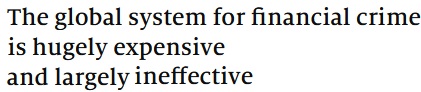
…banks remain the Achilles heel in the global war on money-laundering, despite the reams of regulations aimed at turning them into front­line soldiers in that conflict. However, closer examination suggests that the global anti-money-laundering (AML) system has serious structural flaws, largely because governments have outsourced to the private sector much of the policing they should have been doing themselves. …Money-laundering was not even a crime across much of the world until the 1980s. Since then countries from Afghanistan to Zambia have been arm-twisted, particularly by America, into passing laws. …This has turned AML compliance into a huge part of what banks do and created large new bureaucracies. It is not unusual for firms such as HSBC or JPMorgan Chase to have…more than 20,000 overall in risk and compliance.

Here’s some of the evidence cited in the article.


A study published last year…concluded that the global AML system could be “the world’s least effective policy experiment”, and that compliance costs for banks and other businesses could be more than 100 times higher than the amount of laundered loot seized. A report based on a survey of professionals, published last year by LexisNexis, an analytics firm, found that worldwide spending on AML and sanctions compliance by financial institutions (including fund managers, insurers and others, as well as banks) exceeds $180bn a year. …the numbers tell of a war being lost. …Statistics on how much is intercepted by authorities are patchy. A decade-old estimate by the United Nations Office on Drugs and Crime put it at just 0.2% of the total. In 2016 Europol estimated the confiscation rate in Europe to be a higher but still paltry 1.1%.

Sounds like a damning indictment right?

But I wrote that the article was only “sort of” good news. That’s because the writers at the Economist fail to reach the logical conclusion.  Instead of junking the current system, they want to double down on failure.

…governments need to work harder collectively to make the AML system fit for purpose.

This is akin to looking at welfare programs, realizing that they create dependency and weaken families, but then supporting even more redistribution.  Sadly, I suspect the new evidence cited in the article won’t lead to more sensible thinking in Washington, either.

  • Democrats don’t care if the current approach is failing since they see anti-money laundering laws as a way of destroying financial privacy, which they think is necessary to collect more tax revenue.
  • Republicans don’t care if the current approach is failing because they mindlessly support a tough-on-crime approach, regardless of whether it actually produces positive results.

Indeed, politicians in DC recently expanded AML laws.  I guess the moral of the story is that politicians can always take a bad situation and make it worse.

P.S. I’m batting .500 in my career as a global money launderer.

P.P.S. Here’s Barack Obama’s satirical encounter with AML laws and KYC rules.

P.P.P.S. Speaking of Obama and money laundering, I fear Biden will resuscitate his reprehensible “Operation Chokepoint.”

P.P.P.P.S. I also fear Biden will continue support for asset forfeiture, another disgusting policy that is a part of money-laundering policy.


Wednesday, December 9, 2020

Policing for Profit Is Morally Offensive

Since I’m an economist specializing in public finance, I get very upset about punitive tax policy and wasteful government spending.

But what really gets my blood boiling is reading about the horrific policy of civil asset forfeiture, which literally allows government to steal your property even if you haven’t been convicted of a criminal offense. Or, in many cases, even charged with any wrongdoing!

I’ve decided to revisit this issue because of a recent tweet reminding us that the people who are supposed to protect us actually take more of our property than burglars.

What’s particularly nauseating is that this policy gives law enforcement an incentive to misbehave.

Consider, for instance, these details from a 2014 story in the New York Times.


…civil asset forfeiture…allows the government, without ever securing a conviction or even filing a criminal charge, to seize property suspected of having ties to crime. The practice, expanded during the war on drugs in the 1980s, has become a staple of law enforcement agencies because it helps finance their work. …The practice…has come under fire…amid a spate of negative press reports and growing outrage among civil rights advocates, libertarians and members of Congress who have raised serious questions about the fairness of the practice, which critics say runs roughshod over due process rights. …Much of the nuts-and-bolts how-to of civil forfeiture is passed on in continuing education seminars for local prosecutors and law enforcement officials… In the sessions, officials share tips on maximizing profits, defeating the objections of so-called “innocent owners” who were not present when the suspected offense occurred, and keeping the proceeds in the hands of law enforcement…seized money has been used by the authorities, according to news reports, to pay for sports tickets, office parties, a home security system and a $90,000 sports car. …forfeitures were highly contingent on the needs of law enforcement. …Flat screen televisions…“are very popular with the police departments.”

This is why asset forfeiture is accurately described as “policing for profit.”

There was some good news on this issue last year in South Carolina, as reported by the Greenville News.


A South Carolina circuit court judge in Horry County has ruled the state’s civil asset forfeiture law unconstitutional, in violation of the U.S. Constitution’s Fourth, Fifth and 14th amendments. …Earlier this year The Greenville News published coverage from a two-year investigation into civil asset forfeiture in South Carolina. …Nearly 800 times when police seized money or property, no related criminal charge was filed. In another 800 cases, someone was charged with a crime but not convicted. …About 65% of the cases involved black men though black men make up just 13% of the state’s population. …John’s written decision found that South Carolina’s forfeiture laws violate both the federal and state constitutional protections against excessive fines by allowing the government to seize unlimited amounts of cash and property that aren’t proportionate to the alleged crime. …The judge’s ruling signals how he would approach forfeiture cases in his court in the future but doesn’t set precedent across the state.

What we really need, of course, is a ruling from the U.S. Supreme Court that civil asset forfeiture violates the Constitution (violates the presumption of innocence, excessive punishment, etc), and there are some reasons to hope that may soon happen.

It’s also good news that conservatives have joined with libertarians (such as the great people at the Institute for Justice) in opposing this egregious practice.

Here are some excerpts from a National Review article by Isaac Schorr.


The process is broken. …the government brings charges against the property itself without leveling any against the property owner. On a federal level, criminal behavior need not be proven for law enforcement to initiate civil-asset-forfeiture proceedings; mere suspicion is considered reason enough. It’s worth noting that as California’s attorney general, Democratic vice-presidential nominee Kamala Harris strongly supported handing this same power to local law enforcement — for the people, of course. …Why has civil-asset forfeiture, which flies in the face of American expectations of due process and the presumption of innocence, been allowed to persist in its current form? It’s all about the Benjamins. …This practice…provides local authorities with perverse incentives. …they can move to forfeit property under federal law and take up to 80 percent of what the property is worth,” which gives them “a direct financial stake in forfeiture encourag[ing] profiteering and not the pursuit of justice.” What police department would not take advantage of such a profitable opportunity, particularly when those profits are not subject to the same oversight as taxpayer dollars?

When cops lose access to this loot, they naturally complain.

Here are some passages from a story in the Mercury News.


While the value of property seized in California has skyrocketed, the state’s share of the booty — which has traditionally helped fund local police agencies — has plunged. That’s largely because of a new state law seeking to protect personal property, allowing local agencies to keep proceeds from asset seizures only when people are convicted of a crime, rather than simply when they’re arrested. …California…passed laws — more stringent than the federal government — restricting when state and local police could seize private property. So local agencies worked around them by partnering directly with the U.S. Department of Justice in asset-forfeiture cases, bypassing the rules in state laws. SB 443 closes that loophole for state and local agencies — but not for the federal government, which can continue to seize property without criminal convictions. …The Golden State is trying to set a good example and do the principled thing, even as the federal government goes in the opposite direction, said Gregory Chris Brown, associate professor of criminal justice at Cal State Fullerton.

In other words, fixing this problem involves all levels of government.

Local law enforcement needs to stop policing for profit.

 https://cdn2.vox-cdn.com/thumbor/MyYVduXouRgBTX4DRZEkyG7POFk=/800x0/filters:no_upscale()/cdn0.vox-cdn.com/uploads/chorus_asset/file/3794308/forfeiture%20percent.png

State government needs to stop policing for profit.

And Uncle Sam needs to get out of the racket as well.

Speaking of the federal government, the Obama Administration took a tiny step in the right direction, but the Trump Administration has been very unhelpful.

And what about the incoming Biden Administration? I haven’t seen any indication, but I’m not brimming with optimism given Biden’s generic desire for Washington to have more money, as well as his unpalatable record as a booster of the failed War on Drugs.

But hopefully he’ll surprise me.

In the meantime, let’s keep our fingers crossed for further reforms at the state level.

Let’s close by recycling a great video on this issue from the folks at Reason. 

P.S. It’s worth noting that the first two people in charge of asset forfeiture for the federal government have since come out against this odious practice.

P.P.S. Here’s some sauce-for-the-goose-sauce-for-the-gander humor involving asset forfeiture.