Search This Blog

De Omnibus Dubitandum - Lux Veritas

Showing posts with label Money Laundering. Show all posts

Saturday, July 13, 2024

Restraining Government in America and Around the World Dictators Hate Financial Privacy

July 12, 2024 by Dan Mitchell @ International Liberty

Earlier this year, I began a column about anti-money laundering laws with four observations.

I now want to confess that I committed a sin of omission. I should have included a fifth point.

  • As a believer in democracy, I don’t like how AML laws can be used as tools of oppression.

But I’m not going to cite a libertarian-leaning source to justify this additional observation.

Instead, let’s look at some excerpts from a recent article in the Economist.


…charities that support small-scale farmers and help people after natural disasters have…had their top brass charged and accounts frozen for allegedly breaching the Philippines’s Anti-Terrorism Act, a draconian law passed in 2020. Their ordeal is an example of how governments are weaponising rules intended to stop dirty-money flows, both at home and abroad. …international directives create opportunities for large-scale abuse.

And evidence suggests that strongmen are becoming increasingly creative in how they wield tools of financial suppression. At fault is a body called the Financial Action Task Force (FATF). …The worst offenders are autocratic regimes keen to maintain a pretence of democratic rule… But even democracies are sometimes tempted. In 2022 Canada broadened its anti-money-laundering laws to stop funding for a protest by lorry drivers… Some strongmen start by collecting information. The FATF requires governments to establish “Financial Intelligence Units” with the power to obtain data…

Abusers might then starve victims of funds so they cannot continue to work. …banks, wary of being punished, are often ultra-cautious in how they handle frozen assets… the FATF can be used to make politically motivated arrests…and…allows repressive regimes to lock up people for months or years on baseless charges. …

FATF standards require states to provide legal assistance, cross-border asset freezes and extraditions. Belarus and Kazakhstan have used this to make Western democracies provide financial intelligence on exiled dissidents.

The bottom line is that it is a very dangerous idea to give politicians carte blanche access to everyone’s financial data.

That’s true when dealing with dictatorships like Russia. And it’s even dangerous, as the Economist noted, in (supposedly) civilized societies such as Canada.

By the way, anti-money laundering laws are just part of the problem. In this video from 15 years ago, I explained why financial privacy laws in tax havens should have been defended rather than attacked.

Pay close attention about 4:40 and you’ll notice that even some left-wing sources admitted that governments would misuse financial data.

Subsequent events (including in the United States) confirm that my fears were fully warranted.

P.S. On a related note, you can read my seven-part series about the “War on Cash” by clicking here, here, here, here, here, here, and here.

Wednesday, April 14, 2021

The Pointless Burden of Anti-Money Laundering Laws

April 13, 2021 by Dan Mitchell @ International Liberty 

Back in 2010, I narrated this video on money laundering for the Center for Freedom and Prosperity, mostly to help people understand that governments are imposing huge costs on both industry and consumers without any offsetting benefits (such as reductions in crime).


As you can tell from the video, I’m not a big fan of anti-money laundering (AML) laws and know-your-customer (KYC) regulations.

And in the 11-plus years since the video was released, I’ve shared lots of additional data about the costly futility of the government anti-money laundering laws and regulations.

 https://danieljmitchell.files.wordpress.com/2012/04/money-laundering-reasons-to-be-non-banked.jpg

That’s the bad news.

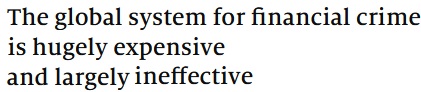
The good news (sort of) is that more people are noticing that the current approach is an expensive failure. Even some folks from the establishment media are waking up to the problem, as illustrated by an article in the latest edition of the Economist.


…banks remain the Achilles heel in the global war on money-laundering, despite the reams of regulations aimed at turning them into front­line soldiers in that conflict. However, closer examination suggests that the global anti-money-laundering (AML) system has serious structural flaws, largely because governments have outsourced to the private sector much of the policing they should have been doing themselves. …Money-laundering was not even a crime across much of the world until the 1980s. Since then countries from Afghanistan to Zambia have been arm-twisted, particularly by America, into passing laws. …This has turned AML compliance into a huge part of what banks do and created large new bureaucracies. It is not unusual for firms such as HSBC or JPMorgan Chase to have…more than 20,000 overall in risk and compliance.

Here’s some of the evidence cited in the article.


A study published last year…concluded that the global AML system could be “the world’s least effective policy experiment”, and that compliance costs for banks and other businesses could be more than 100 times higher than the amount of laundered loot seized. A report based on a survey of professionals, published last year by LexisNexis, an analytics firm, found that worldwide spending on AML and sanctions compliance by financial institutions (including fund managers, insurers and others, as well as banks) exceeds $180bn a year. …the numbers tell of a war being lost. …Statistics on how much is intercepted by authorities are patchy. A decade-old estimate by the United Nations Office on Drugs and Crime put it at just 0.2% of the total. In 2016 Europol estimated the confiscation rate in Europe to be a higher but still paltry 1.1%.

Sounds like a damning indictment right?

But I wrote that the article was only “sort of” good news. That’s because the writers at the Economist fail to reach the logical conclusion.  Instead of junking the current system, they want to double down on failure.

…governments need to work harder collectively to make the AML system fit for purpose.

This is akin to looking at welfare programs, realizing that they create dependency and weaken families, but then supporting even more redistribution.  Sadly, I suspect the new evidence cited in the article won’t lead to more sensible thinking in Washington, either.

  • Democrats don’t care if the current approach is failing since they see anti-money laundering laws as a way of destroying financial privacy, which they think is necessary to collect more tax revenue.
  • Republicans don’t care if the current approach is failing because they mindlessly support a tough-on-crime approach, regardless of whether it actually produces positive results.

Indeed, politicians in DC recently expanded AML laws.  I guess the moral of the story is that politicians can always take a bad situation and make it worse.

P.S. I’m batting .500 in my career as a global money launderer.

P.P.S. Here’s Barack Obama’s satirical encounter with AML laws and KYC rules.

P.P.P.S. Speaking of Obama and money laundering, I fear Biden will resuscitate his reprehensible “Operation Chokepoint.”

P.P.P.P.S. I also fear Biden will continue support for asset forfeiture, another disgusting policy that is a part of money-laundering policy.


Monday, May 13, 2019

The Messy Mix of Red Tape, Money Laundering, and Extraterritoriality

April 30, 2019 by Dan Mitchell @ International Liberty
I’m not a big fan of so-called anti-money laundering (AML) requirements.
And things are getting worse because these laws and rules increasingly are part of a Byzantine web of extraterritorial mandates – meaning nations trying to impose their laws on things that happen outside their borders.

Bruce Zagaris, a lawyer with special expertise in international legal issues, just wrote a study on this issue for the Center for Freedom and Prosperity Foundation.

Here’s how he frames the issue.
From the introduction of anti-money laundering laws in 1986, the United States government has led international efforts to prevent and prosecute money laundering…the U.S.’s unilateralism in the financial enforcement arena has alienated smaller jurisdictions and led to a substantial increase of costs for cross-border transactions. This article examines the trade-offs of the U.S.’s unilateral approach and argues for a rebalancing of the expanding financial enforcement regime. …under the “territorial” theory of extraterritorial jurisdiction, the U.S. has proactively asserted that it has the right to regulate criminal acts occurring outside the U.S. as long as they produce effects within the United States. …A criminal statute which Congress intends to have extraterritorial application may reach a defendant who has never even entered the U.S. if s/he participated in a conspiracy in which a co-conspirator’s activities occurred within the U.S.
In part, this is a problem of the United States trying to dictate policy in other nations.

But what goes around, comes around. As Bruce explains,the European Commission is trying to coerce American territories into changing their policies.
On February 13, 2019, the European Commission blacklisted 23 jurisdictions for their weak regulation of AML/CTF policy, increasing the level of oversight that European banks would have to overcome in conducting business with said jurisdictions. The list included four U.S. territories – Puerto Rico, Guam, American Samoa, and the Virgin Islands… The U.S. Treasury Department immediately and swiftly condemned the blacklist, noting that it had “significant concerns about the substance of the list and the flawed process by which it was developed.” The Treasury further stated that it did not expect U.S. financial firms to pay any heed to the blacklist.
All this cross-border bullying would be bad news even if the underlying laws were reasonable.
But Bruce concludes by explaining that this is not the case.
The result of over-aggressive application of extraterritorial jurisdiction by the U.S. and the EU for anti-money laundering and prosecution of financial institutions and officials, together with the use of informal organizations, such as FATF, to establish new AML/CFT standards, has led to increasing exclusion of countries (called de-risking) and other depositors, especially in small jurisdictions. It has also led to substantial increase of costs for cross-border transactions, as financial institutions must increase AML due diligence, including Know Your Customer, Customer Due Diligence, and the requirement to report suspicious transactions, as well as be subject to prosecution and regulatory enforcement actions. National laws and international standards should have a cost-effect requirement, especially as they continually impose new requirements on the private sector and impede normal commerce and privacy.
All this extraterritoriality has economic implications.

Richard Rahn, in a column for the Washington Times, opines about the CF&P report.
…rarely do government leaders fully think through the effects of their actions — extraterritorial application of law being a prime example. …Noted legal scholar Bruce Zagaris, who specializes in international financial crime, has written a new paper for the Center for Freedom and Prosperity Foundation… the United States has proactively asserted it “has the right to regulate criminal acts by non-U.S. citizens occurring outside the U.S., as long as they produce effects in the U.S.” As can easily be seen, such a definition is a never-ending slippery-slope, which is causing great conflicts among governments. As a result of the increasingly expansive view of U.S. courts to take cases and enforce judgments extraterritorially, courts and legislatures in other countries are also asserting extraterritorial enforcement authority.
Richard explains why this is bad news for those who care about economic growth.
…It is difficult enough for businesses and individuals in any one jurisdiction to understand all the laws and regulations that apply to them, but once governments begin to extend their laws and regulations to foreign jurisdictions, the global financial and legal system begins to melt down. Laws and regulations are often in conflict, so those who are engaged in multiple legal jurisdictions are increasingly at risk — which causes them to rationally de-risk by withdrawing investment from those entities least able to defend themselves. The result is slower world growth and job creation. …Clear global rules need to be established as to when extraterritorial application of laws is justified and not justified. Issues like dual criminality in tax, anti-money laundering and terrorist finance need to be addressed to bring some rationality and fairness to the system. And finally, procedures need to be established so that any jurisdiction can challenge a rule that does not meet a reasonable cost-benefit test.
I’ll close by making two points.

First, politicians and bureaucrats claim that laws and regulations against money laundering are designed to fight crime. Don’t believe them.
 
Money laundering is mostly a problem in “onshore” nations. The real motive is to undermine financial privacy so governments can track – and tax – capital around the world.
 
Second, American politicians and bureaucrats are playing with fire. The more we try to bully other nations to enforce our bad tax laws, the greater the risk that other governments no longer will use the dollar as a reserve currency. That would be costly to the U.S. economy.

P.S. Senator Rand Paul is one of the few heroes on this issue.

P.P.S. Click here for a good summary article on why laws should be limited by borders.