Search This Blog

De Omnibus Dubitandum - Lux Veritas

Showing posts with label BBB. Show all posts

Monday, July 14, 2025

Will The OBBB Put An End To Heavily Subsidized Wind And Solar Generation Projects?

@ Manhattan Contrarian

What does the future hold as to large additions to heavily subsidized wind and solar electricity generation capacity in the U.S.? For those paying attention, the legislative back-and-forth of the One Big Beautiful Bill, as it made its way through Congress, has been something of a roller coaster ride. At this point, I am betting that the utility-scale wind and solar industries are near the end of their line. This post reports on the latest development, which is an Executive Order signed by President Trump on July 7. But count on the wind and solar subsidy farmers to keep fighting to the last dollar of their government handouts.

Note that it is my view, from extensive study of the subject, that wind and solar generators of electricity are essentially useless, not to mention dangerous and costly, for a modern grid that needs reliable generation 24/7/365. Nobody will invest private capital in them without huge government subsidies. To date those subsidies have been provided mostly in the form of tax credits under the Internal Revenue Code. Those tax credits have existed since 1978 (and since 1992 for an additional tax credit for wind generation), always with expiration dates that, however, have time and again been extended as the deadlines neared.

I have had two previous posts about provisions in the OBBB on this subject: this one from May 24 (immediately after the House had passed its version of the Bill), and this one from July 6 (after the President had just signed the final Bill into law). As I reported in the May 24 post, the version of the OBBB passed by the House had such strict limitations on further qualification for the wind and solar tax credits that it was likely that few if any additional projects would be able to qualify. Projects would have had only 60 days after enactment to begin construction, and would have had to enter service by 2027 — that is, before President Trump would leave office. That would mean that any attempt to revive the subsidies before they expired would have to overcome Trump’s veto. In other words, if the language in that version of the Bill had survived, the wind and solar industries were basically finished.

But as I then reported in the July 6 post, the final language of the OBBB as enacted appeared to give the big wind and big solar industries the chance to fight another day. The time to commence construction and qualify for the tax credits had been extended to a year (thus, to July 4, 2026), and the time to enter service had been extended to four years after that (thus, in 2030, which would be well beyond President Trump’s term). Big wind and solar would thus get a substantial window to commence new projects, plus an opportunity to lobby Congress for further extension of the credits in 2029 and 2030, after Trump had left office. The post quoted energy writer Alex Epstein as pointing out that the IRS rules on what constitutes beginning of construction were so lenient and flexible as to pose no real constraint on how many economically useless projects could qualify for a decade of taxpayer subsidies.

In an update to the July 6 post, I cited David Blackmon at the Daily Caller as attributing the tax credit deadline extensions in the final OBBB to a deal negotiated by Senator Lisa Murkowski of Alaska. This piece from Politico says that other Republican Senators, including Grassley and Ernst of Iowa and Curtis of Utah, were also involved in the deal.

Well, it turns out that people in the White House were on to the scam and have taken steps to try to ensure that the extended deadlines in the final OBBB do not turn into an open ended taxpayer blank check for the wind and solar industries.

Note that the potential for new deadlines in the OBBB to turn into such a massive blank check turns on how easy it is for large numbers of projects to qualify as having “begun construction” within the year ending July 4, 2026. The test for what constitutes “beginning of construction” appears in some IRS regulations adopted under the Internal Revenue Code sections providing for the tax credits; and during the Covid pandemic era, the IRS issued a notice of a “safe harbor” to qualify. Here is the IRS Notice from 2021 containing the relevant language. As Epstein notes, the test for “beginning construction” under the so-called safe harbor is “insanely-easy-to-meet. . . . All you need to do is commit 5% of expected project cost to buying re-sellable assets like solar panels.”

This is the specific loophole addressed by President Trump’s July 7 Executive Order. Here is the text of Section 3(a) of that Order:

Within 45 days following enactment of the One Big Beautiful Bill Act, the Secretary of the Treasury shall take all action as the Secretary of the Treasury deems necessary and appropriate to strictly enforce the termination of the clean electricity production and investment tax credits under sections 45Y and 48E of the Internal Revenue Code for wind and solar facilities.  This includes issuing new and revised guidance as the Secretary of the Treasury deems appropriate and consistent with applicable law to ensure that policies concerning the “beginning of construction” are not circumvented, including by preventing the artificial acceleration or manipulation of eligibility and by restricting the use of broad safe harbors unless a substantial portion of a subject facility has been built.

So the test for “beginning construction” will likely turn out to be not so easy to meet at all. The Secretary of the Treasury is directed to issue “new and revised guidance” within 45 days from July 4, which would be August 18. We won’t know exactly how strict and onerous the new guidance is until it is issued, but we do know that Trump has directed that the purpose of the new guidance will be to assure that the new deadline as to “beginning of construction” is not “circumvented.”

According to Utility Dive here on July 9, the language of the Executive Order is the result of a deal reached between Trump and the House Freedom Caucus to secure their votes for passage of the OBBB. It seems that both sides can play this game.

I would think it is well within the power of Treasury Secretary Bessent to come up with guidance on the meaning of “beginning of construction” that will strongly discourage almost all efforts to try to qualify for the extended tax credits.


Monday, August 1, 2022

The Depressing Reincarnation of Build Back Better

July 31, 2022 by Dan Mitchell @ International Liberty

One of the best things about 2021 was the fact that Congress did not approve Joe Biden’s economically debilitating plan to raise taxes and expand the welfare state.


His so-called Build Back Better plan was a very bad mix of class-warfare tax policy and redistributionist spending policy.

But one of the worst things about 2022 may be the reincarnation of a slimmed-down version of Biden’s plan.

Simply stated, the “slimmed-down version” of a terrible piece of legislation is bad news – even if it is possible to envision something even worse.

The Wall Street Journal‘s editorial on the package illustrates why it is bad news that Senator Joe Manchin is trying to rescue Biden’s statist agenda.


As the economy slouches near recession, Majority Leader Chuck Schumer and West Virginia Sen. Joe Manchin…unveiled a tax-and-spending deal that they call the Inflation Reduction Act. Is their aim to reduce inflation by chilling business investment and the economy? …A more accurate name would be the Business Investment Reduction and Distortion Act since that will be the result of its $433 billion in climate and healthcare spending, and $615 billion in new taxes and drug price-control “savings.”

The editorial highlights four terrible provisions.

First, there’s a big tax hike on American companies, with the biggest tax hike on firms that make new investments.

…the 15% minimum tax on corporate book income…will slam businesses whose taxable income is lower than the profits on their financial statements owing to the likes of investment expensing.

For all intents and purposes, politicians would be creating a second type of corporate income tax.

Heavy compliance costs for the business community, of course, but the rest of us probably care more about the estimated loss of 218,000 jobs according to the National Association of Manufacturers.

Second, there are corrupt “green energy” provisions that will degrade America’s energy efficiency and security.

…the bill’s $369 billion in climate spending, most of which is corporate welfare. …All of this will steer private investment into green energy at the cost of reduced investment in fossil fuels. Wind and solar subsidies are already creating distortions in power markets that make the electric grid less reliable and energy more expensive. The expansion of subsidies will compound these problems.

If you want to know why this is bad, just remember Solyndra.

Third, the legislation imposes back-door price controls on the pharmaceutical industry.

The bill will require the Health and Human Services Secretary to “negotiate” Medicare prices—i.e., impose price controls—for dozens of drugs. But the $288 billion in putative savings are fanciful. Manufacturers will hedge potential future losses by launching drugs at higher prices. …The bill will also discourage investment in innovative treatments that could reduce future healthcare spending.

For those of us who value the development of new drugs to fight problems like cancer and Alzheimer’s, this is very bad news.

Fourth, a very corrupt internal revenue service is rewarded for its bad behavior.

Speculative revenue of $124 billion will also come from an $80 billion boost for the IRS. Most of this will finance more audits. The rich can afford more tax lawyers, but middle and upper-middle class Americans will be inclined to settle IRS claims, however meritless, lest they spend even more to defend themselves.

P.S. I can’t resist sharing one final bit of information.

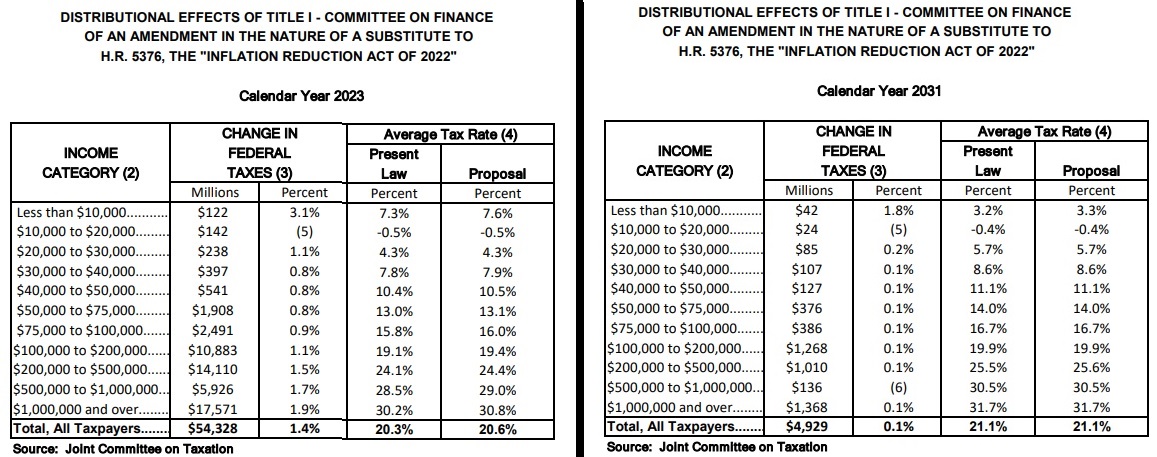
If you peruse the Joint Committee on Taxation’s analysis of the bill, you’ll find that Joe Biden is breaking his promise not to raise taxes on people making less than $400,000 per year.

Not that anyone should be shocked. I have repeatedly explained that the big spenders need to pillage lower-income and middle-class household if they want to finance bigger government.


Thursday, January 6, 2022

Hopes and Fears for 2022

January 1, 2022 by Dan Mitchell @ International Liberty

It’s an annual tradition (2021, 2020, 2019, 2018, etc) to list a handful of things that I hope might happen in the upcoming year, as well as the things I fear may happen.

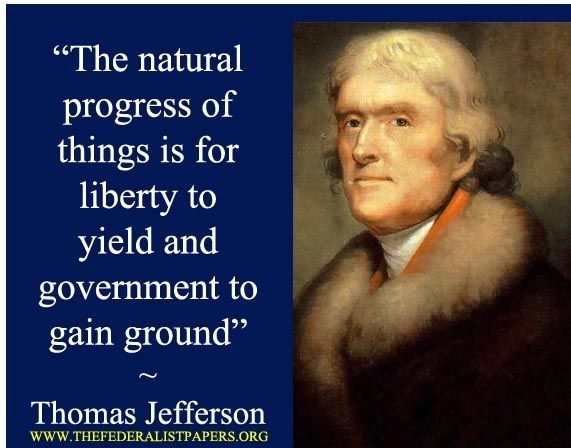
Sadly, since I understand the economics of “public choice” (something Thomas Jefferson also implicitly understood) it’s always easier to envision the latter category.

But it’s good to begin a new year with optimism, so here are the good things that hopefully will happen in 2022.

Biden’s So-Called Build Back Better Stays Dead – The President squandered money on a fake stimulus and an infrastructure boondoggle, but we dodged the biggest bullet when Democrats couldn’t get all 50 of their Senators to support a multi-trillion dollar, growth-sapping expansion in taxes and spending.

The Supreme Court Ends Civil Asset Forfeiture – This was on my list last year, but the odious practice of “theft by government” continues. That being said, I still think it won’t survive if the Supreme Court has a chance to make a ruling (especially since America’s best Justice is very aware of the problem).

Republicans Win Congress in 2022 – I don’t have much faith in Republicans to do the right thing (especially when a Republican is in the White House), but I hope they win the House and Senate in November because they will oppose big tax increases while Democrats control the White House – even if only for partisan reasons.

In the “honorable mention” or “runner-up” category, I also hope to see further progress for school choice in 2022.

And I used to list a collapse of Venezuela’s reprehensible socialist government as one of my annual “hopes,” but I’ve largely given up (particularly since Latin Americans seem foolishly susceptible to “leftist saviors“).

Now let’s shift to the bad things that I fear will happen over the next 365 days.

Biden’s BBB Budget Plan Springs Back to Life – The President’s “Build Back Better” plan may be on life support, but sadly it’s not quite dead. I fear a scaled-down (but still horrible) version of the legislation may get approved this year. Senator Manchin of West Virginia, for instance, says he is willing to support a $1.5 trillion package and I fear the left eventually will decide that 50 percent of a (moldy and weevil-ridden) loaf is better than none. (Editor's Note:  Supposedly Manchin has said since then he will not support it. RK)

Biden’s Remains a Protectionist – I hoped last year that Biden would reduce government trade taxes. Not because he believes in economic liberty, but simply because he wouldn’t want to continue a Trump-era policy. But that didn’t happen, and I now fear he’ll continue with protectionism in 2022. I don’t even have much hope that he’ll resuscitate the World Trade Organization.

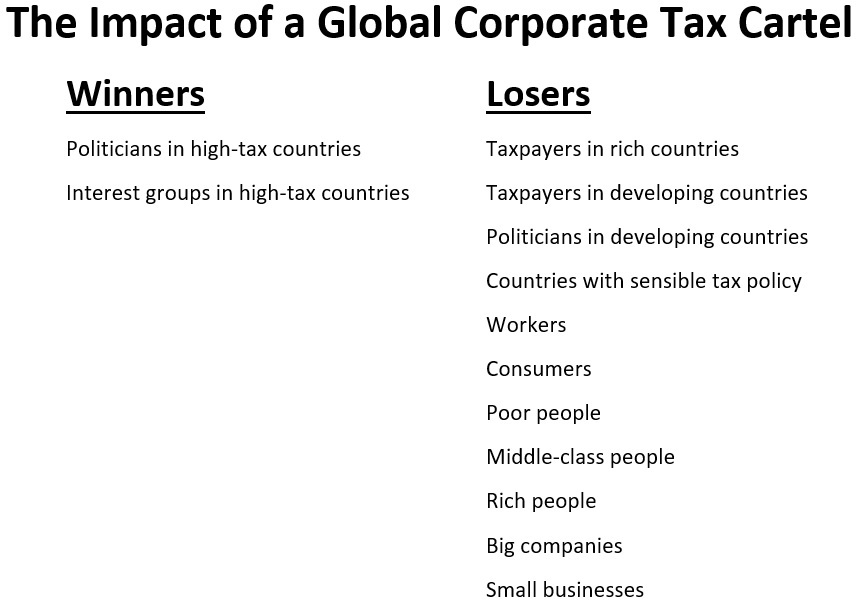
New Tax Cartels – One of last year’s big defeats was the creation of a global tax cartel by governments. 


Barring some sort of miracle that prevents implementation, greedy politicians have set up a system that will require all nations to have a minimum corporate tax of 15 percent. That’s very bad news for workers, consumers, and shareholders, but I’m even more worried about the precedent it creates for additional tax cartels and ever-higher tax rates.

I’ll close by noting that last year’s list included the possibility of Kamala Harris becoming president.

But Biden has been so bad that it’s unclear that Harris would make things worse.

P.S. For the “fears” category, I could – and probably should – list entitlements every single year. Simply stated, the country is in deep long-run trouble because of an aging population and poorly designed tax-and-transfer programs. Years ago, I was semi-hopeful that we would get Medicaid and Medicare reform.

Now that seems like a distant dream and the real battle is preventing further entitlement expansions such as Biden’s per-child handout.

Rate this: