Search This Blog

De Omnibus Dubitandum - Lux Veritas

Showing posts with label Government Subsidies. Show all posts

Monday, July 14, 2025

Will The OBBB Put An End To Heavily Subsidized Wind And Solar Generation Projects?

@ Manhattan Contrarian

What does the future hold as to large additions to heavily subsidized wind and solar electricity generation capacity in the U.S.? For those paying attention, the legislative back-and-forth of the One Big Beautiful Bill, as it made its way through Congress, has been something of a roller coaster ride. At this point, I am betting that the utility-scale wind and solar industries are near the end of their line. This post reports on the latest development, which is an Executive Order signed by President Trump on July 7. But count on the wind and solar subsidy farmers to keep fighting to the last dollar of their government handouts.

Note that it is my view, from extensive study of the subject, that wind and solar generators of electricity are essentially useless, not to mention dangerous and costly, for a modern grid that needs reliable generation 24/7/365. Nobody will invest private capital in them without huge government subsidies. To date those subsidies have been provided mostly in the form of tax credits under the Internal Revenue Code. Those tax credits have existed since 1978 (and since 1992 for an additional tax credit for wind generation), always with expiration dates that, however, have time and again been extended as the deadlines neared.

I have had two previous posts about provisions in the OBBB on this subject: this one from May 24 (immediately after the House had passed its version of the Bill), and this one from July 6 (after the President had just signed the final Bill into law). As I reported in the May 24 post, the version of the OBBB passed by the House had such strict limitations on further qualification for the wind and solar tax credits that it was likely that few if any additional projects would be able to qualify. Projects would have had only 60 days after enactment to begin construction, and would have had to enter service by 2027 — that is, before President Trump would leave office. That would mean that any attempt to revive the subsidies before they expired would have to overcome Trump’s veto. In other words, if the language in that version of the Bill had survived, the wind and solar industries were basically finished.

But as I then reported in the July 6 post, the final language of the OBBB as enacted appeared to give the big wind and big solar industries the chance to fight another day. The time to commence construction and qualify for the tax credits had been extended to a year (thus, to July 4, 2026), and the time to enter service had been extended to four years after that (thus, in 2030, which would be well beyond President Trump’s term). Big wind and solar would thus get a substantial window to commence new projects, plus an opportunity to lobby Congress for further extension of the credits in 2029 and 2030, after Trump had left office. The post quoted energy writer Alex Epstein as pointing out that the IRS rules on what constitutes beginning of construction were so lenient and flexible as to pose no real constraint on how many economically useless projects could qualify for a decade of taxpayer subsidies.

In an update to the July 6 post, I cited David Blackmon at the Daily Caller as attributing the tax credit deadline extensions in the final OBBB to a deal negotiated by Senator Lisa Murkowski of Alaska. This piece from Politico says that other Republican Senators, including Grassley and Ernst of Iowa and Curtis of Utah, were also involved in the deal.

Well, it turns out that people in the White House were on to the scam and have taken steps to try to ensure that the extended deadlines in the final OBBB do not turn into an open ended taxpayer blank check for the wind and solar industries.

Note that the potential for new deadlines in the OBBB to turn into such a massive blank check turns on how easy it is for large numbers of projects to qualify as having “begun construction” within the year ending July 4, 2026. The test for what constitutes “beginning of construction” appears in some IRS regulations adopted under the Internal Revenue Code sections providing for the tax credits; and during the Covid pandemic era, the IRS issued a notice of a “safe harbor” to qualify. Here is the IRS Notice from 2021 containing the relevant language. As Epstein notes, the test for “beginning construction” under the so-called safe harbor is “insanely-easy-to-meet. . . . All you need to do is commit 5% of expected project cost to buying re-sellable assets like solar panels.”

This is the specific loophole addressed by President Trump’s July 7 Executive Order. Here is the text of Section 3(a) of that Order:

Within 45 days following enactment of the One Big Beautiful Bill Act, the Secretary of the Treasury shall take all action as the Secretary of the Treasury deems necessary and appropriate to strictly enforce the termination of the clean electricity production and investment tax credits under sections 45Y and 48E of the Internal Revenue Code for wind and solar facilities.  This includes issuing new and revised guidance as the Secretary of the Treasury deems appropriate and consistent with applicable law to ensure that policies concerning the “beginning of construction” are not circumvented, including by preventing the artificial acceleration or manipulation of eligibility and by restricting the use of broad safe harbors unless a substantial portion of a subject facility has been built.

So the test for “beginning construction” will likely turn out to be not so easy to meet at all. The Secretary of the Treasury is directed to issue “new and revised guidance” within 45 days from July 4, which would be August 18. We won’t know exactly how strict and onerous the new guidance is until it is issued, but we do know that Trump has directed that the purpose of the new guidance will be to assure that the new deadline as to “beginning of construction” is not “circumvented.”

According to Utility Dive here on July 9, the language of the Executive Order is the result of a deal reached between Trump and the House Freedom Caucus to secure their votes for passage of the OBBB. It seems that both sides can play this game.

I would think it is well within the power of Treasury Secretary Bessent to come up with guidance on the meaning of “beginning of construction” that will strongly discourage almost all efforts to try to qualify for the extended tax credits.

Wednesday, March 26, 2025

Removing a Subsidy Is Not an Attack

March 18, 2025 by Dan Mitchell @ International Liberty

Government is far too big today and it will become an even bigger burden in the future because of demographic changes and poorly designed entitlements.


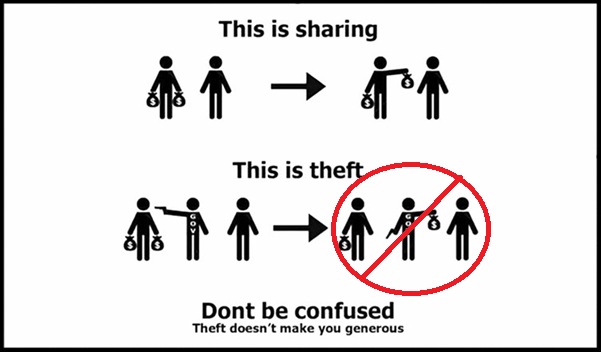
There’s no way to fix this problem without a major effort to shrink the redistributive state, as depicted by this modification of a libertarian meme.

That means entitlement reform, but many recipients will object. They will argue that they deserve money from government. Some of them will even argue that they have “earned” their benefits.

That’s an interesting argument when looking at programs with dedicated revenues, such as Social Security and Medicare.*

But there are many other types of spending that are unambiguously handouts. What’s the case for and against reducing those goodies?

Let’s look at an example. The New York Times has an editorial asserting a major MAGA attack on higher education. Not just an attack, but a step toward authoritarianism.

But much of the argument is based on their objection to a reduction in handouts and subsidies. Here are some excerpts.


When a political leader wants to move a democracy toward a more authoritarian form of government, he often sets out to undermine independent sources of information and accountability. …The weakening of higher education tends to be an important part of this strategy. …Mr. Trump’s multifaceted campaign against higher education is core to this effort to weaken institutions that do not parrot his version of reality. Above all, he is enacting or considering major cuts to universities’ resources. The Trump administration has announced sharp reductions in the federal payments that cover the overhead costs of scientific research… Vice President JD Vance and other Republicans have urged a steep increase of a university endowment tax that Mr. Trump signed during his first term. …Mr. Trump is squeezing higher education in other ways too. The Education Department let go of about half its work force, potentially making it harder for students to receive financial aid. The virtual elimination of the U.S. Agency for International Development led to the cancellation of $800 million in grants to Johns Hopkins alone. …The nonfinancial parts of the administration’s campaign against higher education are also alarming.

This is not persuasive, at least with regards to the accusation that Trump wants to be an authoritarian.

Telling an interest group that they no longer have easy access to other people’s money is not oppressive.

If the New York Times or university presidents want to make an argument (and they do) that universities should get handouts because they will generate a positive rate of return, that certainly legitimate.

And I surely would agree that dollars spent on scholarly research are more likely to generate positive outcomes than ordinary redistribution spending.

But, at the risk of repeating myself, cutting off the flow of money to higher education is not authoritarianism.

By the way, the NYT‘s editorial does acknowledge that universities have made mistakes.

Too many professors and university administrators acted in recent years as liberal ideologues rather than seekers of empirical truth. Academics have tried to silence debate on legitimate questions, including about Covid lockdowns, gender transition treatments and diversity, equity and inclusion. A Harvard University survey last year found that only 33 percent of graduating seniors felt comfortable expressing their opinions about controversial topics, with moderate and conservative students being the most worried about ostracization.

This is one of the reasons why I want the federal government out of education. Including higher education.

Let colleges and universities rise and fall depending on consumer demand. Let them attract or not attract research funds based on merit rather than political pull.

*Regarding “earned” entitlements, there is a somewhat close relationship between Social Security taxes paid and Social Security benefits received. But there are nonetheless two problems: 1) a big decline in the numbers of workers compared to retirees, leading to massive fiscal shortfalls, and 2) workers could enjoy far more retirement income if they could shift their payroll taxes to personal retirement accounts. In the case of Medicare, the average person gets $3 of benefits for every $1 of taxes they paid.

Saturday, January 25, 2025

Germany Incentivizes Sickness by Subsidizing Sick Days

January 24, 2025 by Dan Mitchell @ International Liberty

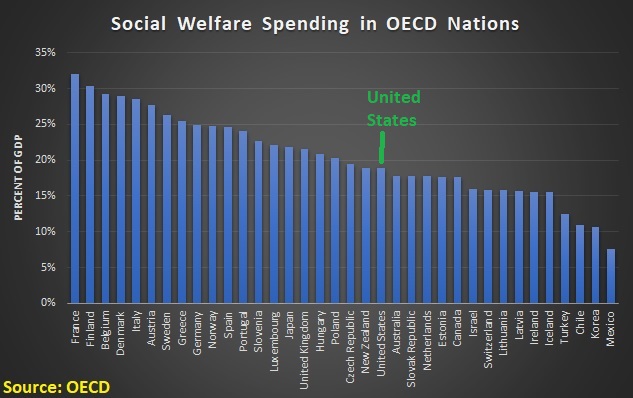
Back in 2019, I compared OECD nations based on the total burden of social welfare spending as a share of economic output.

France was the worst of the worst, unsurprisingly, followed by Finland and Belgium.

That column also differentiated by types of spending.

  • Greece had the biggest burden of pension spending.
  • France had the biggest burden of heath spending.
  • Belgium had the biggest burden of redistribution spending.

Today, let’s look at an even narrower slice of the social welfare state.

According to a new article in the Economist, Germany arguably has the most lavish sickness benefits in Europe. Maybe the most extravagant in the world.

That sounds very kind and compassionate, but it seems this policy is creating perverse incentives and undermining national prosperity.

Here are some excerpts from the article.


Germany is now “the world champion when it comes to sick days,” according to Oliver Bäte, the boss of Allianz, Europe’s biggest insurer. …Ola Källenius, the boss of Mercedes, agrees with Mr Bäte. He warns of the “economic consequences” of a sickness rate in Germany that is often twice as high as in other European countries. …Germany has one of the most generous sick-leave regimes in the world and it is costing businesses dearly. …

“It’s very hard to police,” says Jochen Pimpertz of the German Economic Institute (iw). In a study he found that the total nominal cost of sick pay for employers rose from €36.9bn to €76.7bn between 2010 and 2023 (a 57% increase, adjusted for inflation). …There is clear correlation between the generosity of the system and the number of sick days, says Nicolas Ziebarth of the Leibniz Centre for European Economic Research. Germany’s arrangements are lavish compared with elsewhere in Europe and have become easier to manipulate.

The article mentions that there used to be similar problems in some Scandinavian nations, and that reminded me that Sweden enacted some good reforms a few decades ago.

So I did a search for “sick days Sweden” and found a study published by the OECD in 2020.

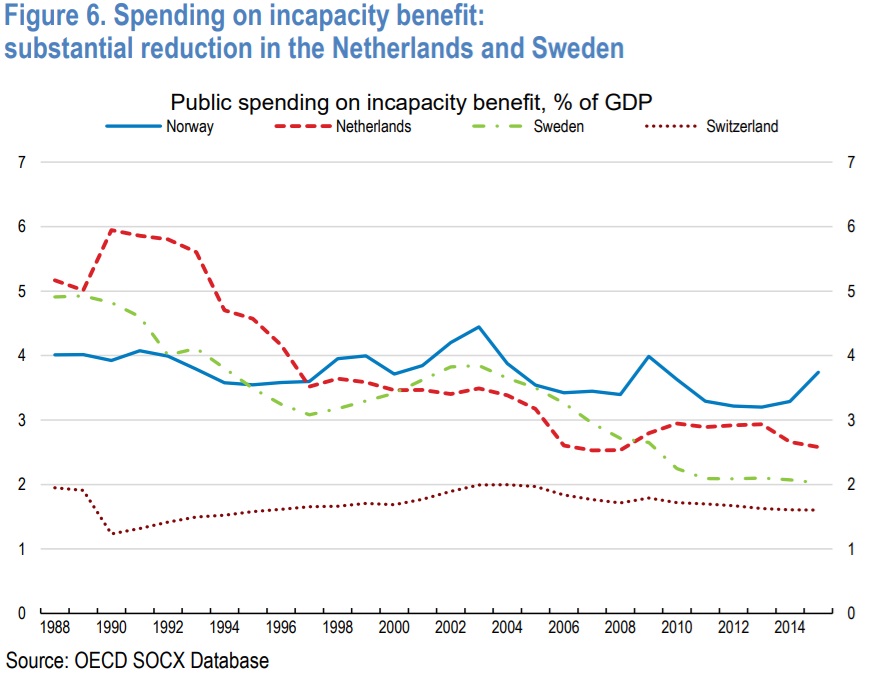
Authored by Philip Hemmings and Christopher Prinz, it included this chart showing that spending on sick days was dramatically reduced over a 20-year period, dropping from 5  percent of GDP in the late 1980s to 2 percent of GDP about 20 years later.

How did Sweden get these remarkable results?

The answer was simple. They reduced, in two stages, the amount of money people got for being sick (or, in many cases, for pretending to be sick). Here are a few excerpts from the study.


Sick-leave compensation reform (1990s). Pushed by a major economic downturn in the early 1990s, Sweden embarked on a series of sickness benefit reforms as part of a broader attempt to curb public spending. This included the introduction of a 14-day sick-pay period covered by employers (1992). In addition there were significant changes to compensation:  Before 1991, sickness benefits replaced 100% of earnings for 90 days and 95% thereafter, with no time limit. As of 1993, there was no payment on the first day of sickness absence (i.e. one “waiting day”), compensation then varied over time: 75% of previous earnings (days 2 and 3 of absence), 90% (until day 90), 80% (to the end of first year) and 70% thereafter.

This reform promoted a sharp drop in absence spells, especially in short-term absences… When the economy recovered in the late 1990s, sick-pay rates were increased, to 90% of the previous wage until the end of the first year and 80% thereafter. This led to a significant rise in absence rates, especially longer-term absences… Overall, the cost of being absent significantly affected absence behaviour. …

Starting in 2006, Sweden undertook a series of reforms to sickness and disability policies, which contributed to further considerable drops in both sickness absence rates and disability claims. These reforms included (Economic Survey of Sweden, OECD 2012b) among other things the introduction of…more rigorous implementation of existing regulations… Requirements for individuals on sick leave to consider a wider scope of jobs… A 2.5-year ceiling on the duration of sick leave compensation… More stringent disability-pension entitlement criteria.

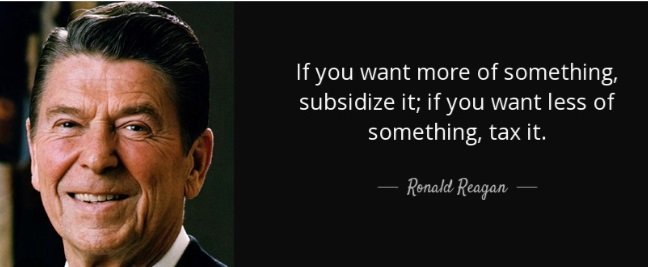
The broader lesson from Sweden’s successful reforms is that Ronald Reagan was right.

As was Thomas Sowell.

The more you subsidize of something, the more you get of it.

And, at the risk of stating the obvious, it’s not a good idea to subsidize dependency and idleness.

P.S. Sweden has implemented a lot of good reforms in recent decades. What happened with sickness benefits is laudable, but I’m even more impressed by the country’s partially private Social Security system and the impressive 1992-2001 period of spending restraint. Though a lot more needs to be done.

Monday, October 21, 2024

FEMA Foolishness and Moral Hazard

October 20, 2024 by Dan Mitchell @ International Liberty

With hurricane season (hopefully) coming to a close, this is a good opportunity to share this video from John Stossel about the absurdity of government-subsidized insurance in flood-prone areas.

Kudos to Rand Paul for addressing this issue. It’s a textbook case of “moral hazard” when government rewards people for making imprudent choices.


Heck, even Crazy Bernie understands that these subsidies are misguided (though I wonder whether he would be on the right side if Vermont had lots of flood plains, just as I wonder whether Sen. Kennedy would be bad on the issue if he was from Vermont).

Public Choice in action!

The left-leaning Washington Post also understands there’s a problem. Here are some excerpts from a new editorial.


Hurricane Helene likely caused more than $30 billion worth of damage. Less than two weeks later, Hurricane Milton inflicted almost $50 billion more. …Who pays for all of this? …Because private home insurers generally find this sector of the business unprofitable, the federal National Flood Insurance Program shoulders the burden of providing homeowners inundation coverage — and it has problems. The NFIP is managed by the Federal Emergency Management Agency…

The program provides nearly $1.3 trillion in coverage to more than 5 million policyholders. It’s funded by the premiums collected from policyholders but borrows from the U.S. treasury when claims it’s obligated to pay outpace revenue, as is often the case. …

And yet Congress has made no fundamental reforms to the program since its inception nearly six decades ago. That cannot continue. …Moral hazard took hold…as developers and other real estate interests gamed the system to suppress premiums and permit building in low-lying areas and beachfronts exposed to storms. …

Heavily lobbied by the interested industries, Congress has taken little action to rectify these long-standing issues, which have been festering for decades. …The one attempt at genuine reform in recent history — the Flood Insurance Reform Act of 2012 — would have ended subsidized rates for second homes and properties that repeatedly flooded. After Hurricane Sandy, however, coastal-state representatives reversed even these modest improvements. …

It’s simply unfair to ask the entire population to provide deep subsidies for properties that, by definition, only a portion of Americans can occupy and enjoy.

I’ve only said this a handful of times, but the Washington Post is correct.

Federal flood insurance is a way for some rich people to shift costs on to the rest of us. And it’s a way for insurance companies to shift their risks on to taxpayers.

The entire programs should be eliminated. Though, like Rand Paul, I’m willing to start by getting rid of the subsidies for rich people’s vacation homes.

P.S. The government also subsidizes insurance in areas susceptible to volcano damage.

Thursday, February 15, 2024

When You Crunch The Numbers, Green Hydrogen Is A Non-Starter

@ Manhattan Contrarian 

 This post reports on two new instances of people applying a little critical thinking to the issue of using so-called “green” hydrogen as an essential piece of a future de-carbonized energy system. This is a subject that I have previously addressed, here in a post of June 13, 2022, and here again in my energy storage Report of December 1, 2022.

The two new pieces covered in this post are (1) a February 1 Report for the Manhattan Institute by Jonathan Lesser titled “Green Hydrogen: A Multibillion-Dollar Energy Boondoggle,”, and (2) a February 13 article in the Washington Examiner by Steve Goreham titled “Can the government create a green hydrogen fuel industry?”

If you think that a “de-carbonized” energy system is some kind of urgent priority for humanity, and you put your mind to how to achieve that, it won’t take you long to realize that hydrogen is the only way to get there. OK, there’s nuclear, but environmentalists and regulators have nuclear completely blocked. That means that to be carbon-free, most electricity must come from the wind and sun, and in turn that means need for energy storage far beyond the capabilities of any batteries. Hydrogen is the one and only remaining solution.

And not just any hydrogen. Only “green” hydrogen will do — that is, hydrogen that is itself produced by some carbon-free process. The alternative is to get your hydrogen the way almost all hydrogen is produced today: you “reform” methane (CH4), separating out the hydrogen and discarding the carbon as CO2 into the atmosphere. But this process has the same CO2 emissions as if you just burned the methane (aka natural gas) in a power plant to get your energy in the first place. If the entire goal is de-carbonization, that is clearly not allowed.

Over at the government, their minds move slowly, but they have recently figured out that keeping their energy transition fantasy alive can only be accomplished with vast amounts of green hydrogen. And so they have undertaken to address the issue in the only way they know, which is to throw oodles of taxpayer funding at it. This piece from JPT on October 24, 2023 covers the government’s latest big announcement:

US President Joe Biden and Energy Secretary Jennifer Granholm announced that seven regional clean hydrogen hubs have been selected to receive $7 billion in Bipartisan Infrastructure Law funding in an effort to accelerate the domestic market for low-cost, clean hydrogen. The seven selected regional clean hydrogen hubs are expected to catalyze more than $40 billion in private investment and create tens of thousands of jobs, bringing the total public and private investment in hydrogen hubs to nearly $50 billion.

Note that the government’s big initiative came just about a year after the two Manhattan Contrarian pieces in 2022 explaining why this could never be done economically. But anyway, now that the government funds are flowing, and so-called “infrastructure” is getting built, others are starting to look at whether this makes any sense.

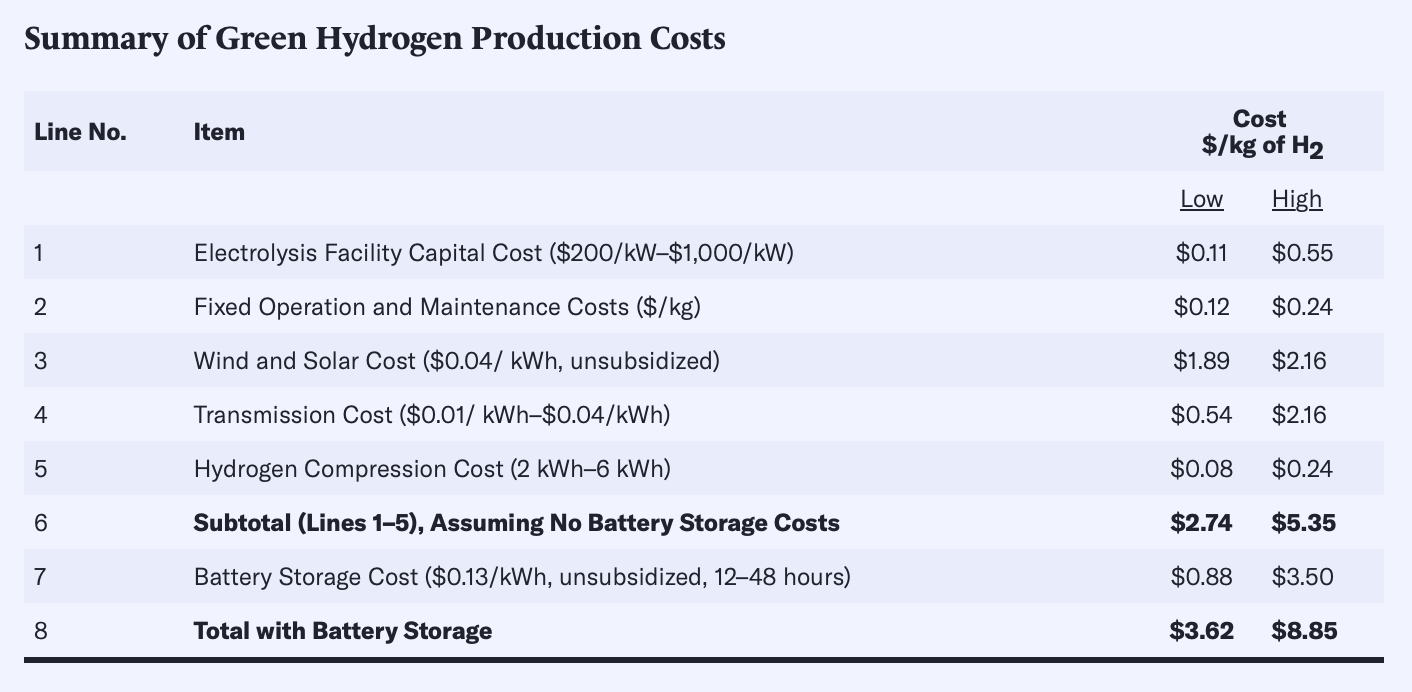
Of the two new pieces covered here, Lesser’s is far the longer and more detailed. He goes through a careful look at all the elements of trying to produce this green hydrogen stuff — building the electrolysis facility, operating and maintaining the facility, buying electricity from wind and solar producers, transmitting the wind/solar electricity to the site of electrolysis, and compressing the hydrogen into a form ready for transit somewhere to be used — and puts assumed cost figures on each piece of the process. He comes up with a total cost range of $2.74 to $5.35 per kg of hydrogen produced. Here is Lesser’s chart:

Note that Lesser comes up with even higher figures of $3.62 to $8.85 per kg of hydrogen if he further adds costs of battery storage of electricity to make it so that the electrolyzers can run all the time and not be dependent on the intermittency of wind and sun. Green hydrogen advocates would dispute whether this is necessary, so let’s leave it out for now. Even without this additional cost, we are at $2.74 to $5.35 per kg for the hydrogen.

Since a kg of hydrogen is good for about 33.3 kwh, that would mean something in the range of 8.3 to 16.2 cents per kwh just for the fuel, without yet considering any cost to get the fuel to a power plant to be burned.

I would comment that some of Lesser’s assumptions are very low, and by “low” I mean favorable to the economic viability of this green hydrogen. Most notably, he has an assumption of an unsubsidized cost of 4 cents per kwh for the wind/solar-generated electricity. Crazy. Here in New York, off-shore wind developers who had bid last year for contracts at about $90-100/MWH (i.e., 9 - 10 cents per kwh) have recently reneged and demanded prices in the range of $150-160/MWH, or 15-16 cents per kwh. If the recent New York demands represent the real cost of wind/solar electricity, then you can multiply Lesser’s figure for the electricity input to produce a kg of hydrogen by 4, adding about $6 per kg, bringing the total cost of a kg to around $9 - 11, instead of Lesser’s $2.74 - 5.35. In cents/kwh that would be about 18 additional cents per kwh, in either the high or low scenario; instead of a range of about 8 to 16 cents, it would be 24 to 32 cents per kwh to make the green hydrogen.

Goreham does not give us such a detailed calculation, but his bottom line is about the same (including a more realistic cost for the wind/solar electricity):

Hydrogen feedstock made from natural gas or coal is inexpensive, with a cost as low as $1 per kilogram. . . . To produce a kilogram of hydrogen by electrolysis, electricity alone costs $3 to $6 per kilogram, resulting in a total cost of at least $5 per kilogram. This makes hydrogen from electrolysis more than five times as expensive as hydrogen made from natural gas or coal.

Goreham’s “at least $5 per kg” for green hydrogen is actually well below Lesser’s figure after we adjust for the cost of electricity from wind and solar generation.

Note that, as I reported on January 12, recent bids in the UK for producing green hydrogen using electricity from off-shore wind came in at about $306/MWH, or 30.6 cents per kwh. Using the conversion factor of 33.3 kwh/kg of hydrogen would make this the equivalent of over $10 per kg of hydrogen.

We won’t really know how much this green hydrogen stuff actually costs until there are some real facilities up and running. But whether it is ten times as expensive as the stuff produced from natural gas, or only five times as expensive, doesn’t really matter. It is uneconomic, and nothing is going to change that. Nobody will ever buy it or use it without government mandates or subsidies or both.

Goreham’s conclusion:

[G]overnments now want to create a new hydrogen fuel industry using market intervention, mandates, and massive subsidies. But physics and economics strongly oppose the development of a green hydrogen fuel industry. Get ready for a spectacular failure of these government-sponsored efforts.

Tuesday, October 17, 2023

Biden Stumbles Again With Green Energy Subsidies

By: Andrew Moran October 16, 2023  @ Liberty Nation News

Over the past year, US taxpayers have learned that one of the chief lessons of Bidenomics 101 is doling out billions of dollars in green energy subsidies for wealthy corporations. This was what the trifecta of legislative accomplishments – Inflation Reduction Act, the CHIPS and Science Act, and the Bipartisan Infrastructure Law – was all about. President Joe Biden traveled to Philadelphia, PA, this weekend to again tout Bidenomics and announce several billion dollars in so-called federal investments for hydrogen projects.

Everyone Is Pleading Not Guilty

$7 Billion for Green Energy Subsidies

Stumbling twice on a short flight of stairs, President Biden took to the stage to award $7 billion in federal grants across 16 states, from California to Pennsylvania, for developing seven regional hydrogen hubs as part of the administration’s broader decarbonization initiative. What companies will receive some of these green energy subsidies? A range of businesses will be involved, but three of the most prominent names on the list are Amazon, Chevron, and Exxon Mobil, worth a combined $2.2 trillion.

While critics would likely ask why some of the wealthiest corporations in the world need a handout from Uncle Sam, President Biden noted that the giveaway is essentially seed money to help jump-start the production of clean hydrogen by having the critical infrastructure established. Additionally, the total investment in these hubs will reach $50 billion because of the substantial private investment also being made.

“I’m here to announce one of the largest advanced manufacturing investments in the history of this nation. It’s all part of my plan to make things in America,” Biden said.

Of course, the administration’s latest announcement focuses on clean energy, but observers are omitting one key thing: Green energy subsidies are just more corporate welfare. Politicians are, once again, transferring resources from taxpayers to special interests.

Is Hydrogen the Answer?

Hydrogen is considered a crucial component for achieving the world’s net zero carbon emissions objective by 2050. Hydrogen emits only water when burned as fuel or inside a fuel cell for automobiles. However, hydrogen production requires an immense volume of energy, meaning that, depending on its source, it might not be as green as its proponents would contend. So, for instance, hydrogen can be produced from natural gas, and this so-called bridge fuel has received enormous criticism from climate activists.

Consider this statement from Maggie Coulter, an attorney at the Center for Biological Diversity’s Climate Law Institute, who told the Associated Press: “Throwing billions at hydrogen hubs deepens our dependence on fossil fuels and worsens the climate emergency.”

Indeed, hydrogen could only be labeled green if new renewable sources are built to power hydrogen output rather than relying on the present grid and other carbon accounting programs. In other words, it might have the same environmental effects as fossil fuels. For now, according to the International Council on Clean Transportation, the world is greenwashing green hydrogen.

Trickle-Down Bidenomics

GettyImages-1531918146-min green energy

(Photo by Marijan Murat/picture alliance via Getty Images)

US administration officials have repeatedly asserted that Bidenomics is about growing the economy from the middle out and bottom up, abandoning the concept of trickle-down economics of the past three decades. However, this pejorative term – economic policies that disproportionately favor Corporate America and the 1% – can apply to the president’s economic doctrine.

As Liberty Nation has regularly reported, the White House, state governments, and city officials are spending trillions of dollars on corporate welfare. No one in the Oval Office or inside the Democratic caucus on Capitol Hill wants to admit this because the taxpayer-funded subsidies are allocated to their preferred sectors, mainly green energy.

President Biden has demanded that corporations must pay their fair share while signing over checks to these same entities. Moreover, global leaders, like United Nations Secretary-General Antonio Guterres, have called for an end to fossil fuel subsidies. This should be a welcome call to action as long as it includes renewables and green energy. Otherwise, they pick winners and losers, favor one industry over another, and engage in hypocrisy. Leftists are not opposed to corporate welfare. They just want the money to go to another set of special interests for a specific cause. That is Bidenomics 101.

Read More From Andrew Moran

Wednesday, June 21, 2023

"Stranded Assets": Who Will Have The Last Laugh?

June 19, 2023 @ Manhattan Contrarian 

It’s been a persistent drumbeat for many years: Fossil fuels are obsolete, and the facilities that produce them, along with any further facilities that might be built for that purpose, will shortly become worthless. These facilities will be “stranded assets.” And any energy company stupid enough to make further investment in fossil fuel extraction or use will inevitably suffer a total loss.

Do you believe that prediction? Those making it are among the aggressive promoters of an energy transition to supposedly superior sources like the wind and sun. The prediction has been widely used in the attempt to bludgeon energy companies into reducing or ending their coal, oil and gas investments. But if fossil fuels were really obsolete, and renewables superior and cheaper, why would such bludgeoning be needed? Wouldn’t the investment just flow naturally over to the wind and solar facilities?

For starters, here is a sampling of some of those staking out the position that fossil fuel assets will shortly become “stranded”:

  • Senator Sheldon Whitehouse (D-RI), Chair of the Senate Budget Committee, at a hearing March 29, 2023: “[T]he world is moving away from oil and gas, but truculent and politically connected market actors persist in fossil fuel investments, which crash in value when their unsustainable economics overwhelm the artificial politics that supported them.  The operative term of today’s hearing: stranded assets.”
  •  From an article by Semieniuk, et al., in Nature Climate Change, May 2022: “The distribution of ownership of transition risk associated with stranded fossil-fuel assets remains poorly understood. We calculate that global stranded assets as present value of future lost profits in the upstream oil and gas sector exceed US$1 trillion under plausible changes in expectations about the effects of climate policy.”
  • From MIT News, August 19, 2022: “As the world transitions away from greenhouse-gas-emitting activities to keep global warming well below 2 C (and ideally 1.5 C) in alignment with the Paris Agreement on climate change, fossil fuel companies and their investors face growing financial risks (known as transition risks), including the prospect of ending up with massive stranded assets.” 
  •  From the New York Times, March 21, 2022, quoting a speech by UN Secretary General Antonio Guterres: “In his speech, Mr. Guterres said wealthy nations should be dismantling coal infrastructure to phase it out completely by 2030, with other nations doing so by 2040. . . . ‘Their support for coal not only could cost the world its climate goals,’ he said. ‘It’s a stupid investment — leading to billions in stranded assets.’”

Meanwhile, out here in the real world, fossil fuel investments are looking very much the opposite of “stranded.” Here’s a brief summary from AP on May 2 of some major oil company earnings for the first quarter of 2023:

Exxon earned a record $11.4 billion in the first quarter, and Chevron raked in $6.6 billion. Saudi Aramco said in March that it earned $161 billion in 2022, the highest-ever recorded annual profit by a publicly listed company.

And for the full year 2022, here are the earnings of Exxon and Chevron, as reported by NPR:

ExxonMobil earned nearly $56 billion in profit in 2022, setting an annual record not just for itself but for any U.S. or European oil giant. Buoyed by high oil prices, rival Chevron also clocked $35 billion in profits for the year, despite a disappointing fourth quarter.

NPR quotes Exxon CEO Darren Woods as to the reason for Exxon’s recent success: 

"We leaned in when others leaned out.”

Woods was referring to Exxon’s decision to continue investing in producing oil and gas, while several other oil majors were cutting back and making ridiculous commitments to reduce their “emissions,” as if they had forgotten what business they are in. Leaders in the category of seeking climate virtue were the two European giants, BP and Shell. How has that been working out? Britain’s Daily Telegraph (behind pay wall) reports on June 15 on the latest from those two:

First BP, now Shell. One by one, the oil giants are returning to what they know best – doubling down on fossil fuels and prioritising shareholder returns – in u-turns that inevitably have to come at the expense of climate pledges.

It seems that BP and Shell had been lagging the competition in oil and gas profits, while they invested in various politically-favored green energy projects. No more. Here is the Daily Telegraph describing Shell after its recent pivot:

Shell privately concedes that biofuels, hydrogen, electric vehicle charging and carbon capture storage – the four areas it has earmarked for investment – are at the more speculative and unproven end of the renewables spectrum. The absence of any plans to invest in other, far more established clean energy sources such as wind and solar – which are attracting record investment around the world – is glaring.

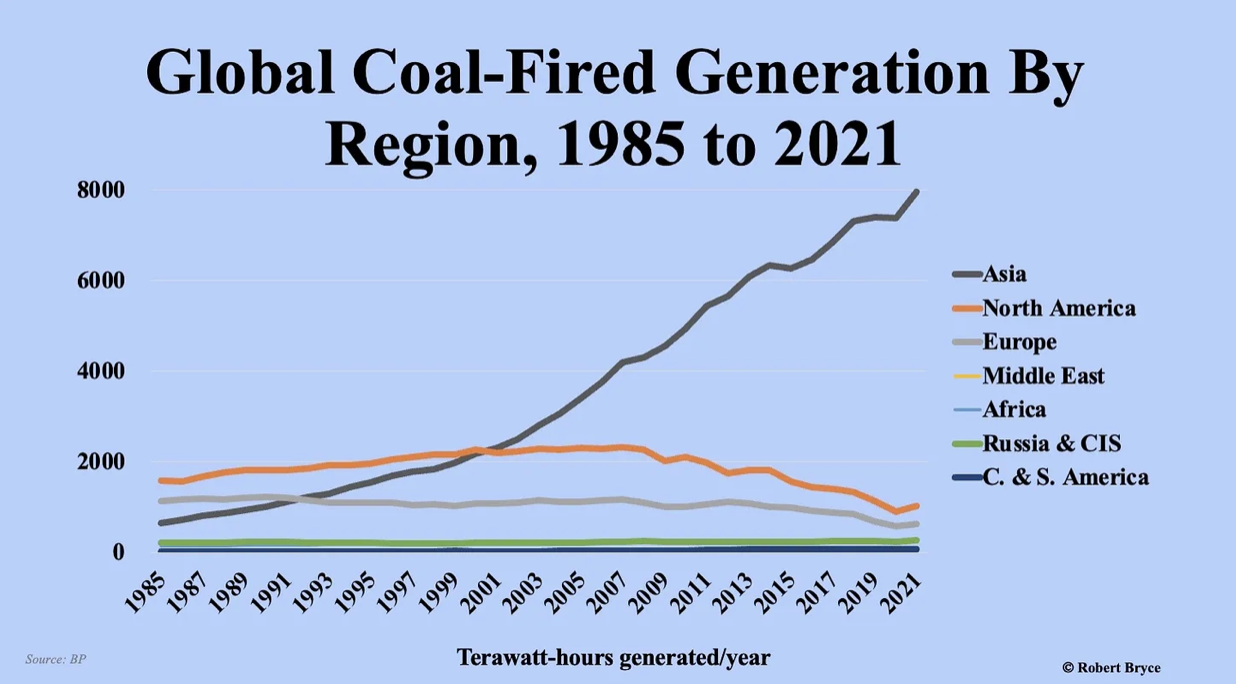
And for the latest on coal, you can check out Robert Bryce’s Substack column from June 17. Here are a few statistics provided by Bryce from Vietnam and China:

Vietnam is now getting about 60% of its juice from coal-fired power plants. Since 2009, Vietnam’s coal-fired electricity output has grown tenfold and more growth is on the way. Last year, according to Global Energy Monitor, Vietnam commissioned about 1,900 megawatts of new coal-fired capacity.

Much . . . coal growth is happening in China, which accounts for more than half of all global coal consumption and a shade more than half (52%) of all the electricity generated from coal. Yesterday, June 16, Reuters reported that during the first five months of this year, coal-fired generation in China jumped by 6.6%. And that trend will continue. In February, Global Energy Monitor reported that China permitted about two new coal-fired power plants per day in 2022.

And here is a chart from Bryce showing the overall trend of generation of electricity from coal:

As between oil, gas, and coal assets on the one hand, and wind, solar, and battery assets on the other, I think it’s a very easy call which ones are going to end up “stranded.” On the first day when any government withdraws its subsidies for any wind, solar or battery asset, that asset becomes “stranded.”

Tuesday, December 13, 2022

Federally Subsidized State Profligacy

November 18, 2022 by Dan Mitchell @ International Liberty

I was going to write about Argentina again today, following up on yesterday’s column.

But the National Association of State Budget Officers has released a new report about spending in the 50 states.

This is an opportunity to see how all the pandemic spending by Washington has encouraged bad fiscal policy at the sub-national level.

To be succinct, the answer is “a lot.”

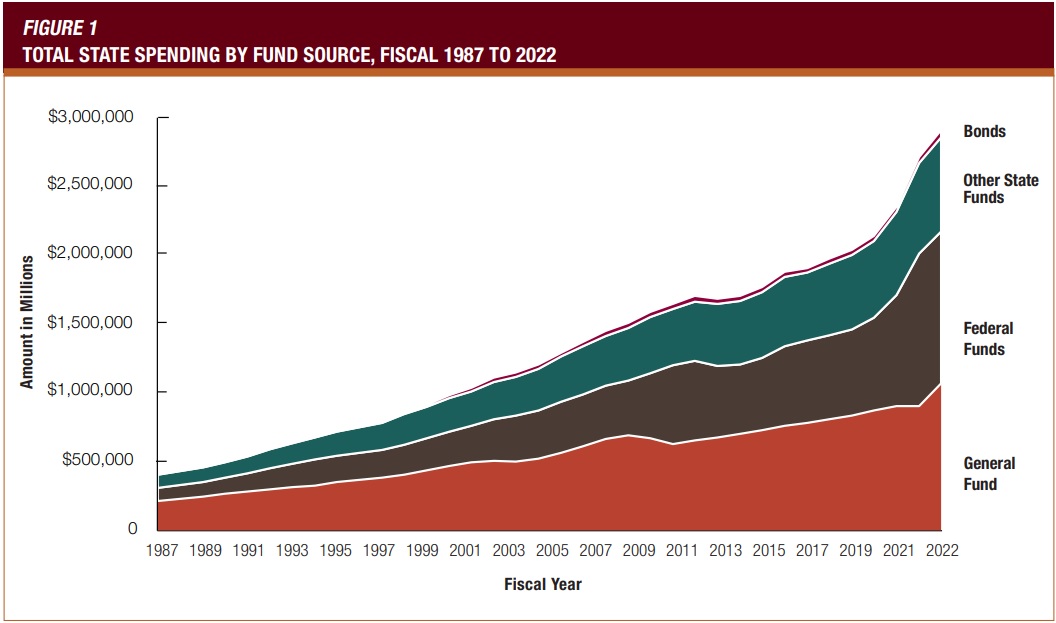
Figure 1 shows that all the grants and handouts enabled reckless policy. For all 50 states, the burden of spending climbed 24.7 percent between 2020 and 2022.

But not all states are created equal.

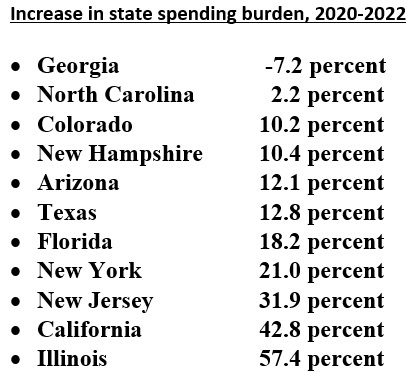
So I went to Table 1 of the report to see how much spending increased in various states.

Here are some of the highlights. Special applause for Georgia (home of my beloved Bulldawgs!), which actually reduced the spending burden over the past two years. And honorary mention to North Carolina, which is further enhancing its reputation for sensible fiscal policy.

Colorado also was one of the best states, doubtlessly thanks to TABOR. And New Hampshire also deserves further plaudits for relative frugality.

The big states of Texas and Florida increased spending by less than the 24.7 percent average. As did New York, surprisingly.

I’m sure nobody is surprised to see such bad results from New Jersey and California. And Illinois deserves some sort of Booby Prize for its recklessness.

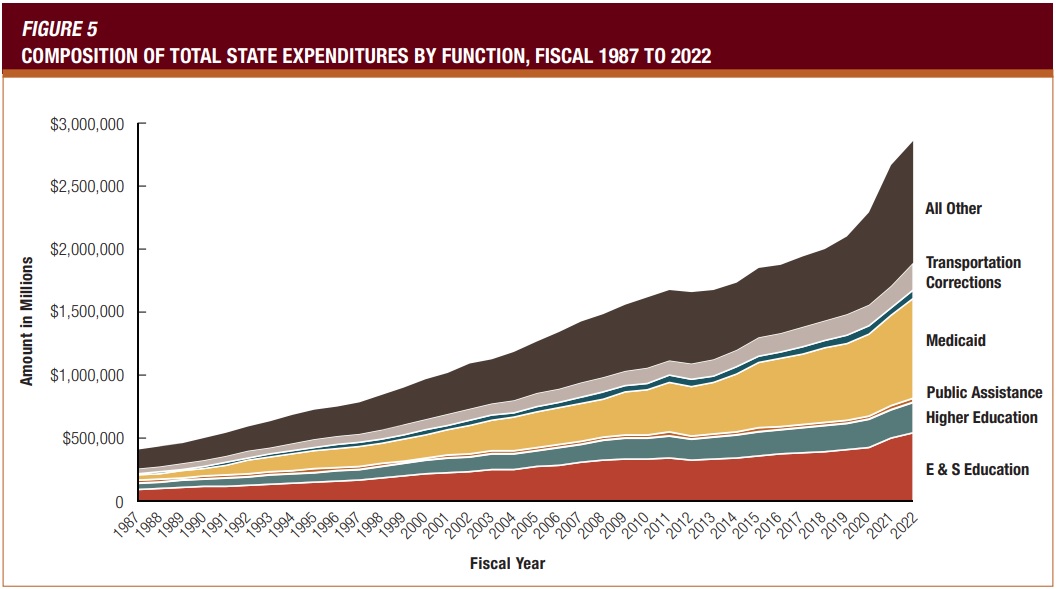
P.S. I’ll close by shifting to a different topic. As you can see from Figure 5, Medicaid (the government’s health entitlement for poor people) is consuming ever-larger shares of state budgets (and the federal budget).

Medicaid reform (block granting the program) is a very good idea to fix budget problems at the state level and to fix budget problems in Washington. And reduce fraud as well.


Monday, October 17, 2022

The Real “Existential Threat” to people and planet

It is government policies that promote green energy and suppress fossil fuels

Don Ritter

It’s ironic. The very Biden Administration and European Government policies that are supposed to address the asserted “existential threat” of climate change are themselves the true existential threat to modern civilization.

As someone trained in science and engineering, a lifelong hiker, gardener and lover of nature in the extreme, I want a healthy, sustainable planet as much as anyone promoting the climate change agenda. It’s not that “green” energy is bad. It’s that the rate of “going green,” and the enormous investments required, are wildly disproportionate to society’s energy needs, now and for the foreseeable future.

Elon Musk gets it, but most government leadership do not – or choose to remain silent. “Realistically, civilization will crumble if we don’t continue to use oil and gas in the short run,” Musk has said.

Civilization crumbling is clearly an “existential threat.” And this guy sells electric cars! He also recommended “continued drilling and exploration for oil and gas,” because he understands that producing and fueling electric vehicles will require substantial fossil fuel electricity generation, for years to come.

“Existential” issues like war, peace, economic vitality, jobs and living standards all have the same critical driving force: energy – all forms of energy. Energy to transport people and goods, to run farms and provide food, to heat and cool homes, to power manufacturing, and to fuel ships, planes and vehicles for our military. Natural gas is essential for fertilizers to feed a hungry world. Oil and natural gas are the building blocks for plastics, pharmaceuticals, synthetic fibers, paint and thousands of other products.

Today, these vital, almost-taken-for-granted benefits come almost entirely from oil, gas and coal. Those who have it will be powerful; those who don’t will not. China and Russia know this well.

Europe made a deal with the devil by handing its energy supply to Vladimir Putin and energy-rich Russia – while crippling its own energy future with anti-fossil-fuel climate change policies. Europe closed its coal, gas and nuclear power plants, while building expensive, unreliable, weather-dependent solar and wind facilities. Putin’s war on Ukraine couldn’t have happened without his dominance over gas, oil and coal supplies to Europe.

And where is the United States government on energy reality? It’s copying Europe, with vast green energy subsidies and an unrelenting “whole of government” regulatory war on fossil fuels.

America should be telling an energy-insecure world, “We will do everything in our power to increase the supply of energy,” in an-all-of-the-above approach: not only fossil fuels and renewables, but nuclear, and hydroelectric power when feasible. Instead, we beg hostile dictatorships – that pay no attention to human rights or ecological values – to increase their production, because we refuse to increase ours.

Isn’t that just a little embarrassing? We could be the “gas station for democracy” for the Free World. But our government’s climate change policies stand in the way.

Simple arithmetic tells the story. Fossil fuels still provide some 80% of the world’s and America’s energy consumption. The rest comes from hydro, nuclear, solar, wind and biomass. In the USA, solar and wind provide less than 5% of our total energy consumption – and less than 2% for transportation, to fuel 290 million cars, trucks and buses. For airplanes, the percentage is zero.

Coal constitutes some 33% of total energy consumption in the U.S. and 37% worldwide. Yet it is being prematurely withdrawn from global energy supplies by climate change policies. This is devastating, especially for poor countries.

Developing nations need expanded coal mining to produce electricity, to create jobs and lift billions out of abject poverty. But they are denied access to capital by the climate-obsessed bureaucracies in international financial institutions and government aid agencies like the World Bank, Asian Development Bank and USAID. This is this hypocritical, especially because the West industrialized predominantly with coal.

Climate campaigners at all levels of government and in the revenue-driven private sector have created a new energy economy based on vast subsidies for solar and wind, to replace coal, oil and gas. It portends disaster, for Europe and America, because they are doing it prematurely – before the replacements are anywhere near ready for prime time.

The Biden Administration “Inflation Reduction Act” contains some $370 billion in new green energy subsidies, purposely skewing massive private investment into solar and wind, and away from fossil fuels that are still essential – practically, economically and geopolitically.

Before governments provide such enormous subsidies, they need to analyze all the environmental impacts of producing and installing massive wind turbine, solar panel and backup battery facilities. On U.S. and global scales, those technologies would require metals and materials mining and processing – almost all with fossil fuels – on scales unprecedented in human history; indeed, at levels impossible to reach for decades to come.

Wind, solar and battery facilities also impact and destroy vast amounts of land: wildlife habitats, croplands and scenic areas. They kill birds, bats and other wildlife. Without expensive, fire-prone battery backup, they require inefficient hydrocarbon “peaker” facilities going on and off repeatedly, whenever the wind isn’t blowing and the sun isn’t shining.

Demonizing energy sources brings risks of blackouts, factory shutdowns, and freezing people in the dark during long winters. Supposedly “clean, green, renewable” energy is simply not yet able to meet America’s and the world’s growing electricity needs.

Substituting natural gas for coal in electricity generation is the reason America has been leading the Free World in reducing greenhouse gas emissions. Natural gas should be seen not as a pariah, but as the “bridge fuel” to any fossil-fuel-free future.

The Biden Administration is putting long-range, uncertain, potentially faulty, probably exaggerated predictions about climate over the lives and independence of Ukraine, the security of our European allies – and even America’s own security and well-being. India, Brazil, Indonesia and many others in the “Global South” need oil, gas and coal to exist and modernize. But the Biden Administration will not assure them that America will work to fill the gap if they try to wean themselves off Russian fossil fuels. Is it any wonder they have stayed neutral on Putin’s brutal invasion?

Sadly, the debate over expanding American energy to substitute for Russia’s – and ensure our own energy security – is virtually non-existent within the Administration, many think tanks and the media. In fact, they all cooperate to censor and silence debate.

This is not only strange, because the soaring cost of energy is the primary factor driving inflation and threatening recession, not just in America but worldwide. In fact, it is worse than strange.

Government suppression of fossil fuel production is threatening the national security and economies of countless nations. Demands that we precipitously “go green” represent the greatest “existential threat” of all – to the survival of modern industrialized nations, to developing nations, and to the survival of our planet as we know it.

Don Ritter received his Doctorate in Metals and Materials from MIT. He served 14 years on the House Energy and Commerce and Science and Technology Committees; was Ranking Member on the Congressional Helsinki Commission, and was founding Co-Chair of the Baltic States-Ukraine Caucus. Ritter led the National Environmental Policy Institute after leaving Congress. He is a Trustee of the Victims of Communism Memorial Foundation, and Trustee and President & CEO Emeritus of the Afghan American Chamber of Commerce.

Tuesday, October 4, 2022

“Climate-Smart” Agriculture Incentives — Not-So-Smart Results

In a move that could only have been conceived and executed by a federal bureaucracy, the Biden Administration, as part of its Inflation Reduction Act, is spending $40 billion dollars to get farmers and ranchers to engage in “climate-smart” conservation practices. On the one hand, it’s not at all clear how printing and spending this money is going to reduce inflation. On the other, it’s even less clear how these conservation practices are going to influence climate change. It’s like throwing two stones at one bird and still missing. This scheme is an exercise in futile posturing, a political theater performance to which you, fair citizen, are required to buy a ticket.

The New York Times reports that the program is “the largest federal investment to date in climate-smart practices,” and that demand for the program far exceeds available funding, with “half to two-thirds of farmers who apply” turned away. No kidding. Demand for the program is inevitably going to outstrip supply, which also inevitably means the pressure to increase the program’s budget will intensify. “Farmers want to do these types of conservation programs,” opines Ben Lilliston, who works at an agricultural research and advocacy nonprofit, “…we need this money and these resources.”

Don’t we all?

This kind of agricultural boondoggle is nothing new. In fact, this is just the latest iteration of the sort of failed agricultural interventionism that got its start in the New Deal. One of the very first acts of Roosevelt’s Agricultural Adjustment Administration was to pay farmers to butcher six million baby hogs and plow under every third row of cotton, all during a time of national hunger. It was the epitome of big-government “Brain-Trust” wisdom of the day, tackling the era’s equivalent of “climate change” (low prices) with heavy-handed policy edicts. What seems extraordinary wisdom in one generation is recognized as ludicrous by the next. And so here we are, once again chasing a government carrot in a collective circle. 

The “Climate-Smart” initiative commends itself by explaining how its programs improve efficiency and conservation. Farmer interviews unfailingly highlight how adjusting their practices to align with government incentives has actually “helped their bottom line.” But if these are all such economically sensible practices, why do they require government incentives in the first place? “There’s a real risk, based on recent history,” says Scott Faber, Vice President for Government Affairs at the Environmental Working Group, “that a lot of this funding will be squandered.” Well said, Mr. Faber, and I assume you’re in a position to know…

Climate Change Impact?

Risking a nose-dive into another Great Depression is one thing, but at least this is all helping the earth, right? Maybe not. Since climate science is really in its infancy, and climate change claims are generally heavily overblown, it’s safe to bet this program will have little, if any, net effect on global temperatures. Bjørn Lomborg writes that the effects of this new climate law (sorry… “Inflation Reduction Act”) will be impossible to detect in the next fifty years using UN climate models. The Times, in rare candor, says of the “Climate-Smart” program:

…scientists still have not determined just how much and for how long carbon can be sequestered and how to even measure any impact. Nevertheless, farmers, experts, and the federal government broadly agree that these practices confer benefits like improving soil and water health, building resilience against drought and enhancing biodiversity.

So scientists can’t even measure the climate-efficacy of the program, yet everyone is agreeing to go along with it because it feels about right—especially, no doubt, within the departments that are getting bigger budgets and amongst the farmers they are paying to sustain a bucolic lifestyle. 

I don’t begrudge anyone wanting to live on the land—quite the contrary in fact. Most of the principles being incentivized are probably benign. But no sensible voter should embrace coerced inflationary handouts to support other people’s back-to-the-land ambitions. The “Climate-Smart” scheme—a self-licking ice cream cone if ever there were one—cannot stand on principles of collective good or efficient resource allocation. For example, of the $40 billion dollars being spent, $19.5 billion is being spent to prop up decades-old programs that were of dubious benefit in the first place.

The Times highlights Lindsay Klaunig as a poster child for this incentive program. She and her partner bought acreage the Times admits was “ill-suited for farming,” and are now, with “a little help from the Agriculture Department,” enjoying the rustic life on Trouvaille (“lucky find”) Farm (not to be confused with “Travaille”), raising a small herd of rotationally grazed grassfed cattle and making small-batch chocolates on her Appalachian farm. “For Ms. Klaunig, the practices yield practical benefits and adhere to her convictions.” Good for her, I say. She’s clearly not foolish enough to leave free money on the table. The Times likewise admits, however, that “it remains to be seen whether more widespread deployment of such methods—as the Biden administration has sought to encourage—can truly reverse the effects of climate change.” 

“Lucky Find” indeed. Far better, it would seem, to have just given the money away to all the roughly 2 million farms nationwide. The $20,000 each would probably have done more for the economy and environment, without adding the deadweight of further bloated government agencies. 

Paul Schwennesen

Paul Schwennesen is completing a PhD dissertation on environmental history and Spanish conquest in the Arizona/New Mexico borderlands. He holds a Master’s degree in Government from Harvard University and degrees in History and Science from the United States Air Force Academy.

He is a regular contributor to the Property and Environment Research Center and his writing has appeared at the New York Times, American Spectator, Claremont Review, and in textbooks on environmental ethics (Oxford University Press and McGraw-Hill). He is the father, most importantly, of three delightful children.

Follow him on Twitter @agrarianfree

Get notified of new articles from Paul Schwennesen and AIER.


Wednesday, March 2, 2022

Stadium Subsidies, Reverse Redistribution, and Cronyism

March 1, 2022 by Dan Mitchell @ International Liberty

Redistribution is bad economic policy.

As the great Thomas Sowell observed, the people who finance redistribution are hurt because they get taxed for working and producing. And the people on the receiving end often are hurt because they get lured into dependency.


But not all forms of redistribution are equally bad.

For instance, I don’t like America’s welfare state, which redistributes from the rich to the poor.

But I utterly despise government programs that redistribute from the poor to the rich (such as the Export-Import Bank, the National Endowment for the Arts, bailouts for student loan deadbeats, ethanol subsidies, etc).

Amazingly, some politicians even want to subsidize millionaires and billionaires. It’s happening in my state!

Sarah Rankin of the Associated Press summarizes a sweetheart deal that Virginia politicians have prepared for the local NFL team (formerly the Redskins, now the Commanders).


Virginia lawmakers are advancing a measure intended to lure the Washington Commanders to the state by allowing the NFL team to forgo what could be $1 billion or more in future tax payments to help finance a potential new football stadium. The move…is intended to help Virginia secure its first major pro sports franchise. … “They’re going to go someplace. Absent some kind of incentive, they’re likely not to be here,” Tray Adams, a lobbyist representing the team, told a panel considering the legislation. …

The House and Senate passed differing versions of the measure this month with broad bipartisan support… Both versions of the legislation would create a Virginia Football Stadium Authority tasked with financing the construction of a stadium and related facilities. The nine-member authority would be allowed to issue bonds, then recapture certain tax revenues to pay down that debt. …

Virginia’s newly inaugurated Republican governor, Glenn Youngkin, seemed to throw support to the idea… In an interview with the AP, Youngkin said he hoped he and the Legislature could reach agreement on a bill that would “best reflect the interests of Virginia taxpayers and hopefully bring the Washington Commanders to Virginia.”

As a Virginia taxpayer, I can assure the Governor that it’s not in my interest if I have to pay taxes while millionaire players and a billionaire owner get a sweetheart deal.  In a column for the Washington Times, Michael Farren and John Mozena explain why taxpayers are the big losers when politicians subsidize sports stadiums.


Proving that bipartisan ideas can be just as bad as those cooked up by a single party, legislation just passed in both the Virginia House and Senate to create a “Virginia Football Stadium Authority” — a government entity that would fund construction of a new stadium… Here’s what most people don’t understand about Virginia’s multibillion-dollar proposal: …it looks like nearly all taxes — sales, corporate income and personal income — collected at the stadium and entertainment complex will go to the stadium authority, not Richmond. The stadium authority then funnels the tax revenue back to the team, meaning the legislation creates a miniature tax haven for the team owners. In other words, ..other Virginia residents and businesses will have to compensate for the fact that the Commanders will pay almost nothing at all. …three leading sports economists — J.C. Bradbury, Dennis Coates and Brad Humphreys — just threw a penalty flag. Their recent research summarizes more than 120 academic studies from the past 30 years regarding the effects of stadium subsidies… “The large subsidies commonly devoted to constructing professional sports venues are not justified as worthwhile public investments.” That confirms the results of a University of Chicago survey of some of the nation’s leading economists, including seven Nobel Laureates. The consensus was that subsidies cost communities more than they deliver in economic benefits. Only 4% disagreed. …Maybe a better team name would be the Washington Tax Demanders.

For what it’s worth, I think the Washington Leeches would have been the best name. And I’ve thought that ever since I moved to Virginia in the 1980s.

Though I confess that’s simply because so many member’s of D.C.’s parasite class root for the team.

But I’m digressing. The message of today’s column is that cronyism is bad, but the worst kind of cronyism is upside-down redistributionism that gives special preferences to the rich and powerful.

Wednesday, September 9, 2020

Remember Solyndra? (Blast From the Past)

(Editor's Note: I've been going back through my files and updating the labels, and I've come across some worthwhile articles that are still relevant today. This is one of them.  RK)

By WND Staff Published October 18, 2012

'Extent of its failure has been largely ignored by the press'
Remember Solyndra? That’s where taxpayers lost hundreds of millions of dollars after the Obama administration handed out money and the company took it and went out of business.
But how about Evergreen Solar? Or Beacon Power? Or EnerDel subsidiary Ener1? They also took taxpayer money from the Obama administration for their “green” energy projects, and then filed for bankruptcy.
In fact, a new report from the Heritage Foundation says, “So far, 36 companies that have received federal support from taxpayers have either gone bankrupt or are laying off workers and are heading for bankruptcy.”
“It is no secret that President Obama’s and green-energy supporters’ (from both parties) foray into venture capitalism has not gone well. But the extent of its failure has been largely ignored by the press. Sure, single instances garner attention as they happen, but they ignore past failures in order to make it seem like a rare case,” the report said.   Those are among the “losers”accused Obama of picking.  
Editor’s Note: Please read the whole article.  Those 36 companies are listed. To Read More.......