Search This Blog

De Omnibus Dubitandum - Lux Veritas

Showing posts with label Energy Subsidies. Show all posts

Thursday, February 15, 2024

When You Crunch The Numbers, Green Hydrogen Is A Non-Starter

@ Manhattan Contrarian 

 This post reports on two new instances of people applying a little critical thinking to the issue of using so-called “green” hydrogen as an essential piece of a future de-carbonized energy system. This is a subject that I have previously addressed, here in a post of June 13, 2022, and here again in my energy storage Report of December 1, 2022.

The two new pieces covered in this post are (1) a February 1 Report for the Manhattan Institute by Jonathan Lesser titled “Green Hydrogen: A Multibillion-Dollar Energy Boondoggle,”, and (2) a February 13 article in the Washington Examiner by Steve Goreham titled “Can the government create a green hydrogen fuel industry?”

If you think that a “de-carbonized” energy system is some kind of urgent priority for humanity, and you put your mind to how to achieve that, it won’t take you long to realize that hydrogen is the only way to get there. OK, there’s nuclear, but environmentalists and regulators have nuclear completely blocked. That means that to be carbon-free, most electricity must come from the wind and sun, and in turn that means need for energy storage far beyond the capabilities of any batteries. Hydrogen is the one and only remaining solution.

And not just any hydrogen. Only “green” hydrogen will do — that is, hydrogen that is itself produced by some carbon-free process. The alternative is to get your hydrogen the way almost all hydrogen is produced today: you “reform” methane (CH4), separating out the hydrogen and discarding the carbon as CO2 into the atmosphere. But this process has the same CO2 emissions as if you just burned the methane (aka natural gas) in a power plant to get your energy in the first place. If the entire goal is de-carbonization, that is clearly not allowed.

Over at the government, their minds move slowly, but they have recently figured out that keeping their energy transition fantasy alive can only be accomplished with vast amounts of green hydrogen. And so they have undertaken to address the issue in the only way they know, which is to throw oodles of taxpayer funding at it. This piece from JPT on October 24, 2023 covers the government’s latest big announcement:

US President Joe Biden and Energy Secretary Jennifer Granholm announced that seven regional clean hydrogen hubs have been selected to receive $7 billion in Bipartisan Infrastructure Law funding in an effort to accelerate the domestic market for low-cost, clean hydrogen. The seven selected regional clean hydrogen hubs are expected to catalyze more than $40 billion in private investment and create tens of thousands of jobs, bringing the total public and private investment in hydrogen hubs to nearly $50 billion.

Note that the government’s big initiative came just about a year after the two Manhattan Contrarian pieces in 2022 explaining why this could never be done economically. But anyway, now that the government funds are flowing, and so-called “infrastructure” is getting built, others are starting to look at whether this makes any sense.

Of the two new pieces covered here, Lesser’s is far the longer and more detailed. He goes through a careful look at all the elements of trying to produce this green hydrogen stuff — building the electrolysis facility, operating and maintaining the facility, buying electricity from wind and solar producers, transmitting the wind/solar electricity to the site of electrolysis, and compressing the hydrogen into a form ready for transit somewhere to be used — and puts assumed cost figures on each piece of the process. He comes up with a total cost range of $2.74 to $5.35 per kg of hydrogen produced. Here is Lesser’s chart:
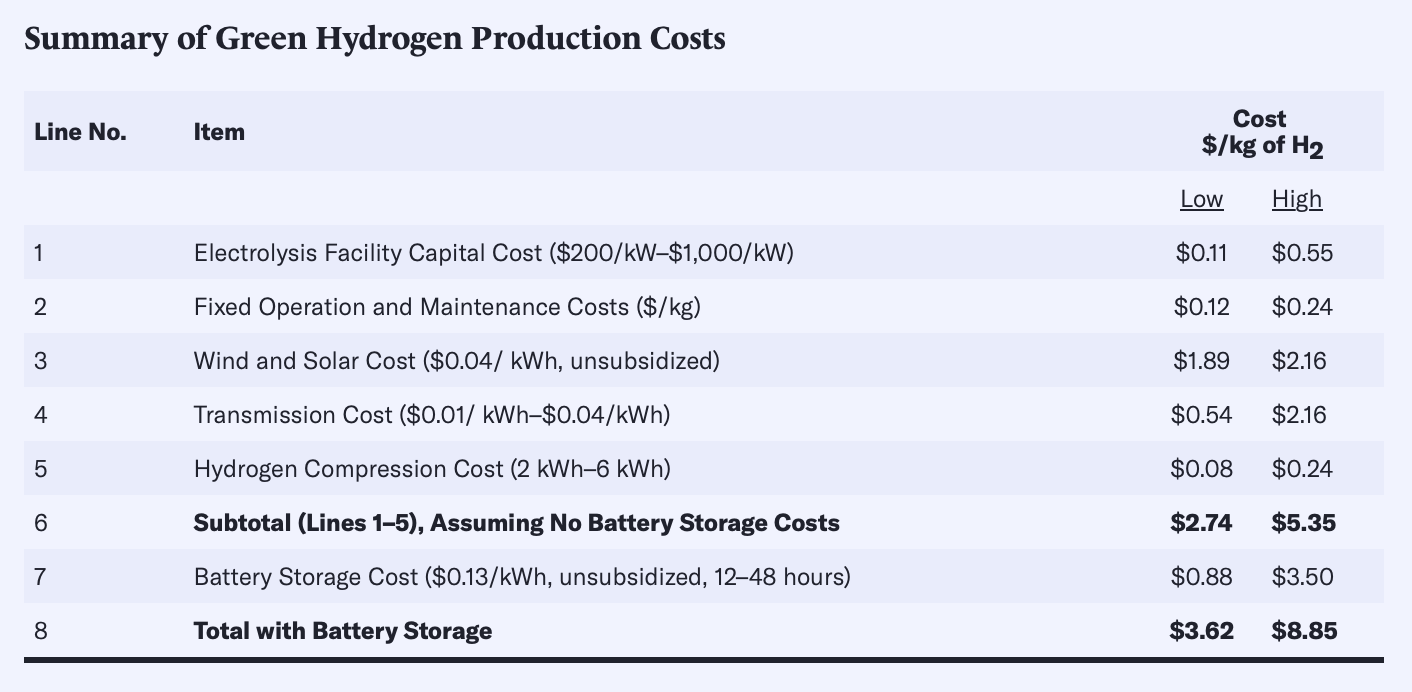
Note that Lesser comes up with even higher figures of $3.62 to $8.85 per kg of hydrogen if he further adds costs of battery storage of electricity to make it so that the electrolyzers can run all the time and not be dependent on the intermittency of wind and sun. Green hydrogen advocates would dispute whether this is necessary, so let’s leave it out for now. Even without this additional cost, we are at $2.74 to $5.35 per kg for the hydrogen.

Since a kg of hydrogen is good for about 33.3 kwh, that would mean something in the range of 8.3 to 16.2 cents per kwh just for the fuel, without yet considering any cost to get the fuel to a power plant to be burned.

I would comment that some of Lesser’s assumptions are very low, and by “low” I mean favorable to the economic viability of this green hydrogen. Most notably, he has an assumption of an unsubsidized cost of 4 cents per kwh for the wind/solar-generated electricity. Crazy. Here in New York, off-shore wind developers who had bid last year for contracts at about $90-100/MWH (i.e., 9 - 10 cents per kwh) have recently reneged and demanded prices in the range of $150-160/MWH, or 15-16 cents per kwh. If the recent New York demands represent the real cost of wind/solar electricity, then you can multiply Lesser’s figure for the electricity input to produce a kg of hydrogen by 4, adding about $6 per kg, bringing the total cost of a kg to around $9 - 11, instead of Lesser’s $2.74 - 5.35. In cents/kwh that would be about 18 additional cents per kwh, in either the high or low scenario; instead of a range of about 8 to 16 cents, it would be 24 to 32 cents per kwh to make the green hydrogen.

Goreham does not give us such a detailed calculation, but his bottom line is about the same (including a more realistic cost for the wind/solar electricity):

Hydrogen feedstock made from natural gas or coal is inexpensive, with a cost as low as $1 per kilogram. . . . To produce a kilogram of hydrogen by electrolysis, electricity alone costs $3 to $6 per kilogram, resulting in a total cost of at least $5 per kilogram. This makes hydrogen from electrolysis more than five times as expensive as hydrogen made from natural gas or coal.

Goreham’s “at least $5 per kg” for green hydrogen is actually well below Lesser’s figure after we adjust for the cost of electricity from wind and solar generation.

Note that, as I reported on January 12, recent bids in the UK for producing green hydrogen using electricity from off-shore wind came in at about $306/MWH, or 30.6 cents per kwh. Using the conversion factor of 33.3 kwh/kg of hydrogen would make this the equivalent of over $10 per kg of hydrogen.

We won’t really know how much this green hydrogen stuff actually costs until there are some real facilities up and running. But whether it is ten times as expensive as the stuff produced from natural gas, or only five times as expensive, doesn’t really matter. It is uneconomic, and nothing is going to change that. Nobody will ever buy it or use it without government mandates or subsidies or both.

Goreham’s conclusion:

[G]overnments now want to create a new hydrogen fuel industry using market intervention, mandates, and massive subsidies. But physics and economics strongly oppose the development of a green hydrogen fuel industry. Get ready for a spectacular failure of these government-sponsored efforts.

Friday, December 1, 2023

No Amount Of Subsidies Will Ever Make A Wind/Solar Electricity System Economically Feasible

November 30, 2023 @ Manhattan Contrarian 

The COP 28 climate confab opened today in Dubai. Some 70,000 true believers in the energy transition are said to be gathering. And not one of them appears to be either willing or able to do the simple arithmetic that shows that this can’t possibly work.

So far, no country that has made a commitment to “net zero” has officially backed off. (Argentina may soon become the first.). Things proceed as if all that is needed is to build sufficient wind and solar generation facilities, until eventually you have enough of them to meet demand. But that’s not how this works. The absurdity becomes more obvious every day. Can somebody please tell the poor people making fools of themselves in Dubai?

Let’s consider the latest from Germany. According to Statista here, Germany consumed 511.59 TWh of electricity in 2021 (latest year given, although the numbers have recently changed very little from year to year). Divide by 8760 (number of hours in a year) and you learn that Germany’s average usage of electricity is 58.3 GW. So, can you just build 58.3 GW of wind and solar generators to supply Germany with electricity?

Absolutely not. In fact, Germany already has way more wind and solar electricity generation capacity than the 58.3 GW, but can’t come anywhere near getting all its electricity from those sources. As of June 2023 Germany had 59.3 GW of generation capacity from wind turbines alone, and (as of end 2022) another 67.4 GW of generation capacity from solar panels. The total of the two is 126.7 GW — which would supply more than double Germany’s usage at noon on a sunny and breezy June 21. But, according to Clean Energy Wire here, through the first three quarters of 2023, the percent of its electricity that Germany got from wind and solar was only 52%. Capacity seemingly sufficient to supply double the usage in fact only supplies half. That’s because the supply does not come at the same time as the demand, and the wind/solar generation system provides no mechanism to shift the supply to a time to meet the demand.

And why doesn’t Germany just double the amount of its wind/solar generation, so that those sources would go from supplying 52% of usage to 100%. Because it doesn’t work that way. If they double the wind and solar generation, then on the sunny/breezy June 21 mid-day they will now have over 250 GW of electricity generation — more than 4 times what they need — so they will have to discard or give away the rest. But on a calm night in January, they will still have nothing and need full backup from some other source. Multiplying the wind/solar generation capacity by 10 or even 100 (referred to as “overbuilding”) will increase the costs of the system exponentially, but will never be enough to keep the lights on all the time. Or you can try energy storage to save up the surpluses to cover the deficits, but that also multiplies the costs of the system exponentially. For more than you will ever want to know about energy storage and its costs, read my December 2022 energy storage report, “The Energy Storage Conundrum.”

Renewable energy promoters and governments committed to “net zero” are engaged in a gigantic exercise of self-deception. They have come up with a thoroughly misleading metric to compare the costs of generating electricity from various sources which they call “Levelized Cost of Electricity.” Reports that claim to calculate these LCOEs are published by various organizations, including notably the investment bank Lazard and the International Renewable Energy Agency or IRENA. Here is IRENA’s 2022 Report covering supposed renewable energy costs for 2021, title “Renewable Power Generation Costs in 2021.” Key quote from page 17:

In 2021, the global weighted average LCOE of new utility-scale solar PV and hydropower was 11% lower than the cheapest new fossil fuel-fired power generation option, whilst that of onshore wind was 39% lower.

Wow, solar is 11% cheaper than any fossil fuel alternative, and onshore wind 39% cheaper. Why would any dope ever look to fossil fuels again?

And here’s their key chart:

 Incredible! Solar is under 5 cents per kWh, and onshore wind is even lower at 3.3 cents per kWh. And how much is in those numbers to account for the cost of either overbuilding or energy storage in order to make a system that works 24/7/365 without fossil fuel backup? The answer is, exactly nothing.

The fact is that building a wind/solar/storage electricity system without fossil fuel backup does not provide cheaper electricity than a predominantly fossil fuel system, but more expensive electricity. And the additional expense is not some small amount like 10 or 20 or 30 percent. It’s more like a multiple of 10 or 20. Nobody knows exactly how much, because there does not exist anywhere in the world a working demonstration project from which costs can be benchmarked and extrapolated. As you start to eliminate the fossil fuel backup from the system, far and away the predominant costs become the energy storage and/or overbuilding. The costs of the wind turbines and solar panels themselves become relatively insignificant. As noted, Germany has gotten to about 50% of its electricity generation from wind and solar, with so far about a 2 times overbuild of capacity, and almost no storage. With the next round of overbuild of capacity, should they do it, they will be lucky to get to 60% of electricity from renewables; and each successive round of overbuild adds less useful electricity and more that must be discarded. Meanwhile, storage is ruinously expensive in quantities that are meaningful to keeping the lights on year round.

In the real world of investment decisions, the costs are becoming increasingly obvious. Greg Ip has a piece in today’s Wall Street Journal, headline “Why No One Wants to Pay for the Green Transition.” Excerpt:

Investors and consumers balk at costs of replacing fossil fuels with renewable energy, highlighting painful economics of climate mitigation. . . . In the past few years, Washington and Wall Street started fantasizing that the transition to net-zero carbon emissions could be an economic bonanza. . . . This year the fantasy ended. . . . [T]he economics of getting to net zero remain, fundamentally, dismal: Someone has to pay for it, and shareholders and consumers decided this year it wouldn’t be them.

 Of course consumers are never voluntarily going to pay $2 for energy that can be had for $1. Nor are investors ever going to invest to provide consumers the $2 energy when the consumers can go elsewhere for $1. As it becomes obvious that the whole LCOE “wind and solar are cheaper” thing is a transparent lie, all private money will exit the energy transition. The only possible way to get this wind/solar system built is government subsidies. Gigantic, massive government subsidies on a scale far greater than anything ever seen in human history. It’s a very safe bet that it will never happen.

Wednesday, November 29, 2023

Biden’s Green Energy Push is Gone with the Wind

Billions in corporate welfare turns to dust.

President Joe Biden will be in Colorado today, November 28, to champion green energy policies inside his Inflation Reduction Act and the CHIPS and Science Act. He will spend time in Denver and Pueblo to tout a couple of wind-related factories that are set to take advantage of the administration’s corporate welfare scheme. The president, facing abysmal polling data one year away from the election, will target Republicans and point out how they voted against his investments and job creation efforts. Clean energy, like wind, has been the focal point of Bidenomics. But have the billions in federal and state funds poured into the private sector yielded tangible results?

Green Energy Setbacks

By 2030, the Biden administration aims to generate 30 gigawatts of offshore wind power. This would be enough to power ten million US households. Is this doable? The road to green energy has hit a couple of roadblocks in recent months, leaving some industry analysts to warn that the goal is unlikely to be reached in seven years.

Earlier this month, Orsted, an international energy developer, put the kibosh on two major offshore wind projects off New Jersey’s coast. The Denmark-based company confirmed that the board of directors voted to cancel the high-profile Ocean Wind 1 and Ocean Wind 2 amid high inflation, supply chain snafus, and increasing interest rates. In July, the White House celebrated these green energy projects, which were projected to offer more than 2.2 gigawatts of power, for being examples of “Bidenomics in action.”

The Danish firm’s cancellations came around the same time other developers in the New England region announced that they were ending power contracts for three projects. These were supposed to generate 3.2 gigawatts of wind power for Connecticut and Massachusetts.

President Biden Holds News Conference After Summit with Chinese President Xi In San FranciscoWOODSIDE, CALIFORNIA - NOVEMBER 15: U.S. President Joe Biden delivers remarks at a news conference at the Filoli Estate on November 15, 2023 in Woodside, California. The news conference follows a meeting between Biden and Chinese President Xi Jinping during the Asia-Pacific Economic Cooperation (APEC) Leaders' week, their first since meeting at the Indonesian island resort of Bali in November 2022. (Photo by Kent Nishimura/Getty Images)

(Photo by Kent Nishimura/Getty Images)

These developments accounted for close to one-fifth of the White House’s 2030 objective. But these were not all, as several other organizations, including BP and Shell, canceled or sought to renegotiate power agreements for wind farms that were set to be operational sometime between 2025 and 2028. In July, Rhode Island Energy chose not to move forward with several offshore wind turbines due to soaring costs that would have put tremendous pressure on customers’ wallets.

Michael Brown, the US country manager for Ocean Winds, an offshore wind joint venture between France’s ENGIE and Portugal’s EDP Renovaveis, told a Reuters Events conference this past summer: “Thirty gigawatts is now unfortunately not something that the developers are really aspiring to. We want to meet as high a gigawatt target as possible, but it’s not going to be possible to meet those 30 GW.” Timothy Fox, a ClearView vice president, concurs. However, he believes the US will eventually reach the 30-gigawatt target and surpass the mark.

Like the “net zero by 2050” dream, this is yet another climate-related vision that will not be realized.

Nevertheless, the Biden administration is not conceding defeat. In September, White House spokesperson Michael Kikukawa confirmed that Biden will be “using every legally available tool to advance American offshore wind opportunities and achieve the goal of 30 GW by 2030.” One of these tactics is increasing handouts to domestic and foreign firms. Over the last year, the federal government has bolstered wind investments by $7.7 billion, mainly in the form of tax credits for green energy. The sector says this is not enough, and reports suggest that a plethora of US offshore wind project developers are lobbying Washington for more subsidies. Companies are struggling to bring these endeavors online, even with generous assistance from all three levels of government, because of the current inflationary and high-rate environment.

This does not mean the green energy movement is over. In fact, a chorus of Democrats, including Sen. Brian Schatz (D-HI), says that the recent blows to the green energy crusade are mere “bumps in the road” and that the president’s legislative trifecta is exceeding all expectations “and we just need to do more of it.” Republican lawmakers disagree, warning that the incumbent regime is wasting taxpayer dollars on something private companies cannot make work without additional funding.

Blowing in the Wind

President Biden will use his two pitstops in The Centennial State to push Bidenomics, promoting the accomplishments and masking the many failures. As Liberty Nation reported, administration officials have found a new scapegoat for why the president’s economic agenda is unpopular with the American people: allies in the mainstream media. So, Colorado voters will be presented with the same Biden entertainment: a two-second half-jog, a story about the folks in Scranton, mispronounced names of local representatives, and repeating the doctrine of growing the economy from the middle out and the bottom up. Unfortunately, those in attendance will not be informed that critical planks of the president’s schemes have stumbled, much like a particular US president.

 
Read More From Andrew Moran

Tuesday, October 17, 2023

Biden Stumbles Again With Green Energy Subsidies

By: Andrew Moran October 16, 2023  @ Liberty Nation News

Over the past year, US taxpayers have learned that one of the chief lessons of Bidenomics 101 is doling out billions of dollars in green energy subsidies for wealthy corporations. This was what the trifecta of legislative accomplishments – Inflation Reduction Act, the CHIPS and Science Act, and the Bipartisan Infrastructure Law – was all about. President Joe Biden traveled to Philadelphia, PA, this weekend to again tout Bidenomics and announce several billion dollars in so-called federal investments for hydrogen projects.

Everyone Is Pleading Not Guilty

$7 Billion for Green Energy Subsidies

Stumbling twice on a short flight of stairs, President Biden took to the stage to award $7 billion in federal grants across 16 states, from California to Pennsylvania, for developing seven regional hydrogen hubs as part of the administration’s broader decarbonization initiative. What companies will receive some of these green energy subsidies? A range of businesses will be involved, but three of the most prominent names on the list are Amazon, Chevron, and Exxon Mobil, worth a combined $2.2 trillion.

While critics would likely ask why some of the wealthiest corporations in the world need a handout from Uncle Sam, President Biden noted that the giveaway is essentially seed money to help jump-start the production of clean hydrogen by having the critical infrastructure established. Additionally, the total investment in these hubs will reach $50 billion because of the substantial private investment also being made.

“I’m here to announce one of the largest advanced manufacturing investments in the history of this nation. It’s all part of my plan to make things in America,” Biden said.

Of course, the administration’s latest announcement focuses on clean energy, but observers are omitting one key thing: Green energy subsidies are just more corporate welfare. Politicians are, once again, transferring resources from taxpayers to special interests.

Is Hydrogen the Answer?

Hydrogen is considered a crucial component for achieving the world’s net zero carbon emissions objective by 2050. Hydrogen emits only water when burned as fuel or inside a fuel cell for automobiles. However, hydrogen production requires an immense volume of energy, meaning that, depending on its source, it might not be as green as its proponents would contend. So, for instance, hydrogen can be produced from natural gas, and this so-called bridge fuel has received enormous criticism from climate activists.

Consider this statement from Maggie Coulter, an attorney at the Center for Biological Diversity’s Climate Law Institute, who told the Associated Press: “Throwing billions at hydrogen hubs deepens our dependence on fossil fuels and worsens the climate emergency.”

Indeed, hydrogen could only be labeled green if new renewable sources are built to power hydrogen output rather than relying on the present grid and other carbon accounting programs. In other words, it might have the same environmental effects as fossil fuels. For now, according to the International Council on Clean Transportation, the world is greenwashing green hydrogen.

Trickle-Down Bidenomics

GettyImages-1531918146-min green energy

(Photo by Marijan Murat/picture alliance via Getty Images)

US administration officials have repeatedly asserted that Bidenomics is about growing the economy from the middle out and bottom up, abandoning the concept of trickle-down economics of the past three decades. However, this pejorative term – economic policies that disproportionately favor Corporate America and the 1% – can apply to the president’s economic doctrine.

As Liberty Nation has regularly reported, the White House, state governments, and city officials are spending trillions of dollars on corporate welfare. No one in the Oval Office or inside the Democratic caucus on Capitol Hill wants to admit this because the taxpayer-funded subsidies are allocated to their preferred sectors, mainly green energy.

President Biden has demanded that corporations must pay their fair share while signing over checks to these same entities. Moreover, global leaders, like United Nations Secretary-General Antonio Guterres, have called for an end to fossil fuel subsidies. This should be a welcome call to action as long as it includes renewables and green energy. Otherwise, they pick winners and losers, favor one industry over another, and engage in hypocrisy. Leftists are not opposed to corporate welfare. They just want the money to go to another set of special interests for a specific cause. That is Bidenomics 101.

Read More From Andrew Moran

Thursday, December 18, 2014

Germany's "energy transformation:" unsustainable subsidies and an unstable system

Marita Noon
Perhaps when Germany’s Chancellor Angela Merkel was a child, she attend a party and was the only one who came without a present, or wearing inappropriate attire—and the embarrassment she felt haunts her to this day. That’s how psychodynamic psychology (Freud) might explain her December 3 decision spend more money on Germany’s failing energy experiment to avoid, as Reuters puts it: “the embarrassment of missing her government’s goal of a 40 percent reduction of emissions by 2020.”
As Europe’s biggest economy, Germany has also embraced the biggest carbon dioxide reductions through a program known as “Energiewende”—or, in English, also called energy change, shift, or transformation. Energiewende was launched in 2000 under Merkel’s predecessor who offered subsidies for any company that produced green energy.
 
While the European Union (E.U.) has committed to carbon dioxide cuts of 40 percent by 2030, Germany’s national goal aims to get there a decade sooner—which may have seemed achievable early in the program. After the 1990 reunification of Germany, the modernization of East Germany brought rapidly reduced emissions. However, the program’s overall result has raised costs and the emissions the expensive programs were designed to cut. 
 
A few months ago, Bloomberg reported that due to increased coal consumption: “Germany’s emissions rose even as its production of intermittent wind and solar power climbed fivefold in the past decade”—hence Merkel’s potential embarrassment on the global stage where she’s put herself in the spotlight as a leader in reducing emissions. 
 
On December 3, while 190 governments were meeting for two weeks of climate change talks in Lima, Peru (which, after 30 hours of overtime, produced a compromise deal that environmental groups see “went from weak to weaker to weakest”), Merkel’s cabinet agreed to a package that continues Germany’s optimistic—though unrealistic—goal and increases subsidies for measures designed to cut emissions. Regarding Germany’s “climate protection package”, Barbara Hendricks, Environment Minister, admitted: “if no additional steps were taken, Germany … would miss its targets by between five to eight percentage points.”
 
The results of the German agreement will require operators of coal-fueled power plants to reduce emissions by at least 22 million tons—the equivalent of closing eight of them. The Financial Times (FT) believes the plan will “lead to brownouts in German homes.”
 
With the goal of generating 80 percent of its energy from renewable sources by 2050, Germany has aggressively pursued a green dream with unsustainable subsidies that have produced an unstable system described by FT, on November 25, as: “a lesson in doing too much too quickly on energy policy.”
So, what are the lessons? What should the U.S., and other countries, learn from Germany’s generous subsidy programs and rapid, large-scale deployment and integration of renewable energy into the power system? These are the questions U.S. legislators should be asking themselves as they argue over a tax extender package that includes a retroactive extension for the now-expired Production Tax Credit for wind energy.
 
Fortunately, the answers are easy to determine. Finadvice, a Switzerland based advisor to the utility and renewable industry, did an exhaustive study: “Development and Integration of Renewable Energy—Lessons Learned from Germany.” The introductory comments of the resulting report, includes the following statement: “The authors of this white paper would like to state that they fully support renewables as a part of the power portfolio. …a couple [of the authors] have direct equity interests in renewable projects.” The author’s viewpoint is an important consideration, especially in light of their findings. They wanted Germany’s experiment to work, yet they begin the Executive Summary with these words: 
 
“Over the last decade, well-intentioned policymakers in Germany and other European countries created renewable energy policies with generous subsidies that have slowly revealed themselves to be unsustainable, resulting in profound, unintended consequences for all industry stakeholders. While these policies have created an impressive roll-out of renewable energy resources, they have also clearly generated disequilibrium in the power markets, resulting in significant increases in energy prices to most users, as well as value destruction for all stakeholders: consumers, renewable companies, electric utilities, financial institutions, and investors.” 
 
After reading the entire 80-page white paper, I was struck with three distinct observations. The German experiment has been has raised energy costs to households and business, the subsidies are unsustainable, and, as a result, without intervention, the energy supply is unstable.
 
Cost
 
We, in the U.S., are constantly being told that renewable energy is close to cost parity with traditional power sources such as coal and natural gas. Yet, the study clearly points out the German experiment has resulted in “significant increases in energy prices to most users”—which will “ultimately be passed on to electricity consumers.” Germany’s cost increases, as much as fifty percent, are manmade not market-made—due to regulation rather than the trust costs. The high prices disproportionately hurt the poor giving birth to the new phrase: “energy poverty.”
 
The higher costs hurt—and not just in the pocket book. The authors cite an International Energy Agency report: “The European Union is expected to lose one-third of its global market share of energy intensive exports over the next two decades due to high energy prices.”
 
Subsidies and instability are big factors in Germany’s high prices.
 
Subsidies
 
To meet Germany’s green goals, feed-in tariffs (FIT) were introduced as a mechanism that allows for the “fostering of a technology that has not yet reached commercial viability.” FITs are “incentives to increase production of renewable energy.” About the FITs, the report states: “This subsidy is socialized and financed mainly by residential customers.” And: “Because of their generosity, FITs proved capable of quickly increasing the share of renewable power.”
 
Germany’s original FITs, “had no limit to the quantity of renewables to be built” and “lead to unsustainable growth of renewables.” As a result, Germany, and other E.U. countries have “had to modify, and eventually phase out, their program because of the very high costs of their renewable support mechanisms.” 
 
Germany has also begun to introduce “self-generation fees” for households and businesses that generate their own electricity—typically through rooftop solar, “to ensure that the costs of maintaining the grid are paid for by all consumers, not just those without rooftop PVs.” These fees remove some of the cost-saving incentive for expensive solar installation. 
 
Section four of the report, “Unintended Consequences of Germany’s Renewable Policies,” concludes: “Budgetary constraints, oversupply and distortion of power prices, transaction-specific operational performance, market economics (i.e. Germany proposing to cut all support for biogas), debt structures, and backlash of consumers paying higher prices were all factors contributing to regulatory intervention. Projecting past 2014, these factors are expected to continue over the next several years.” 
 
Stability
 
Hopefully, by now, most people—especially my readers—understand that the intermittent and unreliable nature of wind and solar energy means that in order for us to have the lights go on every time we flip the switch (stability) every kilowatt of electric capacity must be backed up for times when the sun doesn’t shine and the wind doesn’t blow. But, what most of us don’t think about, that the report spotlights, is that because the favored renewables benefit from “priority dispatch”—which means that if a renewable source is generating power, the utility company must buy and use it rather than the coal, natural gas or nuclear power it has available—the traditional power plants operate inefficiently and uneconomically. “Baseload thermal plants were designed to operate on a continuous base. …they were built to operate at their highest efficiencies when running 24 hours a day, seven days a week.” Now, due to renewables, these plants operate only a fraction of the time—though the cost to build and maintain them is constant. “The effect of fewer operational hours needs to be compensated by higher prices in these hours.”
 
Prior to the large integration of renewables, power plants earned the most when demand is high—in the middle of the day (which is also when the most solar power is generated). The result impacts cost recovery. “There are fewer hours in which the conventional power plants earn more than the marginal cost since they run fewer hours than originally planned and, in many cases, provide back-up power only.”
 
This translates into financial difficulties for the utilities that have resulted in lower stock prices and credit ratings. (Note: utility stocks often make up a large share of retirement portfolios.) Many plants are closed prematurely—which means the initial investment has not been recovered.
Because the reduced use prevents the power plants from covering their full costs—yet they must be available 24/7, power station operators in Germany are now seeking subsidies in the form of “capacity payments.” The report explains that a plant threatened to close because of “economic problems.” However, due to its importance in “maintaining system stability” the plant was “kept online per decree” and the operator’s fixed costs are compensated. 
 
*****
 
Anyone who reads “Development and Integration of Renewable Energy” will conclude that there is far more to providing energy that is efficient, effective and economical than the renewable fairytale storytellers want consumers to believe. Putting a solar panel on your roof is more involved than just installation. The German experiment proves that butterflies, rainbows and pixy dust won’t power the world after all—coal, natural gas, and nuclear power are all important parts of the power portfolio.
Why, then, did Merkel continue Germany commitment to an energy and economic suicide? It is all part of the global shaming that takes place at the climate change meetings like the one that just concluded in Lima, Peru. 
 
If only U.S. legislators would read “Development and Integration of Renewable Energy” before they vote for more subsidies for renewable energy, but, heck, they don’t even read the bill—which is why calls from educated constituents are so important. I am optimistic. Maybe we could learn from Germany’s experience what they haven’t yet learned themselves.
 
The author of Energy Freedom, Marita Noon serves as the executive director for Energy Makes America Great Inc. and the companion educational organization, the Citizens' Alliance for Responsible Energy (CARE). Together they work to educate the public and influence policy makers regarding energy, its role in freedom, and the American way of life. Combining energy, news, politics, and, the environment through public events, speaking engagements, and media, the organizations' combined efforts serve as America's voice for energy.