Search This Blog

De Omnibus Dubitandum - Lux Veritas

Showing posts with label Alternative Energy. Show all posts

Monday, June 30, 2025

Burning trash for energy, people and planet

By Paul Driessen, Tags, Spain’s Impossible Dream of ‘Green’ Electricity, Reexamining the Obama Era Endangerment Finding, My Paul Driessen File

Prologue: New York City generates nearly eight million tons of waste annually. But what starts in NYC doesn’t stay in NYC. The trash now gets exported to landfills and incinerators in New Jersey, Upstate New York, Pennsylvania, and even Virginia, Ohio and South Carolina!

A far more responsible, ecological and energy-wise solution would be to copy Fairfax County, Virginia’s waste-to-energy electricity generation and resource recovery facility. Doing so would turn that trash into reliable, affordable electricity, while recovering iron, copper, aluminum and other metals … and utilizing most of the remaining ash for building roads and manufacturing construction materials.

I hope you enjoy reading my article and thank you for posting it, quoting from it, sharing it with friends and colleagues – and helping to improve America’s trash handling and electricity generation policies. Waste-to-Energy reduces land filling, increases recycling, powers society and avoids blackouts

After years of opposing them, but facing constituents increasingly angry about rising electricity prices, New York Governor Kathy Hochul recently gave grudging support for two new Williams Companies natural gas pipelines.

Assuming they clear new hurdles, the Constitution Pipeline will transport gas 100+ miles from northeastern Pennsylvania fracking fields toward Albany. The 23-mile Northeast Supply Enhancement Pipeline will connect New York to the New Jersey segment of the Transco Pipeline, America’s largest-volume natural gas pipeline system, and carry enough gas to heat 2.3 million homes.

Hochul, other state Democrats and environmental activists have long stymied the projects, using exaggerated and fabricated water quality and climate change arguments – and fanciful expectations that heavily subsidized solar panels and onshore and offshore wind turbines can provide enough affordable electricity, enough of the time, to meet steadily increasing New York City and State power demands.

In exchange, the Trump Administration will let them continue installing gigantic offshore wind turbines that will generate 9,000 MW of electricity (less than one-third of what the state needs on hot summer days) perhaps 30-40% of the year … and be supported by fire-prone grid-scale batteries that would provide statewide backup power for about 45 minutes.

New gas turbines would help avoid blackouts, ensure that poor families freeze less often in winter and swelter less in summer, and help the state meet power needs that are soaring because of data centers, artificial intelligence, and legislatively mandated conversions from gasoline and gas to electric vehicles, stoves, and home and water heating.

They could also help reduce the need to import electricity from Canada and other states: some 36,000 gigawatt-hours (11% of statewide electricity) annually.

But legislators want to put another hurdle in the way. New legislation would force homes and businesses to pay $10,000 or more to connect to natural gas lines. If Gov. Hochul signs the bill, or the legislature overrides a veto, few or no new customers would take advantage of the new gas.

It’s a kill switch, reflecting the state’s determination to impose “climate leadership” and “protect communities” from alleged dangers from fossil fuels.

It’s also hypocritical and irresponsible. New York doesn’t just import electricity; it also exports garbage.

New York City generates nearly eight million tons of waste annually. Its last municipal incinerator closed in 1990; its last municipal landfill in 2001. City trash is now mostly sent on barges, trucks and trains to landfills (80%) and incinerators (20%) in New Jersey, Upstate New York, Pennsylvania, and even Virginia, Ohio and South Carolina! NY State exports 30% of its garbage.

The city and state could address both garbage and electricity challenges by using natural gas to power waste-to-energy (WTE) generating plants that burn trash, thereby reducing the need to landfill or export garbage, while increasing recycling, producing reliable, affordable, much-needed electricity, and reducing blackout risks that are climbing every year.

In Fairfax County, Virginia, a WTE or resource recovery facility operated by Reworld Waste burns home, business, industrial and other garbage that doesn’t go straight into recycling programs and would typically be landfilled, including myriad extraneous plastics. The trash is dumped in a receiving area, sorted for unacceptable materials like rocks, mixed thoroughly, and burned with natural gas in a chamber at 2000 degrees F for up to two hours, until it’s totally combusted to ash. 

The heat converts water to steam, which is super-heated in tubes to drive turbines that generate electricity: 80 megawatts 24/7, enough for about 52,000 homes. Depending on its composition, a ton of waste generates 550-700 kilowatt-hours of electricity.

Since opening in 1990, the plant’s trash has replaced the equivalent of burning 2,000,000 barrels of oil for electricity every year.

Glass from lightbulbs and other nonrecyclable sources becomes part of the ash stream, from which ferrous and nonferrous metals are recovered. Most of the remaining ash is used as a substitute for sand and aggregates in road and building construction, cement and cinder block production, and manufacturing other building materials.

Unsold ash is landfilled but, by the time the metals are removed, only about 10% of the original trash bulk and 25% of its original weight is left.

Even staples, paper clips, bottle caps, metal light bulb bases, aluminum foil, and wires from spiral notebooks and furnace filters can be “recycled” this way. In fact, enough iron, steel, aluminum, copper and other metals are recovered from the resultant ash at the Fairfax facility to build 20,000 automobiles annually.

However, plastic-metal-glass waste (computers, monitors, keyboards, printers, microwaves), broken pots and pans, household appliances and other larger refuse should go to special “white goods” and metal recycling centers.

Lime neutralizes acids in the airstream, activated carbon controls heavy metals, and fabric filter bags remove particulates, keeping air emissions below EPA standards. The scrubber waste (fly ash) is then dewatered and chemically stabilized, before being landfilled or used in construction materials. 

Process steam condenses back into water and is reused. Water from the wastes and scrubbers is recovered, treated and used to cool the facility and equipment.

Two other trash-to-energy facilities serve the Washington, DC area; 75 across the USA generate over 2,500 MW of electricity. However, more WTE plants could help solve garbage, energy, landfill and pollution problems in metropolitan areas across the country (and worldwide), including:

* Philadelphia, PA – 1,300,000 tons per year of municipal solid waste (MSW), but only one WTE; 

* Chicago, IL – 3,100,000 tpy, but just one WTE plant (other proposed facilities were rejected);

* Houston, TX – 4,200,000 tpy, with one WTE facility;

* Phoenix, AZ – 1,000,000 tpy, and one WTE facility;

* Los Angeles, CA – 4,000,000 tpy, but again only one WTE facility.  

New York and other jurisdictions that have rejected natural gas and waste-to-energy/resource-recovery facilities are missing enormous opportunities to address challenges that will only become worse. They’re also dumping their own local responsibilities into their neighbors’ backyards.

These facilities ensure secure, affordable electricity generation close by, without the need for expensive backup power and multi-hundred-mile transmission lines to part-time wind and solar power.

They utilize fuels that America still has in abundance: gas and trash. And they reduce the need for resources that are in increasingly short supply: landfill space, cropland and wildlife habitats impacted, and bird, bat and other wildlife lost due to wind, solar and transmission installations.

From my perch, these clear and significant benefits clearly offset the cost and subsidy concerns that some have raised about WTE facilities.

Metro areas and states should apply pragmatism, reality and these benefits when reconsidering climate and “renewable” energy ideologies that have dominated public policies for far too long.

Paul Driessen is senior policy advisor for the Committee For A Constructive Tomorrow (www.CFACT.org) and author of books and articles on energy, climate change, environmental protection and human rights. 

Epilogue:  My Take - Here's a bit more on this issue of energy production.  Four fifths of New York's energy is imported, and from traditional energy production sources from outside the state, if they're true believers in the "Net Zero" insanity, that should end.  But it won't!

 It's amazing how the price of energy is a reality that overwhelms ideology.  After  giving in to green activists they closed nuclear plants, and now Governor Hochul has ordered the New York Power Authority to develop and construct a zero-emission advanced nuclear power plant in upstate New York ..... and it will only take 15 years.  If you're in your seventies it's unlikely you will see the benefits of that endeavor.  

The price of alternative energy is going to grow, right along with the maintenance costs, compounded by alternative energy's lack of reliability, it's just a matter of time before all this "net zero" virtue signally ends and they start using natural gas in traditional power plants, and who knows, maybe even coal in the near future.   RK


Monday, June 16, 2025

Spain’s Impossible Dream of ‘Green’ Electricity

By Paul Driessen

Updated Man of La Mancha lyrics could read: “To dream the impossible dream of clean, green, net-zero electricity, to fight the unbeatable foe of manmade climate cataclysms, we must run where the brave dare not go.”

Don Quixote saw windmills as malevolent and dangerous dragons. Spain’s governing classes view them from the Chinese perspective: benevolent and magical dragons.

They’ve erected over 22,000 gigantic windmills, to harness the wind and generate electricity. Portugal has nearly 3,000. Together, when conditions are perfect, they can generate almost 38 gigawatts.

Like Cervantes’ hero, the elites also want “to reach the unreachable star” – or at least capture the energy from one star: the sun. Spain and Portugal together also have 38 GW of photovoltaic solar panels.

However, the Iberian Peninsula neighbors have long ignored the dark sides of the forces they seek to commandeer. 

Those wind turbines, solar panels and transmission lines sprawl across some 2,000,000 acres of Spanish and Portuguese vistas, habitats and croplands. That’s equal to Delaware and Rhode Island combined.

They kill eagles, bustards, vultures, and other raptors and birds. Building them requires mining, pollution and child labor on historically unprecedented scales. Solar panels are easily destroyed by storms.

Worst, they provide intermittent, weather-dependent electricity – necessitating expensive backup power and making the electrical grid unstable. Just how unstable was demonstrated recently, and dramatically.  

On April 16, for the first time, for a few hours, Spain generated 100% of its electricity with wind, solar and hydro power.

A fortnight later, on April 28, a prolonged blackout sent Iberia into chaos. Lights, televisions, refrigerators, cell phones and traffic lights went dark. Trains, subways and elevators trapped passengers. Airports canceled flights. Hospital backup power provided only basic and emergency services.

The outage even struck parts of France and Belgium. It was Europe’s biggest blackout ever. If France hadn’t shut off its connection to Spain’s cascading problems, all of Europe could have shut down.

Just a week later, another blackout hit Spain’s Canary Islands.

Power outages are nothing new. But the Spain-Portugal blackouts underscore fundamental problems with the supposedly “inevitable transition” from coal, oil, natural gas and nuclear electricity to wind, solar and battery power.

They show that the only inevitability will be more frequent and severe blackouts – because of our soaring reliance on electricity … political decisions to mothball or destroy reliable generating systems … and ideological commitments to “green” energy.

We’re effectively being told: You’ll have electricity when it’s available – not necessarily when you need it. In this modern technological era, that is absurd, outrageous, intolerable and dangerous.

One fundamental reality must override all other considerations: Modern industrialized societies require enormous quantities of steady, synchronous alternating current, 24/7 – at the precise frequency of 50 Hertz in Europe and 60 Hz in the United States. Without it, life shuts down, societies descend into chaos, and people die.

Frequencies outside 0.2 Hz above or below that frequency can trigger major emergencies. A mere ±0.5 Hz deviation can cause system-wide cascading blackouts.

In Spain’s case, with 80% of its power now coming from renewable sources, the country simply did not have enough reliable, dispatchable, instantly accessible power on hand to keep its grid from collapsing when a power generation glitch happened.

Advertisement

Rice University’s Baker Institute explained how a malfunction at two Spanish solar power plants triggered the widespread chaos.

“At approximately 12:30 pm local time in Spain – just minutes before the grid collapsed – renewable sources accounted for 78% of electricity generation in the Iberian system, with solar alone contributing nearly 60%. By contrast, conventional technologies, such as gas-fired and nuclear power plants, comprised only around 15% of the total generation mix….

“[Then] two consecutive generation loss events occurred in southwestern Spain, likely involving large solar installations…. Given the limited availability of conventional generation, these unexpected losses, combined with reduced support from neighboring systems – the instability triggered a disconnection from the French system – created a “perfect storm” for a massive power outage.

“In just five seconds, Spain lost approximately 15 GW of capacity, equivalent to 60% of its national electricity demand. The remaining generation was insufficient to meet demand, thus triggering a cascading failure across the entire grid. Various generating units were automatically disconnected to protect infrastructure, and nuclear plants were shut down in accordance with safety protocols.”

That’s all it took. In the blink of an eye, the Iberian Peninsula and beyond had a massive blackout.

Unless America’s Net Zero politicians and utility companies wake up to reality, multiple US states – indeed entire regions – face similar preventable (almost inevitable) disasters. The same nightmarish realities confront other countries worldwide.

First, because federal, state and local governments have pressured or ordered utility companies to shut down coal, gas, nuclear and even hydro power plants that still have years or decades of operational life. Other utilities have done so voluntarily, to showcase their climate and green energy bona fides.

Second, because the same governments also provide subsidies, loan guarantees, tax breaks, rapid permitting, and exemptions from endangered species and other environmental rules – to incentivize utilities to build more and more wind, solar and battery installations, instead of traditional power plants.

Third, because those same entities demand and often subsidize a steady conversion to electricity from gasoline and natural gas. Vehicles, home and apartment building heating systems, stoves and ovens, water heaters, lawn mowers, leaf blowers and more must be powered by electricity – to save the planet from manmade climate change – even as electricity generation and reliability dwindle.

This shortsighted, ideological, virtue-signaling government intrusion into what should be market-driven, reality-based, reliable-electricity-focused decisions puts our grid, our society and our lives at risk.

Abundant, reliable, affordable electricity is the lifeblood of twenty-first century civilization. Modern industrialized societies simply cannot function, or even survive, if they are forced to rely on land-hungry, expensive, insufficient, intermittent electricity.

And yet, largely because of misplaced climate fears, $9 trillion has been spent globally over the past decade on wind and solar power, electric vehicles, energy storage, electrified heating and power grid adjustments. 

Congress, state governors and legislatures, the Trump administration, our courts and utility companies need to act quickly and decisively to end this wasteful spending and fix our fragile electricity generating system and grid. The news media and academia must stop parroting “climate crisis” and “renewable energy” talking points, and start presenting the complexities and realities of these issues.

Paul Driessen is senior policy advisor for the Committee For A Constructive Tomorrow (www.CFACT.org) and author of books and articles on energy, climate change, environmental protection and human rights.

Wednesday, June 4, 2025

Alternative Energy is a Bust, and That Was as Predictable as Night Follows Day. Get Over It!

By Rich Kozlovich

This article appeared in Human Events in 2012, but the link no longer works, as Human Events has gone through some changes.  Supposedly it's still publishing on line, but I don't see much from them, so you will have to take my word for what was said... or not ..... as it pleases you.  

The article went on to say:
It was one of Barack Obama’s favorite green-energy companies. And green-energy companies, according to the president, are one of the best ways to facilitate economic growth.  Well, yesterday, The Denver Post detailed the criminal investigation of Abound Solar, a defunct solar-panel manufacturer in Colorado that was run on taxpayer “investments,” for securities fraud, consumer fraud and financial misrepresentation.
Abound shuttered its Colorado plant during the summer and filed for bankruptcy, leaving “125 workers without jobs and taxpayers holding the bag for up to $60 million in defaulted loans.” 
I don’t care how much money is wasted on this horsepucky, alternative energy is a bust, it always has been a bust, and expensive bust.
We're not running out of "fossil fuels", CO2 isn't warming the globe, and the computer projections about global warming are all "game boy" science, garbage in, garbage out.   The fact is, while these nitwits are often wrong, they're never in doubt, and humanity is left paying the penalty for their folly.  
The reality is the technology for so-called alternative energy has not progressed all that much beyond what Jimmy Carter tried in the seventies.  That was a failure then and so is it still a failure now.  Even if we could get these farces to work and produce vast amounts of energy we couldn’t do it without destroying the environment.   
Did anyone ever see how much land it takes to produce large amounts of solar energy?  Did anyone ever see how many wind mills it takes to produce large amounts of wind energy?  Did anyone ever see the impact ethanol production takes on the environment, and at every stage of production?

Even beyond the fact alternative energy systems are completely incapable of producing enough energy, and do it reliably, the biggest problem they have to overcome is how to store enough energy for when the sun doesn’t shine and the wind doesn’t blow.  You can only pack so many electrons in a confined area.  No battery system in the world can meet those needs.  That means we will have to maintain traditional power plants in reserve.  Okay, what's that mean.  That means they are up and running, but not producing energy, or little energy.   
I have gone over this before, but I will do it again.
Power plants cannot just be shut off like a light switch.  It takes a lot of heat to make enough steam to turn the turbines at a high enough rate to produce enough electricity to meet demand.  That means they are burning coal or gas constantly to keep the ovens hot.   That is expensive.  So what we are doing is paying for energy we aren’t using, in order to use energy we don’t need.  
 The world went insane over this, but that's changing because as Europe is discovering alternatives are a bust, and an expensive bust.  
We've reached the Inevitability Factor!  That's when reality reaches its zenith!  What I find interesting is all of this was a predictable as night follows day, but when corrupt thinking permeates governments and the media, "truth takes the hindmost".  Ideology makes smart people stupid.  

Wednesday, May 21, 2025

"Renewable" Electricity Champion Denmark Now Looking Into Nuclear

M @ Manhattan Contrarian

At this site, when I have written about countries and states seeking to be among the leaders in eliminating fossil fuels from their electricity supply, I have generally focused on the larger jurisdictions, like Germany and the UK in Europe, and California and New York in the U.S. But there is one much smaller country that puts all of those bigger ones to shame: Denmark. 

With a population of only about 6 million, Denmark has pushed the “renewable” electricity generation thing well beyond what others have been able to accomplish. According to its official statistics, in 2024 Denmark got some 79.5% of its electricity from what it calls “low carbon” sources. The large majority of that came from wind and solar, with only a minimal contribution from nuclear. As to nuclear, Denmark had in fact mandated phasing it out, by a law passed back in 2003.

So then, does it seem like, with just a final little push, Denmark can go over the top and reach the long-sought goal of 100% of generation from “renewables”?

In fact, according to the most recent news from Denmark, it is the opposite. Just during the past week, the lower house of Denmark’s Parliament, by a wide margin (102-8), passed a resolution reversing the nuclear phase out. This will likely lead to retaining the few remaining reactors, and then starting to build new ones. The immediate impetus for the resolution appears to have been the recent blackout in Spain and Portugal, which has been generally attributed to the lack of synchronous generation on the power grids of those countries. 

The statement by the Danish government announcing the Parliament’s resolution did not explicitly walk back support for the continued build-out of wind and solar generators, but said that this new pro-nuclear approach “pave[s] the way for a realistic and resilient energy model.”

Now that Denmark has recognized the need for some form of high-inertia synchronous generation to make its grid work reliably, it’s hard to see how they can avoid the next inevitable question: Do wind and solar actually serve any real function here? Or are they just a large added cost without any corresponding benefit? It can’t be long before lots of people start pressing this obvious question.

A brief history of how Denmark got to where it is can be found in this May 16 piece from World Nuclear News. Excerpt:

Belgium's federal parliament has voted by a large majority to repeal a 2003 law for the phase-out of nuclear power and banning the construction of new nuclear generating capacity. Meanwhile, the Danish parliament has approved an analysis of the potential use of nuclear, which has been banned for the past 40 years. Belgium's federal law of 31 January 2003 [has] require[d] the phase-out of all nuclear electricity generation in the country.

Under the 2003 law, several nuclear plants had been closed, although the closure of the last two had been delayed. Most recently, those last two were scheduled to close in November of this year, but now that is likely to be postponed again.

And meanwhile, up to now Denmark has been the absolute champion of building wind turbines and solar panels to supply its grid. Since the 1990s, Denmark has had a crash program to build out more and more wind and solar generators. According to Danish statistics reported at Low Carbon Power here, in 2024 Denmark got 52.3% of its electricity from wind and 10.2% from solar, for a total of 62.5% from those two sources. Here is a pie chart from Low Carbon Power showing all of the sources of Denmark’s electricity for 2024: 

 https://images.squarespace-cdn.com/content/v1/503a5bade4b0b543ed240317/88f3b2af-64ca-410f-9be6-d533683f6cd9/Screenshot+2025-05-19+at+5.49.38%E2%80%AFPM.png?format=2500w

The “low carbon” total comes to 79.5%, after adding an additional 17% from a category they call “biofuels.” Note the leafy branch appearing in the pie chart as the symbol for the “biofuels.” Don’t be fooled. As far as I know, “biofuels” mainly means burning garbage, with some wood pellets from cutting down trees thrown into the mix. Both garbage and wood pellets contain carbon, and thus the energy from the “biofuels” comes from burning the carbon. Exactly why this is in the “low carbon” category is a mystery to me.

But with or without the biofuels, Denmark has well surpassed other de-carbonization “leaders” in getting its electricity from “renewable” sources. Compared to Denmark’s 62.5% of electricity from wind and solar in 2024, Germany in 2024 got a combined 43% of its electricity from those sources (28% wind and 15% solar), while in California the percentage from the two sources was 37.5% (12.5% wind and 25% solar). For their virtue, the Danes got to enjoy average residential electricity prices of 37.63 euro cents per kWh.

And yet, having surpassed the 60% threshold of electricity from wind and solar, Denmark has now recognized that 100% is not feasible, and wind and solar alone cannot be the only sources to power their grid. Even if the intermittency problem can be overcome, the problems of lack of synchronization and inertia cannot be solved with only wind and solar. Some amount of timed spinning generation is necessary, and nuclear is the proposed low-carbon solution. Some amount of nuclear is going to get built. Let’s assume the amount of nuclear to be built will be sufficient to supply 50% of average demand (the exact percentage is not important).

Once you have nuclear to supply half of average demand, here’s the key question: should you run it all the time, or should you turn it on and off, or ramp it up and down, as wind and solar generation may be available to meet the same demand? This is not a difficult question. Nuclear reactors are expensive, and the cost of the capital needed to build them (e.g., interest on bonds) accrues 24 hours a day and 365 days a year. To minimize the cost of capital per unit of electricity produced, you want to run your nuclear plant all the time. Yes, there is a cost of fuel involved in a nuclear plant, but it is minimal compared to the cost of capital.

Instead of running your new nuclear plant at full capacity all the time, you could choose to have it ramp up and down as intermittent wind and solar generation are randomly available. Assume that (like Denmark) you have sufficient wind and solar generation to supply 62.5% of demand. This means that your new nuclear plant, operating in backup mode, will only be selling power 38.5% of the time. But the bondholders who financed it must be paid 100% of the time. After some (relatively small) adjustments for costs of fuel and operations, the bottom line is that the cost per unit of electricity from your new nuclear plant will be close to triple what the cost per unit would have been if you had chosen to run the plant all of the time. But if you run the nuclear plant all the time, you don’t need the wind and the solar. They are just a useless extra cost.

The real world cost calculations would be somewhat more complex than what I have outlined, but not much. The fact is that once you have nuclear plants to cover a given level of electricity demand, wind and solar generators serve no useful function.

It shouldn’t take the Danes too long to figure this out. I will enjoy watching the process unfold.

Wednesday, April 30, 2025

Have The Intermittent Energy Blackouts Begun?

April 28, 2025 @ Manhattan Contrarian 

Today there have been widespread electricity blackouts across Europe, beginning in Spain and Portugal in the early afternoon (local time), and then spreading to other countries including France, Andorra, Belgium and the Netherlands. Is this related to the increasing penetration of intermittent generation from wind and solar facilities?

For years, many in the climate skeptic community have warned that expansion of intermittent renewable electricity generation on the grid will, sooner or later, lead to frequent blackouts. The reason for the warning is easy to understand: The grid has some rather exacting operational requirements that the intermittent renewable generation technologies cannot fulfill. Primary among these requirements are, first, minute-by-minute matching of electricity supply with electricity demand and, second, grid-wide synchronization of the frequency of the alternating current. When wind and solar provided relatively small portions of the electricity consumed, other generation sources, particularly thermal (fossil fuel) and hydro, would fulfill these requirements. But as wind and solar come to dominate generation, the problems become much more difficult to solve.

Here at Manhattan Contrarian, I have mostly steered clear of covering this topic. Although I think I understand the main issues, I am certainly not a grid engineer. And there are many smart people who are engineers and who have the job of “balancing” the grid to keep it consistently up and running in the face of the challenges of intermittent wind and solar generation. Maybe they can succeed. I doubt it. But I definitely have wanted to avoid “crying wolf,” predicting over and over that frequent blackouts are imminent, only to find that the engineers have come up with solutions that seem to work reasonably well.

As of this writing, it does not appear that a definitive cause (or causes) of today’s blackouts has been established. However, there is every reason to think that the increasing penetration of wind and solar generation in Spain is the most important part of the problem. Here are links to some articles that have appeared so far today: this one from the Daily Mail at 8:41 AM EDT (which would be 2:41 PM in Spain); this one from Yahoo News at 10:21 AM EDT (4:21 PM in Spain); and this one from Climate Change Dispatch (no time indicated, but based on a paywalled piece from the Telegraph, with a time stamp of 3:21 BST).

According to the piece in the Daily Mail, Spain’s state electricity network operator, known as Red Electric, reported that today’s problem began with “‘a very strong oscillation’ in the electrical network [that] caused Spain’s power system to ‘disconnect from the European system.’” On the question of the initial cause of the “oscillation,” there is only speculation. Proposed causes range from “extreme temperature variations along very high-voltage power lines in Spain,” to a hacking attack.

But whatever the initial cause of the “oscillation,” what is clear is that the Spanish system then lacked the ability to respond sufficiently to keep the power on. Why? The Daily Mail puts forth a very plausible explanation of grid instability resulting from heavy reliance on wind and solar generation. The Mail attributes the theory to “some analysts” (unnamed):

[S]ome analysts have suggested that the Spanish grid operator's reliance on renewable energy sources to supply the majority of the nation's electricity could have led to the blackout. Traditional generators, like coal and hydroelectric plants or gas turbines, are connected directly to the grid via heavy spinning machines.  

When turned on, these massive machines are in constant motion and the inertia created by their weight and momentum acts like a shock absorber, helping to insulate the grid against a sudden disturbance - for example, in the event of a transmission failure.  Solar and wind power do not provide the natural inertia generated by these so-called 'spinning machines', leaving the grid more vulnerable to disruptions and subsequent oscillations in the electrical frequency.

Just before the blackout hit, it seems that solar facilities were generating over 60% of Spain’s electricity:

At 12:30pm local time today - five minutes before the widespread blackouts occurred - solar power was generating some 60% of Spain's electricity. . . .

But how about wind generation? This is from the Yahoo News piece:

Spain has one of Europe’s highest proportions of renewable energy, providing about 56pc of the nation’s electricity. More than half of its renewables comes from wind with the rest from solar and other sources. That means Spain’s electricity supplies are increasingly reliant on the weather delivering enough wind to balance its grid. For much of the last 24 hours, that wind has been largely missing. The website Windy.com, for example, shows wind speeds of 2-3mph, leaving the country reliant on solar energy and old gas-fired power stations.

So when the “oscillation” occurred, what is going to keep the grid steady on its 50 Hz frequency? From Michael Schellenberger today on X:

[A]ll of Europe appears to have been seconds away a continent-wide blackout. The grid frequency across continental Europe plunged to 49.85 hertz — just a hair above the red-line collapse threshold. The normal operating frequency for Europe’s power grid is 50.00 Hz, kept with an extremely tight margin of ±0.1 Hz. Anything outside ±0.2 Hz triggers major emergency actions. If the frequency had fallen just another 0.3 Hz — below 49.5 Hz — Europe could have suffered a system-wide cascading blackout.

The bottom line is that there were multi-hour blackouts in many places today. A random “oscillation” of some sort, which could have been easily handled in a world of fossil fuel power plants, became a huge problem when wind and solar generators could not respond to it appropriately. And so people were stuck for hours in elevators or subway trains; traffic lights went dark; banking and cell phone networks stopped working; and so forth. But within a few hours all of those were back in business.

So was this really a big deal? As Schellenberger points out, with just “a hair” more frequency variation it could have been far worse. Will that happen some time soon? I’m not going to pretend I know. But I do know that the electricity system in most of Europe and many U.S. states is in the hands of crazed fanatics who have no idea what they are doing. My own bet would be that there are many far worse blackouts to come, until this idiotic “net zero” thing is abandoned.


Wednesday, March 26, 2025

Energy Fantasy Versus Reality In Woke-Land -- Part III

M @ Manhattan Contrarian

JP Morgan Chase — that’s the largest bank in the country. It has been headed for almost 20 years by celebrity CEO Jamie Dimon. For much of the 20 years, Chase and Dimon have been known for their fealty to woke orthodoxies, at least in their official pronouncements. For example, here is a Forbes piece from October 2020 citing Dimon on the subject of “systemic racism.” 
 
(Pithy quote: “Systemic racism is a tragic part of America’s history. . . . It’s long past time that society addresses racial inequities in a more tangible, meaningful way.”)

The fealty to woke orthodoxies has in the past extended in particular to the subject of “climate change.” In April 2021 JPM put out a big announcement of plans to facilitate investment of some $2.5 trillion in what they called “climate action and sustainable development.” In October 2021, JPM joined the so-called Net Zero Banking Alliance, then being organized by the UN (led by Mark Carney), promising to starve fossil fuels of investment capital in order to reduce CO2 emissions.

But meanwhile, over at J.P. Morgan Asset & Wealth Management, they have a guy named Michael Cembalest, who currently has the title Chairman of Market and Investment Strategy. For some 15 years, Cembalest has put out an annual Report called the Annual Energy Paper. I have covered a couple of Cembalest’s prior reports, here for 2021, and here for 2022. The titles of both those posts included the words “Fantasy Versus Reality In Woke-Land.” Cembalest is just out with the 2025 version of his Annual Energy Paper, so consider this to be Part III of this series.

These Reports by Cembalest are far from perfect. At a basic level, the Reports accept the ideas that there is a real energy transition going on, that it is somehow important, and that use of fossil fuels must eventually be eliminated. I don’t know if Cembalest really believes those things himself, or if accepting them for purposes of your public reports is the price of holding a highly-paid job at JPM. Either way, while I consider the failure to question those ideas to be a major flaw of these Reports, that failure does not prevent Cembalest from taking a serious and realistic look at many aspects of the supposed energy transition that are completely failing.

I’ll start with a couple of sections of this year’s Report that I consider to be the strongest: those covering hydrogen and carbon capture and storage (CCS).

Hydrogen

Cembalest’s section on hydrogen, beginning at page 45, is titled “Frydrogen: the cancellation of green hydrogen projects when exposed to the sunlight of energy math.” The reason for use of the word “fry”: 

“[M]any hydrogen projects are being fried (terminated) since the energy math didn’t work.”

Cembalest quotes Hanns Neubert in the June 2024 German MIT Technology Review:

“Electrolyzers, which do not exist, are supposed to use surplus electricity, which does not exist, to feed hydrogen into a network that does not exist in order to operate power plants that do not exist. Alternatively, the hydrogen is to be transported via ships and harbors, which do not exist, from supplier countries, which - you guessed it - also do not exist.”

There is a long list of some 12 insurmountable obstacles standing in the way of a green hydrogen economy. My favorite:

The green hydrogen economy barely exists despite mountains of taxpayer subsidies promoting supply. In the US, for example: a production tax credit of $3 per kg is equivalent to $91 per MWh based on the energy content of hydrogen (i.e., greater than wholesale electricity prices which averaged between $30 and $50 per MWh in 2024).

(Note that the $91/MWh tax credit for green hydrogen is just the subsidized portion of the cost of making the fuel; the $30-50/MWh wholesale cost of electricity includes all elements of making the electricity, not just the fuel.)

CCS

In a section on CCS on page 19 of the Report, Cembalest correctly takes note of the fact that after decades of hype, CCS has gone absolutely nowhere. He calls the CCS “citation-to-usage ratio” (that is, the number of citations of CCS in academic papers divided by the actual operating capacity of CCS facilities) “the highest ratio in the history of science.” A chart shows current U.S. capacity of operating CCS facilities at about 0.1% of CO2 emissions. If all planned facilities actually get built (highly unlikely based on experience), then the percent of emissions captured would go to around 0.8% of emissions.

https://images.squarespace-cdn.com/content/v1/503a5bade4b0b543ed240317/1aebd26a-d106-4760-8292-eb766a51cef8/Screenshot+2025-03-16+at+10.48.09%E2%80%AFPM.png?format=2500w

Another interesting chart shows that CCS facilities that have been built capture far from all of the CO2 emissions from the plant in question, despite consuming substantial portions of the energy production of the plant. Here is a portion of that chart:

Capturing 55-75% of the emissions of a coal power plant is never going to satisfy the environmental zealots. So what’s the point?

OK, those were the strong parts of the Report. Let’s get to the fundamental flaw.

Solar power

The biggest theme of this year’s Report is “Heliocentrism.” The title of the Executive Summary of the Report is “Heliocentrism and the speed of the energy transition.” Why the term “heliocentrism”?  

“For purposes of this paper, heliocentrism refers to the view that rapid growth in solar power and energy storage are at the heart of the energy transition, and that new investment in complementary thermal power generation is no longer required.”

Cembalest says that there are “believers in heliocentrism,” apparently lots of them, and lays out their case for them:

Believers in heliocentrism point to rapid growth in global solar capacity which more than doubled over the last three years. If BNEF projections are correct, solar capacity will double again from 2024 to 2027. Solar is now the dominant form of global capacity additions, comprising 60% of new capacity in 2024 and by our estimates ~75% in 2027. According to Carbon Brief, the International Energy Agency underestimated solar capacity growth for years and has been trying to catch up as shown below. Globally, the combination of wind and solar power generation has soared past nuclear and should surpass hydropower in 2025.

Cembalest then states that “there are a couple of ‘buts’ to keep in mind.” That’s putting it mildly! As the “buts,” Cembalest mentions that solar facilities have annual capacity factors in the range of 15-20%, and that producing electricity from solar panels does not solve the issue of non-electrified uses of energy, like transportation, industry, and most space heating. Fair enough. But he never gets to the biggest problem, which is dealing with the problem of intermittency as the penetration of solar generation into the grid increases.

The problem of energy storage is barely mentioned. There is this on page 5:

EIA analysts I spoke with cite a “staggering” amount of battery storage being added to the US grid: another 38 GW by 2027 on top of 22.5 GW already in place. This suggests that some natural gas peaker and baseload plants could eventually be displaced.

Well, how “staggering” is that? It’s really discouraging that Cembalest does not even use the correct units for describing battery capacity (which are watt-hours rather than watts). But assume that we are talking about standard 4-hour lithium-ion batteries. A few minutes of simple arithmetic would show that this “staggering” amount of storage is a tiny fraction of what would be needed to back up a predominantly solar electrical grid. The U.S. used 4,086 TWh, or 4,086,000 GWh, of electricity in 2024. Dividing by 8760 (hours in a year), that’s 466 GWh every hour. 38 + 22.5 GW of batteries would total 60.5 GW, times 4 hours’ duration would come to 242 GWh of storage. So, about half an hour’s worth. Full backup of a predominantly solar grid would take about 500 to 1000 hours of storage. So the “staggering” 242 GWh is around 0.05% - 0.1% of the storage that would be needed. An almost meaningless amount.

Cembalest’s conclusion is that while solar generation is increasing rapidly, it is only increasing “linearly,” which is not nearly fast enough to overtake all fossil fuel generation in any short number of years. Thus, “[A]s a general principle, . . . the US and Europe are a long way off from no longer needing both baseload and backup thermal capacity.”

Well, sorry Mike, but you’ve missed the big picture. If you had done the arithmetic, you could easily have seen that solar is not just “a long way off” from powering the grid without thermal backup; solar is never going to be the main source energy for a developed economy. You owed it to your clients to tell them that this can’t work, and there is a Green Energy Wall coming; but you failed.

Meanwhile, there is at least some reason to think that JPM at the highest levels has finally started to see reality and re-think its green energy commitments. Just in January, JPM quit the Net Zero Banking Alliance. Maybe by the time next year’s Report rolls around, the shackles will have been taken off Mr. Cembalest, and he can give his readers a dose of the truth.

Wednesday, March 12, 2025

Markers On The Road To The Green Energy Wall -- Electric Trucks Edition

M @ Manhattan Contrarian

In a post in December 2021, I first asked which state or country would be the first to hit the “Renewable Energy Wall” — described as “a situation where the electricity system stops functioning, or the price goes through the roof,” or some other aspects of impossibility become so unavoidable that the zero carbon fantasy must be abandoned. In subsequent posts I have explored various ways that the Wall was starting to manifest — for example, cancellation of offshore wind energy developments, and abandonment of large investments in producing so-called “green hydrogen.”

Although the coming of the Wall has been obvious to intelligent observers for a long time, the green energy fantasists had set their statutory and regulatory mandates sufficiently far into the future that there was no immediate reckoning. But now, five and more years on, that is starting to change. The first of the impossible mandates are suddenly looming. The arrival of President Trump on the scene has also been a huge negative for the green energy crowd. But for today I’ll focus on a subject that has much more to do with reality than with any action of the President. That subject is fully electrified heavy duty trucks.

Here in New York, our State and City governments have gone nuts adopting one after another green energy mandate that is impossible and will never happen. The majority of them came with the State’s Climate Leadership and Community Protection Act (CLCPA) and the City’s Local Law 97, both adopted in 2019. For the most part, the impossible mandates only begin to kick in in 2030. So, no Wall there yet.

But in 2021 Governor Hochul sought to do the CLCPA one better by adopting a regulation called the Advanced Clean Truck Rule. This Rule requires a certain percentage of heavy duty trucks sold in New York to be “zero emissions,” i.e., all-electric. It so happens that New York copied this Rule and its percentages from California. For the 2025 model year, now under way, the relevant percentage is 7%.

All-electric heavy duty trucks? Did anyone think this one through? Clearly not. The New York Post today reports that two upstate legislators of the Democratic Party have now introduced legislation to postpone the electric heavy-duty truck mandate until 2027. The legislators are Jeremy Coney Cooney of Rochester and Donna Lupardo of Binghamton. The two call the mandate “nearly impossible for the trucking industry to comply with.” Here is one among several noted problems:

The legislators noted that an average diesel truck can be refilled in about 10 minutes and can drive for about 2,000 miles. By comparison, an electric, zero-emission heavy-duty truck takes approximately 10 hours to charge and can run for about 500 miles. . . . “Battery charging times are . . . a challenge and will remain so until new technology emerges and is commercialized,” [Lupardo] said.

Does anybody really think that this battery charging issue is going to be solved within a couple of years? People have only been working on batteries that are suitable for this purpose for about 100 years or so. Other issues noted by the legislators include “lack of charging infrastructure” and “cost.” On the cost front, it the Post reports that the price of a fully-electric heavy-duty truck can be as much as triple that of a diesel competitor with comparable load capacity. Exit quote from these legislators:

“As we transition to a clean energy future, there is no point in putting an entire industry at risk in the process.”

Needless to say, all of the New York environmental groups are lined up on the other side. From the Post:

[E]nviromental groups opposing the proposed rule delay include the Alliance for Clean Energy New York, Environmental Advocates of NY, Earthjustice, Environmental Defense Fund,  New Yorkers for Clean Power, Sierra Club, Tri-State Transportation Campaign and Union of Concerned Scientists.

Here is their perspective on the matter:

“Delaying implementation is not only a foolish response to a false crisis whipped up by manufacturers, who are looking to rig the market in their favor, but it will lead to more ER visits, people suffering from asthma, and increased health costs, particularly for communities of color and low-income,” said a memo co-signed by the New York City Environmental Justice Alliance. “Our organizations urge the governor and the legislature to stand up for vulnerable communities and reject this legislation, and any effort like it.”

The enviros seem to think they can get their way by claiming to speak for “vulnerable communities.” As far as I’ve ever been able to determine, greenhouse gas emissions have almost nothing to do with rates of asthma or other health issues. I live right here in the middle of Manhattan, with hundreds of diesel trucks passing by each day, and we don’t have noticeably worse health than people anywhere else. Meanwhile, don’t “vulnerable” communities, or at least low-income ones, have an interest in not having the cost of delivering their groceries and other goods increased by a multiple by an all-electric truck requirement?

So far, here at the consumer level, the impact of the electric truck mandate has not been noticeable. The mandate only applies to manufacturers’ sales, not to the actual fleets of the truck operators. The manufacturers seem to have figured out some workaround for themselves that is working at least for the moment. (Maybe they are making a few electric trucks that may or may not work and selling them to themselves or friends for a dollar.). But that won’t help for long. The 7% goes to 10% next year, 15% in 2027, 20% in 2028, 25% in 2029, and on up from there.

California apparently has tried to apply its percentage mandates to the fleets of the truck operators, rather than just to the sales of the manufacturers. That has been nixed by the incoming Trump administration.

There are ten states (including California) that have adopted the California rules on fully-electric heavy-duty trucks. As far as I can determine, New York is the first one showing signs of blinking. Without the miraculous arrival of some new technology within the next year or two, there is no way that this can go on much longer. The likelihood of the miraculous new technology is about zero.

The initiative of Assembly members Cooney and Lupardo is unlikely to succeed this year. Next year, or maybe the year after, it will likely be a different story.

Tuesday, February 25, 2025

Amicus Brief Filed In Glen Oaks Village Owners v. City Of New York

@ Manhattan Contrarian
 
Back at the beginning of the year, I had a post titled “New York On The March To Climate Utopia.” The post took note that everything about New York State’s vision for a zero-emissions economy and for “climate leadership” was in the process of falling apart. Its contracts for vast off-shore wind farms to replace fossil fuel generation had either been completely canceled (the majority) or rebid at much higher and uneconomic prices (the minority). Its two contracted facilities to produce “green” hydrogen to back up the intermittent wind and solar had run into financial difficulties and were likely to fail. Its one big contracted high-capacity transmission line to bring the imaginary upstate wind and solar electricity to downstate markets had also been canceled, without stated reason but almost certainly because of unworkable economics.

 Trump's Wile E. Coyote Campaign — the Cascade Review

I illustrated the piece with this picture of Wile E. Coyote in the role of New York State, having run off the cliff and about to fall to the bottom of the canyon:

 In the few short weeks since that post, you would think that it would be almost impossible for the situation of New York’s utopian climate plans to have gotten any worse. But in fact the situation has gotten worse — much, much worse.

On January 20, President Trump was inaugurated, and he immediately went to work dismantling federal support and subsidies for “green” energy. By this January 20 Executive Order, Trump “temporarily” withdrew all of the Outer Continental Shelf from leasing for wind power projects. That appears to nix most, although perhaps not all, of New York’s offshore wind plans. (Although the pause in leasing is said to be “temporary,” there is no commitment that the leasing will ever resume.).

Also on January 20, Trump signed another Executive Order titled “Unleashing American Energy.” That one, in Section 7, ordered an immediate halt to all disbursements of subsidies to “green” energy projects under the Inflation Reduction Act or Infrastructure Investment and Jobs Act:

All agencies shall immediately pause the disbursement of funds appropriated through the Inflation Reduction Act of 2022 (Public Law 117-169) or the Infrastructure Investment and Jobs Act (Public Law 117-58), . . . and shall review their processes, policies, and programs for issuing grants, loans, contracts, or any other financial disbursements of such appropriated funds for consistency with the law and the policy outlined in section 2 of this order.

It is highly likely that New York was relying on receiving many billions of dollars under these Acts to prop up its wind, solar, transmission and green hydrogen schemes. Again, the pause from this EO is only “temporary,” but in all likelihood these funds will never come back during the Trump presidency, and probably ever.

Meanwhile, New York State’s Climate Leadership and Community Protection Act of 2019 (Climate Act) remains on the books. That statute commands the complete restructuring of New York’s energy economy to reach “net zero” greenhouse gas emissions by 2050, with a most immediate first deadline of 70% of electricity generation from “renewables” by 2030. They never had a credible plan to achieve that, but they pretended they were going to do most of it with the big offshore wind buildout. Now that that is dead, they don’t even have a fake plan.

And also meanwhile, New York City’s statute known as Local Law 97 also remains on the books. That’s the statute that mandates that all residential buildings in excess of 25,000 square feet convert to electric heat by 2030 — the same year that the State’s Climate Act mandates 70% of electricity generation from “renewables,” of which the large majority can only come from non-existent wind and solar. Thus we have the City mandating a huge increase in electricity demand by 2030 at the same time that the State is mandating dismantling our existing reliable electricity generation with no credible plan to replace it.

Back in 2022, a group of co-op owners and boards in Queens brought a case in the New York State courts seeking to get the City’s Local Law 97 declared invalid as “pre-empted” by the State’s Climate Act. The case goes by the name Glen Oaks Village Owners, Inc. v. City of New York. Since it started, the case has been tied up in motions and appeals. Initially, the trial court (in New York we call that the Supreme Court) dismissed the case, finding no pre-emption. However, the Appellate Division, First Department, reversed and ordered the trial court to consider whether there was pre-emption. Rather than going back to the trial court, the City decided to try to appeal to the Court of Appeals, our highest court, to get the dismissal re-instated. The case has just concluded briefing in that court.

On Friday, my co-counsel Cam Macdonald and I filed an amicus brief in this case on behalf of a group of parties including some co-op owners and a not-for-profit called New Yorkers for Affordable Reliable Energy. The amicus brief argues that the Climate Act and Local Law 97 are in irreconcilable conflict because the State via the Climate Act has no plan or ability to provide the electricity that would be needed to enable compliance with the City’s Local Law 97. Here is a quote from our Summary of Argument:

The irreconcilability [of the two laws] arises from the simultaneous mandates in Local Law 97 and the Climate Act. First, Local Law 97 mandates that large residential buildings in New York City convert to electric heat by 2030. Meanwhile, the Climate Act requires 70 percent of the state’s electricity come from “renewables,” also by 2030.

The latter mandate requires replacing always-available fossil fuel electrical generation capacity with intermittent wind and solar electricity generation, Wind and solar cannot provide continuous electricity supply. Intermittency threatens buildings that have converted to electric heat with losing heat for extended periods in the dead of winter.

The Climate Act, and a “Scoping Plan” developed under it, contain no credible plan to provide the additional reliable electricity needed to heat all large New York City buildings, as Local Law 97 mandates.

I don’t yet have a link for this amicus brief, but I will plan to update this post when a link becomes available.

The Court of Appeals has a chance here to save New York City and its residents from their own folly. It may or may not take advantage of the opportunity. If it takes a pass, and reinstates the dismissal of the case, Local Law 97 will still fail within a few years at most. It’s just that, in that scenario, a lot of people stand to get hurt.

Monday, February 24, 2025

Often Wrong, Never in Doubt

By Rich Kozlovich

“Renewable,” “sustainable” energy was supposed to be the salvation of mankind. It promised cheap, unlimited energy more than sufficient to meet all mankind’s present and future needs, and to successfully address the existential threat of global cooling,,,oops. I mean global warming…darn!  I mean climate change, yeah, that’s the ticket.

 Even before Donald Trump won reelection, however, it was becoming increasingly clear climate change was perhaps history’s most profitable scam—for the scammers—and renewable energy like wind and solar couldn’t meet our current needs, to say nothing of future needs, and was far less reliable and far more expensive than fossil fuels. It was also clear these miraculous sources of energy couldn’t exist without massive government subsidies, which, with electric vehicles, have all been part of the “Green New Deal” climate change scam.


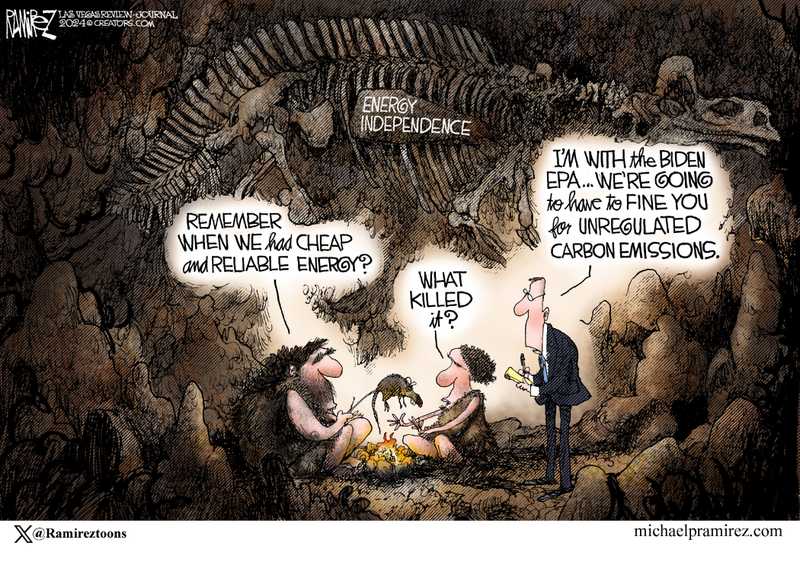
When the left ranted and screamed traditional energy production was disastrous, assuring us the world was going to be incinerated in months unless we abandoned everything we were doing that allows for advanced civilizations to exist.  What everyone should have asked was: It's disastrous compared to what?  Compared to living in caves, filthy, hungry, and sick?    

When they offered alternatives few asked how much will it cost?  But it was clear this was going to be massively expensive if for no other reason not one businessman in the country was willing to take all this on without massive government handouts.   

But.... and this is really big but.....  when they were asked what hard evidence they had to support their views on, and the effectiveness of alternative energy schemes, the left went insane and attacked anyone challenging their "settled science".  And these lunatics attacked them viciously!   Many losing their grants and even positions in the scientific community.   How dare they question consensus science?  They dared because politics is consensus, science questions everything.  

That alone should have been enough to make everyone aware it was a corrupt scam, and power grab.   In spite of all that there were many who predicted this failure, including me, even before this stuff was constructed, and did so because the lack of technological capability was already known.

Question: If an autodidact bug man, meaning me, knew this was going to be a hugely expensive failure, how could all these highly educated '“experts” not know it?

Answer: These green misfit activists and politicians ignore that which is known, and make up what’s not known.   Corruption and ideology make smart people stupid.

Modern leftists are just like the Teddy Roosevelt and Woodrow Wilson "progressives", often wrong but never in doubt, a legacy that lives and thrives on the left.   Leftists are the least likely to recognize their ignorance and incompetence in all the things in which they meddle, and this has always been so. 

If we want this fixed, it's time for someone to go to jail.  Time after time we've seen billions of dollars wasted on these which in my opinion represents criminal fraud.   Yet none of the people involved ever seem to end up in jail. 

  1. When will someone finally realize all these environmental movements are blatantly promoting fraud.  The last I heard fraud is a crime?
  2. When will someone finally realize it's not only these green organizations who are promoting fraud, but also those who fund them, and the agencies that enable them?
  3. When will someone finally realize this is all part of a massive international criminal enterprise, and decide an equally massive RICO investigation is needed?  
  4. When will someone finally realize someone needs to be sent to prison over all this?

Good questions....don't you think?


Tuesday, January 7, 2025

The True Cost of Wind Energy — Updated

John Droz jr. Jan 06, 2025 @ Critically Thinking About Select Societal Issues 

When I wrote the original version of this last year, some attentive readers said that although my list of ten costs were spot-on, I should have added more. My original list was intended to be a summary, not all inclusive. That said I believe that several of their suggested additions are not trivial, so I am reposting this commentary which now has fifteen typically ignored costs of industrial wind energy…

Periodically I get asked: What is the TRUE cost of industrial wind energy?  It seems like that should be a relatively straightforward answer, but it is anything but.  To appreciate what is going on, we need to understand the Big Picture regarding wind energy. (FYI, the same applies to solar.) The system is setup to grease the skids for wind energy developers — not ratepayers. When it comes to wind energy, we are dealing with 21st century snake oil salespeople. They have a sophisticated multi-part strategy to profit at the public’s expense…

Their FIRST major strategy is to sell politicians on the bogus concept that our electrical Grid should be inclusive — i.e., include ALL electrical energy sources (whether they are good or bad. An all of the above policy makes no technical or economic or environmental sense. (For a discussion of this, see here.) My alternative motto is that our electrical grid should include all of the sensible.

Their SECOND major strategy is to sell politicians on the false belief that we need enormous amounts of industrial wind energy to “save the planet from pending climate catastrophe.” Ignoring the accuracy of the Climate Change fear-mongering aspect, the reality is that there has never been a genuine scientific study that has concluded that wind energy saves a consequential amount of CO2! In fact, there have been multiple scientific studies that have concluded that wind energy can make Climate Change WORSE! (See here for some examples.)

Their THIRD major strategy is to sell politicians and the public on the illusion that industrial wind energy is inexpensive — so we should do it anyway (irrespective of points #1 and #2 above). So what is the true cost of industrial wind energy?

Why this is not a simple question to answer is because wind promoters are VERY well aware that industrial wind energy is MUCH more expensive than our other conventional sources of electricity (fossil fuels, nuclear and hydro). So to get politicians and the public onboard, they have gone to EXTREME lengths to obfuscate wind energy’s REAL cost.

Here are fifteen sample examples of wind energy costs that are NOT acknowledged by wind promoters, so are NOT factored into any of their “cost of wind energy” claims:

 1. Production Tax Credit (PTC)

How much is this? This objective report says: “While the original justification for the PTC was to boost a nascent industry, the PTC continues to subsidize a mature industry to the expected tune of nearly $24 billion from 2016-2020 according to the Joint Committee on Taxation. And that estimate will almost certainly be too low…”

2. Other Federal Handouts

A good example is the $100 million for wind energy in the 2022 “Infrastructure” bill. As it spells out in a separate legislative document, this taxpayer money is for such nonsense as “To support the integration of wind energy technologies with the electric grid and other energy technologies and systems” and “To support the domestic wind industry, workforce, and supply chain.” Billions of federal dollars are hidden in wind related costs (e.g., see here). This expert concludes that: “New Treasury Department numbers show that soaring federal handouts for wind & solar dwarf all other energy-related provisions in the tax code and will cost taxpayers $421 billion by 2034.“

3.  Time Value of Money for Federal Largess

It’s bad enough that the federal government awards tens of billions to inferior but politically favored energy sources. However, the federal government does not have this money sitting in a bank account. Instead these tens of billions of dollars are mostly borrowed, so we also pay substantial interest costs on this foolishness. Yet another part of this absurdity is that communist China has loaned us almost a Trillion dollars of this — so they are directly profiting from this insanity. Now see this major red flag!

4. Transmission Cost

A Nuclear power facility (for example), will have: a) one transmission line, and b) the distance will be relatively short, as it will almost always be located fairly near a population center. On the other hand, a very rough equivalent of wind energy will have: a) many transmission lines, and b) will be located a considerable distance from population centers. The transmission cost difference is substantial — but none of it is attributed to the root cause: industrial wind energy.

5. Auxiliary Power Cost

The Electric Grid needs to have Supply and Demand balanced in a fraction of a second. Since wind energy is 100% unpredictable — and frequently goes to zero — 100% auxiliary power is necessary. For a variety of technical and economic reasons, the most appropriate auxiliary source is almost always gas. However, as with the preceding items, the cost and operation of whatever auxiliary source is used, is almost never attributed to the reason for it: wind energy.

6. Dutch Auction Cost

This is a bit complicated, but once you understand it you will almost certainly say: this makes no sense whatsoever! That’s because it doesn’t.

A quickie summary is: let’s say that a Grid estimates that it needs 900 MWH next Tuesday. Five sources each bid to supply 200 MWH of it: Wind @ 1¢/KWH; Coal @ 2¢/KWH; Hydro @ 3¢/KWH; Nuclear @ 4¢/KWH; and Gas @ 6¢/KWH. The Grid takes the price of the highest accepted source (Gas), and then PAYS ALL THE SUPPLIERS THAT PRICE! Here is a good pictorial example of what happens.

What that means is that (in this case) wind gets 6¢/KWH (along with everyone else). But the wind people advertise that they are low cost (1¢/KWH) even though they got paid 6¢/KWH — and even though they knew that 1¢/KWH would never be the price they were paid (based on how the auction works). Dishonest.

7. No Penalty for Noncompliance

Let’s say that Nuclear is unable to supply all their 200 MWH of electricity next Tuesday, as they had committed to (in #5). In this case the Grid manager heavily fines Nuclear, because the Grid manager now has to buy electricity on the spot market, which is quite expensive — so the fine is fair to ratepayers.

Let’s say that Wind is unable to supply all their 200 MWH of electricity next Tuesday, as they had committed to (also in #5). In this case the Grid manager does NOT fine wind, even though the Grid manager now has to buy electricity on the spot market, which is quite expensive. This is an ENORMOUS concession to wind developers, which is NOT fair to ratepayers. Further (like everything above), this extra Grid expense is NOT attributed to Wind — even though they caused it!

8. Payments for Non-Usage

As if these Grid breaks aren’t enough, when the wind developers see the handouts that they are readily given, this green lights them to ask for more! Contrary to our traditional electricity sources, wind energy is not predictable — which is the excuse used for paying for underperformance of a bid. But, stunningly, in most cases wind energy also gets paid for over-performance as well! In other words, if they produce 100MWH that is not needed, in many cases they get paid to dump that (e.g., see here)! Of course, those payments are not attributable to wind energy’s cost.

9. Direct Host Community Costs

There are numerous environmental costs to wind host communities — e.g., health costs to nearby residents (e.g., from infrasound), reduction of the values of nearby homes, etc., etc. There are multiple other costs that are spelled out here. No surprise, but none of these substantial costs are attributed to wind energy.

10. Indirect Host Community Cost

There are several of these costs, like farmers reducing or stopping their crop production (after they sign a lease to host turbines). This means that they: lay off help, do not buy seed, fertilizer and equipment, do not provide food to the community, etc… Adverse military consequences (e.g., interfering with radar, etc.)… Trees are taken down (which are CO2 absorbers). Etc. None of these are factored into wind energy’s cost.

11.  The High Cost of the Wind Supply Chain

Some major turbine components are extraordinarily problematic from several perspectives. Rare Earth materials are a fine example. (Note: some 2 to 4 thousand pounds of Rare Earths are in every turbine!) The environmental and health cost of Rare Earths is staggering — but much of that is happening in China. Even though wind promoters say that climate impacts anywhere in the world are important to address, none of them are publicly objecting to this wind energy cost.

12. De-Industrialization

Nowhere on earth can it be demonstrated that wind and solar grid imposters reduce electricity costs. Any country that pursues these fantasies is pursuing impoverishment because industry (and the economic benefits they create), will likely eventually leave for countries with cheaper, more reliable energy sources.

13. Utility Conflict Exposed

The bribes (aka subsidies) doled out to wind and solar exposes a significant conflict of interest for power providers: are they acting in the best interest of shareholders or customers? For example, since utilities are often guaranteed a return on their "capital base" they are perversely incentivized to install a huge capital base of unreliables to increase their profits — even though that increases costs and reduces reliability to their customers. So where is their primary allegiance?

14. Loss of Serenity

Serenity's legal definition is that environmental quality which provides the greatest sense of wellbeing. Industrial wind turbines are anathema to the serenity of pastoral communities. Just as with other key values in life (like happiness, contentment, peacefulness, etc.) there is no way to put a sufficient dollar value on this huge loss.

15.  Loss of Community

This frequently results when the wind industry uses citizen money to bribe local officials and select landowners in order to create an us vs. them conflict. Other nearby property owners then sign a so-called Good Neighbor Agreement by which they agree not to complain about the numerous liabilities of the industrial wind project. For an annual pittance of a bribe, these "good neighbors" cooperate in the torture of nearby non-participating residents afflicted with adverse health effects, property devaluation, etc.

The Bottom Line

This is a somewhat complicated, technical subject, so the above is a layperson’s summary. The takeaway is that — despite what the lobbyists are pitching to the non-critically thinking public — the real cost of wind energy is 3± times the cost of nuclear and other conventional sources of electricity. Solar is higher than that!


Here is other information from this scientist that you might find interesting:

I am now offering incentives for you to sign up new subscribers!

I also consider reader submissions on Critical Thinking on my topics of interest.

Check out the Archives of this Critical Thinking substack.

WiseEnergy.org: discusses the Science (or lack thereof) behind our energy options.

C19Science.info: covers the lack of genuine Science behind our COVID-19 policies.

Election-Integrity.info: multiple major reports on the election integrity issue.

Media Balance Newsletter: a free, twice-a-month newsletter that covers what the mainstream media does not do, on issues from COVID to climate, elections to education, renewables to religion, etc. Here are the Newsletter’s 2024 Archives. Please send me an email to get your free copy. When emailing me, please make sure to include your full name and the state where you live. (Of course, you can cancel the Media Balance Newsletter at any time - but why would you?

Leave a comment

Share

Thanks for reading Critically Thinking About Select Societal Issues! Please pass a link to this article on to other associates who might benefit. They can subscribe for FREE to receive new posts (typically about once a week).