Search This Blog

De Omnibus Dubitandum - Lux Veritas

Showing posts with label Batteries. Show all posts

Wednesday, March 26, 2025

Energy Fantasy Versus Reality In Woke-Land -- Part III

M @ Manhattan Contrarian

JP Morgan Chase — that’s the largest bank in the country. It has been headed for almost 20 years by celebrity CEO Jamie Dimon. For much of the 20 years, Chase and Dimon have been known for their fealty to woke orthodoxies, at least in their official pronouncements. For example, here is a Forbes piece from October 2020 citing Dimon on the subject of “systemic racism.” 
 
(Pithy quote: “Systemic racism is a tragic part of America’s history. . . . It’s long past time that society addresses racial inequities in a more tangible, meaningful way.”)

The fealty to woke orthodoxies has in the past extended in particular to the subject of “climate change.” In April 2021 JPM put out a big announcement of plans to facilitate investment of some $2.5 trillion in what they called “climate action and sustainable development.” In October 2021, JPM joined the so-called Net Zero Banking Alliance, then being organized by the UN (led by Mark Carney), promising to starve fossil fuels of investment capital in order to reduce CO2 emissions.

But meanwhile, over at J.P. Morgan Asset & Wealth Management, they have a guy named Michael Cembalest, who currently has the title Chairman of Market and Investment Strategy. For some 15 years, Cembalest has put out an annual Report called the Annual Energy Paper. I have covered a couple of Cembalest’s prior reports, here for 2021, and here for 2022. The titles of both those posts included the words “Fantasy Versus Reality In Woke-Land.” Cembalest is just out with the 2025 version of his Annual Energy Paper, so consider this to be Part III of this series.

These Reports by Cembalest are far from perfect. At a basic level, the Reports accept the ideas that there is a real energy transition going on, that it is somehow important, and that use of fossil fuels must eventually be eliminated. I don’t know if Cembalest really believes those things himself, or if accepting them for purposes of your public reports is the price of holding a highly-paid job at JPM. Either way, while I consider the failure to question those ideas to be a major flaw of these Reports, that failure does not prevent Cembalest from taking a serious and realistic look at many aspects of the supposed energy transition that are completely failing.

I’ll start with a couple of sections of this year’s Report that I consider to be the strongest: those covering hydrogen and carbon capture and storage (CCS).

Hydrogen

Cembalest’s section on hydrogen, beginning at page 45, is titled “Frydrogen: the cancellation of green hydrogen projects when exposed to the sunlight of energy math.” The reason for use of the word “fry”: 

“[M]any hydrogen projects are being fried (terminated) since the energy math didn’t work.”

Cembalest quotes Hanns Neubert in the June 2024 German MIT Technology Review:

“Electrolyzers, which do not exist, are supposed to use surplus electricity, which does not exist, to feed hydrogen into a network that does not exist in order to operate power plants that do not exist. Alternatively, the hydrogen is to be transported via ships and harbors, which do not exist, from supplier countries, which - you guessed it - also do not exist.”

There is a long list of some 12 insurmountable obstacles standing in the way of a green hydrogen economy. My favorite:

The green hydrogen economy barely exists despite mountains of taxpayer subsidies promoting supply. In the US, for example: a production tax credit of $3 per kg is equivalent to $91 per MWh based on the energy content of hydrogen (i.e., greater than wholesale electricity prices which averaged between $30 and $50 per MWh in 2024).

(Note that the $91/MWh tax credit for green hydrogen is just the subsidized portion of the cost of making the fuel; the $30-50/MWh wholesale cost of electricity includes all elements of making the electricity, not just the fuel.)

CCS

In a section on CCS on page 19 of the Report, Cembalest correctly takes note of the fact that after decades of hype, CCS has gone absolutely nowhere. He calls the CCS “citation-to-usage ratio” (that is, the number of citations of CCS in academic papers divided by the actual operating capacity of CCS facilities) “the highest ratio in the history of science.” A chart shows current U.S. capacity of operating CCS facilities at about 0.1% of CO2 emissions. If all planned facilities actually get built (highly unlikely based on experience), then the percent of emissions captured would go to around 0.8% of emissions.

https://images.squarespace-cdn.com/content/v1/503a5bade4b0b543ed240317/1aebd26a-d106-4760-8292-eb766a51cef8/Screenshot+2025-03-16+at+10.48.09%E2%80%AFPM.png?format=2500w

Another interesting chart shows that CCS facilities that have been built capture far from all of the CO2 emissions from the plant in question, despite consuming substantial portions of the energy production of the plant. Here is a portion of that chart:

Capturing 55-75% of the emissions of a coal power plant is never going to satisfy the environmental zealots. So what’s the point?

OK, those were the strong parts of the Report. Let’s get to the fundamental flaw.

Solar power

The biggest theme of this year’s Report is “Heliocentrism.” The title of the Executive Summary of the Report is “Heliocentrism and the speed of the energy transition.” Why the term “heliocentrism”?  

“For purposes of this paper, heliocentrism refers to the view that rapid growth in solar power and energy storage are at the heart of the energy transition, and that new investment in complementary thermal power generation is no longer required.”

Cembalest says that there are “believers in heliocentrism,” apparently lots of them, and lays out their case for them:

Believers in heliocentrism point to rapid growth in global solar capacity which more than doubled over the last three years. If BNEF projections are correct, solar capacity will double again from 2024 to 2027. Solar is now the dominant form of global capacity additions, comprising 60% of new capacity in 2024 and by our estimates ~75% in 2027. According to Carbon Brief, the International Energy Agency underestimated solar capacity growth for years and has been trying to catch up as shown below. Globally, the combination of wind and solar power generation has soared past nuclear and should surpass hydropower in 2025.

Cembalest then states that “there are a couple of ‘buts’ to keep in mind.” That’s putting it mildly! As the “buts,” Cembalest mentions that solar facilities have annual capacity factors in the range of 15-20%, and that producing electricity from solar panels does not solve the issue of non-electrified uses of energy, like transportation, industry, and most space heating. Fair enough. But he never gets to the biggest problem, which is dealing with the problem of intermittency as the penetration of solar generation into the grid increases.

The problem of energy storage is barely mentioned. There is this on page 5:

EIA analysts I spoke with cite a “staggering” amount of battery storage being added to the US grid: another 38 GW by 2027 on top of 22.5 GW already in place. This suggests that some natural gas peaker and baseload plants could eventually be displaced.

Well, how “staggering” is that? It’s really discouraging that Cembalest does not even use the correct units for describing battery capacity (which are watt-hours rather than watts). But assume that we are talking about standard 4-hour lithium-ion batteries. A few minutes of simple arithmetic would show that this “staggering” amount of storage is a tiny fraction of what would be needed to back up a predominantly solar electrical grid. The U.S. used 4,086 TWh, or 4,086,000 GWh, of electricity in 2024. Dividing by 8760 (hours in a year), that’s 466 GWh every hour. 38 + 22.5 GW of batteries would total 60.5 GW, times 4 hours’ duration would come to 242 GWh of storage. So, about half an hour’s worth. Full backup of a predominantly solar grid would take about 500 to 1000 hours of storage. So the “staggering” 242 GWh is around 0.05% - 0.1% of the storage that would be needed. An almost meaningless amount.

Cembalest’s conclusion is that while solar generation is increasing rapidly, it is only increasing “linearly,” which is not nearly fast enough to overtake all fossil fuel generation in any short number of years. Thus, “[A]s a general principle, . . . the US and Europe are a long way off from no longer needing both baseload and backup thermal capacity.”

Well, sorry Mike, but you’ve missed the big picture. If you had done the arithmetic, you could easily have seen that solar is not just “a long way off” from powering the grid without thermal backup; solar is never going to be the main source energy for a developed economy. You owed it to your clients to tell them that this can’t work, and there is a Green Energy Wall coming; but you failed.

Meanwhile, there is at least some reason to think that JPM at the highest levels has finally started to see reality and re-think its green energy commitments. Just in January, JPM quit the Net Zero Banking Alliance. Maybe by the time next year’s Report rolls around, the shackles will have been taken off Mr. Cembalest, and he can give his readers a dose of the truth.

Monday, April 29, 2024

A Shockingly Inept Report From The IEA On Battery Storage Of Energy

April 27, 2024 @ Manhattan Contrarian

In my self-designated role critiquing various schemes for total transformation of the world energy system, I get to review large amounts of poor, shoddy, and incompetent work. When people get into advocating for this “energy transition,” the stars regularly align to bring forth the most extreme levels of ineptitude. Start with the fact that the “smartest” people are filled with arrogance and hubris, but are not actually very smart. Add that many innumerate Politics and English majors have flooded into a field that cries out for engineering calculations. Add too that groupthink and orthodoxy enforcement prevent anyone from pointing out obvious flaws. And then throw in a strong dose of religious zealotry that obstructs the intrusion of anything resembling critical thinking. All in all, it’s a prescription for catastrophe.

But in a field rife with bad, worse, still worse, and even dangerously incompetent work, I don’t know if I’ve ever seen anything as shockingly inept as the Report just out from the International Energy Agency with the title “Batteries and Secure Energy Transitions.” The Report has a date only specified to the month of “April 2024,” but the press release came out just two days ago on April 25.

If I had been given the assignment by the North Koreans to write the Report to somehow induce the West to self-destruct, I don’t know how I would have done it differently.

Are you familiar with the International Energy Agency? It is not part of the UN, but rather a separate consortium currently of some 40+ countries, mostly Western and mostly rich, founded in the wake of the oil shocks of the 1970s with a then-goal of promoting energy security. It is based, of course, in Paris. The current (and since 2015) head is a guy named Fatih Barol.

Somewhere along the line the IEA completely lost track of the energy security mission, and turned into an unabashed advocate for the green energy transition. That’s where they are today.

I don’t know how many people work at the IEA, but it seems like most to all of them got in on writing this Report. On page 5 there is a list of some 35 “directors,” “lead authors,” and “principal authors” from among IEA employees, plus another 4 who provided “support,” and then, on pages 6 to 8, some 89 people said to be “high-level government representatives and international experts from outside of the IEA” who somehow “contributed to the process.” From the content of the Report, one has to wonder if any of these people ever completed the study of arithmetic at the sixth-grade level, let alone if any have read any of the important work in this area.

The thesis of the Report is that batteries, and particularly lithium ion batteries, are the key to the impending energy transition, and need to be scaled up massively and immediately with whatever amount of government subsidies and handouts that it takes. Here are a few quotes from the press release:

After their deployment in the power sector more than doubled last year, batteries need to lead a sixfold increase in global energy storage to enable the world to meet 2030 targets. . . . In the first comprehensive analysis of the entire battery ecosystem, the IEA’s Special Report on Batteries and Secure Energy Transitions sets out the role that batteries can play alongside renewables as a competitive, secure and sustainable alternative to electricity generation from fossil fuels. . . . IEA Executive Director Fatih Birol [said,] “Batteries will provide the foundations in both areas, playing an invaluable role in scaling up renewables and electrifying transport while delivering secure and sustainable energy for businesses and households.

I suppose it would be too much for me to expect these grandees to have read my energy storage report, published by the Global Warming Policy Foundation in December 2022. But if you are claiming that you have at hand a “competitive, secure and sustainable alternative to electricity generation from fossil fuels,” as these guys are, there is a series of very obvious question that must be addressed. Those include:

  • Quantitatively, how much energy storage, in watt-hours (or gigawatt-hours)will be necessary to provide full back-up to a national electricity grid once all fossil fuel back-up has been banished and the storage is all that is available when the instantaneous generators are not supplying the full demand?
  • How much will that amount of storage cost?
  • What is the maximum length of time that energy must be held in storage before it is called upon, and is the proposed storage technology capable of the task of storing energy for that period of time?

There are other comparably important questions, but at least those are absolutely essential.

The IEA Report addresses none of them.

What we get instead is endless happy talk about the wonders of lithium ion battery technology, how the costs are falling rapidly, how deployments are soaring, and how utopia (i.e., meeting UN COP 28 emissions reduction targets) is right around the corner if only we accelerate the process with massive government “support.” The full Report is some 159 pages (with appendices and references), so I can only give you a small sample. But here are a few choice quotes from the Executive Summary:

  • From page 11: “Batteries are an essential part of the global energy system today and the fastest growing energy technology on the market. Battery storage in the power sector was the fastest growing energy technology in 2023 that was commercially available, with deployment more than doubling year-on-year.”
  • Also from page 11: “Lithium-ion batteries dominate battery use due to recent cost reductions and performance improvements. Lithium-ion batteries have outclassed alternatives over the last decade, thanks to 90% cost reductions since 2010, higher energy densities and longer lifetimes.”
  • From page 12: “Policy support has given a boost for batteries deployment in many markets but the supply chain for batteries is very concentrated. Strong government support for the rollout of EVs and incentives for battery storage are expanding markets for batteries around the world.” [For the obtuse among the readership, “policy support” is code for vast subsidies and handouts.]
  • More from page 12: “Batteries are key to the transition away from fossil fuels and accelerate the pace of energy efficiency through electrification and greater use of renewables in power.”
  • Still on page 12: “To triple global renewable energy capacity by 2030 while maintaining electricity security, energy storage needs to increase six-times. To facilitate the rapid uptake of new solar PV and wind, global energy storage capacity increases to 1 500 GW by 2030 in the NZE Scenario, which meets the Paris Agreement target of limiting global average temperature increases to 1.5°C or less in 2100. Battery storage delivers 90% of that growth, rising 14-fold to 1200 GW by 2030.”

Check out that last bullet point. Yes, they are so dumb that they discuss energy storage capacity in GW rather than GWh. How did they come up with the line that to reach their goals “energy storage needs to increase six-times” when they don’t even know the right units to do the calculations? You won’t find an answer in this Report. In my own energy storage report, I calculated that to reach a zero-emissions electricity sector that could get through a year without fossil fuel back-up would require increasing energy storage by something around 10,000 times. I used the correct units and showed how my calculations were done.

And how about the question of the length of time that energy must remain in storage to back-up a wind/solar powered grid, and whether the proposed technology is up to the task? In my own report, which only considered scenarios of getting through a single year, I showed that much of the stored energy would need to be held for 6 - 12 months before use. In a further blog post on September 28, 2023, I covered a new report then out from the UK’s Royal Society (described by me as “semi-competent”), which used 37 years of data. Based on the 37 years of data, that report concluded that hundreds of hours worth of grid peak usage would need to be held in storage for multiple decades in order to get through worst-case sun and wind droughts. I had this quote from the Executive Summary of the Royal Society report:

Wind supply can vary over time scales of decades and tens of TWhs of very long-duration storage will be needed. The scale is over 1000 times that currently provided by pumped hydro in the UK, and far more than could conceivably be provided by conventional batteries.

(Emphasis mine.). I’m ready to forgive these IEA guys for not being familiar with my own report, but not for complete ignorance of the Royal Society’s effort.

The entire discussion that I can find in the IEA Report on the problem of need for massive amounts of very long duration storage consists of a chart and one paragraph of text on page 47. Here is the chart:


And the text:

Iron air and other battery technologies that potentially could enable the storage of electricity over longer durations measured in weeks, are still in their infancy. Currently it is not clear whether those technologies can be developed so as to provide what is required in a cost-efficient way. For even longer duration storage, such as seasonal storage, battery technologies are not fit for purpose, and other mechanical, e.g. pumped storage hydro, and chemical, e.g. hydrogen storage, technologies need to be deployed.

So 90 plus percent of the storage needed to back up the intermittently-supplied grid needs to be stored for months and years, but the only battery technologies that can even last for “weeks” are things that are “in their infancy” and where it is “not clear” that they can be provided in a “cost-efficient way.”

Overall, a shockingly inept and embarrassing piece of work from the IEA. Undoubtedly our government will react by piling forth a few more hundreds of billions of dollars to subsidize batteries to do a job for which they are completely “unsuitable.”

Wednesday, November 1, 2023

A Do-It-Yourself Demonstration Project Of Wind, Solar And Batteries Comes Nowhere Near Eliminating Fossil Fuels

October 29, 2023 @ Manhattan Contrarian 

Under the enlightened leadership of our expert bureaucrats in Washington and various state governments, we are embarked on a program to replace our functioning electricity generation system with an alternative system based on wind, solar, and energy storage. We are told that this will be easy, and in fact cheaper than what we currently have. Surely, if that is true for an entire country, it must be equally true for some small place like an island or a small town. Easiest of all for the demonstration would be an individual house, particularly if the house is surrounded by sufficient land to accommodate all the required elements of the system.

I have previously reported here that there is no such thing anywhere in the world as a demonstration project that has achieved anything close to 100% electricity generation from wind and solar sources without fossil fuel backup. The most significant attempt at such a demonstration project — El Hierro Island off the coast of Spain, which opened in 2014 — has barely achieved 50% of electricity generation from its wind/storage system in some years, while falling far short of even that level in other years. Today their website has quietly dropped or downplayed any mention of claims to be trying to achieve 100% renewable electricity generation. In the most recent year for which they provide data (2020), their backup diesel generator ran approximately 85% of the time.

On October 26, the Daily Sceptic website featured a piece by an anonymous Australian author who has set up his own do-it-yourself wind/solar/storage system to supply electricity to two houses on a plot of land in a rural area of Victoria. The headline is Living Off-Grid Has Shown Me That Modern Society Cannot Function on Renewable Energy.” JoNova also has a write-up covering the piece on October 28.

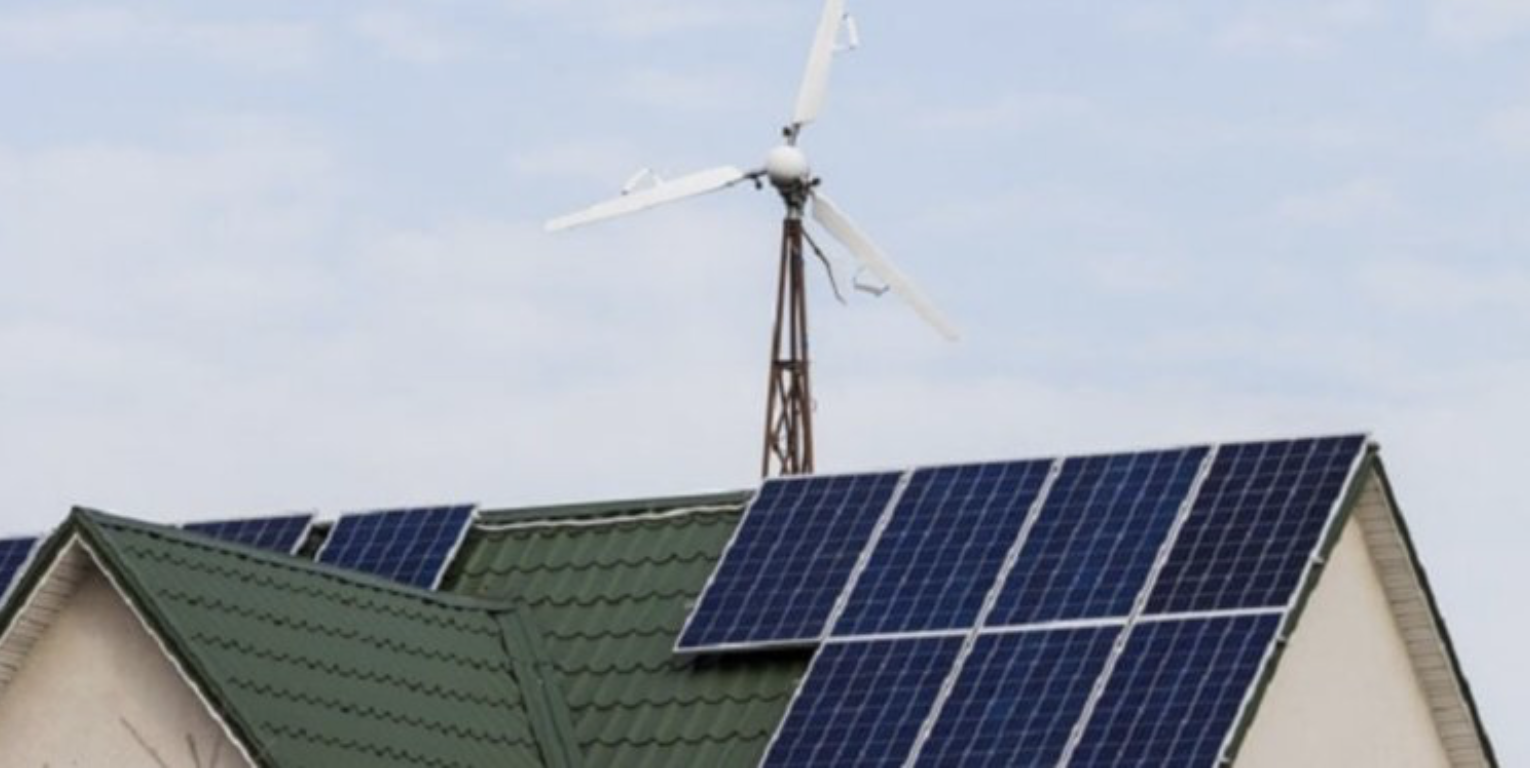
It appears that the guy in question — who goes by the name Pseudonaja Textilis — has invested some $160,000 in his own wind turbines, solar panels and batteries in his project to go “off grid.” (The piece does not say if the $160,000 represents US dollars or Australian dollars. If it’s Australian dollars, that would be the equivalent of about $102,000 in US dollars.). He has both wind turbines and solar panels for each of the two houses, plus batteries. Here is a picture of one of the two houses, with the solar panels on the roof and the wind turbine behind:

The Daily Sceptic piece unfortunately lacks some basic data that would be useful, including the average and peak electricity usage of the houses, the capacity and annual production of the wind and solar generators, and the capacity (in kWh) of the batteries. But the piece does make clear that the capacity of the wind/solar generators is more than sufficient to supply usage when the wind blows and the sun shines. Unfortunately, that is not the case much of the time:

So how do [the wind/solar/storage systems] perform? In summer perfectly. We don’t have to do much other than check in with the laptop once a week to monitor the system, and we often take the wind generators offline for extended periods. In winter, . . . solar energy input per square metre drops to about 30% of peak summer level and then for only a few hours a day. . . . To some extent power usage can be matched to storage levels and fluctuating input from the wind generator. 

However, the total renewable input is just too patchy and unreliable so petrol or diesel powered generator backup is absolutely required. It’s not just in winter, but in autumn especially and sometimes in springtime too. When cloudy skies and windless days persist we need to make recourse to our petrol generators, sometimes everyday for a week at a time to keep the batteries charged and provide peak load supply.

“Textilis” reports that his diesel generators only run about 60 to 100 hours per year, which is only about 1% of the time. That sounds pretty good. But then, they need to be capable of supplying 100% of full electricity demand when called upon, even for such brief periods. Oh, and “Textilis” doesn’t use electricity for either heat or hot water. For those things he uses wood, grown on his own property — and which he cuts and hauls by labor-intensive means using a gasoline-powered chainsaw.

Conclusion:

It matters nought that you have massive renewable generation capacity if you can’t store power for extended periods. So you can have all the wind and solar farms you want, but without fossil fuel or nuclear back up you’ll need to buy a good supply of warm blankets and candles if you don’t want to be spending a lot of time shivering in the dark.

We’ll see if the likes of President Biden or New York Governor Kathy Hochul catch on any time soon.


Thursday, September 7, 2023

The Elites Directing The Energy Transition Really Have No Idea What They Are Doing

September 06, 2023 @ Manhattan Contrarian

We are on our way to Net Zero by 2050. It must be true because everybody says so. The entire $6+ trillion per year federal government is committed to the project, which obviously would not be the case if the whole thing were impossible. Equally fully committed are essentially all of the colleges and universities, where all of the smartest people are to be found. As well as every other elite institution of every kind and sort.

Take the World Economic Forum. If there is a number one elitist among all elite institutions, this has to be it. At their annual confab in Davos, Switzerland, they gather the greatest of geniuses to instruct the very top government and business leaders how to run the world. Would you like to go? It will cost you $52,000 to join the organization, and then an additional $19,000 to attend the conference. Chartering a private jet to get you there will cost a few more thousand. Once there, you can hear the very smartest people imparting their thoughts on the most important topics of the day, like “The Great Reset,” “Emerging Technologies,” “Diversity and Inclusions,” and, of course, “The Net Zero Transition.”

Is it possible that these people are completely incompetent and have no idea what they are doing?

A reader has sent me the very latest from the WEF on how the world is going to get to Net Zero. The piece has a date of September 5, 2023, and is titled “How battery energy storage can power us to Net Zero.” The authors are three people from the World Bank, with the lead author being one Amit Jain, who is the Bank’s Energy Storage Program Lead. This is the guy on the receiving end of tens of billions of dollars of government money to pass out to make the energy transition happen throughout the developing world.

Now, it so happens that energy storage is something I know a little about, and in particular about the problem of trying to store enough energy to make an electrical grid work without full dispatchable backup. See my energy storage Report, dated December 1, 2022, at this link.

So let’s take a look at Jain, et al.’s, take on how battery storage will “power us to Net Zero.” First, some excited happy talk:

Across the globe, power systems are experiencing a period of unprecedented change. Low-cost renewable electricity is spreading and there is a growing urgency to boost power system resilience and enhance digitalization. This requires stockpiling renewable energy on a massive scale, notably in developing countries, which makes energy storage fundamental. . . .

Making energy storage systems mainstream in the developing world will be a game changer. Deploying battery energy storage systems will provide more comprehensive access to electricity while enabling much greater use of renewable energy, ultimately helping the world meet its Net Zero decarbonization targets. International organizations and development institutions are leading the way forward to enable this decarbonization. . . .

So OK Amit, how much storage are we talking about here?

In 2022, approximately 192GW (gigawatts) of solar and 75GW of wind were installed globally. However, only 16GW/35GWh (gigawatts per hour) of new storage systems were deployed. A recent International Energy Agency analysis finds that although battery energy storage systems have seen strong growth in recent years, grid-scale storage capacity still needs to be scaled up to reach Net Zero Emissions by 2050. . . . To meet our Net Zero ambitions of 2050, annual additions of grid-scale battery energy storage globally must rise to an average of 80 GW annually between now and 2030.

Holy underwear, Batman! Could this guy really not even know what units he’s talking about? Thinking his readers might not understand the abbreviation “GWh” he helpfully defines it as “gigawatts per hour”! Could he really be this clueless? And he had two co-authors to check him!

And then there’s the statement that to meet the 2050 Net Zero ambition, annual deployments of grid-scale batteries “must rise to an average of 80 GW annually.” Of course he is using the wrong units (and undoubtedly does not know that). But let’s give him the benefit of the doubt, and assume that he is talking about the standard batteries available today, which are 4 hour batteries, meaning that 80 GW would provide 320 GWh of storage. If the world would add that much capacity every year from now to 2050, that would come to 8960 GWh of storage. How have Mr. Jain et al. come to the conclusion that this 8960 GWh of storage will be enough to “meet our Net Zero ambitions of 2050”? The piece contains no quantitative analysis or backup of any kind to support the proposition that this amount of storage would be sufficient.

My own energy storage Report does contain backup and calculations, although only for certain countries rather than for the whole world. For example, for the United States, the figures cited in my Report are that it would take some 233,000 GWh of battery storage to fully back up the electrical grid, assuming current levels and patterns of usage. Since the U.S. is about 4% of world population, we can multiply that figure by 25 to get the storage requirement for the world (assuming that the world electrifies to the U.S. level by 2050). The total would be 5,825,000 GWh. In other words, Jain, et al., are off by a factor of about 650, give or take maybe a few hundred.

But it’s OK, because Jain and his colleagues have no skin in this game. They just babble some happy talk to get their hands on a few hundred billions of money from rich governments, and pass it out to build impressive-looking battery projects that are actually next to useless to provide reliable grid electricity. They can be very confident that no one in their circles will ever check the math to see if the numbers add up. When 2050 rolls around and the whole thing doesn’t work, they will be long retired on generous pension.

Thursday, August 10, 2023

The Real World Costs Of Backing Up Weather-Dependent Electricity Generation With Battery Storage

August 8, 2023  @ Manhattan Contrarian 

A recurring question at this blog has been, how do the world’s politicians plan to provide reliable electricity without fossil fuels? Country after country, and state after state, have announced grand plans for what they call “Net Zero” electricity generation, universally accompanied by schemes for massive build-outs of wind and solar generation facilities. But what is the strategy for the calm nights, or for the sometimes long periods at the coldest times of the winter when both wind and sun produce near zero electricity for days or even weeks on end?

When pressed, the answer given is generally “batteries” or “storage.” That answer might appear plausible before you start to think about it quantitatively. To introduce some quantitative thinking into the situation, last December I had a Report published by the Global Warming Policy Foundation titled “The Energy Storage Conundrum.” That Report discussed several calculations of how much energy storage would be required to get various jurisdictions through a year with only wind and/or solar generation and only batteries for back-up, with fossil fuels excluded from the mix. The number are truly breathtaking: for California and Germany, approximately 25,000 GWh of storage to make it through a year; for the continental U.S., approximately 233,000 GWh of storage to make it through a year. At a wildly optimistic assumption of $100/kWh for storage, this would price out at $2.5 trillion for California or Germany, $23.3 trillion for the U.S. — equal or greater than the entire GDP of the jurisdiction. At more realistic assumptions of $300 - 500/kWh for battery storage, you would be looking at 3 to 5 times GDP for one round of batteries, which would then need replacement every few years.

But even these numbers wildly understate the real world costs of storage that would be needed. Here’s why: the calculations that I presented were based on actually data for particular years, and what storage would have been needed to make it through that year. For example, here is the chart from my Report of the annual charge and discharge cycle for a collection of batteries that would have been sufficient to get California through the year 2017 on a wind/solar system, fossil fuels eliminated, without running out of electricity:

As you can see, the calculation assumes that California would run its batteries right down to zero in March with the expectation that they would then begin to recharge.

But if you are planning a system that must have 99.9% reliability, you can’t just look at one year and assume you can run your storage down to zero. You need to consider the worst-case year. This is particularly true in the case of an electricity system consisting only of wind and solar generation plus batteries. If the batteries run down to zero, then what? It is not at all obvious how to restart. You might need to dedicate the generation exclusively to charging the batteries for weeks or even a month or more before you can have confidence that you can restart without immediately crashing again.

So, in the real world, how would you run such a system prudently?

There actually exists a closely analogous type of system from which we can make inferences of what kind of margins are necessary to assure reliability. That analogous type of system is the system for water supply. The supply of water from a reservoir system, like generation of electricity from wind and sun, is dependent on unpredictable weather. What kind of margins for storage are necessary to assure reliability?

The New York City water supply system makes lots of data available to investigate this question. Here are some key data points:

  • New York City consumes about 1 billion gallons of water a day from its reservoir system. (Although the population has grown somewhat over the past couple of decades, that figure has remained quite stable, and actually decreased by a little, largely due to universal metering and increasing prices.)

  • The New York City reservoir system has a capacity of approximately 550 billion gallons — which is about 1.5 years of consumption, or 18 months’ worth.

  • Rainfall, on average, is a generous 4 inches per month, year-round. However, there can be droughts, which can continue for months on end.

The New York City reservoirs have a usual annual cycle. Usage exceeds replenishment in the summer and fall, and then the reservoirs refill in the spring with run-off from melting winter snows. In a typical year, the reservoir level never falls below 70% of capacity. However, there are periodic drought years, when reservoir levels can get much lower.

Here is a chart from New York City on historical droughts going back to the 1960s. There were droughts in 1963-65, 1980-82, 1985, 1991, 1995, and 2002. The lowest level reported for the reservoirs in this chart occurred on January 19, 1981, when the level reached 33% (which would represent approximately 6 months of usage). A drought “Emergency” was declared at that point. Another “Emergency” was declared in April-July 1985, with the reservoir level ranging between 55% and 62% (10-11 months of average usage), and again in April 2002 with the level at 57.5% (10 months average usage).

I would contend that this represents government over-reacting as usual and trying to scare the people into compliance. All of these drought conditions resolved themselves when rains came and refilled the reservoirs long before they emptied out.

But the point remains: Nobody is going to let the reservoirs get anywhere close to zero before declaring an emergency. After all, there is no further back-up when the reservoirs are empty. At that point, there is no more water until some rain shows up. And so we consider it a drought emergency when the remaining storage is somewhere in the range of 6 to 10 months of water.

Now apply that to a prospective wind/solar/battery electricity system with fossil fuel back-up eliminated. Are we really going to run such a system in accordance with the models in my Report, where we allow the batteries to drain right down to zero every spring? What if the wind and sun don’t cooperate for the next month (or two, or three)? Won’t we insist on having at least a month’s worth of spare storage at the normal low point of the year, just in case we have a worst-case situation?

In that case, I suggest that the number presented in my Report for the cost of batteries to back up a fossil fuel-free system are low by at least a factor of two, and probably more.

Tuesday, May 16, 2023

Emissions-free Electric Vehicles Are a Fantasy

Apr 21, 2023 By Diana Furchtgott-Roth @DFR_Economics Director, Center for Energy, Climate, and Environment

Key Takeaways

  • Come 2032, if President Joe Biden has his way, most Americans who want new cars may have to buy electric vehicles.
  • Research shows that electricity for battery-powered vehicles is coming from coal and natural gas rather than renewables.
  • Until electricity can be generated by emissions-free power, battery-powered vehicles will generally increase, rather than reduce, emissions.

Come 2032, if President Joe Biden has his way, most Americans who want new cars may have to buy electric vehicles. While the administration insists that such a mandate will reduce climate change, the fact is, when adding up the emissions required to produce and power the batteries of electric vehicles, EVs can create more carbon emissions than gas-powered cars.

New proposed regulations on automobile emissions from the Environmental Protection Agency would require 60% of new car sales to be battery-powered electric vehicles by 2030 and 67% by 2032, compared to fewer than 6% in 2022.

The stated rationale: These cars produce fewer carbon emissions than cars with internal combustion engines, emissions contribute to global warming, and global warming poses a threat to the planet and mankind.

What the regulations don’t seem to take into account is that electric cars don’t have tailpipe emissions, but their batteries are charged using electricity. And much of electricity production—unless it’s from renewables, hydropower, or nuclear energy—still results in carbon emissions...........

Battery-powered electric vehicles might sound attractive when gasoline is over $3 per gallon. And electric Ford F-150 Lightning pickup trucks may be fun to drive, especially if you don’t need to tow anything, but these new purchases might not be reducing greenhouse gas emissions and saving the planet.

2022 paper by Kelly Senecal of Convergent Science and other scientists compares greenhouse gas emissions from plug-in, battery-powered electric vehicles with emissions from hybrid vehicles, which combine internal combustion engines with small battery packs.

The conclusion: Pure plug-in battery-powered vehicles can create more emissions than hybrids and even more than some traditional internal combustion engine vehicles—whose fuel delivery, air delivery, and ignition systems have improved over the past 20 years, increasing overall vehicle gas mileage.

Here’s why............To Read More....


Thursday, April 6, 2023

Bill Ponton's "Reality Check" On UK Wind Power: The Issue Of Energy Storage

@ Manhattan Contrarian

Bill Ponton’s new Report, “The Cost of Increasing Wind Power: A Reality Check,” contains a short but pithy section addressing the question of energy storage. Here’s the question to be addressed: If after the first round of overbuilding, adding new wind generation resources adds little useful energy and most of the added generation ends up getting “curtailed,” then why not just add some batteries or other energy storage to the system? Wind energy advocates suggest that some form of batteries can store the excess electricity production until it is needed, and everything will then just balance out in perfect equilibrium.

Is there any problem here? Ponton does the simple calculations with his UK 2022 spreadsheet to derive how much storage in GWh will be needed, and what its functional characteristics must be. His results are very similar to the results of comparable exercises previously undertaken by Roger Andrews for California and Germany, and Ken Gregory for the U.S.

The main problem identified by Ponton is the same one previously identified by Andrews and Gregory. Before you even get to the very high cost of storing electricity, there is another huge hurdle, which is that the availability of wind to generate electricity varies with a seasonal pattern. Therefore, to match electricity supplied to electricity demanded, the storage balance must be built up over about a six month period to an enormous level, and then discharged over the following six month period.

Ponton considers the case of a tripling of UK wind generation rated capacity, from the current 28 GW to 84 GW. Average usage is about 35 GW, and peak usage is about 45 GW; so the 84 GW of rated wind capacity provides plenty of spare electricity to charge the batteries when the wind is blowing at full strength, or even close to that.

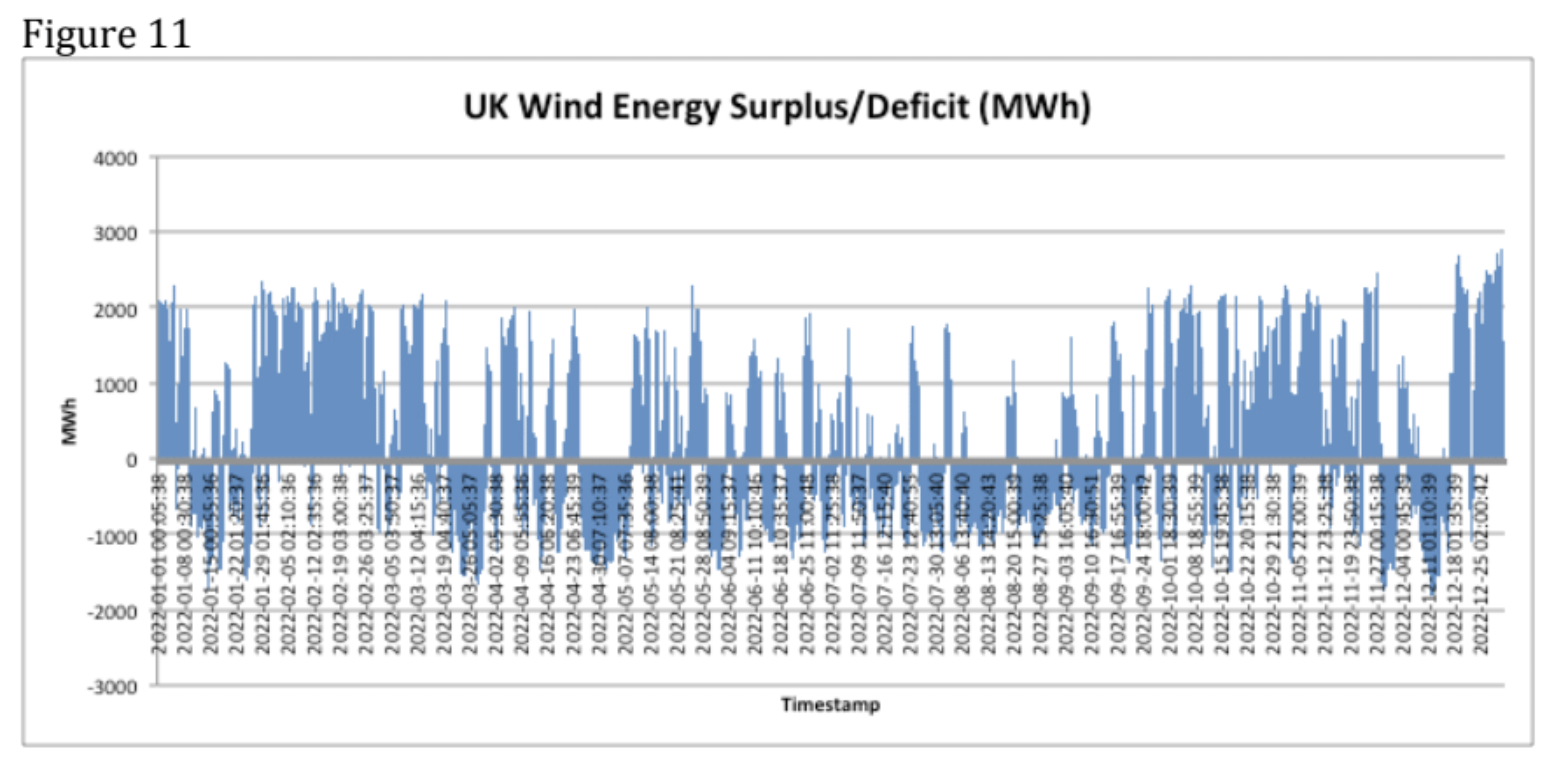
Ponton next assumes purchase of 12,000 GWh of battery storage capacity. With that in place, here is his chart of additions and withdrawals from storage based on the UK 2022 data:

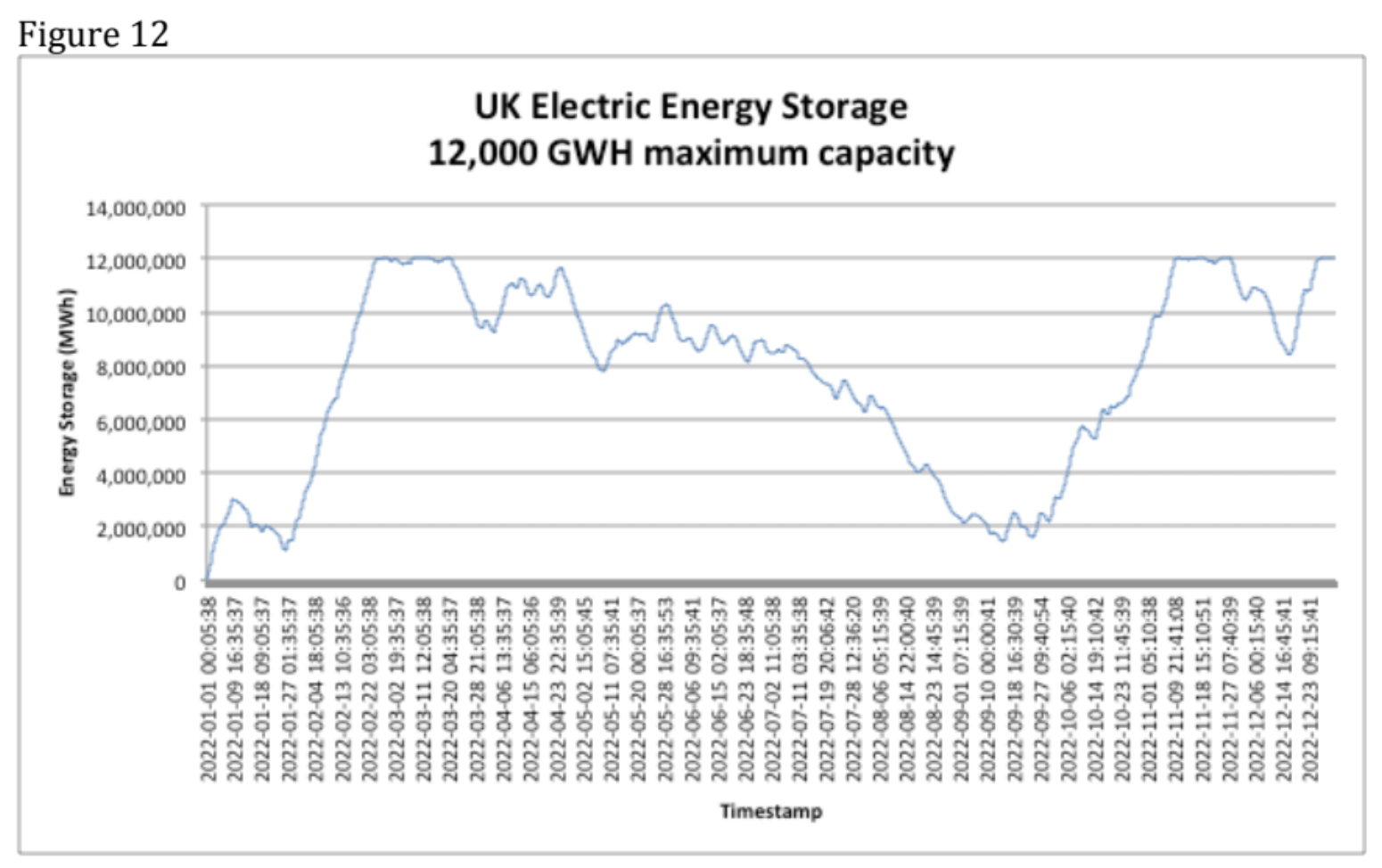
You can immediately see that the wind is much stronger and more consistent in the Spring and Fall than in the Summer. Then, here is the chart of the storage balance, assuming you initialized the system with zero storage at January 1, 2022:

The batteries build up to the 12,000 GWh maximum by about March, then discharge through September, and then begin building the storage balance back up starting in October. On the particular weather pattern of 2022, the 12,000 GWh of storage capacity was sufficient to get through the year, with the minimum stored amount in September being more than 1,000 GWh.

For readers who don’t recall the previous results from Andrews and Gregory, here is Andrews’s comparable chart for California based on 2017 data:

And here is Gregory’s chart for the U.S. with two different lines representing 2019 and 2020 data, both again showing the characteristic seasonal pattern:

All these results clearly illustrate the problem that the energy storage to accomplish the task of using the excess production from wind must have both very large capacity and the ability to charge and discharge in one grand annual cycle. Ponton’s comment:

Batteries do not exist that are up to the task of such long-term energy storage.

Pumped water storage does at least theoretically have the ability to charge and discharge to meet this criterion of an annual cycle, but it also has the problems of enormous cost and, even more important, complete lack of sufficient suitable sites. Ponton:

If there were sites in the UK for pumped storage, it would cost $2 trillion. The UK would have to construct 500 pumped storage facilities with 24,000 MWh capacity [each]. Each would be comparable in size to the largest facility in existence at Bath, VA, which cost $4 billion to construct.

My own comment: Ponton’s illustration of 12,000 GWh of storage needed to get through the year represents about 14-15 days of average usage in the UK. That figure is quite low compared to the amounts of storage found by Andrews and Gregory to be needed for California and the for entire U.S., which are in the range of 25-30 days of average usage. I think the difference is explained by the following things:

  • Andrews and Gregory assumed a renewables mix of wind and solar facilities in similar proportion to what exists currently in California and in the entire U.S., respectively. Ponton assumes only wind as the renewable addition. This makes a substantial difference because solar generation is much more seasonal even than wind, and operates at a much lower average annual capacity factor. (Note that both California and the full U.S. have substantial solar in the mix. Since solar is strongest in the summer, the peak of the annual charge/discharge cycle in the Andrews and Gregory spreadsheets is later in the year than in the Ponton spreadsheet. But the annual cyclical pattern is basically the same.)
  • Ponton assumes that the “other” category of generation currently existing in the UK remains in place. This “other” category consists of a mix of things like coal, nuclear, hydro and biomass, most or all of which may well be on the environmentalists’ chopping block. As shown on Ponton’s charts, the “other “ category operates at a quite steady 10 or so MW, covering almost a third of the UK’s average usage like a “baseload” generator. The continued existence of this “other” category substantially reduces the annual seasonality of production over what would be the case of wind was expected to take over all power generation.
  • Ponton has no assumptions for losses in storage, such as the loss from every charge/discharge cycle, or the dissipation loss from having energy stored in a battery for months on end. Since the costs he comes to are already ridiculous before adding these additional elements, he can be forgiven for not continuing to beat the dead horse.

Ponton does not compute prices for 12,000 GWh of storage using lithium ion batteries, which is reasonable since those batteries are not up to the job of storing energy for 6 months to a year without catastrophic loss. But just to give an idea, at $250 per kWh (lower than current prices for grid-scale storage), 12,000 GWh would run about $3 trillion — approximately equal to the entire annual GDP of the UK. If you start trying to shift the coal and nuclear production in the UK to wind, and if you then consider major losses from trying to store power for up to a year before use, you can multiply that $3 trillion by a factor of 2 or 3 or maybe 4. Whatever.

As stated many times at this site, this will never happen. The only question is how disastrous the crash will be when it all falls apart.

Again, many thanks to Bill Ponton for putting in the work to demonstrate these issues, all without compensation.

Monday, March 20, 2023

Greens refuse to discuss recycling renewables and restoring mining locations to pristine condition

By |March 19th, 2023 46 Comments @ CFACT

The reality is that all the mineral products and metals needed to make wind turbines, solar panels, and EV batteries are mined and processed in places like Baotou, Inner Mongolia, Bolivia, and the Democratic Republic of Congo, mostly under Chinese control. Decommissioning and restoration of those mining landscapes back to their original pristine condition is not in the cards in developing countries. Recycling of worn-out turbine blades, solar panels, and EV batteries, in wealthy countries is also not in the cards.

The sites for the mining of materials required to build wind, solar, and EV batteries are under minimal to nonexistent labor, wage, environmental, reclamation, and worker health and safety regulations. The mere extraction of those exotic minerals presents social challenges, human rights abuses, and environmental degradations worldwide, but are of no significance to the wealthy countries benefiting from those “green” materials.

The climate cult COULD seek decommissioning and restoration standards in those developing countries down to the last dandelion, just like we have for decommissioned mines, oil, and nuclear sites in America, but the climate cult avoids the same in developing countries.

The life cycle for renewable electricity like wind and solar runs from design, procurement, and construction, through operations and maintenance, and repair, as well as the life ending decommissioning and disposal, but again, recycling and restoration of the landscaping back to its original pristine condition, is also not in the cards in the wealthy countries that are going green.

Since the blades and panels and EV batteries are very difficult to recycle, the waste stream created by them is a mounting problem. According to a 2017 study published in the scientific journal Waste Management, the world’s wind industry alone will be producing 43 million tons of blade waste annually by 2050.

Those worn out wind turbines will be the equivalent weight of 215,000 locomotives. The demand of the wealthy economies for more wind turbines are projected to cause 43 million tons of blade waste worldwide by 2050 with China possessing 40 percent of the waste, Europe 25 percent, the United States 16 percent, and the rest of the world 19 percent.

The size and weight of the blades vary, but the average length is around 120 feet, and they weigh around five tons. Some of the largest can be as long as a football field and weigh 20 tons.  Currently, there are no scalable, cost-effective technologies to recycle the blades, and most of them are going to landfills.

Those 1,000-pound EV batteries present similar challenges. With more than 40 percent of all EV’s in America being located in California, there are no EV-battery recycling plants in California, and only five up and running nationwide, according to CalEPA. That’s even though used lithium-ion batteries contain valuable minerals that otherwise must be mined from the earth, mostly from overseas operations in developing countries. The” throw away” society is alive and well in America.

With wealthy countries obsessed with a “green” society, it looks like decommissioning, recycling, and restoration of the mining landscapes in developing countries and renewable generating sites in developed countries back to their original pristine conditions is not in the cards for the foreseeable future.

The vast majority of these critical minerals and elements are mined abroad, and almost all the refining of them is done by China alone.

What’s more, China is the largest single provider of most of the critical minerals and rare earths used around the globe, and is almost the only refiner of such products. This means minerals and rare earth elements mined elsewhere, often with Chinese funding, are shipped to China for processing into usable materials. Much of the mining and refining of materials in China is produced by forced or slave labor, often of persecuted religious minorities, like Falun Gong followers and Uighurs.

The Biden administration declared October 4, 2022 that batteries from China may be tainted by child labor, yet the American government continues to enforce mandates, subsidies, and tax breaks to go green, that provides financial incentives for developing countries to continue their current practices of inflicting environmental degradation to their local landscapes, force labor atrocities upon their workforce.

Concerning China, the Biden administration acknowledged the problem of slave labor, having signed the Uighur Forced Labor Prevention Act in 2021.  Now, the Biden administration is leaning more on Africa to counter China’s control over U.S. energy.

Still, the reality of today’s globalized supply chain and America’s financial incentives that continuously encourage further exploitations of humanity and the environment makes it almost a certainty the massive green energy transition being pushed by the Biden administration will be built with minerals and parts produced using Chinese and/or African slave labor.

With insufficient intelligence on the ground in China or Africa to track forced-labor manufacturing, and less still the raw materials, wealthy countries will continue to exploit the folks with yellow, brown, and black skin in developing countries.

In economic terms, the wealthier countries climate hysteria is imposing severe negative externalities on developing countries. Ethically, the West’s climate obsession is immorally condemning present generations of impoverished peoples and nations to continued perjury and early deaths in the years ahead. Make no mistake, this ruse exists to further enrich people in developed countries while they simultaneously exploit those in developing countries.

Author

  • Ronald Stein

    Ronald Stein is an engineer, senior policy advisor on energy literacy for CFACT, and co-author of the Pulitzer Prize nominated book “Clean Energy Exploitations.”


Tuesday, January 10, 2023

Vital energy lessons for Virginia and America

Legislators shouldn’t Californicate Virginia or America on EVs and Green Energy

By Paul Driessen        

When they open their 30-day session January 11, Virginia’s Senate and House of Delegates must correct some serious energy mistakes they made two years ago, when Democrats controlled nearly the entire state government and passed the “Virginia Clean Economy Act.”

One of its party-line provisions requires that Virginia adopt California’s requirement that only low emission vehicles (LEVs) be sold by model year 2025 and only zero emission vehicles (ZEVs) by MY 2035. That means in barely twelve years only new electric vehicles (EVs) could be sold in Virginia.

Again mimicking California, in addition to EVs, the VCEA also requires a massive shift from affordable, reliable coal and natural gas-generated electricity to expensive, weather-dependent, land-intensive wind and solar electricity, stabilized and backed up by huge batteries.

As I’ve explained previously (here, here, here and here), this is unworkable. Texas, Buffalo and the Midwest have demonstrated that heavy reliance on wind and solar can bring deadly blackouts during blizzards. California told residents not to charge their soon-to-be-mandatory EVs during last summer’s heat waves, to prevent blackouts. Switzerland might ban EV charging this winter for the same reason.  

The Suburban Virginia Republican Coalition PAC (SUVGOP) recognizes these realities, and understands that the wind turbines, solar panels and transmission lines will not be in Democrat strongholds like Alexandria, Arlington, Falls Church and Richmond. They will be in beautiful rural Virginia, which will also be hardest hit by bans on gasoline and diesel vehicles. SUVGOP has therefore gotten the ball rolling on reversing these ill-advised laws, by launching a campaign to repeal LEV/ZEV mandates.

SUVGOP calls its campaign “Don’t CA my VA.” (When I lived in the Centennial State, bumper stickers proclaimed a crasser version of this message: “Don’t Californicate Colorado.”)

Arguments for avoiding or terminating LEV/ZEV mandates are compelling – for Virginia and America.

* While great for short hauls and some motorists, EVs don’t get you far along on your 800-mile vacation trip; recharging can take hours, depending on multiple factors; and charging stations are more limited off main highways.

* You don’t want to get caught in your EV during a hurricane evacuation or blizzard, especially since already limited battery life decreases in cold weather and with heater or AC use.

* EVs (and backup batteries) can burst into chemical-fueled infernos, especially if they get immersed in water. That can be catastrophic and deadly if the EV is in a home or underground garage (or on a cargo ship loaded with EVs). The fires cannot be extinguished with water.

* EVs require 3-4 times more metals than internal-combustion cars: copper, iron, nickel, aluminum, cobalt, lithium, rare earths and others. Those materials don’t just appear via Materials Acquisition for Global Industrial Change mechanisms (MAGIC). They must be dug out and processed, somewhere.

China’s BYD Auto company alone used 13,000 tons of copper to make EVs in 2016. Based on average porphyry ore deposits today, every 100,000 tons of copper requires processing 23,000,000 tons of copper ore, after removing 35,000,000 tons of overlying rock – using explosives and fossil fuels!

Start calculating how many billions of tons of copper and other metals and minerals would be required for all the EVs, wind turbines, solar panels, transmission lines, and grid-stabilizing and backup batteries Virginia, or your state, or the United States or entire world, are planning to mandate. Then calculate how many trillions of tons of ore that would require – and how much mining, blasting, processing and fuel.

Where will all that work take place? In whose backyards? With how much ecological destruction, air and water pollution, hazardous waste generation, slave and child labor, and human health risks?

“Clean” energy and vehicles? There may be zero emissions out of Virginia EV tailpipes – maybe even at the electricity source, if it comes from wind or solar power, when the wind is blowing and sun is shining.

But there is no “zero emissions” for mining, processing and manufacturing. It just happens somewhere else, often in Africa or Asia, often by Chinese companies – affecting someone else’s air and water quality, scenery, croplands, wildlife habitats, wildlife, health and wellbeing.

Meanwhile, millions of acres of Virginia and US lands would be covered with turbines, panels, transformers and transmission lines; millions of birds, bats and other animals would be killed annually.

Bottom line: There is no such thing as “clean, green, renewable, sustainable” energy or vehicles. It’s just a matter of where and how and how much the mining and materials processing, manufacturing and emissions take place. It’s just a matter of how good the “green” PR programs are; and whether US environmentalists, journalists and politicians recognize ... or cancel and censor ... these realities.

Earth’s atmospheric, oceanic and climate systems are global. The loss of habitats and species is a global problem. We should think globally, and act locally.

Regarding backup batteries, the VCEA mandates acquisition of 3,100 megawatts of storage. Assuming legislators meant 3,100 megawatt-hours, this would require some 36,000 Tesla half-ton 85-kWh modules; and it would still meet less than 1% of Virginia’s average daily electricity consumption (and less than 0.5% of its peak demand). This doesn’t include batteries to stabilize wind-solar grid fluctuations.

Virginia legislators therefore need to address these vitally important issues, as well – with some precision:

* How many wind turbines, solar panels, transformers, backup/grid-balancing battery modules, and miles of new transmission lines will The Old Dominion need to replace existing coal and gas generation?

* How many more will it require after half of all cars, trucks and buses are electric? After restaurants and new and remodeled homes are forced to have electric home and water heating, stoves and ovens, instead of gas – and upgrade home and neighborhood electrical systems to handle the added loads?

* Where and on whose property will all these “renewable” systems and power lines be installed? How many millions of acres of land and coastal areas (and their wildlife) will be impacted? Will residents or local governments be able to veto developments? How often will eminent domain be employed?

* How many millions (billions?) of tons of metals, minerals, carbon-fiber composites, plastics, concrete and other materials will be needed? How much ore, overburden and fuels? How many tons of pollution will be emitted, cumulatively, throughout the mining-processing-manufacturing-transportation process?

* How many of these materials (and turbines, panels, battery modules and transformers) will come from China or other adversarial nations, or their surrogates?  

* Under what pollution control, wildlife habitat and endangered species protection, workplace safety, slave and child labor, and other “responsible sourcing” laws will all this work be done?

* Where will worn out, broken and obsolete solar panels, enormous wind turbine blades and other non-recyclable equipment be landfilled?

* How many billions or trillions of dollars will all this cost Virginia and US ratepayers and taxpayers?

It takes more than declaring that actions taken under “clean economy” laws are “in the public interest” to make it so. It’s vital that legislators look beyond tailpipes, and beyond Virginia or US borders, to avoid destroying the planet with wind and solar, to save it from fossil fuels and “manmade climate change.”

The 2023 legislative session is a perfect opportunity to start reexamining “clean economy” assumptions, misconceptions and mandates – and implementing reality-based Environment-Social-Governance (ESG) principles. Are Virginia’s legislators up to the task?  


Paul Driessen is senior policy analyst for the Committee For A Constructive Tomorrow (www.CFACT.org) and author of books and articles on energy, environment, climate and human rights issues.