Search This Blog

De Omnibus Dubitandum - Lux Veritas

Showing posts with label Energy Storage. Show all posts

Monday, October 21, 2024

The DEFR Follies -- Cost Of Hydrogen Storage

October 18, 2024 @ Manhattan Contrarian

Here in New York we have our own unique and special acronym for how we think we are going to make our future emissions-free electrical grid work with predominantly wind and solar generation. The acronym is DEFR — the “Dispatchable Emissions-Free Resource.” When the sun goes down and the wind stops blowing in the dead of winter, we will crank up the DEFR to keep us all warm and cozy. There will of course be zero carbon emissions, because by definition the DEFR is “emissions-free.”

Unfortunately nobody is quite sure what this DEFR might be. There are only a few options. Nuclear could work, but in New York it is completely blocked by regulatory obstruction and the certainty of decades of litigation. Batteries are wildly too expensive and physically not up to the job. That leaves many green energy advocates grasping at hydrogen as the last remaining option. Granted, we don’t yet have any meaningful production of hydrogen from carbon-free sources. But it seems so simple: just use wind and solar generators to run electrolyzers to make hydrogen from water; then store the hydrogen in some big caverns, and burn it when you need it. No carbon is involved. Problem solved!

I’ve had a few posts over the past couple of years commenting on some of the many issues that make this “green” hydrogen fantasy infeasible. This post from June 2022 noted that the cost of making hydrogen from water is unlikely ever to fall below, or even close to, the cost of getting new natural gas out of the ground; this post from August 2024 discussed numerous other problems with hydrogen, like its lower energy density compared to natural gas, and the prospective need for a whole new infrastructure of pipelines, power plants, delivery trucks and consumer appliances.

Now comes along a new study focusing on a different piece of the costs of using hydrogen as a main energy source for the economy. The issue is the cost of storing the hydrogen from the time of its production until it is needed for use. The new study appeared in the scientific journal Joule on October 8 with the title “Carbon abatement costs of green hydrogen across end-use sectors.” (The link goes just to a lengthy introduction and abstract. You’ll need to pay $35 to get the whole article, but the introduction at the link tells you what you need to know.)

Perhaps most significant about this new study is the authors. They are Roxana Shafiee and Daniel Schrag, both of whom work at Harvard and have impeccable climate cult credentials, including multiple appointments at various Harvard sub-schools and institutes (Harvard University Center for the Environment, Harvard Department of Earth and Planetary Sciences, Harvard Paulson School of Engineering and Applied Sciences, Harvard Kennedy School Belfer Center for Science and International Affairs — you get the idea). These are not people who can be dismissed as “climate deniers.”

Shafiee and Schrag correctly recognize that the cost of producing hydrogen from water is just a piece, and possibly a small piece, of the cost of getting useful hydrogen to a consumer at point of use. They criticize green hydrogen enthusiasts for paying insufficient attention to other costs, and particularly to the costs of “storage and distribution”:

Hydrogen generated via electrolysis using renewable energy (green hydrogen) has gained prominence as a potential strategy in decarbonizing hard-to-abate sectors of the economy, in which electrification is technically challenging or prohibitively expensive. Many governments have set policy targets and, in some cases, financial incentives for green hydrogen production, with the expectation that production costs will fall rapidly in the coming decades, providing low-cost carbon abatement opportunities across many sectors. Yet, many recent analyses do not consider the storage and distribution costs of delivering green hydrogen to different sectors or how these costs may vary across end uses.

So Shafiee and Schrag set out to correct those deficiencies. To their credit, S&S have figured out that the costs of distribution and storage infrastructure are highly dependent on how intensely that infrastructure is used. (As far as I can determine, not one of the thousands of people in the vast New York energy regulatory bureaucracies has yet figured out this simple principle.) The more often the storage gets cycled, the lower the charge for each unit of energy stored and then used. S&S note that some sectors, particularly industries like petrochemicals and steel, can cycle hydrogen storage many times per month, thus driving down costs. Unfortunately, the same does not apply to the power sector:

Although low costs of hydrogen storage and distribution (<$1/kgH2) are possible through economies of scale, this requires high utilization of storage and distribution infrastructure, which is not applicable to all end-use sectors. If storage and distribution infrastructure is used at a low rate, costs increase significantly. Salt cavern storage costs increase from less than $0.50/kgH2 to $6/kgH2, on average, if stores are cycled fewer than 10 times per year, for example, in the context of seasonal changes in demand (e.g., heating or electricity generation).

That’s right: hydrogen produced and stored for purposes of home heating only gets cycled once per year at most. To understand the significance of the costs cited, recall that the energy-equivalence conversion factor from $/kgH2 to $/MMBTU (the units in which natural gas prices are customarily quoted) is 8. $6/kgH2 converts to $48/MMBTU. And that’s just for the intra-year storage. Meanwhile, the current price for Henry Hub natural gas is $3.06/MMBTU, and most of it does not need to be stored for any significant period because it gets produced roughly as needed to meet demand.

So kudos to S&S for figuring out that cost of storage for hydrogen is a big and unrecognized issue. But unfortunately, they only go as far as considering intra-year storage. There is also a huge issue of multi-year storage if green hydrogen is to become the backup for a grid powered mostly by wind and sun. In a post on September 28, 2023, I covered a Report then just out from Britain’s Royal Society dealing with issues of long-term energy storage to back up wind and solar generators. The Royal Society had collected weather data for Britain for some 37 years, which had revealed that there are worst-case wind and sun “droughts,” comparable to rain droughts, that may occur only once every 20 years or more. A storage solution to back up wind and solar electricity generation without fossil fuel back-up needs to cover these worst-case droughts.

The Royal Society Report includes the following graph of potentially needed withdrawals from storage to cover these worst case droughts: 

Editor's Note: There's a chart here I can't properly reproduce, please follow the link to the original article. RK

 The graph shows that of the storage needed for full back-up over the 37 year period of data, fully half would only have been called on twice, and about a quarter would only have been called on once. Perhaps S&S should go back to their laptops to figure out how much salt cavern storage costs per unit of energy stored when it only gets called on once in 37 years. If storage that gets cycled once per year costs $6/kgH2, does storage that gets cycled once per 37 years cost $222/kgH2? The blended cost — between the storage that gets cycled once per year and the rarely-used part that gets cycled only once every 10 or 20 or even 37 years — would look to be around $100/kgH2, equivalent to $800/MMBTU of natural gas. That’s more than 250 times the current price of natural gas, and of course is only the cost of storage. The cost of actually producing the hydrogen would be additional.

I understand that there are people moving forward on setting up some of this hydrogen infrastructure, funded with government subsidies. It’s almost impossible to imagine how much subsidies it would take to make such a system fully functional. It will never happen.

Sunday, March 10, 2024

New York And California Getting Totally Lost With Energy Storage

March 08, 2024 @ Manhattan Contrarian 

For a number of years, I’ve been observing demands of activists and promises of politicians that we transition our electrical grid to being supplied mainly by the intermittent renewables, wind and solar, with all large dispatchable sources (fossil fuel and nuclear) banished. Early on, I thought it was obvious that such a transition would inevitably mean that the only way to make the grid function full-time would be energy storage — on a vast scale never before contemplated or attempted.

How much storage, and at what potential cost? This is actually an arithmetic problem, somewhat cumbersome but conceptually very elementary, and easily done with today’s widely-available spreadsheet programs. To help matters along, in December 2022 I produced my energy storage Report (“The Energy Storage Conundrum”), laying out the main options and the calculations involved. My conclusion was that I could not see any way that this could be done at remotely feasible cost. (Anybody who disagrees is welcome to prove me wrong.) Today, if somebody wants to effect an energy transition in a state or country, they can just look to my Report to quickly understand the nature and extent of the energy storage challenge.

What has actually occurred since December 2022 is that our “climate leader” jurisdictions — in the U.S., that would be New York and California — have moved forward with energy storage proposals that any moron can easily see will not work. Both states are in the process of spending huge sums of money on storage capacity that is so small as to be meaningless to address the problem, and at the same time not technically capable of meeting the challenge no matter the cost. Naturally, the federal government is also involved to pick up a big chunk of the wasted cost from its infinite pile of money.

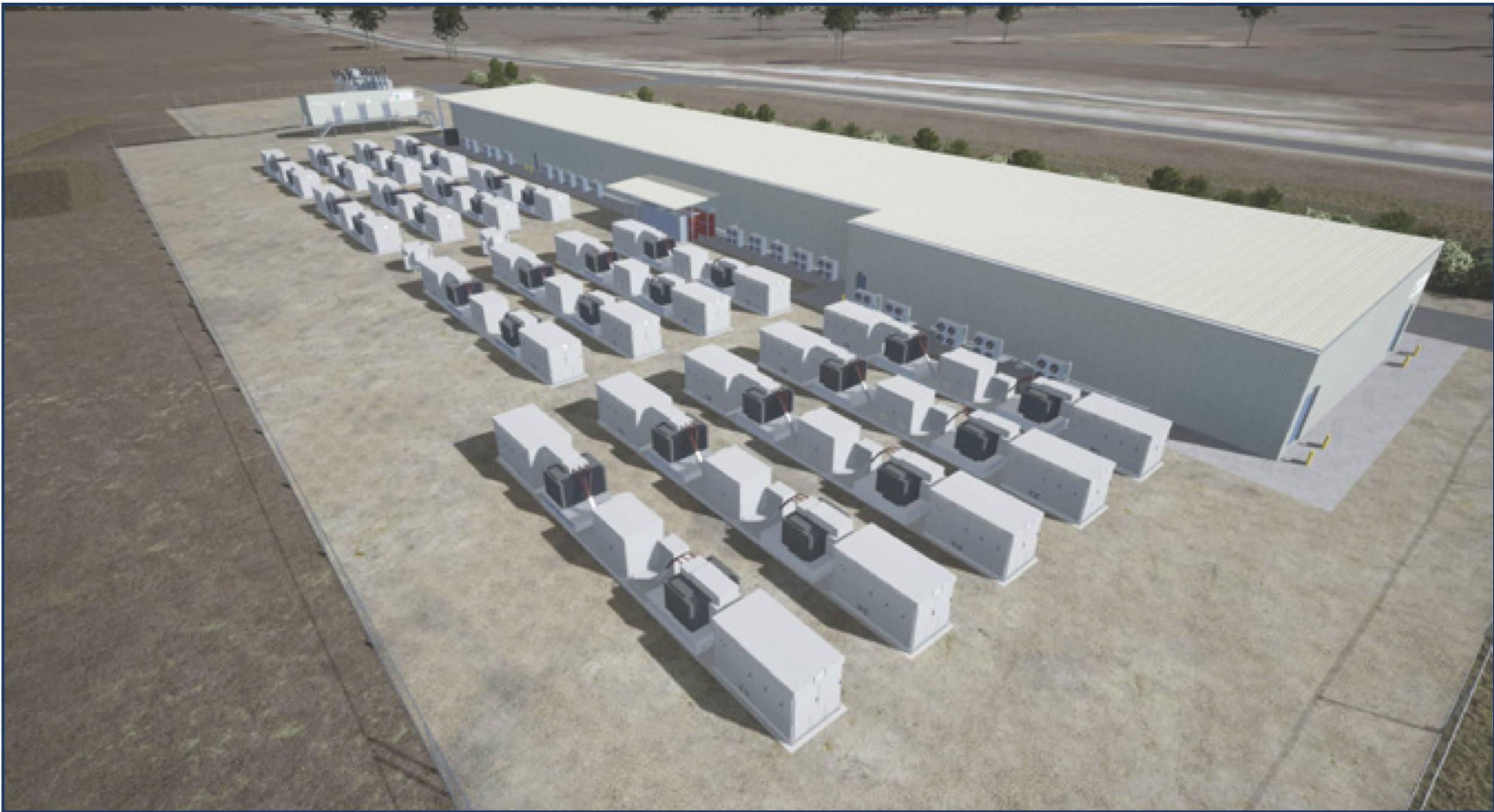
As to New York, a reader sends me a link to this June 2023 federal Department of Energy letter to the New York bureaucrats, approving a loan guarantee for construction of a 300 MW battery storage facility for grid backup. The facility in question is proposed to be placed on some large barges and anchored in the East River in the bay that once was the site of the Brooklyn Navy Yard. In some respects 300 MW is a very large battery storage facility. These are 4-hour duration batteries, so we are talking 1200 MWh of storage. My Report had a picture of a 150 MWh battery storage facility then under development in Queensland, Australia:

This one for New York would be eight times bigger! But would it be a meaningful amount of storage for backing up wind and solar generation? No. My report found, based on calculations from various jurisdictions, that about a month’s worth of storage would be the minimum needed to get through a full year without running out of power. A (30 day) month is 720 hours. New York State’s average electricity demand (from a 2023 NYISO Report linked in my previous post) is about 17,000 MW. So the 1200 MWh battery provides storage to back up the grid for — about 4.2 minutes. To get your 720 hours of backup, you will need about 10,200 of them. Bloomberg NEF gives the average 2024 price of a lithium ion battery as $150 per kWh. So this one 1200 MWh facility will run about $180,000,000 for the batteries alone. (Note that they are putting the batteries on barges and dredging the harbor to make it deep enough to anchor them there. Without doubt the final cost will be well more than double the $180 million.). 10,200 of these at the highly optimistic $180 million each will run close to $2 trillion.

Nobody in New York government is making these simple calculations. Instead, they forge ahead undeterred, without any idea how much storage is needed or how it is going to work or how much it will cost. This August 2023 article from Canary Media says that the Governor has set a goal of 6000 MW of battery storage by 2030:

[Governor Hochul] is pushing to increase the state’s battery storage capacity from about 300 megawatts today to 6,000 megawatts in 2030, to complement an expansive buildout of renewable generation.

As always, they speak of the wrong units, MW instead of MWh. But if these are the usual 4-hour batteries, 6000 MW would be 24,000 MWh. Now we’re up to about an hour and 25 minutes of storage for the State, versus a basic requirement of 720 hours. And that paltry amount will run us (at $150/kWh) at least $3.6 billion.

And California is no more numerate. Here’s a Los Angeles Times piece from October 2023 with figures on California’s plans for battery storage to back up its wind/solar-based grid:

If California is going to meet its ambitious goals to transition from electricity using fossil fuels, the state will need energy storage to shoulder a significant amount of the load. . . . Four years ago, the state counted a mere 250 megawatts of battery storage available to the California Independent System Operator, which manages the grid for 80% of the state and a small part of Nevada. By the end of this year, that number is expected to grow to 8,000 megawatts. And the amount of battery storage integrated fully into the grid is expected to increase to 19,500 megawatts by 2035 and 52,000 megawatts by 2045.

Once again, it’s the usual MW instead of MWh. But assume that that 52,000 MW in 2045 will be 4-hour duration batteries, so 208,000 MWh. At $150/kWh, that will cost California a cool $31.2 billion. And how long will that last if it starts fully charged and the wind is calm at night? This federal Department of Energy webpage gives California’s current annual electricity demand as 259.5 TWh, or 259,500 GWh. Divide by 8760 (hours in a year) and you get average demand of about 30,000 MW. So the 208,000 MWh of storage will last about seven hours. You’ll need about a hundred times that amount — at a cost of $3+ trillion — to get the 720 hours of storage that you will need.

The amounts of storage that they are talking about are so ridiculously inadequate that I won’t even bother getting to the issue of whether these lithium ion batteries can handle the physical task at hand, which in the real world would involve storing energy for a year and more before it is used, without having it drain away. But before closing, I would be remiss not to mention that both the Canary Media and LA Times pieces linked above devote considerable space to the issue of lithium ion battery fires. It seems that in both New York and California, the really tiny amounts of grid-scale battery storage built to date have been plagued by repeated major fires. From New York:

New York state is grappling with how to adjust its ambitious buildout of clean energy storage after fires broke out at three separate battery projects between late May and late July [2023]. . . . First, on May 31, a battery that NextEra Energy Resources had installed at a substation in East Hampton caught fire. . . . Then, on June 26, fire alarms went off at two battery units owned and operated by Convergent Energy and Power in Warwick, Orange County; one of those later caught fire. On July 27, a different Convergent battery at a solar farm in Chaumont caught fire and burned for four days straight.

Funny that these fires don’t seem to be news in the mainstream press. Here from the Canary piece is a picture of the fire at the Chaumont facility:

 It’s the same exact story in California — repeated fires at the handful of grid battery storage facilities that have so far gone operational. From the LA Times piece:

[A] persistent problem keeps coming up — fires igniting at battery storage facilities. Most recently, a fire broke out at the Valley Center Energy Storage Facility in San Diego County on Sept. 18 [2023]. Although fire officials said the blaze was put out in about 45 minutes and extinguished by the site’s internal fire prevention system, businesses and the small number of homes within a quarter-mile of the industrial park where the facility is located were evacuated and shelter-in-place orders were in effect within a half-mile of the site. . . . In September 2022, a Tesla Megapack caught fire at a battery storage facility operated by Pacific Gas & Electric in the Northern California town of Moss Landing. No injuries were reported, but California Highway Patrol closed a section of Highway 1 and redirected traffic away from the site for hours.

Just wait until they have 208,000 MWh worth of these things out there.

Thursday, September 7, 2023

The Elites Directing The Energy Transition Really Have No Idea What They Are Doing

September 06, 2023 @ Manhattan Contrarian

We are on our way to Net Zero by 2050. It must be true because everybody says so. The entire $6+ trillion per year federal government is committed to the project, which obviously would not be the case if the whole thing were impossible. Equally fully committed are essentially all of the colleges and universities, where all of the smartest people are to be found. As well as every other elite institution of every kind and sort.

Take the World Economic Forum. If there is a number one elitist among all elite institutions, this has to be it. At their annual confab in Davos, Switzerland, they gather the greatest of geniuses to instruct the very top government and business leaders how to run the world. Would you like to go? It will cost you $52,000 to join the organization, and then an additional $19,000 to attend the conference. Chartering a private jet to get you there will cost a few more thousand. Once there, you can hear the very smartest people imparting their thoughts on the most important topics of the day, like “The Great Reset,” “Emerging Technologies,” “Diversity and Inclusions,” and, of course, “The Net Zero Transition.”

Is it possible that these people are completely incompetent and have no idea what they are doing?

A reader has sent me the very latest from the WEF on how the world is going to get to Net Zero. The piece has a date of September 5, 2023, and is titled “How battery energy storage can power us to Net Zero.” The authors are three people from the World Bank, with the lead author being one Amit Jain, who is the Bank’s Energy Storage Program Lead. This is the guy on the receiving end of tens of billions of dollars of government money to pass out to make the energy transition happen throughout the developing world.

Now, it so happens that energy storage is something I know a little about, and in particular about the problem of trying to store enough energy to make an electrical grid work without full dispatchable backup. See my energy storage Report, dated December 1, 2022, at this link.

So let’s take a look at Jain, et al.’s, take on how battery storage will “power us to Net Zero.” First, some excited happy talk:

Across the globe, power systems are experiencing a period of unprecedented change. Low-cost renewable electricity is spreading and there is a growing urgency to boost power system resilience and enhance digitalization. This requires stockpiling renewable energy on a massive scale, notably in developing countries, which makes energy storage fundamental. . . .

Making energy storage systems mainstream in the developing world will be a game changer. Deploying battery energy storage systems will provide more comprehensive access to electricity while enabling much greater use of renewable energy, ultimately helping the world meet its Net Zero decarbonization targets. International organizations and development institutions are leading the way forward to enable this decarbonization. . . .

So OK Amit, how much storage are we talking about here?

In 2022, approximately 192GW (gigawatts) of solar and 75GW of wind were installed globally. However, only 16GW/35GWh (gigawatts per hour) of new storage systems were deployed. A recent International Energy Agency analysis finds that although battery energy storage systems have seen strong growth in recent years, grid-scale storage capacity still needs to be scaled up to reach Net Zero Emissions by 2050. . . . To meet our Net Zero ambitions of 2050, annual additions of grid-scale battery energy storage globally must rise to an average of 80 GW annually between now and 2030.

Holy underwear, Batman! Could this guy really not even know what units he’s talking about? Thinking his readers might not understand the abbreviation “GWh” he helpfully defines it as “gigawatts per hour”! Could he really be this clueless? And he had two co-authors to check him!

And then there’s the statement that to meet the 2050 Net Zero ambition, annual deployments of grid-scale batteries “must rise to an average of 80 GW annually.” Of course he is using the wrong units (and undoubtedly does not know that). But let’s give him the benefit of the doubt, and assume that he is talking about the standard batteries available today, which are 4 hour batteries, meaning that 80 GW would provide 320 GWh of storage. If the world would add that much capacity every year from now to 2050, that would come to 8960 GWh of storage. How have Mr. Jain et al. come to the conclusion that this 8960 GWh of storage will be enough to “meet our Net Zero ambitions of 2050”? The piece contains no quantitative analysis or backup of any kind to support the proposition that this amount of storage would be sufficient.

My own energy storage Report does contain backup and calculations, although only for certain countries rather than for the whole world. For example, for the United States, the figures cited in my Report are that it would take some 233,000 GWh of battery storage to fully back up the electrical grid, assuming current levels and patterns of usage. Since the U.S. is about 4% of world population, we can multiply that figure by 25 to get the storage requirement for the world (assuming that the world electrifies to the U.S. level by 2050). The total would be 5,825,000 GWh. In other words, Jain, et al., are off by a factor of about 650, give or take maybe a few hundred.

But it’s OK, because Jain and his colleagues have no skin in this game. They just babble some happy talk to get their hands on a few hundred billions of money from rich governments, and pass it out to build impressive-looking battery projects that are actually next to useless to provide reliable grid electricity. They can be very confident that no one in their circles will ever check the math to see if the numbers add up. When 2050 rolls around and the whole thing doesn’t work, they will be long retired on generous pension.

Tuesday, December 6, 2022

My Energy Storage Report: Hydrogen As An Alternative To Batteries

65 Comments

Editor's Note:  While this isn't listed as "Part II", I would consider this piece to be such after his last commentary on this, The Manhattan Contrarian Energy Storage Paper Has Arrived!  While this isn't being presented as a series, so much of his work deals with the insane folly of alternative energy.  Folly those promoting it must be aware of, along with the consequences of those actions to humanity, and yet still promote it.  Please peruse my files.

As mentioned in the last post, my new energy storage report, The Energy Storage Conundrum, mostly deals with issues that have previously been discussed on this blog; but the Report goes into considerable further detail on some of them.

One issue where the Report contains much additional detail is the issue of hydrogen as an alternative to batteries as the medium of energy storage. For examples of previous discussion on this blog of hydrogen as the medium of storage to back up an electrical grid see, for example, “The Idiot’s Answer To Global Warming: Hydrogen” from August 12, 2021, and “Hydrogen Is Unlikely Ever To Be A Viable Solution To The Energy Storage Conundrum” from June 13, 2022.

At first blush, hydrogen may seem to offer the obvious solution to the most difficult issues of energy storage for backing up intermittent renewable generation. In particular, the seasonal patterns of generation from wind and sun require a storage solution that can receive excess power production gradually for months in a row, and then discharge the stored energy over the course of as long as a year. No existing battery technology can do anything like that, largely because most of the stored energy will simply dissipate if it is left in a battery for a year before being called upon. But if you can make hydrogen from some source, you can store it somewhere for a year or even longer without significant loss. Problem solved!

Well, there must be some problem with hydrogen, or otherwise people would already be using it extensively. And indeed, the problems with hydrogen, while different from those of battery storage, are nevertheless equivalently huge. Mostly, to produce large amounts of hydrogen without generating the very greenhouse gas emissions you are seeking to avoid, turns out to be enormously costly. And then, once you have the hydrogen, distributing it and handling it are very challenging.

Unlike, say, oxygen or nitrogen, which are ubiquitous as free gases in the atmosphere, there is almost no free hydrogen available for the taking. It is all bound up either in hydrocarbons (aka fossil fuels — coal, oil and natural gas), carbohydrates (aka plants and animals), or water. To obtain free hydrogen, it must be separated from one or another of these substances by the input of energy. The easiest and cheapest way to get free hydrogen is to separate it from the carbon in natural gas. This is commonly done by a process called “steam reformation,” which leads to the carbon from the natural gas getting emitted into the atmosphere in the form of CO2. In other words, obtaining hydrogen from natural gas by the inexpensive process of steam reformation offers no benefits in terms of carbon emissions over just burning the natural gas. So, if you insist on getting free hydrogen without carbon emissions, you are going to have to get it from water by a process of electrolysis. Hydrogen obtained from water by electrolysis is known by environmental cognoscenti as “green hydrogen,” because of the avoidance of carbon emissions. Unfortunately, the electrolysis process requires a very large input of energy.

How much is it going to cost to produce green hydrogen as the storage medium for a mainly wind/solar grid? My Report first notes that as of today there is almost no production of this green hydrogen thing:

To date, there has been almost no commercial production of green hydrogen, because electrolysis is much more expensive than steam reformation of natural gas, and is therefore uneconomic without government subsidy. The JP Morgan Asset Management 2022 Annual Energy Paper states that ‘Current green hydrogen production is negligible...’

So we don’t have any large functioning projects from which we can get figures for how expensive green hydrogen is going to be. In the absence of that, I thought to undertake an exercise to calculate how much capacity of solar panels it would take to produce 288 MW of firm power for some jurisdiction, where the panels could either provide electricity directly to the consumers or alternatively produce hydrogen by electrolysis that could be stored and then burned in a power plant to produce electricity. (The 288 MW figure was selected because GE produces a turbine for natural gas power plants with this capacity, and says that it can convert the turbine for use of hydrogen as the fuel.). Here is that exercise as written up in my Report:

Consider a jurisdiction with steady electricity demand of 288 MW. . . . The electricity needs of our jurisdiction can be fully supplied by burning natural gas in the plant. But now suppose we want to use solar panels to provide the electricity and/or hydrogen for the plant sufficient to supply the 288 MW firm throughout the year. What capacity of solar panels must we build? Here is a calculation:

• Over the course of the year, the jurisdiction will use 288 MW × 8760 hours = 2,522,880 MWh of electricity.

• We start by building 288 MW of solar panels. We will assume that the solar panels produce at a 20% capacity factor over the course of a year. (Very sunny places such as the California desert may approach a 25% capacity factor from solar panels, but cloudy places such as the Eastern US and all of Europe get far less than 20% of capacity; in the UK, typical annualised solar capacity factors are under 15%). That means that the 288 MW of solar panels will only produce 288 × 8760 × 0.2 = 504,576 MWh in a year.

• Therefore, in addition to the 288MW of solar panels directly producing electricity, we need additional solar panels to produce hydrogen to burn in the power plant sufficient to generate the remaining 2,018,304 MWh.

• At 80% efficiency in the electrolysis process, it takes 49.3 kWh of electricity to produce 1 kilogram of hydrogen. GE says that its 288 MW plant will burn 22,400 kilograms of hydrogen per hour to produce the full capacity. Therefore, it takes 49.3 × 22,400 = 1,104,320 kWh, or approximately 1,104 MWh of electricity to obtain the hydrogen to run the plant for one hour. For the 1,104 MWh of electricity input, we get back 288 MWh of electricity output from the GE plant.

• Due to the 20% capacity factor of the solar panels, we will need to run the plant for 8760 × 0.8 = 7008 hours during the year. That means that we need solar panels sufficient to produce 7008 × 1104 = 7,736,832 MWh of electricity.

• Again because of the 20% capacity factor, to generate the 7,736,832MWh of electricity using solar panels, we will need panels with capacity to produce five times that much, or 38,684,160 MWh. Dividing by 8760 hours in a year, we will need solar panels with capacity of 4,416 MW to generate the hydrogen that we need for backup.

• Plus the 288MW of solar panels that we began with. So the total capacity of solar panels we will need to provide the 288MW firm power using green hydrogen as backup is 4,704 MW.

Or in other words, to use natural gas, you just need the 288 MW plant to provide 288 MW of firm power throughout the year. But to use solar panels plus green hydrogen backup, you need the same 288MW plant to burn the hydrogen, plus more than 16 times that much, or 4,704 MW of capacity of solar panels, to provide electricity directly and to generate sufficient hydrogen for the backup.

That calculation assumed a 20% capacity factor of production from the solar panels over the course of a year. It turns out that actual solar capacity factors are more like 10-13% for Germany, 10-11% for the UK, and about 12.6% in New York. (California, with few clouds, gets capacity factors somewhat in excess of 25%.). Doing the same series of calculations using a 10% capacity factor for the solar panels, you will need something like 9,936 MW of solar panels to provide your 288 MW of firm power for the year, with the green hydrogen as your storage medium.

In other words, you will need about 35 times the capacity of solar panels as the amount of firm power that you are committed to provide. The reasons for the vast differential include: the sun doesn’t shine fully half the time; most of the time when the sun does shine it is low in the sky; places like the UK, Germany and New York are cloudy more often than not; and there are significant losses of energy both in electrolyzing the water and then again in burning the hydrogen.

Anyone and everyone should feel free to check my arithmetic here. I’m fully capable of making mistakes. However, several people have already checked this.

My Report then takes a stab at translating the enormous incremental capital cost of all these solar panels into a very rough cost comparison of trying to generate the 288 MW of firm power from solar panels and green hydrogen versus simply burning natural gas in the plant. I got cost figures for the turbine plant and the solar panels from a March 2022 report of the U.S. Energy Information Agency. Using that data:

[T]he cost of the 288MW General Electric turbine power plant [would be] around $305 million, and the cost of the 4,704 MW of solar panels [would be] around $6.25 billion.

If you needed the 9,936 MW of solar panels because you live in a cloudy area, the $6.25 billion would become about $13 billion.

My very rough calculation in the Report, with the 20% solar capacity factor assumption, is that electricity from solar panels plus green hydrogen storage would start at somewhere in the range of 5 to 10 times more expensive than electricity from just burning the natural gas. At the 10% solar capacity factor assumption, make that 10 to 20 times more expensive.

And after all of this we still haven’t gotten to the very substantial additional engineering challenges of working with the very light, explosive hydrogen gas. A few examples from the Report:

  • Making enough green hydrogen to power the world means electrolysing the ocean. Fresh water is of limited supply, and is particularly scarce in the best places for solar power, namely deserts. When you electrolyse the ocean, you electrolyse not only the water, but also the salt, which then creates large amounts of highly toxic chlorine, which must be neutralised and disposed of. Alternatively, you can desalinise the seawater prior to electrolysis, which would require yet additional input of energy. There are people working on solving these problems, but solutions are far off and could be very costly.

  • Hydrogen is only about 30% as energy dense by volume as natural gas. This means that it takes about three times the pipeline capacity to transport the same energy content of hydrogen as of natural gas. Alternatively, you can compress the hydrogen, but that would also be an additional and potentially large cost.

  • Hydrogen is much more difficult to transport and handle than natural gas. Use of the existing natural gas pipeline infrastructure for hydrogen is very problematic, because many existing gas pipelines are made of steel, and hydrogen causes steel to crack. The subsequent leaks can lead to explosions.

It’s no wonder that green hydrogen is all talk. Nobody is willing to actually try to build out a demonstration project. The so-called “hydrogen economy” is highly unlikely ever to happen.

Monday, December 5, 2022

The Manhattan Contrarian Energy Storage Paper Has Arrived!

/

Today my long-awaited energy storage paper was officially published on the website of the Global Warming Policy Foundation. Here is a link. The paper is 22 pages long in the form in which they have published it plus another few pages for an Executive Summary and table of contents. They have given it the title “The Energy Storage Conundrum.”

Most of the points made in the paper have been made previously on this blog in one form or another. However, there is a good amount of additional detail in the paper that has never appeared here. I’ll provide one example of that today, and more of same in coming days.

The main point of the paper is that an electrical grid powered mostly by intermittent generators like wind and sun requires full backup from some source; and if that source is to be stored energy, the amounts of storage required are truly staggering. When you do the simple arithmetic to calculate the storage requirements and the likely costs, it becomes obvious that the entire project is completely impractical and unaffordable. The activists and politicians pushing us toward this new energy system of wind/solar/storage are either being intentionally deceptive or totally incompetent.

If you follow the news on this subject at a general level, you might find this conclusion surprising. After all, there are frequent announcements that this or that jurisdiction has entered a contract to purchase some seemingly large amount of batteries for grid-level storage. The Report cites data from consultancy Wood Mackenzie as to announced plans or contracts for storage acquisition in all major European countries, and cites other reports as to announced plans from California and New York in the U.S. The title of the April 2022 Wood Mackenzie paper on Europe certainly gives the impression that these people have the situation under control and know what they are doing: “Europe’s Grid-scale Energy Storage Capacity Will Expand 20-fold by 2031.” Impressive!

But this is one of those subjects on which you have to look at the actual numbers to evaluate whether the plans make any sense. In this situation, you need to compare the amount of energy storage that would be required for full backup of an almost-entirely wind/solar grid (with fossil fuels excluded), to the actual quantity of grid-scale energy storage being acquired.

Consider the case of Germany, the country that has gone the farthest of any in the world down the road to “energy transition.” My Report presents two different calculations of the energy storage requirement for Germany in a world of a wind/solar grid and no fossil fuels allowed (both of which calculations have been previously covered on this blog). One of the calculations, by a guy named Roger Andrews, came to a requirement of approximately 25,000 GWh; and the other, by two authors named Ruhnau and Qvist, came to a higher figure of 56,000 GWh. The two use similar but not identical methodology, and somewhat different assumptions. Clearly there is a large range of uncertainty as to the actual requirement; but the two calculations cited give a reasonable range for the scope of the problem.

To give you an idea of just how much energy storage 25,000 (or 56,000) GWh is, here is a rendering (also from my Report) of a grid-scale battery storage facility under construction in Queensland, Australia by Vena Energy. The facility in the rendering is intended to provide 150 MWh of storage.

Remember that 150 MWh is only 0.15 of one GWh. In other words, it would take about 167,000 of these facilities to provide 25,000 GWh of storage, and about 373,000 of them to get to the 56,000 GWh in the larger estimate.

And against these projections of a storage requirement in the range of tens of thousands of GWh, what are Germany’s plans as presented in this “20-fold expansion” by 2031? From my Report:

In the case of Germany, Wood Mackenzie states that the planned energy storage capacity for 2031, following the 20-fold expansion, is 8.81GWh.

Rather than tens of thousands of GWh, it’s single digits. How does that stack up in percentage terms against the projected requirements?:

In other words, the amount of energy storage that Germany is planning for 2031 is between 0.016% and 0.036% of what it actually would need. This does not qualify as a serious effort to produce a system that might work.

The story is the same in the other jurisdictions covered in the Report. And remember, these are the jurisdictions that consider themselves the leaders and the vanguard in the transition to renewable energy. 

For example, New York, with an estimated storage requirement for a mainly-renewables grid of 10,000-15,000 GWh, is said by trade magazine Utility Dive to be “forging ahead” with plans to procure some 6 GW of grid storage (presumably translating into about 24 GWh). That would come to around 0.2% of what is needed. Unless, of course, New York simultaneously “forges ahead” with its plans to triple the demand on the grid by electrifying all automobiles and home heating; in that case the 24 GWh would be back down to less than 0.1% of the storage requirement.

California? The Report cites another article from Utility Dive stating that the California Public Utilities Commission has ordered the state’s power providers to collectively procure by 2026 some 10.5 GW (or 42.0 GWh) of lithium-ion batteries for grid-scale storage:

The additional 10.5 GW of lithium-ion storage capacity, translating to at most about 42 GWh, would take California all the way to about 0.17% of the energy storage it would need to fully back up a wind/solar generation system.

However bad you might think this situation is, it’s worse. Am I the only person who has ever made these simple calculations? I certainly have never seen them anywhere else.

I would be very happy to be proved wrong about any and all of this. All I say is that the proponents of this miraculous fantasy energy future owe it to the rest of us to build a working demonstration project before forcing us all to adopt their utopian scheme at ruinous cost, only to find out that it won’t work and can’t work.

Here’s what tells you all you need to know: not only is there no working demonstration project anywhere in the world of the wind/solar/storage energy system, but there is none under construction and none even proposed. Instead, the proponents’ idea is that your entire state or country is to be the guinea pig for their dreams. After all, they are “saving the planet.” If there has ever previously been something this crazy in the history of the world, I certainly can’t name it.

UPDATE, December 2: A commenter points out that 150 MWh is 15% of one GWh, rather than 0.15%. That is correct. I have corrected the text. The number of 150 MWh facilities to get to 25,000 GWh or 56,000 GWh does not change.