Search This Blog

De Omnibus Dubitandum - Lux Veritas

Showing posts with label Absenteeism. Show all posts

Saturday, January 25, 2025

Germany Incentivizes Sickness by Subsidizing Sick Days

January 24, 2025 by Dan Mitchell @ International Liberty

Back in 2019, I compared OECD nations based on the total burden of social welfare spending as a share of economic output.

France was the worst of the worst, unsurprisingly, followed by Finland and Belgium.

That column also differentiated by types of spending.
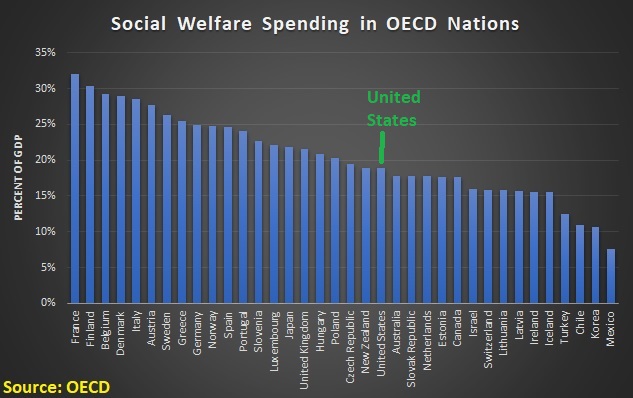
  • Greece had the biggest burden of pension spending.
  • France had the biggest burden of heath spending.
  • Belgium had the biggest burden of redistribution spending.

Today, let’s look at an even narrower slice of the social welfare state.

According to a new article in the Economist, Germany arguably has the most lavish sickness benefits in Europe. Maybe the most extravagant in the world.

That sounds very kind and compassionate, but it seems this policy is creating perverse incentives and undermining national prosperity.

Here are some excerpts from the article.


Germany is now “the world champion when it comes to sick days,” according to Oliver Bäte, the boss of Allianz, Europe’s biggest insurer. …Ola Källenius, the boss of Mercedes, agrees with Mr Bäte. He warns of the “economic consequences” of a sickness rate in Germany that is often twice as high as in other European countries. …Germany has one of the most generous sick-leave regimes in the world and it is costing businesses dearly. …

“It’s very hard to police,” says Jochen Pimpertz of the German Economic Institute (iw). In a study he found that the total nominal cost of sick pay for employers rose from €36.9bn to €76.7bn between 2010 and 2023 (a 57% increase, adjusted for inflation). …There is clear correlation between the generosity of the system and the number of sick days, says Nicolas Ziebarth of the Leibniz Centre for European Economic Research. Germany’s arrangements are lavish compared with elsewhere in Europe and have become easier to manipulate.

The article mentions that there used to be similar problems in some Scandinavian nations, and that reminded me that Sweden enacted some good reforms a few decades ago.

So I did a search for “sick days Sweden” and found a study published by the OECD in 2020.

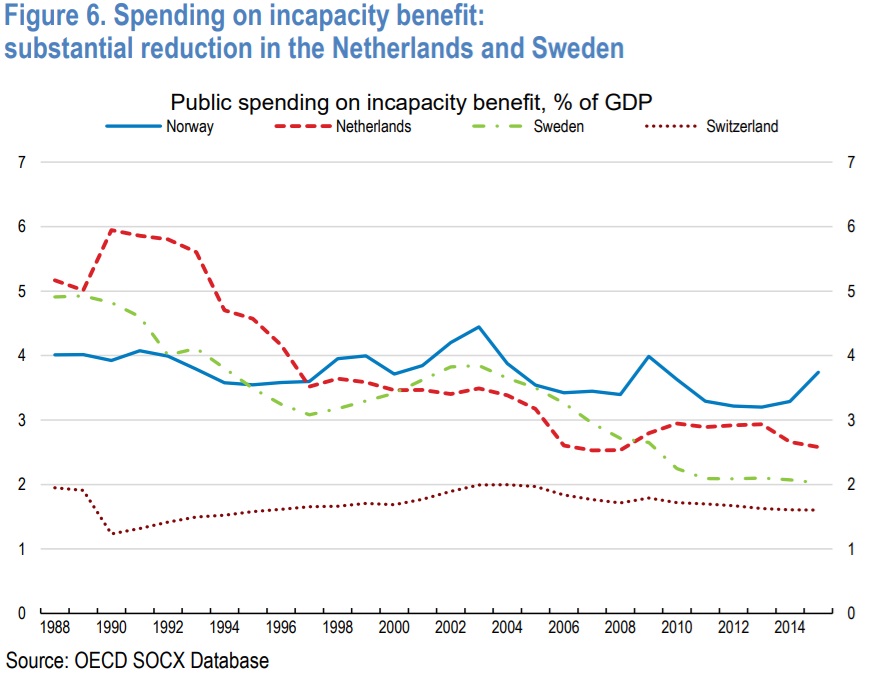
Authored by Philip Hemmings and Christopher Prinz, it included this chart showing that spending on sick days was dramatically reduced over a 20-year period, dropping from 5  percent of GDP in the late 1980s to 2 percent of GDP about 20 years later.
How did Sweden get these remarkable results?

The answer was simple. They reduced, in two stages, the amount of money people got for being sick (or, in many cases, for pretending to be sick). Here are a few excerpts from the study.

Sick-leave compensation reform (1990s). Pushed by a major economic downturn in the early 1990s, Sweden embarked on a series of sickness benefit reforms as part of a broader attempt to curb public spending. This included the introduction of a 14-day sick-pay period covered by employers (1992). In addition there were significant changes to compensation:  Before 1991, sickness benefits replaced 100% of earnings for 90 days and 95% thereafter, with no time limit. As of 1993, there was no payment on the first day of sickness absence (i.e. one “waiting day”), compensation then varied over time: 75% of previous earnings (days 2 and 3 of absence), 90% (until day 90), 80% (to the end of first year) and 70% thereafter.

This reform promoted a sharp drop in absence spells, especially in short-term absences… When the economy recovered in the late 1990s, sick-pay rates were increased, to 90% of the previous wage until the end of the first year and 80% thereafter. This led to a significant rise in absence rates, especially longer-term absences… Overall, the cost of being absent significantly affected absence behaviour. …

Starting in 2006, Sweden undertook a series of reforms to sickness and disability policies, which contributed to further considerable drops in both sickness absence rates and disability claims. These reforms included (Economic Survey of Sweden, OECD 2012b) among other things the introduction of…more rigorous implementation of existing regulations… Requirements for individuals on sick leave to consider a wider scope of jobs… A 2.5-year ceiling on the duration of sick leave compensation… More stringent disability-pension entitlement criteria.

The broader lesson from Sweden’s successful reforms is that Ronald Reagan was right.

As was Thomas Sowell.

The more you subsidize of something, the more you get of it.

And, at the risk of stating the obvious, it’s not a good idea to subsidize dependency and idleness.

P.S. Sweden has implemented a lot of good reforms in recent decades. What happened with sickness benefits is laudable, but I’m even more impressed by the country’s partially private Social Security system and the impressive 1992-2001 period of spending restraint. Though a lot more needs to be done.


Wednesday, April 24, 2024

Chronic Absenteeism is Becoming a Post Pandemic Problem

The perfect storm of economics, apathy, and the inability to cope.

by @ Liberty Nation News, Apr 23, 2024 | Articles, Education, Opinion

Ah, the well-orchestrated ditch days by students in the US public school system were often legendary. Tales to not tell your children but recall the glory days with pals at the reunion. Contrary to a high school student’s deep-felt belief, parents always knew. But now moms and dads are complicit in allowing children to stay home on a whim, and absenteeism has become a post-pandemic epidemic.

Between the 2018-19 and 2021-22 school years, there was an alarming 91% spike in skipping school, and an estimated 6.5 million students are chronically absent compared to before the pandemic. Yes, this generation is becoming an unwelcome statistic.

Nat Malkus, senior fellow and deputy director of AEI’s Education Policy Studies, created a “tracker” and is one of the many public school researchers beginning to panic. Chronic absenteeism, which refers to the number of students who missed at least 10% of a school year, has grown considerably – (15%) from 2018 to 28% in 2022 – according to the American Enterprise Institute (AEI).

Most experts are pointing to COVID as the culprit, but other factors also play into the continual failure of the education system.

Um, the Pandemic Is Over

Forensic psychiatrist Carole Lieberman explained to Fox News Digital the ripple effect of absenteeism:

“The economic impact of school absenteeism is tremendous — both in terms of the ultimate earning power of the absentee students and on the overall economy. Absenteeism leads to kids not doing well in school, which discourages them and causes many to drop out before being graduated from high school. Most of these end up in dead-end, low-income jobs.”

Well, that does not bode well for future solid American citizens. So, one must ask, why now? There are no mandatory closures. Today’s public schools are mostly woke, hand out hugs and participation trophies, and coddle their charges. But instead of heading to school to be glorified during education, students are allowed to stay home for mental health days, and no one blinks an eye.

Is basement dwelling a goal?

“We simply cannot accept chronic absenteeism as the new normal,” White House Domestic Policy Council Director Neera Tande said at a recent event. “Students have to be present if they are to learn.”

Absenteeism Is a Layered Problem

This new rise in skipping school doesn’t have just one cause, though. That’s what another detailed study from the Times Union came up with as well after a deep dive into 17 school districts in the Empire State. After interviewing school administrators and teachers, the publication relayed the following:

“The confluence of being allowed in the past to attend classes from home, the ability to play online games together from separate homes, and the addictive nature of social media and its impact on student sleep appear to be playing a role in the increase, according to various school officials. Parental struggles with getting middle and high schoolers to attend can bleed into the rest of the household, causing younger siblings to also remain home.”

Unfortunately, bad habits allowed during the pandemic – staying home and not being accountable – have become the norm. The study also showed that a small percentage of children don’t show up at all: A growing group of (303 students) out of the 17 districts missed 100 days or more in one school year.

Antonette Bowman, a former teacher who writes the “Raising Americans” Substack, believes that fear is also a driving factor for parents who keep kids at home:

“While students skipping school is nothing new, COVID-19 and problems arising from pandemic learning, cultural polarization, and school shootings have likely exacerbated the truancy crisis. Those dynamics have stoked fears and distrust, weakening the cornerstone ties between homes and schools, and undermining the willingness of students to attend school and the motivation of parents to send them there.”

Another factor, albeit a small one, is teacher absenteeism. Interruption in daily classroom learning not only sets students back but also has another domino effect as well: Other instructors in the same school are calling off. Maybe teachers embracing ditch day has to do with their mental health days after trying to instruct through COVID.

Or they see the once-invisible writing on the wall. School districts nationwide are running out of those federal COVID handouts. That coupled with ridiculously high inflationary costs, and perhaps more than a few poor spending decisions, have administrators laying off teachers. And some parents reveled in homeschooling and praising the fortunes of COVID in allowing them to get far away from the crazy PTA and school board meetings and being labeled a domestic terrorist by Joe Biden’s FBI.

All of these factors have affected the decline in student attendance in school. Now it’s time to do the heavy lifting and get America’s kids back on track.

 
Read More From Sarah Cowgill