Search This Blog

De Omnibus Dubitandum - Lux Veritas

Showing posts with label Vietnam. Show all posts

Tuesday, November 4, 2025

Can We Add Vietnam To The List Of Countries Abandoning Socialism?

Even as New York City looks poised to try one more time to make socialism work, multiple countries that have gone down the socialist road are trying instead to turn off. Notable examples include Argentina, where President Xavier Milei’s party just scored a notable victory over the Peronists in legislative elections; and Bolivia where, in the August 2025 first round of the presidential election, after nearly 20 years of explicitly socialist rule under the MAS Party, accompanied by economic stagnation, the MAS candidate for President got just 2% of the vote.

Can we add Vietnam to the list of countries moving away from socialism? A November 1 piece at American Greatness by Stephen Young and Bradley Thayer asserts the thesis that we can. The headline is “Did We Just Win the Vietnam War?” Excerpt:

Half a century after America’s withdrawal, Vietnam has quietly vindicated U.S. sacrifice—abandoning Marxism for nationalism and embracing the very ideals America once defended. . . . While few Americans have noticed, Vietnam’s new General Secretary of the Communist Party, To Lam, has replaced Marxist-Leninism as the Party’s governing ideology with something more authentically Vietnamese: Truong Ton Dan Toc, or “Vietnamese nationalism.”

Young and Thayer cite some serious evidence in support of their thesis. My overall conclusion: Vietnam is making some meaningful strides in the right direction, but still, Young and Thayer are getting ahead of themselves.

Here are the main points that Y&T make in support of their thesis:

  • In a speech on April 27, 2025, Vietnamese Communist Party General Secretary To Lam “presented his party as one dedicated to Vietnamese nationalism, not Marxist-Leninism, saying that honor will always be given to those who sacrificed for the Vietnamese people’s “happiness and prosperity” and “their truong ton [nationalism] and development.”
  • “On May 4, 2025, the Politburo of the Vietnamese Communist Party adopted Resolution 68, putting private enterprise at the center of economic development. The resolution gave responsibility for national wealth creation to self-management, self-effort, and self-empowerment. The rights of private property will be guaranteed and protected. The Vietnamese state will henceforth ‘serve and support’ private enterprise and not contradict the ‘principles of the market.’”
  • On October 8, 2025, in remarks closing the 14th Session of the Central Committee of the Vietnamese Communist Party, “To Lam doubled down on his new vision for a non-Communist, truly Vietnamese Vietnam. Democracy must be guaranteed with discipline and transparency, with elections as broad-based politics to earn the trust of the people. Private enterprise must be pushed forward for national development. The benefit of the people must become the objective of the government’s new economic policy. Finally, dogma, meaning turgid Communist dogma, must be eliminated.”

These are all excellent points, and I certainly wish the Vietnamese people the best in their efforts to leave Communism behind and move forward to capitalism, democracy, and prosperity. However, the Communist Party has been in power continuously since the 1970s, and remains in power. No elections are scheduled, nor are any serious preparations for elections under way. Current GDP per capita is only about $4700 — a pitiful level, representing the fruits of decades of excessive government control of the economy.

The transition away from socialism or Communism is not simple. Once private business is allowed, some businesspeople start to succeed, and become rich. That makes them a threat to the power of the governing elite. And then the push-back begins, where only those businesspeople under the thumb of those in power are allowed to succeed. And the party re-tightens its grip. This is what has happened in China during the reign of Xi Jin-Ping.

In January 2019 I took a trip to Vietnam, and wrote a series of posts about my observations. Here is an excerpt from my post of January 16, 2019:

So with the perspective of the last 44 years, who “won” the Việt Nam War? The U.S. is very close to achieving all of its principal objectives without having risked any more lives or fired any more shots since 1973. Probably, about the same economic situation would prevail today if there had never been any Việt Nam War. Although proclaiming itself a “socialist republic,” Việt Nam is not part of an aggressive and militaristic communist bloc that continually threatens its neighbors. Its citizens are chasing prosperity through private property and free exchange just as fast as they can chase it. The only thing left of “socialism” is a government sector much larger than it needs to be or than it should be.

It would be nice if today’s government of Việt Nam could find itself feeling secure enough to stand for election like grown-up governments do; but there is no current prospect of that. On the other hand, achieving a government willing to conduct periodic elections was never really one of the main objectives that the U.S. was hoping to accomplish with its military force those many decades ago.

To Lam’s recent statements represent additional progress from where Vietnam was six years ago. But the progress is slow and incremental, rather than the sudden reversal painted by Young and Thayer. Hopefully, the change will continue, without the backsliding seen in China. I’ll believe that Vietnam has truly come out of its long winter when an election is held and advocates of a free economy win a decisive victory.

So has the U.S. finally won the Vietnam War? Basically yes. But the main lesson is that a free economy most often cannot be established by military force. With almost all academic elites teaching and believing economic nonsense, people need to learn the lessons of freedom through their own bitter experience. Little by little, Vietnam is getting there.

Saturday, January 18, 2025

Will Vietnam Become the Next Asian Tiger?

January 17, 2025 by Dan Mitchell @ International Liberty

Vietnam’s economic trajectory is similar to China’s.

  • Horrible poverty and even starvation (in the case of China) during the days of hard-core communism.
  • Less poverty today thanks to a few pro-market reforms starting in the 1980s.
  • Still low-to-middle income jurisdictions because they’re stuck in the third circle of “statist hell.”

This chart from the Fraser Institute’s Economic Freedom of the World shows that Vietnam and China both rank way below Singapore and Hong Kong.

Since China used to have scores below 4, being above 6 is a lot of progress. And something similar presumably happened with Vietnam (though it only produced enough data to get scores starting in 2000).

The interesting question is what happens to these countries in the future. Will there be a new round of pro-market reform, allowing them to start converging with rich nations? Or will they tread water, doomed to be – at best – middle-income countries because of inadequate economic liberty?

I’ve written many times (here, here, here, here, here, here, here, here, here, here, here, here, here, and here) that I’m worried about China.

But let’s focus today on Vietnam. I wrote last year about that country’s partial liberalization, noting that “Vietnam has take the first steps in what hopefully will be a long journey.”

Well, “hopefully” may turn into “actually.”

Why am I now more optimistic?

Because of a report last week in Bloomberg. Authored by Francesca Stevens, Nguyen Dieu Tu Uyen, and Nguyen Xuan Quynh, it described how Vietnam may be copying Javier Milei’s radical pro-market reforms.

Here are some excerpts.


As Elon Musk and Argentina’s Javier Milei champion ambitious plans to dramatically slash the size of government, a similar effort is getting underway across the globe from political leaders with a completely different ideology: Vietnam’s Communist Party.

In what amounts to the biggest overhaul of the state since adopting pro-market reforms in the 1980s, Vietnamese officials are targeting a roughly 20% reduction in the size of ministries, government agencies, and civil service workforce. It’s being pitched as essential medicine to remedy a bloated bureaucracy, reduce red-tape and cut unnecessary costs from local governments on up. The plans would see five ministries abolished…

Four government agencies, including the State Capital Management Committee, will be eliminated. Five state television channels, 10 newspapers and 19 magazines will be scrapped. …“This is a very urgent issue which must be done,” Lam said in a speech posted on the Communist Party’s website in December.

“Sometimes we have to take bitter medicine, endure pain and cut out tumors in order to have a healthy and strong body,” he said. …civil servants are clearly stressed — one deputy prime minister said 100,000 jobs would be affected… “reforms…are necessary to achieve their goal of high-income status by 2045,” ISEAS-Yusof Ishak Institute’s Giang said.

This report is very exciting, though time will tell whether the nominal communists running Vietnam genuinely intend to shrink the burden of government.

In other words, I want to see actual evidence of smaller government, not just rhetoric. As the great Ronald Reagan said, “trust but verify.”

That being said, I’ll close with two optimistic comments.

Incidentally, if I’m right on the second point, then the Fourth Theorem of Government kicks in.

Reforms continue and Vietnam joins the club of Asian Tigers.

P.S. This column illustrates why Milei’s importance extends way beyond Argentina. Yes, it will be great if he turns Argentina from a statist disaster to a free-market success. But I’m even more excited about him showing the rest of the world that dramatic free-market reforms are the way to go. Sort of the Washington Consensus, but on steroids.

Wednesday, June 21, 2023

"Stranded Assets": Who Will Have The Last Laugh?

June 19, 2023 @ Manhattan Contrarian 

It’s been a persistent drumbeat for many years: Fossil fuels are obsolete, and the facilities that produce them, along with any further facilities that might be built for that purpose, will shortly become worthless. These facilities will be “stranded assets.” And any energy company stupid enough to make further investment in fossil fuel extraction or use will inevitably suffer a total loss.

Do you believe that prediction? Those making it are among the aggressive promoters of an energy transition to supposedly superior sources like the wind and sun. The prediction has been widely used in the attempt to bludgeon energy companies into reducing or ending their coal, oil and gas investments. But if fossil fuels were really obsolete, and renewables superior and cheaper, why would such bludgeoning be needed? Wouldn’t the investment just flow naturally over to the wind and solar facilities?

For starters, here is a sampling of some of those staking out the position that fossil fuel assets will shortly become “stranded”:

  • Senator Sheldon Whitehouse (D-RI), Chair of the Senate Budget Committee, at a hearing March 29, 2023: “[T]he world is moving away from oil and gas, but truculent and politically connected market actors persist in fossil fuel investments, which crash in value when their unsustainable economics overwhelm the artificial politics that supported them.  The operative term of today’s hearing: stranded assets.”
  •  From an article by Semieniuk, et al., in Nature Climate Change, May 2022: “The distribution of ownership of transition risk associated with stranded fossil-fuel assets remains poorly understood. We calculate that global stranded assets as present value of future lost profits in the upstream oil and gas sector exceed US$1 trillion under plausible changes in expectations about the effects of climate policy.”
  • From MIT News, August 19, 2022: “As the world transitions away from greenhouse-gas-emitting activities to keep global warming well below 2 C (and ideally 1.5 C) in alignment with the Paris Agreement on climate change, fossil fuel companies and their investors face growing financial risks (known as transition risks), including the prospect of ending up with massive stranded assets.” 
  •  From the New York Times, March 21, 2022, quoting a speech by UN Secretary General Antonio Guterres: “In his speech, Mr. Guterres said wealthy nations should be dismantling coal infrastructure to phase it out completely by 2030, with other nations doing so by 2040. . . . ‘Their support for coal not only could cost the world its climate goals,’ he said. ‘It’s a stupid investment — leading to billions in stranded assets.’”

Meanwhile, out here in the real world, fossil fuel investments are looking very much the opposite of “stranded.” Here’s a brief summary from AP on May 2 of some major oil company earnings for the first quarter of 2023:

Exxon earned a record $11.4 billion in the first quarter, and Chevron raked in $6.6 billion. Saudi Aramco said in March that it earned $161 billion in 2022, the highest-ever recorded annual profit by a publicly listed company.

And for the full year 2022, here are the earnings of Exxon and Chevron, as reported by NPR:

ExxonMobil earned nearly $56 billion in profit in 2022, setting an annual record not just for itself but for any U.S. or European oil giant. Buoyed by high oil prices, rival Chevron also clocked $35 billion in profits for the year, despite a disappointing fourth quarter.

NPR quotes Exxon CEO Darren Woods as to the reason for Exxon’s recent success: 

"We leaned in when others leaned out.”

Woods was referring to Exxon’s decision to continue investing in producing oil and gas, while several other oil majors were cutting back and making ridiculous commitments to reduce their “emissions,” as if they had forgotten what business they are in. Leaders in the category of seeking climate virtue were the two European giants, BP and Shell. How has that been working out? Britain’s Daily Telegraph (behind pay wall) reports on June 15 on the latest from those two:

First BP, now Shell. One by one, the oil giants are returning to what they know best – doubling down on fossil fuels and prioritising shareholder returns – in u-turns that inevitably have to come at the expense of climate pledges.

It seems that BP and Shell had been lagging the competition in oil and gas profits, while they invested in various politically-favored green energy projects. No more. Here is the Daily Telegraph describing Shell after its recent pivot:

Shell privately concedes that biofuels, hydrogen, electric vehicle charging and carbon capture storage – the four areas it has earmarked for investment – are at the more speculative and unproven end of the renewables spectrum. The absence of any plans to invest in other, far more established clean energy sources such as wind and solar – which are attracting record investment around the world – is glaring.

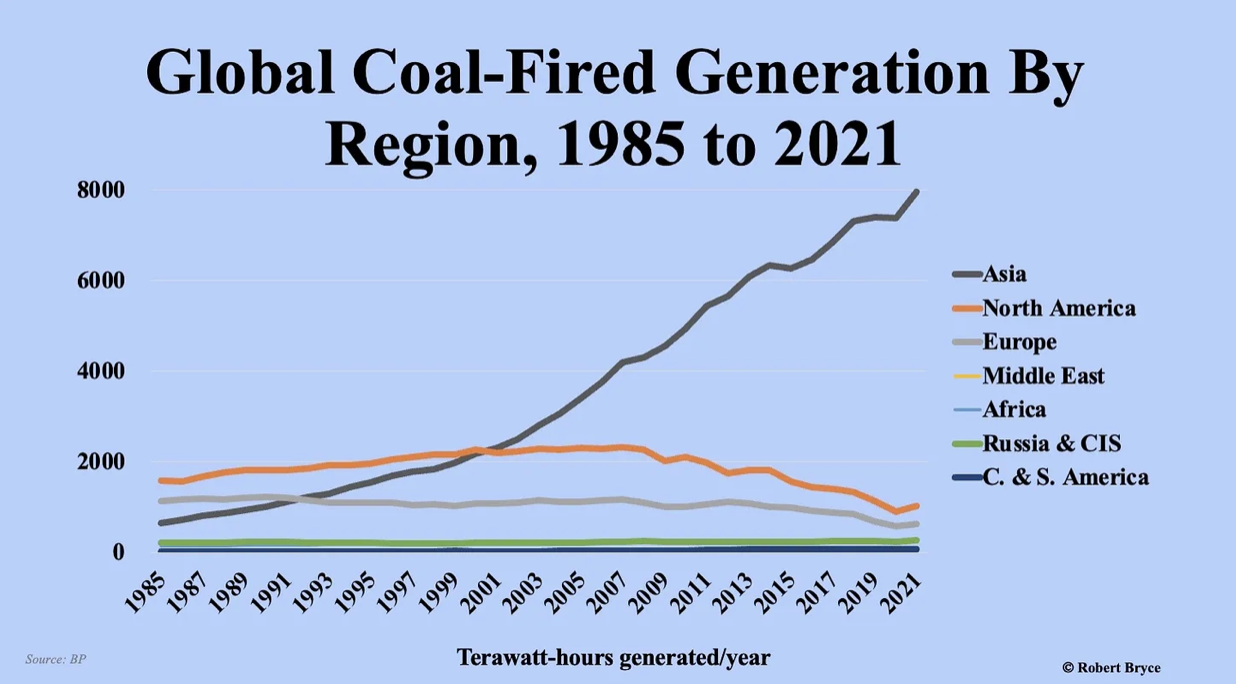
And for the latest on coal, you can check out Robert Bryce’s Substack column from June 17. Here are a few statistics provided by Bryce from Vietnam and China:

Vietnam is now getting about 60% of its juice from coal-fired power plants. Since 2009, Vietnam’s coal-fired electricity output has grown tenfold and more growth is on the way. Last year, according to Global Energy Monitor, Vietnam commissioned about 1,900 megawatts of new coal-fired capacity.

Much . . . coal growth is happening in China, which accounts for more than half of all global coal consumption and a shade more than half (52%) of all the electricity generated from coal. Yesterday, June 16, Reuters reported that during the first five months of this year, coal-fired generation in China jumped by 6.6%. And that trend will continue. In February, Global Energy Monitor reported that China permitted about two new coal-fired power plants per day in 2022.

And here is a chart from Bryce showing the overall trend of generation of electricity from coal:

As between oil, gas, and coal assets on the one hand, and wind, solar, and battery assets on the other, I think it’s a very easy call which ones are going to end up “stranded.” On the first day when any government withdraws its subsidies for any wind, solar or battery asset, that asset becomes “stranded.”

Monday, May 1, 2023

PBS Propaganda Dishonors Vietnam Veterans

April 30, 2023 By Robert F. Turner

On March 28—just two days before the congressionally proclaimed “National Vietnam War Veteran’s Day“—PBS broadcast “The Movement and the ‘Madman,’” gleefully depicting America’s resistance to blatant international Communist aggression in Vietnam as moronic and portraying leaders of the so-called “peace movement” as heroes who saved the world from nuclear disaster. The program was as absurd as it was shameful.

Jefferson advised that, when angry, count to 10 before speaking. When very angry, count to 100. Waiting a month did not quell my outrage, but today’s forty-eighth anniversary of the Communist conquest of South Vietnam necessitated a response.

I spent considerable time in Vietnam between 1968 and leaving during the 1975 final evacuation, including tours as an Army Lieutenant and Captain, a stint as a journalist, and multiple visits while serving as national security adviser to a member of the Senate Foreign Relations Committee. After leaving the Army, I was a fellow at Stanford’s Hoover Institution, where I authored the first major English-language history of Vietnamese Communism.

Beginning in 1965, I took part in more than 100 debates, lectures, ‘teach-ins,” and other programs on the war. During that time, I encountered a litany of arguments against the war from some of the most prominent war critics in the country. Most of their alleged “facts” were clearly false—a point confirmed by the “Pentagon Papers.”...............To Read More...

Thursday, September 9, 2021

Vietnam misses Trump as it struggles with China

September 2, 2021 By Peter Kauffner

While U.S. pundits see Vice President Kamala Harris's visit to Hanoi as a way for her to get out of town and avoid awkward questions, the Chinese media responded with sharp commentary accusing her of inciting Vietnam against China.  For her part, Harris accused China of "bullying" in the South China Sea.  The U.S.-China-Vietnam strategic triangle is certainly on the minds of ordinary Vietnamese.

At a park in central Saigon, some students asked me, "Do you know why we love Trump?" "Is it because he hates China?" I asked. "Yeah!"  They responded in unison.  Yes, Donald Trump is a Vietnamese folk hero.  In fact, Trump is more popular in Vietnam than in any other country except the Philippines...........To Read More....


Sunday, October 13, 2019

Liberals' Tears For Kurds Ring Hollow After Vietnam

By PHILLIP JENNINGS, Special to the Sun | October 9, 2019

The uproar over President Trump’s plan to draw down our forces in northeast Syria certainly takes me back — to Vietnam. The howls of protest from Democratic politicians and the liberal foghorns in the press over how terrible it would be to leave brave American allies in the lurch, it’s almost like a time machine, complete with assertions that the evil Mr. Trump is ruining America’s hard-earned reputation for loyalty and trustworthiness.

Flash back to the mid-1970s and these, or their parents, were the same people cheering as we abandoned Southeast Asia’s millions of wonderful people to a generations-long nightmare of life under communism. Recall the suave assurances from, say, the Times, that “disengagement from a civil war in which the United States should never have become engaged need not shake this country’s position in the world.”........

As a veteran of the Vietnam War and the so-called secret war in Laos, I don’t get upset thinking about how we lost the war. That’s because we didn’t lose it. We won it. It was lost — thrown away — by liberal politicians besotted with hubris over from their success in forcing Nixon from office. It was they who threw away our victory........

He has already done more for them than President George H.W. Bush, who let Saddam Hussein slaughter them, or President Clinton, who sent Turkey arms to kill their Kurds, or President George W. Bush, who let Turkey bomb the Iraqi Kurds, or President Obama, who pressured Arab states not to arm the Syrian Kurds for the fight against ISIS............... .....To Read More.....

My Take - I inserted this to highlight who in American politics are contemptible to our "allies".  It's the left....we need to get that....as for the Kurds being noble.  They're Muslims, it's convenient to be presented as noble when it's convenient, but if the table turned, they'd stab us in the back.  We're allies of convenience to them, and we need to act accordingly. 

There's no fixing the Middle East.  They've been butchering each other for 1400 years, and they live for it.  Let them!

Friday, October 4, 2019

BBC caught spreading lies about climate change, Vietnam crop production

 September 30th, 2019 General Information 8 Comments

Unbelievable, simply freakin’ unbelievable. Alarmist deception and lies know no bounds. Here is the lede from a BBC News article, titled “Climate change in Vietnam ‘destroying family life,’ published September 30 :
“Vietnam is one of the world’s most vulnerable countries to climate change. It’s already having a huge impact on the lives of those in the Mekong Delta, the agricultural heartland of the country and home to 20% of the country’s population.”
Climate change is having a “huge impact” on Vietnam’s agricultural heartland? Well, actually, it is. Here is a chart from the UN Food and Agriculture Organization regarding crop production in Vietnam.

Oh, the horrors! Crop yields per acre in Vietnam (and the rest of the world) have been dramatically rising for decades. The past six years were the six highest crop yields per acre in Vietnam history. And you can say the same about the past 10 years, the past 15 years, and the past 20 years, etc. Yet people read climate alarmist garbage published by BBC and the rest of the media and simply believe it at face value............To Read More.....

Wednesday, October 26, 2016

Tom Hayden’s Vietnam Memorial

Stalinist Vietnamese regime used his broadcasts as soundtrack for torture sessions of American POWs.
Lloyd Billingsley

Tom Hayden has passed away at 76 and the New York Times obituary recalled him as a “civil rights and anti-war activist.” That bears little resemblance to the real person, especially in regard to Vietnam.........After Vietnam, many who had played leading roles in the New Left had second thoughts, David Horowitz and Peter Collier among them. Not so, Tom Hayden, who remained shrink-wrapped in leftist superstition to the end.   In a December 20, 2014 oped piece in the Sacramento Bee, Hayden wrote that he first went to Cuba in 1968. He made five more trips but remained uncritical of the Castro regime, one of the most repressive in the world, never championing the cause of a single dissident or political prisoner. ....To Read More....