Search This Blog

De Omnibus Dubitandum - Lux Veritas

Showing posts with label Death Tax. Show all posts

Tuesday, June 24, 2025

Slowly Strangling the Death Tax

June 22, 2025 by Dan Mitchell @ International Liberty

Back in 2013, I debated Joe Biden’s top economist on the death tax. Everything I said then (and wrote four years before then) is still true today.


Slowly Strangling the Death Tax

Back in 2013, I debated Joe Biden’s top economist on the death tax. Everything I said then (and wrote four years before then) is still true today.

In the interview, I mentioned nations that have abolished their death taxes, including Australia.


I should have mentioned Sweden as well.

As a general rule, I don’t want to copy Swedish tax policy, but that nation wisely abolished its death tax (and also its wealth tax).

We should do the same thing in the United States.

There’s obviously a strong economic argument against the death tax since it exacerbates the problem of double taxation in the internal revenue code.

But I’m even more motivated by the moral argument against the death tax. Simply stated, it’s wrong to impose an extra layer of tax merely because someone has died.

Well, the good news is that the death tax will become less of a problem if Republicans enact the so-called One Big Beautiful Bill. Here are some excerpts from a report in the Washington Post by Jeff Stein.


Congressional Republicans are proposing to permanently allow wealthy families to pass on more of their assets tax-free, as the federal government all but abandons taxing large inheritances. …both the House and Senate versions would raise the exemption starting next year to $15 million for individuals and $30 million for couples, then set them to adjust for inflation in the future. …these changes are set to weaken an estate tax that already affects fewer households than it has in decades. … 

While the tax’s defenders say it is necessary to curb dynastic wealth at a time of rising inequality, conservatives have long argued the policy unfairly hits the same taxpayer twice because it taxes assets that were originally accumulated after their owners paid income taxes. … 

“It’s a tax on savings, and there’s a double-taxation issue — you earn the money, you paid taxes, and then the government comes after you again when you die,” said Michael Strain, an economist at the American Enterprise Institute.

While I like that the Republicans want to “weaken an estate tax,” it would be much better to fully repeal this awful levy. That will upset advocates of class warfare. And it also will disappoint the tax planning industry, which collects big fees for helping families protect against the death tax. But dying should not be a taxable event. The only good thing about the death tax is that it creates all sorts of weird examples of how taxes affect behavior.

But I’m willing to have fewer topics for my columns if we have better tax policy for the country.

P.S. Trump may have learned through personal experience that the death tax is bad. Hillary Clinton, by contrast, wanted others – but not herself – to pay the tax.

P.P.S. Bureaucrats at the Paris-based OECD don’t have to pay tax, yet they are pushing for higher death taxes in the US. Republicans need to cease all taxpayer handouts for those hypocrites.

Thursday, May 11, 2023

The Negative Economic Effects of State Death Taxes

April 29, 2023 by Dan Mitchell @ International Liberty

I’ve written many times about the harmful consequences of the federal death tax. Simply stated, it is both immoral and foolish for the IRS to grab as much as 40 percent of someone’s assets simply because they die.

That drains private capital from the economy and is a de facto heavy tax on those who save and invest (triple or quadruple taxation!).

That’s the bad news.

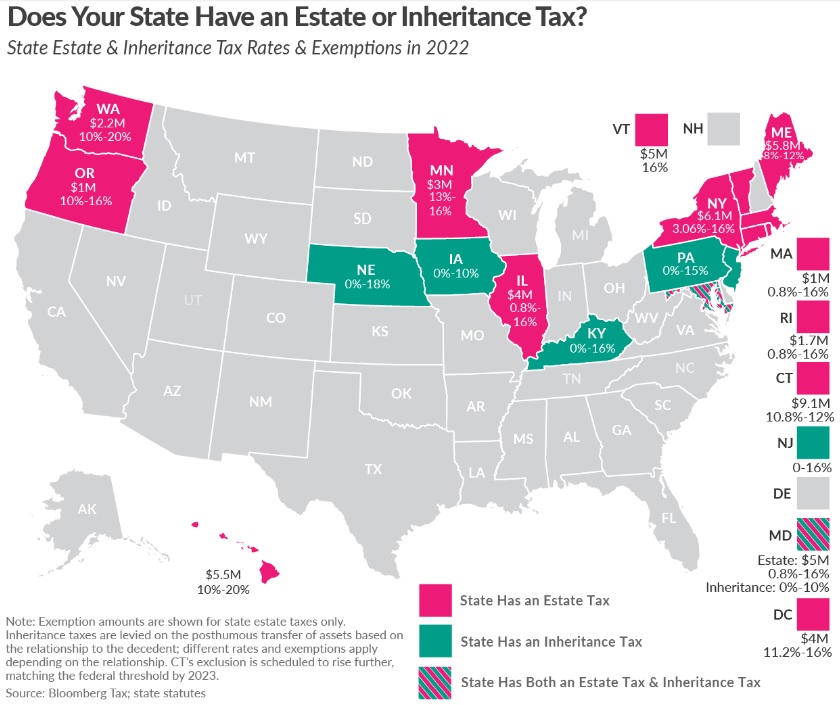
The worse news is that some states augment the damage with their own death taxes. Here’s a map from the Tax Foundation showing which states shoot themselves in the foot.

For those curious, the estate tax is imposed on the dead person’s assets and an inheritance tax is imposed on the the people who inherit the dead person’s assets.

In both cases, it’s bad news.

How bad?

There’s some new research from a couple of scholars examining this topic. Enrico Moretti of Berkeley and Daniel J. Wilson of the San Francisco Federal Reserve have a study published by the American Economic Journal that quantifies the impact of state death taxes on location choices.


In this paper, we contribute to the literature on the effect of state taxes on the locational choices of wealthy individuals by studying how estate taxes affect the state of residence of the American ultra-rich and the implications for tax policy. …Specifically, we estimate the effects of state-level estate taxes on the geographical location of the Forbes 400 richest Americans between 1981 and 2017. We then use the estimated tax mobility elasticity to quantify the revenue costs and benefits for each state of having an estate tax. We find that billionaires’ geographical location is highly sensitive to state estate taxes. Billionaires tend to leave states with an estate tax, especially as they get old. …On average, estate tax states lose 2.35 Forbes 400 individuals relative to non–estate tax states. …—21.4 percent of individuals who originally were in an estate tax state had moved to a non–estate tax state, while only 1.2 percent of individuals who originally were in a non–estate tax state had moved to an estate tax state. The difference is significantly more pronounced for individuals 65 or older… Overall, we conclude that billionaires’ geographical location is highly sensitive to state estate taxes. …We estimate that tax-induced mobility resulted in 23.6 fewer Forbes 400 billionaires and $80.7 billion less in Forbes 400 wealth exposed to state estate taxes.

What makes the study especially persuasive is that state death taxes suddenly no longer could be offset against federal death taxes because of a policy change in 2001.

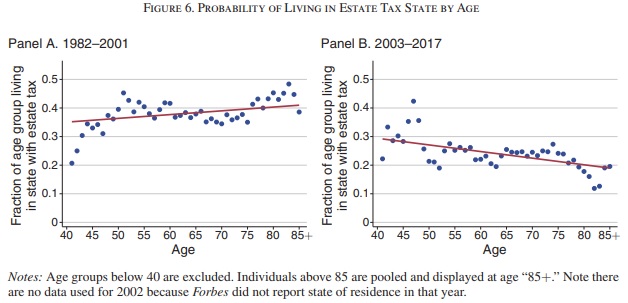
That meant post-2001 data should look different. And that’s exactly what the authors found, as illustrated in Figure 6 of the study.

Here are some final excerpts from the conclusion.

The 2001 federal tax reform introduced stark cross-state variation in estate tax liabilities for wealthy taxpayers. Our findings indicate that the ultra-wealthy are keenly sensitive to this variation. Specifically, we find that billionaires responded strongly to geographical differences in estate taxes by increasingly moving to states without estate taxes, especially as they grew older. Our estimated elasticity implies that $80.7 billion of 2001 Forbes 400 wealth escaped estate taxation in the subsequent years due to billionaires moving away from estate tax states.

By the way, the study said that most states still wind up collecting net revenue because of death taxes.

In other words, the death tax revenue from remaining rich people is generally greater than the foregone income tax revenue because of those who left.

But I wonder if those findings would be true if the authors had been able to measure the secondary effects such as lost sales tax revenue, lost property tax revenues, and (perhaps most important) lost income tax revenue from people who did business with escaping rich people.

But, regardless of the findings, it is always immoral and wrong for politicians to impose taxes simply because someone dies.

P.S. In Australia, people changed when they died because of the death tax.

P.P.S. In France, people changed who they were because of the death tax.

P.P.P.S. In Ireland, people pretended to change their sexual orientation because of the death tax.

Tuesday, May 2, 2023

Nauseating Government Thuggery

May 1, 2023 by Dan Mitchell @ International Liberty

It’s hard to pick the worst government policy since there are so many options.

  • Death tax – The IRS penalizing saving and investment by grabbing money just because someone dies.
  • Fannie Mae and Freddie Mac – Government entities that helped give us the 2008 financial crisis.
  • OECD subsidies – American tax dollars flowing to a Paris-based bureaucracy that pushes for bigger government.
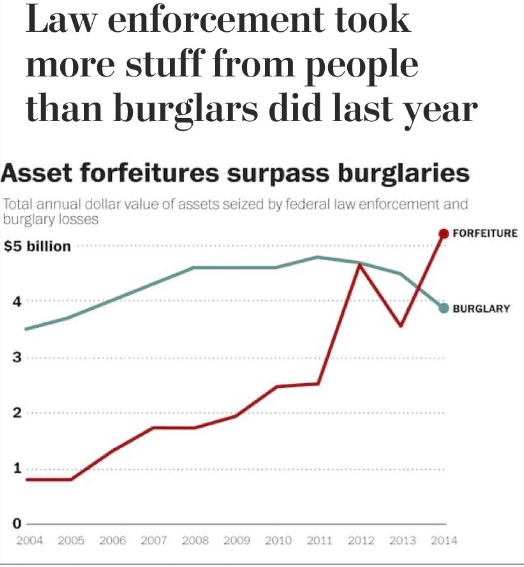
  • Asset forfeiture – When bureaucrats steal money or property because they think a crime may have occurred.

Normally, I might argue that asset forfeiture is the worst policy. It is reprehensible that government officials seize property without ever convicting someone of a crime.

Of sometimes without even charging someone with a crime.

But there’s a version of asset forfeiture that represents an impossible level of government depravity.

Here’s what George Will wrote for the Washington Post about a state government’s mistreatment of an elderly woman.


“Minnesota nice…” expires when grasping government wants to steal your house. Just ask Geraldine Tyler, 94, the Black grandmother… In 2010, alarmed by neighborhood disorder, Tyler, retired and living alone, moved from her Minneapolis condominium to a senior living center. She neglected to pay taxes on her one-bedroom condominium, and by 2015 the $2,300 due in back taxes — combined with penalties, interest and fees — brought her liability to $15,000. The county seized and sold her property for $40,000. Tyler is not challenging the propriety of the seizure or sale, but of the county’s home equity theft. Instead of returning $25,000 to her, the government, in a common act of legalized self-dealing, kept $25,000… Such predatory forfeiture is done by a dozen states and the District of Columbia, which took a $200,000 home from a man with dementia and a $133 tax debt.

Fortunately, the Supreme Court has an opportunity to end this odious practice.

Billy Binion of Reason shared some thoughts about the legal case.


The Supreme Court…heard arguments in a consequential case. The query before the justices: Was it unconstitutional when the government seized a woman’s home over an unpaid tax bill, sold it for more than the amount of the debt, and then kept the profit? …Multiple federal courts ruled against Tyler, who is now 94 years old, prior to her case’s ascension to the Supreme Court… Christina M. Martin, a senior attorney at the Pacific Legal Foundation…said…”the county should have taken the property, sold it, paid the debts from the proceeds, and refunded the remainder to Ms. Tyler. Instead, the county took everything.” It’s a line of thinking the Court appeared receptive to.

Let’s keep our fingers crossed that the Supreme Court rules against the Minnesota bureaucrats who are trying to steal money from an old woman.

I know Clarence Thomas is skeptical of this abusive practice. Let’s hope all of the other Justices join him in voting to return Ms. Tyler’s money.

And, in a just world, hopefully they will issue a broad ruling ending all versions of “policing for profit.”

Thursday, October 27, 2022

European Fiscal Policy Week, Part IV: Bad U.K. Monetary Policy Leads to Bad U.K. Fiscal Policy

October 27, 2022 by Dan Mitchell @ International Liberty

I was excited about the possibility of pro-growth tax policy during the short-lived reign of Liz Truss as Prime Minister of the United Kingdom.

However, I’m now pessimistic about the nation’s outlook. Truss was forced to resign and big-government Tories (akin to big-government Republicans) are back in charge.

As part of my “European Fiscal Policy Week,” let’s take a closer look at what happened and analyze the pernicious role of the Bank of England (the BoE is their central bank, akin to the Federal Reserve in the U.S.).


Let’s start with a reminder that the Bank of England panicked during the pandemic and (like the Federal Reserve and the European Central Bank) engaged in dramatic monetary easing.

That was understandable in the spring of 2020, perhaps, but it should have been obvious by the late summer that the world was not coming to an end.

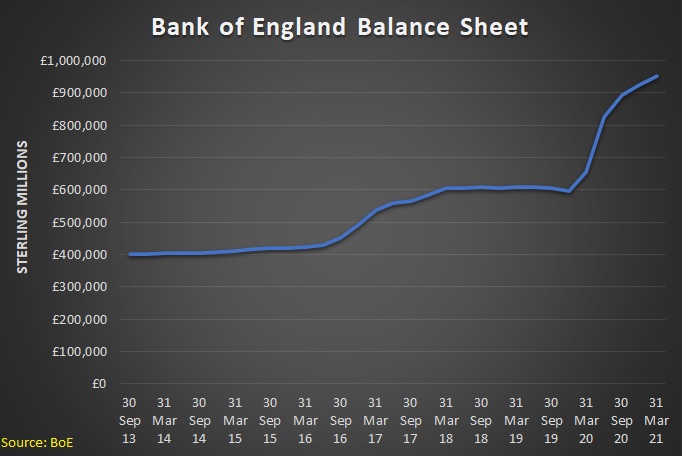
Yet the BoE continued with its easy-money policy. The balance sheet kept expanding all of 2020, even after vaccines became available.

And, as shown by the graph, the easy-money approach continued into early 2021 (and the most-recent figures show the BoE continued its inflationary policy into mid-2021).

Needless to say, all of that bad monetary policy led to bad results. Not only 10 percent annual inflation, but also a financial system made fragile by artificially low interest rates and excess liquidity.

So how does any of this relate to fiscal policy?

As the Wall Street Journal explained in an editorial on October 10, the BoE’s bad monetary policy produced instability in financial markets and senior bureaucrats at the Bank cleverly shifted the blame to then-Prime Minster Truss’ tax plan.


Bank of England Governor Andrew Bailey is trying to stabilize pension funds, which are caught on the shoals of questionable hedging strategies as the high water of loose monetary policy recedes. …The BOE is supposed to be tightening policy to fight inflation at 40-year highs and claims these emergency bond purchases aren’t at odds with its plans to let £80 billion of assets run off its balance sheet over the next year. But BOE officials now seem confused about what they’re doing. …No wonder markets doubt the BOE’s resolve on future interest-rate increases. Undeterred, the bank is resorting to the familiar bureaucratic imperative for self-preservation. Mr. Cunliffe’s letter is at pains to blame Mr. Kwarteng’s fiscal plan for market ructions. His colleagues Jonathan Haskel and Dave Ramsden —all three are on the BOE’s policy-setting committee—have picked up the theme in speeches that blame market turbulence on a “U.K.-specific component.” This is code for Ms. Truss’s agenda. …Mr. Bailey doesn’t help his credibility or the bank’s independence by politicizing the institution.

In a column for Bloomberg, Narayana Kocherlakota also points a finger at the BoE.

And what’s remarkable is that Kocherlakota is the former head of the Minneapolis Federal Reserve and central bankers normally don’t criticize each other.


Markets didn’t oust Truss, the Bank of England did — through poor financial regulation and highly subjective crisis management. …The common wisdom is that financial markets “punished” Truss’s government for its fiscal profligacy. But the chastisement was far from universal. Over the three days starting Sept. 23, when the Truss government announced its mini-budget, the pound fell by 2.2% relative to the euro, and the FTSE 100 stock index declined by 2.2% — notable movements, but hardly enough to bring a government to its knees. The big change came in the price of 30-year UK government bonds, also known as gilts, which experienced a shocking 23% drop. Most of this decline had nothing to do with rational investors revising their beliefs about the UK’s long-run prospects. Rather, it stemmed from financial regulators’ failure to limit leverage in UK pension funds. …The Bank of England, as the entity responsible for overseeing the financial system, bears at least part of the blame for this catastrophe. …the Truss government…was thwarted not by markets, but by a hole in financial regulation — a hole that the Bank of England proved strangely unwilling to plug.

Last but not least, an October 18 editorial by the Wall Street Journal provides additional information.


When the history of Britain’s recent Trussonomics fiasco is written, make sure Bank of England Governor Andrew Bailey gets the chapter he deserves. …The BOE has been late and slow fighting inflation… Mr. Bailey’s actions in the past month have also politicized the central bank…in a loquacious statement that coyly suggested the fiscal plan would be inflationary—something Mr. Kwarteng would have disputed. …Meanwhile, members of the BOE’s policy-setting committee fanned out to imply markets might be right to worry about the tax cuts. If this was part of a strategy to influence fiscal policy, it worked. …Mr. Bailey may have been taking revenge against Ms. Truss, who had criticized the BOE for its slow response to inflation as she ran to be the Conservative Party leader this summer. Her proposed response was to consider revisiting the central bank’s legal mandate. The BOE’s behavior the past month has proven her right beyond what she imagined.

So what are the implications of the BoE’s responsibility-dodging actions?

  • First, we should learn a lesson about the importance of good monetary policy. None of this mess would have happened if the BoE had not created financial instability with an inflationary approach.
  • Second, we should realize that there are downsides to central bank independence. Historically, being insulated from politics has been viewed as the prudent approach since politicians can’t try to artificially goose an economy during election years. But Bailey’s unethical behavior shows that there is also a big downside.

Sadly, all of this analysis does not change the fact that tax cuts are now off the table in the United Kingdom. Indeed, the new Prime Minister and his Chancellor of the Exchequer have signaled that they will continue Boris Johnson’s pro-tax agenda.

That’s very bad news for the United Kingdom.

P.S. There used to be at least one sensible central banker in the United Kingdom.

P.P.S. But since sensible central bankers are a rare breed, maybe the best approach is to get government out of the business of money.


Wednesday, September 21, 2022

The Death Tax and British Royalty

September 19, 2022 by Dan Mitchell @ International Liberty

Every American school kid presumably learns about the Boston Tea Party and other events that culminated with the United States gaining independence from from the rule of King George III.

Think of it as America’s first tax revolt.

But that’s not the only interesting story regarding taxes and English royalty.

I wrote in both 2017 and 2020 that Prince Harry and Meghan Markle (now the Duke and Duchess of Sussex) were going to suffer some adverse tax consequences by residing in the United States.

The recent death of Queen Elizabeth II gives us another opportunity to comment about tax policy. It seems the royal family has some very nice tax preferences.

For some background, Jyoti Mann reported on the topic for Business Insider.


King Charles III..spent half a century turning his royal estate into a billion-dollar portfolio and one of the most lucrative moneymakers in the royal family business. …Over the past decade, he has assembled a large team of professional managers who increased his portfolio’s value and profits by about 50 percent. …The conglomerate’s holdings are valued at roughly $1.4 billion, compared with around $949 million in the late queen’s private portfolio. These two estates represent a small fraction of the royal family’s estimated $28 billion fortune. …The growth in the royal family’s coffers and King Charles’s personal wealth over the past decade came at a time when Britain faced deep austerity budget cuts. …the Duchy of Cornwall…has funded his private and official spending, and has bankrolled William, the heir to the throne, and Kate, William’s wife. It has done so without paying corporation taxes like most businesses in Britain are obliged to, and without publishing details about where the estate invests its money. …leaked financial documents known as the Paradise Papers revealed that Charles’s duchy estate had invested millions in offshore companies, including a Bermuda-registered business.

Before continuing, I can’t resist making two comments.

First, the United Kingdom has not “faced deep austerity” or “budget cuts.” The most that can be said is that spending “only” grew at the rate of inflation when David Cameron and Theresa May were in charge.

Second, it is not newsworthy that the royal family uses so-called offshore companies. It’s probably safe to say that 99 percent of people with cross-border investments (including people like you and me with IRAs and 401(k)s) benefit from some form of financial interaction with tax-neutral jurisdictions such as Bermuda and the Cayman Islands.

Now let’s peruse a story for the New York Times by Jane Bradley and 


King Charles will not have to pay inheritance tax on the Duchy of Lancaster estate he inherited from the Queen due to a rule allowing assets to be passed from one sovereign to another. Charles automatically inherited the estate, the monarch’s primary source of income… The new king will avoid inheritance tax on the estate worth more than $750 million due to a rule introduced by the UK government in 1993 to guard against the royal family’s assets being wiped out if two monarchs were to die in a short period of time… The clause means that, to help protect its assets, members of the royal family do not have to pay the 40% levy on property valued at more than £325,000 ($377,000) that non-royal UK residents do. …The Queen began voluntarily paying income and capital gains tax on the estate in 1993 and Charles may decide to follow suit.

Let’s focus specifically on the death tax.

Is it unfair for the royal family to benefit from good tax policy (such as no death tax) when other residents of the United Kingdom don’t get the same treatment? The answer is yes, of course.

But the right way to deal with that inequity is for the U.K. to eliminate its death tax, not to extend it to Kings, Queens, and Princes.


Let’s focus, though, on a passage from the article that deserves a lot of attention. We are told that the exemption from the death tax was designed to “guard against the royal family’s assets being wiped out if two monarchs were to die in a short period of time.”

Technically, the assets wouldn’t be wiped out. But that scenario would result in a loss of nearly 65 percent of the family’s wealth.

I’m not expecting anyone to shed many tears about the plight of British royalty.

Instead, I want everyone to think about investors, entrepreneurs, and business owners in the United Kingdom. Is it okay for them to lose 65 percent of their money simply because there are two deaths “in a short period of time”?

The answer is no. The death tax is an evil and destructive tax. That’s true for royalty.

And, notwithstanding predictably bad analysis from the OECD,  it’s true for us peasants as well.


Tuesday, September 28, 2021

Biden’s Tax Plan Is a Middle-Class Death Tax Dressed as a Capital Gains Tax on the Rich

James R. HarriganJames R. Harrigan  Antony Davies Antony Davies  – September 27, 2021 @ American Institute for Economic Research


The federal government’s insatiable appetite for spending has left politicians casting about for untapped revenue sources. Enter President Biden’s tax plan, which contains a death tax on the middle class dressed up as a capital gains tax on the rich. Having squeezed from the rich about as much as they are likely to get, politicians are now gunning for the rest of us.

Bernie Sanders and Elizabeth Warren get good headlines when they call for taxing billionaires’ wealth. But, even if a wealth tax were constitutional (it isn’t), and even if politicians taxed 100% of US billionaires’ wealth (they won’t), and even if the billionaires could sell trillions of dollars in assets for full market value (they can’t), politicians still wouldn’t collect enough to fund their profligate spending. US billionaires’ combined $4.2 trillion wealth would fund the federal government’s 2021 budget for less than eight months. And at the end of that eight months, there’d be no more US billionaires.

What politicians know, but won’t say, is that the middle classes are the great untapped revenue source. What the middle classes lack in income, they more than make up for in numbers. Before taxes and transfers, the average household in the middle income quintile earned $77,000 and the average household in the upper middle quintile earned $117,000. Combined, those households earned $4.8 trillion in 2018. That’s twice what the top 1% earned. Meanwhile, the top 1% paid an average effective federal tax rate of 30.2 percent, versus 12.8 percent for middle income and 16.7 percent for upper middle income households.

The President emphasizes that his plan closes an arcane loophole, “stepped-up basis,” that has allowed billionaires to get away with paying less taxes. He and his supporters keep saying “capital gains,” and “billionaires,” but the fact is that the proposal for closing that loophole will hit middle class homes, farms, and businesses.

Under long-established law, an heir owes capital gains taxes when the heir sells, not inherits, assets. So, a family home, farm, or business, passed down from generation to generation, only creates a tax liability when the heir at the end of the line finally sells it. Even then, the heir pays tax on the increase in value from when the heir inherited the asset to when it was sold. This is “stepped-up basis,” and it partially compensates for the fact that capital gains taxes don’t adjust for inflation. For example, under current law, a home purchased for $50,000 in 1980 and sold for $150,000 in 2021 could be subject to more than $20,000 in capital gains taxes even though, adjusted for inflation, the home was sold at a loss. Stepped-up basis attempts to eliminate this inflation bias by resetting the clock on the asset’s value at inheritance.

Biden’s plan would remove the stepped-up basis, meaning that heirs would pay tax on the increase in value from when the ancestor purchased the asset to when the heir sold the asset. For businesses passed down through multiple generations, this can significantly magnify the tax bill. And in a one-two punch, Biden’s plan also requires that heirs pay the tax when they inherit assets, not when they sell them. So rather than the family home, farm, or business being taxed when the last heir finally sells it, it would be taxed each time it moved from one generation to the next.

The President insists on calling this a “capital gains tax,” but the combination of these two pieces – removal of stepped-up basis and pay-at-inheritance – causes the tax to behave exactly like a death tax. It is a death tax aimed squarely at the middle classes.

To mollify farmers, the President has said that heirs can delay paying the tax provided they continue to work the farm. This is scant help as the heirs will still be subject to the increased tax. The plan merely allows them to pay later. To throw a bone to family businesses and people who have lived frugally to save for their children, Biden’s plan offers a $1 million exemption.

But passing this new tax plan will be much harder than ratcheting that $1 million exemption down after the law is passed. Once the new plan is in place, expect that $1 million exemption to start shrinking until the new tax hits everyone. For evidence, look at the history of the federal income tax, which politicians at the time promised would apply only to “the rich.” Once instituted, it took less than a decade for politicians to extend the federal income tax all the way down to the poor.

The President’s tax plan is a death tax on the working class dressed up as a capital gains tax on the rich. Say what they will about using the tax code to reduce income inequality, the fact is that multi-trillion dollar deficits have made politicians desperate for new sources of tax revenue. And, having eaten the rich, they’re now turning their eyes to the middle class.

James R. Harrigan

James R. Harrigan

James R. Harrigan is Senior Editor at AIER. He is also co-host of the Words & Numbers podcast.

Dr. Harrigan was previously Dean of the American University of Iraq-Sulaimani, and later served as Director of Academic Programs at the Institute for Humane Studies and Strata, where he was also a Senior Research Fellow.

He has written extensively for the popular press, with articles appearing in the Wall Street Journal, USA Today, U.S. News and World Report, and a host of other outlets. He is also co-author of Cooperation & Coercion. His current work focuses on the intersections between political economy, public policy, and political philosophy.

Get notified of new articles from James R. Harrigan and AIER.

Antony Davies

Antony Davies

Antony Davies is the Milton Friedman Distinguished Fellow at the Foundation for Economic Education, and associate professor of economics at Duquesne University.

He has authored Principles of Microeconomics (Cognella), Understanding Statistics (Cato Institute), and Cooperation and Coercion (ISI Books). He has written hundreds of op-eds appearing in, among others, the Wall Street Journal, Los Angeles Times, USA Today, New York Post, Washington Post, New York Daily News, Newsday, US News, and the Houston Chronicle.

He also co-hosts the weekly podcast Words & Numbers. Davies was Chief Financial Officer at Parabon Computation, and founded several technology companies.

Get notified of new articles from Antony Davies and AIER.
 

Wednesday, July 21, 2021

Biden’s Awful Plan for a Hybrid Death Tax/Capital Gains Tax

July 20, 2021 by Dan Mitchell @ International Liberty 

More than 10 years ago, I narrated this video explaining why there should be no capital gains tax. 


The economic argument against capital gains taxation is very simple. It is wrong to impose discriminatory taxes on income that is saved and invested.  It’s bad enough that government gets to tax our income one time, but it’s even worse when they get to impose multiple layers of tax on the same dollar.


Unfortunately, nobody told Biden. As part of his class-warfare agenda, he wants to increase the capital gains tax rate from 23.8 percent to 43.4 percent.  Even worse, he wants to expand the capital gains tax so that it functions as an additional form of death tax.  And that tax would be imposed even if assets aren’t sold. In other words, it would a tax on capital gains that only exist on paper (a nutty idea associated with Sens. Ron Wyden and Elizabeth Warren).

I’m not joking. In an article for National Review, Ryan Ellis explains why Biden’s proposal is so misguided.


The Biden administration proposes that on top of the old death tax, which is assessed on estates, the federal government should add a new tax on the deceased’s last 1040 personal-income-tax return. This new, second tax would apply to tens of millions of Americans. …the year someone died, all of their unrealized capital gains (gains on unsold real estate, family farms and businesses, stocks and other investments, artwork, collectibles, etc.) would be subject to taxation as if the assets in question had been sold that year. …In short, what the Biden administration is proposing is to tax the capital gains on a person’s property when they die, even if the assets that account for those gains haven’t actually been sold. …to make matters worse, the administration also supports raising the top tax rate on long-term capital gains from 23.8 percent to 43.4 percent. When state capital-gains-tax rates are factored in, this would make the combined rate at or above 50 percent in many places — the highest capital-gains-tax rate in the world, and the highest in American history.

This sounds bad (and it is bad).

But there’s more bad news.

…that’s not all. After these unrealized, unsold, phantom gains are subject to the new 50 percent double death tax, there is still the matter of the old death tax to deal with. Imagine a 50 percent death tax followed by a 40 percent death tax on what is left, and you get the idea. Karl Marx called for the confiscation of wealth at death, but even he probably never dreamed this big. …Just like the old death tax, the double death tax would be a dream for the estate-planning industry, armies of actuaries and attorneys, and other tax professionals. But for the average American, it would be a nightmare. The death tax we have is bad enough. A second death tax would be a catastrophic mistake.

Hank Adler and Madison Spach also wrote about this topic last month for the Wall Street Journal.

Here’s some of what they wrote.


Mr. Biden’s American Families Plan would subject many estates worth far less than $11.7 million to a punishing new death tax. The plan would raise the total top rate on capital gains, currently 23.8% for most assets, to 40.8%—higher than the 40% maximum estate tax. It would apply the same tax to unrealized capital gains at death… The American Families Plan would result in negative value at death for many long-held leveraged real-estate assets. …Scenarios in which the new death tax would significantly reduce, nearly eliminate or even totally eliminate the net worth of decedents who invested and held real estate for decades wouldn’t be uncommon. …The American Families Plan would discourage long-term investment. That would be particularly true for those with existing wealth who would begin focusing on cash flow rather than long-term investment. The combination of the new death tax plus existing estate tax rates would change risk-reward ratios.

The bottom line is that it is very misguided to impose harsh and discriminatory taxes on capital gains. Especially if the tax occurs simply because a taxpayer dies.

P.S. Keep in mind that there’s no “indexing,” which means investors often are being taxed on gains that merely reflect inflation.

P.P.S. Rather than increasing the tax burden on capital gains, we should copy Belgium, Chile, Costa Rica, Czech Republic, Hungary, Luxembourg, New Zealand, Singapore, Slovenia, Switzerland, and Turkey. What do they have in common? A capital gains tax rate of zero.


Tuesday, November 22, 2016

Death to the Death Tax

By James K. Jeanblanc

The Death Tax is a product of the politics of envy and notions of wealth redistribution. As a killer of economic and job growth, the Death Tax deserves a speedy execution. Its confiscatory nature amounts to a government grab of property once the owner is gone. And, it’s an inefficient and costly tax for the Treasury to administer. ......... To Read More.....