Search This Blog

De Omnibus Dubitandum - Lux Veritas

Showing posts with label Capital Gains Tax. Show all posts

Thursday, August 4, 2022

More Evidence against the Capital Gains Tax

August 3, 2022 by Dan Mitchell @ International Liberty

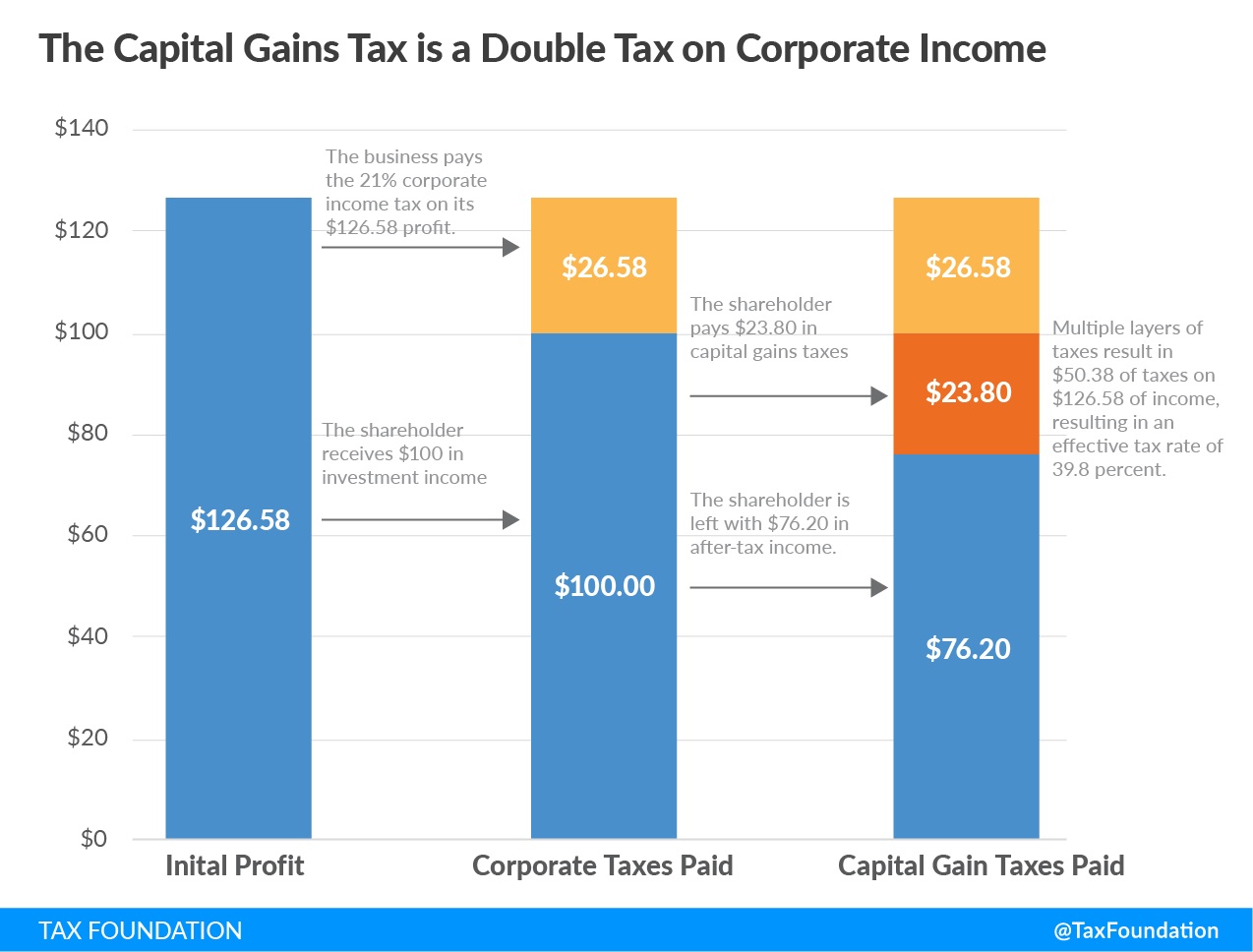
The capital gains tax is double taxation, and that’s a bad idea (assuming the goal is faster growth and higher wages).

Let’s consider how it discourages investment. People earn money, pay tax on that money, and then need to decide what to do with the remaining (after-tax) income.

 http://freedomandprosperity.org/wp-content/uploads/2019/09/Sep-19-19-TF-Chart.jpg

If they save and invest, they can be hit with all sorts of additional taxes. Such as the capital gains tax.

If you want to be wonky, a capital gain occurs when an asset (like shares of stock) climbs in value between when it is purchased and when it is sold.

But stocks rise in value when the market expects a company will generate more income in the future.

Yet that income gets hit by both the corporate income tax and the personal income tax (the infamous double tax on dividends).

So a capital gains tax is a version of triple taxation.

Now that I’ve whined about capital gains taxation, let’s see what happens when a country moves in the right direction.

Professor Terry Moon, from the University of British Columbia, authored a study on the impact of a partial cut in South Korea’s capital gains tax. His abstract succinctly summarizes the results.

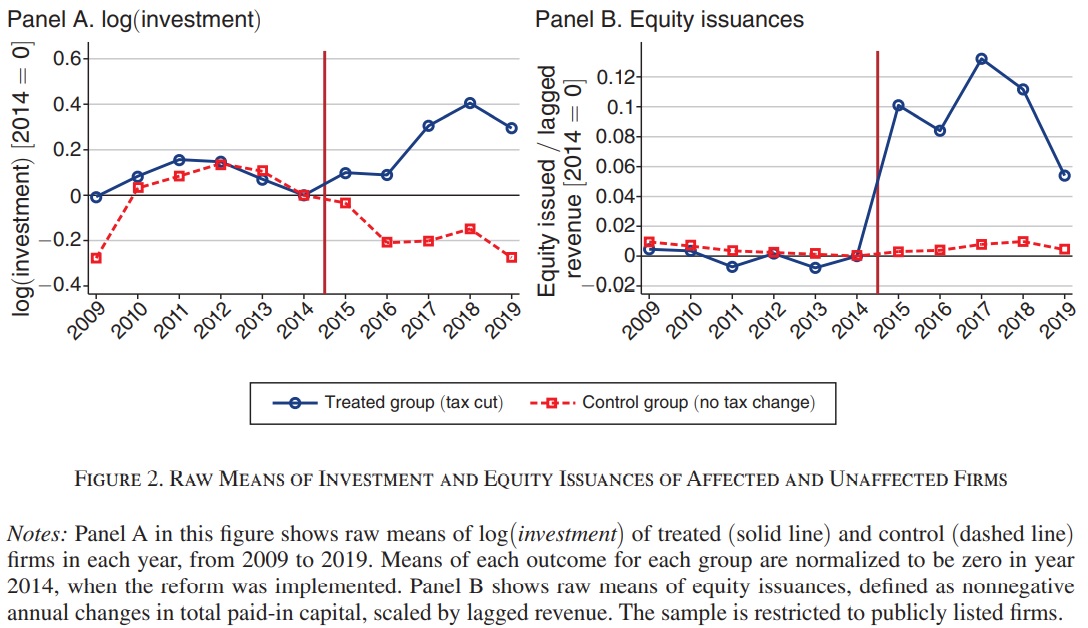
This paper assesses the effects of capital gains taxes on investment in the Republic of Korea (hereafter, Korea), where capital gains tax rates vary at the firm level by firm size. Following a reform in 2014, firms with a tax cut increased investment by 34 log points and issued more equity by 9 cents per dollar of lagged revenue, relative to unaffected firms. Additionally, the effects were larger for firms that appeared more cash constrained or went public after the reform. Taken together, these findings are consistent with the “traditional view” predicting that lower payout taxes spur equity-financed investment by increasing marginal returns on investment.

There are several interesting charts and graphs in the study.

But this one is particularly enlightening since we can see big positive results for the firms that were eligible for lower tax rates compared to the ones that still faced higher tax rates.
Richard Rahn wrote about capital gains taxation late last year.

Here are some excerpts from his column in the Washington Times.

Would you vote for a tax that frequently taxes people at an effective rate of 100% or more, misallocates investment, reduces economic growth and job creation, often becomes almost impossible to calculate, and in many cases reduces, rather than increases, revenue for the government? …So-called “capital gains” are price changes most often caused by inflation, which, of course, is caused by incompetent or corrupt governments. …Some countries explicitly allow for the indexing of a capital gain for inflation. Other countries have no capital gains tax at all because they recognize what a destructive tax it is. …The current maximum federal capital gains tax is 23.8%. …“Build Back Better” (BBB) bill would push the top rate to 31.8%…and…citizens of states with high state income tax rates like California, New York, and New Jersey would find themselves paying destructive rates from 43 to 45%.

Needless to say, it is a bad idea to impose a 43 percent-45 percent tax on any type of productive behavior.

But it is downright crazy to impose that type of tax on economic activity (investment) that also gets hit by other forms of tax.

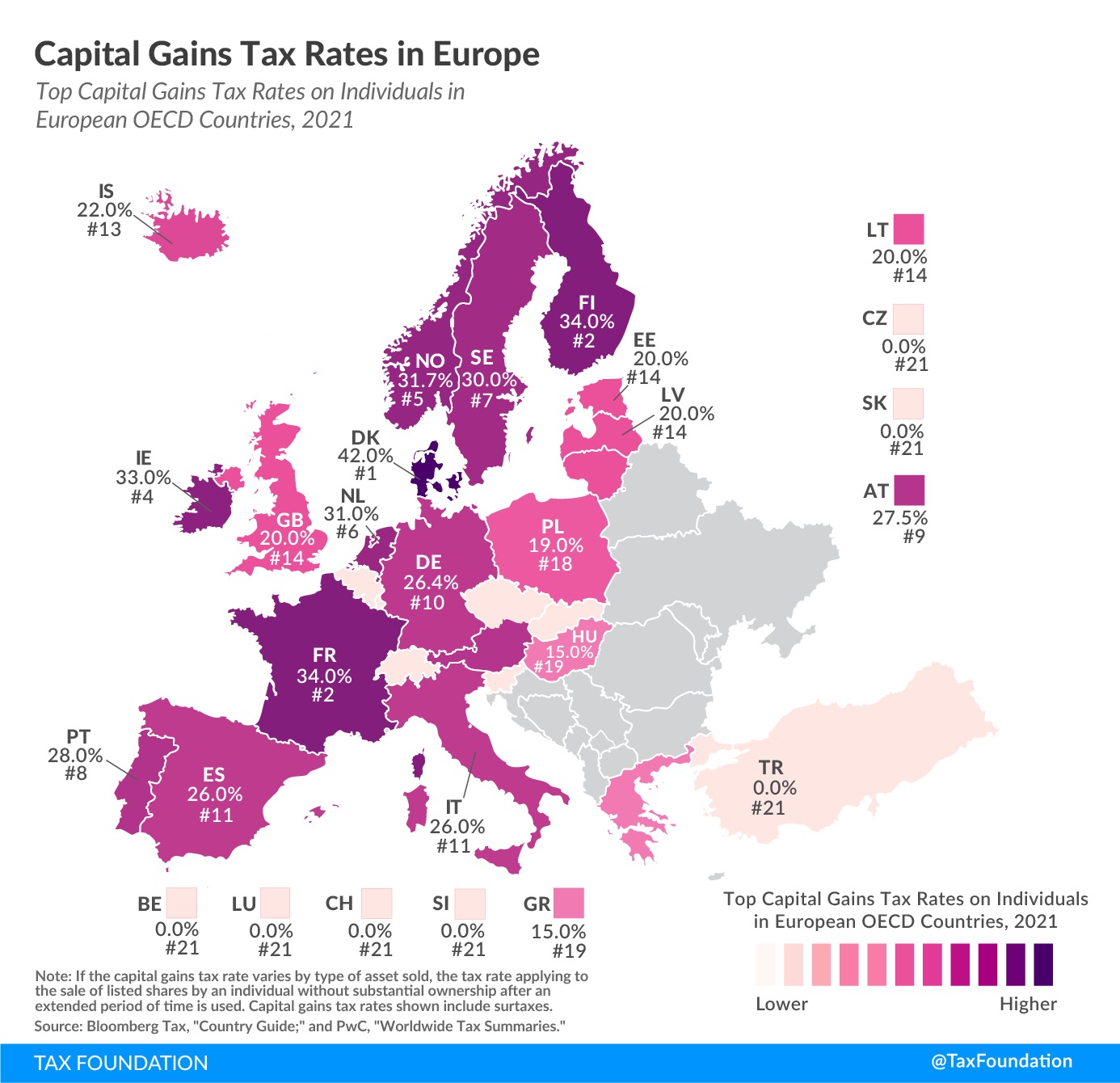
Let’s close with this map from the Tax Foundation. As you can see, some European nations have punitive rates, but countries such as Belgium, Slovakia, Luxembourg, the Czech Republic, and Switzerland wisely have chosen not to impose a capital gains tax..
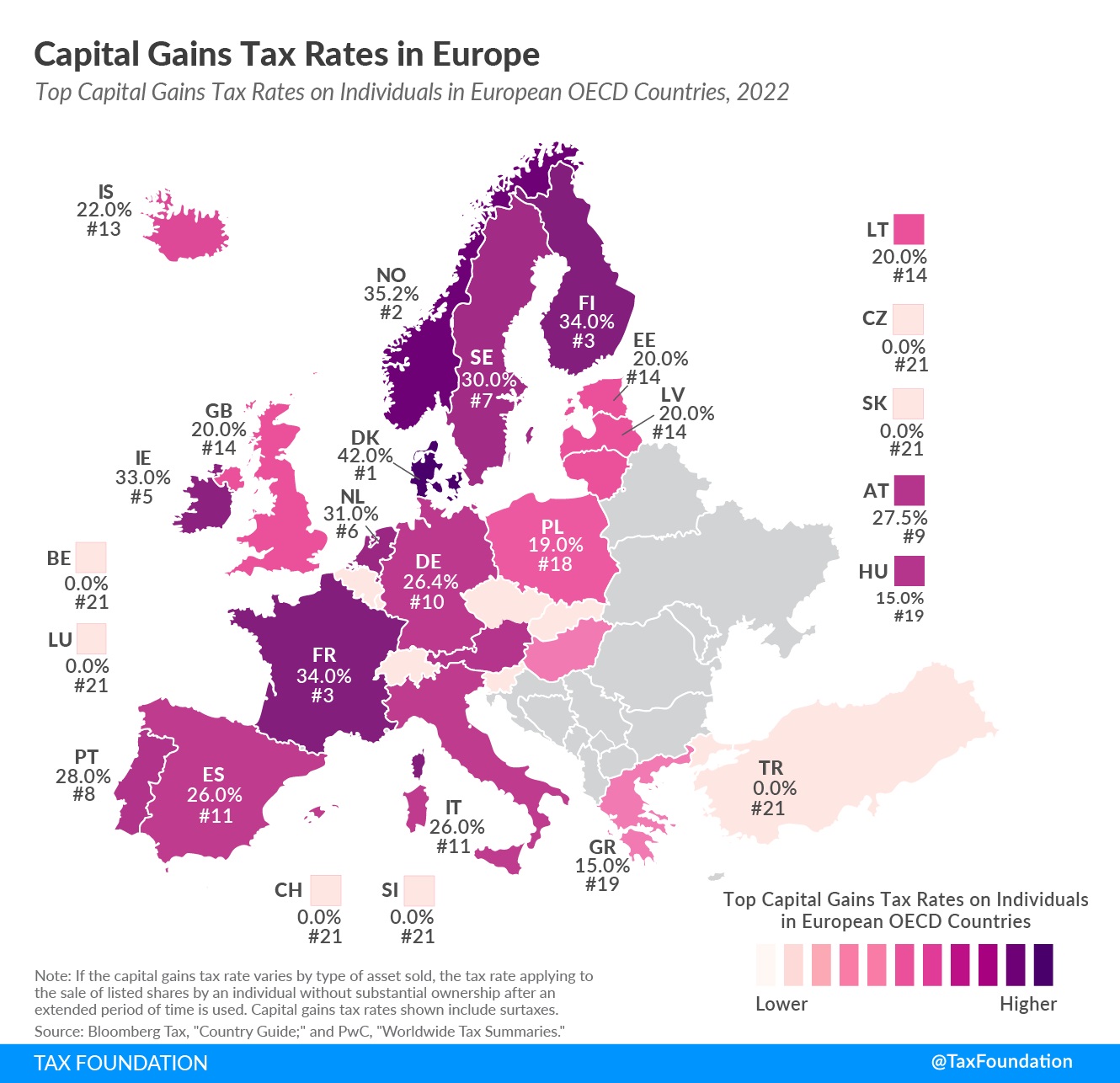
P.S. For more information, I invite people to watch the video I narrated on the topic. And this editorial from the Wall Street Journal also is a good summary of the issue.

P.P.S. Biden wants America to have the world’s worst capital gains tax. To learn why that’s a bad idea, click here and here.


Tuesday, September 28, 2021

Biden’s Tax Plan Is a Middle-Class Death Tax Dressed as a Capital Gains Tax on the Rich

James R. HarriganJames R. Harrigan  Antony Davies Antony Davies  – September 27, 2021 @ American Institute for Economic Research


The federal government’s insatiable appetite for spending has left politicians casting about for untapped revenue sources. Enter President Biden’s tax plan, which contains a death tax on the middle class dressed up as a capital gains tax on the rich. Having squeezed from the rich about as much as they are likely to get, politicians are now gunning for the rest of us.

Bernie Sanders and Elizabeth Warren get good headlines when they call for taxing billionaires’ wealth. But, even if a wealth tax were constitutional (it isn’t), and even if politicians taxed 100% of US billionaires’ wealth (they won’t), and even if the billionaires could sell trillions of dollars in assets for full market value (they can’t), politicians still wouldn’t collect enough to fund their profligate spending. US billionaires’ combined $4.2 trillion wealth would fund the federal government’s 2021 budget for less than eight months. And at the end of that eight months, there’d be no more US billionaires.

What politicians know, but won’t say, is that the middle classes are the great untapped revenue source. What the middle classes lack in income, they more than make up for in numbers. Before taxes and transfers, the average household in the middle income quintile earned $77,000 and the average household in the upper middle quintile earned $117,000. Combined, those households earned $4.8 trillion in 2018. That’s twice what the top 1% earned. Meanwhile, the top 1% paid an average effective federal tax rate of 30.2 percent, versus 12.8 percent for middle income and 16.7 percent for upper middle income households.

The President emphasizes that his plan closes an arcane loophole, “stepped-up basis,” that has allowed billionaires to get away with paying less taxes. He and his supporters keep saying “capital gains,” and “billionaires,” but the fact is that the proposal for closing that loophole will hit middle class homes, farms, and businesses.

Under long-established law, an heir owes capital gains taxes when the heir sells, not inherits, assets. So, a family home, farm, or business, passed down from generation to generation, only creates a tax liability when the heir at the end of the line finally sells it. Even then, the heir pays tax on the increase in value from when the heir inherited the asset to when it was sold. This is “stepped-up basis,” and it partially compensates for the fact that capital gains taxes don’t adjust for inflation. For example, under current law, a home purchased for $50,000 in 1980 and sold for $150,000 in 2021 could be subject to more than $20,000 in capital gains taxes even though, adjusted for inflation, the home was sold at a loss. Stepped-up basis attempts to eliminate this inflation bias by resetting the clock on the asset’s value at inheritance.

Biden’s plan would remove the stepped-up basis, meaning that heirs would pay tax on the increase in value from when the ancestor purchased the asset to when the heir sold the asset. For businesses passed down through multiple generations, this can significantly magnify the tax bill. And in a one-two punch, Biden’s plan also requires that heirs pay the tax when they inherit assets, not when they sell them. So rather than the family home, farm, or business being taxed when the last heir finally sells it, it would be taxed each time it moved from one generation to the next.

The President insists on calling this a “capital gains tax,” but the combination of these two pieces – removal of stepped-up basis and pay-at-inheritance – causes the tax to behave exactly like a death tax. It is a death tax aimed squarely at the middle classes.

To mollify farmers, the President has said that heirs can delay paying the tax provided they continue to work the farm. This is scant help as the heirs will still be subject to the increased tax. The plan merely allows them to pay later. To throw a bone to family businesses and people who have lived frugally to save for their children, Biden’s plan offers a $1 million exemption.

But passing this new tax plan will be much harder than ratcheting that $1 million exemption down after the law is passed. Once the new plan is in place, expect that $1 million exemption to start shrinking until the new tax hits everyone. For evidence, look at the history of the federal income tax, which politicians at the time promised would apply only to “the rich.” Once instituted, it took less than a decade for politicians to extend the federal income tax all the way down to the poor.

The President’s tax plan is a death tax on the working class dressed up as a capital gains tax on the rich. Say what they will about using the tax code to reduce income inequality, the fact is that multi-trillion dollar deficits have made politicians desperate for new sources of tax revenue. And, having eaten the rich, they’re now turning their eyes to the middle class.

James R. Harrigan

James R. Harrigan

James R. Harrigan is Senior Editor at AIER. He is also co-host of the Words & Numbers podcast.

Dr. Harrigan was previously Dean of the American University of Iraq-Sulaimani, and later served as Director of Academic Programs at the Institute for Humane Studies and Strata, where he was also a Senior Research Fellow.

He has written extensively for the popular press, with articles appearing in the Wall Street Journal, USA Today, U.S. News and World Report, and a host of other outlets. He is also co-author of Cooperation & Coercion. His current work focuses on the intersections between political economy, public policy, and political philosophy.

Get notified of new articles from James R. Harrigan and AIER.

Antony Davies

Antony Davies

Antony Davies is the Milton Friedman Distinguished Fellow at the Foundation for Economic Education, and associate professor of economics at Duquesne University.

He has authored Principles of Microeconomics (Cognella), Understanding Statistics (Cato Institute), and Cooperation and Coercion (ISI Books). He has written hundreds of op-eds appearing in, among others, the Wall Street Journal, Los Angeles Times, USA Today, New York Post, Washington Post, New York Daily News, Newsday, US News, and the Houston Chronicle.

He also co-hosts the weekly podcast Words & Numbers. Davies was Chief Financial Officer at Parabon Computation, and founded several technology companies.

Get notified of new articles from Antony Davies and AIER.
 

Wednesday, July 21, 2021

Biden’s Awful Plan for a Hybrid Death Tax/Capital Gains Tax

July 20, 2021 by Dan Mitchell @ International Liberty 

More than 10 years ago, I narrated this video explaining why there should be no capital gains tax. 


The economic argument against capital gains taxation is very simple. It is wrong to impose discriminatory taxes on income that is saved and invested.  It’s bad enough that government gets to tax our income one time, but it’s even worse when they get to impose multiple layers of tax on the same dollar.


Unfortunately, nobody told Biden. As part of his class-warfare agenda, he wants to increase the capital gains tax rate from 23.8 percent to 43.4 percent.  Even worse, he wants to expand the capital gains tax so that it functions as an additional form of death tax.  And that tax would be imposed even if assets aren’t sold. In other words, it would a tax on capital gains that only exist on paper (a nutty idea associated with Sens. Ron Wyden and Elizabeth Warren).

I’m not joking. In an article for National Review, Ryan Ellis explains why Biden’s proposal is so misguided.


The Biden administration proposes that on top of the old death tax, which is assessed on estates, the federal government should add a new tax on the deceased’s last 1040 personal-income-tax return. This new, second tax would apply to tens of millions of Americans. …the year someone died, all of their unrealized capital gains (gains on unsold real estate, family farms and businesses, stocks and other investments, artwork, collectibles, etc.) would be subject to taxation as if the assets in question had been sold that year. …In short, what the Biden administration is proposing is to tax the capital gains on a person’s property when they die, even if the assets that account for those gains haven’t actually been sold. …to make matters worse, the administration also supports raising the top tax rate on long-term capital gains from 23.8 percent to 43.4 percent. When state capital-gains-tax rates are factored in, this would make the combined rate at or above 50 percent in many places — the highest capital-gains-tax rate in the world, and the highest in American history.

This sounds bad (and it is bad).

But there’s more bad news.

…that’s not all. After these unrealized, unsold, phantom gains are subject to the new 50 percent double death tax, there is still the matter of the old death tax to deal with. Imagine a 50 percent death tax followed by a 40 percent death tax on what is left, and you get the idea. Karl Marx called for the confiscation of wealth at death, but even he probably never dreamed this big. …Just like the old death tax, the double death tax would be a dream for the estate-planning industry, armies of actuaries and attorneys, and other tax professionals. But for the average American, it would be a nightmare. The death tax we have is bad enough. A second death tax would be a catastrophic mistake.

Hank Adler and Madison Spach also wrote about this topic last month for the Wall Street Journal.

Here’s some of what they wrote.


Mr. Biden’s American Families Plan would subject many estates worth far less than $11.7 million to a punishing new death tax. The plan would raise the total top rate on capital gains, currently 23.8% for most assets, to 40.8%—higher than the 40% maximum estate tax. It would apply the same tax to unrealized capital gains at death… The American Families Plan would result in negative value at death for many long-held leveraged real-estate assets. …Scenarios in which the new death tax would significantly reduce, nearly eliminate or even totally eliminate the net worth of decedents who invested and held real estate for decades wouldn’t be uncommon. …The American Families Plan would discourage long-term investment. That would be particularly true for those with existing wealth who would begin focusing on cash flow rather than long-term investment. The combination of the new death tax plus existing estate tax rates would change risk-reward ratios.

The bottom line is that it is very misguided to impose harsh and discriminatory taxes on capital gains. Especially if the tax occurs simply because a taxpayer dies.

P.S. Keep in mind that there’s no “indexing,” which means investors often are being taxed on gains that merely reflect inflation.

P.P.S. Rather than increasing the tax burden on capital gains, we should copy Belgium, Chile, Costa Rica, Czech Republic, Hungary, Luxembourg, New Zealand, Singapore, Slovenia, Switzerland, and Turkey. What do they have in common? A capital gains tax rate of zero.


Saturday, April 24, 2021

Biden Wants America to Have the World’s Highest Tax Burden on Capital Gains

April 23, 2021 by Dan Mitchell @ International Liberty 

Because of the negative impact on competitiveness, productivity, and worker compensation, it’s a very bad idea to impose double taxation of saving and investment. Which is why there should be no tax on capital gains, and a few nations sensibly take this approach. But they’re outnumbered by countries that do impose this pernicious form of double taxation. For instance, the Tax Foundation has a new report about the level of capital gains taxation in Europe, which includes this very instructive map.

As you can see, some countries, such as Denmark (gee, what a surprise), have very punitive rates.  However, other nations (such as Switzerland, Belgium, Czech Republic, Slovakia, Luxembourg, and Slovenia) wisely don’t impose this form of double taxation.

If the United States was included, we would be in the middle of the pack. Actually, we would be a bit worse than average, especially when you include the Obamacare tax on capital gains.  But if Joe Biden succeeds, the United States soon will have the dubious honor of being the worst of the worst.

The Wall Street Journal opined this morning about the grim news.


Biden officials leaked that they will soon propose raising the federal tax on capital gains to 43.4% from a top rate of 23.8% today. …Mr. Biden will tax capital gains for taxpayers who earn more than $1 million at the personal income tax rate, which he also wants to raise to 39.6% from 37%. Add the 3.8% ObamaCare tax on investment, and you get to 43.4%. And that’s merely the federal rate. Add 13.3% in California and 11.85% in New York (plus 3.88% in New York City), which also tax capital gains as regular income, and you are heading toward the 60% rate range. Keep in mind this is on the sale of gains that are often inflated as assets are held for years without adjustment for inflation. Oh, and Mr. Biden also wants to eliminate the step-up in basis on capital gains that accrues at death.

Beating out Denmark for the highest capital gains tax rate is bad.  But it’s even worse when you realize that capital gains often occur because investors expect an asset to generate more future income. But that future income gets hit by the corporate income tax (as well as the tax on dividends) when it actually materializes.

So the most accurate way to assess the burden on new investment is to look at the combined rate of corporate taxation and capital gains (as as well as the combined rate of corporate taxation and dividend taxation).

By that measure, the United States already has one of the world’s most-punitive tax regimes, And Biden wants to increase all of those tax rates. Sort of a class-warfare trifecta, and definitely not a recipe for good economic results.

For those interested in more details, here’s a video I narrated on the topic back in 2010. 

And I also recommend these columns (here, here, and here) for additional information on why we should be eliminating the capital gains tax rather than increasing it.

P.S. Don’t forget that there’s no indexing to protect taxpayers from having to pay tax on gains that are due only to inflation.

P.P.S. And also keep in mind that some folks on the left want to impose tax on capital gains that only exist on paper.

Sunday, September 22, 2019

The Looming Threat of Higher Capital Gains Taxation

September 19, 2019 by Dan Mitchell  @ International Liberty
I wrote yesterday about the generic desire among leftists to punish investors, entrepreneurs, and other high-income taxpayers.

Today, let’s focus on one of the specific tax hikes they want. There is near-unanimity among Democratic presidential candidates for higher tax rates on capital gains.

Given the importance of savings and investment to economic growth, this is quite misguided.
The Tax Foundation summarizes many of the key issues in capital gains taxation.
…viewed in the context of the entire tax system, there is a tax bias against income like capital gains. This is because taxes on saving and investment, like the capital gains tax, represent an additional layer of tax on capital income after the corporate income tax and the individual income tax. Under a neutral tax system, each dollar of income would only be taxed once. …Capital gains face multiple layers of tax, and in addition, gains are not adjusted for inflation. This means that investors can be taxed on capital gains that accrue due to price-level increases rather than real gains. …there are repercussions across the entire economy. Capital gains taxes can be especially harmful for entrepreneurs, and because they reduce the return to saving, they encourage immediate consumption over saving.
Here’s a chart depicting how this double taxation creates a bias against business investment.


Here are some excerpts from a column in the Wall Street Journal on the topic of capital gains taxation.

The authors focus on Laffer-Curve effects and argue that higher tax rates can backfire. I’m sympathetic to that argument, but I’m far more concerned about the negative impact of higher rates on economic performance and competitiveness.
…there is a relatively simple and painless way to maintain the federal coffers: Restore long-term capital-gains tax rates to the levels in place before President Obama took office. A reduction in this tax could generate significant additional revenue. …This particular levy is unique in that most of the time the taxpayer decides when to “realize” his capital gain and, consequently, when the government gets its revenue. If the capital-gains tax is too high, investors tend to hold on to assets to avoid being taxed. As a result, no revenue flows to the Treasury. If the tax is low enough, investors have an incentive to sell assets and realize capital gains. Both the investors and the government benefit. …The chance to test that theory came in May 2003, when Congress lowered the top rate on long-term capital gains to 15% from 20%. According to the Congressional Budget Office, by 2005-06 realizations of capital gains had more than doubled—up 151%—from the levels for 2002-03. Capital-gains tax receipts in 2005-06, at an average of $98 billion a year, were up 81% from 2002-03. Tax receipts reached a new peak of $127 billion in 2007 with the maximum rate still at 15%. By comparison, federal capital-gains tax receipts were a mere $7.9 billion in 1977 (the equivalent of about $31 billion in 2017 dollars), according to the Treasury Department. The effective maximum federal capital-gains tax was then 49%. …Using our post-2003 experience as a guide, we can predict a dramatic improvement in realizations and tax receipts if the top capital-gains tax rate is lowered to 15%. …but that’s not the only benefit. Such changes also increase the mobility of capital by inducing investors to realize gains. This allows investment money to flow more freely, particularly to new and young companies that are so important for growth and job creation.
Here’s another chart from the Tax Foundation showing that revenues are very sensitive to the tax rate.


Last but not least, Chris Edwards explains that the U.S. definitely over-taxes capital gains compared to other developed nations.
Democrats are proposing to raise capital gains taxes. …Almost every major Democratic presidential candidate supports taxing capital gains as ordinary income. …These are radical and misguided ideas. …capital gains taxes should be low or even zero. …the United States already has high tax rates compared to other countries. The U.S. federal-state rate on individual long-term gains of 28 percent compared at the time to an average across 34 OECD countries of just 16 percent. …the combined federal-state capital gains tax rates on investments in corporations…includes the corporate-level income tax and the tax on individual long-term gains. …Numerous countries in the OECD study do not tax individual long-term capital gains at all, including Belgium, Chile, Costa Rica, Czech Republic, Hungary, Luxembourg, New Zealand, Singapore, Slovenia, Switzerland, Turkey. The individual capital gains tax rate on long-term investments in those countries is zero. …Raising the federal corporate and individual capital gains tax rates would be a lose-lose-lose proposition of harming businesses and start-ups, undermining worker opportunities, and likely reducing government revenues.
Here’s his chart, showing the effective tax rate caused by double taxation.

As you can see, the 2017 tax reform was helpful, but we still need a much lower rate.


I’ll close by recycling my video on capital gains taxation.


You can also click here to learn about the unfairness of being taxed on gains that are solely due to inflation.

For what it’s worth, Senator Wyden wants to force investors to pay taxes on unrealized gains.