Search This Blog

De Omnibus Dubitandum - Lux Veritas

Showing posts with label Corporate Taxes. Show all posts

Friday, September 19, 2025

Part II: Who Pays the Corporate Income Tax?

September 17, 2025 by Dan Mitchell @ International Liberty

More than 15 years ago, I shared a 2007 video about the corporate income tax. One of my first points in that nine-minute video was that businesses pay the tax, but people bear the burden.

I elaborate in this much-shorter clip from a recent interview

.

But what’s my proof?

We have lots of evidence that lower corporate tax rates are good for growth (see here, here, and here), so that’s indirect proof.

There’s also plenty of evidence that lower corporate tax rates have a Laffer Curve effect (see here, here, and here), so that’s more indirect proof.

Today, let’s look at a direct estimate.

We’ll start with this chart looking at the effect of increases in local corporate tax rates in Germany.

I’ve highlighted the impact on wages.

But what does it actually mean? Well, here are some relevant excerpts from the accompanying study, starting with a description of theory and methodology.


The obligation to pay a tax and bearing its economic burden are two different things. Typically (a part of) the economic burden of a tax is passed on to other economic agents through price adjustments. The fact that the legal incidence of taxation differs from its economic incidence is particularly evident in the case of corporate income taxation. While the taxpayer is a legal entity, the economic burden of a tax can only be borne by people. This paper offers the so far most comprehensive analysis of the incidence of corporate in come taxation. Combining theoretical modeling with an empirical analysis, we investigate how changes in corporate income tax rates affect the economic welfare of four groups: firm owners, workers, owners of residential real estate, and owners of commercial real estate.

And here are some results.

Our main finding is that higher corporate income tax rates significantly reduce profits, wages, as well as residential and commercial property prices. The negative effect of tax hikes on property prices and wages is increasing over time, while the negative effect on profits becomes smaller (in absolute terms). …we find that wages decline by about one percent following a one percentage point tax hike, which is close to the estimate by Fuest et al. …the U.S. Congressional Budget Office (CBO) assumes that 75 percent of the corporate income tax burden falls on capital owners and 25 percent on workers

The part that seems most relevant is the finding that wages drop by one percent if the corporate tax rate goes up by one-percentage point.

Not that different from some similar research unveiled back in 2017.

The moral of the story is that American workers should feel very grateful that Joe Biden’s plan to boost the corporate tax rate was not successful.
 

Or that Kamala Harris isn’t in the White House to push her proposed higher corporate tax rate.

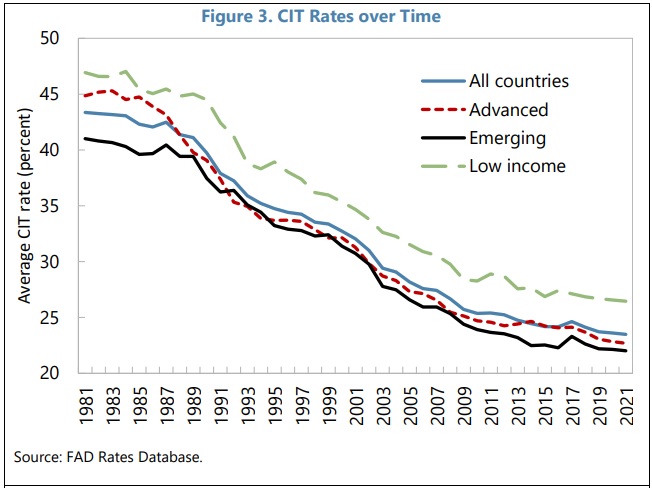
P.S. The good news is that corporate tax rates have been declining, largely thanks to tax competition.

All the more reason why the U.S. should stop subsidizing the Paris-based Organization for Economic Cooperation and Development. That bureaucracy’s campaign for a global corporate minimum tax would be terrible news for just about every group in society, including workers.

Monday, October 25, 2021

Biden’s Befuddlement on Corporate Taxation

October 24, 2021 by Dan Mitchell @ International Liberty 

Let’s look today at the wonky issue of “book income” because it’s an opportunity to point out that there are three types of leftists.

  1. Honest leftists who understand economics and recognize tradeoffs (I think of them as “Okunites“).
  2. Dishonest leftists who understand economics but pretend that tradeoffs don’t exist (the “demagogues“).
  3. Leftists who have no idea what they’re saying or thinking (I think of them as, well, Joe Biden).

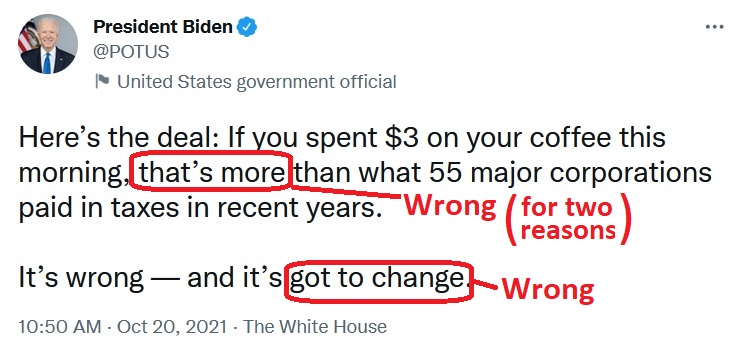
I’m being snarky about the President because of this recent tweet, which contains a couple of big, glaring mistakes.

What are the mistakes (I’m not calling them lies because I don’t think Biden has the slightest idea that he is wrong, much less why he’s wrong).

  • The first mistake is that corporations pay a lot of tax (payroll tax, property tax, etc) even if they are losing money and don’t owe any corporate income tax.
  • The second mistakes is that Biden is relying on a report about corporate income taxes that has been debunked because it relied on book income rather than taxable income.
  • The third mistake is that the President implies that his plan force all big companies to pay the corporate tax when that’s obviously not true.

Regarding that third mistake, Kyle Pomerleau of the American Enterprise Institute explains why there will still be companies paying zero corporate income tax.


While the Biden administration’s proposals would increase the tax burden on corporations by about $2 trillion over the next decade, they would not change the basic structure of the corporate income tax. The Democrats’ proposal would not end corporations paying zero federal income tax in certain years. Corporations will still be able to carryforward losses, and credits will still be available for corporations to offset their tax liability. The administration has proposed a minimum tax to address these headlines by tying federal tax liability to book income. The minimum tax would require corporations with net income over $2 billion to pay the greater of their ordinary corporate tax liability or 15 percent of their book or financial statement income. Corporations would still be able to offset the book minimum tax with losses and general business credits.

Glenn Kessler of the Washington Post tried to defend Biden’s tweet as part of his misnamed “Fact Checker.”

He had to acknowledge Biden was using a made-up number, but nonetheless concluded that the President’s assertion was “probably in the ballpark.”


This is one of Biden’s favorite statistics. …the president has used it in speeches or interviews 10 times since April. Normally he is careful to refer to “federal income taxes” so the tweet is little off by referring just to “taxes.” …Let’s dig into this statistic. It’s not necessarily wrong but there are some limitations. …The number comes from…the left-leaning Institute on Taxation and Economic Policy (ITEP). …Company tax returns generally are not made public, so ITEP’s numbers are the product of its own research and analysis of public filings. But it is an imperfect measure. …the information in the filings may not reflect what is in the tax returns. …Nevertheless, the notion that 10 to 20 percent of Fortune 500 companies do not pay federal income taxes is consistent with a 2020 report by the nonpartisan Joint Committee of Taxation. …This “55 corporations” number is probably in the ballpark.

For what it’s worth, I don’t care that Kessler gave Biden a pass for writing “taxes” instead of “federal income taxes.”

After all, that’s almost surely what he meant to write (just like Trump almost surely meant “highest corporate tax rate” when complaining about America being the “highest taxed nation”).

But I’m not in a forgiving mood about the rest of Biden’s tweet (or Kessler’s biased analysis) for the simple reason that there is zero recognition that companies occasionally don’t pay tax for the simple reason that they sometimes lose money.

I’ve made this point when writing about boring issues such as depreciation, carry forwards, and net operating losses.

At the risk of stating the obvious, companies shouldn’t pay any corporate income tax in years when they don’t have any corporate income.

P.S. I’m not mocking Biden’s tweet for partisan reasons. I was similarly critical of one of Trump’s tweets that was glaringly wrong on the issue of trade.

Editor's NoteDan and I don't necessarily agree on this issue about Trump's trade decisions, as they were perdicated on a value system, whether or not you agree with his values.  Biden on the other hand is now and has always been a slack jawed vacant eyed dweeb. RK


Thursday, October 14, 2021

The Laffer Curve and Trump’s 21 Percent Corporate Tax Rate

Reducing the corporate tax rate from 35 percent to 21 percent was the crown jewel of Trump’s 2017 Tax Cut and Jobs Act (TCJA).

  • It was good for workers since a lower rate means more investment, which translates to increased productivity and higher wages.
  • And it was good for U.S. competitiveness since the United States corporate tax rate no longer was the highest in the developed world.

Some critics downplayed those benefits and warned that a lower corporate tax rate would deprive the government of too much revenue.

Since I don’t want politicians to have more money, that was not a persuasive argument. Moreover, I argued during the debate in 2017 that a lower corporate tax rate would generate “revenue feedback.”

In other words, there would be a “Laffer Curve” effect as corporations responded to a lower tax rate by earning and reporting more income.

Based on the latest fiscal data from the Congressional Budget Office (CBO), I was right.

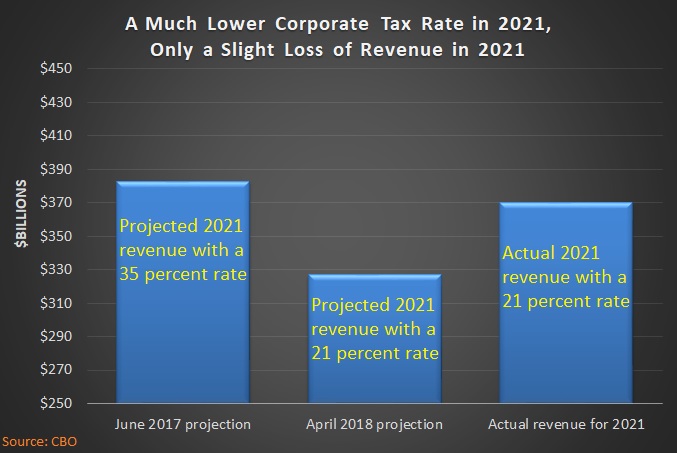
Corporate tax revenues for the 2021 fiscal year (which ended on September 30) were $370 billion. As shown in this chart, that’s only slightly below CBO’s estimate back in 2017 of how much revenue would be collected – $383 billion – if the rate stayed at 35 percent.

The chart also shows CBO’s 2018 estimate of what revenues would be in 2021 with a 21 percent rate (and if you want more data, the Joint Committee on Taxation estimated that the Trump tax reform would reduce corporate revenues in 2021 by $131 billion).

This leads me to ask two questions.

  1. Is this a slam-dunk argument for the Laffer Curve?
  2. Did the lower corporate tax revenue generate so much revenue feedback that it was almost self-financing?

The answer to the first question almost certainly is “yes” but “don’t exaggerate” is probably the prudent response to the second question.

Here are a few reasons to be cautious about making bold assertions.

  • CBO’s pre-TCJA estimate in 2017 may have been wrong for reasons that have nothing to do with the tax rate.
  • CBO’s post-TCJA estimate in 2018 may have been wrong for reasons that have nothing to do with the tax rate.
  • The surge of 2021 revenues may have been a one-time blip that will disappear or fade in the next few years.
  • The coronoavirus pandemic, or the policy response from Washington, may be distorting the numbers.

These are all legitimate caveats, so presumably it would be an exaggeration to simply look at the above chart and claim Trump’s reduction in the corporate tax rate almost “paid for itself.”

But we can look at the chart and state that there was a lot of revenue feedback, which shows that the lower corporate tax rate did produce good economic results.

Perhaps most important, we now have more evidence that Biden’s plan to increase the corporate tax rate is very misguided. Yes, it’s possible that the President’s plan may generate a bit of additional tax revenue, but at a very steep cost for workers, consumers, and shareholders.

P.S. If you want an example of tax cut that was self-financing, check out the IRS data on how much the rich paid before and after the Reagan tax cuts.

Friday, October 8, 2021

The Grim Economics of Higher Corporate Tax Rates

October 7, 2021 by Dan Mitchell @ International Liberty

There are many reasons to reject Joe Biden’s proposal for higher corporate tax rates, and I listed many of them when I narrated this nine-minute video.

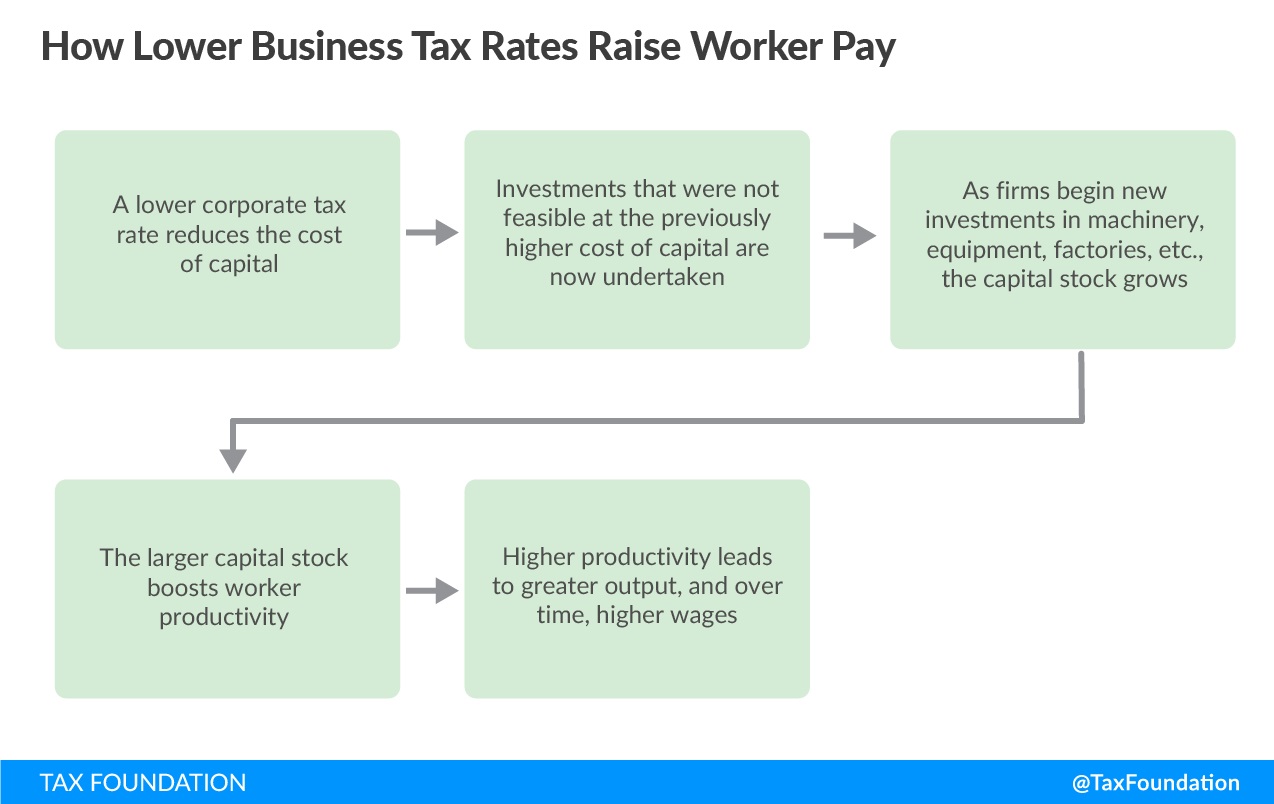
This two-minute video from the Tax Foundation has a similar message.


The main message is that workers, consumers, and shareholders are the ones who actually pay when suffer when politicians impose higher taxes on business.

And the damage grows over time because higher corporate tax rates reduce investment, which inevitably leads to lower wages.

By the way, while a low tax rate is very important, there are many other policy choices that determine the overall damage of business taxation.

This is just a partial list. There are other policies – such as alternative minimum taxation, book income, loopholes, and extenders – that also can increase the damage of the corporate taxation.

The bottom line is that we know the sensible approach to business taxation, but the Biden Administration is motivated instead by class warfare and grabbing revenue.

P.S. For more information on corporate taxation and wages, click here, here, here, here, and here.

P.P.S. For more information on corporate tax rates and corporate tax revenue, click here, here, here, and here.


Monday, September 6, 2021

Washington State’s Tax Revolt

Local municipalities balk at a new state levy they fear will hurt their economy.

Tax revolts are usually led by citizens, sometimes banding together into taxpayer groups. But in Washington State, the latest tax revolt is being engineered by cities and towns objecting to the Democratic-led state legislature’s attempt to impose a capital gains tax. Local officials fear that the new levy, which faces a court challenge, would be a prelude to a state income tax that could hamper economic growth and opportunity. Right now, the Evergreen State is one of only seven states without an income tax and one of just nine without taxes on capital gains.

Five Washington communities—Spokane, Yakima, Spokane Valley, Granger, and Battle Ground—have passed resolutions in recent weeks pledging to outlaw income taxes at the local level if the state adopts income or capital gains taxes. More jurisdictions are promising to follow suit. Local officials are intent on sending the state a message. “Small businesses are the backbone of our local, regional, state, and national economy and it is imperative that the city not put unnecessary hurdles in the way of their success,” Battle Ground’s resolution declared. “Citizens want good government that is fiscally responsible,” Republican state representative Chris Corry argued at a hearing in Yakima. “Putting an income tax ban locally shows a commitment to being fiscally responsible.”

Washington lacks an income tax thanks to a 1932 state Supreme Court ruling that interpreted the state constitution as prohibiting the levy. Over the years, voters have rejected ten attempts to amend the constitution to institute an income tax. The last vote was in 2010, when nearly 65 percent of voters gave a thumbs-down to a ballot initiative heavily supported by the state’s public-sector unions and Bill Gates Sr. (Then-Microsoft CEO Steve Ballmer and Amazon founder Jeff Bezos helped lead the opposition.) 

Undeterred by these failures, Washington Democrats narrowly approved the tax on capital gains in a straight party vote this past May, arguing that it is not an income tax, though capital gains taxes are typically levied as part of an income-tax system. Citizens and groups have already filed lawsuits against the tax; arguments in the case are scheduled to be heard later this month.

The tax, amounting to a 7 percent levy on capital gains from the sale of stocks, bonds, and other types of investments where the profit exceeds $250,000, is projected to raise $415 million annually. Critics argue that it is both unconstitutional and unnecessary. Like many states, Washington’s tax revenues have bounced back robustly from last year’s economic lockdowns, and the state government, as well as localities and school districts, received about $10 billion from the Biden administration’s stimulus bill. Earlier this year, Washington legislators passed a two-year budget that increases spending by 12 percent. “With strong revenue projections and operating budgets already leaping—up to around $59 billion in 2021-23 from $32 billion just a decade ago—it’s difficult to justify a brand-new tax,” the Seattle Times complained in an editorial.

Opponents also say that the lack of an income tax has long given Washington a competitive economic advantage. They point out that the state’s economic-development agency touts the tax-friendly environment in ads to out-of-state businesses. Washington has among the lowest tax bites of states governed entirely by Democrats. A 2018 study by the Federation of Tax Administrators ranked it 26th among states in taxes as a percentage of personal income. “We are an economic powerhouse,” former state treasurer Duane Davidson, a Republican, has observed in arguing against the new levy.

Backers of the capital gains tax, however, argue that wealthy residents have a “moral imperative” to pay more, regardless of the state’s strong fiscal position. “We are asking the wealthiest Washingtonians to share in the responsibility of funding the needs of our communities and putting money back in the pockets of low-income families,” Seattle state representative Noel Frame said. The new levy makes Washington the third Democratic-governed state seeking to raise taxes amid an unexpectedly strong rebound in revenue. Earlier this year, New York raised taxes by $4.3 billion, and Democrats in Massachusetts have put a referendum on the ballot to amend the state constitution so that they can pass a $2 billion tax increase. By contrast, 11 states, mostly Republican-governed, have cut taxes in the wake of the lockdown rebound.

States typically raise taxes most aggressively after economic slowdowns that reduce government revenues. After the 2008 recession, they boosted taxes collectively by $29 billion in 2009, the largest one-year increase in state taxes up to that point. A new generation of progressive Democratic state leaders is now intent on raising taxes during times of plentiful government resources. They’ve framed the debate as a moral crusade, arguing that it’s righteous to require those who have earned more to pay more.

That begs the question: Just how much more will these legislators ask for the next time government revenues take a hit? The sky’s the limit, it seems. Taxpayers beware.

Photo: wh1600/iStock


Thursday, May 27, 2021

Nigel Farage Has a Message for the Democratic Party in America

Editorial of The New York Sun | May 26, 2021

The heads-up this week to American Democrats from Nigel Farage strikes us as more newsworthy than its coverage so far would suggest. He’s warning that left-wing hostility to Israel could deliver to Democrats the kind of political catastrophe that befell Labor in Britain in December 2019. That’s when voters, reacting in part to Labor’s hostility to the Jewish state, gave Conservatives such a victory that Jeremy Corbyn was forced to resign.

On a visit here, Mr. Farage, a founding father of the Brexit movement, issued his warning in an interview Monday with Fox News’ Maria Bartiromo. He reckoned that Mr. Corbyn’s taking the Labor Party “in the pro-Palestinian, anti-Israel but clearly also anti-Semitic direction” had prompted voters in “Middle England” to say “‘we don’t like this kind of extremism,’ and it did hurt the Labor Party.”

“I think,” Mr Farage also said, “there are many instances here in the USA of members of Congress who are supporting these Palestinian protests.” He scored the Democrats for failing to condemn attacks on Jews “in strong enough terms.” He suggested that “across the western world” the left has “openly supported a Palestinian cause that behaves more like a terrorist organization,” and “decent people don’t like this sort of thing.”.........To Read More.......