Search This Blog

De Omnibus Dubitandum - Lux Veritas

Showing posts with label Jane Menton. Show all posts

Tuesday, February 20, 2024

Please Watch and Share "Juice: Power, Politics, and The Grid" by Robert Bryce

@ Manhattan Contrarian

Most of what Robert Bryce covers in his new documentary Juice won’t be news to you if you’re a regular reader of this blog. However, it is exactly the tool we need to bring everyone else into the fold.

It’s gripping, well produced, and covers a ton of ground in short, extremely digestible, 20 minute episodes. In 5 parts (so about an hour and a half total), Bryce and director/producer Tyson Culver cover: how the energy market developed; where we are now; the politics and profits driving decisions; why solar/wind energy will never work; and hope for a possible nuclear renaissance. And they do it all without ever getting too technical for the average viewer.

The first three episodes should be required viewing for everyone, in my opinion, and provide a thorough overview of the grid, the players, and the politics. The last two episodes are very focused on nuclear as our best option for reliable, carbon-free energy, which comes off as hopeful and solution oriented, but may be much further from realization than Bryce optimistically portrays.

If you read this blog, I can safely assume you already know a lot about energy and why current government policies towards energy are absurd at best and dangerous at worst. But it’s just as likely that you have several people in your life who struggle to understand your obsession with energy policy or can’t see why it’s so important, so fundamental to modern society, and on the cusp of turning into the biggest political issue of our time.

You can start with the first episode, linked here, and then send it to someone you think could be convinced.

Friday, September 15, 2023

New York Urgently Needs To Confront the Contradiction of Trying To Electrify Everything While Also Eliminating Fossil Fuels

September 13, 2023 @ Manhattan Contrarian

The following post was written jointly by Jane Menton and Francis Menton:

In New York, politicians are selling the public a narrative that electricity is going to be the solution to climate change. We will eliminate all CO2 emissions by banning gasoline-powered cars, banning natural gas infrastructure, banning gas heat in buildings, and banning gas for cooking.  All of these are to be replaced with supposedly “green,” emissions-free, alternatives – which in practice consist of only one thing, electricity.  We’ve been told that this is how we are going to protect the planet for future generations.

But there is nothing emissions-free about the way electricity is currently generated in New York.  About half of our electricity comes now, as it traditionally has, from burning fossil fuels.  New York has announced plans to eliminate those from electricity generation by 2030, but as of now has no realistic plan to replace them.  Meanwhile, it is forcing its citizens to convert essential systems like heating to electricity, with no basis to believe that the electricity will be available to prevent people from freezing in the winter only a few years from now.  This is a glaring contradiction, that needs urgently to be addressed before we suffer a self-inflicted catastrophe.

At present, fossil fuels are critical to our generation of electricity.  According to the most recent data from the federal government’s Energy Information Administration, in 2021 New York got some 46% of its electricity from burning natural gas and another 1% from fuel oil, and almost all of the rest from either nuclear (25%) or hydropower (23%, most of which comes from Niagara Falls).  Non-hydro “renewables” (wood, wind and solar) provided only about 6% in total, and about 2% of that was from wood.  After decades of hype about their wondrous future, wind and solar provided only about 4%.  And in 2021, the state closed the Indian Point nuclear plant, replacing its output almost entirely with natural gas generation, meaning that the percent of our electricity supply coming from fossil fuels is now up near 50% today.

If more electricity is needed, the options are few. New nuclear plants face vociferous opposition from environmentalists, with almost no prospect that that can be overcome. A completely finished nuclear plant called Shoreham sits idle on Long Island, having never been approved for commercial operation in the face of vigorous environmental opposition. As to hydropower, we do not have another Niagara Falls. Wind and solar produce remarkably small amounts after decades of hype and massive subsidies; and what they do produce is intermittent and often unavailable when most needed on the hottest and coldest days. The last option, natural gas – the one that is available, scalable, and actually works – is the one our politicians are pledging to eliminate without anything to replace it.

In the face of this generation picture, the State and New York City are proceeding with proposed electricity mandates that will have the effect of greatly increasing demand for the power. This will either require scaling up our electric grid to match that need or else leaving people without functioning infrastructure.  Policies already in place in New York City require electrification of cars, heat, and cooking, aiming for widespread conversion by 2035, and continuing thereafter.  A piece in the Daily News on June 3 includes a projection from National Grid (one of our utilities) that the State will need to increase the capacity of the grid by 57% by 2035, and 100% by 2050.

In scenarios where people’s cars, heat, cooking and more are all entirely dependent on reliable electricity, ensuring that our electricity sources are adequate and reliable is critical to the functioning of everyday life. Yet, even as our government is rapidly rolling out electrification mandates, it is simultaneously closing the biggest piece of our reliable generation. 

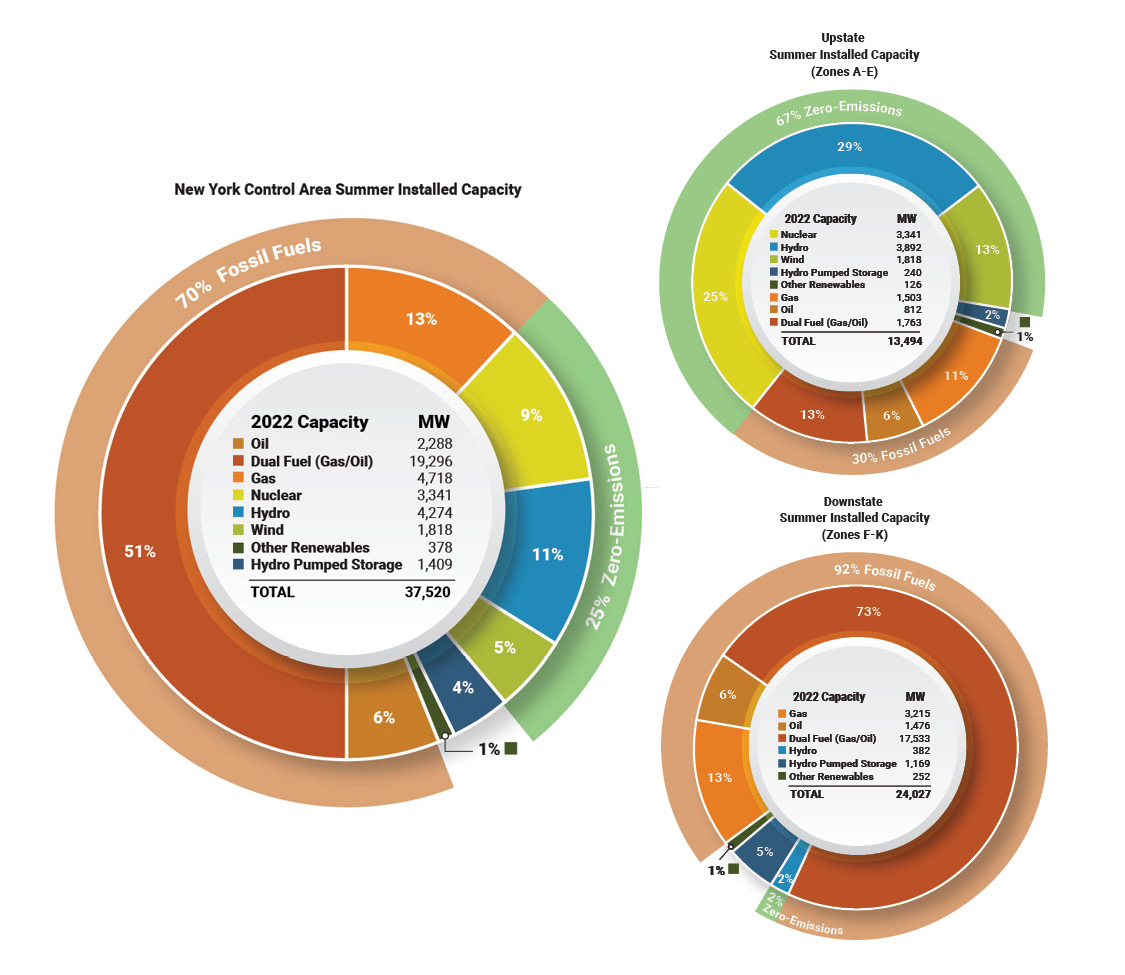
New York is Exhibit A of a current crisis-in-waiting. At the State level, Governor Hochul has committed to closing all of the State’s fossil fuel electricity plants by 2030.  Current  New York State summer installed capacity is 37,520 MW, or 37.5 GW.  Of that, about 60%, or more than 22 GW, consists of natural gas facilities, which are capable of running nearly all the time and ramping up to maximum output when most needed.  Based on National Grid’s projection of 57% increased demand by 2035, New York should be planning to have 37.5 GW x 1.57, or almost 59 GW of always-available capacity on hand by that year.  Yet the only significant plans for additional capacity by 2035 consist of about 9 GW of offshore wind, and another 1.25 GW to come from a transmission line to bring hydropower from Quebec.  (In recent weeks, all of the offshore wind developers have demanded major contract price increases of 50% and up, failing which they threaten to walk off the job.)    

Something here does not remotely add up.  If New York state succeeds by 2030 in closing its natural gas plants -- the plants that account for 60% of the State’s generation capacity -- that would bring our total installed capacity down from 37.5 GW to as little as 15 GW. But we need almost 60 GW to meet projected demand.  And that’s 60 GW that can be called on any time as needed to meet peak usage.  The 9 GW of projected offshore wind turbines wouldn’t make much of a dent even if they operated all the time and could be dispatched to meet peak demand, which they can’t.  Instead, they will operate only about a third of the time, and at their own whim.  At best they will provide about 3 GW on average, when what we need for this full electrification project is more like 45 GW of dispatchable power to add to our existing hydro and nuclear.    

The New York Independent System Operator, which is well aware of this gigantic contradiction, talks vaguely of something they call a “dispatchable emissions-free resource” to fill the enormous gap.  Other than nuclear, which is blocked, that is something that is a pure fantasy and does not exist.

Our State’s and City’s proposed plans are putting New Yorkers on a path to catastrophe, with greatly increased dependence on electricity, but without nearly enough of the stuff to function at even the current usage level.  New York City got a huge lesson on dependence on electricity from Hurricane Sandy a decade ago, when a week-long blackout left people in high-rises without elevator service and without water.  Now they plan to add all heat, cooking, and transportation to the things that absolutely require electricity.  In that world, insufficient electricity becomes a humanitarian crisis.

It is high time for the politicians writing electricity mandates to demonstrate that it is even possible to build and scale an emission-free grid, one that is dispatchable (meaning it will work when we need it), reliable, and resilient. In today’s world, no demonstration of such a grid exists anywhere in the world.

If these mandates are allowed to go forward unabated, the real cost of will be the impoverishment of communities and destruction of quality of life. It’s up to us to realize we’re being sold a false narrative and to stop playing along. 

Tuesday, March 28, 2023

Pursuit of the Green Dream Will Make Inequality a LOT Worse

March 26, 2023 @ Manhattan Contrarian 

There are different ways of looking at the issue of human inequality. The modern Left obsesses about inequality as measured in dollars of income.  But if one measures inequality based on quality-of-life, it quickly becomes clear that we have achieved great progress toward equality on the things that really count. Much of that progress is at risk of reversal from imposition of the green dream.

By the time I was born in the late twentieth century, comforts that had begun in the exclusive domain of the very wealthy had long since become widely available to most hard working people. I’m thinking of things like cars and personal travel, but also small scale conveniences like in-home washers, dryers and dishwashers. All of these things, of course, were brought to us by the widespread access and affordability of electricity and fossil fuels.

But even as the baseline human experience improved, the Left has continued to campaign on the moral abomination that is persistent “income inequality.” This is “inequality” as measured by dollars of income and ability to buy super luxuries.  The rich don’t just travel, they travel via yacht and private jet. And the cities where wealth accumulates, like New York and San Francisco, are, according to their own voters, the worst offenders. Former New York Mayor de Blasio campaigned, and won, on the theme of a “Tale of Two Cities,” the “inequality that increasingly divided New York along the fault lines of fabulous wealth and grinding poverty.”  Guilty New Yorkers fell for it hook, line, and sinker.

It is true that New York is home to some of the wealthiest people in the world.  But it is also true that the poorest people in the city still have widespread access to decent housing with heat, plumbing, food, and transportation — things that were out of reach to most poor Americans in the 19th or even well into the 20th century. They also have widespread access to electricity, and as a result many have televisions, telephones, and modern healthcare – things that did not even exist until the 20th century.

Throughout history, “poverty” once meant something very different from what it means in America today, and the difference in quality of life between the rich and the poor was stark. Being poor often meant living in one room shacks with inadequate access to food, while being rich meant living in mansions staffed with servants to attend to one’s every need.  That’s what “income inequality” once meant, and that’s what income inequality still means in many parts of the developing world. Quality of life in America only started to change dramatically after the industrial revolution and the introduction of widespread electricity and fossil fuels. And the number one thing that keeps the developing world under-developed is its limited access to those two things.

But the same politicians and voters who don’t seem to have noticed how much better the human condition has been in America in the 21st century also haven’t realized how much worse it will be if they achieve their goal of eliminating human use of fossil fuels. In fact, the dream of ending “inequality” directly conflicts with the dream of ending reliance on fossil fuels.

Laws that restrict or aim to eradicate the use of fossil fuels take direct aim at the quality of life for America’s middle and lower classes — that forgotten group existing between “fabulous wealth” and "grinding poverty.” Laws that restrict fossil fuel usage will automatically raise the cost of electricity, meaning people will have to pay more for the same level of use or immediately start cutting back. The first people to make cutbacks will be those who live on the tightest budgets, the types who will notice if their annual heating bill suddenly goes up by $500 or even $1000. This is the average American, not the 1%, and it’s already becoming a reality in Europe: a friend recently confessed to me that her extended family in Italy had moved from two apartments into one for the winter because collectively they could only afford to heat one apartment. My friend thought that was a reasonable sacrifice to make to protect the climate. Might communal housing soon become an economic necessity for many?

Here are just a few things that we currently take for granted that will quickly become difficult to afford as fossil fuels get restricted: heat and air-conditioning, driving for leisure or for any purpose outside of commuting for work, taking family vacations. If electricity becomes exorbitantly expensive, people will be forced to cut back on lighting their homes and using their appliances. Then there are even bigger questions that have yet to be addressed: how will we farm without fossil fuels? How will we run a hospital and provide life-saving care without reliable electricity? Who can say what that will do to our access to food and healthcare.

But the bottom line is: When the eggs go up to $10, the middle class notices, but the wealthy won’t. When gas goes from $2.95 to $4.05, the middle class notices, but the wealthy won’t. The lower, middle, and upper-middle classes will be making cut backs for a while before any of the rich have to do the same. 

It’s amazing how quickly we could find ourselves living in a world where the vast majority of people have become poorer, in the sense of struggling to meet their basic living standard, while only a few elites have access to the things we currently take for granted. We see that already in the celebrity poster-children for climate change, e.g. Leonardo DiCaprio, who continues to fly private and summer on a yacht in the Mediterranean, unaffected by the rising costs of fuel. This is not an outlandish claim or an impossibility, rather it would simply be returning to a meaning of “inequality” we had successfully left in the past. 

The beauty of our freedom-based economic order has been closing that quality of life gap between the rich and the poor, but all the progress we’ve made to lift the living standard for ordinary people could be undone with the wave of a politician’s pen. And when that day comes, the Bill de Blasios and Bernie Sanders of the world won’t be responsible for solving inequality, they’ll be responsible for creating it.


Wednesday, January 18, 2023

If Healthcare is a Human Right, Will the Younger Generation Provide It?

January 16, 2023 @ Manhattan Contrarian

Last week, my email inbox was flooded with headlines about a nursing strike taking place at two major NYC hospitals. E.g., from the New York Daily News, January 9:

Hospitals Struggle, severely short staffed, as 7K NYC nurses strike at Mt. Sinai, Montefiori:  "There's  no help.  Can't do nothing."

More than 7000 nurses walked off the job early Monday at two major New York hospitals after contract talks disintegrated overnight, leaving Mt. Sinai in Manhattan and Montefiori Medical Center in the Bronx struggling to care for patients. 

Though the strike has since ended, my thought when I read the headlines was: Here is a legitimate concern: For years, there has been a looming shortage of healthcare workers, and of nurses specifically. The linked article has a list of statistics, such as: 4.7 million nurses are expected to retire by 2030; 55% of current registered nurses are over the age of 50. 

It is possible, maybe even likely, that the nursing union might exaggerate claims of a looming staffing shortage in order to strengthen its negotiating positions. However, I maintain that we have enough social indicators from Gen Z and Millenials – that is, people in the 20-45 age range – to wonder what might happen if there comes a time when there are not enough people willing to work in industries that require difficult physical labor or emotional hardship. If there are insufficient incentives for people to do that work, then our problems with strikes and shortages are just beginning.

The Left frequently proclaims that “Healthcare is a Human Right!” But that statement assumes conditions in which healthcare can take place: the innovations, technology, and personnel to administer advanced medicine. Beyond requiring that healthcare be “fully funded” by the government, and insisting patients not bear financial responsibility for their treatment, Leftists seem to take for granted that there will always be enough people willing to dedicate their lives to the service of others, while ignoring the complex incentive structures at play. 

Nursing is not just “a job,” in the normal sense. “Just a job” is what I had when I worked for a law firm as a campus recruiter. One memory stands out from that era of my life: there were a few months of the year, during the on-campus interviews, when we worked long hours and never seemed to have enough time to get everything done. One day as I was buzzing about my desk, frantically trying to get folders organized for candidates that were about to walk in the door for their interviews, a partner at the firm saw I was struggling. He came over to me to reassure me. “Just remember,” he said, “no one’s life is at stake here. Your mistakes don’t really matter.”

On the other hand, during the nursing strike last week, many patients at Mount Sinai and Montefiore hospitals did not receive necessary medical procedures. The Daily News quotes Veronica Santos, who took her father to the emergency room, saying that he had not received a CT scan for a heart ailment because there was no one to administer it. Healthcare can’t be a “human right” when there is no one there to administer it.

That’s the thing about nursing: it’s uniquely immediate and purposeful work. It requires a belief in the value of serving the community, and a willingness to be present for some of life’s ugliest and most difficult moments. As those currently working in the industry start to retire, Millennials and Gen Z have given little indication that they are interested in taking their place – quite the opposite. 

Far from being “tough” or able to handle difficulty, young people are afraid of hearing words they don’t like. They want “safe spaces” and trigger warnings. They have been known to accuse people of “violence” and “trauma” for “misgendering” them. The Washington Free Beacon reported in September that during a mandatory training, Harvard told its students that “using the wrong pronouns constitutes abuse.” If words have become violence, what will younger generations make of the real thing? 

Millennials and Gen Z are also the first generations to have grown up with the internet. In the case of Gen Z, they’ve been carrying the internet in their pocket since elementary school. The Hill reports that 1 in 4 Gen Z’ers “Plan to become social media influencers.” They have seen their peers make millions by simply making TikTok videos of themselves dancing in the mirror. If that’s an option, who would choose long hours on their feet during a hospital shift, arms deep in human fluids?

This sums up my lack of faith that rising generations will be called to nursing: first, that they are accustomed to having a screen between themselves and reality; second, that there are a plethora of options for them to work cushy laptop jobs that pay six figures and don’t require any physical or emotional labor. There’s no blood, and no screaming – unless it’s to accuse someone of racism.

To be clear, I can’t disparage my fellow Millennials or our juniors, Gen Z, in this at all. I am also to blame. I am a working mom and I work at home full-time. I swear, I am not one of the Sarah/Elizabeth bots that comment on my dad’s blog about making 120/hr for online work. But, I share their desire to pursue my dreams from the comfort of the couch, while saving my mental and emotional energy for my family.

But I too would say, adamantly, that the world needs nurses, and if they want more money or more support, they should have it. But ? that seems to underscore the basic flaw in the younger generation’s worldview: with the infinite supply of government money, we can summon up an infinite supply of other people to do the work. Meanwhile, we’ll keep our cushy laptop jobs.

It is one thing to see what needs to happen, quite another to incentivize people to do it – especially when the work requires a sacrifice on someone else’s part. Those incentives might require a cultural shift: a return to the values of community and service. In our current political environment, young people seem to think that claiming something as an entitlement means someone will inevitably show up to do the work. Perhaps if nobody does, younger generations will be forced to realize that if they want healthcare to be a human right, then they might have to abide by that old saying: if you want something done, you have to do it yourself.

Monday, October 31, 2022

NYC Hates Its Middle Class Homeowners

Four years ago, just before our son was born, my husband and I bought our first home: a two bedroom, one bathroom apartment in Queens. 

Queens has a lot to recommend it; it is often known as the City’s “middle class” borough, with almost no slums, and an equivalent lack of notable wealth. It is not a small area: more than 100 square miles, with a population over 2.25 million. The homeownership rate is about 45%, which is high for New York City. In addition, it is the most ethnically diverse county in the U.S., and a place where immigrants from all over the world have sought the American dream. Unfortunately, our politicians are working hard to put an end to that. 

About a year ago I joined the board of my building, a nondescript co-op which has about 160 apartments. Within my first month of joining a senior board member, one who has been on the board for many years and is about 20 years my senior, sent us all the following email: 

“I just wanted to bring this topic to your attention… The Climate Mobilization Act of 2019 will have a big impact on our building. Our emissions must be cut by 60% in the next 10 years or so. If we fail, the fines are in the range of $150k a year. We will be required to make hundreds of thousands of dollars in investments to upgrade our systems.” 

For reference, this act, the Climate Mobilization Act, is a New York City statute also known by the name Local Law 97 (LL97).

Since I am the daughter of the MC, I was already familiar in a general way with this New York City law, and with the similar law at the state level known as the Climate Leadership and Community Protection Act, also passed in 2019. But our senior board member’s email brought home the particular financial consequences that our building – and hundreds of others like it – would shortly be facing.

My colleague’s email was accompanied by the following chart, created by this website, called the NYC LL97 Carbon Emissions Calculator. This site has been endorsed by the City for buildings to use to calculate how much they are supposed to reduce their carbon emissions and how much they will owe in fines if they fail to install “zero-emissions” heating systems by the set deadlines. Here is the chart that my colleague came up with for our building:

Editor's Note: I can't properly reproduce the image of the chart, so please go to the original article. RK 

According to the chart, about 75% of our carbon emissions result from our natural gas heat, represented in green in the circles in the lower right portion of the chart.  The City’s statute mandates a series of lowering thresholds for building emission per square foot of space. By 2035, supposedly we must reduce our emissions by 60%, or face fines well in excess of $100,000 per year. In order to reduce our emissions by 60% we would have no option but to convert our building away from its current gas heat system – which is quite reliable, only a few years old, and in fine working condition – to an electric heating system.  

In addition to the lowering emissions mandates, the City statute also prohibits new natural gas hookups in new buildings under 7 stories starting in 2024, and buildings over 7 stories starting in 2027.   

Policy makers busily writing these edicts have yet to figure out how NYC’s electric grid could support such a transition. Spoiler alert: it cannot.  They push ahead even as California begins to realize the folly of requiring everyone to buy an electric car. Supposedly New York is going to triple the load on the electrical grid by forcing the electrification of all buildings and automobiles, while also closing reliable fossil fuel power plants and trying to replace them with wind and solar facilities that only work part time. Meanwhile, they have made no effort to demonstrate how this could possibly work. See prior Manhattan Contrarian discussion, for example here. Beyond being a financial burden on New York’s middle class, there are serious quality of life concerns to consider.

Assuming that they decide to or are forced to go along with this, how much will it cost the unfortunate co-op owners? We haven’t yet had an estimate done for our building, but here are a few words from Warren Schreiber, board president of another Queens co-op, the Bay Terrace Gardens Co-op Section 1, and co-president of the Presidents Co-op & Condo Council (PCCC):

“Converting to (electric) heat pumps will cost [the co-op] $2.5 to $3 million, which does not include finance charges. This expense will result in a 25-30% monthly maintenance increase. Shareholders who have lived here for 20, 30, 40 and 50 years will have to leave Bay Terrace Gardens to find more affordable housing.”

A 25-30% maintenance increase is significant. In my building, we just had a relatively minor maintenance assessment due to rising gas prices. The total was $45,000, spread over 160 apartments, to be paid over the course of three months. We announced this at the annual shareholder meeting in September. During the meeting, our accountant also briefed everyone on the other things that were likely to affect our building finances, including: rising cost of labor, rising property taxes, and inflation.

“This meeting is a call to action to vote Republican” I texted my friend on the board. 

She replied: “Yep.”

After the meeting, a shareholder came up to me to complain about the assessment. 

“If you are going to have a maintenance assessment, you really need to give tenants more warning. It's too expensive. It’s an increase of $88 a month for me.” 

In our building, $100 a month is not money most residents won’t miss. Knowing that, I seized the opportunity to warn this resident about the Climate Mobilization Act and the much higher costs NYC plans to impose on us. 

“But that’s crazy! They can’t do that — it would ruin the city! You know, this is the Republicans’ fault and the Democrats are too cowardly to stand up to them.” 

How anyone could believe that when our city is under exclusive control by the Democratic Party, and the “Green New Deal” has been entirely championed and sponsored by Democrats, is beyond me. But that’s the NYC mindset for you. Even as the costs of policies championed by Democrats begin to hit home, there is acute denial over who’s to blame.

I am trying to take productive action. I wrote the following to my fellow board members: 

“My primary concern in all this is that it seems clear the city wants to push us to convert to electric heat. The cost to retrofit such a system to our building would be astronomical, not to mention that the cost per resident for electric heat would be a significant personal expense. Further, if hundreds of NYC buildings were to suddenly depend on electric heat, I have no faith in the city grid to rise to that level of demand. The cascading negative consequences of imposing this on NYC co-op owners are immense. I’m seeing a housing market crash and financial ruin for middle class citizens (as evidence, see: Europe). What can we realistically do to push back?”

I haven’t heard back from them yet. I’ll let you know if I do.

In the meantime, there are several co-ops in the city who understand what’s at stake. They have mounted a legal challenge against the law. I hope to join them.

FRANCIS MENTON adds: 

The costs of installing and running an electric heat system are actually the smaller part of the problem. The much bigger issue is that the City has embarked on forcing all buildings (and separately, all automobiles) to convert to electricity without any sort of realistic plan of how to provide the necessary electricity. 

My recommendation to Jane and her Board is that they get together with several other co-ops in Queens and call a meeting with their State and City representatives where they say: “We can’t responsibly convert our buildings to electric heat until you can demonstrate a workable system to provide the electricity without blackouts. Otherwise we risk having our owners freeze to death in the winter. And if you persist in this, we will tell our shareholders that this is on you, and advise them that they must vote you out of office to avoid disaster.” 

And meanwhile, the last thing Jane’s building should do is actually invest anything toward converting to electric heat. This whole mania will be long forgotten before these supposed fines kick in for them some time after 2030.

Monday, November 8, 2021

Pandemic Disruptions Give Reasons for Optimism

/

No one wants to live through a pandemic. But for those who don’t have a choice, there is a silver lining: pandemics have historically brought about periods of social disruption that have had positive outcomes for the following generations. There are reasons to be optimistic that we will experience some of that today.

The most prominent historical example of this is the Black Death in 14th century Europe, which by some estimates wiped out 30 to 50% of the total population (exact numbers are not known). The comparison to COVID-19 deaths is dramatic: As of a month ago, 0.2% of Americans have died from COVID-19. (Not that you would know it was such a small percentage considering the sturm und drang). We may think the death count from this pandemic has been traumatic, but we simply cannot comprehend what it would be like to lose a third or more of the population. 

But for those who survived the medieval plague, and for succeeding generations, rapid depopulation created an opening that had not existed in the entrenched social hierarchy of the largely feudal society. Labor shortages suddenly allowed for social mobility, and gave the underclass a voice. Says anthropologist Sharon DeWitte: “the Black Death marked the beginning or, at the very least, an acceleration of a huge economic and sociological shift in Europe.”

When the world seems to be ending, it might be on the verge of changing for the better. It’s possible that we’ll get to experience analogous sociological shifts today, but, luckily for us, we haven't had to endure dramatic depopulation. Policy decisions that were intended to “slow the spread” of disease instead brought every aspect of our personal and economic lives to a halt. Before the pandemic, our society was functioning on autopilot. Now we have a chance to take back control of the wheel -- and the momentum to do so. 

There are plenty of things ready to get disrupted, and that energy can be felt strongly where I live: New York City. On the Reason Roundtable Podcast episode “Economy is Weird Right Now”, Reason editor-at-large Nick Gillespie described New York City as feeling like a “deflated balloon.” That’s an apt description for a place that has always considered itself to be the center of the universe. But Gillespie ends his point optimistically, noting that while it’s unlikely that New York will ramp back up to pre-pandemic levels in the near term, he believes there’s a lot of potential because there was so much detritus that needed to be cleared away. 

Many New Yorkers knew that was true, but as long as the city was growing, there was little incentive to do anything about it. We complained: about the public school system that consistently failed students, the MTA that continually hiked fares while offering deteriorating service, the unaffordable housing, and the proliferation of homeless people. But New York was still New York: it was the business capital, the place where opportunities existed for everyone, and the home of theater, art, and culture. It didn’t seem like anything could radically change that. 

Then, the pandemic brought the city to a standstill. More than anything, it irrevocably ended a tradition that had become a myth: that white collar work must be done from a specific office location five days a week. Thanks to computers and smartphones, office workers have known for a while that their job can be done from anywhere. But for a long time, there were good enough reasons to pretend otherwise. Once offices were closed, many young people found it was much easier to live where they could own a reasonably sized house and pay a reasonable share of their income in taxes -- places without homeless people, unreliable subways, or failing schools.

How this will affect New York in the long run will probably depend largely on how our policy makers adapt to changing circumstances. In July 2021, then-Governor Andrew Cuomo urged employers to bring everyone back to the office, and said publicly that a 15% decrease in the number of people returning to New York “would be devastating.” During the same briefing, Cuomo also addressed rising crime statistics, saying he’d heard from many people that they “just don’t feel safe in New York City.”

The city is currently glowing from reports that it’s exceeding sales tax expectations, and Wall Street has announced a record year for profit — both of which indicate a strong economy. But this month, Nicole Gelinas reports for the New York Post that 11% of New York’s pre-COVID private sector jobs are “still missing” -- and that includes a 7% drop within the financial sector. We’re hovering very close to the percentage of decline that Cuomo warned would be devastating.

The fact that New Yorkers elected Eric Adams for mayor indicates they might be waking up to this reality. Adams is a black former-cop who pledged to be tough on crime and took a comparatively moderate economic stance compared to the other candidates. There is at least some reason to be optimistic that New Yorkers believe the progressive jig is up.

New York is just one example of this trend. Disruptions are occurring across our societal landscape. A particularly exciting example is in public schooling. In 2020, school closures and virtual learning gave parents, many of whom were also suddenly working from home, a window into the classroom every day. 

Issues compounded: the invasion of Critical Race Theory; teachers unions insisting that schools remain closed; ongoing mask mandates; parental frustration. This past year, parents have challenged their school boards like never before — and gone viral in the process. In Loudoun County, VA parents are working to recall their school board. An easy way to tell that the school system is receiving unprecedented pushback is that AG Merrick Garland unleashed the FBI to investigate angry parents.

But even while many parents continue to fight with school boards, more parents are pulling their kids out of institutional schools to homeschool instead. In the academic year 2020-2021, 11.1% of American households with elementary school-age kids reported homeschooling, doubling from 5.6% the year before. Among families that self-identified as black or African American, the change was even more significant, rising from 3.3% to 16.1%. “American homeschooling goes boom,” writes Suzy Weiss, in a long-form article that is well worth reading in full.

According to the New York Times, public elementary school enrollment in NYC declined 4.5% in 2020-2021, and Reason reports that NYC charter schools experienced a simultaneous 7% increase in enrollment (though Reason indicates that NYC politicians have been suppressing that information). The New York Times goes as far as to call the pandemic’s effect on public schooling “profound.” 

In Virginia, the home of Loudoun county, all eyes have been on the gubernatorial election where conservative candidate Greg Youngkin made education a central feature of his run. He said in a recent speech: “this is no longer a campaign, it is a movement where we are all standing up for our children.“ Youngkin’s surprise victory over Democrat McAuliffe was immediately tied directly to his position on education. Many commentators pointed to McAuliffe’s ruinous debate gaffe, where he said “I don’t think parents should be telling schools what they should teach” as a turning point of the race. In September, McAuliffe held a lead in polls among those who ranked education as a top policy priority. By the end of October, that group had swung to Youngkin by a significant margin. Headlines following the election are already hailing Youngkin for turning the Republican Party into the “Party of Parents” -- and outlining a roadmap for the rest of the GOP to follow.

Could this be the beginning of fundamentally disrupting our education system? As a long-time proponent of school choice, I feel hopeful. Whether you believe that the school system simply needed reform or it needed to be upended entirely, the fact remains that public schools and teachers’ unions had existed to benefit faculty and staff (rather than the students) for far too long. The pandemic finally upset the status quo and gave parents back their voice. A new dynamic that puts the parents back in charge has the potential to dramatically improve the lives of future generations of students — generations that might otherwise have been stuck in a system that seemed intent on doubling down on failure.   

The pandemic has been an overdue catalyst for change. I sincerely hope we can seize the opportunities available in these moments of upheaval instead of letting them pass us by. It can be tempting to “return to normal” — and many voted for Biden based on that idea alone. But our old “normal” was a process of slow decline, brought about by our entrenched, self-interested institutions. It suited them to have us believe they were too big to be challenged, and too necessary to live without. But they never were. Now that we know that, let’s go after the rest of the government.