Search This Blog

De Omnibus Dubitandum - Lux Veritas

Showing posts with label Growth. Show all posts

Thursday, March 27, 2025

Economic Freedom and Broadly Shared Prosperity

March 19, 2025 by Dan Mitchell @ International Liberty

In 2014, I dug through Census Bureau data to show that the well being of all income groups is closely correlated.

More specifically, the incomes of all five quintiles (from the poorest 20 percent up to the richest 20 percent) tend to rise and fall together.

My takeaway was that President Kennedy was right. A rising tide does lift all boats. I wrote, “If you want policies that help the poor, those also will be policies that help the middle class and rich.”

In other words, policymakers should focus on growth rather than inequality or redistribution.

I then gave some advice to my leftist friends, writing that, “if you hate the rich, you need to realize that policies hurting them will almost certainly hurt the less fortunate as well.”

Now let’s investigate whether this is true in other nations as well. Let’s start by looking at two charts showing that income levels for both the bottom 10 percent and top 10 percent are higher when there is more economic freedom.
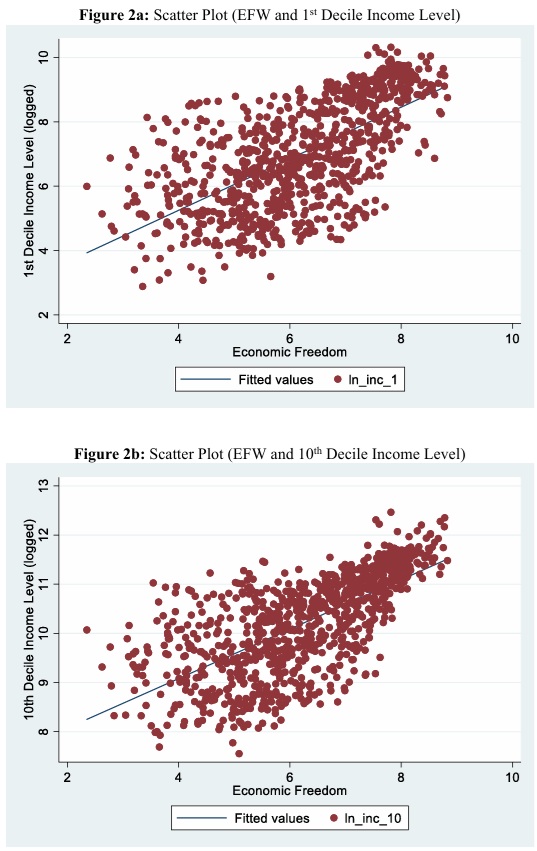
These figures seem compelling, but we also know that correlation is not causation (after all, crowing roosters don’t cause the sun to rise).

Fortunately, we have an answer. The above figures come from some academic research by Justin Callais and Andrew Young. In a 2023 article published by the Journal of Comparative Economics, they use statistical analysis to determine whether there is a link between economic liberty and income levels.

Here are some of the findings.

Does a rising tide of economic freedom lift the boats of a country’s poor, middle class, and wealthy? Or – as most commonly is alternatively hypothesized – does greater economic freedom favor the wealthy at the expense of the rest? …In this paper we employ matching methods to address…concerns. …We study changes in economic freedom and their relationship to inequality using 117 countries from 1970 up through 2015. We examine income deciles (both population shares and average levels) as well as Gini coefficients. By employing matching methods, we work to mitigate endogeneity and nonlinearity concerns. …We use logs of the income levels so that the outcome…can be interpreted as a growth rate. The results are reported in table 5. Each of our 36 estimates are positive and statistically significant. …The picture it paints is one of economic freedom as a rising tide that lifts all boats. …the results here are consistent with an increase in economic freedom causing positive income growth, and growth that is not discernably different across income deciles. …it is difficult to argue that the modest increases in income inequality negate the broad-based gains to individuals generally.

For wonky readers, here is the aforementioned Table 5.
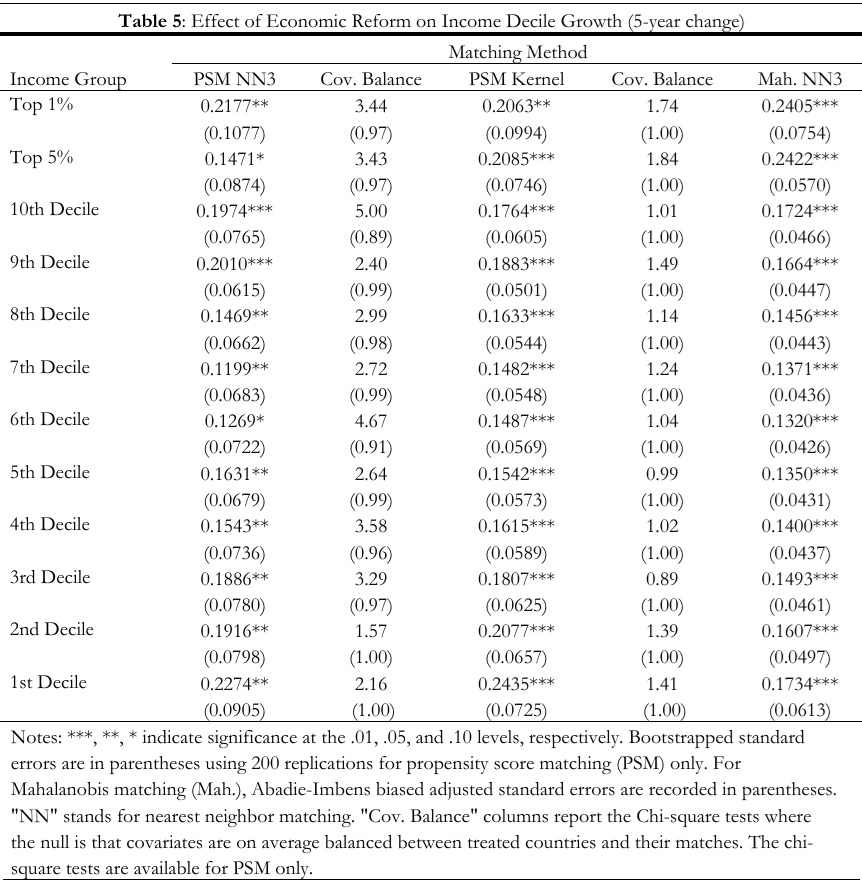
I think this evidence is compelling.

And it matches other research I’ve shared in recent years.

But I’m not overly optimistic that some folks on the left will change their minds. As captured by my Eighth Theorem of Government, many of them are not primarily interested in helping the poor.

Indeed, I fear some of them (including at the IMF) are motivated primarily by resentment and spite for the rich. Indeed, they might even be willing to hurt poor people if they knew the rich would be hurt even more.

Margaret Thatcher was right!

Thursday, July 22, 2021

The Economics of Inequality

July 21, 2021 by Dan Mitchell

In my four-part series on inequality (here, here, here, and here), I argue that that it is more important to instead focus on reducing poverty – especially since we know the policies needed to achieve that latter goal.

In this discussion, I contemplate why some folks don’t understand that message.  One reason is that some of them don’t care.  As explained by the Eighth Theorem of Government, they are motivated first and foremost by a desire for bigger government.

And it doesn’t matter whether they are driven by ideology or “public choice.” The bottom line is that helping people climb the economic ladder is – at best – a secondary concern.

But what about the well-meaning folks on the left? Is there a way of convincing them to channel their compassion in a better direction?

As mentioned in the interview, these are the people who generally believe that the economy is a fixed pie. As such when someone like Jeff Bezos is rich, they think it means other people are poor.


So it should be simple to show them that this isn’t true. There is a wealth of data showing how good (or even just decent) policies create more prosperity.

Looking specifically at the United States, we’re much richer today than we were in the past. And that’s true whether you go back 200 years or if you simply compared today’s economy with where America was after World War II.

And the same pattern exists in other market-based nations.

But here’s what frustrates me. When I share this data with my left-leaning friends, they seem to have some sort of mental block that prevents them from reaching the obvious conclusion.

A few of them will pivot, acknowledge that broad-based growth happens, but then argue that growth is unaffected by policy.

In other words, nations can become more prosperous whether government is big or government is small.

Needless to say, there’s also a wealth of data showing that this isn’t true.

At which point the honest and intelligent folks on the left will explicitly or implicitly embrace Arthur Okun’s argument that it’s okay to have less growth if there’s more equality.

That’s when I point out that even small differences in growth make a big difference to income levels over just a few decades. Which means poor people ultimately will be richer if there’s more economic liberty.

So if they really care about the well-being of the less fortunate, they should be the biggest advocates of free markets and limited government.

Monday, August 21, 2017

Investment, Productivity, Wages, and Economic Prosperity

Here’s a simple and fundamental question: What is economic growth?

And here’s a simple answer: It’s when there’s more national income.

That’s seems like a trivial tautology, but let’s explore some implications. When you dig into the numbers, it turns out that increases in national income (usually measured by gross domestic product, though I prefer gross domestic income) are driven by two factors.
  • More people.
  • More output per hour, also known as increased productivity.
This is why people sometimes say that GDP growth is a function of population growth plus productivity growth.

And what really matters, at least if we want higher living standards, is to have more output per hour. As a result, we should be very concerned that productivity growth seems to be lagging in the United States.

Here’s a chart that was created by the Wall Street Journal, showing data from the Labor Department on productivity all the way back to the 1950s...........To Read More.....