Search This Blog

De Omnibus Dubitandum - Lux Veritas

Showing posts with label Wages. Show all posts

Thursday, September 12, 2024

Census Bureau Income Data: Four Years, No Progress

I’ve repeatedly cited monthly data from the Labor Department to show that workers have struggled during the Biden-Harris years because inflation has increased faster than wages.

Those monthly numbers specifically show that workers lost a lot of ground in 2021 and 2022. There’s been a bit of progress since then, but the best-case scenario is that workers have merely recovered their losses.

Which means zero overall economic progress over the past four years.

Today, let’s look at some annual numbers from the Census Bureau, which just published its yearly report on income in the United States.

The good news is that median family income rose last year. The bad news is that families are still worse off than they were before the pandemic.
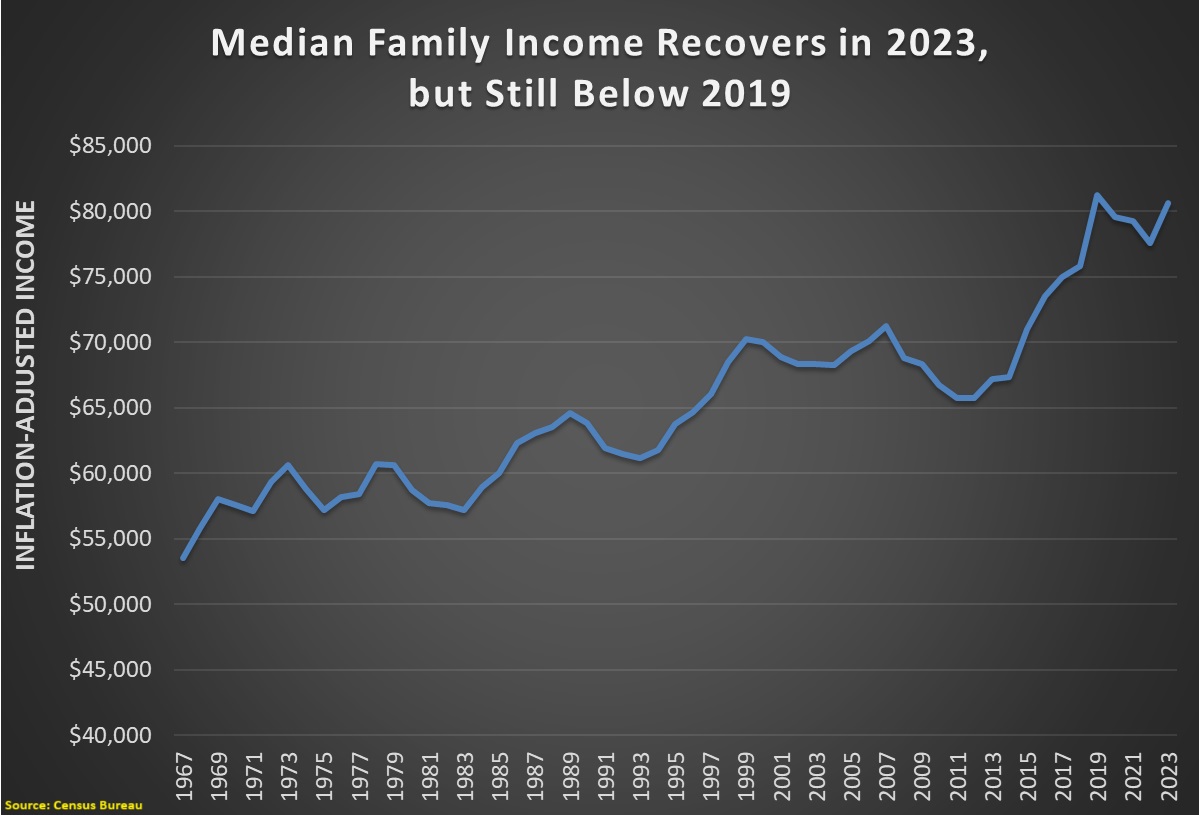
So is this good economic news or bad economic news? Is it good political news? If so, is it good for Harris or Trump? Here are some excerpts from Abha Bhattarai‘s report in the Washington Post.


Household incomes rose last year for the first time since 2019 but are still lower than they were before the pandemic, according to a new U.S. Census Bureau report that helps explain why so many Americans remain dissatisfied with the economy… After inflation, median household income rose to $80,610 last year, up from $77,540 in 2022 but less than the $81,210 families brought home in 2019. …White households saw a 5.4 percent increase in income, while median incomes for their Black, Asian and Hispanic counterparts remained largely flat. …The White House…has struggled to persuade Americans that they’re better off financially than they were four years ago.

My assessment is that neither Harris nor Trump will benefit from these numbers. The somewhat good news in 2023 is offset by the very bad news the previous two years.

So the tiebreaker may be the monthly Labor Department numbers for 2024. I’ll be sure to do a column when new data gets released in early October.

For what it’s worth, here is some of what I wrote about this time last year, when the 2022 Census Bureau income numbers were released.

Median household income dropped by more than $1,000 in Reagan’s first two years, and even dropped by a couple of hundred dollars in 1983, yet that did not preclude big improvements in 1984 and a landslide reelection for the Gipper. So there is still time for Biden to turn things around.

I’ll stick with that analysis, other than replacing Biden with Harris.

Now that I’ve issued my amateur political analysis, I’ll close with hard-headed economic analysis. If we want more jobs, higher wages, and better living standards, free markets and limited government are the right approach.

(Editor's Note: Dan and I diverge on what he's calling Trump's "protectionism", but I'm concerned about the "endless spending" no matter who's elected.  RK)

Unfortunately, a Trump victory may mean economically debilitating protectionism and a Harris victory may mean destructive class-warfare taxes. And endless spending if either of them win!

So whoever prevails, I’m worried that the American people lose.

Monday, September 4, 2023

Beware Especially of Claims Made By Politicians

Donald J. Boudreaux Donald J. BoudreauxSeptember 1, 2023 

A friend recently asked me to assess the stylistic merits of a short essay that his college-age daughter wrote during her competition to become a columnist for a campus newspaper. I did so, and was happy to report to my friend and his daughter – who I’ll call “Sarah” – that this young woman’s flair for writing is enviable. Her language is clear, active, and vivid, with not a word wasted or wanted. If her essay is any guide, Sarah already writes better than do some seasoned columnists for major newspapers.

Fortunately, I wasn’t asked to assess the essay’s substance. Offering such an assessment would have required me to be uncomfortably critical.

With her essay, Sarah describes the surprisingly difficult challenges encountered by an attentive “socially conscious” person – such as herself – who insists on patronizing only businesses that are truly committed to cleaning the environment, furthering workers’ rights, and promoting social justice. Sarah’s disappointment is palpable as she tells of her unfolding realization that labels and advertising slogans often mislead. A bag of coffee beans labeled “Fair Trade Certified” doesn’t guarantee that all workers on that grower’s coffee plantation are paid wages that Sarah and her classmates regard as fair. And just because a brand-name sounds eco-friendly and is accompanied by a boast of its owner’s deep devotion to sustainability and “combating climate change” doesn’t ensure that that brand’s parent company isn’t a gigantic, heartless, wasteful, polluting multinational corporation seeking only maximum lucre for its shareholders...........To Read More...

Monday, December 17, 2018

Overpaid public-sector employees

By Chriss Street December 17, 2018

The U.S. Bureau of Labor Statistics reported that state and local government employee total compensation is now 47 percent higher than for private sector employees.

Total compensation for federal, state, and local government employees cost taxpayers $1.9 trillion in 2016, or about $15,176 per household. Although a 2010 studyby the Bureau of Labor Statistics (BLS) found full-time private industry workers worked an average of 12 percent more hours per year than state and local government workers, private sector workers on average make less in every category.

Most Americans are under the impression that the $50.03 average total hourly compensation for state and local employees versus the $34.53 an hour for private sector employees, is due to public sector defined benefit pension costs.

BLS hourly data reveals that state and local government employees receive $18.80 in benefits compared to $10.48 for the private sector, a spread of $8.32 or 79 percent more. But state and local employee hourly wages and salaries average $31.23 versus $24.06 for private sector employees, a spread of $7.17 or 30 percent more. That means public............To Read More

Monday, December 10, 2018

Should Uncle Sam Subsidize Wages?

November 29, 2018 by Dan Mitchell @ International Liberty
 
Washington is a place that gets infatuated with trendy ideas. A few years ago, everyone was talking about a “universal basic income” because of the strange assumption that millions of people will be unemployable in the future.

That idea was mostly embraced by folks on the left (though not Joe Biden), but there’s now a related idea on the right to provide “wage subsidies” so that unemployable (or difficult to employ) people can get work.

A leading proponent is Oren Cass of the Manhattan Institute, who wrote The Once and Future Worker: A Vision for the Renewal of Work in America.

National Review published an excerpt from his book.
Work has enormous social value for the individuals who engage in it and for the formation and stability of their families, the opportunities of their children, and the vibrancy of their communities. Ideally, the labor market would settle in a place where productive, family-supporting work was available to all people in all places. But nothing in the theory of economics guarantees such an outcome… If we really want to “pay for jobs” — and we should — then we should do it directly. …a…“Federal Work Bonus,”…an additional $3 into your check for every hour worked? That would be a wage subsidy. …a wage subsidy aims to produce that effect in the labor market. Workers unwilling to sell their labor for less than $12 per hour may be worth only $9 per hour to an employer. No job will emerge in that scenario. With the insertion of a $3-per-hour wage subsidy, by contrast, the employer can pay the $9 per hour that the work is worth and the worker can receive the $12 per hour that he demanded. Thus will appear a job where none existed before. …The value of the subsidy would be set relative to a “target wage” of, say, $15 per hour and would close half the gap between the market wage and the target. A worker would initially receive a subsidy of $3 per hour in this case, equal to approximately $6,000 per year if he worked full-time.
The wage subsidy Cass advocates is similar to the “earned income tax credit,” which is basically a redistribution program that is administered through the tax code.

But Cass wants the EITC to be universally available rather than primarily targeted at households with children.
The federal earned income-tax credit (EITC) already operates something like a wage subsidy, offering low-income households large tax refunds that can exceed what they paid in taxes to begin with. But the EITC gets paid long after the income is earned — at tax time the following year — based on an opaque formula. It creates none of a wage subsidy’s immediate, transparent effect in the labor market. …The EITC also skews its benefits heavily toward households with children. A single person working full-time at minimum wage would get a credit of $41, less than 1 percent of what his colleague with kids can expect.
For what it’s worth, Cass acknowledges that employers might capture some of the benefits of a wage subsidy.
If the government offers a $3 subsidy atop a $9-per-hour job, the result will not necessarily be a $12-per-hour job. The employer might instead cut the market wage to $8, to which the government would add $3.50 — half the $7 gap to the target wage of $15 — leaving the worker with $11.50. …How workers and employers respond to the subsidy will vary based on labor-market conditions. What we do know from studies of the EITC and a similar program in the United Kingdom is that, in those instances, roughly 75 percent of the financial benefit accrued to workers.
Now let’s discuss the policy implications.

Cass openly admits that a wage subsidy is a form of redistribution, and – much to my dismay – he doesn’t object if at least some of that new spending is financed by higher taxes.
Subsidizing wages is a particularly well-tailored response to the challenges that globalization presents for American workers. First, the wage subsidy is the appropriate mechanism for redistributing gains from the economy’s “winners” to its “losers.” It comes closest to doing this directly, by taking tax revenue drawn from higher earners and inserting it directly into the paychecks of lower earners. …it is redistribution. And yes, high-income taxpayers will finance it. …The roughly $200 billion price tag for a wage subsidy might require some new tax revenue, but its funding could come largely from the existing safety net, which already dedicates more than $1 trillion annually to low-income households — including many with workers.
The following excerpt also rubbed me the wrong way since he seems to be saying that it would be better if Washington had expanded redistribution instead of lowering the corporate tax rate.
…in debates over the 2017 tax-reform package, which ultimately increased the ten-year federal deficit by $1.5 trillion for the sake of reducing the corporate tax rate, while failing to deliver even the small EITC increase for childless workers that Ryan had once championed. Indeed, while the Khanna proposal in its 2017 form is not a serious one, even it could have been implemented more cheaply than the tax reform that ultimately passed. The deficit spending would have been equally costly, but at least the labor market and its low-wage workers would have been the chief beneficiaries. …the Republican party’s relative disinterest in the labor market is made apparent by its preference for a tax cut over a wage subsidy.
This is very troubling. In the long run, faster growth is much better for low-income workers.
I’m not the only skeptic of this plan.

Writing for the Week, AEI’s Jame Pethokoukis argues that Cass bases his idea on a misreading of the economy.
One of his innovative analytical insights is that economic growth from globalization is bad for workers. …This is a terrible reading of history… America would be worse off today if it had somehow kept the closed “golden age” economy of the 1950s and 1960s. Its lack of openness greatly harmed American workers… Too much of American industry became complacent, unproductive… Likewise, would America have a more thriving economy today without Silicon Valley? …Cass’ reading of the data isn’t much better as he adopts the stance of many leftists that most Americans are no better off than decades ago. Yet a recent Congressional Budget Office study shows a nearly 50 percent increase in middle-class incomes since 1970, with incomes for the bottom fifth up some 80 percent.
And Michael Strain, also with the American Enterprise Institute, was similarly critical in a column for Bloomberg.
Economic growth is under attack. Or, more specifically, the idea that public policy should place a large amount of emphasis on the economy’s rate of growth is under assault… Traditionally, conservatives have placed a premium on growth as the best way to advance the fortunes of all Americans. But in recent years, some on the right have [been] playing down the importance of growth to the well-being of many working-class Americans. The latest argument for that position comes from Oren Cass… Cass argues that the results from decades of policies designed to encourage GDP growth are “embarrassing” and have “steered the nation off course.” …conservatives have been right in their traditional focus on growth. Let’s recall why. …the hot U.S. economy is the best jobs program available for lower-wage and vulnerable workers. …this strength is benefiting low-wage workers more than other groups. …Growth doesn’t just help low-income and working-class households in the short term. Over longer periods, seemingly small changes in the growth rate have large consequences. In the past four decades, for example, real GDP per person has increased from about $28,000 to over $55,000, growing at about 1.7 percent per year. If growth instead had been 1 percent, average GDP per head would be about three-quarters what it is today.
Needless to say, I strongly agree with Strain’s final point about the importance of faster growth.

Though I confess to being at a disadvantage when judging these anti-Cass columns since I haven’t read the book.

However, to the degree that Cass truly has given up on growth (i.e., accepting some form of the “secular stagnation” hypothesis), then I side with Pethokoukis and Strain.

But that’s not my main concern. Here are the four reasons that motivate my objection to wage subsidies.
  1. Redistribution should not be a responsibility of the federal government. Indeed, I want all redistribution devolved to state and local governments (or to the private sector).
  2. Cass says the program will cost $200 billion. Like with most government programs, I assume the actual fiscal burden will wind up being much higher. Especially after the left starts a bidding war.
  3. Existing wages subsidies are riddled with fraud because the government effectively gives people lots of money simply for filing a tax return, yet rarely bothers to confirm they actually earned the income.
  4. Wage subsidies actually turn into wage penalties (i.e., punitive implicit marginal tax rates) when income rises above the target level and the handouts are withdrawn.
The bottom line is that Cass is right that it’s better to subsidize work rather than idleness.

However, Americans already are too dependent on Uncle Sam. It would be even better if we simply achieved more growth by adopting the tried-and-tested recipe for prosperity.

Sunday, December 2, 2018

No, the ‘Real Gender Wage Gap’ Isn’t 51 Percent

An Institute for Women's Policy Research study twists the stats.

By November 30, 2018

For decades, the term “gender wage gap” has referred to the difference in median earnings between full-time working women and full-time working men. Often — erroneously — this statistical difference has been promoted as evidence that women are being paid less than men for doing the same work.

In recent years, especially as evidence emerged of “wage gaps” in the Obama White House and Clinton Foundation offices, many have come to understand that it’s an error to use wage-gap data as a proxy for discrimination, since there are many reasons why men end up earning more than women on average. Full-time working women tend to work fewer hours, to choose different industries and specialties, and to opt for better hours over more compensation, for example.............To Read More....

Friday, September 15, 2017

Income Trends, the Middle Class, and American Prosperity

September 12, 2017 by Dan Mitchell
 
Let’s consider some good news about America.

Some folks on the left like to claim that the middle class is shrinking and that therefore we need bigger government and more redistribution to protect these Americans from falling into poverty.
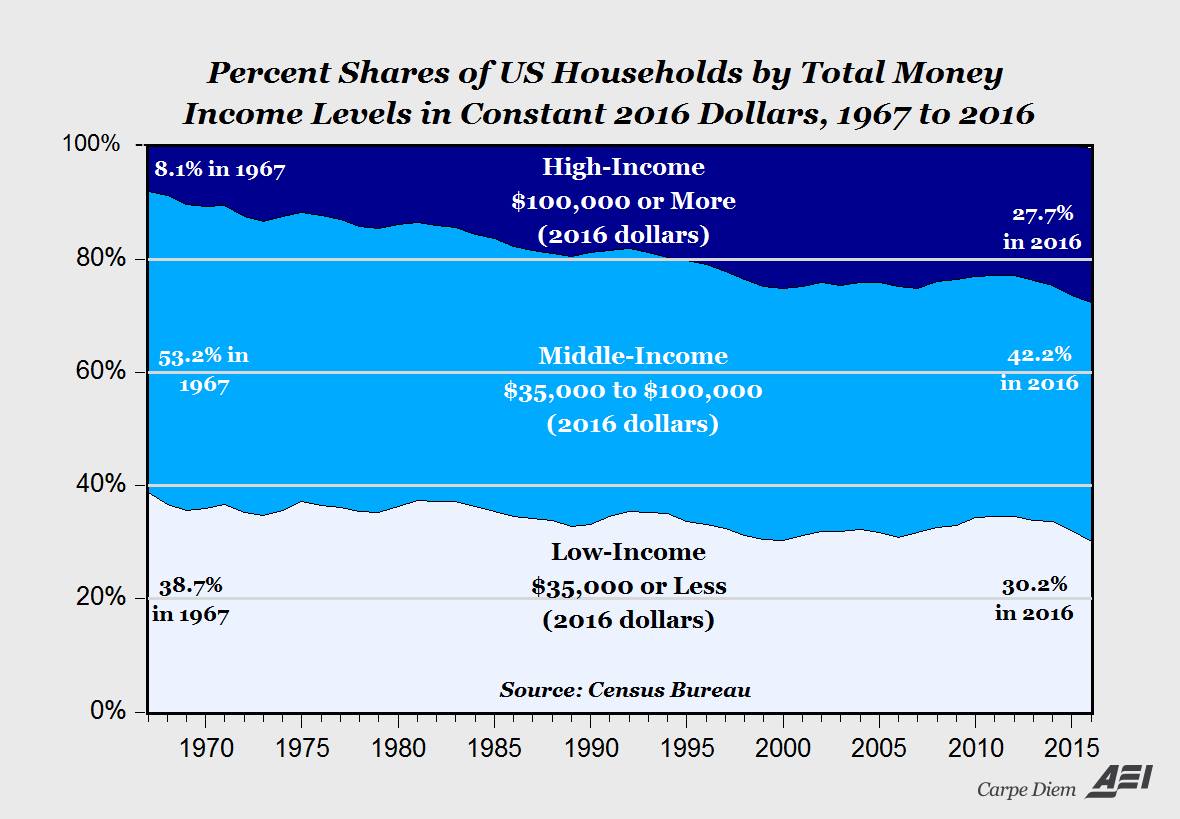
Well, the first half of that statement is true. The middle class is becoming smaller. But here’s the good news. As I noted in 2015 when sharing some data from Pew, the middle class is shrinking because more and more households are earning six-figure incomes.

Now we have more confirmation. Courtesy of Mark Perry of the American Enterprise Institute, here’s a nice chart based on data from the Census Bureau’s new report on income and poverty in the United States.


Want to feel even better?

In a column for CNBC, Professor Daniel Smith of Troy University explains that government data understates the improvements in living standards. He points out that total compensation has increased much faster than wages.
Complaints that the rich are getting richer while the majority have hit a brick wall in wage growth have led to calls to impose regulations and taxes aimed at creating a “fair” economy. This mantra, however, is wrought with holes and erroneous interpretation of the data… Over the last few decades, employees have been receiving an increasingly larger portion of their overall compensation in the form of benefits such as health care, paid vacation time, hour flexibility, improved work environments and even daycare. …Total compensation, which adds these benefits to wages and salaries, shows that earnings have actually increased more than 45 percent since 1964.
And he notes that income gains are understated if measured against the PCE index rather than the consumer price index.
Furthermore, “purchasing power,” the amount of stuff people can buy with each dollar, has changed dramatically… CPI is notorious for overstating inflation, and thus understating the growth of real wages received by workers. Adjusting the data with the more appropriate Personal Consumption Expenditure index brings the growth in average hourly wages from 5.58 percent to more than 35 percent and the growth in total compensation of employees from more than 45 percent to more than 87 percent.
The bottom line is we’re able to buy more and better for less work.
But even that index fails to grasp the drastic increase in what workers get for their wages. …100.5 hours of work was required to purchase a washing machine in 1959 compared to just 23.3 hours of work (for the average worker) in 2013. Purchasing a TV demanded an astounding 127.8 hours of work in 1959, whereas a worker in 2013 could purchase one with only 20.7 hours of work. Moreover, the improved quality of these goods over the past few decades is staggering. …Today’s iPhones and other smart-phone models seem like a different species from their predecessors… We’ve seen the same progress in knee-replacement surgeries, computers, the Internet, vacuum cleaners, and other technologies we’ve come to rely on.
Professor Smith wrote this piece back in 2014, but these arguments apply just as well today as they did back then.

Though I don’t want to be a Pollyanna. There are very worrisome trends in our economy, especially increased dependency and reduced labor force participation.

So if you prefer to look at the glass as being half empty, Nicholas Eberstadt of the American University authored an article that is very pessimistic assessment about recent trends.
It turns out that the year 2000 marks a grim historical milestone of sorts for our nation. For whatever reasons, the Great American Escalator, which had lifted successive generations of Americans to ever higher standards of living and levels of social well-being, broke down around then—and broke down very badly. …it should be painfully obvious that the U.S. economy has been in the grip of deep dysfunction since the dawn of the new century. …It took America six and a half years—until mid-2014—to get back to its late 2007 per capita production levels. And in late 2016, per capita output was just 4 percent higher than in late 2007—nine years earlier. By this reckoning, the American economy looks to have suffered something close to a lost decade. …Between 2000 and 2016, per capita growth in America has averaged less than 1 percent a year. To state it plainly: With postwar, pre-21st-century rates for the years 20002016, per capita GDP in America would be more than 20 percent higher than it is today. …If 21st-century America’s GDP trends have been disappointing, labor-force trends have been utterly dismal. Work rates have fallen off a cliff since the year 2000 and are at their lowest levels in decades.
I don’t disagree with any of this. Growth has been weak this century.

Which is hardly a surprise since we’ve seen an erosion of economic liberty (thanks Bush and Obama!).

But I also want to keep things in perspective. Weak growth is better than no growth. Our living standards are increasing, even if they could – and should – be rising at a faster clip.

So let me swing back to the Pollyanna side by sharing a chart which ostensibly is bad news because it shows rising inequality. But I view it as good news because it shows that all of us are at least 40 percent richer – in real terms – than we were back around 1980.


By the way, Thomas Sowell has pointed out that higher-income households tend to do better because they have more people working, while lower-income households feature lots of dependency. Moreover, if Professor Smith and others are right, the increase in living standards is far greater than what this chart shows anyhow. But even if you accept this data at face value, we are all getting richer over time.

Yes, growth rates should be faster and incomes should be climbing more rapidly. Especially at the bottom. Whether you look at global data or country-specific data, that’s an argument for free markets and small government.

As I wrote last year, we don’t need perfect policy to get more prosperity. Just give the private sector some breathing room.


Monday, August 21, 2017

Investment, Productivity, Wages, and Economic Prosperity

Here’s a simple and fundamental question: What is economic growth?

And here’s a simple answer: It’s when there’s more national income.

That’s seems like a trivial tautology, but let’s explore some implications. When you dig into the numbers, it turns out that increases in national income (usually measured by gross domestic product, though I prefer gross domestic income) are driven by two factors.
  • More people.
  • More output per hour, also known as increased productivity.
This is why people sometimes say that GDP growth is a function of population growth plus productivity growth.

And what really matters, at least if we want higher living standards, is to have more output per hour. As a result, we should be very concerned that productivity growth seems to be lagging in the United States.

Here’s a chart that was created by the Wall Street Journal, showing data from the Labor Department on productivity all the way back to the 1950s...........To Read More.....

Thursday, January 19, 2017

Cut a bureaucrat's pay to $1? Top Dem fears GOP to target federal workers

By (@Duranni1) 1/18/17

The top Democrat on the House Rules Committee is hopping mad that Republicans revived a 19th-century rule allowing lawmakers to essentially fire individual civil servants and eliminate entire federal programs when they approved the rules package governing the 115th Congress on a party-line vote earlier this month.  New York Rep. Louise Slaughter said inclusion of the Holman Rule, first approved in 1876, in the package is a way for Republicans to punish federal workers for implementing laws with which they don't agree.......To Read More.....

Friday, July 19, 2013

Ohio teacher union employee earns 77% more than average teacher

Posted by EAGNEWS on Jul 18, 2013
A new report finds that many of the best-paid members of Ohio’s public education system never set foot in a classroom.  According to Jason Hart of MediaTrackers.org, the average employee of the Ohio’s largest teachers union earns 77 percent more than the average classroom teacher.   “The average Ohio Education Association (OEA) employee was paid $43,838 more than Ohio’s average teacher in 2012,” Hart writes.  The average OEA staff member earned $100,553 last year, while the average classroom teacher earned $56,715.
All told, the Ohio teachers union has 25 employees who make at least $150,000 annually…….. When compared to the average Ohio worker, union officials do even better. According to Hart, the average OEA employee earns 127 percent – or $56,300 – more than the average laborer in the Buckeye State.  No doubt about it, life is good for teacher union leaders.....To Read More......