I
subscribe to Geopolitical Futures for good reason, as this June 19th article, Germany, Poland and the limits of Rapprochement, by Antonia Colibasanu demonstrates. Unfortunately it's a subscription article so you'll just have to take my word for it, or not as it pleases you. The article discusses issues between Germany, Poland and Ukraine, and while Ukraine isn't part of NATO, in reality,
this really is what NATO is. A group of petty self-serving European nations who can
never have harmony.
It's my view NATO's days are numbered, right along with the
EU. They speak over 200 languages in Europe and a ton of
historical resentment exists between these nations. If you read the history of events surrounding
what's now Germany, Poland and Russia, you find they've been butchering
each other for centuries. Each of them being the aggressor at some
point in time, and we need to understand, it isn't just WWII that molds their attitude. It's been molded by time and history.
"Although Warsaw remains one of Kyiv’s strongest supporters, historical
memory has repeatedly surfaced as a source of tension. Some of this is
connected to Polish domestic politics. For example, in 2023-24, disputes
over Ukrainian grain imports and World War II-era atrocities were
caught up in campaigning for Poland’s 2023 parliamentary elections and
2025 presidential race. Indeed, Nawrocki, a historian by training and
former head of Poland’s Institute of National Remembrance, has long
emphasized the importance of historical justice in Poland’s foreign
relations."
It isn't just U.S. money that keeps it together.
The U.S. is "daddy" with a big stick if they get out of line, and that's not working all that well any longer. Truthfully, Europeans have doubts as to America's continued commitment to NATO, and yet believe they can't defend themselves without America.
"Earlier this year, NATO Secretary-General Mark Rutte said anyone
thinking that Europe could defend itself without the U.S. was ‘dreaming’
— angering some European lawmakers.”
Quite frankly, I don't care if they get their panties all in a twist over all this. The fact is Americans are tired of playing the funder/moderator/disciplinarian that
keeps NATO alive, saving Europe. In two world wars and a cold war Europe has cost America trillions of dollars, and thousands of gallons of American blood, and they have the nerve to look down on America. Truth be told, many in America, including me, are tired of Europe, and in my case it's been my view for decades.
By the end of this decade it's my view the EU will no longer exist, their economy will be trashed, and Europe is a second rate continent that will end up being a third rate continent. What if my timetable is off? Immaterial, because even if my time table is off; that's what's coming.
The reality is, over the last 500 years, almost all of the advances that
have come about that have improved the lives of mankind have come from
white males living in Western civilizations. This is particularly true
since the founding of the United States. That doesn’t mean that others
haven’t contributed or that the white males got or get everything right,
because they most certainly didn’t. But it does make one wonder why
the leaders of the civilizations built by that group are so determined
to destroy everything that they built in the name of diversity. The reality is, “diversity” for diversity’s sake is never, ever, a positive for Western civilization.
Imagine that, what could possibly go wrong?
Diversity without accomplishment is incompetence without consequence.
Given my interest in this topic, I was curious to read an article on boosting prosperity in the latest issue of the Economist.
But my curiosity turned to frustration because pro-market policies (the “Washington Consensus“) were viewed as an afterthought and the article instead focused on government planning (i.e., industrial policy).
By 2050 there will be a new crop of economic powers—if things go to plan. Narendra Modi, India’s prime minister, wants his country’s GDP
per person to surpass the World Bank’s high-income threshold three
years before then. Indonesia’s leaders reckon that they have until the
mid-century mark…to catch up with rich countries.
…These…all have
something in common: breathtaking ambition.
…Very few countries have maintained such growth for five years, let
alone for 30. Nor is there an obvious recipe for runaway growth. To
boost prosperity, economists typically prescribe liberalising reforms of
the sort that have been advanced…under the label of the “Washington
consensus”.
…the three strategies employed by countries looking to get
rich—leaping to high-tech manufacturing, exploiting the green transition
and reinventing the entrepot—all represent gambles, and expensive ones
at that. …a certain amount of state involvement in the process is
inevitable, and that policymakers will have to pick some winners. Even
so, governments are now intervening much more frequently.
Many have lost
patience with the Washington consensus.
At the risk of understatement, the countries discussed in the article
(India, Indonesia, Saudi Arabia, etc) will never become rich for the
simple reason that they generally have bad economic policy.
And to the extent they waste taxpayer money trying to pick “winners,” their bad policies will become worse policies.
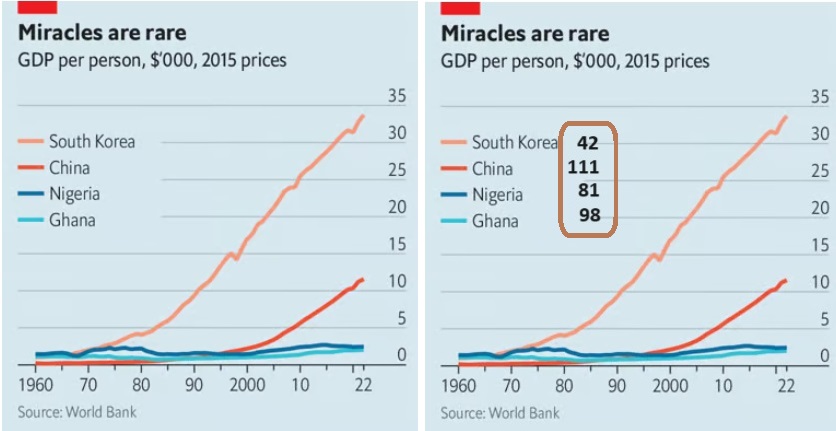
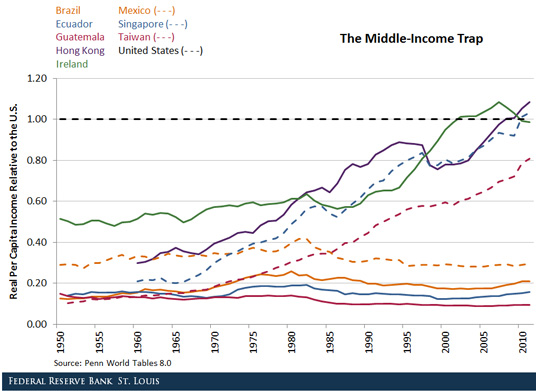
The article included a chart about rare growth miracles, but there
were two big problems with the chart. First, there was no explanation of
why South Korea grew faster than China, Nigeria, and Ghana. So I added
the economic freedom rankings to show that South Korea has pro-market
policies compared to the other nations.
My second concern is that I don’t view South Korea as a “growth miracle.”
Yes, it has done well compared to the other nations. And you could say it is a miracle compared to the disaster of North Korea.
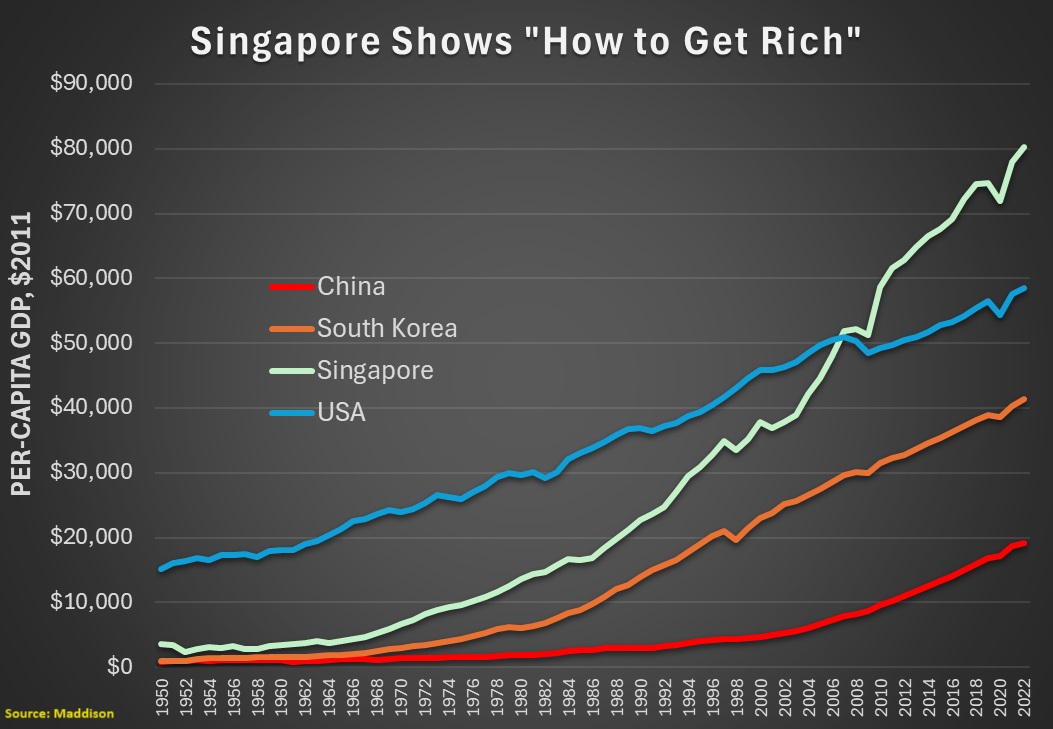
But the Economist should have used Singapore as their example of “how to get rich.” As you can from this chart, South Korea has enjoyed decent growth, but there’s very little chance it will ever catch the United States.
Singapore, by contrast, already has eclipsed the United States.
In other words, it is possible to avoid the “middle-income trap,” but it only happens rarely because politicians are not will willing to stand aside and let markets work.
A friend recently asked me to assess the stylistic merits of a short
essay that his college-age daughter wrote during her competition to
become a columnist for a campus newspaper. I did so, and was happy to
report to my friend and his daughter – who I’ll call “Sarah” – that this
young woman’s flair for writing is enviable. Her language is clear,
active, and vivid, with not a word wasted or wanted. If her essay is any
guide, Sarah already writes better than do some seasoned columnists for
major newspapers.
Fortunately, I wasn’t asked to assess the essay’s substance. Offering
such an assessment would have required me to be uncomfortably critical.
With her essay, Sarah describes the surprisingly difficult challenges
encountered by an attentive “socially conscious” person – such as
herself – who insists on patronizing only businesses that are truly
committed to cleaning the environment, furthering workers’ rights, and
promoting social justice. Sarah’s disappointment is palpable as she
tells of her unfolding realization that labels and advertising slogans
often mislead. A bag of coffee beans labeled “Fair Trade Certified”
doesn’t guarantee that all workers on that grower’s coffee plantation
are paid wages that Sarah and her classmates regard as fair. And just
because a brand-name sounds eco-friendly and is accompanied by a boast
of its owner’s deep devotion to sustainability and “combating climate
change” doesn’t ensure that that brand’s parent company isn’t a
gigantic, heartless, wasteful, polluting multinational corporation
seeking only maximum lucre for its shareholders...........To Read More...
The
development of generative AI tools that can spit out everything from
paintings to essays is the next step in frictionless technology
disrupting our society. The frictionless illusion is all around us. It
tells us that the complex matters of delivery services, supply chains
and transportation have been reduced to an app and a few swipes on a
smartphone.
In
the frictionless utopia, food is delivered to your door through an app,
meat is cloned in a lab and human relationships are achieved by swiping
right.
Electric cars magically just work, without any pollution or
moving parts, much like wind turbines and solar panels. Where the
achievements of the past, like splitting the atom or building a national
highway system, depended on mastering complexities, postmodern
technology promises to eliminate them.,
To understand how massive
scams like Theranos or FTX could take place, you have to live in an
imaginary matrix of impossibilities where new ideas eliminate complexity
rather than multiplying it. Any engineer could tell you that it works
the other way around, and that simplicity is inherently deceptive, and
yet the public keeps being sold on the frictionless illusion.
Then
when the app turns out not to be hooked up to anything and there’s no
money in the bank, the illusion falls apart and an incomprehensible
panic sets in because we have mistaken the interfaces for the processes.
But the panic only goes on long enough for a new set of shiny
frictionless objects promising to simplify reality to be rolled out as
substitutes for the old.
Cryptocurrency and the metaverse have imploded, but in their place is the promise of AI.
Among
so much else, AI offers seductively frictionless art and literature.
The hype, some of it authored by ChatGPT, boasts that chabots will
eliminate millions of white collar jobs. That’s no doubt true. But what
that really means is that American white collar workers will be replaced
not by some omnipotent artificial intelligence, but by the low-paid
third-world workers training it.
In the 18th century, crowds were
wowed by the Mechanical Turk: a machine that seemed able to play chess.
In reality, there was a man inside the machine making the moves.
ChatGPT isn’t an omnipotent intelligence: it’s Kenyan workers
maintaining the illusion by training it for the princely sum of $1.32 an hour.
OpenAI is no less of a dystopian hall of mirrors than its tech industry
predecessors who put conventional nerds like Bill Gates or Mark
Zuckerberg out front while much of the actual work was carried out by
anonymous Asian and Indian workers on visas or abroad who provided the
intelligence that made the software tools seem smart.
The machine
has never actually replaced the man. All it’s done is shove the man
deeper inside a cubicle or in a distant land while a sophisticated
society gawks at a new Mechanical Turk.
Every frictionless
prophecy turns out to be a clean lie hiding an ugly reality. Recycling
begins as a perpetual loop of three arrows on a blue or green bin, but
actually ends with 8-year-old boys climbing over mountains of garbage in
Africa.
Phone delivery and ride apps connect to illegal aliens
doing gig work, and content moderation at Facebook and YouTube is
handled by Filipino women viewing thousands of images and videos of
graphic violence and pornography an hour in exchange for what to us is
spare change.
Because there’s always someone inside the
Mechanical Turk. And the system is not run to the standards of whatever
lies come from the girls in PR or the geeks in black turtlenecks out
front, but to the third world workers who are actually hiding inside the
metaphorical guts of the system.
GIGO or Garbage In, Garbage
Out, is a binding principle for a reason. What goes in these is
mountains of our data. Generative AI hoovered up the individual work of
millions of writers, artists and just ordinary people, and then with
some third-world fine-tuning, spits out a randomized imitation whose
sole function is to fool us into thinking it’s original content.
These
models feed the essential frictionless myth that work can begin with an
idea and end with a product while entirely evading the process. It’s a
seductive postmodern idea that is at the heart of so much progressive
folly. Art is not an idea and it’s not a product, it’s a process. The
value of anything derives not from what it looks like, but the work that
someone put into it.
Modern society has mostly forgotten that.
It’s why America’s manufacturing was outsourced and gutted, flooded by
‘Made in China’ garbage whose sole virtue is that it imitates actual
products. Consumers buy pricey German knives made in China only to see
them dull in less than a year, they buy fake leather shoes that crumble
in even less time, and tools that instantly rust.
Any product is only as good as its process. Without the process, a product is only an illusion.
And
that’s true of culture as well. WGA writers are striking in Hollywood
because they know that in the industry at its current state, ChatGPT can
easily replace them and is already doing so. There’s more content than
ever in the streaming wars and it’s also more disposable than ever.
Viewers who notice that every movie and show seems to be the same aren’t
wrong. They’re all made in assembly line processes using formulaic
tools and driven by politics and effects. Outwardly they offer an
illusion of being set in different times and places, with different
characters, but they are actually just reskinned versions of each other.
Does it really matter then if a human writer automates his writing with
a Save the Cat formula or ChatGPT does it for him?
Generative AI
works so well because so much of our writing has become rote. Its
models can easily mimic the rote work that lawyers, doctors and
bureaucrats do, and the rote photoshopped fan art that Midjourney
produces so well and the generic internet content that ChatGPT models.
AI
can replace humans to the extent that they allow their work to be
driven by digital tools and impulses, by the need to conform it to a
technological model, rather than a creative soul. Much as in the
industrial revolution, machines make better machines than people do, but
people cannot be replaced by machines as long as they retain the
humanity of their work.
The frictionless impulse is the work of
men (and a few women) who believe in a singularity in which man and
machine will unite to become one. This foolish posthuman delusion could
only be entertained by people who have forgotten what it is to live a
human life. And it could only gain currency in a society that has lost
its religious and cultural bearings. And thus its humanity.
Such a
society comes to think that men and women can swap roles and even
biologies, that children should be killed if they are unwanted and that
everything we are is reducible to DNA strands and social standards.
Rather than humanizing society, progressives have mechanized it. And the
culture of a mechanical society can easily be duplicated by generative
AI, even if all that it’s doing is using hidden humans to pull the
digital levers so the Mechanical Turk fools us.
AI is not a
threat, it’s a symptom of a soulless society that has forgotten the
value of art and even more importantly of the striving impulses of
labor. Art is not found in the glimmer of an idea or a page that rolls
out of a printer, but in the creative human struggle to make something.
Everyone has ideas and most images have been infinitely duplicable for
well over a century. Art happens in the soul. So do all the things that
make life meaningful and give mankind purpose.
The frictionless
society makes the private public, simplifies it, demystifies it,
industrializes it and in the process loses its soul. Human relationships
and the family collapse even as they are deconstructed. Religion,
philosophy and art cease to exist. Everything appears to be at our
fingertips and yet nothing seems to be. On the surface everything
appears to be sleek and shiny, but underneath is a swamp of slave labor
and filth into which it is all collapsing.
Everything is supposed to just work and yet nothing actually works when we need it to.
Beneath
the frictionless world of apps and AI, there’s no food in the stores,
no products in the supply chain and so many of the things people once
took for granted, no longer work. Mistaking the interface for the
process is an economic, cultural and moral disaster that is destroying
us.
Progressivism depends on the illusion of a golden chariot of a
new age sweeping across the sky. In the frictionless future, there will
be no work, no dirt, no pollution and no process. Everything will just
happen. But the only thing that’s happening is the end of our humanity.
The theory of “economic convergence” is based on the notion that poor nations should grow faster than rich nations and eventually achieve the same level of development.
The link between good policy and convergence explains why Hong Kong and Singapore, for instance, have caught up to the United States.
And the adverse effect of bad policy is a big reason why Europe continues to lag.
Moreover, it also explains why some nations with awful policy are de-converging.
Today, let’s look at convergence between Western Europe and Eastern Europe.
Here are some excerpts from a new study published by the European Central Bank.
This paper analyses real income convergence in central, eastern and south-eastern Europe (CESEE) to the most advanced EU economies between 2000 and 2016. …The paper establishes stylised facts of convergence, analyses the drivers of economic growth and identifies factors that might explain the differences between fast- and slow-converging economies in the region. The results show that the most successful CESEE economies in terms of the pace of convergence share common characteristics such as, inter alia, a strong improvement in institutional quality and human capital, more outward-oriented economic policies, favourable demographic developments and the quick reallocation of labour from agriculture into other sectors. Looking ahead, accelerating and sustaining convergence in the region will require further efforts to enhance institutional quality and innovation, reinvigorate investment, and address the adverse impact of population ageing.
The study is filled with fascinating data (at least if you’re a policy wonk).
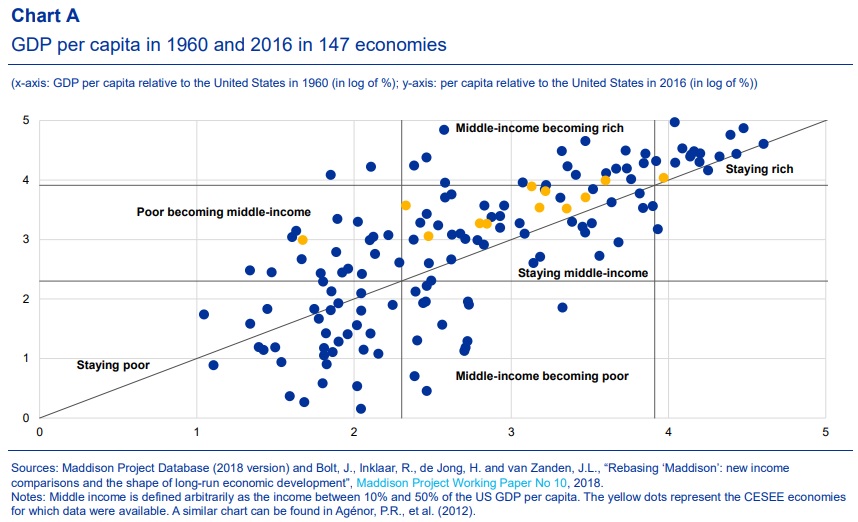
This chart, for example, shows how many nations are converging (the dots above the diagonal line) and how many nations are falling behind (the dots below the diagonal line).
The yellow dots are Eastern European nations, so it’s good news that all of them are experiencing some degree of convergence.
But the above graphic doesn’t provide any details.
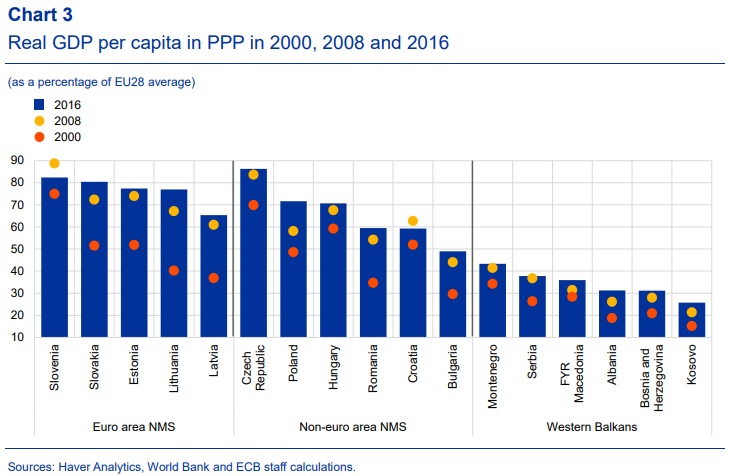
So let’s look at another chart from the study. The blue bar shows per-capita GDP in selected Eastern European nations as a share of the EU average. The yellow dot shows where the countries were in 2008 and the orange dot shows where they were in 2000.
The good news, at least relatively speaking, is that all nations are catching up to Western Europe.
But the report notes that some are catching up faster than others.
The developments were…heterogeneous within CESEE countries that are EU Member States. Some of them (the Baltic States, Bulgaria, Poland, Romania and Slovakia) experienced particularly fast convergence in the period analysed. At the same time, other CESEE EU Member States found it hard to converge… In fact, GDP per capita in Croatia and Slovenia diverged from the EU average after 2008… Given these heterogeneous developments, it appears that while in some CESEE countries the middle-income trap hypothesis could be dismissed (at least given their experience so far), in others the signs of a slowdown in convergence after reaching a certain level of economic development are visible.
My one gripe with the ECB study is that there’s a missing piece of analysis.
The report does a great job of documenting relative levels of prosperity over time. And it also has a thorough discussion of the characteristics that are found in fast-converging countries.
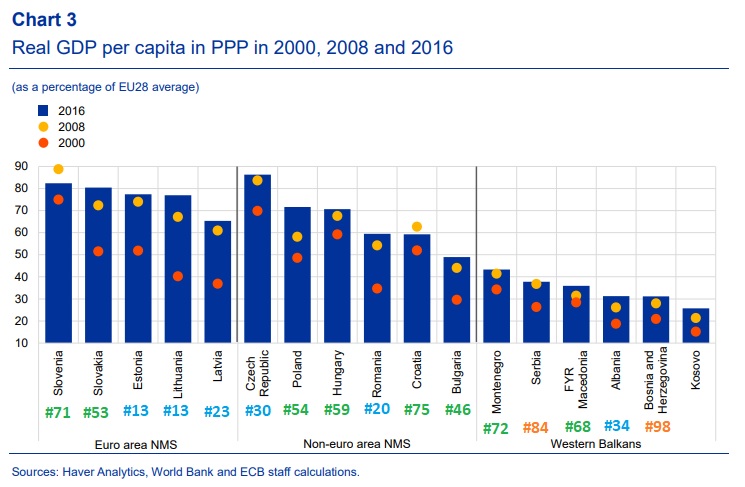
But there’s not nearly enough attention paid to the policies that promote and enable convergence. Why, for instance, has there been so much convergence in Estonia and so little convergence in Slovenia?
Lo and behold, a quick glance shows that higher-ranked nations (blue numbers indicate a nation is in the “most free” category) have enjoyed the greatest degree of convergence.
Here are some specific observations.
The Baltic nations are the biggest success stories of the post-communist world. Thanks to pro-market reforms, they have enjoyed the most convergence.
Romania and Slovakia also experienced big income gains. Romania is in the “most free” group of nations and Slovakia was in the “most free” group until a few years ago.
Poland has enjoyed the most convergence since 2008. Not coincidentally, that’s a period during which Poland’s economic freedom score climbed from 7.00 to 7.27.
Bulgaria also merits a positive mention for a big improvement, doubtlessly driven by a huge improvement (from 5.55 to 7.41) in economic freedom since 2000,.
Sadly, Slovenia and Croatia have not experienced much convergence, which presumably is caused in part by their comparatively low rankings for economic liberty.
To be sure, there’s not an ironclad relationship between a nation’s annual score and yearly growth rates. But, over time, poor nations that want convergence almost certainly won’t get the necessary levels of sustained strong growth without high scores for economic liberty.
Now imagine that you are put in charge of tax policy.
Like Elizabeth Warren, you obviously won’t volunteer to start paying tax, but what would you recommend for other people?
Would you want them to also enjoy tax-free status, or at least get to experience a smaller tax burden? Or would you take a malicious approach and suggest tax increases, comforted by the fact that you wouldn’t be affected?
In this theoretical scenario, I hope most of us would choose the former approach and seek tax cuts.
But not everybody feels the same way. The bureaucrats at the International Monetary Fund actually do receive tax-free salaries. Yet instead of seeking to share their good fortune with others, they routinely and reflexively urge higher taxes on the rest of us. Here are some articles, all from the past 12 months, that I’ve written about the IMF’s love affair with punitive taxation.
Last June, I wrote about the IMF pushing a theory that higher taxes would improve growth in the developing world.
Last July, I wrote about the IMF complaining that tax competition between nations is resulting in lower corporate tax rates.
Last October, I wrote about the IMF asserting that lower living standards are desirable if everyone is more equally poor.
Also in October, I wrote about the IMF concocting a measure of “fiscal space” to justify higher taxes across the globe.
Last November, I wrote about the IMF publishing a study expanding on its claim that equal poverty is better than unequal prosperity.
This February, I wrote about the IMF advocating more double taxation of income that is saved and invested.
What upsets me most of all, however, is that the IMF is trying to punish very poor nations is sub-Saharan Africa.
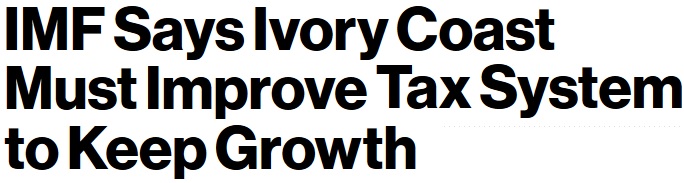
This came to my attention when I saw a Bloombergreport about the IMF recommending policy changes in Ivory Coast. At first glance, I thought the IMF was doing something sensible, supporting faster growth and higher income.
Ivory Coast must improve its tax system if the world’s biggest cocoa producer wants to maintain economic growth of at least 7 percent, the International Monetary Fund said. Jose Gijon, the resident representative for the Washington-based lender, said in an interview in the commercial capital of Abidjan Wednesday. “…if it wants to become an emerging country and for that, it needs higher income.”
But I found out that the bureaucrats wanted higher income for the government.
“The key for Ivory Coast is revenue…The government needs to create sufficient fiscal space…”
Unsurprisingly, local politicians like the idea of getting more loot.
The government seeks to gradually increase its tax revenue to 20 percent of gross domestic product from 15.9 percent now, Prime Minister Amadou Gon Coulibaly said in 2017.
How sad. Ivory Coast (now usually known as Côte d’Ivoire) is a very poor country, with living standards akin to those of the United States in 1860. Yet rather than recommend the policies that allowed the United States and other western nations to become rich, such as no income tax and very small government, the IMF wants to fatten the coffers of a corrupt and ineffective public sector.
Here’s something else that is sad. This seems to be the advice the IMF gives to all nations in sub-Saharan Africa.
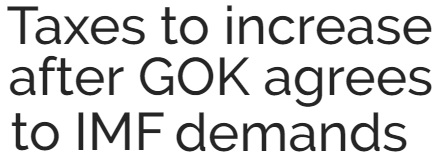
Kenyans should brace themselves for higher taxes after the Government caved in to the International Monetary Fund’s (IMF) demands. …It made the commitment to the IMF in a letter of intent that spells out a raft of measures that are likely to eat into consumers’ pockets. …The sectors to be hit include agriculture, manufacturing, education, health, tourism, finance, social work, and energy. …The Government hopes to squeeze an extra Sh40 billion in taxes from these sectors. This is likely to have a ripple effect by pushing up the cost of goods and services… The Government intends to increase income tax by over Sh100 billion in the financial year 2018/19.
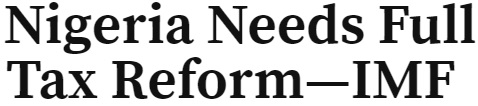
The International Monetary Fund (IMF) has advised Nigeria to embark on a full Value Added Tax (VAT) reform. …The lender’s Mission Chief for Nigeria, African Department, Mr Amine Mati, …said government must raise taxes… In addition, government should also increase taxes on alcohol and tobacco and broaden VAT.
The International Monetary Fund (IMF) Deputy Managing Director, Tao Zhang has hailed Tanzania for managing to boost tax collection… The visiting IMF leader said it was vital to mobilise more…public resources by strengthening tax collection… “it is crucial to mobilise more…public resources within Tanzania, especially by strengthening tax collection…” he said at a public lecture he gave in Dar es Salaam yesterday.
Ghana needs to improve revenue collection…to achieve its fiscal targets, the International Monetary Fund said. …“Fiscal consolidation has to be revenue-based,” Koliadina told reporters in the capital, Accra. …A positive outcome of the fifth and sixth reviews of the program will lead to the IMF disbursing $190 million to Ghana, Koliadina said.
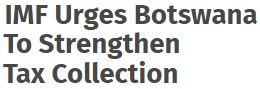
The Government of Botswana should seek to strengthen its revenue base…, the International Monetary Fund has said. …”The authorities agreed that there is a significant potential to boost domestic revenues through tax administration and tax policy reforms that could…provide additional funding for future fiscal expenditures,” the report stated.
Higher taxes to finance bigger government? Wow, talk about economic malpractice.
Since Botswana has been one of the few bright spots in Africa, I hope lawmakers tell the IMF to get lost. But I worry that politicians will be happy to take the IMF’s bad advice.
How tragic.
These are the only nations I investigated, so I guess it’s possible that there’s a sub-Saharan nation where the IMF hasn’t recommended higher taxes. Heck, it’s even theoretically possible that the bureaucrats may have suggested lower taxes somewhere on the continent (though that’s about as likely me playing pro football next season).
I’ll simply note that the IMF openly admits that it wants higher taxes all across the region.
Tax revenues play a critical role for countries to create room in their budgets to increase spending on social services…raising tax revenues is the most growth-friendly way to stabilize debt. More broadly, building a country’s tax capacity is at the center of any viable development strategy…we see potential in many countries of sub-Saharan Africa to raise tax revenues by about one percent of GDP per year over the next five or so years. …Since building the capacity to collect more from personal income taxes takes time, in the next few years VAT and excise taxes likely offer the biggest potential for additional revenue. For example, recent studies by the IMF indicate a revenue potential of about 3 percent of GDP from VAT in Cape Verde, Senegal, and Uganda, and ½ percent of GDP from excises for all countries in sub-Saharan Africa. …It is also important to consider newer sources of revenue, such as property taxes. …Raising revenues is often a politically difficult task. But the current economic junction in sub-Saharan Africa together with sustained development needs creates an imperative for action now.
I’m almost at a loss for words. It’s mind-boggling that anybody could look at policy in sub-Saharan Africa and conclude that the recipe for growth is giving more money to politicians.
And I’m equally flabbergasted that the IMF openly claims that bigger government is good for growth. Unsurprisingly, the bureaucrats never try to justify that bizarre and anti-empirical assertion.
For those who are interested in genuinely sensible information on how poor nations can become rich nations, I strongly recommend this video from the Center for Freedom and Prosperity.
P.S. Back in 2015, to mock the pervasive statism at the Organization for Economic Cooperation and Development, I created a fake fill-in-the-blanks/multiple-choice template. A similar exercise for the IMF would only require one short sentence: “The nation of __ should raise taxes.”
P.P.S. In other words, this cartoon is very accurate.
Karin McQuillan, American Thinker, January 17, 2108
Three weeks after college, I flew to Senegal, West Africa, to run a community center in a rural town. Life was placid, with no danger, except to your health. That danger was considerable, because it was, in the words of the Peace Corps doctor, “a fecalized environment.”
In plain English: s— is everywhere. People defecate on the open ground, and the feces is blown with the dust – onto you, your clothes, your food, the water. He warned us the first day of training: do not even touch water. Human feces carries parasites that bore through your skin and cause organ failure.
Never in my wildest dreams would I have imagined that a few decades later, liberals would be pushing the lie that Western civilization is no better than a third-world country. Or would teach two generations of our kids that loving your own culture and wanting to preserve it are racism.........
Senegal was not a hellhole. Very poor people can lead happy, meaningful lives in their own cultures’ terms. But they are not our terms. The excrement is the least of it. Our basic ideas of human relations, right and wrong, are incompatible.............In Senegal, corruption ruled, from top to bottom. Go to the post office, and the clerk would name an outrageous price for a stamp. After paying the bribe, you still didn’t know it if it would be mailed or thrown out. That was normal............Americans think it is a universal human instinct to do unto others as you would have them do unto you. It’s not. It seems natural to us because we live in a Bible-based Judeo-Christian culture............To Read More....