Search This Blog

De Omnibus Dubitandum - Lux Veritas

Showing posts with label Department of Education. Show all posts

Tuesday, March 25, 2025

How to (Really) Get Rid of the Department of Education

March 22, 2025 by Dan Mitchell

Today’s column is about shutting down the Department of Education. But I’m not going to explain why that should happen since I have already done that (once in 2015 and twice (here and here) in 2022).
 

Instead I’m going to explain how it should happen. Let’s begin by looking at where things stand in Washington.  As reported by Laura Meckler of the Washington Post, President Trump is seeking to eliminate the department and just issued an executive order to facilitate that long-overdue goal.

Here are some excerpts.

President Donald Trump is set to sign a much-anticipated executive order Thursday aimed at closing the Education Department, the White House said, though administration officials have acknowledged that shuttering the agency would require congressional approval. …the executive order will direct Education Secretary Linda McMahon to “take all necessary steps” to facilitate the closure of the department “and return education authority to the States.” …Already, the agency has reduced its workforce by nearly half, mostly through layoffs, and worked to cancel dozens of grants and contracts. …The executive order also will repeat the administration’s directive that no program that advances diversity, equity and inclusion (DEI) or “gender ideology” receive Education Department funding.

That’s the good news.

The bad news is that Trump and his Secretary of Education, Linda McMahon, apparently have no intention of actually reducing federal government spending and intervention.

McMahon suggested moving some functions to other government agencies, a decision experts say would also require congressional approval. …McMahon suggested moving some functions to other government agencies, a decision experts say would also require congressional approval. …The Education Department administers federal grant programs, including the $18.4 billion Title I program that provides supplemental funding to high-poverty K-12 schools, as well as the $15.5 billion IDEA program that helps cover the cost of education for students with disabilities. And the department oversees the $1.6 trillion federal student loan program… A senior administration official said Wednesday that these programs, which make up the bulk of the Education Department’s budget and work, “will NOT be touched.”


In other words, even though the federal government is far too big, Washington will continue to drain money from the private sector, continue to fund an education bureaucracy (albeit placed in a different department), and continue to send money to politicians and bureaucrats at the state and local level.

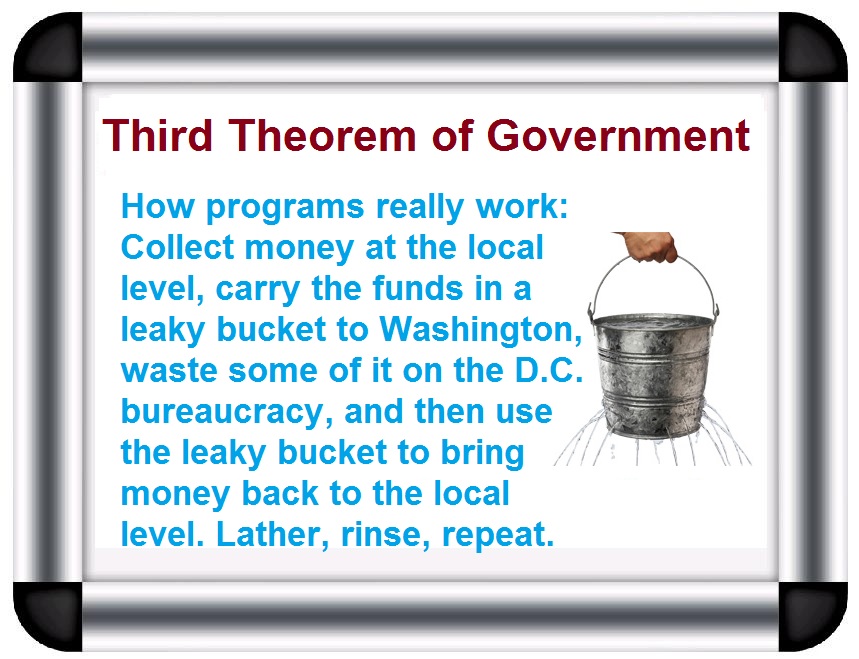
All of which is grimly depicted by the Third Theorem of Government.

At the risk of understatement, I’m underwhelmed. This is not as disappointing as Trump’s decision to stick his head in the sand about America’s entitlement crisis, but it’s yet another piece of evidence that America needs a return to Reaganism.

The Education Racket, March 16, 2025

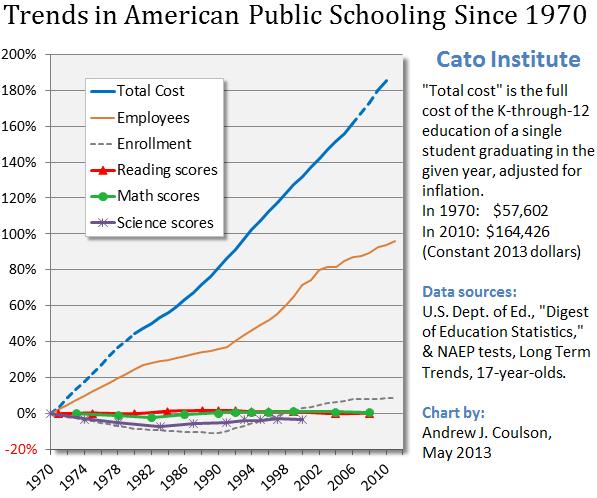
It’s not quite the “Chart of the Century,” which captures the perverse impact of government intervention, but Andrew Coulson’s chart on government schools is one of the most powerful visuals I’ve ever seen.

Unfortunately, he passed away about 10 years ago, so there is not an up-to-date version.

But there’s now a close substitute. Corey DeAngelis of the Education Freedom Institute recently shared this comparison.
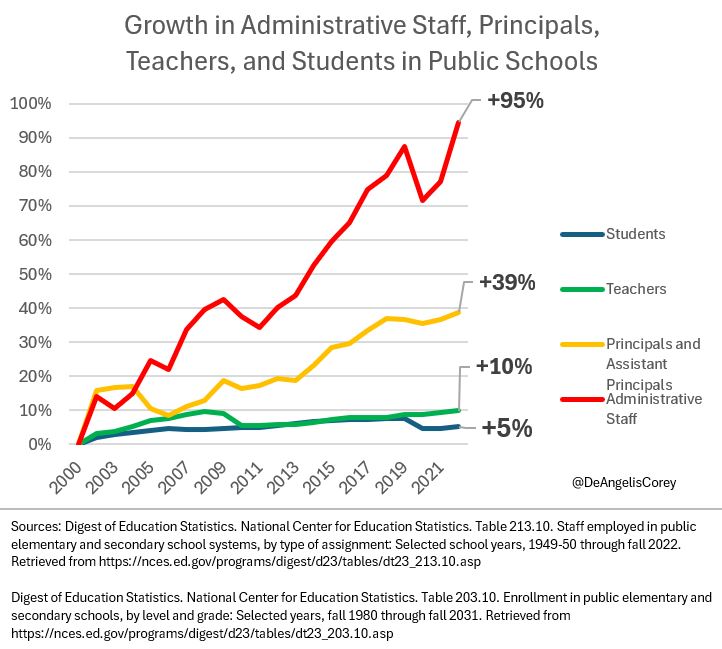
As you can see, there’s been almost no growth in the number of students or the number of teachers over the past twenty-plus years.

But there’s been a giant increase in the number of education bureaucrats.

The only thing missing from Corey’s chart is a line (or lines) showing test scores. This is important information because some people might want to argue that more bureaucrats somehow leads to better results.

But this data from Kevin Drum shows that is not the case.
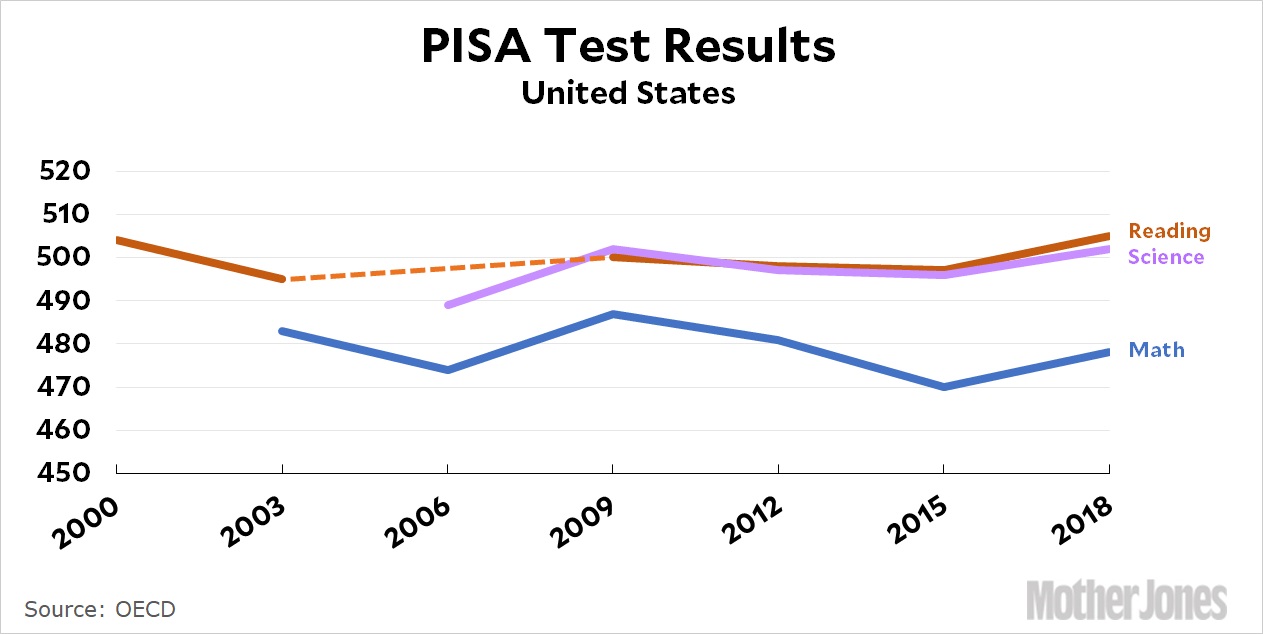
My suggestion to Corey is that he augment his chart so that people can see that more bureaucrats don’t help students.

By the way, school closures during the pandemic hurt test scores, so the above chart would look much worse if it included the latest numbers.

The bottom line is that government schools cost far too much and deliver very weak outcomes. One obvious conclusion is that government schools are for the benefit of insiders, not students. Which was the message from my 1st Theorem of Government.

P.S. Shutdowns are another reason to “thank” teacher unions and left-leaning politicians.

P.P.S. I have recently shared data on school spending and educational outcomes from America’s worst city and America’s best state.


Monday, February 10, 2025

More Money =/= Better Education: Part IV

February 9, 2025 by Dan Mitchell @ International Liberty

In the three previous columns in this series (here, here, and here), we’ve reviewed all sorts of evidence showing that dumping more tax dollars into government schools is not a recipe for better educational outcomes.


Instead, our taxes mostly go to hiring more bureaucrats. Meanwhile, student performance is flat at best. Or, thanks to the greedy actions of teacher unions during the pandemic, student performance is falling. Let’s look at the latest data.

The Wall Street Journal editorialized on this topic late last month. Here are some depressing excerpts.


Talk about throwing good money after bad. Washington spent $190 billion to make up for the damage from the Covid school shutdowns. What did it get students and taxpayers? Worse academic performance. …Fourth and eighth grade reading scores declined by two points on average since 2022—roughly as much as they did between 2019 and 2022. Some 33% of eighth graders scored below “basic” on the reading exam—a record low. …Pouring more money into the public school system clearly isn’t helping. On average, public school districts nationwide spent $15,825 per student in fiscal 2023 compared to $10,724 a decade earlier, according to the Census Bureau.

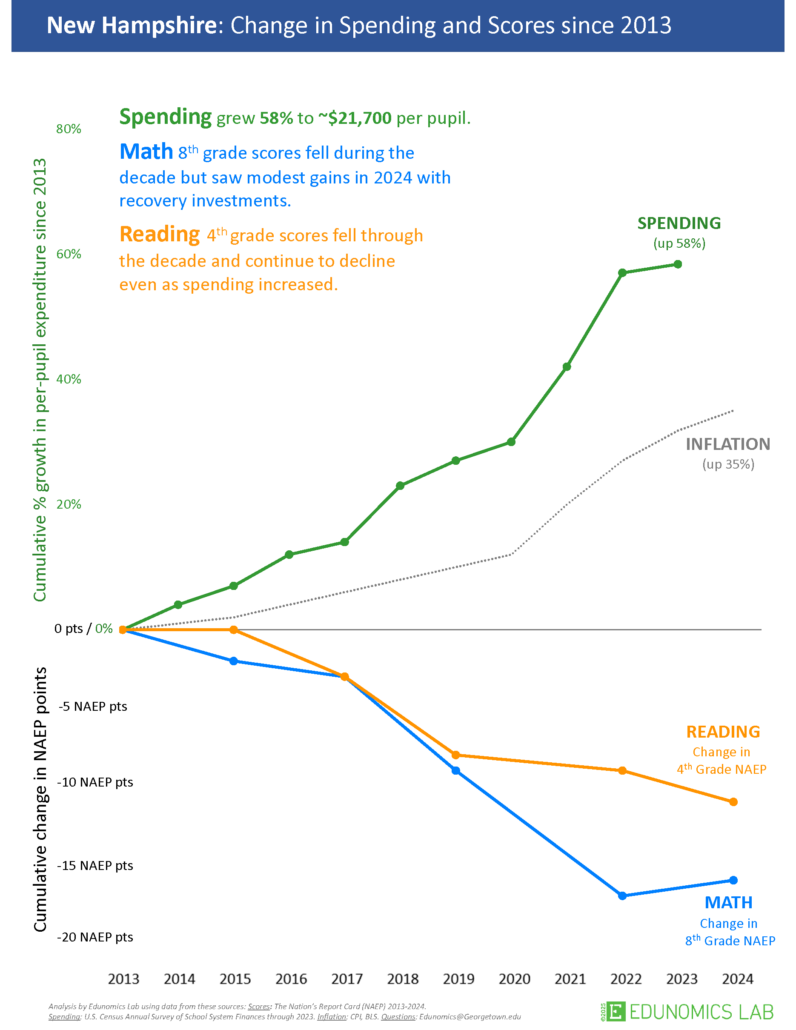
Now let’s look at New Hampshire for an example of what’s happening on the state level. The Josiah Bartlett Center for Public Policy has an excellent new report about education trends in the Granite State. Here are some highlights, though lowlights might be a better word.


From local elections to legislative debates to legal challenges, discussion of public education in New Hampshire has been dominated by two persistent myths.  The first is that more spending is the primary means of producing better educational outcomes.  The second is that our educational outcomes are stunted because funding for K-12 public schools has “been slashed…” The data show clearly that New Hampshire, along with the rest of the United States, has made the critical error of equating spending with investment. …Spending more money on fewer students is exactly what was supposed to lead to higher educational outcomes.  Parents have been told for decades that schools could offer higher quality services if only they had the resources to hire more staff and reduce class sizes. In New Hampshire, those two input goals have been achieved. With rising revenues and declining enrollments, public school districts have hired thousands of additional staff and cut class sizes. …Voters are often misled into thinking that additional spending by itself is the best way to improve student outcomes.  But that is demonstrably untrue.

How do they know it is untrue?

This chart tells you everything you need to know.

More spending and worse results.

This is the main argument for school choice.

Such dismal results would be highly unlikely if there was competitive pressure on schools. If you don’t believe me, look at this evidence, this evidence, and this evidence.

P.S. Needless to say, the Department of Education hurts rather than helps.

Thursday, January 16, 2025

Critically Thinking about the Federal Department of Education

By John Droz, Jr. @ Critically Thinking About Select Societal Issues

Three Powerful, Practical, Plausible Recommendations to Improve DOEd

There is now an unprecedented opportunity that Critical Thinkers (that’s us) should take advantage of.  Arguably, for the first time in modern US history, the federal government is:  

  1. ) open to making radical changes in government agencies,
  2.  ) has the right political perspective, and 
  3.  ) is receptive to citizen inputs.

Yes, there are always reasons to be skeptical — but the upside is so great that we should assume the best, and offer assistance. For those who are incurably cynical and say no, then you are foregoing your future rights to complain!

I’m polling my Critical Thinking Substack readers as to their best ideas regarding the Department of Health and Human Services (FDA, CDC, etc.), Department of Education (DOEd), Department of Energy (DOE), EPA, and Department of Government Efficiency (DOGE). [If you have any good connections with the upper echelon of any of these federal Departments, please email me.]

Let’s say that this is the scenario:  

a) we are given five (5) minutes for a face-to-face meeting with the Secretary of each of these Departments, and 

b) we are asked to limit our suggestions to three (3) items.  

Due to these rules, we need to filter out many ideas so that we are left with just three (3) succinct, important, doable recommendations.

This is the second in my series of commentaries to each of the above-mentioned Departments. Below are my suggested three (3) recommendations for the federal Department of Education (DOEd). Critically Thinking readers can constructively weigh in with support or any improvements on what I’ve proposed, in the Comments below...

We’ll then try to get the end product to the new Department of Education Secretary, probably Linda McMahon.

Recommendation #1 —

Redefine its Mission. Here is the boilerplate pablum that is their current mission statement. This should be upgraded to say something like: meaningfully assisting States in producing high school graduates who are competent, productive, healthy, critical thinkers (e.g., see this fine piece). In other words, the Department should leverage the power and money of the federal government to aggressively assist States in fixing the currently deplorable K-12 education system. (Note: in 2024 the Department had $80± Billion in discretionary funding (out of a $250± Billion budget) — that is a LOT of leverage!)

In the process of reformulating DOEd’s mission get rid of bureaucratic bloat. Strip down the Department to the bare essentials. (Right now there are over 4100 employees. How about aiming for 400 — a 90% reduction? Four hundred competent, motivated, mission-focused employees can do a LOT!)

Recommendation #2 —

Clearly spell out what the primary objective of K-12 education should be. Assuming that the 3Rs are properly taught, the #1 objective of every state education system should be to produce Critically Thinking graduates. In other words, States should radically change their education systems from their current focus on teaching students WHAT to think, to instead teach them HOW to think. Since no State is currently doing that(!), this would revolutionize American education. (Note: presently less than ten States even mention Critical Thinking in their Mission statements!)

DOEd should put this as a condition for States to receive money from DOEd. In other words, unless a State can show that their K-12 education curricula is properly teaching students to be Critical Thinkers, they are not eligible for certain DOEd funds.

Recommendation #3 —

DOEd should take an unequivocal stand against age-inappropriate books being in K-12 school classes and libraries (e.g., see here and here). The fundamental problem is that the American Library Association (ALA) does not recognize the issue of age-appropriateness! DOEd has the power and authority to stand up against ALA — much more than most States do.

This idea is already societally accepted in the US. A good example is that the rating systems for movies and TV are based on age-appropriateness. The movie website says: “Established in 1968, the film rating system provides parents with the information needed to determine if a film is appropriate for their children.” Exactly the same thing applies to books being considered for K-12 schools!

To make a profound improvement in K-12 education, the Department should specify that they will not provide any certain DOEd funds to a State that does not have an enforced appropriate official written policy regarding the age-appropriateness of materials associated with their K-12 schools. [Towards that same end the Department should aggressively oppose legislation that undermines the concept of age-appropriateness — like this.]

—————————————————————————————

Yes, I am fully aware that there are a multitude of other education-related issues — and several of them are significant (e.g., see here). The question is, if you only had five (5) minutes to speak to the DOEd Secretary, and were limited to your three (3) best recommendations, what would they be? These are my recommendations.


Here is other information from this scientist that you might find interesting:

I am now offering incentives for you to sign up new subscribers!

I also consider reader submissions on Critical Thinking on my topics of interest.

Check out the Archives of this Critical Thinking substack.

WiseEnergy.org: discusses the Science (or lack thereof) behind our energy options.

C19Science.info: covers the lack of genuine Science behind our COVID-19 policies.

Election-Integrity.info: multiple major reports on the election integrity issue.

Media Balance Newsletter: a free, twice-a-month newsletter that covers what the mainstream media does not do, on issues from COVID to climate, elections to education, renewables to religion, etc. Here are the Newsletter’s 2024 Archives. Please send me an email to get your free copy. When emailing me, please make sure to include your full name and the state where you live. (Of course, you can cancel the Media Balance Newsletter at any time - but why would you?

Leave a comment

Share

Thanks for reading Critically Thinking About Select Societal Issues! Please pass a link to this article on to other associates who might benefit. They can subscribe for FREE to receive new posts (typically about once a week).

Tuesday, December 3, 2024

Critically Thinking about the US Department of EducationWhat is the best path forward for this troubled agency?

What is the best path forward for this troubled agency?  

By John Droz jr.,Dec 02, 2024 @ Critically Thinking About Select Societal Issues

There is almost universal agreement — and solid evidence — that the US K-12 education system is an abject failure from multiple important perspectives. This is not good for the children (who are the victims), or for America.

The solutions proposed for this have ranged from:  

a) scrapping the entire K-12 public school system, to  

b) eliminating the federal Department of Education (e.g., here). Although the rationale behind these is understandable, neither of these suggestions are wise, practical, or effective resolutions to the dire situation we are in.

Consider, for example, the idea of eliminating the Department of Education. What we would be left with is fifty (50) State Education Departments. Radically reforming 50 State Education Departments would be an extraordinarily expensive, Herculean project that would take at least twenty years — if ever — to come to fruition. In the meantime, the US is left with 50 different education systems. How is that good for the country? Who would take on this Sisyphean task? And who would pay for it?

My recommendation (as an education outsider) is to solve this — affordably, effectively, and relatively quickly — by fundamentally changing the Department of Education. The idea is that the Department would become a powerful game-changing force for good (which would be a radical change).

The new Department of Education would properly do major things like:

  1. - Redefine its Mission.Here is the boilerplate pablum that is their current mission. Its objective should be upgraded to something like: meaningfully assistingStates in producing high school graduates who are competent, productive, healthy critical thinkers (e.g., see this fine piece).In other words, the Department should leverage the power and money of the federal government to aggressively assist States in fixing the currently deplorable K-12 education system. (Note: in 2024 the Department had 80± Billion in discretionary funding (out of a $250± Billion budget) — that is a LOT of leverage!)
  2.  - Get rid of bureaucratic bloat. Strip down the Department to the bare essentials. Right now there are over 4100 employees. How about aiming for 400 — a 90% reduction? Four hundred competent, motivated employees can do a LOT!
  3.  - Clarify what should be the primary objective of K-12 education. Assuming that the 3Rs are properly taught, the #1 objective of every state education system should be to produce Critically Thinking graduates. In other words, radically change the education system from its current focus on teaching students WHAT to think, to instead teach them HOW to think. Since no State is currently doing that, this would revolutionize American education. (Note: presently there is zero uniformity among States on this foundational issue. Less than ten even mention Critical Thinking in their Mission!)
  4. - Investigate what is the most effective methodology of teaching. For example, would the best way to educate our children be to have a classical education program (like here)? Or, would the best way be to adopt the state-of-the-art techniques used by MacKenzie Price? Or something else? The Department should solicit and consider a variety of ideas — and then pass on their findings to the States. What sense does it make for 50 States to do this type of investigation? (Note: almost no States are investigating this.)
  5. - Take the lead in resolving the religion issue embedded in K-12 education. For some time now the public school system has been in a conflicting situation regarding religion. On the one hand, schools are bending over backward to not do anything that some activists might claim is a 1st Amendment violation (a federal matter).  
    1.  On the other hand, US public schools feel obligated to convey morality and ethics (e.g., “discrimination is wrong” — which is a religious [moral] position). Aggressively stepping into this gap are atheism and relativism — which are effectively religions (e.g., see here). So, despite their concerns about not advocating for any religion, that is exactly what public schools are doing. The Department should research and take a position on this exceptionally important issue, as (again) no States are doing that.
  6.   - Take the lead in other national K-12 education matters.

a) A good example is what’s going on regarding extremely problematic books being in K-12 school libraries (see here and here). The fundamental problem is that the ALA does not recognize the issue of age-appropriateness! The Department should officially go on record endorsing the significance of age-appropriateness in K-12 classes, libraries, and associated matters.

This idea is already societally accepted in the US. A good example is that the rating systems for movies and also for TV, are based on age-appropriateness. The movie website says “Established in 1968, the film rating system provides parents with the information needed to determine if a film is appropriate for their children.” Exactly the same thing applies to books being considered for K-12 school classes and libraries!

To make a profound improvement in K-12 education, the Department should specify that they can not provide any money to a State that does not have an appropriate official written policy regarding the age-appropriateness of materials associated with their K-12 schools. [Towards that same end the Department should oppose legislation that undermines the concept of age-appropriateness — like this.]

b) A different example is that the Department should take an official stand against the scourge of SEL that has infested public schools nationwide. Their position should be along the lines of this.

c) Yet another example (of several) is that the Department should weigh in on teacher certification. The education mills are pushing out progressive graduates (e.g., see here) who have few Critical Thinking skills. No State can fix this, but the Department may be able to.

BTW the best chance we have for substantially reforming the Department, is to have a good collection of “outsiders” (not from the education establishment) participating in the process. People who have few pre-conceived ideas of what can and can not be done, are more likely to be advancing more creative improvements (like above).

The Bottom Line —

All of the current K-12 education system’s weaknesses are being taken advantage of by anti-American, Left-leaning ideology advocates. The corruption of the K-12 Science curricula is a perfect example of how American students are being Pied Pipered to a woefully inadequate education.

Worse — MUCH WORSE — is that most of these miseducated graduates soon become voting citizens. What is our future if it is being determined by citizens who have no Critical Thinking skills, and have been thoroughly propagandized by Left-leaning ideology???

This clearly says that leaving our children’s education up to 50 different States IS NOT WORKING — and will likely NEVER WORK!

An updated Department of Education should step into this void and provide constructive and effective K-12 education leadership. Now is the time to do exactly that!


Here is other information from this scientist that you might find interesting:

I am offering incentives for you to sign up new Substack subscribers!

I also consider reader submissions on Critical Thinking on my topics of interest.

Check out the Archives of this Critical Thinking substack.

WiseEnergy.orgdiscusses the Science (or lack thereof) behind our energy options.

C19Science.infocovers the lack of genuine Science behind our COVID-19 policies.

Election-Integrity.infomultiple major reports on the election integrity issue.

Media Balance Newsletter: a free, twice-a-month newsletter that covers what the mainstream media does not do, on issues from COVID to climate, elections to education, renewables to religion, etc. Here are the Newsletter’s 2024 Archives. Please send me an email to get your free copy. When emailing me, please make sure to include your full name and the state where you live. (Of course, you can cancel the Media Balance Newsletter at any time - but why would you?

Leave a comment

Share

Thanks for reading Critically Thinking About Select Societal Issues! Please pass a link to this article on to other associates who might benefit. They can subscribe for FREE to receive new posts (typically about once a week).

Tuesday, November 26, 2024

The Political Pitfalls of Disbanding the Department of Education

It will be a full-on cage match for Linda McMahon. 

By | Nov 25, 2024 @ Liberty Nation News, Tags: Articles, Education, Opinion

Most schools are either already out for the Thanksgiving holiday or headed for a break later this week. As the education system nationwide hits the pause button, it’s worth taking a moment to consider what lies ahead for the US Department of Education (ED) and its promised demise at the hands of the incoming Trump administration.

The last time the Department of Education faced the chopping block was in 1982, when President Ronald Reagan attempted to dismantle the entity. Obviously, he was not successful, and one wonders if President Trump will be able to accomplish what The Gipper could not. The answer lies in the details. Here are a few things that might help flesh out why Reagan’s effort failed and what could stand in the way once again:

Much of what the ED does is mandated by legislation that has been passed into law since its inception in 1980. Some of it even existed before the department’s founding. For example, the Smith-Hughes Act of 1917 instituted federal engagement in vocational education that created a national board of oversight to develop curricula. In 1944, the G.I. Bill was passed, which provides funds for the college education of veterans.  Then, the federal student loan program came on the scene under the Higher Education Act of 1965. The Basic Educational Opportunity Grant program arrived in 1972, and in 1975, Congress passed the Individuals with Disabilities in Education Act. More recently, in 2015, funding for schools that serve low-income students became law in the name of the Every Student Succeeds Act. This list goes on and on, but you get the picture.

Wiping out the ED will not end all these programs. They will simply have to shift to another federal agency. So where would they go? Good question. According to US News & World Report, a great deal of shuffling would have to take place. They suggest the disabilities act could be turned over to the Department of Health & Human Services. The vocational program could be run by the Department of Labor, and some of the grant programs could be sent off to the Treasury. Thus, the central question becomes, is the Trump initiative really thinning out a morbidly obese federal government by shuttering the Department of Education? The answer is a definitive no.

Education and Forking Over Federal Funds to the States

It sounds like a good idea to give federal education dollars to the states. However, one must ask what the bright blue territories would do with all this new cash. Might it be used to pioneer a fresh golden age of American education, or to double down on what many see as cultural indoctrination?

Adam Ellwanger wrote an article in RealClearEducation outlining some of the current failures in the American education system:

“When these activist-teachers enter classrooms, they often abandon their duty to transmit America’s culture, knowledge, and values. Instead, they teach students to disdain their nation, its people, its past, and its way of life. This undermines social cohesion and deprives disadvantaged students of the tools they need to succeed.”

These issues aren’t likely to go away if progressive areas have more dollars to fuel their values because, as we know, politics is downstream from culture. Thus, giving these folks more money isn’t going to fix this problem: In fact, it may even exacerbate it. Perhaps federal funding could be doled out conditionally, but then there’s the issue of having to police the compliance necessary to ensure the money is used properly.

Progressive media outlet Vox brought up another reality that concerns those who seek to overhaul education. Quoting Jon Valant, director of the Brookings Institution’s Brown Center on Education Policy, they made the point: “[O]nly about 10 percent of federal public education funding flows to state boards of education, according to Valant. The rest comes primarily from tax sources, so states and local school districts are already controlling much of the funding structure of their specific public education systems.”

Politics Rules the Roost

Pure political machinations must be considered when effectuating the end of the Department of Education. The administration would need a 60-vote majority to make that happen, which it will not have in the 119th Congress. Trump’s Senate allies could also make an effort to end the filibuster, but that’s a game of Russian Roulette.

Like it or not, a lot of education policy is federal law, already baked in and not going away anytime soon. What concerns President Trump and those who support him are the social justice and woke elements of education currently impressed on America’s young people. It doesn’t seem like giving local education an extra 10% each year is going to fix that. Nor does it appear likely that blue states would take the extra dollars and use them wisely. And getting Congress to dump the entire ED isn’t going to happen, either. Without a doubt, this is a heavy lift, and Trump’s people will have to come up with a workable solution because the roadblocks that lie ahead are not surmountable with a pen and a phone.

~

Liberty Nation does not endorse candidates, campaigns, or legislation, and this presentation is no endorsement.

Read More From Leesa K. Donner

Monday, August 19, 2024

Education in America is a Dark Hole of Ignorance and Corruption

By Rich Kozlovich

Equal justice under the law is a constitutional principle.  No one, whether they're elected officials, citizens, or institutions, no matter how important or powerful, should be above the law.  Yet what we're seeing is the ruling class doing everything possible to cover up its corruption and criminal behavior, even using the the Department of Justice to target constitutional conservatives because they threaten their continued criminal behavior and their radical agenda to destroy America. 

The FBI's targeting parents, calling them domestic terrorists, (more here and here) for speaking out about the indoctrination of their children on the gay agenda among other outrages.

  • Speaking truth to school boards March 13, 2024 by Pete Colan An 11-year-old girl speaks to the school board after being forced to share a locker room with a boy. 

One thing seems clear, entirely too many Americans are ignorant of the concept of equal justice; ignorant about the rule of law; ignorant regarding the balance in government created by the Constitution!  Why?   The biggest reason for that is America's children are deliberately being ill-educated, misled, and philosophically corrupted by our institutions of education, turning out illiterate undisciplined thugs, and the violence being perpetrated by these thugs is cultural.

Note to Black Lives Matter: Literacy Made Civilization -Reading is white supremacy now. Good luck getting ahead. 

The lost generation(s)- Hitler desired to create young people who were consumed with violence and mindlessness. Are we seeing a similar trend today?

Nikole Hannah-Jones beclowns herself on Meet the Press -  The fact that Nikole Hannah-Jones has been honored with a MacArthur Foundation "genius grant" and a Pulitzer Prize, and has had the New York Times backing her error-riddled and fundamentally mistaken 1619 Project as a curriculum throughout the United States, tells us that we live in an intellectually degenerate moment in history.  That she has been granted an endowed chair (despite no doctorate) and is heading a new center with $20 million in funding at Howard University bespeaks a collapse of standards.

Public education is a scam and a racket, and the teacher's unions, which are controlled by corrupt leftists, are undermining the traditional values that created Almeria.  They have turned our schools into a national disaster. Public education in America is a failure, and yes, it really "is" the teacher's fault

  1.  Education in America Has Become a Snare and a Racket: Part I  
  2.  Education in America Has Become a Snare and a Racket: Part II

Restoring excellence in public education, starting at the lowest levels is fundamental.  And  doing so in higher education has become critical.  In combination, that's Job One in America, and that needs to be addressed in five ways, for a start.

  1. Eliminate the Department of Education, after 45 years of failure, wasting billions of dollars that should be a no-brainer.
  2. End all federal funding to education at all levels.
  3. Create a voucher system.  
  4. The nation's Boards of Education seem to forget, the work for the parents, and have gotten totally out of control in so many areas.  Form a national group to act as watchdogs, and sue any board of education that fails to bring excellence to our schools.
  5. Eliminate public employee unions, and fire all the teachers, they can't be fixed.
  6. Make all universities for profit institutions, end all student loan programs, which is turning into a national disaster.  Tax and regulate them just like any other business.   It's long past time we put this idea out of our heads they're experts because they're educated.  If that was true, then why do we see so much exposure of plagiarism by these people
North Carolina drops STEM departments, keeps politically correct ones -  February 25, 2024 By Arnold Cusmariu -The University of North Carolina system oversees 16 state universities. Campus locations include Chapel Hill, Wilmington, Charlotte, Asheville, and Greensboro.  UNC-Chapel Hill, originally called the University of North Carolina, was founded in 1789 and is one of the oldest public universities in the United States. According to Wikipedia statistics, some 245,000 students attended UNC system universities in 2021......

Here's an article I published in 2014, Before There Was Common Core!, and in this article I posted a picture of the eighth grade test for Bullitt County, Kentucky.....in 1912.

This is a test I would like to see all of America's teachers, their union leaders, and the professors in our universities take.  And any who fail would be fired.  Go here for a list of answers.  

You might also wish to review this 8th grade test from Salina Kansas....... 1895, and I'm willing to bet 99% of America would fail it, including me, but these two tests are a clear demonstration of how far our system of education nationwide has plunged down into a dark hole of ignorance.  But it's fixable.

John Droz, Jr. graciously allows me to publish his work.  John has been writing about, and testifying about, what's wrong with American education for many years.  In the two articles below John has done an excellent job of outlining what the fixes are, and they must be put in place, and I emphasized the word "must". 

  1. ) Saving American Children - Part 1 
  2. ) Saving American Children - Part 2

 Make sure to read his solutions and observations.  They're deep, wide ranging, and far seeing.  


Trump Targets the Department of Education

What has the DOE actually accomplished in its more than four decades?

By | Aug 18, 2024 @ Liberty Nation News Tags: Articles, Opinion, Politics

Former President Donald Trump, should he win re-election, plans to dismantle the Department of Education. Isn’t that a radical plan? Well, actually, no, it isn’t. The idea that the federal government should control education would have been considered strange for the majority of the nation’s history. It wasn’t until 1979 that Jimmy Carter created the modern DOE, and Republicans have been trying to abolish it ever since. Can Donald Trump succeed where so many others have failed?  And what, in its very expensive 44 years of existence, has the Department of Education accomplished?

Department of Education in the Crosshairs

Trump brought up eliminating the Department of Education in his interview with Elon Musk on X: “What I’m going to do, one of the first acts – and this is where I need an Elon Musk; I need somebody that has a lot of strength and courage and smarts – I want to close up the Department of Education, move education back to the states.”

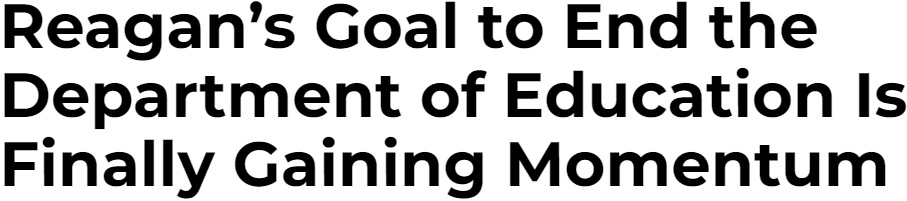
Democrats have since seized on that proposal to call the former president a far-right extremist. But the idea isn’t that alien to mainstream Republicans. Jimmy Carter signed the act in October of 1979, and the DOE began its work in May of 1980, right in the middle of a presidential election year. Ronald Reagan, the Republican challenger seeking to oust Carter, wasted no time attacking the new department. “At 11:01 a.m. Eastern Standard Time on Sunday, President Jimmy Carter’s new bureaucratic boondoggle was born: the Department of Education,” he said. “Welfare and education are two functions that should primarily be carried out at the state and local levels.”

As president, Reagan tried to end the department but failed. When Bob Dole ran for president in 1996, the GOP platform said: “The federal government has no constitutional authority to be involved in school curricula or to control jobs in the marketplace. This is why we will abolish the Department of Education.” Of course, Bill Clinton’s win put a stop to that. It became a platform issue again in 2012 and resurfaced during the 2016 primaries.

In his first term, Trump eventually gave up on abolition and moved to consolidation. His administration released a 132-page framework for merging the Departments of Education and Labor.

But what was created by an act of Congress must be destroyed by an act of Congress – and if Trump wins, the GOP may be ready. Representative Thomas Massie (R-KY) has been introducing bills to end the Department of Education since 2017, and his 2023 attempt won more than 160 Republican votes, though it ultimately failed to pass. With a president friendly to the cause, however, it may be easier to rally the party for another vote.

A Legacy of Waste

What has the Department of Education really accomplished – and what would be lost if it ended? There are plenty of factors to help measure its worth. “Since the 1970s, the long-term trend National Assessment of Educational Progress (NAEP) has reported periodic data on the reading and mathematics achievements of 9-, 13-, and 17-year-olds enrolled in public and private schools,” reads the intro to a fast facts page by the National Center for Education Statistics. The line looks fairly flat when viewing average reading scores from 1971 to 2022. There are ups and downs, but the score – 215 – isn’t significantly higher than the first: 208. Mathematics doesn’t look much better, ranging from 219 to 234 in the same span.

A look at average composite scores for the ACT (American College Testing) shows a fairly flat trend from 1970 on, too. The average composite for both boys and girls was 18.6 in 1970, 18.5 in 1980, 20.6 in 1990, 21 in 2000 and 2010, and 20.6 in 2020. That’s a slight increase over the decades – just a 2-point improvement over half a century. The SAT (Scholastic Aptitude Test) stats tell the same tale. Students averaged 509 in math and 530 in critical reading in 1972, and in 1990, it was 501 and 500, respectively. Math averages rose slightly in the 2000s, and reading scores fell into the 490s. In 2023, the average was 508 for math and 520 for Evidence-Based Reading and Writing (the test was restructured in 2017). That’s a net change of minus one in math and minus ten in reading over 51 years.

While American students don’t seem to be getting much smarter or dumber, regardless of which test you track, the US certainly is falling behind internationally. While we once led the world in the quality of education, that hasn’t been the case in many years. According to the 2022 test data from the Program for International Student Assessment (PISA), the US comes in 34th out of 80 countries tracked.

So, if the Department of Education hasn’t resulted in smarter students, what has it done? Well, it has spent a ridiculous amount of money. In 2023, the Washington Examiner ran a story on the long-term NAEP test scores. “What sticks out is that, particularly in reading, there were never significant improvements over time in either category,” the author concluded. “At their peaks, math scores had risen 7% and reading scores had risen a mere 3%. Comparing the 1970 scores to those today, reading scores rose by 1% and math scores rose by 1.8%. To put that in context, since 1971, inflation-adjusted educational funding per student has risen by more than 245%.”


The Department of Education has wasted a staggering amount of tax dollars. In 2024 alone, the DOE requested $90 billion – a 13.6% increase from 2023 funding levels. Most schools in America closed from 2020 to 2022, though some reopened in 2021 or even late 2020. The DOE’s budget was $64 billion in 2022, $66.6 billion in 2021, and $102.8 billion in 2022 – but for what? If schools were closed and students were falling behind, why did the Department of Education see some of the highest funding years on record?

Thanks for Nothing

Gripes with the Department of Education are as varied as its detractors. Many take issue with the woke ideology being pushed on schools by a progressive administration. Others argue it’s simply unconstitutional and, therefore, should not exist. But even without those opinions and interpretations, the objective facts simply don’t bode well for the DOE. The executive agency has controlled the nation’s schools for more than four decades, but all it has to show for its expense is a slight bump in some test scores, a drop in others, and America falling far behind in global educational rankings.

The argument that the states could do a better job – or, at least, that the people of each state should be responsible only for their schools, not those on the other side of the country – certainly has its appeal. Perhaps the days of the Department of Education are numbered, and maybe that’s just fine.

 
Read More From James Fite

Wednesday, November 29, 2023

A Great Moment from the Education Establishment

November 28, 2023 by Dan Mitchell @ International Liberty

Of all the useless and counterproductive bureaucracies in Washington, the Department of Education may be at the top of the list.


It certainly hasn’t produced good results, at least if we care about student performance.

Though it does keep a bunch of bureaucrats on a gravy train, so there are some (undeserving) beneficiaries.

Speaking of which, the top bureaucrat at the DOE, Secretary Miguel Cardona, recently showed that he skipped some history lessons.

As shown in this amusing little video, he completely botched Reagan’s famous warning about getting “help” from government.

To be fair, Reagan’s quote was about government and help, so even though he turned the quote upside down, he was referring to something real.

Moreover, I recall that President George W. Bush said something that libertarians didn’t like about it being government’s role to help when someone is hurting. So I wouldn’t be surprised if Secretary Cardona simply mixed up a good Republican president with a not-so-good Republican president.

Since I once made a $16 trillion mistake on a national TV program, I won’t be overly critical of his misstatement.

But I am glad that his goof has drawn attention to Reagan’s very apt warning.

Thursday, February 16, 2023

Republican Congressman Introduces Bill to Abolish Department of Education

By Eric Lendrum

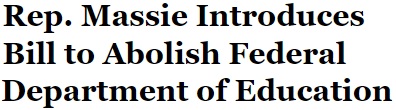
On Tuesday, Congressman Thomas Massie (R-Ky.) introduced a bill to ‘terminate’ the federal Department of Education. As the Daily Caller reports, Massie first announced on Twitter his introduction of H.R. 899, which would “terminate the Department of Education.”

“There is no Constitutional authority for this federal bureaucracy to exist,” Massie continued in his statement. He had previously introduced the same bill in the previous session of Congress, in February of 2021, with the bill only consisting of one single sentence: “The Department of Education shall terminate on December 31, 2022.”

“Unelected bureaucrats in Washington, D.C. should not be in charge of our children’s intellectual and moral development,” said Massie in a press release for the introduction of the original bill two years ago. “States and local communities are best positioned to shape curricula that meet the needs of their students. Schools should be accountable. Parents have the right to choose the most appropriate educational opportunity for their children, including home school, public school, or private school.”

 ................The latest version of Massie’s bill has eight co-sponsors, including Reps. Lauren Boebert (R-Colo.), Andy Biggs (R-Ariz.), Chip Roy (R-Texas), and Dan Bishop (R-N.C.)..........To Read More....

Thursday, July 28, 2022

Another Reason to Purge the Federal Bureaucracy

By Rich Kozlovich

On July 27, 2022 Joe Miller published this piece,  22 AGs sue USDA to stop withholding school lunches over gender, sexual orientation rules, saying: 

Schools ordering food for the beginning of the fall semester could be facing uncertainty over whether they’ll receive federal assistance that’s the center of a legal battle for being tied to sex discrimination rules. Twenty-two attorneys general are suing the Biden administration to prevent any loss of federal nutrition assistance for failing to obey the funding catch tying the money to other issues. 

In May, the United States Department of Agriculture (USDA) announced any state, local agency, program operator or sponsor receiving its funding must “investigate allegations of discrimination based on gender identity or sexual orientation.” The USDA also required all organizations to update discrimination policies and signage to include prohibitions against discrimination based on gender identity and sexual orientation.

There is so much wrong with this it boggles the mind.  First, why and when did the federal government start supplying lunches to school children?  1946, under the  Richard B. Russell National School Lunch Act, with the goal of providing:

"low-cost or free school lunch meals to qualified students through subsidies to schools."

That was the emotional tag to make it palatable to the public.  Whenever there's a program that claims in statement or context, "it's for the children", you had better start looking deeper.  There's always more involved:

The program was established as a way to prop up food prices by absorbing farm surpluses, while at the same time providing food to school age children.  It was named after Richard Russell, Jr., signed into law by President Harry S. Truman in 1946, and entered the federal government into schools' dietary programs on June 4, 1946.

So, while there were many good intentioned people involved, in reality this was a way to justify the federal government's hand outs to agriculture that started with the Roosevelt administration and has continued right up to now, and that figure is massive.  In 2020 it amounted to 20 billion dollars.  

Also, why is the USDA getting involved in this social issue?  How is this an agricultural issue?  The federal government confiscates trillions of dollars every year and returns huge amounts of that money to the states to fund various programs.  That is unless the state has the audacity to ignore these ideological commands from the bureaucrats, stripping them of the funds they have every right to receive.  

These commands are rules being implemented by these agencies don't have the Constitutional authority to impose, as the Supreme Court ruled on  "West Virginia v. EPA that put and end to the EPA's self invented authority to impose rules on emissions, and that mentality is true of every agency of the federal government.  

I have no problem with subsidized lunches being served at schools, but that should exclusively be a state responsibility, and the state should decide if, how much, when, and what will be served by the people of the state that funds it, instead of  Michelle Obama, whether she was right or wrong on her choices isn't the issue.  The issue is where that authority belongs.

As for the arguments the states may not be able to afford it:  That's a load of horsepucky.  If you look at state budgets you will see waste and misspent funds to the tune of millions of dollars, and Ohio is guilty of that.  

It's time to purge these agencies and eliminate the Department of Education, which has been a incredibly expensive failure and a disturbing intrusion in the lives of American  families.  All this is nothing more than a way for the leftists infesting the agencies of the federal government, through incremental steps, impose a socialist tyranny on America.  

Solution?  Repeal the 16th and 17the Amendments. 

Wednesday, July 27, 2022

A Flunking Grade for the Department of Education

July 24, 2022 by Dan Mitchell @ International Liberty

Whether I’m debating the quality of government schools or the funding of government schools, I routinely share this chart from the late Andrew Coulson.


There are two obvious takeaways from this data.

  1. Taxpayers have been shelling out ever-larger amounts of money.
  2. All that money has produced no improvement in student test scores.

Those two takeaways should lead any rational person to conclude that dramatic changes are needed.

Probably the biggest change is school choice. And the good news is that more and more states are moving in the right direction on this issue.

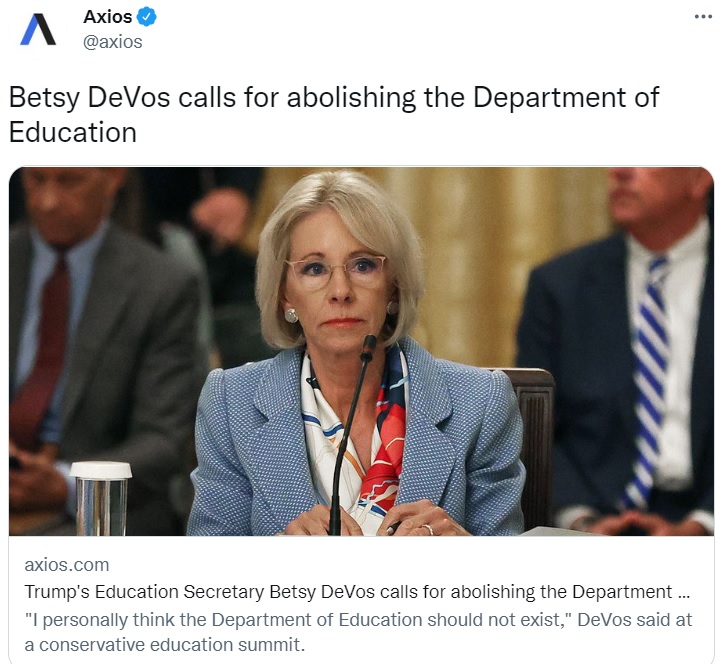
But there’s another potential big change. As illustrated by this tweet (and this story), a former Secretary of the Department of Education thinks it is time to abolish her former bureaucracy.

Unfortunately, we are not seeing any progress on this goal. The bureaucracy’s budget grew dramatically under Trump. And it’s getting even more bloated under Biden.

But maybe there’s hope. Congressman Tom Massie, a libertarian-leaning Republican from Kentucky, has legislation to get the federal government out of education. Here’s some of his office’s press release on the topic.


Representative Thomas Massie…has introduced H.R. 899, a bill to abolish the federal Department of Education. The bill, which is one sentence long, states, “The Department of Education shall terminate on December 31, 2022.” …said Massie. “States and local communities are best positioned to shape curricula that meet the needs of their students. Schools should be accountable. Parents have the right to choose the most appropriate educational opportunity for their children, including home school, public school, or private school.” The Department of Education began operating in 1980. On September 24, 1981, in his Address to the Nation on the Program for Economic Recovery, President Ronald Reagan said, “…we propose to dismantle two Cabinet Departments, Energy and Education. …There’s only one way to shrink the size and cost of big government, and that is by eliminating agencies that are not needed and are getting in the way of a solution. …education is the principal responsibility of local school systems, teachers, parents, citizen boards, and State governments. By eliminating the Department of Education less than 2 years after it was created, we cannot only reduce the budget but ensure that local needs and preferences, rather than the wishes of Washington, determine the education of our children.”

In a column for the Foundation for Economic Education, Patrick Carroll applauds Congressman Massie, along with his cosponsors who have embraced genuine reform.


Though it may be tempting to think Massie and his supporters just don’t care about education, this is certainly not the case. If anything, they are pushing to end the federal Department of Education precisely because they care about educational outcomes. In their view, the Department is at best not helping and, at worst, may actually be part of the problem. …Massie is echoing sentiments expressed by President Ronald Reagan in 1981, who advocated dismantling the Department of Education even though it had just begun operating in 1980. …Education needs vary from student to student, so educational decisions need to be made as close to the individual student as possible. Federal organizations simply can’t account for the diverse array of educational contexts, which means their one-size-fits-all findings and recommendations will be poorly suited for many classrooms.

Amen.

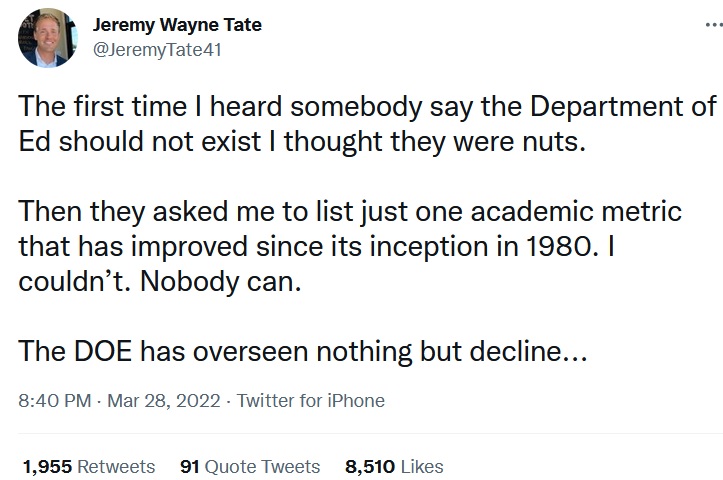
From the moment it was created by Jimmy Carter, the Department of Education has failed to generate  any positive outcome.

https://freedomandprosperity.org/wp-content/uploads/2022/03/Mar-30-22-Tweet.jpg

By that metric, it has something in common with the Department of Energy, Department of Agriculture, Department of Transportation, Department of Housing and Urban Development, and almost every bureaucracy in Washington.

P.S. As one might expect, Bush’s No Child Left Behind and Obama’s Common Core were both expensive failures.

Monday, July 18, 2022

Former Trump Education Secretary Betsy DeVos Calls to Abolish Department of Education

Paul Bois

Betsy DeVos, who served as the U.S. Secretary of Education under former President Donald Trump, has called for the abolishment of the Department of Education.  Speaking at the “Moms for Liberty” summit, DeVos said the federal government should be removed from education, leaving it to state and local governments. “I personally think the Department of Education should not exist,” said DeVos, prompting a loud standing ovation from members of the audience, according to Florida Phoenix.  Though DeVos acknowledged the good that teachers serve, including those in attendance at the summit, she blasted teachers unions as a “K-12 cartel.”.........To Read More.....