Search This Blog

De Omnibus Dubitandum - Lux Veritas

Showing posts with label Statism. Show all posts

Wednesday, May 15, 2024

Defending “Neoliberalism”

May 14, 2024 by Dan Mitchell @ International Freedom

Whenever I’m part of a debate about the merits of free markets, I ask my leftist opponent to respond to my never-answered question.

 

Cite an example, I beg them, of big government producing prosperity.

Inevitably, that person either dodges the question or gives an inaccurate answer.

Based on his new column in the Washington Post, I’m guessing that Joe Stiglitz would dodge the question.

As you can see from these excerpts, he makes lots of assertions about the supposed superiority of big government, but he offers no evidence for that proposition.


We’ve now had four decades of the neoliberal “experiment,” beginning with Ronald Reagan and Margaret Thatcher. The results are clear. Neoliberalism expanded the freedom of corporations and billionaires to do as they will and amass huge fortunes, but it also exacted a steep price: the well-being and freedom of the rest of society. …there are two kinds, positive and negative; freedom to do and freedom from harm.

“Free markets” alone fail to provide economic stability or security against the economic vagaries they create… Government is needed to deliver both. …Neoliberal capitalism has thus failed in its own economic terms: It has not delivered growth, let alone shared prosperity. …and it has instead set us on a populist route raising the prospects of a 21st-century fascism. …

There is an alternative. …I call this new set of economic arrangements “progressive capitalism.” Central are government regulations and public investments, financed by taxation.

Before giving my response, I’ll make two points to help readers understand Stiglitz’s points.

  1. It may seem odd to Americans, but “neoliberal” often is a term for laissez-faire, especially in other nations (and usually intended as a slur). The same thing is true when folks on the left use terms like “free-market fundamentalist” or “zombie Reaganite.”
  2. The “two kinds of freedom” refer to the right to be left alone (negative liberty) and the supposed right to taxpayer-financed goodies (positive liberty). President Franklin Roosevelt’s so-called Second Bill of Rights would be an example of positive liberty.

With those definitional issues out of the way, I already noted that my main criticism is that Stiglitz offers no evidence to back up his assertions.

But there are a couple of other points worth making.

First, Stiglitz claims that capitalism “has not delivered growth, let alone shared prosperity.” Nonsense. There is a very strong correlation become market friendly policies and national prosperity.

And it’s worth noting that free markets have produced mass prosperity. Indeed, capitalism is the only system in the world to ever deliver that result.

Second, Stiglitz refers to “the four decades of the neoliberal experiment” that started with Reagan and Thatcher.

He is right about the starting point. There was an era, starting around 1980, known as the “Washington Consensus” when governments liberalized their economies. But the evidence clearly shows that the drift to statism resumed around the turn of the century.

P.S. I can’t resist sharing one final excerpt from Stiglitz’s column.

Freeing bankers from what they claimed to be excessively burdensome regulations put the rest of us at risk…when the banking system imploded in 2008.

This also is nonsense. Bad government policy (specifically easy money and Fannie/Freddie subsidies) gave us the 2008 crisis.

P.P.S. I also can’t resist pointing out that Stiglitz has cheered the policies that produced terrible outcomes in Greece and Venezuela.

Saturday, April 20, 2024

The Drift to Statism in the Western World

April 19, 2024 by Dan Mitchell @ International Liberty

Three years ago, I wrote about the erosion of economic liberty in Western Europe (specifically, the 15 nations that comprised the European Union between 1995-2004).

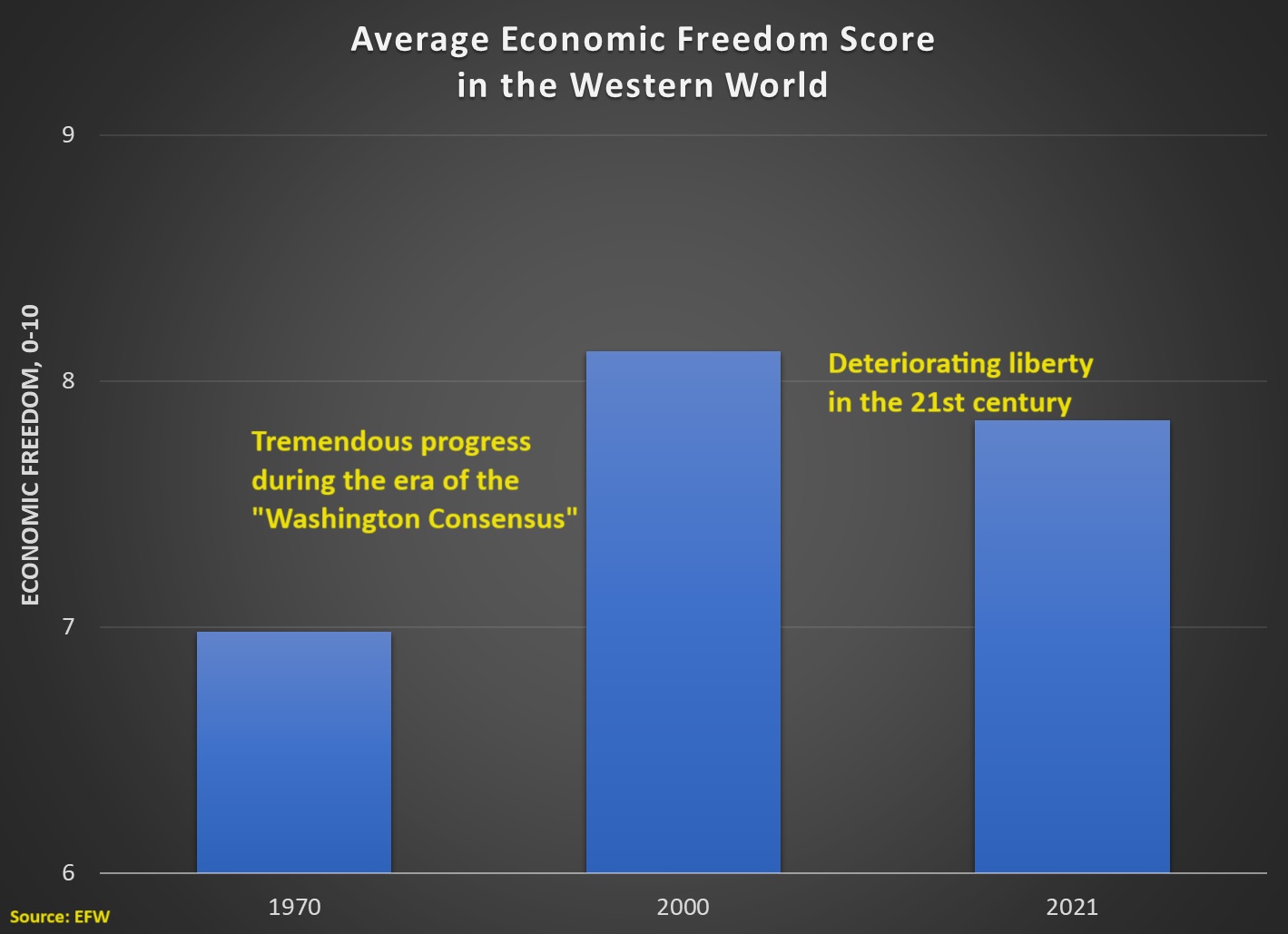
Sadly, here’s a more up-to-date chart showing that the loss of economic freedom is a problem for the entire western world (the advanced nations of North America, Western Europe, and the Pacific Rim).

As you can see, a big increase in economic liberty during the era of the “Washington Consensus” followed by a decline since the turn of the century.

Sadly, only three nations – Israel, South Korea, and Taiwan – improved their economic freedom scores between 2000 and 2021. Every other country declined.

Moreover, it pains me to acknowledge that the United States suffered the biggest decline, dropping from 8.84 to 8.14.

The situation has become so bad that even the New York Times has noticed. Here are some excerpts from a story by Patricia Cohen.


More than 2,500 industrial policies were introduced last year, roughly three times the number in 2019, according to a new study. And most were imposed by the richest, most advanced economies — many of which could previously be counted on to criticize such tactics. …the trend is worrying some international leaders and economists who warn that such top-down economic interventions could end up slowing worldwide growth. …“There are different ways of shooting yourself in the foot,” M. Ayhan Kose, the deputy chief economist of the World Bank, said about the trend of rich countries pursuing industrial policies. “This is one way of doing it.” …The current wave of policies…is a stark contrast to the classic open markets, hands-off government ideology championed by the citadels of capitalism in recent decades. …After years of complaints about China’s subsidies of private and state-owned industries, the United States and Europe have increasingly copied Beijing’s playbook, undertaking multibillion-dollar industrial policies.

The article focuses solely on industrial policy and protectionism.

And those are awful policies. to be sure.

But there are other problems as well, such as a rising fiscal burden of government and inflationary monetary policy.

It’s rather strange that those mistakes were not mentioned. Or, perhaps not so strange since the reporter was talking to people at the annual meeting of the International Monetary Fund and World Bank. And the IMF this century has been controlled by political types who preach a dirigiste message of bigger government and higher taxes.

That’s presumably distressing to the many competent economists who work there.

I’ll close by citing an additional passage that is very discordant.

…faith in the superiority of free-market policies was deeply shaken in recent years by a string of global jolts — the pandemic, supply chain meltdowns, soaring inflation and interest rates, Russia’s invasion of Ukraine, and rising tensions between the United States and China.

Why on earth did the reporter assert that faith in free enterprise was shaken by things that have nothing to do with capitalism?!?

Free markets didn’t impose economic lockdowns. Free markets didn’t cause inflation. Or geopolitical conflicts.

May as well blame capitalism for rainy days and red lights. Sigh.

Monday, June 5, 2023

Statism and China’s Economic Decline

June 4, 2023 by Dan Mitchell @ International Liberty

I was sour about China’s economic prospects more than 10 years ago, and these remarks from earlier this year show that I still think China’s economy is being held back by too much government.

The people who think of China was or is an economic superpower do not pay much attention to policy, as captured by Economic Freedom of the World and the Index of Economic Freedom.


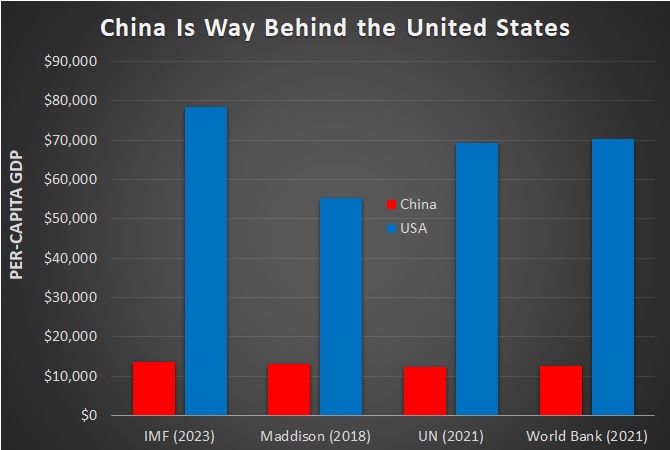
And they also don’t pay much attention to data. When you compare per-capita economic output, it quickly becomes apparent that China is way behind the United States.

And that assumes Chinese economic data is trustworthy, which almost certainly is not the case.

It seems other people are finally waking up to the fact that China is not a success story.

A story in the Wall Street Journal, authored by Stella Yifan Xie  and Jason Douglas, captures some of the country’s ongoing economic challenges.


China’s era of rapid growth is over. Its recovery from zero-Covid is stalling. And now the country is facing deep, structural problems in its economy. …government overinvestment that fueled growth for more than a decade have ended. Enormous debts are crippling households and local governments. Some families, worried about the future, are hoarding cash. Chinese leader Xi Jinping’s crackdowns on private enterprise have discouraged risk-taking… Instead of expanding at 6% to 8% a year as was common in the past, China might soon be heading toward growth of 2% or 3%, some economists say. An aging population and shrinking workforce compound its difficulties. …More than a fifth of Chinese youths aged 16 to 24 were unemployed in April. …Foreign direct investment into China tumbled 48% in 2022 compared with a year earlier.

If that list of problems is not sufficiently compelling, there’s more evidence that China has serious problems.

The bottom line is that China can prosper, but only if it returns to the path of economic liberalization. Pro-market reforms in the late 1900s produced some very positive results.

But I suspect we are more likely to see economic deterioration under the nation’s current leadership.

P.S. China will suffer even more if it follows terrible advice from the IMF and OECD.

P.P.S. Here’s a fascinating comparison of Poland and China. And we can learn even more by comparing Taiwan and China.


Wednesday, November 6, 2019

Capitalism vs. Statism

November 5, 2019 by Dan Mitchell @ International Liberty

 Many libertarians support capitalism because of ethics and morality. Simply stated, they want an economic system based on voluntary exchange compared to statist alternatives (socialism, fascism, communism, etc) that rely on government coercion.

I also like the non-aggression principle, so I certainly don’t want to dissuade anyone from supporting free markets for that reason.

But one of my main goals is to show people that economic liberty also is the best approach from the utilitarian perspective.

This is why I share so many examples showing how market-oriented jurisdictions out-perform statist nations over multi-decade periods.

I want to build on this empirical foundation by sharing some 2009 research from Professor Peter Leeson. Here’s the abstract from his study.
According to a popular view that I call “two cheers for capitalism,” capitalism’s effect on development is ambiguous and mixed. This paper empirically investigates that view. I find that it’s wrong. Citizens in countries that became more capitalist over the last quarter century became wealthier, healthier, more educated, and politically freer. Citizens in countries that became significantly less capitalist over this period endured stagnating income, shortening life spans, smaller gains in education, and increasingly oppressive political regimes. The data unequivocally evidence capitalism’s superiority for development. Full-force cheerleading for capitalism is well deserved and three cheers are in order instead of two.
Here are his data sources.
I consider the trajectory of capitalism and four “core” development indicators in countries that have embraced and rejected capitalism over the past quarter century. These categories are average income, life expectancy, years of schooling, and democracy. …My data are drawn from several sources. The first is the Fraser Institute’s Economic Freedom of the World Project (2008), which provides data on the extent of capitalism across countries and over time. …I get data for my development indicators from Shleifer (2009), who collects his information from several standard sources. His data on countries’ GDP per capita and life expectancies are from the World Bank’s World Development Indicators (2006). His data on education and democracy are from the Barro-Lee (2000) dataset and the Polity IV Database (2000) respectively.
He then compares nations that moved toward free markets with those that gravitated to statism.
The results are unambiguous.
The data are clear: countries that became more capitalist became much wealthier. The average country that became more capitalist over the last 25 years saw its GDP per capita (PPP) rise from about $7600 to nearly $11,800—a 43% increase. If rapidly rising wealth deserves cheering, so does capitalism. What about longevity? All the money in the world doesn’t mean anything if you’re not alive to spend it on things that improve your life. Figure 2b charts the movement of average life expectancy at birth in countries that became more capitalist over the last quarter century at 5-year intervals. Growing capitalism is clearly associated with growing life expectancy. In the average country that became more capitalist over the last 25 years, the average citizen gained nearly half a decade in life expectancy. … In the average country that became more capitalist, the average number of years of schooling in the population rose from 4.7 to just over 6. …Countries that became more capitalist over the last 20 years became dramatically more democratic.
Here are the charts showing great results from capitalism.


Now let’s look at what Professor Lesson discovered about nations that moved in the wrong direction.
The good news is that there weren’t that many since this was the era when the “Washington Consensus” held sway.
Although most countries became more capitalist over the past quarter century, not every country did. …Fortunately, only five countries became significantly less capitalist over the last quarter century when most everyone else was busy reaping the rewards of becoming more capitalist. These countries are: Myanmar, Rwanda, Ukraine, Venezuela, and Zimbabwe. Each of these countries lost more than 1 point of economic freedom over the period on Fraser’s 10-point scale. This decline translates into a 20–40% loss of economic freedom depending on the country one considers.
Unsurprisingly, bad things happen when nations suffer a decline in economic liberty.

Here’s what happened to the four key indicators in countries that moved toward statism.


Professor Leeson’s conclusions are very blunt…and very accurate.
Unless one prefers poverty, premature death, ignorance, and political oppression to wealth, longevity, knowledge, and freedom, less capitalism deserve no cheers. …Global capitalism’s effect is clear to the point of smacking one in the face: it has made the world unequivocally better off.
Amen.

We know the recipe for growth and prosperity. The challenge is convincing self-interested politicians to reduce their power and control over the economy.

P.S. I’m still waiting for any of my left-leaning friends to provide an answer – even just a partial answer – to my two-question challenge.

Friday, March 8, 2019

Individualism and Society

March 7, 2019 by Dan Mitchell @ International Liberty
 
When talking with people who dislike free enterprise, it’s quite common that they will admit (at least once I share some of the evidence) that markets produce more prosperity than statism.

But that generally doesn’t convince them. In part, this is because they believe it is wrong to have significant income disparities. Especially if they’ve been snookered into thinking that the rich are getting richer at the expense of the poor.

To be fair, they generally don’t favor rabid redistribution. And I rarely find anyone who agrees with the twisted IMF prescription to hurt the poor so long as the rich suffer even more. But it bothers them that some people are poor and others are rich.

They’re also skeptical about capitalism because they think it implies a Randian world of ultra individualism where people are so fixated on making money that family and community are afterthoughts.

It is true that individualism-based societies generate much more prosperity than collectivism-based societies, at least according to research from scholars at the University of California at Berkeley.
But does that additional growth come at a cost? Are individualism-based societies cold, harsh, and disconnected?

We have the answer, thanks to a study authored by academics at the University of Tartu in Estonia. They investigated this very issue.
Many social scientists have predicted that one inevitable consequence of modernization is the unlimited growth of individualism, which poses serious threats to the organic unity of society. Others have argued that autonomy and independence are necessary conditions for the development of interpersonal cooperation and social solidarity. We reanalyzed available data on the relationship between individualism-collectivism and social capital within one country (the United States) and across 42 countries.
They considered the hypothesis that individualism corrodes community.
…many theorists have seen the unlimited growth of individualism as a threat to the organic unity between individuals and society. Particularly in France, the concept of individualism has historically carried a negative meaning, denoting individual isolation and social dissolution… For many critics, individualism mainly fosters social atomization, which, in its turn, leads to the disappearance of social solidarity and to the dominance of egoism and distrust. …Thus, in the opinion of communitarians, society should exert a balancing force to excessive individualism, which endangers both individual rights and civic order.
And they also considered the opposite hypothesis, which says that individualism builds social capital.
…individualism does not necessarily jeopardize organic unity and social solidarity. On the contrary, the growth of individuality, autonomy, and self-sufficiency may be perceived as necessary conditions for the development of interpersonal cooperation, mutual dependence, and social solidarity. …normative or ethical individualism even elevates social welfare by promoting trust as well as by encouraging people to work creatively, from which others can benefit…individualism (as it is conceptualized in psychology) is also associated with higher self-esteem and optimism…individualistic cultures are higher on subjective wellbeing…and they report higher levels of quality-of-life… People in individualistic cultures tend to have more acquaintances and friends…they are more extraverted and open to new experience…and they are more trusting and tolerant toward people of different races.
The authors crunched numbers for states and nations.

Here’s what they found in American states.
…states with higher levels of social capital tend to be more individualistic. According to Figure 1, high levels of both community-based social capital and individualism prevail in the states that belong to the Plains region: Montana, North Dakota, South Dakota, and Nebraska. Low social capital and collectivistic tendencies, on the other hand, can be found in the area of the former Confederacy, in the states of South Carolina, Louisiana, Mississippi, Georgia, and so on.
As you can see, there’s a clear correlation showing that more individualism is associated with higher levels of social capital.


And the same is true for countries.
Figure 2 shows that the countries with the highest levels of interpersonal trust are the countries most characterized by high levels of individualism: Finland, Norway, Sweden, Denmark, the Netherlands, Canada, and the United States.
As you can see from the chart, interpersonal trust and individualism are correlated.


As is so often the case, it’s interesting to look at the outliers.

The authors note that Utah and Nevada are outlier states. I’m assuming those results may have something to do with Mormonism and gambling, respectively. But maybe there are other explanations.

Looking at nations with high levels of interpersonal trust, China is a big outlier at one end and the Nordic nations are outliers at another end. For what it’s worth, the authors admit that the Chinese results are counterintuitive.

Now let’s circle back and consider policy implications.

I’ve argued that big government undermines charity, it undermines civil society, and that it undermines societal capital as well.

In a free society, by contrast, people have the ability to strive and prosper in order to have the time and resources to enjoy the things – such as family, neighborhood, friendship and community – that are the sources of happiness and contentment.

Though I confess I’m not sure how to best explain this to skeptics.

Friday, November 16, 2018

The Miracle of Prosperity Unleashed by Classical Liberalism

November 15, 2018 by Dan Mitchell @ International Liberty

I periodically ask my left-leaning friends to identify a nation that became rich with statist policies.

They usually point to Sweden or Denmark, but I point out that Sweden and Denmark became rich in the 1800s and early 1900s, when government was very small.

At that point, they don’t really have any other response.

That’s because, as I pointed out in this clip from a recent debate at Pomona College in California, there is no example of a poor nation becoming rich with big-government policies (though we have tragic examples of rich nations becoming poor with statism).


So if statism isn’t the right approach to achieve prosperity, how can poor nations become rich nations.

I’ve offered my recipe for growth and prosperity, but let’s look at the wise words of Professor Deirdre McCloskey in the New York Times.
The Great Enrichment began in 17th-century Holland. By the 18th century, it had moved to England, Scotland and the American colonies, and now it has spread to much of the rest of the world. Economists and historians agree on its startling magnitude: By 2010, the average daily income in a wide range of countries, including Japan, the United States, Botswana and Brazil, had soared 1,000 to 3,000 percent over the levels of 1800. People moved from tents and mud huts to split-levels and city condominiums, from waterborne diseases to 80-year life spans, from ignorance to literacy. …50 years ago, four billion out of five billion people lived in…miserable conditions. In 1800, it was 95 percent of one billion.
Deirdre then explains that classical liberalism produced this economic miracle.
What…caused this Great Enrichment? Not exploitation of the poor, …but a mere idea, which the philosopher and economist Adam Smith called “the liberal plan of equality, liberty and justice.” In a word, it was liberalism, in the free-market European sense. Give masses of ordinary people equality before the law and equality of social dignity, and leave them alone, and it turns out that they become extraordinarily creative and energetic. …we eventually need capital and institutions to embody the ideas, such as a marble building with central heating and cooling to house the Supreme Court. But the intermediate and dependent causes like capital and institutions have not been the root cause. The root cause of enrichment was and is the liberal idea, spawning the university, the railway, the high-rise, the internet and, most important, our liberties.
In other words, the right ideas are the building blocks that enable the accumulation of capital and the development of institutions.

Deirdre’s analysis is critical. She reminds us that investment doesn’t merely depend on good tax policy and rule of law doesn’t magically materialize. You need a form of societal capital as the foundation.

Anyhow, to show how good ideas changed the world, this chart show how classical liberalism is the key that unlocked modern prosperity.


You may have already seen a chart that looks just like this. It was in a video Deirdre narrated. And Don Boudreaux shared a similar chart in one of his videos.

Circling back to the point I made at the start of this column, socialism (or any other form of statism) has never produced this type of economic miracle.

Friday, August 10, 2018

Do Economic Crises Produce Liberalization or More Statism?

August 9, 2018 by Dan Mitchell @ International Liberty
 
When I give speeches about modern welfare states, I’ll often cite grim data from the IMF, BIS, and OECD about the very depressing fiscal consequences of ever-expanding government.

 
And if I really want to worry an audience, I’ll augment those numbers by talking about the erosion of societal capital and explain it’s very hard to adopt necessary reforms once the work ethic and self-reliance have been replaced by a culture of dependency and entitlement.
 
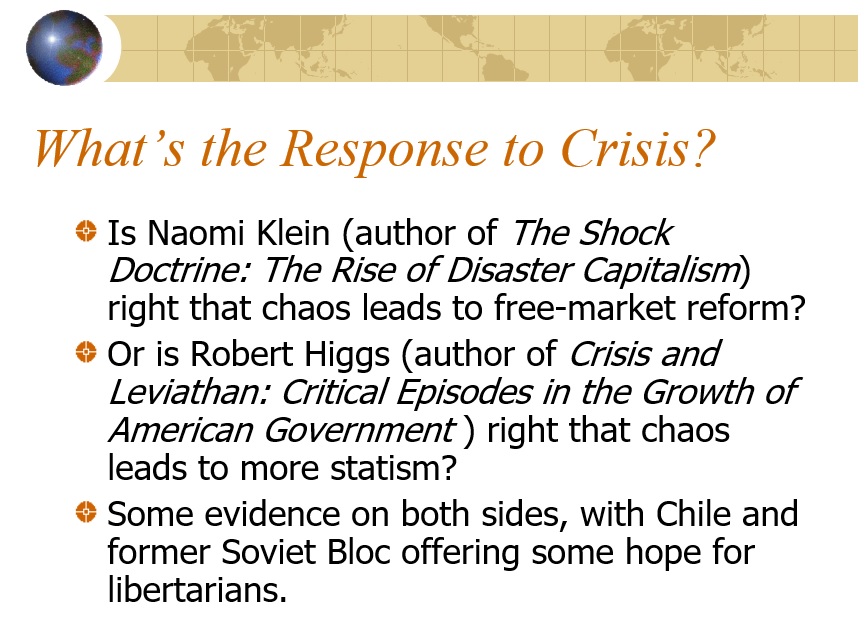
I basically warn people that many western nations (including the United States) are doomed to suffer Greek-style fiscal collapse. Depending on the type of speech, this is where I sometimes share a slide suggesting that there are two possible outcomes once an economic crisis occurs.
  • Does a crisis caused by bad government lead to even more bad government, which is the pessimistic hypothesis in Robert Higgs’ classic, Crisis and Leviathan?
  • Or does an economic crisis force politicians to actually scale back the size and scope of government, which is the hypothesis in Naomi Klein’s The Rise of Disaster Capitalism.
I’ve generally sided with Higgs, though there obviously are cases – such as Chile – where bad statist policies were followed by sweeping economic liberalization.

But, based on new research from the International Monetary Fund, it may be that Klein has a stronger argument (which would be a depressing outcome for her, since she favors bigger government).
Here are some of the issues that the authors investigated.
Relying on a new database of major past labor and product market reforms in advanced countries, we test a large set of variables for robust correlation with reform in each area. …structural reforms are notoriously difficult to implement…one of the most prominent hypotheses put forward in the literature, namely that crisis induces reform… we attempt to minimize value judgements and measurement error by employing a newly constructed “narrative” dataset of major reforms in four areas namely product market regulation (PMR) in network industries, EPL for regular workers, EPL for temporary workers, and unemployment benefit systems. … The large welfare costs of economic or financial crisis can break the deadlock over welfare-enhancing measures that could not be adopted otherwise due to conflict over their distributional consequences.
In short, they wanted to find out whether bad economic news (as captured by data on “GDP growth, deep recession, unemployment, crisis”) leads to pro-market reforms.

The answer is yes.
Our main result supports some form of the crisis-induces-reform hypothesis across all four reform areas. High unemployment, recession and/or an open economic crisis tend to be associated with a greater likelihood of reform. The effect is economically significant. For example, an increase of 10 percentage points in unemployment (as seen in several European economies in the aftermath of the Great Recession) is associated with an increase in the probability to undertake a major EPL reform for regular contract of about 5 percentage points — that is, about twice the average probability in the sample.
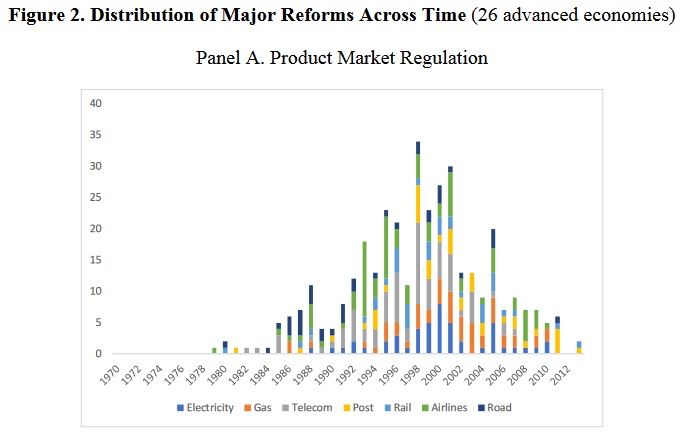
Here’s a chart from the report showing a big spike in deregulation in late 1990s/early 2000s.


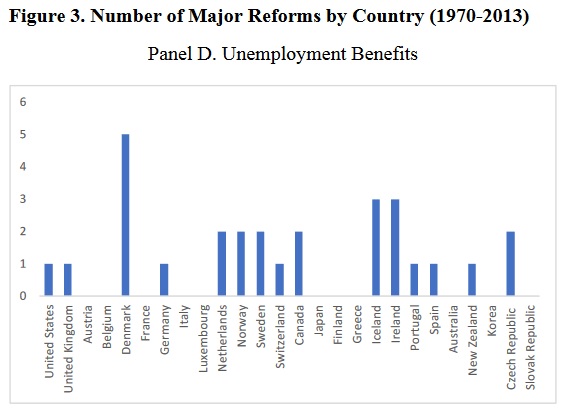
And here’s a chart showing nations that took steps to cut back on unemployment subsidies.


Keep in mind, by the way, that some nations (such as Austria) may not have reformed because they never adopted bad policies in the first place.

Kudos to Denmark for implementing so much reform. And Greece wins a Booby Prize for failing to adopt desperately needed reforms.

I was also happy to see some results that bolster my argument in favor of jurisdictional competition as a tool to encourage better policy.
We also find evidence that outside pressure increases the likelihood of reform in certain areas. Reforms are more likely when other countries also undertake them.
Interestingly, it doesn’t appear that ideology plays a major role.
…we do not find any evidence for an ideological bias—there is no robust difference between left- and right-of-center governments’ propensity to undertake reform. …In the context of labor and product market reforms, while a reforming right-of-center government may face the combined resistance of the leftwing electorate, trade unions and other civil society groups, a left-of-center government will be less likely to be accused of pushing through reforms on ideological grounds and may therefore be more likely to succeed.
My two cents is that ideology can play a role (think Reagan and Thatcher, for instance), but that there are plenty of instances of putative right-of-center politicians making government bigger (Nixon and Bush, to cite US examples) and several instances of supposed left-of-center politicians overseeing pro-market reforms (Bill Clinton being the obvious example from America).

I’ll close with a very important caveat. The IMF study looked at regulatory policy. There are no lessons to be learned from this research about whether crises produce better fiscal policy.

For what it’s worth, based on all the post-financial-crisis tax increases that were imposed in Europe, I suspect that the Higgs hypothesis is still very relevant.