Search This Blog

De Omnibus Dubitandum - Lux Veritas

Showing posts with label Welfare State. Show all posts

Monday, September 1, 2025

Since Upper-Income Taxpayers Finance the American Welfare State, Leftists Should Be Nice to Rich People, Part III

August 31, 2025 by Dan Mitchell @ International Liberty

I’ve written a couple of columns (in 2016 and earlier this year) about how upper-income taxpayers finance the vast majority of the welfare state.
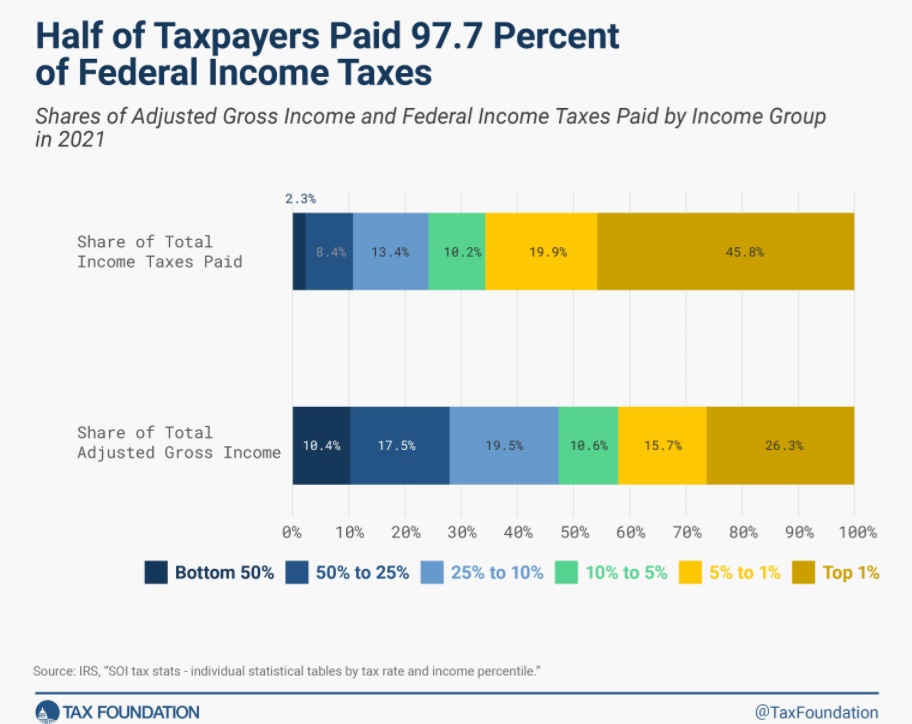
 

The data I shared involved the federal budget in Washington.

And I explained that the Bernie-AOC crowd, instead of despising the rich, should be grateful for them (yes, I realize that is very unlikely, but I view myself as the Don Quixote of economic freedom).

The same lesson applies to state and local governments. Or perhaps I should say it especially applies to state and local governments since internal tax migration is much easier than international tax migration.

Interestingly, some folks in New York are capable of learning. Here are some excerpts from a column by Matthew Haag in the New York Times.


The rate at which New York State has been adding millionaires to its population in recent years has fallen below that of other large states, potentially costing the state billions in unrealized tax revenue, according to a new report from a nonpartisan fiscal watchdog group. At the same time, California, Florida and Texas had large increases in the number of people with annual incomes of at least $1 million residing in their states, all adding them at a faster rate than New York did from 2010 to 2022. The millionaire population in New York nearly doubled over that same time period, but it more than tripled in those other states. …“We have a debate about affordability, but we need to raise more revenue,” said Andrew Rein, the president of the Citizens Budget Commission, “and we can raise even more revenue if we have even more millionaires.” …the group’s arguments that New York City needs more millionaires and that any increase in personal income taxes could drive them away…is in opposition to the platform of Zohran Mamdani, a state assemblyman who is the Democratic nominee. Mr. Mamdani has proposed a new 2 percent tax on income greater than $1 million.

Here are the most important numbers in Haag’s column.

While just 1 percent of the city’s taxpayers are millionaires, their contributions make up 40 percent of all personal income tax collected. If New York’s rate of growth had kept pace with that of other states, the group said, the state and city would have together collected $13 billion in additional taxes in 2022.

The bottom line is that folks on the left in New York have to decide what matters most.


  • Is their main goal to persecute rich people and drive them away? If that’s the case, they should continue what they’re doing and (for the ones in New York City) even take it to the next level by electing Zohran Mamdani, the Champagne Socialist with a lunatic agenda.
  • Or, is their main goal to provide benefits and services to lower-income people? If that’s the case, they should realize that rich taxpayers are the geese with the golden eggs. As such, they should be very grateful for them and maybe, just maybe, they should hope for more of them.

Sadly, I fear that many folks on the left are motivated by envy and instinctively prefer the persecution option.

P.S. It was interesting to read in the NYT column that California still creates millionaires, but perhaps that is not surprising since the state hasn’t figured out how to tax unrealized capital gains. The problem for the not-so-Golden State is that many of those successful taxpayers then emigrate.

Monday, July 28, 2025

OECD Pushes Welfare-State Policies on Thailand

July 25, 2025 by Dan Mitchell @ International Liberty

Hong Kong used to be a role model for good economic policy, but China’s crackdown has had a negative effect, so Singapore is now considered the jurisdiction with the most economic freedom.

But I also like to cite Taiwan, which is a top-20 nation for economic liberty.

Especially if the alternative is Thailand, which only ranks #65.

Unsurprisingly, differences in economic freedom translate to differences in per-capita GDP. Here’s a chart based on the Maddison database.

One reason for the big gap is that Thailand has a bigger burden of government spending.

This second chart utilizes IMF data to compare the three nations.

Looking at these two charts, one obvious conclusion is that Thailand should reduce the burden of government spending.

It makes sense, after all, to mimic the policies of nations that are much richer.

Unfortunately, the bureaucrats at the Organization for Economic Cooperation and Development must have flunked Econ 101.

The Paris-based bureaucracy just published a report that explicitly urges the Thai government to increase taxes and spending.

I’m not joking. Here are some excerpts.


Thailand has made significant progress in expanding its social protection system in recent years, but there is scope to further expand coverage and increase benefit levels. …spending on social protection (excluding healthcare) is only 2.1% of gross domestic product (GDP), which remains low in international comparison… Additional public spending requires increasing Thailand’s tax-to-GDP ratio… 

Raising more tax revenues will require reform across a wide range of direct and indirect taxes. There is scope to increase the standard value added tax (VAT) rate (currently at 7%)… The role of the personal income tax could be strengthened… Further, the dividend withholding tax rate could be increased. …the ceiling on social security contributions…could be raised to increase the contributions from higher incomes.

For those keeping score, the OECD wants more income tax revenue, more payroll tax revenue, and more value-added tax revenue.

And if you read the entire report, they want more energy taxes, more excise taxes, and other taxes as well.

Here’s the OECD’s list of recommendations.

We may as well call this the turn-Thailand-into-France recipe.

Except France became a (relatively) rich nation when government was very small and then made the mistake of adopting an expensive welfare state.

The OECD wants Thailand to adopt a costly welfare state today, which means the country (notwithstanding absurd OECD analysis) will never become rich.

To make matters worse, the OECD is subsidized by money from American taxpayers. So I’m helping to pay for terrible advice that will hurt the people of Thailand.

P.S. Adding insult to injury, OECD bureaucrats get tax-free salaries. So those hypocrites push tax increases on everyone else while being insulated from suffering any real-world consequences.

P.P.S. To be fair, the OECD wants all nations to have higher taxes and bigger welfare states, so it’s not selectively attacking Thailand.

Sunday, April 28, 2024

Comparing Taxation in Sweden and the United States

April 28, 2024 by Dan Mitchell @ International Liberty

I already shared my thoughts about the value-added tax when discussing fiscal policy with an economist at the Confederation of Swedish Enterprise.

Here’s some of what I said about tax progressivity and the welfare state.

The bottom line is that the American tax system targets the rich. But that’s not the case in Sweden.

If you don’t believe me, let’s see what some left-of-center sources say.


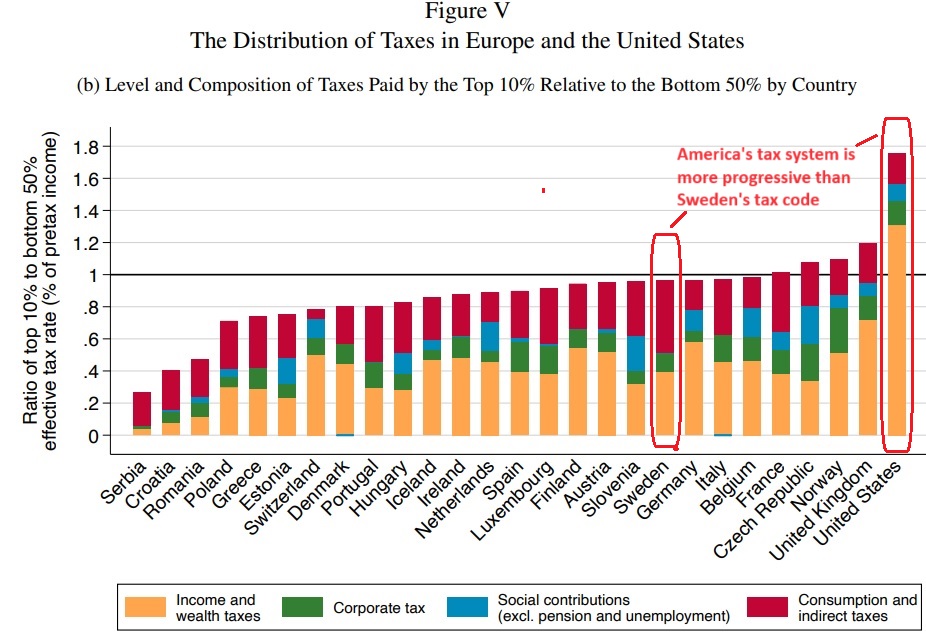
Here’s a chart from a study for the World Inequality Lab by three economists at the Paris School of Economics.

As you can see, the United States is an outlier. The rich pay a much bigger share of the tax burden in America compared to other nations.

Interestingly, it’s not because America imposes higher taxes on the rich. It’s because Europeans impose higher taxes on lower-income and middle-class households.

Want more confirmation from another left-of-center source?

Here are some excerpts from a column in the New York Times by Monica Prasad, a sociology professor at Northwestern.


We can learn from Sweden, but the lesson is not what many people think. Rich Swedes do get taxed at high rates, but so does everyone else: The average American worker’s total tax burden is 31.7 percent of earnings, compared with 42.9 percent for the average Swede. The Swedes actually tax corporations less… Estate tax? In the United States the average effective rate is 16.5 percent. In Sweden, it’s zero. Swedish national sales taxes, which fall disproportionately on the middle classes, are much higher than sales taxes in the United States. …

Some scholars have drawn on this history to argue that the United States needs to give up its fixation with progressive taxation and adopt a national sales tax as every other advanced industrial country has done. …It’s hard to make a case for a big new tax in America on the middle classes and the poor…progressive taxation still has a role to play in the United States — but we do need to learn the larger lesson…the secret of the European welfare states.

Her view of the the “larger lesson” and “secret” is not the same as mine.

She wants an efficient welfare state and – to her credit – she acknowledges that means big tax burdens for lower-income and middle-class households.

I look at comparative living standards and say “are you $&(#)@* crazy!”

I’ll close by emphasizing a point I made at the end of the above video. Our friends on the left like to argue that big government is popular and they’ll cite polling data to make that case.

But people have much different answers to polling questions when they are asked if they are willing to pay higher taxes to finance bigger government.

And since there are not enough rich people to finance big government, the only way to have Swedish-sized government is to have Swedish-level taxes on ordinary people.

P.S. For those who want to focus solely on the taxation of rich households. Europeans tend to impose higher personal income tax rates but to also have less double taxation of income that is saved and invested.


Tuesday, April 16, 2024

In One Image, Everything You Need to Know about the Washington-Created Welfare State (Part II)

April 13, 2024 by Dan Mitchell @ International Liberty

As part of my everything-you-need-to-know series, I shared an incomprehensible flowchart showing the ridiculous maze of federal welfare programs back in 2015.

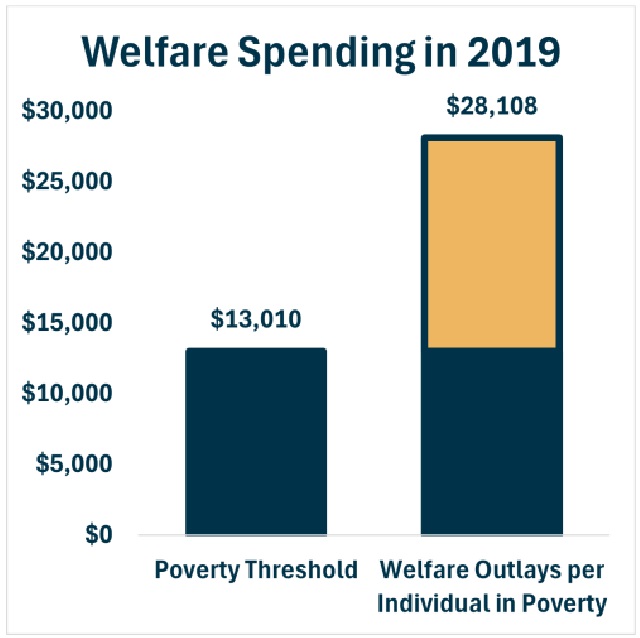
Today, let’s look at another visual that captures what’s wrong with the Washington welfare state. As you can see, taxpayers are footing the bill for a system that spends more than twice what would be required to eliminate all poverty.

The chart comes from a new report by Matt Dickerson for the Economic Policy Innovation Center. And the purpose of the chart is to show that the welfare system is grotesquely inefficient.

Here’s some of what he wrote.


…the welfare bureaucracy is broken, making it more difficult for millions of people to achieve the American Dream. …It is demeaning to believe that many Americans are simply unable to be successful and should be relegated to a life of dependence on perpetual government subsidization of their basic needs. …

the welfare bureaucracy undermines and discourages employment. Only 18% of able-bodied adults receiving Food Stamps, who are expected to meet work requirements, actually work 20 hours or more per week. …Many welfare programs undermine the institution of the family — and the benefits brought by stable two-parent households — by including marriage penalties. …

The principle of subsidiarity dictates that the independent sector, communities, and local and state governments should be empowered rather than the distant and bureaucratic central government. …The welfare bureaucracy is also filled with duplication and overlapping programs. According to the Congressional Research Service, there are 15 different food aid, 13 housing, 12 health care, and five cash aid programs. …Welfare is one of the largest categories of the federal budget, comprising about 20% of annual spending

… the federal government spent more than $28,100 per person in poverty — providing benefits $15,000 above the poverty threshold for individuals

At the risk of understatement, this is an utter disaster.

Terrible for taxpayers. Terrible for poor people.

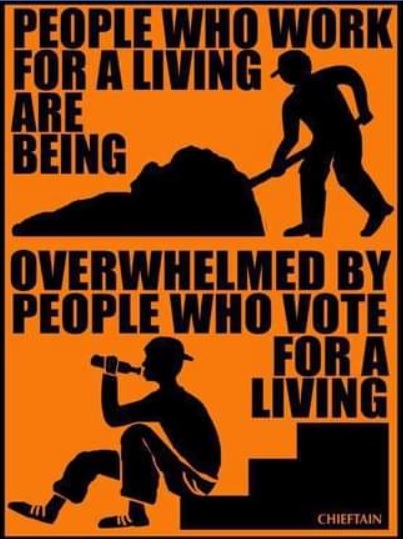
So why does it exist? This clever cartoon tells part of the answer.

But this is only a partial explanation.

Don’t forget all the bureaucrats, consultants, and contractors who make a lot of money administering the programs. Walter Williams called them “poverty pimps” and they have an obvious incentive to maintain the current system.

I’ll close by emphasizing a point from Matt’s EPIC report. The answer is to get Washington out of the redistribution racket. In other words, copy the success of Bill Clinton’s welfare reform by turning all welfare programs into block grants and putting states back in charge. With the ultimate goal, of course, of phasing out the block grants so that states are fully responsible for raising and spending the money.

P.S. The goal should not merely be reducing poverty, but also reducing dependency.

Tuesday, October 3, 2023

There Are Not Enough Rich People to Finance European-Sized Government

October 2, 2023 by Dan Mitchell @ International Liberty

Mostly because of an aging population, entitlement spending in the United States is projected to become a much bigger burden.

Without reform of those programs, the U.S. within a few decades will have a European-sized level of government spending.

Joe Biden and Donald Trump have both stated that they oppose entitlement reform, so this raises the very important question of how they would finance this massive expansion in the burden of government.

Biden’s answer is “tax the rich” while Trump simply pretends the problem doesn’t exist.

Since there’s no way of dealing logically with Trump’s head-in-the-sand approach, let’s address Biden’s supposed solution of soak-the-rich taxes (and keep in mind Biden wants several trillion dollars of new spending on top of the trillions of dollars of higher spending that’s already in the pipeline for existing entitlements).

I’ve written about this issue before, but this is an opportune time for some new data since Brian Riedl of the Manhattan Institute has a new study on the topic.

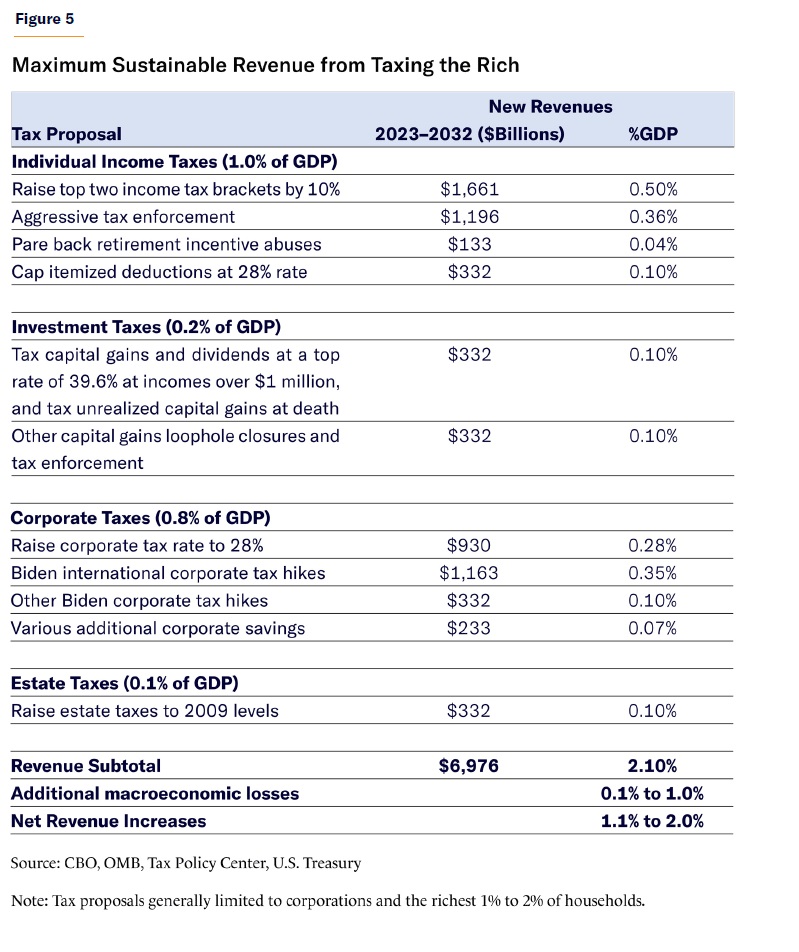
Here’s the table he put together of the revenue that might be generated by the various class-warfare tax proposals the left has offered.

As you can see, establishment sources estimate the maximum revenue from all of these soak-the-rich tax increases is 2 percent of GDP.

And the actual revenue collected would be lower because all of these tax hikes would significantly undermine incentives to engage in productive behavior by entrepreneurs, investors, small business owners, and others.

Would 1-2 percent of GDP be enough to finance existing spending promises, as well as Biden’s proposals for more spending?

Not even close. As Brian explains, it doesn’t even deal with current levels of spending.


Budget deficits have risen to nearly 6% of GDP and are projected to rise to 10% of GDP over three decades. …To close these baseline deficits and finance additional expansions, most progressives reject most spending cuts as well as middle-class tax increases. Instead, just “tax the rich” has become an easy and popular answer. However, …the plausible revenue estimates from these proposals fall far short of closing these budget gaps. …America’s federal tax code is already the most progressive in the Organisation for Economic Co-operation and Development (OECD) and has become sharply more progressive over the past 40 years. Much of this tax progressivity is the result of drastic cuts to low- and middle-income taxes while leaving upper-income-tax rates closer to international norms. …Europe’s significantly higher tax revenues are driven overwhelmingly by broad-based consumption and payroll taxes, rather than by notably higher tax rates on the wealthy.

In other words, Brian’s research confirms my Twelfth Theorem of Government.

This is true even in Nordic nations, as Brian explains.

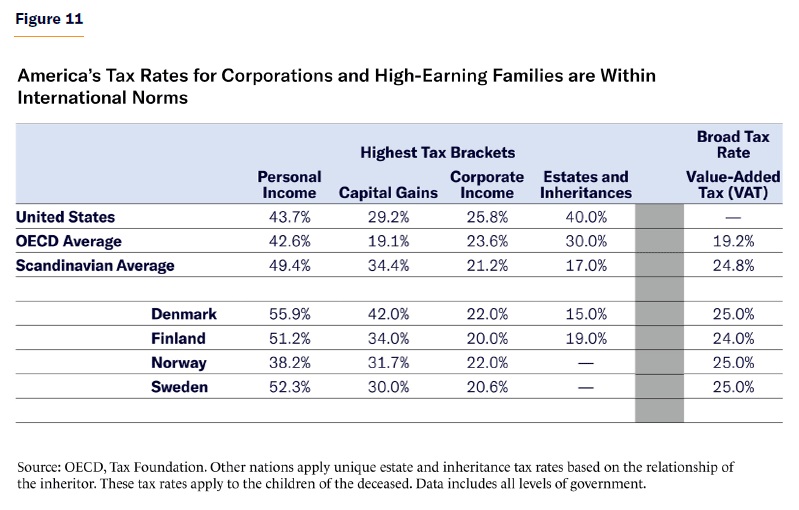
American progressives often hold up Europe—and especially the Scandinavian social democracies of Denmark, Finland, Norway, and Sweden—as successful tax-the-rich utopias that the U.S. should replicate. In reality, European tax systems do not fit the American progressive stereotype, as their higher revenues are overwhelmingly raised through steep income, payroll, and consumption taxes on the middle class.

Here’s a table from the study showing that Denmark, Finland, Norway, and Sweden have slightly higher taxes on income and capital gains, but that’s offset by lower taxes on corporations and lower death taxes.

So what’s the bottom line?

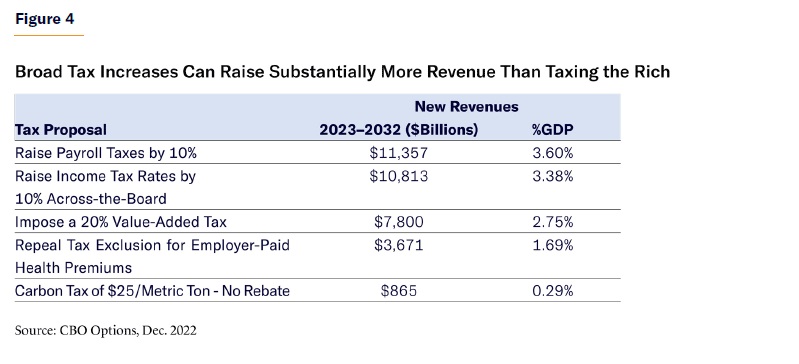
Simply stated, as explained in my Fifteenth Theorem of Government, there is no way to have European-sized government without European-level taxes on lower-income and middle-class households.

As you can see from this table, it’s the only place where there is substantial potential tax revenue.

P.S. There’s one final excerpt from the study I want to share.

I mentioned above that class-warfare taxes would be very detrimental to growth. Well, don’t forget that payroll and consumption taxes are bad for growth as well. And a bigger burden of government spending also is very harmful to prosperity.

So if we go down the wrong path of bigger government and higher taxes, we can expect European-style economic anemia. And Brian explains that also has fiscal consequences.

…a tax package that reduces annual economic growth rates by 1 percentage point would, in turn, reduce tax revenues by $3.3 trillion over the decade—likely canceling all static tax-revenue gains while also costing jobs and reducing incomes. In other words, tax-the-rich advocates cannot afford to ignore economic considerations. Raising every upper-income-tax rate to its revenue-maximizing level—the point at which the economic damage cancels out any additional revenues—is a recipe for economic stagnation, job losses, and declining incomes.

At the risk of understatement, we don’t want to copy Europe.

Friday, July 21, 2023

The Welfare State’s Damaging Impact on Europe, Part III

July 20, 2023 by Dan Mitchell @ International Freedom 

Editor's Note:   Here are the links to Parts I and II, and I've added Part III to that post.   If this series continues, I will continue to add them to that first post. RK

Part I of this series reviewed some data about the United States growing much faster than the welfare states of the European Union.

Part II of the series looked at some very depressing data about the European Union losing ground compared to the United States, even though convergence theory tells us that should not happen.

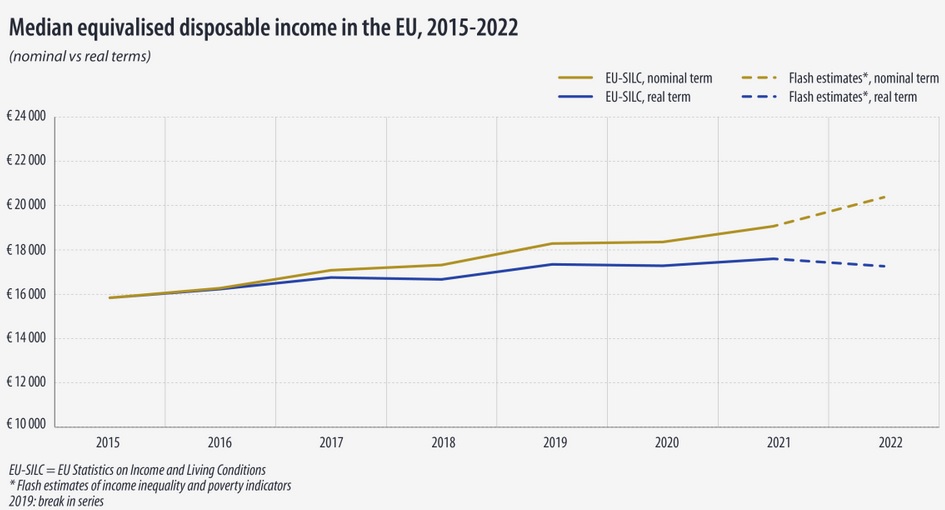
For today’s installment, let’s see what the European Union’s statistical body concluded in a new report about the region’s economic performance. We’ll start with this chart showing that inflation-adjusted disposable income (the blue line) declined last year.

To be sure, American households also suffered a decline in inflation-adjusted income, so this is not just a Europe-specific problem.

Here’s some of Eurostat’s analysis.


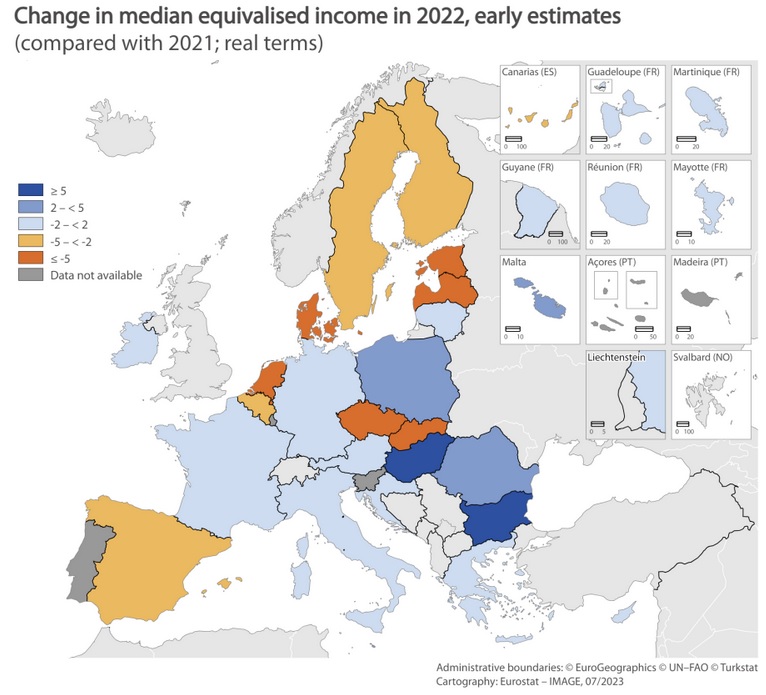
…the nowcasted median disposable income will decrease in real terms in most EU countries. Rising prices for essential items (goods and services), such as food, energy and transport were the main reason for the decrease of the real income. …It is estimated that inflation led to a 1.9 % decrease for EU median disposable income in real terms in 2022 (compared to 2021). The effect of inflation is likely stronger for low-income households, as essential items represent a higher share of their overall consumption, and they have little margin for adjusting their consumption. In this context, the at-risk-of-poverty rate anchored in 2021…is estimated to statistically significant increase for about half of the EU countries. …Figure 6 shows the change in median disposable income in real terms at country level. The largest decreases were estimated in Estonia, Latvia, the Netherlands, Denmark, Slovakia and Czechia. It increased most sharply in Hungary and Bulgaria.

Here’s the map showing which nations enjoyed more real income in 2022 (dark blue) and which ones suffered big losses (dark orange).

Though don’t assume that nations such as Hungary and Bulgaria had good policy.

Inflation-adjusted disposable income can go up for good reasons (faster growth, lower taxes), but it also can increase for not-so-good reasons (more handouts).

P.S. The data above does not include the United Kingdom, which wisely left the European Union, or Switzerland, which wisely never joined.

Rate this: