Search This Blog

De Omnibus Dubitandum - Lux Veritas

Showing posts with label International Liberty. Show all posts

Thursday, November 6, 2025

G20 Report on Inequality Urges More Statism, More Poverty

When I unveiled my Eighth Theorem of Government in 2020, my target was the head of the International Monetary Fund, a bureaucrat with a very generous tax-free salary who wanted other people to pay higher taxes to fund bigger welfare states.
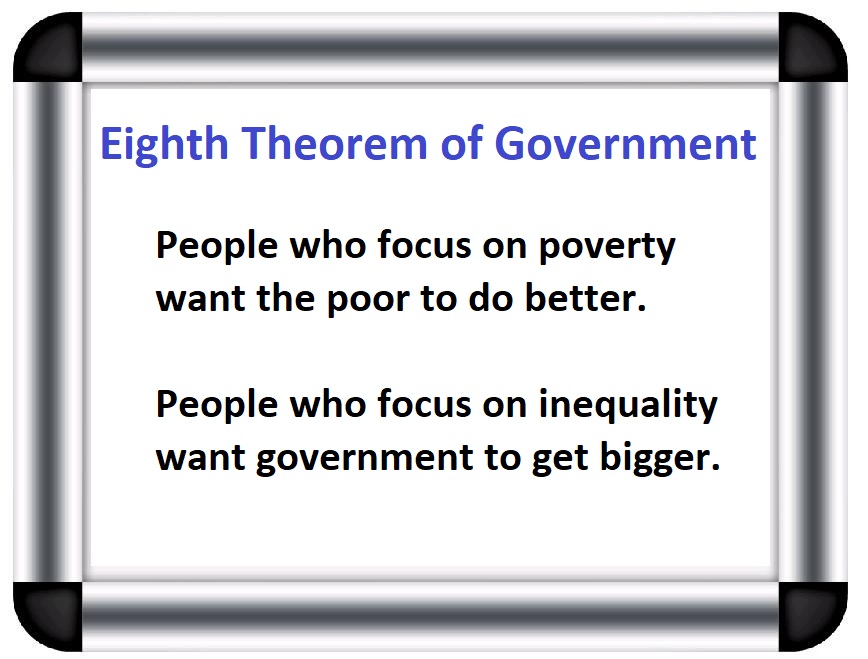
 

Her excuse was fighting inequality, but her policy was bigger government.

And since the IMF had published research implying that societies would be better off if everyone was poorer but more equal (I’m not joking), I decided that I needed a way of capturing this perverse mindset.

Now I have a new reason to share my Eighth Theorem. The failed government of South Africa recently paid some leftist academics to issue a report on inequality.

It was led by Joseph Stiglitz, the guy who infamously praised Venezuela’s failed socialist policies. And it included Jayati Ghosh, who was the lead signatory of the world’s most inaccurate letter.

Here’s their premise (keep in mind that “neoliberal” in much of the world means free market).


A series of economic policies that found favour from the 1980s led to steep increases in economic inequality in many high-, middle- and low-income countries. …Collectively, these policies have been described as ‘neoliberal’. They have been a common feature in most nations at different times over the last four decades… Broadly they are based on the idea that unregulated markets are the most efficient way of allocating resources. They were adopted nationally and globally through globalisation. Several of these policies led directly to higher inequality.

The authors are partly right. As I noted yesterday, there was a global shift to free-market policies that started under Reagan and Thatcher (an era sometimes known as the Washington Consensus).

Did this period of  “neoliberalism” mean more inequality?

My responses is that I don’t care if some people get richer faster than other people get richer. I just want a system that produces more prosperity for everyone.

And, as Johan Norberg noted back in 2022 when responding to a different attack on neoliberalism, it was a spectacularly wonderful time for poor people.
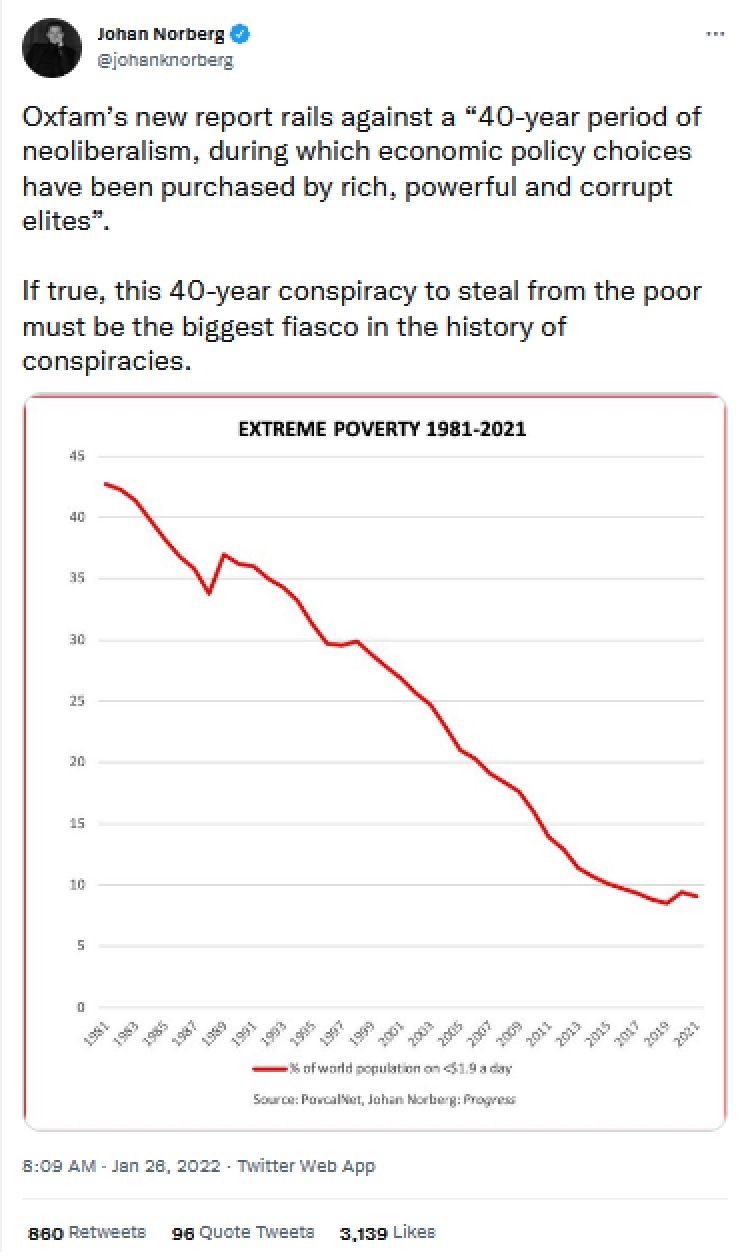
Since the authors started with the wrong premise (fixating on inequality rather than looking at how to reduce poverty), it will come as no surprise that their proposed policies are misguided as well.

At various points, they endorse more spending, industrial policy, price controls, weakening property rights, and protectionism.

As you might suspect, I found their analysis of tax policy especially loathsome.

There is no ‘magic bullet’ to reduce inequality. But there is a menu of prudent policies that have proven to be highly effective, and could even be seen as preconditions, for reducing various dimensions of inequality. …we have a specific emphasis on the international approaches and strategies to reduce inequality… 

An agreement among countries to have a minimum corporate income tax would, for instance, help prevent the destructive race to the bottom in corporate taxation. …new negotiations at the UN towards a Framework Convention on International Tax Cooperation provide a historic opportunity to redesign the international tax architecture. Minimum global tax rates on corporate incomes and extreme wealth could be vital elements of this, which in turn would require…ideally the creation of a global asset register to identify and track wealth ownership.

Their agenda can be summarized as “eliminate tax competition to enable goldfish government.”

P.S. The part about a “global asset register” is especially Orwellian. Fits well with the left’s desire to abolish cash and require everyone to use central bank digital currencies.


 

Saturday, February 22, 2025

Advice for DOGE: Privatize Air Traffic Control

February 19, 2025 by Dan Mitchell @ International Liberty

Based on economic trends, I don’t want the United States to copy Canada.

But there is one big exception. As explained by John Stossel, we should copy our northern neighbors and privatize air traffic control.

I harbor a special distaste for government bureaucracies that deliberately try to screw taxpayers by playing the “Washington Monument game.”


So that’s a strike against the Federal Aviation Administration. But let’s focus on the more substantive issue of how to maximize safety and minimize costs. If those are the two main criteria, the answer is privatization. Indeed, this is a great opportunity for Elon Musk’s Department of Government Efficiency if it wants to show how to save money and make things work better.  The above video has some of the details, but let’s also look at an article in City Journal by John Tierney.

Here are some excerpts.


America’s air-traffic control system, once the world’s most advanced, has become an international disgrace. …chronic mismanagement…has left the system with too few controllers using absurdly antiquated technology. The problems were obvious 20 years ago, when I visited control towers in both Canada and the United States. The Canadians sat in front of sleek computer screens that instantly handled tasks like transferring the oversight of a plane from one controller to another. The Americans were still using pieces of paper called flight strips. …It was bad enough to see such outdated technology in 2005. But they’re still using those paper flight strips in American towers…

The basic problem, which reformers have been trying to remedy since the Clinton administration, is that the system is operated by a cumbersome federal bureaucracy. …after the Washington collision, could the second Trump administration and a new Republican Congress finally create a state-of-the-art system? …Experience in Canada and other countries shows that an independent corporation, able to issue its own revenue bonds because it’s funded directly by user fees instead of taxes, can modernize air-traffic control far more efficiently and cheaply than a government agency.

In an article for Discourse, Gary Leff adds his analysis.


…after 1978…the federal government no longer told airlines where they’re allowed to fly, and how much they can charge. …However, nearly every other element of the experience continues to be dictated—and even directly managed—by the government. …Elsewhere in the world you’ll find nonprofit organizations conducting air traffic control, with better technology to direct planes more effectively and efficiently. …The private nonprofit NavCanada (which rolled out electronic flight strips way back in 2002!) oversees not just Canadian airspace but also the North Atlantic. It operates much more cost efficiently than the FAA. And they’re way ahead technologically as well.

Leff’s article cites other policies that would improve air travel, so privatizing air traffic control is just one piece of the puzzle.

But it’s an important piece, so let’s wrap up our discussion with some passages from Dominic Pino’s column in National Review.


Get the federal government out of air traffic control. I’d call it “privatizing,” but if you want to call it “depoliticizing” air traffic control, that’s fine by me. The air traffic control system should not be affected in the slightest by which politicians are in power… Air traffic control is not a public good in economic theory. It’s a club good, which means it can be provided privately through a system of user fees. …Canada illustrates that the private alternative works: Canadian air traffic control has been provided by a nonprofit since 1996, at zero cost to Canadian taxpayers. …Privatization has been proposed for the U.S. on and off since the 1980s, so DOT doesn’t need to come up with any groundbreaking ideas or ask for more money from Congress.

Amen.

By the way, if you’re not familiar with the concept of “public goods,” click here. Pino is right. Air traffic control does not qualify.

There is no logical reason why we don’t learn from other countries and get politicians and bureaucrats out of this line of business.

P.S. Where we’re on the topic of airlines, click here and here to learn why we should blame government when passengers get hit with so-called junk fees. Leads me to wonder whether the annoying “resort fees” at hotels also are consequence of government interference.

P.P.S. Eight years ago, I shared a very amusing British video that mocked the notion of privatizing the air traffic control system. Since the video is very clever, folks on the left doubtlessly were amused. But folks on the right got the last laugh since the British system is now privatized and working very well.

Wednesday, February 19, 2025

California’s Slow and Steady Fiscal Death

February 16, 2025 by Dan Mitchell @ International Liberty

California’s top fiscal problem is an ever-growing burden of government spending. In case anyone thinks that is just empty rhetoric, the state budget over the past three decades has risen at twice the rate of inflation.

One consequences of ever-expanding government is that California arguably has terrible tax policy.

A main reason for the low scores is that spiteful state lawmakers have turned the income tax into a vehicle for class warfare.

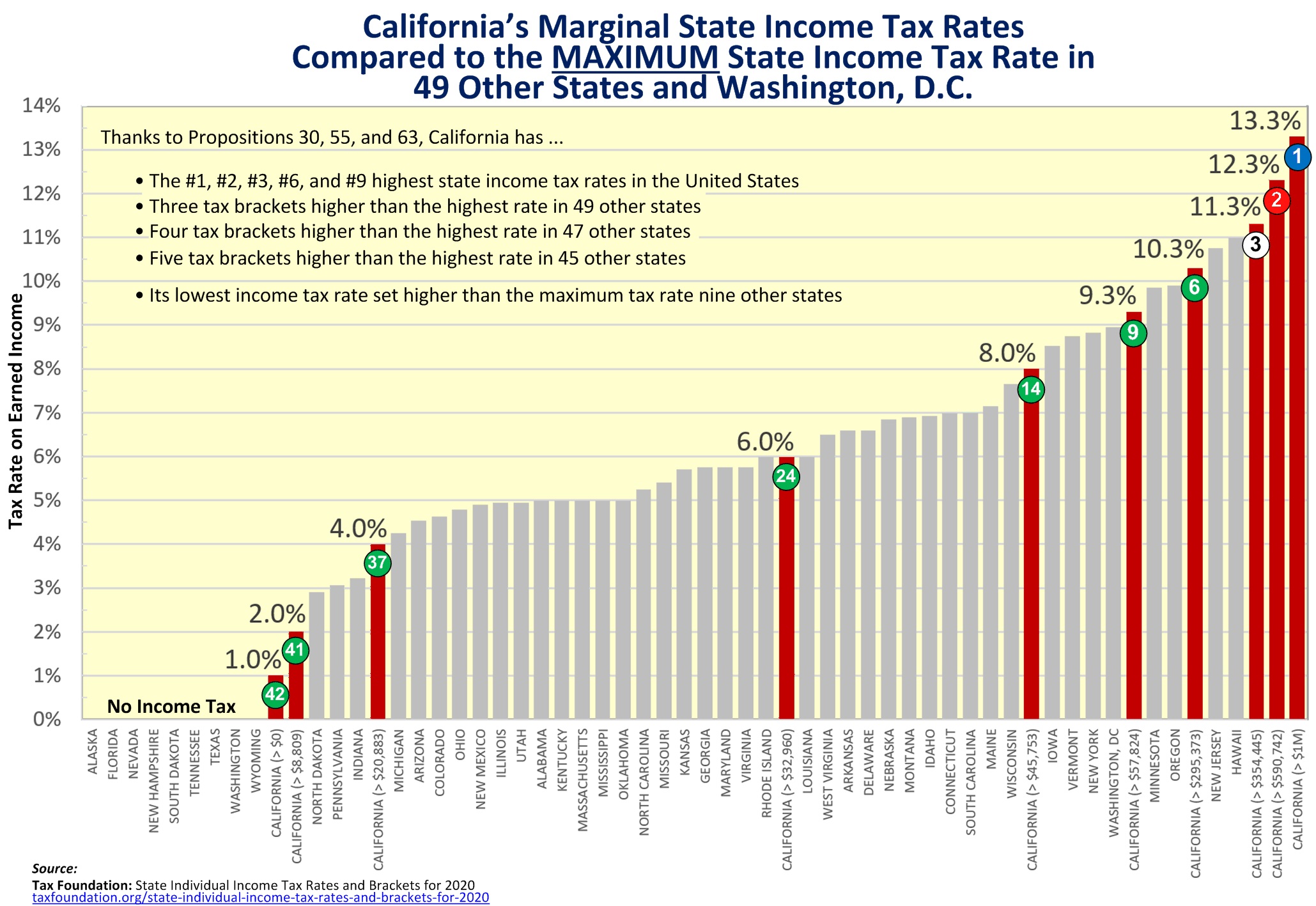
Here’s a chart shared by Grover Norquist showing that not only does California have the highest tax rate among the states, but it actually has the nation’s three-highest tax rates.

To make a bad situation worse, the not-so-Golden State also has the country’s 6th-highest corporate tax rate, so both individuals and businesses in California are mistreated.

But just like a mistreated dog might run away from home, the same is true for taxpayers. Notwithstanding the state’s major advantages (climate, recreation, topography, etc), it is losing residents at a startling rate.

Including some major taxpayers (and some of the ones that stay have figured out how to dramatically slash their tax bills).

And it’s also losing businesses. Here are some excerpts from a 2022 editorial in the Wall Street Journal.

The report by Hoover senior fellow Lee Ohanian and Spectrum Location Solutions President Joseph Vranich finds that 352 companies moved their headquarters from California between 2018 and 2021. Twice as many businesses left last year (153) than in 2020 and 2019 and three times as many as in 2018. The top destinations: Texas (132), Tennessee (31), Nevada (25), Florida (24) and Arizona (21). What do they have in common? Low taxes… California’s high top marginal income-tax rate (13.3%) punishes small pass-through businesses that pay income taxes at the individual rate as well as managers in C-suites.

The following year, Eric Boehm of Reason added even more evidence.


For decades, California has been a desirable destination for Americans… That dream is over for an estimated 343,000 Californians who fled the state between July 2021 and July 2022… Those heading out of state tend to be wealthier residents, and their exit threatens to blow a hole in the state’s finances. California lost about $343 million in tax revenue during 2021 due to out-migration… Combine that with the fact that more jobs can be done from anywhere, and Americans on average are wealthier than ever. As a result, more people have the means and incentive to actively choose where to live, work, and pay taxes.
States must adjust to this new reality. Otherwise, they will discover, as California is, that punishing prosperity comes at a cost.

This trend continued in 2024 and I’m sure it will continue in 2025. And Beyond.

Which raises the interesting question: When will there so many people riding in the wagon that there no longer will be enough people to pull the wagon?

P.S. California’s policies are so terrible that it’s the only state to have generated multiple humor columns (see here, here, here, here, here, and here).

Friday, November 22, 2024

Federal Tax Burdens by Income Group

November 22, 2024 by Dan Mitchell @ International Liberty

There is going to be a major battle over tax policy in 2025, triggered in part by an end-of-year deadline to extend (or not extend) major portions of the 2017 Trump tax reforms.

But lawmakers presumably will also be dealing with some of Trump’s new proposals, both the good ones and the bad ones.

At some point in the near future (probably after he makes some big personnel decisions such as Treasury Secretary), I’ll speculate on the potential policy changes as part of my “Second Edition of Trump” series.

To help set the stage for that future discussion, let’s look at some basic facts about tax burdens in the United States. I did something akin to this back in 2016, showing that the top 20 percent shoulder the cost for the vast majority of federal spending.

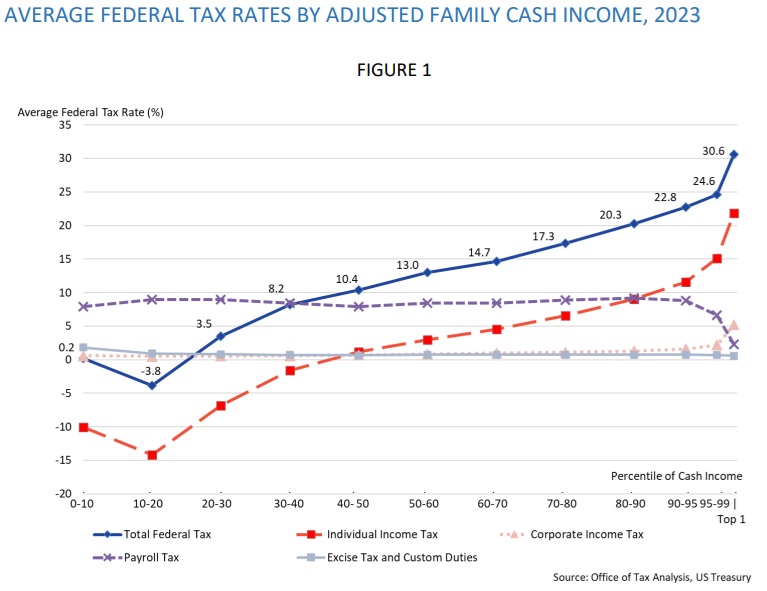
Here are some updated numbers from the Treasury Department showing the total federal tax burden (income taxes, payroll taxes, excise taxes, etc) for every income group in 2023.

As you can see, l0w-income people don’t pay any federal tax. Indeed, they actually get money from the tax system because of “refundable” tax provisions (redistribution spending that is allocated by the IRS).

Middle-class taxpayers, meanwhile, lose about 10-15 percent of their income, while upper-income taxpayers are forced to surrender 25-30 percent of their income to Uncle Sam.

In other words, the United States has a very “progressive” tax system, with the highest rates being imposed on the people contributing the most to economic output.

But that only tells part of the story.

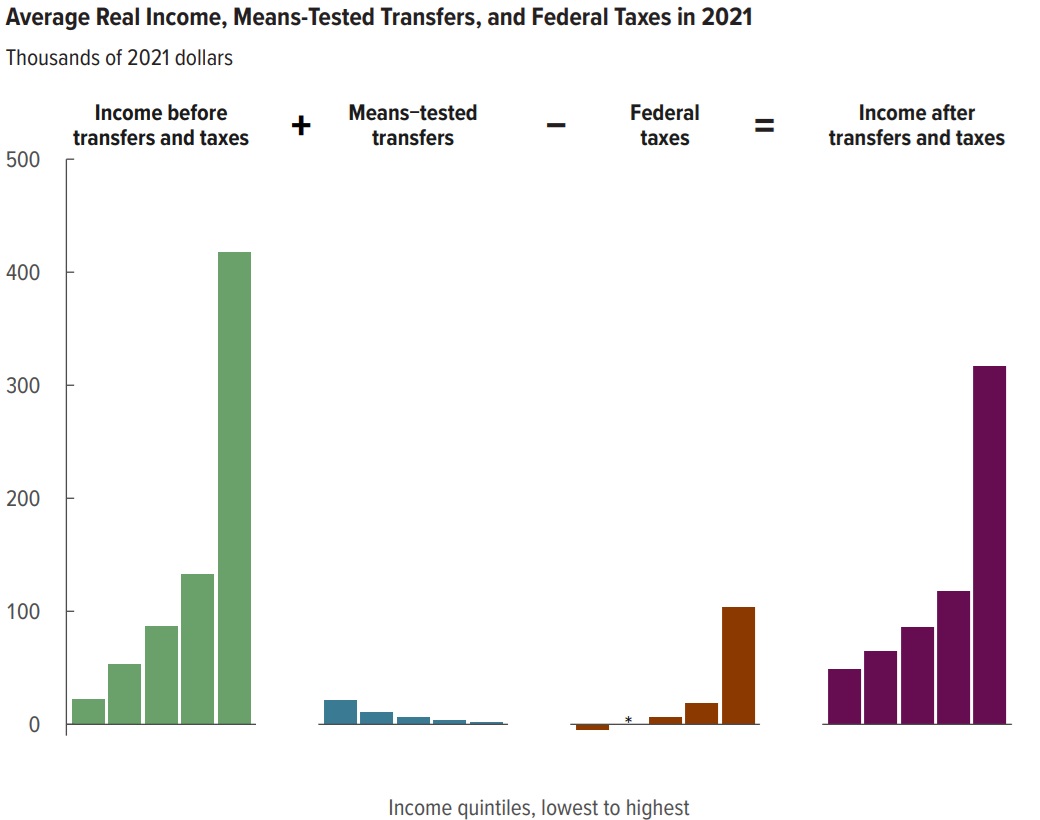
The Congressional Budget Office calculates the impact of both taxes and redistribution spending by income group. This is a more complicated procedure, so the most recent data is for 2021.

And those numbers – showing total income on both ends with transfers and taxes in the middle – are further confirmation that rich people are the ones who finance the bulk of the federal budget.

As you can probably guess, these official numbers contradict the dishonest nonsense disseminated by the Biden Administration.

However, Biden won’t be in office next year. But I suspect there will still be a lot of class-warfare dishonesty from politicians like AOC and Crazy Bernie.