Search This Blog

De Omnibus Dubitandum - Lux Veritas

Showing posts with label VAT. Show all posts

Friday, November 7, 2025

The Value-Added Tax: A Recipe for More Spending…and More Debt: Part II

 November 6, 2025 by Dan Mitchell @ International Liberty 

The case against the value-added tax (VAT) is not complicated.

Simply stated, this hidden type of national sales tax was a key precursor for the expansion of the European welfare state. As you can see in the chart, the burden of government spending in Europe  after World War II was similar to the size of the public sector in the United States.

Then European governments began to adopt the VAT in the late 1960s. Those VATs quickly expanded and became money machines for more spending (and more debt!).
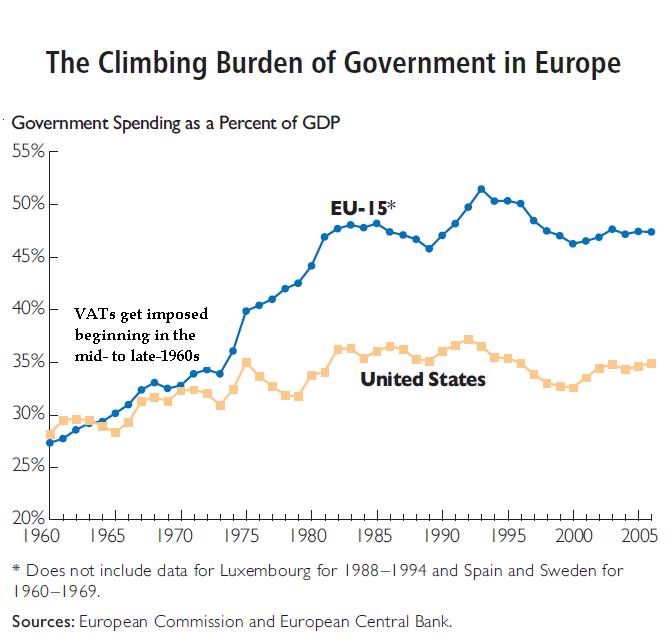
Needless to say, the United States should not make the same mistake. Bigger government has led to worse economic outcomes in Europe, as I’ve documented in my four-part series (here, here, here, and here).

Even the pro-tax International Monetary Fund inadvertently produced a study showing why the VAT is a money machine for big government.

Financing bigger government with a VAT would weaken economic performance. In a 2010 study for the Mercatus Center, Professor Randall Holcombe crunched some numbers and reached some depressing conclusions.


…the effect of various VAT rates on GDP looking 10 years out and 20 years out. …In the revenue-enhancement case, where VAT revenue adds to existing sources of tax revenue, a 3 percent VAT would exact a 2.1 percent GDP penalty by 2020 and a 3.7 percent GDP penalty by 2030. A 5 percent VAT rate would bring with it a 3 percent GDP penalty by 2020 and a 5.6 percent GDP penalty by 2030. A 7 percent VAT rate…would reduce GDP by 4.1 percent by 2020 and 7.5 percent by 2030.

And here’s one of his tables, showing the negative effect on economic output (as well as some calculations showing that the VAT would not collect as much money as supporters hope).

Now let’s look at some more-recent research.

In 2024, Adam Michel wrote a report on the tax implications of bigger government.

Here’s his section on the VAT.

…consumption taxes (taxes on goods and services) account for almost three times as much revenue in the EU countries than in the United States. Every European country uses a value-added tax (VAT), a type of national sales tax collected by businesses at each stage of production instead of at the point of sale. In the United States, most consumption tax revenue is collected by state governments through a point-of-sale retail sales tax. In 2022, the average standard VAT rate in the EU countries was 21.8 percent, and the average state and local sales tax rate in the US was 6.6 percent.  

EU country VATs raise revenue equal to 12 percent of GDP, compared to sales taxes, which collect 4.3 percent of GDP in the United States. The adoption of VATs is closely associated with government growth because new revenue sources, especially when the cost of the tax is not transparent, tend to fuel new public expenditures and reduce pressure on spending reforms. This association is evident in the reliance on VAT revenue across EU countries, where governments are almost 20 percent larger than in the United States.

Here’s Adam’s chart, showing how the absence of a VAT is the main reason the United States has a fiscal advantage over the European Union.

The clinching argument is that one of America’s best presidents opposed a VAT and one of America’s worst presidents supported a VAT. That tells you everything you need to know.

P.S. You can enjoy some amusing – but also painfully accurate – cartoons about the VAT by clicking here, here, and here.

Wednesday, January 5, 2022

Gimmicky Public Policy from Japan

December 27, 2021 by Dan Mitchell @ International Liberty

It’s hard to be optimistic about Japan’s economic future, in large part because the burden of government is expanding thanks to an aging population and a tax-and-transfer entitlement system.


Maintaining that approach is a recipe for ever-higher taxes (especially since Japan already has record levels of debt).

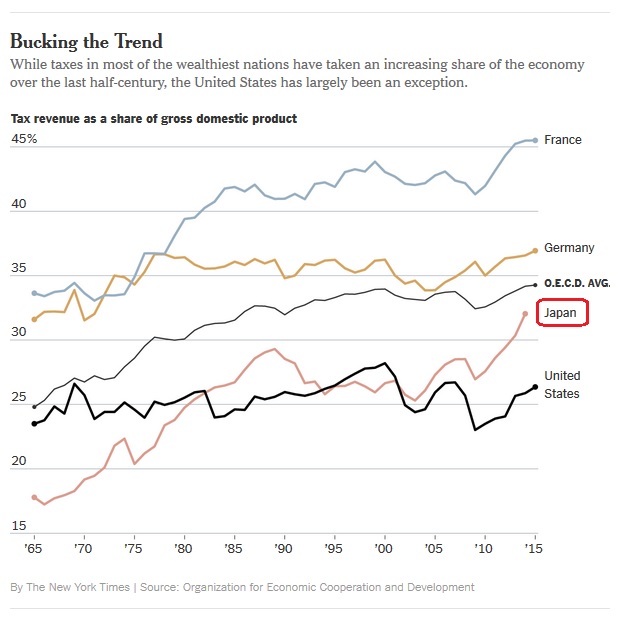
And Japanese politicians definitely have been grabbing more money, enabled to a considerable extent by a money-grabbing value-added tax.

To make matters worse, the country’s economy has not enjoyed much growth ever since a bubble burst about thirty years ago.

Sadly, the current prime minister, Fumio Kishida, doesn’t seem to have any sensible ideas for his country.

Instead, as reported by Ben Dooley and in the New York Times, he’s latched on to a very silly proposal.

Japan’s prime minister…wants…to…Give…employees a substantial raise. The reasoning is simple. Wage growth has been stagnant for decades in Japan, the wealth gap is widening and the quickest fix is nudging people…to pay their employees more. Higher wages, the thinking goes, will jump-start consumer spending and lift Japan’s sputtering economy. …the prime minister is calling on employers to increase pay as much as 4 percent in 2022. Companies that comply will be allowed to increase their overall corporate tax deductions by up to 40 percent. …Mr. Kishida said…Increasing pay “is not a cost,” he added. “It’s an investment in the future.”

Kishida’s scheme is a bizarre mix of industrial policy and Keynesian economics.

He wants a special loophole in the tax code, but only if companies jump through certain hoops.

All based on the flawed notion that consumer spending drives the economy (it’s actually the economy that drives consumer spending).

Unsurprisingly, the private sector isn’t very impressed by the prime minister’s approach.

Business groups, union leaders and others have questioned the feasibility… That businesses would resist increasing wages even when essentially paid to do so shows just how intractable the problem is. Years of weak growth…have left companies little room to raise prices. …The reaction to the wage proposal is an inauspicious sign for Mr. Kishida, who took office two months ago promising to…put Japan’s economy back on track through a “new capitalism.”

Kishida’s “new capitalism” sounds even worse than some of the gimmicky ideas that have been pushed on the right in the United States (reform conservatism, common-good capitalism, nationalist conservatism, and compassionate conservatism).

From an economic perspective, he needs to learn that sustained higher wages are only possible if there’s more productivity, which translates into more income for both companies and workers.

And that’s not a description of what we find in Japan.

…there is the issue of unprofitability. For nearly a decade, a majority of Japanese businesses have been unprofitable — around 65 percent in 2019, the lowest figure since 2010. They have been kept afloat by cheap money underwritten by the Bank of Japan, but no profits mean no corporate tax liability, so those businesses would not be eligible for Mr. Kishida’s incentives.

The bottom line is that Japan’s political elite has been marching steadily in the wrong direction, and they never seem to learn from previous mistakes.

The government has long tried to find something, anything, to stimulate the economy and push up prices. It has pumped money into financial markets and made borrowing nearly free. But it’s been to little avail…the Japanese government has turned to even larger amounts of stimulus, showering consumers with cash handouts and companies with zero-interest loans. …In 2013, Prime Minister Shinzo Abe introduced a similar plan, with little success. Today, average wages remain stuck at around $2,800 a month, about the same level as two decades ago.

P.S. Part of the problem is that Japanese politicians may be listening to terrible advice from left-leaning bureaucracies such as the International Monetary Fund and Organization for Economic Cooperation and Development.

P.P.S. Here’s another example of a foolish gimmick by Japanese politicians.

P.P.P.S. And let’s not forget that Japan may win a prize for the strangest example of regulation.


Thursday, December 26, 2019

The Value-Added Tax Is a Precursor for a Bigger Burden of Government Spending November 30,

November 30, 2019 by Dan Mitchell

I wrote yesterday about Japan’s experience with the value-added tax, mostly to criticize the International Monetary Fund.

The statist bureaucrats at the IMF are urging a big increase in Japan’s VAT even though the last increase was only imposed two months ago (in a perverse way, I admire their ability to stay on message).

Today, I want to focus on a broader lesson regarding the political economy of the value-added tax. Because what’s happened in Japan is further confirmation that a VAT would be a terrible idea for the United States.

Simply stated, the levy would be a recipe for bigger government and more red ink.

Let’s look at three charts. First, here’s a look at how politicians in Japan have been pushing the VAT burden ever higher..........To Read more....