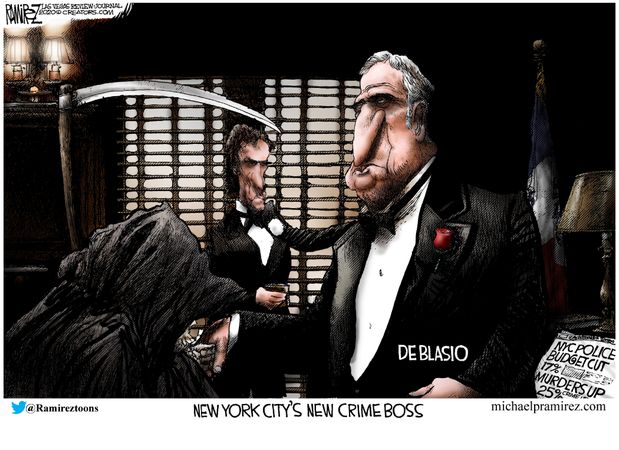
The city will soon be free of Mayor Bill de Blasio, but it desperately needs good governance in a time of crisis and hardship.
Seth Barron January 25, 2021 @ City Journal, published with permission. I recommend subscribing, it's free.
With New York City, more than a year into
the coronavirus pandemic, suffering hard times, it’s natural for people
to number the days until Mayor Bill de Blasio’s term is over and a new
mayor takes the helm. It’s tempting to think that electing a better
leader will repair all the damage. Unfortunately, it’s not that simple.
A series of reforms to New York’s political
and electoral system, undertaken in the name of expanding democracy,
have essentially had the opposite effect. In the mayoral election of
1953, 93 percent of registered voters came to the polls; in 2017, that
figure had fell to less than 22 percent, with just over 1 million New
Yorkers casting ballots. The last time that so few people voted for
mayor was 1917—before women’s suffrage doubled the electorate.
New York City was once run by political machines that rewarded
supporters through patronage in the form of jobs. In the years leading
up to the First World War, Progressive reformers instituted changes in
government staffing. Before the Progressives came along, a change in
political leadership could mean that anyone who worked for the
government might lose his job, from teachers to sanitation workers to
actuaries. This manifest inefficiency led to the introduction of the
civil service and the advent of professional, apolitical administration.
Letting councilmen pick the local dogcatcher and lamp lighter was a
corrupt way to handle municipal hiring, but it forged a responsive
relationship between elected officials and their constituents. Voting
mattered, because if your man lost, you could lose your job. Even after
the decline of the most blatant forms of patronage, local political
clubs—which persist today in some neighborhoods as a shadow of their old
selves—retained significant power and bound elected officials tightly
to their communities.
Today, most New Yorkers don’t know who their local representatives
are. They don’t care, either—and for good reason, because most elected
officials effectively win their seats in primary elections, which
attract much lower turnout than the general election and focus on narrow
issues that most potential voters would find baffling or meaningless.
Many Americans complain about our two-party system as constraining,
but at least a two-party system provides for some give-and-take.
Democrats and Republicans may run to the extremes in their party
primaries, but they know that they will have to answer for these fringe
positions or statements in a general election, so they tend to modulate
their voices accordingly. That’s not the case in New York, which—like
most big cities in the U.S.—operates as a de facto one-party state. Out
of 51 council seats, Democrats occupy 48; perhaps one or two would be
considered swing seats. Of 65 state assembly seats filled from New York
City, 63 are held by Democrats. Out of 24 state senate seats from the
city, 23 are Democrat-held. And out of 11 U.S. congressional seats from
the city, Democrats solidly hold all but one, which swings back and
forth.
What this means is that, in New York, the primary election is usually
the real contest, though the primaries produce even lower turnout than
general elections. With no reason to be concerned about alienating
centrist voters or activating the other side in November by being too
extreme, candidates appeal to the party fringes. In New York, that means
the far left. Candidates leapfrog one another in staking out ever-more
radical positions to appeal to an activist base more ideologically
attuned than the average voter and more likely to punish candidates who
deviate from extreme positions.
For example, until recently it would have
been outlandish to suggest that prostitution—“sex work,” in the
now-common euphemism—should be legalized. But in a November 2020 forum,
five of seven mayoral candidates, including two of the leading
contenders, agreed that it should not carry criminal penalties. And the
so-called Nordic model—which views prostitutes as victims and prosecutes
their clients—is now viewed as regressive and unduly harsh, because how
can prostitutes make money if their clients are afraid to hire them?
Hence, the candidates favored non-prosecution of all involved.
With crime soaring and quality of life plummeting, one would expect
candidates to run on restoring law and order. But, in line with a
seemingly inexorable national pattern, most of the candidates want to
keep as many people out of jail as possible, even for serious crimes. In
cities across the country, a coordinated effort is afoot to
decriminalize supposed “crimes of poverty,” which means non-prosecution
of “low-level offenses” that result from addiction, homelessness, or
being poor.
A tough-on-crime candidate could run a no-nonsense campaign
advocating for victims and safer streets, of course. But the nature of
the Democratic primary system is that anyone who runs even slightly to
the right of the field gets cast as a right-winger. The number of people
in jail in Manhattan is at a historic low—but not low enough, say
almost all the candidates. This is the logic of “progress” as a
political principle: we aim at perfection, and since our prior efforts
have been insufficient toward that goal, we must redouble our
commitment. The nature of the dynamic encourages everyone to shift the
median position further to the left. Yesterday’s radical firebrand
becomes today’s tepid centrist; today’s moderate will be tomorrow’s
reactionary.
This same dynamic works regarding the electorate. The Curley Effect,
named for four-term Boston mayor James Michael Curley, describes how
politicians—as Bertolt Brecht once put it—“elect a new people.” Curley
was an Irish Catholic who found the legacy WASP elite of Boston a
hindrance to his goal of establishing perpetual rule. He used tax
revenue to build playgrounds and other amenities in Irish neighborhoods
and permitted burlesque houses to open in traditionally Protestant
districts, whose potholed streets went unrepaired. He widely expanded
public employment among his preferred constituents and slashed the pay
of school doctors and other elites. Curley specialized in insulting the
legacy Anglo-Saxon population of Boston, while praising the “newer and
better America” represented by more recently arrived Irish immigrants.
The strategy worked. The Brahmins moved out, and Boston has not had a
Protestant mayor—in fact, only one non-Irish mayor—in almost 100 years.
The Curley strategy has been put into
effect—with different players—in many cities. New York City’s racial
politics are complex, but residents of any race who prefer not to live
in a city with high taxes, significant homelessness, and politicians who
favor dismantling the police may find it easier to leave than to stay
and fight. Those who find tolerable the politics of racial resentment,
onerous business regulations, and a school system dedicated to equity
over excellence stick it out. Over time, the electorate is shaped by the
elected.
Term limits, touted as a way to open up a sclerotic system, have only
encouraged this leftward drift. The 2021 election will clear out the
city council almost en masse—40 out of 51 council members are
term-limited. This creates a mad rush of candidates jockeying to
distinguish themselves as more radically committed to social justice
than their rivals. Again, there’s no objective reason why candidates
running on safer streets and improving the business climate couldn’t
emerge as leaders in New York—it’s just not likely to happen at present.
One reason why is that most elected officials in New York City get
their training, funding, and institutional support from working as
political staffers, in government, or from the nonprofit world. As such,
they pass their adult years in a culture of faith in government to
answer all of life’s fundamental problems. They spend their professional
and social lives among similarly minded activists, consuming the same
media and aligning themselves along similar channels of progressive
Democratic politics. Their colleagues in the hothouse of community board
politics, Democratic clubs, community education councils, state party
committee conventions, and protest-march planning sessions are acutely
attuned to deviations in acceptable opinion, and aspirants in that world
quickly learn self-discipline in how to speak and what not to say.
Few elected officials in New York City today have much private-sector
experience. Many, like Mayor de Blasio, spent their formative
professional years as staffers to elected officials or working on
campaigns. They learn about inter-governmental relations; the importance
of cultivating friends and allies in the labor movement; how to
associate with powerful political consultants; and the ins and outs of
election law, including petitioning to get on the ballot and—just as
important—how to get your rivals thrown off the ballot. Owning a
business, achieving professional distinction, or simply working as an
employee for a company may inform most people about real life, but it
will not teach them anything about how to run for office.
To understand how these forces play out in
the real world of city politics, consider the profiles of some of New
York’s most prominent Democrats.
Scott Stringer, a leading mayoral candidate, currently serves as city
comptroller. He signed off on all of de Blasio’s inflated budgets. As
the supposed financial watchdog for New York City, he spent two terms
criticizing the mayor for not spending more money or expanding
social services rapidly enough. He issued a report in September 2019
called “Fees, Fines and Fairness: How Monetary Charges Drive Inequity in
New York City’s Criminal Justice System,” demanding waivers on fines
based on inability to pay. Stringer, who is Jewish, has played up his
support for Israel while also seeking the endorsement of hardline
socialist anti-Zionists in the Democratic Socialists of America group.
And Stringer also supported the effort to “defund the NYPD,” demanding
substantial cuts at a time of rising crime.
Maya Wiley was Mayor de Blasio’s counsel for three years. She devised
the “agents of the city” dodge to protect powerful political/corporate
consultants from disclosing their communications with the mayor. She
also organized a deal with Google to let the tech giant install enormous
surveillance monoliths called “kiosks” around the city. These
purportedly would provide free Wi-Fi to disadvantaged people, closing
the “digital divide,” though their only practical use was to let
vagrants watch porn or YouTube videos, until that feature was disabled.
Wiley’s father founded the National Welfare Rights Organization in the
1960s, the precursor group to Acorn, and for years she worked for the
Open Society and other left-wing activist groups. She is a strong
supporter of Black Lives Matter and protested the NYPD’s efforts to
arrest Derrick Ingram for, in her words, being “at a Black Lives Matter
rally with a bullhorn, expressing himself.” In fact, Ingram assaulted a
cop by placing his megaphone against her ear and shouting into it,
causing the officer severe pain and hearing loss. Wiley demanded that
the NYPD commissioner resign for sending the police to arrest Ingram.
One might imagine that Brooklyn Borough President Eric Adams, a
former NYPD detective, would prioritize public safety. But he, too, has
encouraged massive cuts to the police budget. During summer 2020, when
New York City was flooded with illegal fireworks, Adams encouraged
residents kept up all hours by incendiary explosions not to call the
police. “This is a nonviolent act, so those three numbers that we always
dial—911—get over that,” Adams counseled, explaining that the point of
the George Floyd protests was to end “over-aggressive police action.”
Instead, Adams advised, people bothered by late-night fireworks
displays ought to extend a neighborly hand to the unauthorized
pyrotechnicians. “Go talk to the young people or the people on your
block who are using fireworks,” he suggested. “Maybe we should say ‘good
morning’ to them. Maybe we should say, ‘Hello, how was school? Do you
need a summer job?’” One Brooklyn resident, Shatavia Walls, took Adams’s
advice. She asked a man to stop lighting fireworks outside the Pink
Houses projects in East New York. Offended by her request, he shot her
eight times, killing her.
Contrary to the commonly held idea that police invariably escalate
tension and conflict, cops in fact spend most of their time defusing
quarrels in which they have no personal stake. Their ability to maintain
public order in an impersonal manner is exactly why people call them.
Adams, a former cop, ought to understand this better than most.
Is there any hope that a beleaguered New
York might get a more promising candidate to replace de Blasio? Perhaps
Ray McGuire, a genuine outsider to city politics, is it. McGuire grew up
poor in Dayton, Ohio, attended Harvard, and went on to a successful
financial career. Tapped to run by the city’s business community,
McGuire, who is black, is seen as a candidate who might appeal to
minority voters while promoting pro-growth policies. He has said some
predictable things about police reform expected from someone running in a
Democratic primary, while also implying that he would prioritize public
safety over wide-ranging criminal justice reform.
McGuire has raised a lot of money so far, but he’s no billionaire
capable of pouring $100 million into his own election, as Michael
Bloomberg did. Still, his presence on the scene offers a suggestion that
at least some within New York City’s one-party world sense the need for
a change of direction toward a more moderate, pro-business, and pro-law
enforcement candidate. How broadly that instinct extends remains to be
seen, but New York’s 2021 elections will surely be a test of where the
city is headed.
Seth Barron is associate editor of City Journal. His book, The Last Days of New York, will be published in May 2021.
City Journal is a
publication of the Manhattan Institute for Policy Research (MI), a
leading free-market think tank. Are you interested in supporting the
magazine? As a 501(c)(3) nonprofit, donations in support of MI and City Journal are fully tax-deductible as provided by law (EIN #13-2912529). SUPPORT


 By Rich Kozlovich