Search This Blog

De Omnibus Dubitandum - Lux Veritas

Showing posts with label Hunger. Show all posts

Monday, September 26, 2022

Hunger In America: Why Hasn't It Already Been Ended?

September 24, 2022 @ Manhattan Contrarian 

As you may know, the Biden Administration is planning to hold its big “White House Conference on Hunger, Nutrition and Health” this coming Wednesday, September 28. Apparently, we are to believe that “hunger” is and remains a significant problem today in the United States. Thankfully, we have President Biden and his many minions hard at work on the job, with a promise to finally end this scourge of human hunger once and for all. According to the announcement of the conference, “The Biden-Harris Administration has set the goal of ending hunger . . . by 2030.”

But wait a minute — hasn’t hunger in the United States already been ended? I seem to remember multiple prior government promises to end hunger in America, each of them followed by massive funding, and/or increases in prior already-massive levels of funding to achieve the goal. Are we only now learning that none of these prior efforts worked? If not, that would represent a huge failure of the government bureaucracies that had been charged with dealing with and solving this problem. Those same bureaucracies are still in place today, spending tens and even hundreds of billions of dollars annually and, if we are to believe President Biden, failing miserably in their prime responsibility of ending hunger. Shouldn’t those bureaucracies be held accountable for that failure?

It was May 6, 1969 — I was a freshman in college — when President Richard Nixon delivered his big address to Congress calling on them to “end hunger in America.” Excerpt:

in the past few years we have awakened to the distressing fact that despite our material abundance and agricultural wealth, many Americans suffer from malnutrition. . . . That hunger and malnutrition should persist in a land such as ours is embarrassing and intolerable.

In his big address, Nixon proposed a thorough revamp of the various then-existing federal food programs, all designed to be sure that sufficient food got where it was needed to “end hunger.” According to the text of the address, the program revisions that the President was recommending would add approximately $1 billion per year to a pre-existing food distribution budget of about $1.5 billion per year, for a total of about $2.5 billion per year. (According to this CPI-based inflation calculator from the Bureau of Labor Statistics, $2.5 billion in 1969 dollars would translate to close to $20 billion in 2021 dollars.). Nixon then followed up on these big plans by holding his own “White House Conference on Food, Nutrition and Health” in December 1969., where he “fervently urged that hunger in America must be eliminated.”

Ronald Reagan became President in 1981. By that time, federal spending on food and nutrition programs had about doubled from the 1969 figure, to around $40 billion (in 2021 dollars.). Yet the press contained persistent reports of Americans going hungry, in spite of all the spending supposedly designed to prevent that from happening. In August 1983 Reagan created a Task Force to figure out how that could be, and issued an interesting Memorandum to the Task Force. Excerpt:

I have seen reports in the press in past weeks of Americans going hungry. I am deeply concerned by these stories. . . . At the same time, I admit to being perplexed by these accounts because, the fact is, federal law guarantees that every poor person with an income at or below 130% of the poverty level is eligible to receive free food stamps. Additional federal aid includes free school lunches, free school breakfasts; the Women, Infants and Childrens program, and numerous other federal programs. If the poor, who are eligible by law for this help, are not receiving it, then something is wrong.

But assertions that hunger persisted in America continued. Barack Obama was the President who really believed in federal food programs as the route to “end hunger,” and who pressed that goal throughout his campaign and then his time in office. As a candidate in 2008, Obama presented hunger in America as a continuing and serious problem, and pledged that it would be ended on his watch. From the Food Research & Action Center, October 2015:

In the fall of 2008, then-candidate barack Obama pledged that as President he would aggressively tackle hunger in America and eliminate childhood hunger.

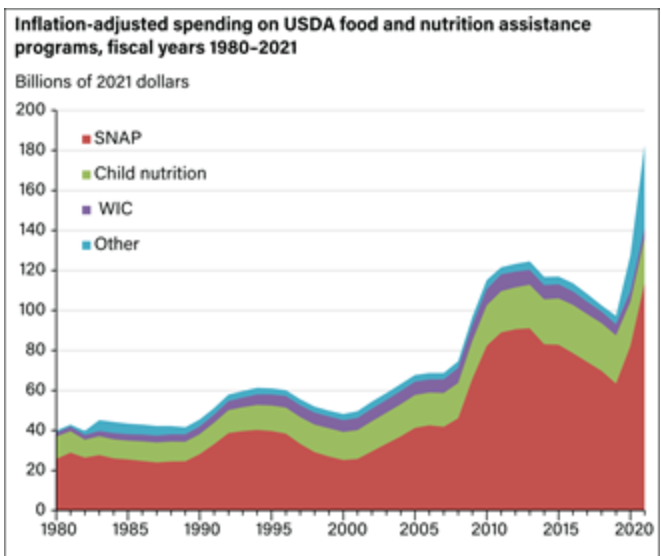
Spending on federal food and nutrition programs had reached approximately $60 billion (2021 dollars) by the time Obama entered office, but then the spending really took off. The spending reached a peak of over $120 billion in 2015 before falling a bit to just under $120 billion by the time Obama left office. Here is a chart of federal food and nutrition program spending from 1980 to 2021, from the US Department of Agriculture:
In an early post on this blog from April 2013, I recounted how the federal government during the Obama administration aggressively recruited people to sign up for the food stamp program.

But Obama was a complete amateur compared to Biden. With the excuse of the Covid-19 pandemic, and the vehicle of his blow-out spending bills, Biden has taken federal food and nutrition spending to incredible new heights. Here is text accompanying that chart from the DOA:

Federal spending on USDA's food and nutrition assistance programs totaled $182.5 billion in fiscal year (FY) 2021, 49 percent more than the previous high of $122.8 in FY 2020. Spending on the Supplemental Nutrition Assistance Program (SNAP) also reached a new high and increased by 44 percent from FY 2020 to FY 2021.

So in just Biden’s first year in office, federal food and nutrition spending soared by some $60 billion, which is about the entire level of such spending at the time Obama first took office less than 14 years ago.

According to the latest from the Census Bureau here, in 2021 there were about 37.9 million Americans deemed to be “in poverty” by the official measure. As discussed here many times, the number of people deemed “in poverty” by the official measure is a wildly inflated figure, ginned up by systematically excluding from the metric well over $1 trillion of annual in-kind distributions from the government, not the least of which is all federal food and nutrition assistance. Still, if you credit this figure of 37.9 million people “in poverty,” it would mean that the federal government in fiscal 2021 distributed some $4815 of food and nutrition aid for each and every one of them, or $19,261 for a family of four.

And now we are told that that enormous generosity by the American people still did not fix the problem. So the White House will hold a new big conference, undoubtedly to give every advocate a platform to come and demand yet more and more spending.

If you’re wondering how it could be possible to spend the incredible sum of $182.5 billion in one year on food and nutrition programs in American without eliminating hunger, one potential answer can be found in the recent series at PowerLine about the Minnesota Feeding Our Future scandal. According to recent federal indictments, scammers in this one incident stole well over $200 million in federal food aid and used it mainly to buy luxury goods and real estate for themselves.

Monday, July 11, 2022

U.N. deletes article on BENEFITS of world hunger

Claims post was 'satirical' after massive backlash


Wednesday, April 21, 2021

Hunger Pays a Heavy Price to Bad Policy

Raising the minimum wage could worsen the problem of food insecurity. 

Craig Gundersen  April 19, 2021 @ City Journal. Published with permission.  I recommend subscribing, it's free. 

The USDA categorized 35 million Americans as food insecure, or having “limited or uncertain access to adequate food,” in 2019—a number that will rise amid the Covid-19 pandemic. Food insecurity is a genuine problem, affecting health outcomes and imposing steep costs. Because higher incomes are associated with lower probabilities of food insecurity, many advocates suggest raising the minimum wage to reduce it. Such calls have received more attention lately, as prominent Democrats call for a national minimum wage of $15. But these advocates are wrong: raising the minimum wage would likely worsen the problem of food insecurity in the U.S.

One group would almost certainly benefit: households with wage-earners currently making the minimum wage. All else held equal, the policy would lead to increases in income and declines in food insecurity for that group. But a wage hike would have other consequences that would generate higher rates of food insecurity among other households and, for that matter, may diminish some of the benefits even for households that see a rise in wages.

Raising the minimum wage affects employment and, consequently, household income. A robust literature shows that increases in the minimum wage lead to declines in aggregate employment, reductions in hours worked, and declines in earnings. Households with individuals who have lost their jobs, seen reductions in hours, or been unable to find work will experience higher probabilities of food insecurity. The negative consequences would be especially acute in areas with low median wages (in many states, the median wage is less than $15 per hour). These happen to be, in the main, counties with already-high rates of food insecurity.

An increase in the minimum wage will also cause prices to rise in industries where a high proportion of workers receives the minimum wage—such as food service. The consequences of this price increase will fall disproportionately on the bottom quintile of earners. Higher food prices mean higher rates of food insecurity.

The argument that most people receiving the minimum wage are poor and, therefore, that raising the minimum wage will help alleviate poverty depends on an inaccurate premise. Almost as many people earning the minimum wage in 2018 had total household incomes over $100,000—20 percent—as did the 23.6 percent with total incomes under $25,000. An increase in the minimum wage would serve to raise the incomes of wealthy households nearly as much as it would raise the incomes of lower-income households.

A wage hike will also have distributional consequences. In response to an increase in the minimum wage, firms would need to make decisions about who will keep their jobs and who will lose them (or not be hired in the first place). As the minimum wage goes up, those with disabilities and criminal records—two groups that already experience high levels of food insecurity—will have an even harder time landing jobs.

Advocates should focus instead on reforming the Supplemental Nutrition Assistance Program, or SNAP. The program has proved successful in reducing food insecurity among recipients. Unlike the minimum wage, SNAP doesn’t discourage work (benefits gradually diminish as incomes increase), doesn’t interfere with the success of our agricultural supply chain, has no demonstrated effect on prices, and assures that benefits go to those who need them. Raising benefit levels by about $160 per month would cut food insecurity by up to 60 percent among SNAP recipients. Expanding eligibility to the millions of households that are near-eligible for SNAP but are food insecure because of raised income thresholds could further reduce it. And cutting the tax associated with SNAP—currently, for each additional dollar of earned income, benefits fall by about 24 cents—would lead to increased incentives for work and higher SNAP benefits per recipient.

Food insecurity remains a leading indicator of well-being in the U.S., and reducing it is an important goal. Increasing the minimum wage is a policy that will do the opposite.

Photo by Scott Olson/Getty Images


Saturday, April 10, 2021

A Look Into New York Times-Think On "Food Relief"

April 07, 2021 @ Manhattan Contrarian

Several years ago I would make a practice about once every few weeks of ridiculing some New York Times article or other. More recently, as Pravda has increasingly abandoned any pretense of being a news organization in favor of pure political advocacy, I haven’t bothered. But every once in a while, it is worth looking at one of their pieces to get some insights into how the progressive brain works.

For today’s lesson, I select the article that appeared at the top right on the front page of the print edition on Monday April 5. (Top right of the front page would be the article that they designated as the most important “news” piece of the day.) The headline of this one is “Many Need Food, Energizing Push To Expand Relief.” The byline is Jason DeParle.

Have you heard of DeParle? He has been writing for the Times for several decades, since at least the late 1980s. His bio says that he “has written extensively” about “poverty and immigration.” Surely, if there is anybody who knows the basics about these subjects, it would be this guy. The bio also says that he has been “a two-time finalist for the Pulitzer Prize.” OK, it must be eating away at him that all his colleagues win the Pulitzers and he still doesn’t have his; but then too, they don’t nominate just anybody.

The subject of this article fits under the “poverty” category of DeParle’s beat, rather than immigration. It is a given that this article will be an exercise in political advocacy. That is not why we are looking at it. We are looking at it to try to understand this fundamental issue: Is DeParle, after covering “poverty” for the Times “extensively” for over 30 years, still completely ignorant about the subject? Or, alternatively, is he intentionally misrepresenting the facts in order to deceive the readership for his noble cause? I think it has to be the second, but honestly, I don’t fully know the answer. So I’ll have to let you be the judge.

Let’s start with the first sentence of the article:

With more than one in 10 households reporting that they lack enough to eat, the Biden administration is accelerating a vast campaign of hunger relief that will temporarily increase assistance by tens of billions of dollars and set the stage for what officials envision as lasting expansions of aid.

More than one in ten U.S. households report that they “lack enough to eat”? Really??? I follow the data on this subject very closely, and I have never seen such a thing, certainly nothing relating to the current time period. Have you? What could this guy possibly be talking about?

As is typical in these Pravda advocacy pieces, DeParle cites no source and gives no clue what he is talking about. Could he be referring to the Department of Agriculture’s (DOA) notoriously fraudulent “food insecurity” surveys? A quick check indicates that this has to be his authority. From the website of the DOA’s Economic Research Service:

In 2019, 89.5 percent of U.S. households were food secure throughout the year. The remaining 10.5 percent of households were food insecure at least some time during the year. . . .

That certainly fits with DeParle’s “more than one in ten.” Looking even a little deeper, we find that the DOA’s “food insecurity” statistic comes from the answer to this question on a survey: “We worried whether our food would run out before we got money to buy more.” Was that often, sometimes, or never true for you in the last 12 months?

So here is the progression: The DOA asks people if they ever “worried,” even once in 12 months, about whether their food would run out before they got more money to buy more. The DOA then reports anybody who says they ever “worried” about that subject even once in a year as being “food insecure.” And DeParle takes that and transforms it into they “lacked enough to eat,” without ever mentioning the source, or that nobody ever said they “lacked enough to eat” or anything close to that.

The background here is that the DOA has a profusion, indeed a cornucopia, of food distribution programs; but almost all of them work by passing out a monthly benefit card where the beneficiary needs to manage the budget to last until the end of the month. Some people just aren’t very good at managing a monthly budget. The result is that literally no amount of distribution of these cards can make it so that nobody ever blows through the budget before the end of the month, or at least worries that they might once during a year.

If you don’t believe me that there is already a cornucopia of food distribution programs, then you may not know much about this subject. That’s OK for you, but not for DeParle, who as we have seen has been covering this subject “extensively” for decades. Check out this web page of the DOA’s Food and Nutrition Service

Food stamps, nowadays known as SNAP, is the main program that you have probably heard of. But that’s just one of four big categories of DOA food assistance programs, the other three categories being the “Women, Infants and Children’s” Programs, the “Child Nutrition” Programs, and the “Food Distribution” Programs. Within those additional categories we have the Farmers Market Nutrition Program, the Senior Farmers Market Nutrition Program, the Special Supplemental Nutrition Program for Women, Infants and Children (WIC), the Summer Food Service Program, the National School Lunch Program, the Special Milk Program, the School Breakfast Program, the Team Nutrition Program, the Fresh Fruit and Vegetable Program, the Community Food Systems Program, the Child and Adult Care Food Program, the Food Distribution Program on Indian Reservations, the Commodity Supplemental Food Program, the Emergency Food Assistance Program, and the USDA [DOA] Foods in Schools Program.

That’s just what we’ve had up to now. By my count there are seventeen of these things. And yes, according to DeParle (and apparently the Biden administration), that incredible profusion of programs has been leaving some 10+% of Americans “lacking enough to eat.” If that’s true, it would seem to be one of the most incredible bureaucratic disasters in human history. Shouldn’t all the people involved get fired for rank incompetence? How is it even possible to fail so completely with so many resources at hand?

In any rational organization, the next step would be to hold the current people accountable, and restructure the existing services to use the resources at hand to actually accomplish the mission. But then, this is the government, and that’s not how it’s done. Abject failure is the basis to go back and double down with massive new spending given to the same incompetent bureaucrats so that they can continue to fail. So now, DeParle reports, the Biden administration will embark on a vast new “effort to rush more food assistance to more people” that is “notable both for the scale of its ambition and the variety of its legislative and administrative actions.” Among the new and expanded initiatives will be “increas[ing] food stamps by more than $1 billion a month, provid[ing] needy children a dollar a day for snacks, expand[ing] a produce allowance for pregnant women and children, and authoriz[ing] the largest children’s summer feeding program in history.”

Let’s get a comment from some left-wing advocate of these things:

“We haven’t seen an expansion of food assistance of this magnitude since the founding of the modern food stamp program in 1977,” said James P. Ziliak, an economist at the University of Kentucky who studies nutrition programs. “It’s a profound change.”

Surely, then, by a year from now the addition of all these new programs and all this new spending will have finally solved the problem of hunger in America.

Of course not. A year from now, they will take another “food insecurity” survey. The result will be that the same 10 or 12% of respondents will report that they felt “food insecure” at least once during the year. The benefits may have expanded, but the beneficiaries didn’t get any better at managing the budget to last through each month.

And the bureaucrats at the DOA will be back again seeking yet further increases in their budget and staffing for yet another round of new “nutrition” programs, none of which will ever change the results of the “food insecurity” surveys. Indeed, as I wrote in this post back in 2014, the whole point of the “food insecurity” metric was to create something that would be completely impervious to going down no matter how many programs were created and how much food was distributed. The American people are good-hearted and generous, and when told that people “lack enough to eat,” they will not seek to deny those people enough food. They can’t be expected to know the already-existing list of seventeen food distribution programs that somehow have been unable to solve — or even reduce — this “food insecurity” thing. And once again they will get duped.

And DeParle? Could he really not know that the “food insecurity” metric is not a measure of people who “lack food” or are “hungry”? I think he has to know that, and he is intentionally deceiving his readers. Then again, we have every reason to believe that he is not very bright. Perhaps he has himself been duped? You will have to be the judge.

Meanwhile, it’s just another one of the Biden administration spending programs of tens of billions of dollars, maybe every year forever, none of which will ever be allowed to solve or even reduce the supposed problem at hand. But the bureaucracies and the dependent classes will mushroom.


Thursday, August 27, 2020

Hungry New Yorkers form quarter-mile line for free food in Queens

Melanie Gray and Georgett Roberts August 22, 2020 

The line stretched a quarter-mile before the sun was barely up Saturday, snaking around corners like bread lines in the 1930s. But the hungry in Queens are today’s New Yorkers, left jobless by the coronavirus.  Until the pandemic struck the city, La Jornada food pantry used to hand out groceries to roughly 1,000 families a week. Now, the figure tops 10,000. And volunteers serve lunch every day to 1,000 — many of them kids with growling stomachs. Across the five boroughs, the hungry number in the hundreds of thousands, the Food Bank of New York estimates.

“It reminds me of the picture from the Great Depression where a man in a suit and tie is giving another man in a suit and tie an apple. That’s all he had,” La Jornada’s Pedro Rodriguez told The Post. “We give all we have, but that’s not enough.”  Seniors, moms and kids, singles — many immigrants from China and Mexico — wait for hours. They turn out in droves wherever, and whenever, the food pantry’s truck shows up............To Read More.....

My Take - And a man named Warren Wilhelm, later know as Warren de Blasio-Wilhelm and finally to Bill de Blasio wanted to do for the United States what he was doing for NYC. Imagine that!