Search This Blog

De Omnibus Dubitandum - Lux Veritas

Showing posts with label Illinois. Show all posts

Tuesday, February 18, 2025

Can America’s Unluckiest Residents Escape Illinois without Moving?

February 15, 2025 by Dan Mitchell @ International Liberty

As part of my continuing comparisons of blue states and red states, I’ve written several columns comparing New York and Florida, and I’ve done the same thing with Texas and California.

I was thinking of doing something similar for Illinois and Indiana.

After all, these neighboring states starkly illustrate the difference between bad governance and good governance.

And the gap is apparent when looking at state rankings.

But instead of simply comparing Illinois and Indiana, I want to use the two states as a springboard for a discussion about secession.

But not the bad version of secession like the U.S. experienced in 1861.

Instead, we’re going to discuss a good version, specifically the effort by some counties to secede from Illinois and join Indiana.

This is not a trivial effort. As shown by this map, 33 counties in the Prairie State have explicitly voted to leave Illinois.

The effort has even attracted the attention of the Wall Street Journal.

Here are some excerpts from an editorial last week.


…the difference between good and bad governance is coming into sharper relief for voters. Enough people are noticing in Illinois that some counties want to secede from the Land of Lincoln and join a state that isn’t ruled by public unions and their political yes-men. …Indiana House Speaker Todd Huston says the Illinois counties would be more than welcome to come on over. On Jan. 14 the Republican introduced legislation to establish the Indiana-Illinois Boundary Adjustment Commission, which would include five members appointed by the Indiana Governor and five members appointed under Illinois law, to discuss moving the state line. …Illinois Governor J.B. Pritzker called the secession idea a “stunt”… Mr. Pritzker is essentially claiming the superiority of his welfare-state, public-union governance model. But fewer people are buying it. …Illinois saw the third highest state out-migration of people in the country, according to census data from October 2024. The state lost 93,247 residents in 2023, after losing 116,000 in 2022 and 141,000 in 2021. Indiana gained 30,000 residents in 2023.

It’s almost an understatement to say that people are fleeing Illinois.

There are many reasons, some of which are shown in this table that was part of the WSJ editorial.

The moral of the story is that Illinois is an unfriendly place for people who are productive.

Many of the problems in Illinois are the result of the state being dominated by one of the worst-governed cities in America. So it’s understandable that many downstate residents are moving.

But wouldn’t it be nice if they could simply stay where they are and instead become part of a well-governed state?

As the late, great Walter Williams wrote, secession is a great way of helping people escape oppression.

P.S. I wrote back in 2015 about how some people in Sardinia want to secede from Italy and join Switzerland. And imagine how many lives could have been saved if people followed my 2014 advice about Ukraine and secession.

Friday, December 15, 2023

DC and California Going Broke Fast

What's the common denominator?

by | Dec 15, 2023 @ Liberty Nation News

The fiscal year just started, and the US government is already running a massive budget deficit. In November, the federal shortfall was a larger-than-expected $314 billion, fueled by a 17% increase in spending. In only the first two months of FY 2024, the gap totals $381.5 billion, thanks to huge outlays for Social Security, Medicare, national defense, and interest payments. Washington’s river of red ink and IOUs stretches across the nation, including into one of the largest states in the country: California.

Budget Deficit in California

GettyImages-1796587831 Gavin Newsom

Gavin Newsom (Photo by Liu Guanguan/China News Service/VCG via Getty Images)

While California Gov. Gavin Newsom (D) proved to the nation during his debate with Florida Gov. Ron DeSantis (R) why his state is a mess, the latest figures confirm what many already know: The Golden State is being sucked into a fiscal black hole. The non-partisan Legislative Analyst’s Office (LAO) confirmed on Dec. 8 that the state’s budget deficit soared to an all-time high of $68 billion, driven by shrinking tax revenues. This topped the June estimate of a $14.3 billion shortfall.

State budget analysts warn that California will need to address the ballooning deficit. This could involve using its $30 billion cash reserves, employing one-time spending cuts, and adjusting how it funds education and other generous social programs. However, all of these options could be short-term solutions, as the LAO forecast that California could face annual budget deficits of $30 billion for the next few years.

The good news for Newsom is that California is not facing a crisis. LAO official Gabriel Petek told reporters: “The state remains in a good cash position, and that really wasn’t the case back at the start of the Great Recession. We don’t face the same kind of liquidity challenges that we had at that time, and so I would stop short of describing it as a crisis.” At the same time, massive budget deficits suggest that the state needs to be more cautious moving forward, says California Senate President Pro Tem Toni Atkins. She told Politico that “we’re going to have to slow down over time,” pertaining to existing and new spending. But will Gavination decelerate its expenditures? Unlikely.

Other States in the Red

The Golden State isn’t the only one facing an immense budget deficit. In fact, nine others are enduring long-term fiscal imbalances, including Connecticut, Illinois, Massachusetts, New Jersey, and New York. This has been driven by governors and legislative chambers overpromising, overspending, and underdelivering for years without any respite.

More could be joining the list soon, including Minnesota, which is forecast to see a shortfall of $2.31 billion in the 2026-27 fiscal years. Mark Koran, a GOP senator in North Branch, summarized the situation in a recent statement following the Office of Minnesota Management and Budget’s economic projection:

“In only one session, single-party Democrat control of government has taken us from a $19 billion surplus to a projected $2.31 billion deficit in the near future. Their record of reckless overspending, massive tax increases, broken tax relief pledges, and now looming deficits are simply not sustainable. At the same time, inflation continues to put pressure on family budgets every month. Minnesotans cannot afford Democrats’ irresponsible governing any longer.”

Sorry, Cheney, Deficits Do Matter

Former Vice President Dick Cheney famously said that “deficits don’t matter.” This Republican mantra was shared shortly before former President George W. Bush declared that the United States needed to sacrifice free-market principles to save the free market. Democrats might not be so blunt in their support of debt and deficits, but their actions, whether at the state or federal level, show that they also lack the ability to balance the books. Since arriving at the White House in 2021, President Joe Biden has overseen the national debt soaring by approximately $7 trillion while recording some of US history’s largest deficits. Many experts have warned of the growing consequences of fiscal irresponsibility, but with interest rates at their highest levels in more than two decades, budget deficits being the new normal might breed a fiscal crisis.

 Tags: Articles, Business News, Opinion

 
Read More From Andrew Moran

Tags: Articles, Business News, Opinion

Thursday, November 2, 2023

Update from Illinois’s ‘EV coordinator’ reveals new dirty details of ‘green’ scam

November 1, 2023 By Olivia Murray

We all know the “green” agenda is a scam, thanks to a number of dead giveaways: the “rules for thee, but not for me” hypocrisy from the political aristocracy; the “more taxes = better weather” schtick (whatever “better” weather actually is); the willingness of its activists to ignore ecological annihilation for the agenda; and the constantly changing narrative about what this dystopian future actually looks like—is it supposed to be too hot or too cold, because I can’t keep up with the flip-flopping.

But just this morning a longtime friend of American Thinker, Peter von Buol shared a story that shed additional light on the movement, and provided new dirty details; from an article published by The Center Square yesterday:............To Read More....

The DNC’s 2024 Convention City is Drowning in Illegal Aliens

November 02, 2023 @ Sultan Knish Blog 

When officials of the donkey party toured Chicago last month in preparation for the 2024 convention, no one wanted to talk about the elephant in the city. The 100 Democratic Party delegates got a tour of the massive United Center arena which is also about the one building in the city that isn’t overrun with hordes of illegal aliens.

With an estimated 1,250 migrant invaders arriving by bus every day, they’re sleeping on the floors of every police station and over 800 of the illegals are staying at O’Hare Airport. In a city where winter temperatures can fall into the negative teens, the administration’s only plan to cope with the human tide is to put up ‘winterized’ tent camps in city parks and other areas.

These giant tents might house as many as 1,000 of the illegal invaders each.

But despite the massive 960,000 square feet of space in the United Center arena, no one is talking about utilizing it to house the illegals. That would not only displace Dave Chappelle and the Wu Tang Clan, it would also be poor optics for the 2024 Democratic National Convention.

But while party delegates are planning for their big shindig in the Windy City, Mayor Brandon Johnson, the radical leftist who ran on a platform of keeping Chicago a “sanctuary city” and extending “this sanctuary promise to everyone who needs it in our city – both long-time residents and newcomers alike” is heading to the border to get more “information”.

Meanwhile Cristina Pacione Zayas, his deputy chief of staff, assured reporters that the migrant tent cities in sub-zero weather “are not concentration camps”. The first rule of public relations is that if you’re a pro-illegal alien progressive and you have to deny that you’re building concentration camps for illegal aliens, something has gone terribly wrong.

The desperate new leftist administration turned to Aegis Defense Services: a British-Canadian private military contractor that used to handle security for the U.S. embassy in Kabul, to set up the tent cities. Chicago is no longer just Chiraq, it’s also Chifghanistan.

Gov. Pritzker, once a strong ally of Biden, has proposed dumping the illegal aliens in federal buildings. He also dispatched a letter to Biden warning that “the federal government’s lack of intervention and coordination at the border has created an untenable situation for Illinois.”

While the future home of the DNC 2024 convention remains off-limits, Chicago has been taking over schools and parks, and closing day care centers, to accommodate the endless invasion.

And Chicagoans are mad as hell.

In Galewood, African-American residents blasted Johnson over plans to turn over a park to the invaders.

“You want to take the little scraps of resources we have and put us at the bottom of the barrel? That’s not fair!” one woman argued. “A lot of these young boys, they don’t have fathers so a lot of these coaches, they are their fathers. They spend part of their weekend here along with during the week, that keeps them in a safe place, it gives them mentorship, it shows them discipline.”

In Woodlawn, black residents had tried to block migrant buses with their bodies. In South Shore, a former director of equity and diversity consultant, along with other community activists, filed a lawsuit to stop a school from being used to house illegal aliens. On the West Side, furious residents complained that day care, pre-school and senior activities were being canceled to make way for the invaders. And that’s been the case across much of an overrun city.


Chicago’s crisis is not so different from that of New York and other cities suffering under the horde that had been allowed to cross the border and penetrate the country, but it’s a particularly big problem for a place that will be used to showcase the accomplishments of Joe Biden.

And of the Democratic Party.

In 10 months, Democrat delegates from all over the country will converge on Chicago’s hotels, walk its streets, duck into its bars and patronize its prostitutes. But some of those hotels, like the Inn of Chicago on the Magnificent Mile (“a contemporary, modern destination hotel for leisure and business travelers”), are filled with migrants. Those migrants will eventually have to be booted to make way for the DNC delegates who won’t want to share their drugs with illegals.

The sight of migrants panhandling in the nicer areas in Chicago has become routine. Others have been arrested for quickly acclimating and joining the local criminal economy. A migrant was busted for threatening pedestrians with a knife, there are serial shoplifters roaming the city, and migrant drug use and violence is not uncommon.

“They disrespect us; they rob us; they harass us!” one woman complained.

The invasion has achieved the seemingly impossible of making Chiraq or Chifghanistan even more dangerous than it was before. And that’s a problem.

2024 might be the first time that Democrats end up with fewer delegates than they started with.

Biden’s decision to ram open the border and funnel the invaders into America might have long-term political advantages for the Democrats, but in the short-term it’s alienating even his base in New York, Chicago and other overrun cities. All of this will be on display in 2024.

Democrats are already worried that Republicans will disrupt the DNC convention by busing more illegal aliens to Chicago during August 2024. And no one has a plan to deal with that.

Mayor Brandon Johnson, an incompetent racist, has no plan except to blame it all on racism.

“There is a different standard that I’m held to. There is,” Johnson whined. “And that’s not something that I’m mad at, but that’s just the reality. I’m not the first person of color, particularly a black man, that will be held to a different standard than other administrations.”

Except that most of the people mad at Johnson are the black voters who put him in office.

Gov. Pritzker demanded to know why the mayor of El Paso, a Democrat, was sending migrants to Chicago and not to Idaho. 

“I think that the mayor of El Paso needs to listen to the cities that he’s sending folks to and to start thinking about whether or not this ought to be spread across the country. Why is he not sending anybody to Idaho, Wyoming?”

That might be because the population of both states combined just about equals Chicago. Illinois declared itself a sanctuary state and Chicago declared itself a sanctuary city. And busing migrants to Chicago is a much more workable plan than busing them to the middle of a field. Finally, none of the invaders want to go to Boise or Laramie, there’s better welfare in Chicago.

Nobody in Illinois or Chicago has a plan to deal with the problem. And, fresh off facing woke controversy for hiring the same company that Gov. DeSantis had been using to transport migrants to California to put up giant tents, Mayor Johnson headed to the border. Why?

Johnson claimed that he’s going to the border “to assess the full situation, and that also requires our team to be at the border.” The situation is that the border is open and the invasion is on.

To his credit, Mayor Johnson blamed the situation on the “failure of federal policies”, joining even more pointed criticism from Mayor Eric Adams of New York City. While the Biden administration has blasted Adams, it would be awkward for it to be warring with the host mayor of its convention. And yet that is exactly the politically dysfunctional trajectory that Biden is on.

Biden’s open border policies have created a feud with the mayors and governors of major Democrat strongholds whose support and allegiance should have been unquestioned. Now the DNC is preparing to hold its convention in a state and city that is turning hostile to Biden, and whose misery will showcase the consequences of the party’s immigration policies.

And after 10 months of 1,250 migrants arriving a day, Chicago could be drowning in a third of a million illegal alien invaders. And by then the only place to put them all will be the DNC.  

Daniel Greenfield is a Shillman Journalism Fellow at the David Horowitz Freedom Center. This article previously appeared at the Center's Front Page Magazine.Click here to subscribe to my articles. And click here to support my work with a donation. Thank you for reading.

Wednesday, July 12, 2023

Illegal Aliens as Police Officers? Blue State Dems Says Yes

The irony of giving law enforcement credentials to people who already broke the rules. 

By Sarah Cowgill July 11, 2023 @ Liberty Nation News

Trailblazing for progressives, Illinois House and Senate legislators have passed House Bill 3751 and sent it to Gov. JB Pritzker’s sturdy desk for final signature. The bill will allow Deferred Action for Childhood Arrivals — DACA — “to apply for positions as police officers, deputy sheriffs, or special policeman.” But the governor seems paralyzed to make it official: It’s been in limbo since mid-June.

Supporters of DACA individuals see this as a way to engage immigrants in the process of American law, but opponents don’t want undocumented people running about with firearms and policing citizens.

Gun Grabbers Giving Aliens Guns?

“I just want a small door (open) for a certain group of people to be able to carry a gun. I’m not saying all undocumented people. I’m just saying if you apply and you are accepted, let’s give you a chance to own, to carry or possess a gun,” the measure’s Democratic sponsor Rep. Barbara Hernandez said. “And maybe what the federal government can say is once you retire, or once you’re out of the job for whatever reason, you don’t have that ability anymore.”

Of course, no one can agree on who should be able to carry a firearm in the United States. On the Alcohol, Tobacco, and Firearms (ATF) site is a plain-as-day warning: “The Gun Control Act (GCA), codified at 18 U.S.C. § 922(g), makes it unlawful for certain categories of persons to ship, transport, receive, or possess firearms or ammunition, to include any person: who is an illegal alien.”

“Unfortunately, it’s strictly symbolic,” state Rep. John Cabello, a Republican and detective with the Rockford Police Department, said of the bill. “It doesn’t do anything until the feds do something about the federal law.”

And there is the rub: What’s the point? Viewed from a different angle, why do so many progressive Democrats want to implement gun control restrictions on Americans while trying to arm undocumented people? Seems counterproductive at best.

In this weird start to the 2024 election showdown, is Illinois simply trolling for progressives’ votes and following lockstep with a West Coast sanctuary state and East Coast municipality: California and the District of Columbia?

They Did It for DACA

Hernandez admits she got the idea from California, one of several states that have passed similar legislation. Gov. Gavin Newsom signed a law that requires aliens and DACA folks to have only a work permit in the United States to join the force. The revised law reads as such:

“The bill would remove the provision that requires peace officers to either be a citizen of the United States or be a permanent resident who is eligible for and has applied for citizenship and would instead  require peace officers be legally authorized to work in the United States and make conforming changes.”

The District of Columbia also implemented similar changes to its Comprehensive Policing and Justice Reform Amendment Act of 2022. It needs police and hopes that DACA folks will want to swell the ranks, which could fast-track citizenship.

“As an agency, we truly believe that a workforce representing our community brings various ideas, experiences, and perspectives. Together, this blend drives innovation and growth,” said interim Chief of Police Ashan Benedict.

The city is down to only 3,400 metro police. The goal is 4,200 in 10 years: A nice carrot of $25,000 is offered as a signing bonus to get there.

Undoubtedly, all Democratic calls to de-fund the police have taken a toll. Now it’s time to fund DACA recipients to choose a career in law enforcement. And Illinois seems to be okay with this new program.  Blue Island Police Chief  spoke at the General Assembly in Springfield, revealing he had one DACA recruit and was hoping for more. “It, at times, is difficult to provide the services to the community without being able to communicate with them,” Farr said. “It’s important that the Police Department reflects the makeup of the community, and what better means do we have than to recruit Hispanic officers.”

The pleas from law enforcement had both sides of the political divide agreeing to push the legislation forward and encourage Pritzker to sign it into law.

What you may not know about the Illinois State Assembly is that even if Pritzker washes his hands and vetoes the bill, Democrats in both chambers can override the governor with supermajority power. And that will give 30,000 DACA recipients in Illinois a big checkmark in the American Dream column.


Read More From Sarah Cowgill

Thursday, June 8, 2023

Disgustingly Hypocritical Politicians in Illinois

There are two astoundingly hypocritical groups in the United States.


Since I’m a fiscal economist, I should be most upset about the first group, but I actually find the second group to be more nauseating.

I want to focus on that latter group because a small school choice plan recently was eliminated in Illinois and the Wall Street Journal opined on that reprehensible development.


Unions want to kill the program because its popularity showcases the failure of the public schools. Invest in Kids had more than 31,000 applications last year, roughly five students for every scholarship it could provide. Every family lined up for a place at a private school is an indictment of a union monopoly that continues to prioritize its power over student learning. Nowhere is this more pronounced than in districts with low-income families. Black and Hispanic families support the scholarship program in large numbers because they often have children assigned to Illinois schools where less than a third of students are proficient at reading or math… The measurable educational shortfalls continue from fourth to eighth grades, consigning young people to failure before they even reach high school. But don’t trouble the unions with this mass betrayal of minority children.

The elimination of this tiny school choice program is a tragedy.

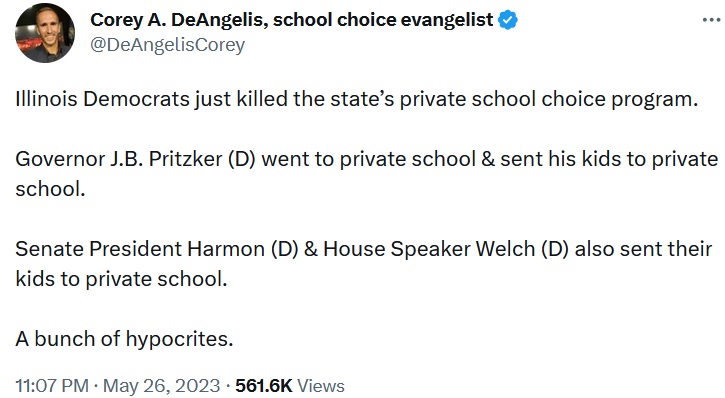
The fact that it was killed by politicians who send their own kids to private school is disgusting.

And why did the top legislators in Illinois decide to deny educational opportunity to poor families?

The WSJ editorial hints at the answer.

Messrs. Harmon and Welch have each had their political careers funded by more than $1 million in contributions from the state’s teachers unions.

What awful people. I wonder how they can sleep at night.

P.S. While the news from Illinois is depressing, the good news is that school choice is spreading elsewhere, with West VirginiaArizonaIowaUtahArkansasFlorida, Indiana, and Oklahoma all adopting universal or near-universal policies over the past three years.


Friday, February 24, 2023

Not a Single Student Can Do Math at Grade Level in 53 Illinois Schools

And no student can read at grade level in 30 Illinois schools.

Ted Dabrowski and John Klingner, February 14, 2023

Spry Community Links High School, in the Heart of Little Village in Chicago, says its vision is to “provide a challenging and supportive environment…to enable our students to succeed in the 21st century.” Number one on the school’s focus list? “Increasing reading and math scores to or above grade level.” But a look at state data that tracks reading and math scores for each Illinois school reveals two frightening facts about Spry. Not a single one of its 88 kids at the school can read at grade level. It’s the same for math. Zero kids are proficient.

Spry is one of 30 schools in Illinois where not a single student can read at grade level. Twenty-two of those schools are part of the Chicago Public Schools and the other eight are outside Chicago.  The failure list in math is even longer. There are 53 schools statewide where not one kid is proficient in math.....To Read More..


Monday, July 25, 2022

Whose problem now?


Friday, June 24, 2022

Illinois and Fiscal Suicide, Part I

June 23, 2022 by Dan Mitchell  @ International Liberty / Illinois and Fiscal Suicide, Part II

I wrote a couple of days ago about California’s grim future.  But now I’ll share some good news. No matter how bad California gets, the Golden State probably won’t have to worry about people and about people and businesses fleeing to Illinois.


That’s because the Prairie State is an even bigger mess. If California is committing “slow motion suicide,” Illinois is opting for the quickest-possible fiscal demise.  

Politicians in Springfield (the Illinois capital) have a love affair with higher taxes. A very passionate love affair.  But the state’s productive people have a different point of view. More and more of them have been escaping.

And they are now being joined by the state’s most-famous company, as Matt Paprocki of the Illinois Policy Institute explains in a column for the Washington Post.


When Boeing announced last month that it was moving its headquarters from Chicago to Arlington, Va., it sent shudders through the Illinois business community and state capital. But last week, when the heavy-equipment manufacturer Caterpillar said it was moving its headquarters to Texas, it felt more like a bulldozer ramming into the news. …If you’re an Illinois business owner or resident, as I am, the economics of staying are tough and the enticements to move away are many. …According to the U.S. Census Bureau, last year the state had the third-largest loss of residents due to domestic migration in the nation (-122,460), trailing only California and New York.

It’s easy to understand why people and businesses are leaving.

In 2017, Illinois lawmakers raised the personal income tax rate to 4.95 percent, from 3.75 percent, and hiked the corporate rate to 7 percent, from 5.25 percent. When J.B. Pritzker took office as governor in 2019, he passed another 24 tax and fee hikes costing taxpayers over $5 billion. …With 278,475 regulatory restrictions and requirements — double the national average — Illinois has the third most heavily regulated environment in the country. …Illinois owes over $139 billion in state pension debt as of last year, and local governments owe about $75 billion, which is the primary driver for Illinois’ spiraling property taxes, second-highest in the nation.

Mr. Paprocki offers all sorts of suggestions for reform, including a spending cap.


But the chances of pro-growth reform are effectively zero. The governor is a hard-core leftist (as well as a hypocrite) and the state legislature is controlled by government employee unions.

So if you’re hoping for a TABOR-style spending cap, there’s little reason to be optimistic.

And if you’re hoping for reforms that will improve the state’s “least friendly” tax climate, don’t hold your breath.

Illinois and Fiscal Suicide, Part II

Yesterday’s column discussed Caterpillar’s decision to move its headquarters from high-tax Illinois to low-tax Texas.


Today, we have more bad news for the Prairie State.

A major investment fund, Citadel, also has decided to leave Illinois.

Is the company moving to a different high-tax state, perhaps California or New York? Maybe Connecticut or New Jersey?

Nope. Citadel is going to Florida, a state famous for having no income tax.

The Wall Street Journal opined this morning about Citadel’s move.


The first step to recovery is supposed to be admitting you have a problem. But Illinois Gov. J.B. Pritzker still won’t, even after billionaire Ken Griffin on Thursday said he’s moving his Citadel hedge fund and securities trading firm to Miami from Chicago. …Meantime, Democrats in Springfield continue to threaten businesses and citizens with higher taxes… It’s no wonder so many companies and people are leaving, and mostly to low-tax states. …In 2020, $2.4 billion in net adjusted gross income moved to Florida from Illinois, about $298,000 per tax filer. …Mr. Griffin has spent tens of millions of his personal fortune trying to rescue Illinois from bad progressive governance. Maybe he figures it’s time to cut his losses.

Other (former) Illinois residents cut their losses last decade.

Scott Shackford of Reason shared grim data at the end of 2020 about the ongoing exodus from Illinois.


For the seventh year in a row, census figures show residents moving out of Illinois in significant numbers. …Perhaps demanding that your excessively taxed residents give the government even more money is not the best way to keep those residents in your state… Over the course of the last decade, Illinois lost more than a quarter-million people…not even California…has seen Illinois’ population loss. …Government leaders have responded not with better fiscal management (the state’s powerful unions blocked pension reforms), but with more taxes and fees, even as residents leave.

The bottom line is that Illinois is currently losing people and businesses.


Just as it lost people and businesses last decade.

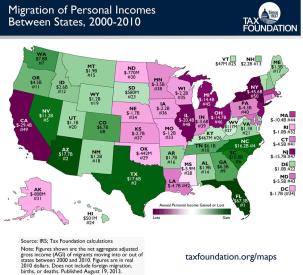
And you can see from this map that taxpayers also were fleeing the state earlier this century.

I’m guessing the state’s hypocritical governor probably thinks this is a good thing because the people who left probably didn’t vote for tax-and-spend politicians.

But that’s a very short-sighted viewpoint.

After all, parasites need a healthy host. If you’re a flea or a tick, it’s bad news if you’re on a dog that dies.

As Michael Barone noted many years ago, that’s a lesson that Illinois politicians haven’t learned.

Thursday, October 14, 2021

Exclusive insight from the Illinois Policy Institute

This edition of The Policy Shop is brought to you by Adam Schuster, senior director of budget and tax research.

Chicago Mayor Lori Lightfoot shared her budget proposal last month. Now what? City council members now have until Dec. 31 to pass a budget for the city.  City council members now have until Dec. 31 to pass a budget for the city.  Here’s the skinny of what Lightfoot proposed and what Chicagoans and the city we love are up against.
 
Finances are so shaky in Chicago that, even with an infusion of $3.5 billion in federal aid, the mayor still included a $76.5 million property tax hike. That increase comprises $22.9 million in automatic increases after Lightfoot pushed for tying property taxes to inflation last year, $25 million for debt service on bonds for Lightfoot’s $3.7 billion infrastructure plan, and $28.6 million from new property. After deducting new property, the $47.9 million discretionary levy increase would raise property tax bills by an average of $72 to $180 depending on the neighborhood. 

We’re from the government and we’re here to help
 
Seriously, with city officials receiving billions of dollars in federal aid, how are Chicagoans facing a property tax hike? Business leaders don’t get it.
 “With the historic level of federal funding coming to the city we can avoid a property tax increase that impacts all residents and businesses.” – Chicagoland Chamber of Commerce. 
 
The business community is right that a property tax increase is unnecessary considering the $3.5 billion in pandemic-related federal aid. Lightfoot’s proposed budget uses $782 million in federal funds to replace 2021 revenues, $385 million for 2022, and reserves $152.4 million for 2023 revenue replacement. That leaves roughly $581 million in flexible aid currently dedicated to new program spending. The property tax hike could be prevented by using just 2.5% of Chicago’s $1.9 billion in American Rescue Plan funding. 
 
Moreover, while U.S. treasury rules prohibit states from using aid to directly or indirectly offer tax relief, this prohibition does not apply to cities. Lightfoot has the greenlight to help overburdened homeowners, if she wants to. 
 
Spin cycle: No new taxes
 
In her budget address, Lightfoot emphasized that her budget proposal achieves balance “without any new taxes, no reduction in city services, and no layoffs.” Similarly, a press release from the mayor’s office claims the budget has “no new tax or significant fee increases for our residents.” Lightfoot claims the $74.5 million property tax hike doesn’t count as a tax increase because automatic annual inflation increases and the increase for infrastructure were approved last year, but this argument is political spin. The bottom line is that city property owners will pay higher property tax bills next year.
 
Lightfoot could have proposed to use the federal aid to undo last year’s property tax increase, which hit during a pandemic and related economic downturn. This would meet the American Rescue Plan’s goal to “support immediate economic stabilization for households and businesses.” Stopping this year’s tax hike would not require cutting anything, just slightly scaling back some of the new spending.  Taking a small portion from each of the larger new line items could prevent the tax hike while still leaving hundreds of millions of dollars more for Lightfoot’s “community priorities” such as youth job training and affordable housing. 
 
A smaller tax increase is still a tax increase
 
How does this $74.5 million property tax increase compare with recent years?

Still, it is an increase and would add an unnecessary burden to a city economy still recovering from COVID-19. (Did we mention it was also unnecessary given the city is sitting on $3.5 billion in federal aid?!)
 
Illinois’ pandemic restrictions, as well as $655 million in state tax hikes pushed in Gov. J.B. Pritzker’s budget this year, have together contributed to the struggle for Illinois’ businesses to create jobs for workers as fast as the rest of the nation. The state’s unemployment rate remains 35% higher than the national average. Piling on even modest additional tax hikes on Chicago residents and businesses will mean fewer jobs and lower wage growth for residents as the economy recovers from the COVID-19 recession. 

Temporary revenue can’t fund permanent programs 

The budget increases spending by roughly $1.2 billion on a range of city services from the Chicago Police Department, affordable housing, and mental health services to a pilot program for a universal basic income. Unfortunately, that spending is propped up by one-time federal aid that expires by 2024, meaning many programs will have to be cut or financed with significant tax hikes within just two years. > If Lightfoot wants to live up to the rhetoric in her budget address – in which she promised to invest in Chicago’s economic recovery while giving predictability and stability to taxpayers – she needs to develop and execute a plan to match revenues and expenses long-term. Only a long-term balanced budget can give city residents confidence programs will continue and taxes will remain affordable.
 
The elephant in the room 
 
Despite calling pension debt the city’s “biggest problem” in May, Lightfoot’s address did not include any plan for Chicago’s pension crisis. Her predecessor, Mayor Emanuel, endorsed a constitutional amendment to allow pension reform late in his final term. Amending the constitution is the only way to unlock changes to 3% compounding cost-of-living increases Lightfoot has called “unsustainable.” 

Pension costs will consume more than $2.3 billion of the city’s budget, or 21.4% of its own source revenue, meaning local collections excluding state and federal grants. That’s $461 million more than last year, a spike that accounts for 63% of the $733 million 2022 budget deficit reported by Lightfoot in August.

Chicago’s pension spending is up nearly $1 billion just during the three years Mayor Lightfoot has been in office and nearly 500% since 2004 in nominal terms. Lightfoot bragged that this is the first year the city is making “actuarially determined” pension payments, but that does not mean they are “actuarially sufficient.” Chicago’s rapid and unsustainable growth in pension spending still won’t be enough without benefit reforms.
 
Springfield must let the people vote on a constitutional amendment to control rising pension costs. Lightfoot needs to use her platform as a public official to push the General Assembly into doing the right thing if Chicago is going to reverse its economic stagnation and provide residents with quality services at a reasonable cost.
 
Read a full rundown of the problems in the proposed Chicago budget here.


Tuesday, October 12, 2021

Illinois Policy

By Rich Kozlovich

 I received the Illinois Policy news alert yesterday.  It turns out Illinois government keeps raising taxes and getting less for it.  Now there's a shocker for you.  But the big deal was their Public Employee pension system.  It's underfunded by $219 billion dollars.  

What happens if it goes belly up?  

The citizens of Illinois are on the hook for that money, to the tune of 45, 000 a person. Currently 27 cents for ever dollar spent by Illinois goes to a pensions, and every year they get a 3% raise, irrespective of the economic conditions.  Exacerbating the problem is the number of people employed by the state.  One person in ten are on the state pension system.  That must mean an awful lot of people are now and have been on the state's payroll.  All those people working for the state, paying more taxes, and getting less services.  Imagine that.

In a state where six of the last seven governors has been charged with a crime, and four went to prison.   Does anyone besides me thinks something smells rotten in Illinois?  

Just a thought!


Friday, October 8, 2021

Illinois Policy and Reality

By Rich Kozlovich Updated 10/9/21 and appears at the end of article.  

Somehow I got on the e-mail list of something called the Illinois Policy Institute. I have no idea how or why, but I get them regularly, and I didn't unsubscribe. Why?   Because there was a great deal of useful information about what happens to the people of a state that's run almost exclusively by leftist Democrats.  

Illinois is a state where six of the last seven governors were charged with crimes, four of which went to prison.  What we see is a state filled with incompetent and corrupt leadership that's typical of leftists, milking their productive citizens of every dime they can squeeze out of them and corrupting the non-productive, who then become serfs to the system who sustain the corruption with their votes.  

This is the reality of the leftism they would like to impose on the nation.  California, Oregon, Washington, New Jersey, New York, Connecticut, Rhode Island and Hawaii, all facing massive economic problems that could bankrupt them.  

Should they be allowed to go bankrupt?  There's the argument, and the number of arguments for not allowing them to go bankrupt is endless, and all of them usually entail bailouts by the Federal Government, which means states that have acted intelligently in their financial dealings are going to be forced to fund states that refuse to act prudently with the people's money, and will never do so as long as there's a federal sugar daddy.  

My answer?  

Refuse to fund their profligacy and demand the states fix their debt problems with funds strictly acquired via taxes they can legally impose.  Or allow the states to go bankrupt.   If they choose bankruptcy, then disenfranchise their statehood, which would require a Constitutional amendment, and turn these states into territories, losing their representation in the House of Representatives and the Senate.  

From that point on they will be controlled entirely by a federally appointed Territorial Governor, who will then control all the state's finances, spending and obligations, including paying off their debt, while funding the needs of the citizens.   

The state legislature, judiciary and executive bodies will be dismissed, and their retirement plans declared void.  Judges will be appointed by the Territorial Governor and the federal judiciary will have no jurisdiction.   All union contracts will be disavowed. Public employee unions will be disallowed, including the teacher's unions - actually especially the teacher's unions - and all retirement packages of state employees restructured.  That restructuring will include changes for those already retired, both union and non union retirees.  

The Territorial Governor will have total control over these state's city, county and state governmental structures, spending and taxation  All with the proviso they must have a balanced budget funded by the taxpayers of those districts.   

They can only apply for statehood once again after 10 years, and demonstrate competence in government, and must be able to show they can run their state without deficits.  Which should be the national norm in all states and the federal government. 

Here's their latest alert. 

NEW PODCAST: Be sure to check out, The Policy Ship, a new podcast from the Illinois Policy Institute that tackles the most important public policy issues facing our state. Available on Spotify, Google and Apple.

Illinois Policy Institute commentary, ideas Illinois schools outspend, under perform neighbors   Illinois test scores lag nearby states as administrative bloat keeps money from classrooms. 3 problems with Lightfoot's Chicago budget starting with an unnecessary property tax hike

Chicago Mayor Lori Lightfoot Sept. 20 proposed a $16.7 billion budget that includes a $76.5 million property tax hike, which after accounting for revenue from new property would raise property tax bills by an average of $72 to $180, depending on a homeowner's region of the city. Illinois aims to put 1 million electric vehicles on the road by 2023

The state's newly adopted clean energy policy adds new incentives for electric vehicles and charging stations for buyers and manufacturers. Will the Chicago Bears stay in the city? Lightfoot hopes so, but says taxpayer dollars won't be part of the deal.

Soldier Field is the NFL's oldest stadium and home to the bears since 1971. Though their city contract runs through 2033, many expect the team will move to the suburbs after the purchase of Arlington Park in the northwest suburbs. Amendment 1 would take away taxpayers' voice in state government

The proposed constitutional amendment would put union contracts above the interests of future taxpayers and voters. Illinois racial employment gap is double U.S. average 

Gov. J.B. Pritzker announced his reelection bid on July 19 with the key pillar of his campaign being his record on protecting the lives and livelihoods of the people of Illinois.  Look at the "livelihoods" in Illinois, and that quickly looks like a poor campaign decision. Illinois' financial condition worsens despite receiving billions in federal aid

A new report from watchdog Truth in Accounting shows each taxpayer's share of state debt has nearly doubled since 2009 to $57,000 as total debt increased by $10 billion, mostly due to pension obligations.  

Your story

 Deb Roti - We have huge shortages of teachers because salaries are low in Illinois for educators, and due to the pension crisis, the state can't even promise they will have money to support teachers who are already retired. It's decimating the education field.

In the news  

Why the national housing boom hasn't lifted Illinois - Crain's Chicago Business: Bryce Hill's op-ed cites original research that shows Illinois ranks 48th in the nation for new home construction by population. The piece attributes the state pension crisis and rising property taxes as major reasons why Illinois' housing market lags the rest of the nation.

Illinois economy recovering slower than rest of country - Yahoo News: Illinois Policy Institute research on unemployment rates was cited in this Center Square article that was picked up by Yahoo News. Orphe Divounguy told reporters that Illinois has the 7th worst unemployment rate in the nation, and jobs have been slow to recover since the COVID-19 pandemic.

Update:

Most recently, if you look at North American Moving Services’ 2020 Migration Report, there are obvious patterns. The two more glaring “key takeaways” are that people “are fleeing California for Texas and Idaho” while “Illinois, New York, and New Jersey are the three states with the most outbound moves.”  California, Illinois, New York, and New Jersey are the most prominent of the solidly blue states. So why are Americans fleeing those states in record numbers to the top seven inbound states of Idaho, Arizona, Tennessee, South Carolina, North Carolina, Florida, and Texas? While not all these states are solidly red, most are, while two are purple at best.  Premature Premonitions of Civil War? By William Sullivan


Tuesday, September 7, 2021

What Happens When Politicians Get too Greedy?

August 24, 2021 by Dan Mitchell @ International Liberty 

(Editor's Note:  I've combined two of Dan Mitchell's commentaries as they both deal with Illinois, making the second article and extension of the first. RK)

I’ve been asked why I periodically mock politicians. The simple answer is that they often deserve our scorn.


It’s not that they’re evil or bad people, but their incentive structure generally leads them to make shallow, short-run, and self-serving decisions.

Such as setting tax rates so high that they even backfire on politicians (i.e., by discouraging economic activity and thus producing less revenue).

It looks like we may have a new example of this phenomenon.

In an article for the Las Vegas Review-Journal, Richard Velotta reports on Chicago’s bungled attempt to attract a big-name casino.


If everything had gone according to plan, we would all be buzzing this week about which company would have the best opportunity to build a casino resort in Chicago. But it hasn’t gone according to plan. …companies have stated that they won’t be bidding. Four of the largest Strip operators — MGM Resorts International, Las Vegas Sands Corp., Wynn Resorts Ltd. and Caesars Entertainment Inc. — have indicated they have no plans to bid on Chicago. …The biggest issue for Las Vegas operators looking at Chicago is the tax rate Illinois would impose on gross gaming revenue from the Chicago resort — 40 percent. By comparison, the maximum rate in Nevada is 6.75 percent.

I guess we shouldn’t be surprised that Illinois politicians would over-tax something.

But I’m amazed they thought they could impose a tax six times higher than the one in Nevada without any negative consequences.  No wonder the big-name casinos aren’t submitting bids. After all, their job is to generate revenue for shareholders, not loot for politicians.

Though there is a silver lining to this dark cloud.

As mentioned in the story, Illinois politicians apparently did realize it wouldn’t work to have a tax rate more than ten times higher than the one in Nevada.  At one time, Illinois floated a tax rate of around 70 percent, but gaming companies persuaded the Illinois Legislature to modify that.  How generous of Illinois politicians to forgo a 70 percent tax rate!

Reminds me of the former French president who “mercifully” chose to limit personal taxes to 80 percent of household income.

P.S. There is a compelling case that Chicago is America’s most poorly governed city. But that’s hard to decide because there’s strong competition from places such as New York, Seattle, Minneapolis, Detroit, and San Francisco.

P.P.S. In this case, though, it’s a state law that is causing the problem. So we should ask whether Illinois is America’s most poorly governed state. There’s certainly evidence for that claim, but New York, California, and New Jersey also would be in the running.

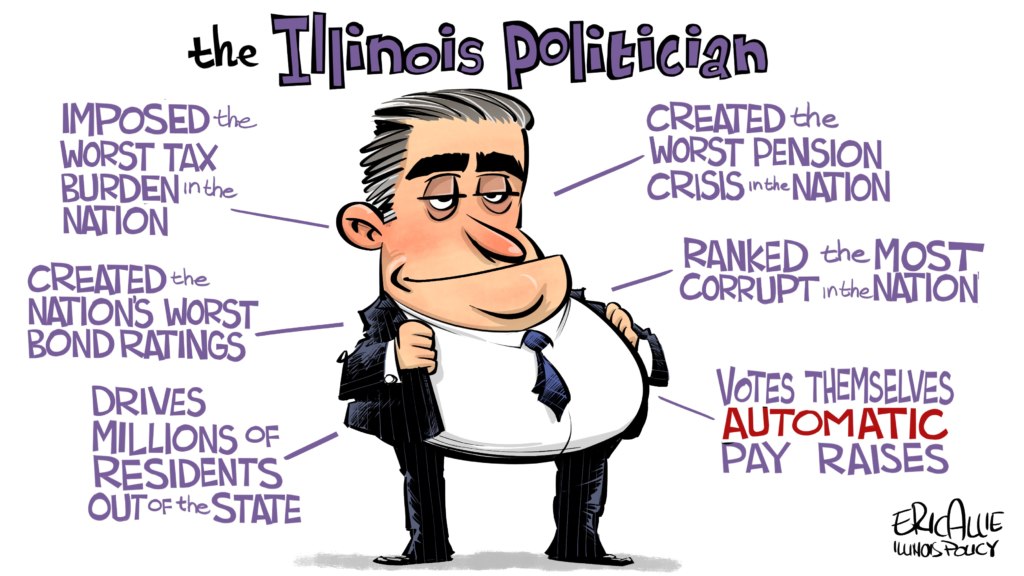
At the risk of understatement, Illinois is not a well-governed state. Greedy (and hypocritical) politicians have taxed and spent the state into a fiscal hole.

Wow. No wonder people have overwhelmingly voted that it is the state most likely to go bankrupt.

As illustrated by the collection of links, there certainly is a lot of data to support the notion that Illinois is in a downward spiral.

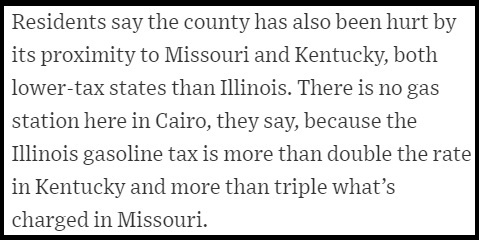
But sometimes an anecdote can help drive home the point. The Wall Street Journal just published a story about the country in Illinois that has suffered the largest decline in population of anyplace in the United States.

What struck me most about the report was that it “buried the lede.” More specifically, it’s not until the 17th paragraph that we learn about the factor that is probably responsible for a big chunk of the out-migration.

This must be the journalistic equivalent of “Other than that, Mrs. Lincoln, how was the play?” Though I’m sure the other factors listed in the article also are relevant.

I’ll close with some speculation about an oft-seen pattern in blue states, which is the way rural areas and poor urban areas keep falling farther and farther behind well-to-do suburbs and wealthy downturn business districts.

Is it random results or a consequence of policy choices? Do politicians in California only care about preserving quality of life for coastal elites? Do politicians in Illinois merely care about Chicago and its suburban counties? Do politicians in New York not care about upstate residents?

I don’t know the answer to those questions, but I do know that people are voting with their feet to escape the states with the most-punitive tax policy.


Wednesday, January 27, 2021

Illinois is a Mess

Bryce Hill Senior Research Analyst Illinois Policy Institute  Via E-mail


Illinois lost 423,300 jobs during 2020, a history-making drop with nearly half of the losses in the leisure and hospitality sector thanks to repeated COVID-19 restrictions.

The state saw 6.9% of its jobs evaporate, the worst year on record. Jobs losses were felt in every sector of the state economy, except for construction employment which saw a December surge that recouped the year's losses.

Leisure and hospitality jobs were hurt the most, losing 198,100 (-31.7%) jobs during the year, nearly half of all job losses, the Illinois Department of Employment Security reported. Suffering the next largest job losses was the mining sector, which lost 1,000 (-12.3%) jobs; the information sector shed 9,100 (-9.5%) jobs; educational and health services payrolls declined by 58,300 (-6.1%); other services payrolls dropped by 17,200 (-6.7%); government lost 48,700 (-5.9%) jobs; manufacturing jobs fell by 23,100 (-4.0%); professional and business services lost 35,600 (-3.8%); financial activities shed 9,800 (-2.4%) jobs; and trade, transportation and utilities lost 23,400 (-1.9%) jobs.

The newest data from mid-November to mid-December shows Illinois' final full month of 2020 saw 2,500 (-0.04%) jobs lost, marking the second consecutive month of job losses. Meanwhile, the national economy also stalled in December, shedding 140,000 (-0.1%) jobs, the first month of national job losses since April.

Hardest hit during the past month in Illinois was the leisure and hospitality sector, which lost 40,900 (-8.8%) jobs during the first full month of the reinstated ban on indoor dining. Only two other sectors of Illinois' economy shed jobs in December: the information sector lost 1,300 (-1.5%) of its jobs, while "other services" payrolls shrank by 800 (-0.3%).

Some sectors of the state economy continued to recover in December. Construction added 8,300 (+3.8%) jobs; mining gained 200 (+2.9%) jobs; professional and business services payrolls increased by 13,000 (+1.5%); trade, transportation and utilities grew by 10,100 (+0.9%) jobs; educational and health services added 4,500 (+0.5%) jobs; manufacturing gained 2,400 (+0.4%) positions; financial activities grew jobs by 1,400 (+0.3%); and government added 600 (+0.1%) jobs.

Although it looks like there may be some hope with a COVID-19 vaccine being dispersed, Illinois still has a painful economic recovery ahead. Making matters worse for already-struggling businesses, Gov. J.B. Pritzker is continuing to pursue new taxes, even after voters soundly rejected his progressive income tax hike Nov. 3.

The governor has suggested he may now be in favor of raising the state's flat income tax 20% or closing "loopholes" to raise more revenue. He recently failed to get the lame duck legislature to cancel a pandemic recovery tax credit for small businesses that would have taken from $500 million to $1 billion more from them as they struggle. Pritzker has vowed to pursue the money again in March with the new legislature.

As the state's economy continues to struggle with the COVID-19 downturn, and to a much greater extent than the rest of the nation, it is imperative lawmakers work to avoid the harm to businesses and jobs that tax hikes would create. Economists argue against raising taxes during a recession.

Instead, Illinois can improve its finances and continue to provide core services mainly by implementing constitutional pension reform. There is also the additional possibility of the state receiving federal aid by reforming state finances, if Congress adopts the Taxpayer Protection Act.

Instead of just throwing more money at pension debt and deficits, constitutional pension reform and the Taxpayer Protection Act would offer overburdened Illinois taxpayers a path to declining debt, lower taxes and more effective state government. The measures would build a more sustainable recovery rather than posting more historic job losses.