Search This Blog

De Omnibus Dubitandum - Lux Veritas

Showing posts with label Public Employee Pensions. Show all posts

Thursday, December 26, 2024

Mirror, Mirror, on the Wall, Which State Has the Most Pension Debt of All?

December 21, 2024 by Dan Mitchell @ International Liberty

The ideal pension system for workers is defined-contribution accounts – such as IRAs or 401(k)s – which is why it is so encouraging that many nations have moved in that direction.

One advantage of that approach is that, by definition, there are no unfunded liabilities with “DC” accounts. Your retirement income is based on how much money you save and how wisely the money is invested.

Many state and local bureaucrats, however, have defined-benefit pension systems. These “DB” systems are prone to systemic risk because politicians can promise lots of future benefits without setting aside the money to finance those goodies.

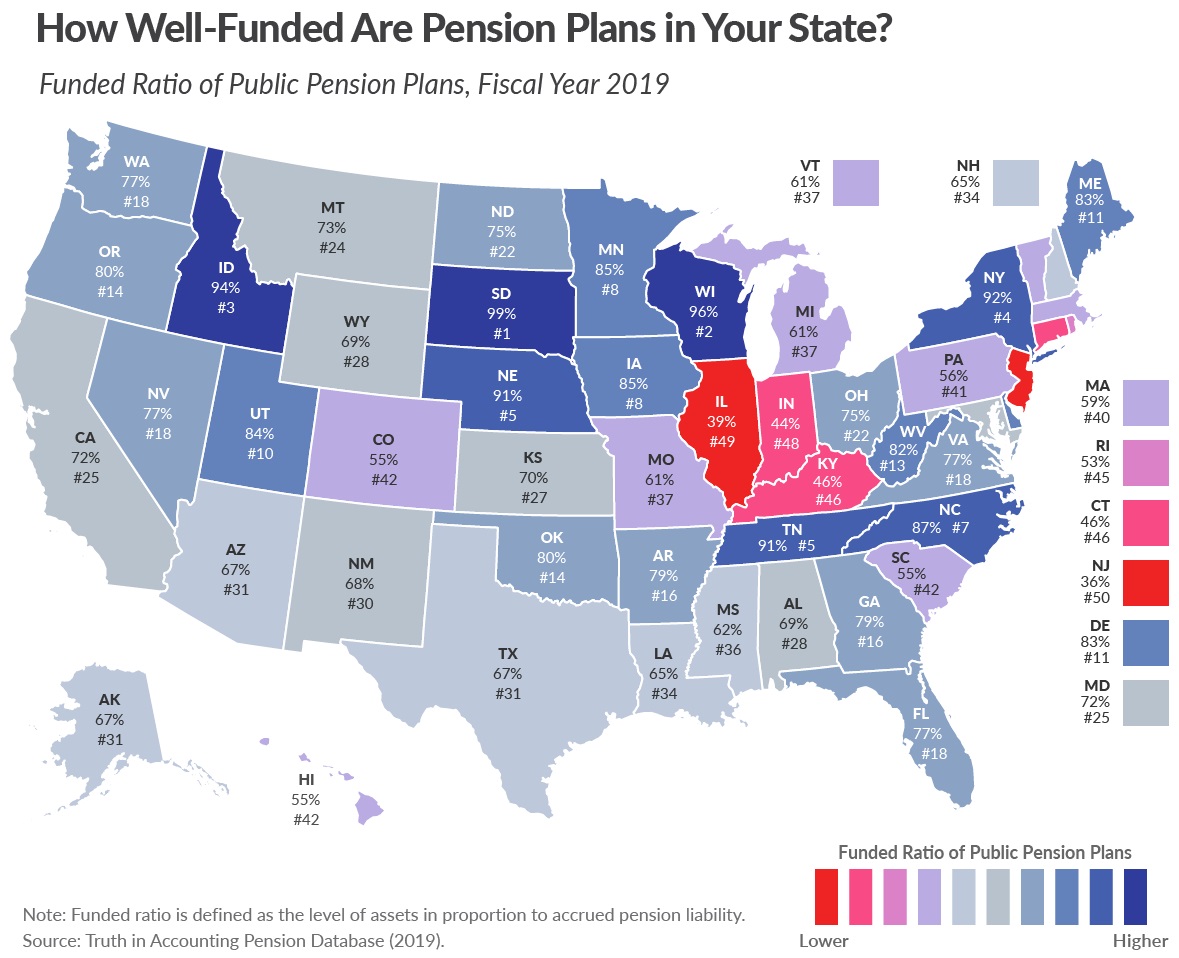
And that is a common problem, as shown by this map from the Tax Foundation based on 2019 data. No state at that time had a fully-funded system (based on how much money is set aside compared to have much pension benefits that have been promised).

Dark blue states are at least close to being fully funded. The worst states are red, followed by pink and purple.

It’s no surprise to see that Illinois and New Jersey are the worst of the worst for unfunded liabilities.

Some readers may be surprised, though, to see that Kentucky and Indiana have a significant problem.

One thing this map does not do, however, is to measure the overall fiscal burden of unfunded liabilities. And that matters since it might be better for taxpayers to be in a state with a larger share of unfunded liabilities but a less extravagant pension system (I’d rather owe someone 50% of $10 instead of 10% of $100).

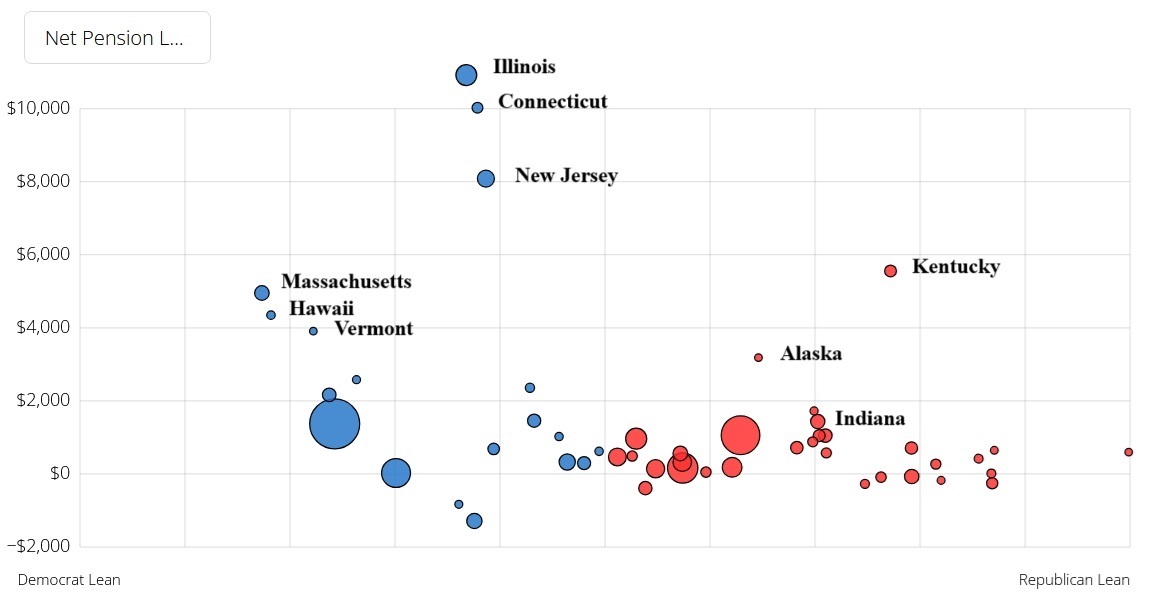
So here’s a visual from the folks at Reason showing per-capita net pension liabilities as of 2022. On this basis, Illinois is the worst of the worst, followed by Connecticut and New Jersey.

Kentucky also is very bad, though Indiana doesn’t look nearly as bad when using this measure.

It’s also important to consider a state’s ability to finance it’s unfunded liabilities. For instance, per-capita income in New Jersey is higher than it is in Kentucky, so the relative fiscal burden in Kentucky may be higher.

The good news is that the vast majority of states have relatively low unfunded liabilities – less than $2,000 per resident. It’s also good news that some states now have fully funded pensions, meaning more money is now set aside than is owed (largely because the stock market has increased in value since the Tax Foundation put together a map based on 2019 data).

That good news can quickly become bad news, though, if there is a recession and the stock market declines. Which is why DC systems are better than DB systems from the perspective of taxpayers.

P.S. Back in 2018, I conducted a poll asking readers which state would be the first to go bankrupt. Based on the data in today’s column, readers may have been wrong to vote California as the second-most likely state to go belly up. Though pension liabilities are not the only reason a state might go bankrupt. Perhaps readers think the exodus of businesses and taxpayers is going to saddle California with too many takers and not enough makers.


Mirror, Mirror, on the Wall, Which City Has the Most Pension Debt of All?

December 22, 2024 by Dan Mitchell @ International Liberty

Yesterday’s column looked at which states had the biggest unfunded liabilities for bureaucrat pensions, with Illinois, Connecticut, New Jersey, and Kentucky being the worst of the worst.

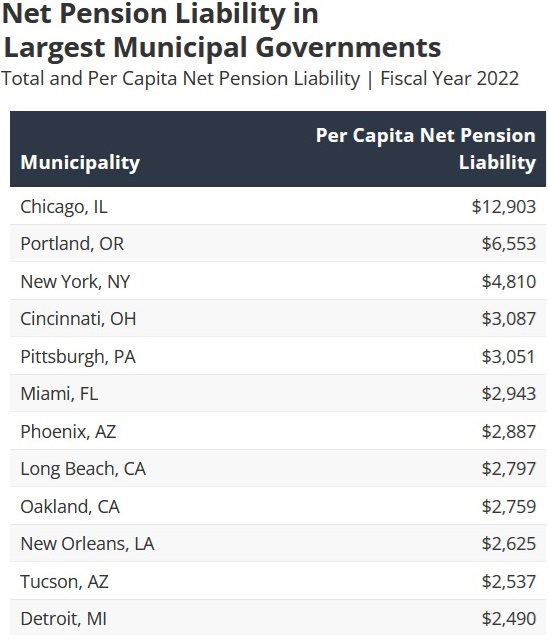
Today, courtesy of the good work of Geoffrey Lawrence, Jordan Campbell and Mariana Trujillo at Reason, let’s look at which cities in America have dug very deep holes for taxpayers.

The Reason experts put together the numbers for America’s 100-largest cities. On a per-capita basis, Chicago is far and away the most irresponsible big city (hardly a surprise), followed by Portland and New York City.

By the way, both today’s column and yesterday’s column are focusing only on pension debt. Many state and local governments also have significant unfunded liabilities for other fringe benefits such as health care for retired bureaucrats and I’ll write on that topic, perhaps as early as tomorrow.

Sticking with the topic of pension debt, there are three points to consider. The first two are simple and straightforward.

  • First, it is a form of fraud to promise future benefits without also providing the revenue to meet those promises.
  • Second, this is why states should migrate to defined-contribution retirement systems rather than defined-benefit schemes.

But here’s the issue that most people don’t fully appreciate.

  • Third, politicians are making long-term spending commitments while simultaneously driving away the taxpayers needed to pay for those promises.

Let’s use the worst state and the worst city as an example. Migration data shows that people are escaping Illinois (including lots of people escaping from the Windy City).

But what matters most is who is leaving. IRS data on migration shows that it is the people paying taxes who are leaving. And that’s true for Illinois and its true for Chicago.

So what’s going to happen 1o or 20 years from now when Chicago’s pension bills are piling up and there are lots of takers but not enough makers?

Margaret Thatcher already told us the answer to that question.

Mirror, Mirror, on the Wall, Which State Has the Most OPEB Debt of All?

December 23, 2024 by Dan Mitchell @ International Liberty 

Part I of this series looked at unfunded pension debt of states and Part II examined the unfunded pension debt of cities.

In Part III, let’s look at the degree to which state taxpayers are exposed to big unfunded liabilities for “Other Post-Employment Benefits” such as health care and life insurance.

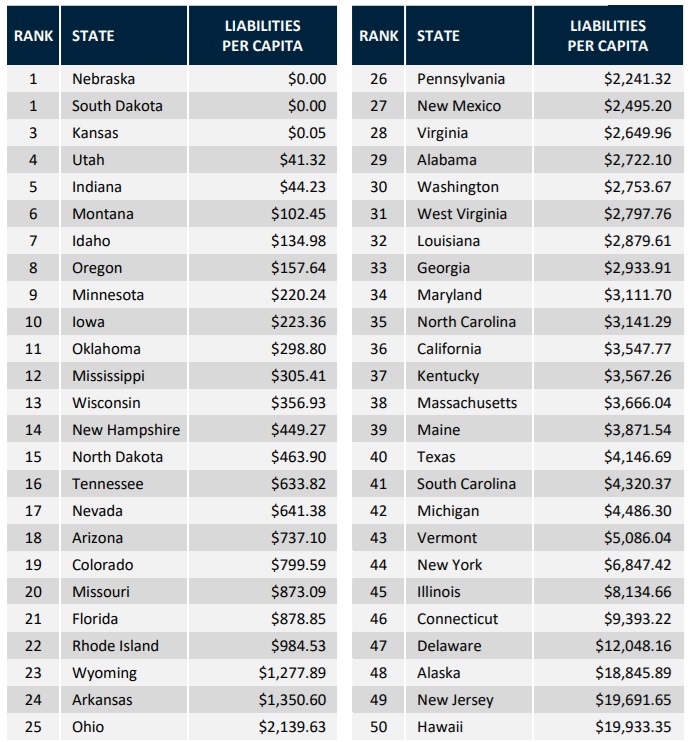
The American Legislative Exchange Council issued a report earlier this year that calculated the state-by-state burdens. Hawaii is the worst of the worst, followed by New Jersey and Alaska. South Dakota and Nebraska do the best job of protecting taxpayers, followed by Kansas.

But what does is mean to be the “worst of the worst”?

The ALEC report calculated that the burden for taxpayers in Hawaii, New Jersey, and Alaska is nearly $20,000 for every man, woman, and child in those states.

That compares to zero burden in Nebraska and South Dakota and almost zero in Kansas.

The nationwide burden of OPEB is now over $1 trillion according to the report.

Here are some highlights (lowlights would be a better term) from ALEC.


Other post-employment benefits (OPEB), also known as the “trillion-dollar acronym,” covers all the benefits a retired public employee is eligible to receive in retirement that are not a pension. These benefits include health insurance, life insurance, Medicare Supplement Insurance, and other benefits. …unfunded OPEB liabilities, now totaling over $1.14 trillion, just under $3,500 for every man, woman, and child in the United States. …

State OPEB plans face many of the same problems as public sector pension plans. Without real reforms, defined benefit OPEB plans will place a severe burden on taxpayers. By offering a range of defined contribution options as well as implicit subsidies by pooling retirees together with active employees, states can keep the promises made to both public employees and taxpayers.

The solution (both for pensions and OPEB) is for states to shift to systems based on “defined contribution” rather than “defined benefit.”

By definition, DC systems don’t have unfunded liabilities. Here’s a summary of the difference between the two approaches put together by the South Carolina-based Palmetto Promise.

The ALEC report notes that the two states with no unfunded liabilities use the DC approach.

Nebraska and South Dakota are the ideal models for state retiree health plans. Plan structures in both states now require current employees and retirees to purchase an HSA, where employees and retirees make tax-free contributions and the states match contributions up to a certain amount as well.

The report also praises Iowa, Indiana, and North Carolina for reforms moving in the right direction.

I’ll conclude by warning that columns about state and local unfunded liabilities may not be overly exciting, but there are big implications. At some point, reckless states such as Illinois and New Jersey are going to suffer a fiscal crisis and some politicians in Washington are going to want to provide bailouts.

That would be horrible policy, rewarding irresponsibility by profligate states.

Monday, December 12, 2022

Bureaucrat of the Year

December 6, 2022 by Dan Mitchell @ International Liberty

Federal bureaucrats are overpaid compared to workers in the productive sector of the economy.

State and local bureaucrats also are overpaid compared to people in the private sector, though usually the gap is not quite as large.


But “usually” does not means “always.”

The most absurd examples of excess bureaucrat pay generally are found at the state and local level.

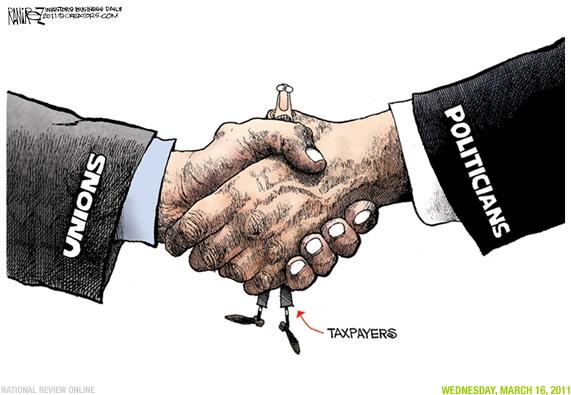
Especially in places like New Jersey where politicians and government employee unions have strong alliances against taxpayers.

And California, of course, where fleecing taxpayers has become an art form for some bureaucrats (see here, here, here, here, here, here, here, and here).

If you don’t believe me, read these excerpts from a Bloomberg report by Martine Paris.


A Beverly Hills cop tops the list of the highest-paid California municipal employees, 100 of whom took home $439,000 or more in total wages last year. The assistant police chief’s total compensation was $716,284 in 2021, $208,087 in regular income, with the rest for lump-sum and other pay… Marc Coopwood retired last year as assistant police chief in Beverly Hills after 4 years and 7 months in the role… As part of his separation agreement, he was issued a final payment that included 12 months’ salary and benefits, as well as compensation for unused leave, the city said in a statement. …The top 10 highest-paid list includes city managers in West Hollywood, Artesia and Fremont, two fire captains in the city of Los Angeles and a firefighter, as well as a load dispatcher at the Los Angeles Department of Water & Power who booked $400,000 in overtime compensation.

I don’t know what’s more outrageous, the assistant police chief with more than $716K of compensation, or the fact that 100 bureaucrats pocketed at least $439K?


Or is it the bureaucrat who fleeced taxpayers for $400K of overtime?

No wonder so many taxpayers are fleeing California.

In any event, we’ll elect Marc Coopwood, the assistant police chief, to the Bureaucrat Hall of Fame.

But maybe we’ll have an asterisk to indicate that he’s representing the 99 other bureaucrats who hit the $439K-and-above level.

P.S. Click here, here, here, here, here, here, here, here, here, and here for some bureaucrat humor.


Thursday, October 14, 2021

Exclusive insight from the Illinois Policy Institute

This edition of The Policy Shop is brought to you by Adam Schuster, senior director of budget and tax research.

Chicago Mayor Lori Lightfoot shared her budget proposal last month. Now what? City council members now have until Dec. 31 to pass a budget for the city.  City council members now have until Dec. 31 to pass a budget for the city.  Here’s the skinny of what Lightfoot proposed and what Chicagoans and the city we love are up against.
 
Finances are so shaky in Chicago that, even with an infusion of $3.5 billion in federal aid, the mayor still included a $76.5 million property tax hike. That increase comprises $22.9 million in automatic increases after Lightfoot pushed for tying property taxes to inflation last year, $25 million for debt service on bonds for Lightfoot’s $3.7 billion infrastructure plan, and $28.6 million from new property. After deducting new property, the $47.9 million discretionary levy increase would raise property tax bills by an average of $72 to $180 depending on the neighborhood. 

We’re from the government and we’re here to help
 
Seriously, with city officials receiving billions of dollars in federal aid, how are Chicagoans facing a property tax hike? Business leaders don’t get it.
 “With the historic level of federal funding coming to the city we can avoid a property tax increase that impacts all residents and businesses.” – Chicagoland Chamber of Commerce. 
 
The business community is right that a property tax increase is unnecessary considering the $3.5 billion in pandemic-related federal aid. Lightfoot’s proposed budget uses $782 million in federal funds to replace 2021 revenues, $385 million for 2022, and reserves $152.4 million for 2023 revenue replacement. That leaves roughly $581 million in flexible aid currently dedicated to new program spending. The property tax hike could be prevented by using just 2.5% of Chicago’s $1.9 billion in American Rescue Plan funding. 
 
Moreover, while U.S. treasury rules prohibit states from using aid to directly or indirectly offer tax relief, this prohibition does not apply to cities. Lightfoot has the greenlight to help overburdened homeowners, if she wants to. 
 
Spin cycle: No new taxes
 
In her budget address, Lightfoot emphasized that her budget proposal achieves balance “without any new taxes, no reduction in city services, and no layoffs.” Similarly, a press release from the mayor’s office claims the budget has “no new tax or significant fee increases for our residents.” Lightfoot claims the $74.5 million property tax hike doesn’t count as a tax increase because automatic annual inflation increases and the increase for infrastructure were approved last year, but this argument is political spin. The bottom line is that city property owners will pay higher property tax bills next year.
 
Lightfoot could have proposed to use the federal aid to undo last year’s property tax increase, which hit during a pandemic and related economic downturn. This would meet the American Rescue Plan’s goal to “support immediate economic stabilization for households and businesses.” Stopping this year’s tax hike would not require cutting anything, just slightly scaling back some of the new spending.  Taking a small portion from each of the larger new line items could prevent the tax hike while still leaving hundreds of millions of dollars more for Lightfoot’s “community priorities” such as youth job training and affordable housing. 
 
A smaller tax increase is still a tax increase
 
How does this $74.5 million property tax increase compare with recent years?

Still, it is an increase and would add an unnecessary burden to a city economy still recovering from COVID-19. (Did we mention it was also unnecessary given the city is sitting on $3.5 billion in federal aid?!)
 
Illinois’ pandemic restrictions, as well as $655 million in state tax hikes pushed in Gov. J.B. Pritzker’s budget this year, have together contributed to the struggle for Illinois’ businesses to create jobs for workers as fast as the rest of the nation. The state’s unemployment rate remains 35% higher than the national average. Piling on even modest additional tax hikes on Chicago residents and businesses will mean fewer jobs and lower wage growth for residents as the economy recovers from the COVID-19 recession. 

Temporary revenue can’t fund permanent programs 

The budget increases spending by roughly $1.2 billion on a range of city services from the Chicago Police Department, affordable housing, and mental health services to a pilot program for a universal basic income. Unfortunately, that spending is propped up by one-time federal aid that expires by 2024, meaning many programs will have to be cut or financed with significant tax hikes within just two years. > If Lightfoot wants to live up to the rhetoric in her budget address – in which she promised to invest in Chicago’s economic recovery while giving predictability and stability to taxpayers – she needs to develop and execute a plan to match revenues and expenses long-term. Only a long-term balanced budget can give city residents confidence programs will continue and taxes will remain affordable.
 
The elephant in the room 
 
Despite calling pension debt the city’s “biggest problem” in May, Lightfoot’s address did not include any plan for Chicago’s pension crisis. Her predecessor, Mayor Emanuel, endorsed a constitutional amendment to allow pension reform late in his final term. Amending the constitution is the only way to unlock changes to 3% compounding cost-of-living increases Lightfoot has called “unsustainable.” 

Pension costs will consume more than $2.3 billion of the city’s budget, or 21.4% of its own source revenue, meaning local collections excluding state and federal grants. That’s $461 million more than last year, a spike that accounts for 63% of the $733 million 2022 budget deficit reported by Lightfoot in August.

Chicago’s pension spending is up nearly $1 billion just during the three years Mayor Lightfoot has been in office and nearly 500% since 2004 in nominal terms. Lightfoot bragged that this is the first year the city is making “actuarially determined” pension payments, but that does not mean they are “actuarially sufficient.” Chicago’s rapid and unsustainable growth in pension spending still won’t be enough without benefit reforms.
 
Springfield must let the people vote on a constitutional amendment to control rising pension costs. Lightfoot needs to use her platform as a public official to push the General Assembly into doing the right thing if Chicago is going to reverse its economic stagnation and provide residents with quality services at a reasonable cost.
 
Read a full rundown of the problems in the proposed Chicago budget here.
 

Tuesday, October 12, 2021

Illinois Policy

By Rich Kozlovich

 I received the Illinois Policy news alert yesterday.  It turns out Illinois government keeps raising taxes and getting less for it.  Now there's a shocker for you.  But the big deal was their Public Employee pension system.  It's underfunded by $219 billion dollars.  

What happens if it goes belly up?  

The citizens of Illinois are on the hook for that money, to the tune of 45, 000 a person. Currently 27 cents for ever dollar spent by Illinois goes to a pensions, and every year they get a 3% raise, irrespective of the economic conditions.  Exacerbating the problem is the number of people employed by the state.  One person in ten are on the state pension system.  That must mean an awful lot of people are now and have been on the state's payroll.  All those people working for the state, paying more taxes, and getting less services.  Imagine that.

In a state where six of the last seven governors has been charged with a crime, and four went to prison.   Does anyone besides me thinks something smells rotten in Illinois?  

Just a thought!