Search This Blog

De Omnibus Dubitandum - Lux Veritas

Showing posts with label Connecticut. Show all posts

Friday, December 15, 2023

DC and California Going Broke Fast

What's the common denominator?

by | Dec 15, 2023 @ Liberty Nation News

The fiscal year just started, and the US government is already running a massive budget deficit. In November, the federal shortfall was a larger-than-expected $314 billion, fueled by a 17% increase in spending. In only the first two months of FY 2024, the gap totals $381.5 billion, thanks to huge outlays for Social Security, Medicare, national defense, and interest payments. Washington’s river of red ink and IOUs stretches across the nation, including into one of the largest states in the country: California.

Budget Deficit in California

GettyImages-1796587831 Gavin Newsom

Gavin Newsom (Photo by Liu Guanguan/China News Service/VCG via Getty Images)

While California Gov. Gavin Newsom (D) proved to the nation during his debate with Florida Gov. Ron DeSantis (R) why his state is a mess, the latest figures confirm what many already know: The Golden State is being sucked into a fiscal black hole. The non-partisan Legislative Analyst’s Office (LAO) confirmed on Dec. 8 that the state’s budget deficit soared to an all-time high of $68 billion, driven by shrinking tax revenues. This topped the June estimate of a $14.3 billion shortfall.

State budget analysts warn that California will need to address the ballooning deficit. This could involve using its $30 billion cash reserves, employing one-time spending cuts, and adjusting how it funds education and other generous social programs. However, all of these options could be short-term solutions, as the LAO forecast that California could face annual budget deficits of $30 billion for the next few years.

The good news for Newsom is that California is not facing a crisis. LAO official Gabriel Petek told reporters: “The state remains in a good cash position, and that really wasn’t the case back at the start of the Great Recession. We don’t face the same kind of liquidity challenges that we had at that time, and so I would stop short of describing it as a crisis.” At the same time, massive budget deficits suggest that the state needs to be more cautious moving forward, says California Senate President Pro Tem Toni Atkins. She told Politico that “we’re going to have to slow down over time,” pertaining to existing and new spending. But will Gavination decelerate its expenditures? Unlikely.

Other States in the Red

The Golden State isn’t the only one facing an immense budget deficit. In fact, nine others are enduring long-term fiscal imbalances, including Connecticut, Illinois, Massachusetts, New Jersey, and New York. This has been driven by governors and legislative chambers overpromising, overspending, and underdelivering for years without any respite.

More could be joining the list soon, including Minnesota, which is forecast to see a shortfall of $2.31 billion in the 2026-27 fiscal years. Mark Koran, a GOP senator in North Branch, summarized the situation in a recent statement following the Office of Minnesota Management and Budget’s economic projection:

“In only one session, single-party Democrat control of government has taken us from a $19 billion surplus to a projected $2.31 billion deficit in the near future. Their record of reckless overspending, massive tax increases, broken tax relief pledges, and now looming deficits are simply not sustainable. At the same time, inflation continues to put pressure on family budgets every month. Minnesotans cannot afford Democrats’ irresponsible governing any longer.”

Sorry, Cheney, Deficits Do Matter

Former Vice President Dick Cheney famously said that “deficits don’t matter.” This Republican mantra was shared shortly before former President George W. Bush declared that the United States needed to sacrifice free-market principles to save the free market. Democrats might not be so blunt in their support of debt and deficits, but their actions, whether at the state or federal level, show that they also lack the ability to balance the books. Since arriving at the White House in 2021, President Joe Biden has overseen the national debt soaring by approximately $7 trillion while recording some of US history’s largest deficits. Many experts have warned of the growing consequences of fiscal irresponsibility, but with interest rates at their highest levels in more than two decades, budget deficits being the new normal might breed a fiscal crisis.

 Tags: Articles, Business News, Opinion

 
Read More From Andrew Moran

Tags: Articles, Business News, Opinion

Monday, October 23, 2023

The Connecticut Green Amendment after Held v. Montana

By October 22nd, 2023 31 Comments @ CFACT

By David Fleming:

A recent Montana court decision on environmental rights may soon have significant legal and economic implications on Connecticut, especially if the state adopts a “green amendment.”

On Aug. 14, Montana District Court Judge Kathy Seeley ruled in favor of 16 “youth plaintiffs” (between the ages of 5 and 22), who argued in Held v. Montana that the state legislature had violated their constitutional rights by passing legislation friendly to fossil fuels in recent years.

Two particular policies drew the plaintiffs’ ire. Since 2011, the Montana legislature has forbidden state agencies from considering the cost of carbon emissions for economic development under the Montana Environmental Policy Act (MEPA). And this past April, the state legislature repealed the Montana Energy Plan, which had “promote[d] energy efficiency, conservation, production and consumption of a reliable and efficient mix of energy sources” since 1993.

The plaintiffs argued that these recent actions were taken without consideration for the environmental rights of residents, especially those of younger generations.

The case will likely be appealed to the Montana Supreme Court, but one thing is clear: climate decision-making through the judiciary suddenly looks more viable than just a few months ago. Since at least 2010, young persons from across the country have attempted to sue the federal and state governments over a perceived lack of action surrounding climate change. Until now, those attempts were never successful.

Even with a supermajority in the House and Senate, Connecticut legislators have been reluctant to seriously consider impeding economic development dependent on fossil fuels en masse. Therefore, finding one sympathetic judge would be a much easier lift for Connecticut’s environmental activists than convincing dozens of legislators.

The probability of beating the government through climate litigation on a state-by-state basis hinges in large part on two factors. First, the right to environmental protection as outlined in a state’s constitution. Second, having state-based environmental planning requirements that mirror the federal National Environmental Policy Act.

Connecticut is one of 20 states with such planning requirements, making it an attractive judicial target. The Connecticut Environmental Policy Act (CEPA) was enacted in 1972 and “requires every state agency to develop a list of agency actions that have significant impacts on the environment, and it provides a process by which those agencies review their proposed actions to determine whether to move forward with them in light of the effects on the environment.”

On the other hand, Connecticut is also one of 43 states that do not have environmental rights enshrined in the state constitution in some form. Therefore, the state is less vulnerable than Montana to judicial challenges in regards to constitutional language — at least for now.

In 1972, Montana rewrote their constitution to include some rather progressive provisions. Article IX, Section 1 of Montana’s Constitution declares, “The state and each person shall maintain and improve a clean and healthful environment in Montana for present and future generations. (2) The legislature shall provide for the administration and enforcement of this duty. (3) The legislature shall provide adequate remedies for the protection of the environmental life support system from degradation and provide adequate remedies to prevent unreasonable depletion and degradation of natural resources.”

Montana’s Article IX sounds incredibly similar to the “green” amendment proposed in Connecticut’s last legislative session:

“Each person of the state of Connecticut shall have an individual right to clean and healthy air, water, soil and environment; a stable climate; and self-sustaining ecosystems; for the benefit of public health, safety and the general welfare. The state shall not infringe upon these rights. The state shall protect these rights equitably for all people regardless of race, ethnicity, tribal membership status, gender, socioeconomics or geography. The state, municipalities, and any political subdivision thereof, shall serve as trustee of the natural resources of Connecticut, among them being its waters, air, flora, fauna, soils, and climate; and shall conserve, protect, and maintain these resources for the benefit of all people, including present and future generations. The rights stated in this section are inherent, inalienable, and indefeasible, are among those rights reserved to the people, and are equivalent with all other inalienable rights.”

Legal experts ascribe much of the ruling’s success to Montana’s clear constitutional language regarding environmental rights.

If Connecticut were sued successfully in court along climate lines, many construction projects could become dependent on judicial outcomes. This could further slow an economy that just regained all the jobs it lost during Covid.

A host of difficulties immediately emerge when “positive rights” — which require sacrifices by or resources from others, rather than just a guarantee of noninterference by government — are extended to something so nebulous as “environmental rights.” This is especially true when the science and politics of climate change comes into play.

As a hypothetical but plausible scenario if the amendment is enacted, Connecticut Resident 1 might enjoy uninhibited views of landscapes and wildlife from her back porch. However, Connecticut Resident 2 could emphasize his “right to a stable climate” as a reason to import solar panels and wind turbines into that pristine landscape. At this point, it would be entirely up to the discretion (and political leanings) of the judge to rule in one resident’s favor.

As it stands now, after Montana’s ruling, Connecticut is vulnerable to climate-based litigation. Passing the green amendment would only accelerate the likelihood of climate litigation and set up a showdown between economic development and the loudest anti-development voices on the fringes of Connecticut discourse.

David Flemming joined the Yankee Institute in April 2023 after working for five years as an energy policy analyst at the Ethan Allen Institute in Vermont. 

This article originally appeared at Real Clear Energy

Author


Thursday, July 28, 2022

Connecticut Steps Up To Save The Planet

July 26, 2022 @ Manhattan Contrarian

Connecticut is a small state, so you may not be paying sufficient attention to its heroic efforts to save the planet. Count on the Manhattan Contrarian to bring you up to date on the latest developments.

On Friday (July 22) Connecticut Governor Ned Lamont signed the just-passed bipartisan Clean Air Act for the state. Lamont and other state officials gathered in New Haven in 90+ degree heat to celebrate the great accomplishment. A State Senator named Will Haskell, who is a member of the legislature’s Transportation Committee, took the occasion to make the main point:

We cannot wait for Washington to step up and save the planet!

But how exactly is Connecticut going to accomplish that? After all, it has a population of only about 3.6 million. Its greenhouse gas emissions are in the range of about 41 MMTCO2e per year, which is well less than 0.1% of total world annual emissions of about 49,000 MMTCO2e. You could zero out Connecticut’s emissions entirely, and it wouldn’t even amount to a rounding error in the world total. Indeed, the increase that occurs each year in China’s CO2 emissions is a multiple of Connecticut’s total emissions. (According to Our World in Data here, from 2019 to 2020, latest years given, China’s CO2 emissions went from 10.49 to 10.67 billion tons, a one-year increase of about 180 million tons, or well more than four times the total annual emissions of Connecticut.)

But our heroes in Connecticut are not going to let such mere statistics discourage them. They have a plan. And the plan, included as the central feature in the new Clean Air Act, is to electrify the state’s fleet of vehicles, particularly its city buses and school buses. Here is state Transportation Commissioner Joe Giuletti speaking at the July 22 event, quoted in the New Haven Register:

“There are approximately 800 buses that we are responsible for at the DOT that are being replaced with no-emissions electric models. They’re quieter, they emit no emissions and they last longer,” Giulietti said Friday.

Governor Lamont also issued a statement emphasizing that the new law would bring about conversion of all the state buses to electric within a few years:

In addition to the electric state-run buses, public school buses will also shift to electric models, according to the governor’s statement. The Clean Air Act will also prohibit the procurement of diesel-powered buses after 2023, according to the statement.

I particularly enjoyed this statement from Transportation Commissioner Giuletti, this time quoted at the website of television station WTNH:

Department of Transportation Commissioner Joe Giulietti remarked, “it’s so nice to hear a bus that’s behind you that’s not making the noise or emitting any of the air, either the propane or the diesel fumes.”

Note the clear implication that Giuletti has never actually ridden on one of these city buses himself, nor would he ever deign to do that. City buses are for the little people. It’s just that when he gets near one, he wants it to be more suitable to his elite esthetic.

The New Haven Register added that the new electric bus program represents a build-out of a pilot program that began with the delivery of some 12 electric buses in 2020. The Register quotes Connecticut Transportation Department spokesman Josh Morgan:

“The first battery electric buses came into service in the fall of 2020,” Morgan said. “Today, there are 12 electric buses in Connecticut. . . .”

And then, as luck would have it, on the very next day, July 23, one of those 12 electric buses already in Connecticut’s fleet suddenly exploded into flames while sitting in a parking lot in the town of Hamden. Here is a picture of the event, courtesy of the Hamden Fire Department:

It’s really quite something when one of those big lithium-ion batteries suddenly explodes into flames. As usual with these lithium fires, they couldn’t extinguish it with water or anything else, and they just had to let it burn itself out.

“Lithium ion battery fires are difficult to extinguish due to the thermal chemical process that produces great heat and continually reignites,” Hamden fire officials said.

Fortunately, no one was on the bus, and it was out of service on a Saturday morning.

The Connecticut officials reacted to the incident by immediately pulling the entire electric bus fleet from service. The Register quotes CT Transit spokesman Josh Rickman:

“The importance of rider safety is demonstrated by taking these buses out of service and ensuring a thorough investigation is completed prior to any redeployment of the fleet,” Rickman said.

No word as yet as to when, if ever, the electric buses may go back into service. Perhaps Connecticut may have to look around for some other way to save the planet.

Wednesday, January 15, 2020

Connecticut’s Continuing Decline

January 14, 2020 by Dan Mitchell

I wrote last week about the ongoing shift of successful people from high-tax states to low-tax states. And I’ve periodically confirmed this trend by doing comparisons of high-profile states, such as Texas vs. California and Florida vs. New York. Today, I’m going to focus on Connecticut.

I actually grew up in the Nutmeg State and I wish there was some good news to share. But Connecticut has been drifting in the wrong direction ever since an income tax was imposed about 30 years ago.

And the downward trend may be accelerating.

A former state lawmaker has warned that the golden geese are escaping the state.
A former state representative says wealthy Connecticut residents are leaving the state at “an alarming pace.” Attorney John Shaban says when he returned to private practice in Greenwich in 2016, one of his most popular services became helping some of the state’s top earners relocate to places like Florida… “Connecticut started to thrive 20, 30 years ago because people came here. We were a tax haven, we were a relatively stable regulatory and tax environment, and we were a great place to live,” says Shaban. …Shaban says many small businesses now require little more than a laptop to operate, and that’s making it easier for small business owners to relocate out of state.
The exodus of rich people has even caught the attention of the U.K.-based Economist..
Greenwich, Connecticut, with a population of 60,000, has long been home to titans of finance and industry. …It has one of America’s greatest concentrations of wealth. …You might think a decade in which rich Americans became richer would have been kind to Greenwich. Not so. …the state…raised taxes, triggering an exodus that has lessons for the rest of America… Connecticut increased income taxes three times. It then discovered the truth of the adage “easy come, easy go”. …Others moved to Florida, which still has no income tax—and no estate tax. …Between 2015 and 2016 Connecticut lost more than 20,000 residents—including 2,050 earning more than $200,000 per year. The state’s taxable-income base shrank by 1.6% as a result… Its higher income taxes have bitten harder since 2018, when President Donald Trump limited state and local tax deductions from income taxable at the federal level to $10,000 a year.
For what it’s worth, the current Democratic governor seems to realize that there are limits to class-warfare policy..
Connecticut Governor Ned Lamont said he opposes higher state income tax rates and he linked anemic growth with high income taxes. …when a caller to WNPR radio on Tuesday, January 7 asked Lamont why he doesn’t support raising the marginal tax rate on the richest 1 percent of Connecticut residents, Lamont responded: “In part because I don’t think it’s gonna raise any more money. Right now, our income tax is 40 percent more than it is in neighboring Massachusetts. Massachusetts is growing, and Connecticut is not growing. We no longer have the same competitive advantage we had compared to even Rhode Island and New York, not to mention, you know, Florida and other places. So I am very conscious of how much you can keep raising that incremental rate. As you know, we’ve raised it four times in the last 15 years.” …Connecticut has seven income tax rate tiers, the highest of which for tax year 2019 is 6.99 percent on individuals earning $500,000 or more and married couples earning $1 million or more. That’s 38.4 percent higher than Massachusetts’s single flat-tax rate for calendar year 2019, which is 5.05 percent.
I suppose it’s progress that Gov. Lamont understands you can’t endlessly pillage a group of people when they can easily leave the state.

In other words, he recognizes that “stationary bandits” should be cognizant of the Laffer Curve (i.e., high tax rates don’t lead to high tax revenues if taxable income falls due to out-migration).

But recognizing a problem and curing a problem are not the same. Lamont opposes additional class-warfare tax hikes, but I see no evidence that he wants to undo any of the economy-sapping tax increases imposed in prior years.

So don’t be surprised if Connecticut stays near the bottom in rankings of state economic policy.

P.S. The last Republican governor contributed to the mess, so I’m not being partisan.

P.P.S. Though even I’m shocked by the campaign tactics of some Connecticut Democrats.

Monday, September 16, 2019

The Continuing Tax Migration to Florida

September 15, 2019 by Dan Mitchell
 
Like most libertarians, I’m a bit quirky.

Most people, if they watch The Great Escape or Rambo II, cheer when American POWs achieve freedom.

I’m happy as well, but I also can’t stop myself from thinking about how I also applaud when a successful taxpayer flees from a high-tax state to a low-tax state.


It’s like an escape from oppression to freedom, though I confess it might not be the best plot for a blockbuster movie.

In any event, here are two recent feel-good stories about this phenomenon.

Here’s a report about two members of the establishment media who are protecting their family’s finances from greedy Connecticut politicians.
After reports that married MSNBC anchors Joe Scarborough and Mika Brzezinski have been mysteriously broadcasting their show from Florida — sources speculated that the location is to benefit Scarborough’s tax situation. The “Morning Joe” anchors have been reportedly on a home set in Jupiter, Fla., but using Washington, DC, backdrops. Sources said the reason for the locale was a “tax dodge” — albeit a completely legal one — since Scarborough has a home in Florida and would need to spend a certain amount of the time there for any tax benefit. …Scarborough, who’s still presently registered to vote in Connecticut., on Oct. 9, 2018 registered to vote in Palm Beach County, Fla. according to public records. …By moving to Florida, he’d reduce his tax burden by roughly $550,000. Scarborough reportedly makes $8 million a year and would pay 6.99-percent state income tax in Connecticut, while there’s no state income tax in Florida, the Post’s Josh Kosman reports. To qualify as a Florida resident, he’d need to be there 183 days a year.
According to the story, Scarborough and Brzezinski are only making the move to be close to aging parents.

That certainly may be part of the story, but I am 99.99 percent confident that they won’t be filing another tax return with the Taxnut State…oops, I mean Nutmeg State.

Meanwhile, another billionaire is escaping from parasitic politicians in New York and moving to zero-income tax in Florida.
Billionaire Carl Icahn is planning to move his home and business to Florida to avoid New York’s higher taxes, according to people familiar with the matter. …The move is scheduled for March 31 and employees who don’t do so won’t have a job… Hedge fund billionaires have relocated to Florida for tax reasons for years — David Tepper, Paul Tudor Jones and Eddie Lampert being among the most prominent. But Florida officials have been aggressively pushing Miami as a destination for money managers since the Republican-led tax overhaul. …Florida is one of seven states without a personal income tax, while New York’s top rate is 8.82%. Florida’s corporate tax rate is 5.5%, compared with 6.5% in New York. Icahn’s move was reported earlier by the New York Post. The difference could mean dramatic savings for Icahn, who is the world’s 47th richest person.
These two stories are only anecdotes. And without comprehensive data, there’s no way of knowing if they are part of a trend.

That’s why the IRS website that reports the interstate movement of money is so useful (it’s not often I give the IRS a compliment!). You can peruse data showing what states are losing income and what states are gaining income.

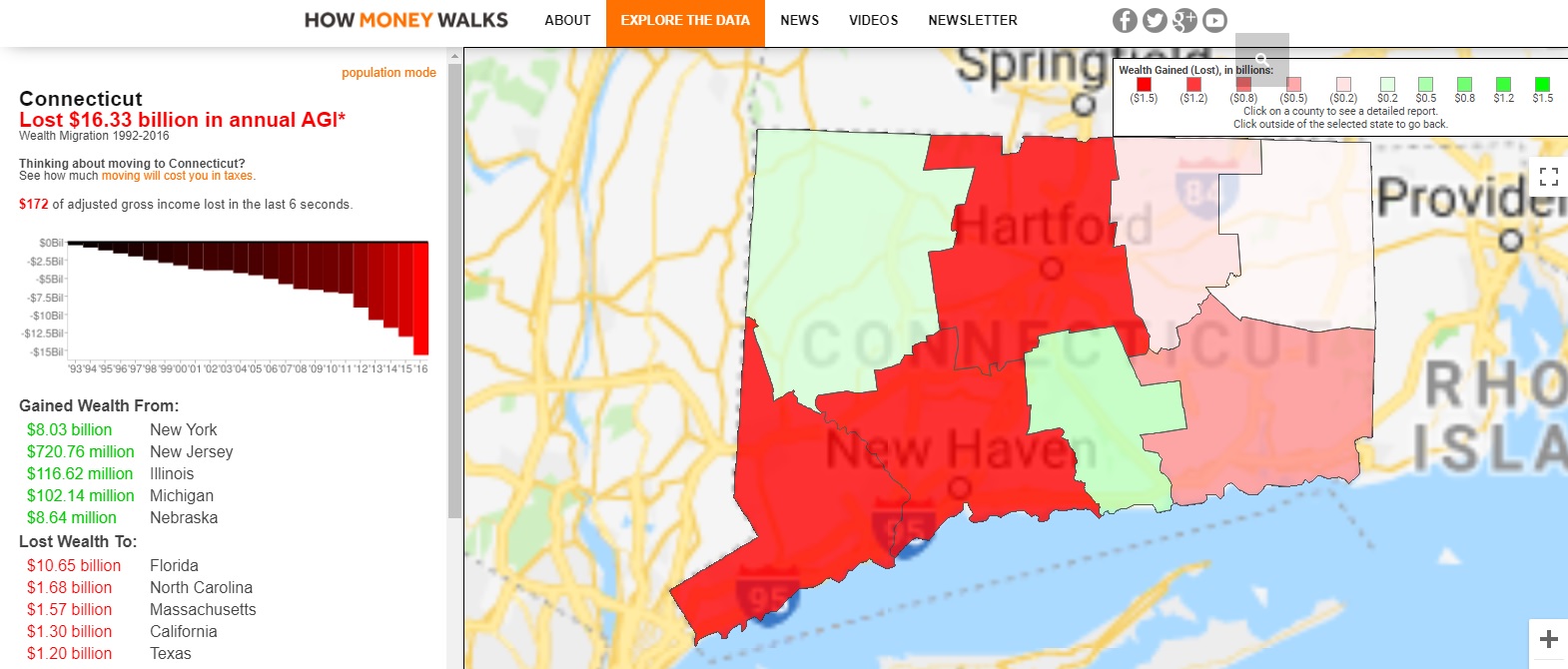
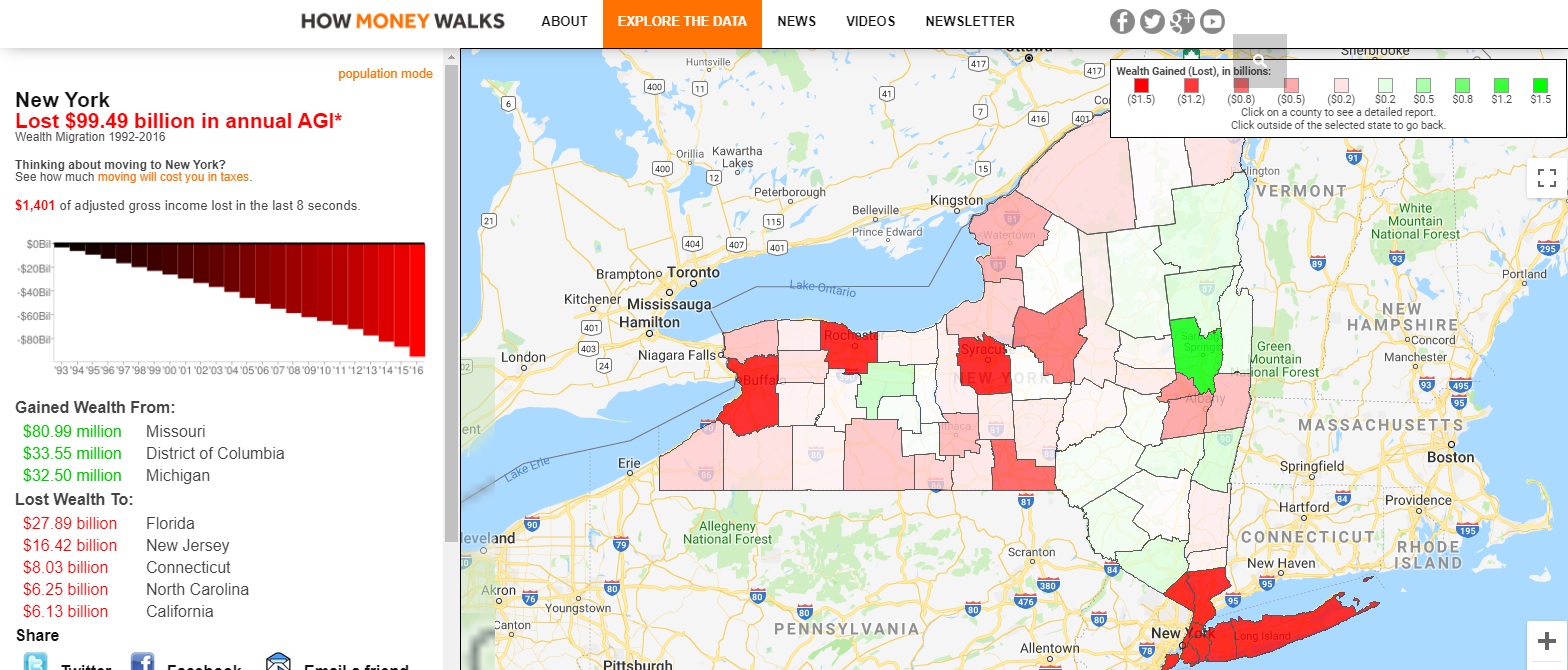
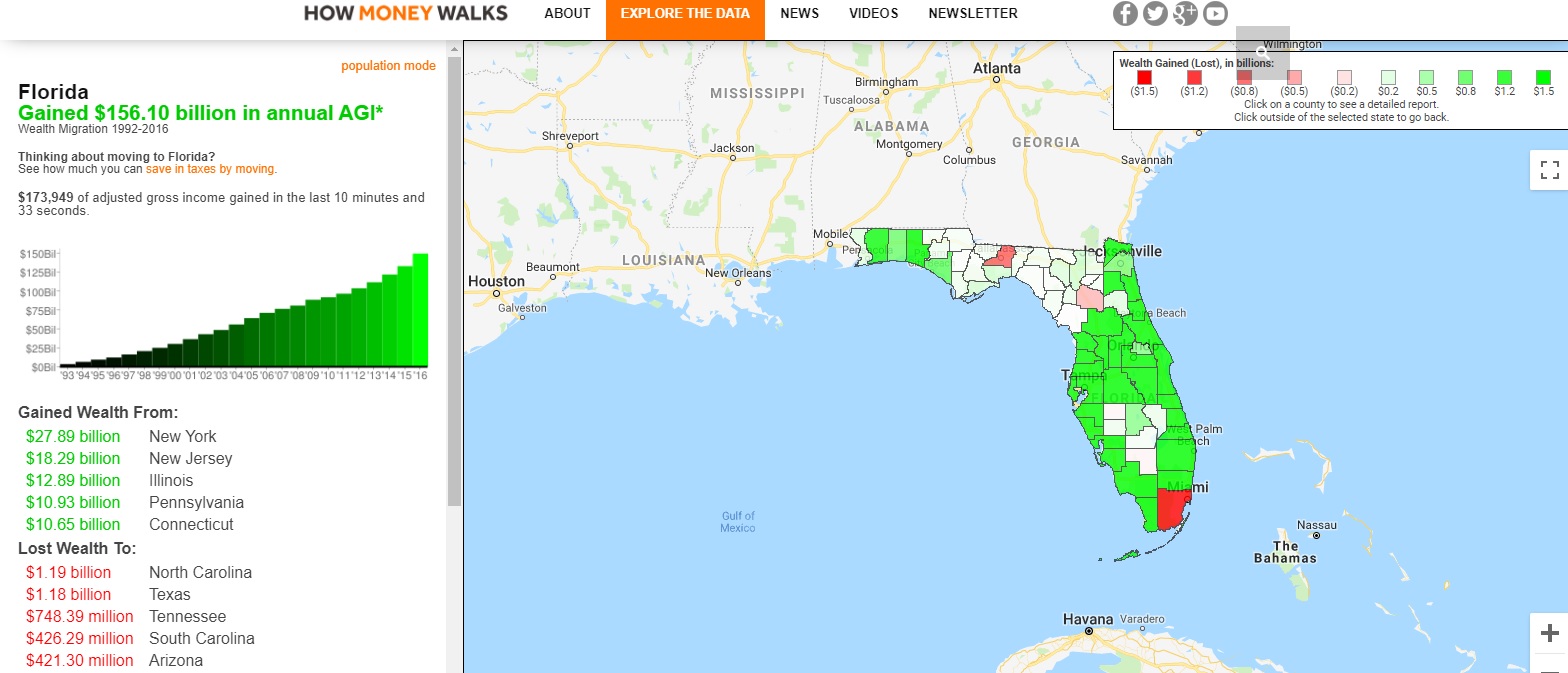
Though if you want a user-friendly way of viewing the data, I strongly recommend How Money Walks. That website allows you to create maps showing the net change in income and where the income is coming from, or going to.

Since our first story was about Connecticut, here’s a map showing that the Nutmeg State has suffered a net exodus (red is bad) over the 1992-2016 period.


In other words, the state is suffering from fiscal decay.

And here’s a map for New York, where we see the same story.


Now let’s look at the state that is reaping a windfall thanks to tax refugees.

Florida, to put it mildly, is kicking New York’s derrière (green is good).


And you can see on the left side that Florida is also attracting lots of taxpayers from New Jersey, Illinois, Pennsylvania, and Connecticut.

By the way, some of my leftist friends claim this internal migration is driven by weather. I suspect that’s a partial factor, but I always ask them why people (and their money) are also migrating out of California, where the weather is even better.

P.S. Tax migration is part of tax competition, and it’s a big reason why left-wing governments sometimes feel compelled to lower taxes.

P.P.S. When the IRS releases data for 2017 and 2018, I’m guessing we’ll see even more people escaping to Florida, in large part because there’s now a limit on deducting state and local taxes.

P.P.P.S. I also cheer when people escape high-tax nations.

Friday, June 21, 2019

Connecticut’s Fiscal Decay

June 19, 2019 by Dan Mitchell @ International Liberty
‘Two years ago, I wrote about how Connecticut morphed from a low-tax state to a high-tax state.

The Nutmeg State used to be an economic success story, presumably in large part because there was no state income tax.

But then an income tax was imposed almost 30 years ago and it’s been downhill ever since.
The last two governors have been especially bad news for the state.

As explained in the Wall Street Journal, Governor Malloy did as much damage as possible before leaving office.
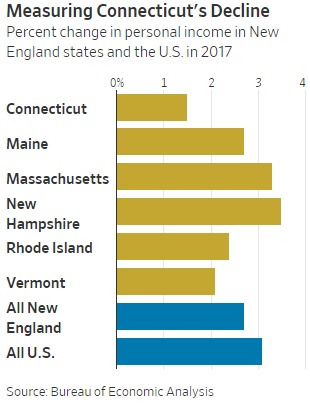
The 50 American states have long competed for people and business, and the 2017 tax reform raises the stakes by limiting the state and local tax deduction on federal returns. The results of bad policy will be harder to disguise. A case in point is Connecticut’s continuing economic decline, and now we have even more statistical evidence as a warning to other states. The federal Bureau of Economic Analysis recently rolled out its annual report on personal income growth in the 50 states, and for 2017 the Nutmeg State came in a miserable 44th. …the state’s personal income grew at the slowest pace among all New England states, and not by a little. …The consistently poor performance, especially relative to its regional neighbors, suggests that the causes are bad economic policies… In Mr. Malloy’s case this has included tax increases starting in 2011 and continuing year after year on individuals and corporations… It is a particular tragedy for the state’s poorest citizens who may not be able to flee to other states that aren’t run by and for government employees.
Here’s some of the data accompanying the editorial.


Eric Boehm nicely summarized the main lesson from the Malloy years in a column for Reason.
If it were true that a state could tax its way to prosperity, Connecticut should be on a non-stop winning streak. Instead, state lawmakers are battling a $3.5 billion deficit. Companies including General Electric, Aetna, and Alexion, a major pharmaceutical firm, have left the state in search of a lower tax burden. Connecticut is looking increasingly like the Illinois of New England: A place where tax increases are no longer fiscally or politically realistic, even though budgetary obligations continue to grow and spending is completely out of control.
Unfortunately, the new governor isn’t any better than the old governor. The Wall Street Journal opined on Ned Lamont’s destructive fiscal policy.
Connecticut desperately needs a new economic direction. Unfortunately, the biennial budget soon to be signed by new Gov. Ned Lamont doubles down on policies that have produced abysmal results.The state’s economic indicators are grim. Connecticut routinely ranks near the bottom in surveys of economic competitiveness. Residents and businesses have been voting with their feet. According to the National Movers Study, only Illinois and New Jersey suffered more out-migration in 2018. General Electric left for Boston in 2016. This week, Farmington-based United Technologies Corp. announced it too will move its headquarters… Mr. Lamont’s budget seems designed to accelerate the decline. It increases spending by $2 billion while extending the state’s 6.35% sales tax to everything from digital movies to laundry drop-off services to “safety apparel.” It adds $50 million in taxes on small businesses, raises the minimum wage by 50%, and provides the country’s most generous mandated paid family medical leave. Florida and North Carolina must be licking their lips. …The state employee pension plan is underfunded by $100 billion—$75,000 per Connecticut household. A responsible budget would try to start filling the gap; the Lamont budget underfunds the teachers’ plan by another $9.1 billion, increasing the long-term liability by $27 billion. …Mr. Lamont proposes to slap a 2.25% penalty on people who sell a high-end home and move out of state. Having given up on attracting affluent families, he’s trying to prevent the ones who are here from leaving.
As one might expect, all this bad news is generating bad outcomes. Here are some details from an editorial in today’s Wall Street Journal.
…as a new study documents, more businesses are leaving Connecticut as they get walloped with higher taxes that are bleeding the state. Democrats in 2015 imposed a 20% surtax on top of the state’s 7.5% corporate rate, effectively raising the tax rate to 9%. They also increased the top income tax rate to 6.99% from 6.7% on individuals earning more than $500,000. The state estimated the corporate tax hike would raise $481 million over two years, but revenue increased by merely $323 million… Meantime, the state’s Department of Economic and Community Development, whose job is to strengthen “Connecticut’s competitive position,” in 2016 alone spent $358 million…to induce businesses to stay or move to the state. This means that Connecticut doled out twice as much in corporate welfare as it raked in from the corporate tax increase. …Thus we have Connecticut’s business model: Raise costs for everyone and then leverage taxpayers to provide discounts for a politically favored few. …The state has lost population for the last five years. …The exodus has depressed tax revenue.
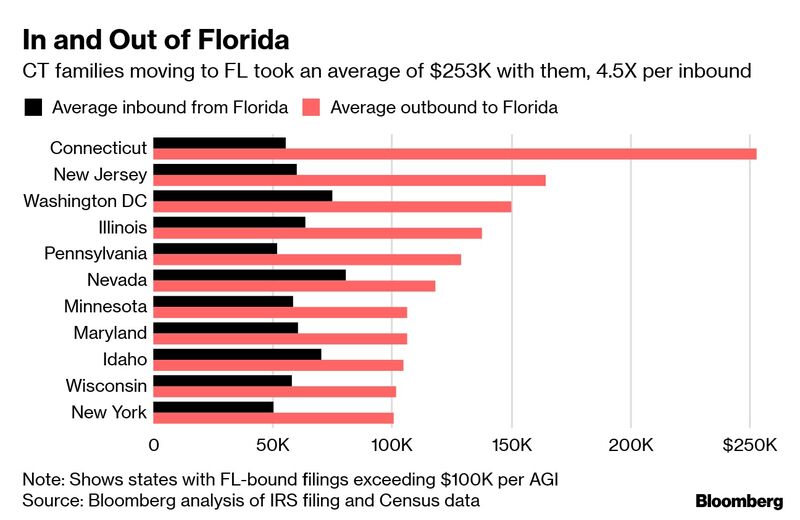
And there’s no question that people are voting with their feet, as Bloomberg reports.
Roughly 5 million Americans move from one state to another annually and some states are clearly making out better than others. Florida and South Carolina enjoyed the top economic gains, while Connecticut, New York and New Jersey faced some of the biggest financial drains, according to…data from the Internal Revenue Service and the U.S. Census Bureau. Connecticut lost the equivalent of 1.6% of its annual adjusted gross income, as the people who moved out of the Constitution State had an average income of $122,000, which was 26% higher than those migrating in. Moreover, “leavers” outnumbered “stayers” by a five-to-four margin.
Here’s a chart from the article showing how Connecticut is driving away some of its most lucrative taxpayers.


Here’s a specific example of someone voting with their feet. But not just anybody. It’s David Walker, the former Comptroller General of the United States, and he knows how to assess a jurisdiction’s financial outlook.
…my wife, Mary, and I are leaving the Constitution State. We are saddened to do so because we love our home, our neighborhood, our neighbors, and the state. However, like an increasing number of people, the time has come to cut our losses… current state and local leaders have the willingness and ability to make the tough choices needed to create a better future in Connecticut, especially in connection with unfunded retirement obligations. …Connecticut has gone from a top five to bottom five state in competitive posture and financial condition since the late 1980s. In more recent years, this has resulted in an exodus from the state and a significant decline in home values.
All of this horrible news suggests that perhaps Connecticut should get more votes in my poll on which state will be the first to suffer fiscal collapse.

Incidentally, that raises a very troubling issue.

The former Governor of Indiana, Mitch Daniels, wrote last year for the Washington Post that we should be worried about pressure for a bailout of profligate states such as Connecticut.
…several of today’s 50 states have descended into unmanageable public indebtedness. …in terms of per capita state debt, Connecticut ranks among the worst in the nation, with unfunded liabilities amounting to $22,700 per citizen. …More and more desperate tax increases haven’t cured the problem; it’s possible that they are making it worse. When a state pursues boneheaded policies long enough, people and businesses get up and leave, taking tax dollars with them. …So where is a destitute governor to turn? Sooner or later, we can anticipate pleas for nationalization of these impossible obligations. …Sometime in the next few years, we are likely to go through our own version of the recent euro-zone drama with, let’s say, Connecticut in the role of Greece.
And don’t forget other states that are heading in the wrong direction. Politicians from California, New York, New Jersey, and Illinois also will be lining up for bailouts.

Here’s the bottom line on Connecticut:


As recently as 1990, the state had no income tax, which put it in the most competitive category.
But then politicians finally achieved their dream and imposed an income tax.

And in a remarkably short period of time, the state has dug a big fiscal hole of excessive taxes and spending (with gigantic unfunded liabilities as well).

It’s now in the next-to-last category and it’s probably just a matter of time before it’s in the 5th column.

P.S. While my former state obviously has veered sharply in the wrong direction on fiscal policy, I must say that I’m proud that residents have engaged in civil disobedience against the state’s anti-gun policies.

Wednesday, October 24, 2018

Connecticut is circling the drain. Time for a change.

By Bill Lalor October 23, 2018

Connecticut Democrats' evasive campaigns are an insult to voters. Let's put this bluntly: the 2018 elections are as close as we will ever get to a referendum on Democratic economic policy in Connecticut. Voters are right to want answers. In spite of a economic and job boom across the country, Connecticut's "death spiral" is accelerating.

 Taxes keep going up, jobs are disappearing, and property values are in the tank. Connecticut's budget deficit in 2020 will be $1.9 billion; in 2021, it will be about $2.5 billion. Those are just pick-up notes to more staggering problems, as more taxpayers move out of the state and the death spiral accelerates.

Connecticut's mess is Democrats' to explain: they have controlled the state budget process for 38 of the last 40 years............Further, among Connecticut's all-Democrat delegation in Washington, those defending seats have held office an aggregate total of 72 years, including both the U.S. House and this year's contested U.S. Senate race.

If Democrat incumbents want to convince voters they can now fix Connecticut's unprecedented crisis, they ought to at least explain what they've been doing all these years. But Democrats are mostly avoiding their own records and, in large part, the voters.

The single most ruinous expense for Connecticut is public-sector union pensions......... Read more

Saturday, June 10, 2017

Paging Fox Butterfield: Another Jurisdiction Gets a Painful Lesson about the High Price of High Tax Rates

June 9, 2017 by Dan Mitchell @ International Liberty

Since I’m a fiscal wonk, it’s sometimes tempting to overstate the importance of good tax policy. So I’m always reminding myself that all sorts of other factors matter for a jurisdiction’s competitiveness and success, including regulation and government effectiveness (and, for national governments, policies such as trade and monetary policy).

That being said, taxes are very important. In some cases, you could almost say tax policy is suicidally important.

Here’s some of what the Wall Street Journal reported earlier this week.
Hartford, Connecticut…is edging closer to joining a small club of American municipalities: those that have sought bankruptcy protection. …The city must pay nearly $180 million on debt service, health care, pensions and other fixed costs in the coming fiscal year beginning July 1. That is more than half of the city’s budget, excluding education.
This sounds like a run-of-the-mill story about a city (like Detroit) that has spent itself into fiscal trouble, mostly because of a bloated and over-compensated bureaucracy.


But tax policy is the story behind the story. Here’s the headline that caught my attention.

As I’ve written before, this is the “Fox Butterfield” version of financial reporting (he’s the New York Times reporter who was widely mocked for repeatedly expressing puzzlement that crime rates fell when crooks were locked up).

Simply stated, it would be more accurate to state (just as it was in Detroit) that the city is in trouble “because of” high property taxes, not “despite” those onerous levies.

Imagine being a homeowner or business with this type of burden.
Since 2000, Hartford has increased its property-tax, or millage, rate seven times. The rate is now more than 50% higher than it was in 1998. At the current level, a Hartford resident who owns a home with an assessed value of $300,000 currently pays an annual tax bill of $22,287, at rate of 7.43%. A West Hartford homeowner with a similar house pays $11,853 at a rate of 3.95%.
Wow, you get to pay twice as much tax on your home simply for the “privilege” of subsidizing an inefficient and incompetent city bureaucracy (not to mention the problem of excessive state taxes).

No wonder some major taxpayers are escaping, leaving the city (and state) even more vulnerable.
…the impending departure of one of its biggest employers, Aetna Inc. …Aetna and the other four biggest taxpayers in the city contribute nearly one-fifth of the city’s $280 million of property-tax revenue. Property-tax receipts make up nearly half of the city’s general-fund revenues.
To make matters worse, the city exempts a lot of property owners, which is one of the reasons for higher tax burdens on those that don’t get favored treatment.
Half of the city’s properties are excluded from paying taxes because they are government entities, hospitals and universities. …In Baltimore, about 32% of the property is tax exempt, and in Philadelphia it’s 27%.
Excuse me if I don’t shed a tear of sympathy for Hartford’s politicians. The city is in dire straits because of a perverse combination of excessive taxation and special tax favors. Combined, of course, with lavish remuneration for a gilded bureaucracy.

That’s the worst of all worlds. It’s Detroit all over again. Or you could call it the local-government version of Illinois.

Needless to say, I don’t want my tax dollars involved in any sort of bailout.

P.S. Though it would be amusing if Hartford politicians thought this bailout application form was real rather than satire.