Search This Blog

De Omnibus Dubitandum - Lux Veritas

Showing posts with label Lawsuits. Show all posts

Thursday, September 4, 2025

"Stupidest Litigation" Update

@ Manhattan Contrarian

Suppose you had decided that the most important issue facing our planet was saving it from the possibility that some trace gas in the atmosphere, currently constituting about 0.04% of the air, might increase to 0.05%, or maybe even (oh no!) to 0.06%. What’s your strategy?

If you think like an environmentalist, the answer is simple: foment a barrage of civil lawsuits by states and municipalities against major oil companies, each seeking many billions of dollars in damages. The chance that such a strategy could ever have any measurable impact on the composition of the atmosphere is zero. However, with enough lawsuits from enough deep-pocketed plaintiffs, you could form an unstoppable juggernaut. Eventually you could coerce some gigantic settlement. Riches will be yours! It’s the American way.

And thus we have the Manhattan Contrarian series on what I have called the “stupidest litigations” in the country — the civil cases brought by states and municipalities, instigated by environmental advocates, against major oil companies, seeking multi billions on the ground that all extreme weather is caused by some tiny increase of CO2 in the atmosphere. My most recent update on this issue was more than four years ago, in April 2021. In the interim, the wheels of justice have been grinding slowly.

If you have the impression that this effort to change the world by civil litigation is some small or niche initiative, that impression would be completely wrong. This is a very large and very well-funded full court press intended to bring the oil companies to their knees. The very explicit model is the tobacco litigation of the 1980s and 90s. That litigation began as individual injury claims by smokers, but over time the states sensed the potential for major recoveries, and one by one they joined in the fray. A 1998 settlement with 46 states included a monetary payment of some $365 billion.

So how has Big Tobacco 2.0 been going? After many years of stalemate, the tide has recently been moving toward the oil company defendants.

The reasons are not hard to discern. Unlike with the tobacco litigations, there are no real injured parties, and nearly all of the claimed damage are based on hypothetical model predictions about future events. Perhaps more important to the specific litigation context, most of the conduct allegedly leading to damage has taken place outside the jurisdiction of the courts where the cases have been brought.

At the time of my 2021 update, the list of claims of this type — common law claims seeking damages from oil companies based on alleged climate impacts — included cases brought by the Cities of Oakland and San Francisco and County of San Mateo, California; the State of Massachusetts; the State of Rhode Island; the State of Delaware; the County of Boulder, Colorado; and the City of Baltimore, Maryland. Since then, the number of cases has continued to mushroom. For the list of cases I am relying on the U.S. Climate Change Litigation data base maintained by Columbia University. New filings have come from: in 2021, the City of Annapolis and Anne Arundel County in Maryland; in 2022, a group of municipalities in Puerto Rico, and the State of New Jersey; in 2023, Multnomah County (Portland), Oregon; in 2024, the State of Maine, Bucks County, Pennsylvania, and the City of Chicago; and just now in 2025, the State of Hawaii.

A big reason why the cases have been proceeding so slowly is that the state and municipality plaintiffs have almost all brought the cases in state courts; but the oil company defendants have sought to have the issues litigated in federal court. This leads to procedural maneuvering, where the defendants initially file a petition for “removal” in the state court, which puts the case in the federal court; but then the plaintiff moves to have the case “remanded” to the state court. Little by little, the states and municipalities have been winning the battle to have the cases proceed in the state courts. Their hope is that, once back in the state court, the case will be treated as a local matter of “nuisance” from emissions of a pollutant, without regard to the nationwide, and indeed worldwide, scope of CO2 emissions.

A big complication for the plaintiffs, as noted in my 2021 post, was that one such claimant, the City of New York, had brought a similar case, but had initiated it in federal court. This meant that the issue of whether the case could be “removed” to federal court never came up, and the case went straight to the issue of whether states had the power to regulate CO2 emissions under the rubric of common law “nuisance” in the face of the comprehensive regulatory scheme of the federal Clean Air Act. In the New York City case, the District Court dismissed the City’s claim, and the Second Circuit affirmed. This quote is from the Second Circuit’s 2021 opinion:

Such a sprawling case is simply beyond the limits of state law.  To start, a substantial damages award like the one requested by the City would effectively regulate the Producers’ behavior far beyond New York’s borders.  Since “[g]reenhouse gases once emitted ‘become well mixed in the atmosphere,’” . . . “emissions in [New York or] New Jersey may contribute no more to flooding in New York than emissions in China,” . . .   Any actions the Producers take to mitigate their liability, then, must undoubtedly take effect across every state (and country).  And all without asking what the laws of those other states (or countries) require.  Because it therefore “implicat[es] the conflicting rights of [s]tates [and] our relations with foreign nations,” this case poses the quintessential example of when federal common law is most needed. . . .

As I noted in my 2021 post, “[T]he Second Circuit has laid down a marker that every state court that gets one of these cases will now need to deal with.” 

And with that background we come to the latest updates, from two of the deepest blue states. The Superior Court of New Jersey, Mercer County, dismissed the New Jersey claims in an opinion back in February. The main precedent cited was the Second Circuit’s opinion in the New York City case:

This court’s decision is reliant upon and consistent with both federal and state courts across the country that have rejected the availability of state tort law in the climate change context. See City of New York v. Chevron Corp., 993 F.3d 81 (2d Cir. 2021) (“City of New York”). . . .

The Columbia climate change litigation data base does not provide further information as to whether that decision has been appealed.

Meanwhile, in January this year, the Circuit Court of Anne Arundel County, Maryland, dismissed the claims of Anne Arundel County and of the City of Annapolis. That court again relied substantially on the Second Circuit’s decision in the City of New York case, as well as a prior dismissal in July 2024 of the City of Baltimore case by another Maryland state court judge.

The Maryland cases are now on appeal to the Supreme Court of Maryland. This post at eidclimate.org has excerpts from amicus briefs filed by the U.S. Department of Justice and by 24 Attorneys General (of red states) supporting affirmance of the dismissal. From the DOJ amicus brief:

“Extending Maryland law to redress climate-related harms caused by activities that overwhelmingly occurred beyond state and international borders would override policy choices made by the federal government and Maryland’s sister states.” (emphasis added) 

From the amicus brief of the 24 states:

“State and local governments cannot regulate the global atmosphere…no one State can ‘enforce its own policy’ on the others.” (emphasis added)

Hard as it may be to believe, the environmental lawyers hoping for a gigantic payday from this Tobacco 2.0 effort may well come up with nothing to show for it. We’ll see how the Maryland Supreme Court rules. But then, if that court comes out the opposite way from the Second Circuit, there will likely be a trip to the Supreme Court thereafter. The unstoppable juggernaut of environmental lawfare may turn out to be not so unstoppable after all.

Wednesday, August 6, 2025

Sex Abuse Settlements Bankrupt Democrat States

By Daniel Greenfield @ Sultan Knish Blog

Los Angeles County is struggling with a massive budget crunch.

Sales taxes are rising to over 10% in some areas and many departments are being cut down the line over what Fesia Davenport, the county’s first black female CEO, has described as “unprecedented financial challenges” and “extraordinary budgetary pressures.”

But those challenges are not coming so much from the massive wildfires that devastated Los Angeles over the winter, but from the even more massive tide of sexual abuse complaints.

Los Angeles County is dealing with $2 billion in costs from the wildfires, after the city’s first black female mayor and first lesbian fire chief badly mishandled the blazes, but the $4 billion in sex abuse settlements are double the worst fires in the area’s history.

What does it say that sex abuse lawsuits have done twice as much damage to LA as the fires?

That $4 billion settlement over alleged abuses in county juvenile halls and foster homes, the largest in the county’s history, makes up nearly 9% of the county’s $47.9 billion budget.

And the bad news has just begun to arrive from the nearly 7,000 sex abuse claims filed so far.

“This is not a one-year, not even a one-decade impact. We anticipate that we will be paying hundreds of millions of dollars every year until 2030, and then millions more each year through fiscal year 2050,” Los Angeles County CEO Davenport warned.

Paying off the sex abuse claims from as far back as 40 years ago will require LA to issue bonds, divert money from reserve funds and make deep cuts in its budgets for the next 25 years.

And that’s not even the end of it.

The $4 billion is a group settlement which does not include all possible plaintiffs. Side negotiations are still taking place with more lawyers who want even more money. County lawyers had previously warned that “If all those cases were to proceed to verdict, the estimated liability could be in the tens of billions of dollars and bankrupt the county.”

Since Assembly Bill 218, which lifted the time limit on sex abuse lawsuits, is a state bill, Los Angeles could be the first of multiple California counties hit with multi-billion dollar bills.

An LA Times article called it as “a looming threat” that “could bankrupt California counties” and reported on a claim by Ventura County lawyers that it “threatens the ‘financial viability’ of every county and public school district in California” and represents a “statewide crisis”.

If a major red state were facing bankruptcy over decades of sex abuses, it would be a huge national story that the media would cover as indicative of the rot in its culture, but since the events are taking place in the bluest part of California, they remain a local story.

And yet Los Angeles County is not the only liberal area in the country being bankrupted by sex abuse settlements. The entire state of Maryland which is in a sex abuse crisis mode.

Like Los Angeles, Maryland unleashed a tidal wave of sex abuse claims by passing a law lifting time limits for sex abuse lawsuits against the state. And then quickly regretted it.

Maryland’s Child Victims Act was only passed in 2023, but legislators rushed to shut it down after it was estimated that the state was facing $4 billion in liabilities.

The same Democrat legislators, under Gov. Wes Moore, who had bragged about their passage of the Child Victims Act, corruptly rushed through a ‘fix’ through the state House, Senate and to Gov. Moore’s desk in a record two days to cover themselves. The ‘fix’ caps settlements for government institutions at $400,000 (and $700,000 for private ones) because, as Del. David Moon (D) explained, the state of Maryland “does not have the option of bankruptcy”.

Sen. Will Smith (D) explained that the ‘fix’ to the bill he had voted for was urgently needed because what “we could never have anticipated was just the sheer volume of cases that ensued”.

A state facing sex abuse bankruptcy and hypocritically rushing through a cap at the last minute should have been bigger news, but once again the national media tried to keep it quiet.

Why did California, Maryland and other state legislatures open the door to these lawsuits?

Democratic legislators were lobbied by politically connected law firms, often using alleged ‘victims’ as a front, with the promise of scoring big payouts from the Catholic Church. California and Maryland officials had been warned that they were exposing their states to untold billions in liability over accusations from a generation ago that could not be defended against.

The dirty little secret of the accusations is how few of them can even be verified.

With over 7,000 claims and over $4 billion in payouts so far, it would seem reasonable that hundreds of sex abusers had also been named and are being arrested and prosecuted.

The actual number in Los Angeles is 2. Not 2,000 or 200. Only 2.

As of 2023, the LA County DA’s office was reviewing the cases of two men, one of whom had allegedly groped a 17-year-old back in 2006, among 21 employees who had been placed on leave. As of now, there has yet to be any word of action actually being taken against them.

Either 2 men, or at best 21, molested thousands of teens, or there has been a massive failure of accountability. But more likely the actions of the California legislature unleashed a massive fraud. Local TV channels were filled with ads for lawyers promising big payouts and the lawsuits could be filed based on little to no evidence based on events that had happened in the 1980s.

One law firm, bragging that it was part of the “$500 million club” of the “National Academy of Sexual Abuse Lawyers” (no such organization appears to exist) even solicited clients by offering “cash advances” on their cases. Plaintiffs could get money just for making an allegation.

Lawsuits could be filed even if there had been no complaint, arrest or prosecution at the time of the alleged abuse. Little more was needed than the word of an individual and perhaps ‘corroboration’ from one of their friends. While there were real abuses and real victims, the wave of thousands of complaints made them all but impossible to seriously investigate.

AB 218 was proposed by Assemblymember Lorena Gonzalez-Fletcher, whose husband, a former fellow assemblyman, had to step down after being sued for sexual assault. Law firms and lawyers represent a not insignificant part of her donor base. And that of many politicians.

While the law firms expect to reap a fortune from these lawsuits, it’s unclear how much the victims, real or fictional, will even end up with, but most of it will go to the ambulance chasers.

Contingency fee rates fall between 33% to 60% of most such settlements. With the species of aggressive law firms spending millions on marketing alone, it’s a safe bet that the fee rate will be on the higher side and that at least $2 billion of the $4 billion settlement will go to the lawyers.

But the more likely scenario is that the law firms will take a majority of the cash.

Any actual victims will have to split the money with an army of fraudsters drawn by the ads and will receive a tiny percentage of the settlement after the lawyers and scam artists cash in. After the lawyers take 60% and the 70% of scammers take the rest, the victims may be left with 12%.

The law firms can be expected to pass the money back to the California legislators who enabled their money grab. While counties raise taxes and local schools cut services, the politicians responsible for this planned disaster will see contributions to their campaigns and ‘dark money’ donations to their 501(c)(3) social welfare nonprofits from those same law firms.

The politicians, some of who have turned a blind eye to sexual harassment in their own offices and among their own allies, will tell taxpayers that they need to pay more in the name of justice.

And life in California will get worse while those destroying the state will get even richer.

Daniel Greenfield is a Shillman Journalism Fellow at the David Horowitz Freedom Center. This article previously appeared at the Center's Front Page Magazine. Click here to subscribe to my articles. And click here to support my work with a donationThank you for reading.


Saturday, May 18, 2024

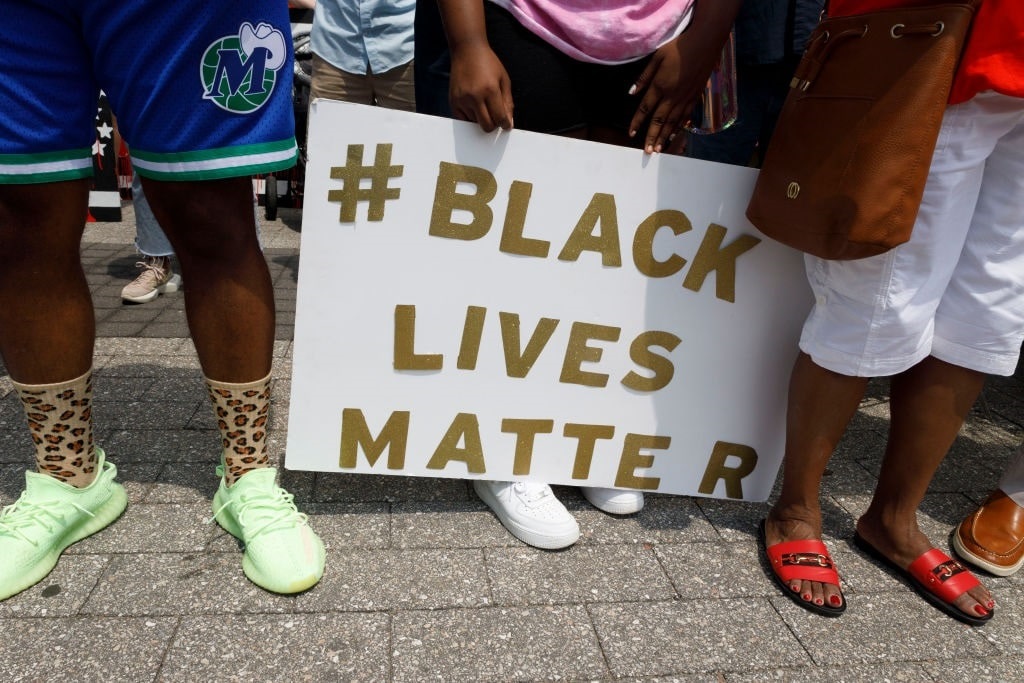
Gutted BLM Sues Soros-Connected Dark Money Group

Is a door about to be opened into the shadowy world of big-bucks radical activism?

Having squandered all the money, BLM is now lashing out at one of its biggest Sugar Daddies. After somehow blowing through more than $90 million in corporate donations, “Black Lives Matter Global Network Foundation Inc. [BLMGNF] is suing in California state court its one-time partner, the Tides Foundation, saying the fund is withholding and has ‘egregiously mismanaged’ more than $33 million in donations earmarked for Black Lives Matter,” Bloomberg Law reported May 7.

The first thing that needs emphasizing is that Tides is a crucial conduit in notorious progressive billionaire George Soros’ dark money spider web. Soros gave Tides more than $20 million from 1998 to 2018, watchdog website Influence Watch stated.

BLM +Tides = Soros

In July 2020, as the Summer of George Floyd was rampaging across America, Tides partnered with BLM. “Tides Foundation has launched the Black Lives Matter Support Fund, which will support BLM’s grantmaking activities,” Tides announced in a statement. “This unique partnership will further amplify the extraordinary, unparalleled successes of BLM’s chapter-led, decentralized organizational model, while also allowing BLM to build the necessary infrastructure for sustainability.”

That sustainable infrastructure never materialized. Amazingly, despite all the trendy corporate and philanthropic cash thrown its way, by 2023 BLM Global was facing bankruptcy. Where did all the money go? BLM Global leaders splurged on luxury homes, hired friends and associates for lucrative “contracting” positions, and have been accused of treating the organization’s coffers as their personal piggy bank.

Now that the intoxicating ride is over, the BLM bigwigs are turning on the hugely influential Tides operation. “Tides Foundation, which has managed hundreds of millions in donations for progressive groups since it was founded in 1976, has ‘refused to honor its promises and continues to commandeer BLMGNF’s donations,’ according to the 285-page lawsuit filed in California Superior Court, Los Angeles County, on [May 6],” The New York Post detailed.

Wouldn’t it be interesting if BLM is the flawed instrument that ends up exposing the murky underbelly of Soros’ infamous dark money network?

‘Tides Operates With Minimal Regulatory Scrutiny’

“Tides has engaged in deceptive business practices and has operated in a quasi-banking capacity without appropriate regulatory oversight of licenses,” the BLMGNF lawsuit asserted, as The Post reported. “Tides operates with a level of autonomy and minimal regulatory scrutiny that is starkly at odds with the regulatory framework imposed on traditional financial institutions,” BLM claimed. Strong words.

“Tides manages over $1.4 billion in assets – more than many regulated community banks – allegedly acting like a bank without licensing, while preying on black- and brown-led organizations, according to the complaint,” Bloomberg Law related.

“Tides benefits at the expense of black- and brown-led charitable organizations, whose assets the fund holds, by charging donors a disproportionately large percentage for each contribution in fees, according to the complaint,” Bloomberg continued. Very interesting. Can we get comment from Soros on that?

No matter how the BLM suit plays out, Tides is in a mess of its own making. It fully got into bed with Patrisse Cullors, the BLM co-founder who was forced to step down from her leadership post in 2021 after being accused of numerous major financial irregularities.

“At the individual level, people can get involved by buying black,” Cullors told Tides in a fawning February 2021 interview posted on the Tides website. “Shop at your local black-owned small business, support black creators, and consider donating to black movements and organizations across the country. Look to your workplace and ask: Are we supporting the movement?”

Around the same time she was saying these things, BLM Global was reportedly purchasing mansions in Los Angeles and Toronto and paying the father of Cullors’ child $970,000 to “produce live events” and provide “creative services.”

Wasn’t Black Lives Matter supposed to help all black communities?

Wouldn’t it be ironic if Soros’ modus operandi ends up finally shedding much-needed light on what wiggles and crawls beneath the jagged rocks holding up his empire?

Read More From Joe Schaeffer

Wednesday, February 28, 2024

Mann vs Steyn: That Judgment Was a Constitutional Disaster

By Rich Kozlovich

Last Thursday, February 8, 2024, a Washington, DC jury found Mark Steyn need to pay Michel E. Mann a million dollars, because of loses he didn't show, couldn't show, and didn't have.  Just like the Trump trials in New York, where he was prevented from defending himself, and was accused of fraud, found guilty of fraud, and there wasn't any accuser.  The corruption of the New York, and the DC jury pools, the prosecutors, and the judges is beyond description. 

The DC Superior Court entered the jury's verdict in final judgment, and Steyn shows what happens next:

What happens now? Well, in the next few weeks, there will be certain "renewed" motions from defendants that one is obliged to do, although they are highly unlikely to find favor with Judge Irving. After that, the case will be appealed by all parties - loser Steyn because he wants the decision overturned, and winner Mann because he wants the original corporate defendants, National Review and the Competitive Enterprise Institute, put back in the dock. (Irving, the "fifth trial judge", dismissed them from the case a couple of years back.)

The DC Court of Appeals, being the way it is, is likely to accede to Mann's wishes, but not Steyn's. How long that will take is hard to say, but, given the length of the last merely "interlocutory" appeal, it's unlikely to be quick. At that point, Mark will go to the US Supreme Court. A minimum of four out of nine judges is required to grant a writ of certiorari and hear the case. As Amy K Mitchell noted on Friday, one of them, Samuel Alito, grasped the implications of Mann vs Steyn half-a-decade back:

The petition in this case presents questions that go to the very heart of the constitutional guarantee of freedom of speech and freedom of the press: the protection afforded to journalists and others who use harsh language in criticizing opposing advocacy on one of the most important public issues of the day. If the Court is serious about protecting freedom of expression, we should grant review.

Justice Alito also foresaw the DC Jury's verdict:

The controversial nature of the whole subject of climate change exacerbates the risk that the jurors' determination will be colored by their preconceptions on the matter. When allegedly defamatory speech concerns a political or social issue that arouses intense feelings, selecting an impartial jury presents special difficulties. And when, as is often the case, allegedly defamatory speech is disseminated nationally, a plaintiff may be able to bring suit in whichever jurisdiction seems likely to have the highest percentage of jurors who are sympathetic to the plaintiff 's point of view.

To emphasize just how dangerous this verdict was, Steyn goes onto quote others saying:

On that last point, Steve from Manhattan, a Steyn Clubber who attended the early part of the trial, notes:

The official court docket includes handwritten notes to the judge from the jury. I decided today to look at a few of them. Here is a note from one juror to the judge that was filed on January 18th:

'It is well known for my family and friends that I am not a fan of fox news. I wanted to inform the judge [indecipherable] to the sensitivity of this case. I did not recognize the defendant as a fox news host until opening statements.'

Needless to say, this person remained on the jury and voted for a $1 million punitive damages verdict—after recognizing Mark Steyn as a Fox News host.

The official court docket includes handwritten notes to the judge from the jury. I decided today to look at a few of them. Here is a note from one juror to the judge that was filed on January 18th:

'It is well known for my family and friends that I am not a fan of fox news. I wanted to inform the judge [indecipherable] to the sensitivity of this case. I did not recognize the defendant as a fox news host until opening statements.'

Needless to say, this person remained on the jury and voted for a $1 million punitive damages verdict—after recognizing Mark Steyn as a Fox News host.

 As Denyse O'Leary puts it in our comments section:

Many people don't understand how serious the problem of Steyn's defeat by the climate lobby is. Let me help:

It becomes risky to criticize climate change claims, no matter how questionable. At at time when governments contemplate destroying agriculture and confining people to within fifteen minutes of their homes in order to fight climate change, any number of whackjob theories will be promoted, always protected by fear of successful legal action against critics.

This at a time when I keep seeing articles whizzing through the science media about the growing problem of questionable or fraudulent research - that the Top People are always "going to" do something about...

Picture the Covid Crazy cubed. If we keep silent and do nothing at this point, we will *earn* a great deal of it. Better to fight the Crazy now.

This verdict is a massively dangerous precedent against the most important foundational level of American law.  The Constitutional rights under the First Amendment, freedom of speech.   

We really need to get that, and we really need to bring the federal judiciary under control with term limits and Congress needs to exercise their constitutional authority in determining the jurisdiction of the federal judiciary, with the exception of what's called original jurisdiction and defining that can get messy. 

Saturday, December 9, 2023

My Gazette: AG Ken Paxton Lawfare

By Rich Kozlovich
 
I save an inordinate number of articles dealing with every issue facing humanity.  I save them with the intention to use them in my own commentaries as source material.  But, after a while my draft files get really big and while I still want to have that materiel for reference, I have to purge those files.  So, I've decided to start a weekly series of Gazettes.  I will be publishing a "Gazette" dealing with each issue regularly, and I will insert "My Take " along the way.  Draft file purged, material saved. 

Warming: Some of these draft articles go aways back, and while that may be tiresome, it will also lay out a historical pattern.   

Lawfare, the misuse of America's judicial system and rule of law by the left has been out of control.  Expensive to defend against SLAPP suits to shut up those who disagree, another form of censorship, and this has been going on for a long time. It's now out of control.  We see the Trump situation, but there are others, including Texas Attorney General Ken Paxton.  They impeached him to get him out of the AG position, and that failed, so he's back, and he's not going to let all this go.  

One more thing.  

For some time I've been saying if Trump is elected he needs to hire an Attorney General with a mad dog in a meat market mentality to purge the Deep State traitors.  I think this is the guy!

Let's start here: 

Texas Attorney General Puts Critics, Biden, and Google in Crosshairs After Impeachment - by John Solomon - Two months after crushing a rushed effort to impeach him, Texas Attorney General Ken Paxton is plotting a dual tsunami designed to politically punish those in the Legislature who tried to remove him from office while putting Google, President Joe Biden and other liberal foes into his legal crosshairs....[he] made clear the impeachment travails he survived have only increased his resolve to reshape politics and the law in Texas. And he thinks GOP voters in the state are motivated to join the fight................

My Take - I believe the pharmaceutical companies have been behind what in my opinion has to be criminal activity trying to cover their lies and misrepresentation regarding these gene altering chemical compounds they're calling vaccines.  I also wonder if the attacks against Paxton didn't originate there. Speculation, I know, but I do wonder. RK

After Getting Hit With a 'Thermonuclear Lawsuit,' Media Matters Is Now Being Investigated by Texas Leah Barkoukis  |  November 21, 2023 10:00 AM Texas Attorney General Ken Paxton opened an investigation into Media Matters after the left-wing media watchdog group published a report last week alleging ads on X from top corporations were running “alongside white nationalist and pro-Nazi" content. Texas Attorney General Ken Paxton opened an investigation into Media Matters after the left-wing media watchdog group published a report last week alleging ads on X from top corporations were running “alongside white nationalist and pro-Nazi content." .....

Attorney General Ken Paxton Files Lawsuit Against Pfizer and Tris Pharma Over Medicaid Fraud and Distribution of Adulterated Drugs to Texas Children - In a bold move to address corporate malpractice in drug manufacturing, Texas Attorney General Ken Paxton has announced the filing of a lawsuit against pharmaceutical giants ​Pfizer, Inc., ​Tris Pharma, Inc., and ​Tris Pharma CEO Ketan Mehta. The companies are accused of engaging in deceitful practices that resulted in defrauding the ​Texas Medicaid program by providing adulterated pharmaceutical drugs specifically designed for children. The lawsuit, brought forth by the Attorney General’s Civil Medicaid Fraud Division, leverages the provisions of the Texas Health Care Program Fraud Prevention Act (THFPA). Paxton’s office stated that Pfizer and Tris Pharma collaborated to produce and distribute Quillivant XR, a medication developed for pediatric attention-deficit/hyperactivity disorder (ADHD), despite recurring failure in quality control assessments..........

Attorney General Ken Paxton Launches Investigation into “Radical Anti-Free Speech Organization” Media Matters Over Fraudulent Activity - On Monday, X (formerly Twitter) filed a federal lawsuit against Media Matters and Eric Hananoki in the Northern District of Texas. “Media Matters knowingly and maliciously manufactured side-by-side images depicting advertisers’ posts on X Corp.’s social media platform beside Neo-Nazi and white-nationalist fringe content and then portrayed these manufactured images as if they were what typical X users experience on the platform,” according to the lawsuit. The complaint added, “Media Matters has opted for new tactics in its campaign to drive advertisers from X. Media Matters has manipulated the algorithms governing the user experience on X to bypass safeguards and create images of X’s largest advertisers’ paid posts adjacent to racist, incendiary content, leaving the false impression that these pairings are anything but what they actually are: manufactured, inorganic, and extraordinarily rare.”...........
 
My Take - Well, it appears that didn't sit well with the left, and they're at it again. RK
 
Texas’s conservative attorney general in the left’s legal crosshairs againNovember 26, 2023  By Amil Imani - This is nothing but a witch hunt, and yet again, Ken Paxton, Texas’s attorney general, finds himself at the epicenter of a protracted legal saga.  But Paxton stands resilient.  At the heart of the controversy lies the presumption of innocence until proven guilty, a foundational principle of our justice system.  Legal challenges, rather than evidence of wrongdoing, are seen as an integral part of a fair process, underscoring the importance of due process in pursuing justice. The absurd claim is that Paxton defrauded investors by encouraging them to fund a tech startup.  The twist lies in the assertion that, unbeknownst to the investors, Paxton was receiving financial compensation for promoting the venture. Paxton pleaded not guilty.  He unequivocally asserts that the charges against him, which have lingered since 2011, are entirely fabricated.  Despite the passage of time, he contends that the statutes of limitations on certain issues have been exceeded while simultaneously arguing that the laws in question were never applicable to him in the first place.............

Saturday, November 18, 2023

CFACT issues “intent to sue” over offshore wind, releases new study

November 16th, 2023 @ CFACT

This week CFACT, partnering with The Heartland Institute, filed their joint intent to bring a lawsuit against the Bureau of Ocean Energy Management (BOEM) and the National Marine Fisheries Service (NMFS) for abrogating their responsibility to protect the endangered Right Whale from the rush to construct wind turbines.

CFACT issues “intent to sue” over offshore wind releases new study

As we state in our press release, “The North Atlantic right whale is listed as ‘critically endangered’ by 

the governments of both the Commonwealth of Virginia and the United States. Numerous studies by federal and environmental organizations have found that only about 350 North Atlantic right whales remain in existence.”

Unprecedented numbers of whales have been found dead along our coasts as wind turbine construction proceeds.  BOEM released its “biological opinion,” giving Dominion Energy a green light to proceed with building its 2,600 MW Coastal Virginia Offshore Wind (CVOW) project 27 miles off Virginia Beach. This biological opinion has numerous pitfalls, including a failure to rely upon the “best available science” and employing a piecemeal approach to assessing risk to marine mammals that minimizes their actual lethality.

If bureaucrats refuse to do their jobs, we aim to force them!

To make matters worse, the Biden Administration’s energy strategy is terribly misguided in claiming offshore wind will meaningfully reduce greenhouse gas emissions.  CFACT released a study this week which concludes, among other things, that “the net ‘carbon’ (carbon dioxide) reduction effects of offshore wind development are hugely negative and cannot justify further investments in this industry.”

You can read the entire study by David Wojick, Ph.D., and CFACT senior policy advisor Paul Driessen at CFACT.org.

The verdict is in regarding offshore wind. When one considers the incredible costs, its threat to the power grid, and the potentially severe threat to marine life, the way forward is simple…

Stop building offshore wind.


Monday, October 23, 2023

The Connecticut Green Amendment after Held v. Montana

By October 22nd, 2023 31 Comments @ CFACT

By David Fleming:

A recent Montana court decision on environmental rights may soon have significant legal and economic implications on Connecticut, especially if the state adopts a “green amendment.”

On Aug. 14, Montana District Court Judge Kathy Seeley ruled in favor of 16 “youth plaintiffs” (between the ages of 5 and 22), who argued in Held v. Montana that the state legislature had violated their constitutional rights by passing legislation friendly to fossil fuels in recent years.

Two particular policies drew the plaintiffs’ ire. Since 2011, the Montana legislature has forbidden state agencies from considering the cost of carbon emissions for economic development under the Montana Environmental Policy Act (MEPA). And this past April, the state legislature repealed the Montana Energy Plan, which had “promote[d] energy efficiency, conservation, production and consumption of a reliable and efficient mix of energy sources” since 1993.

The plaintiffs argued that these recent actions were taken without consideration for the environmental rights of residents, especially those of younger generations.

The case will likely be appealed to the Montana Supreme Court, but one thing is clear: climate decision-making through the judiciary suddenly looks more viable than just a few months ago. Since at least 2010, young persons from across the country have attempted to sue the federal and state governments over a perceived lack of action surrounding climate change. Until now, those attempts were never successful.

Even with a supermajority in the House and Senate, Connecticut legislators have been reluctant to seriously consider impeding economic development dependent on fossil fuels en masse. Therefore, finding one sympathetic judge would be a much easier lift for Connecticut’s environmental activists than convincing dozens of legislators.

The probability of beating the government through climate litigation on a state-by-state basis hinges in large part on two factors. First, the right to environmental protection as outlined in a state’s constitution. Second, having state-based environmental planning requirements that mirror the federal National Environmental Policy Act.

Connecticut is one of 20 states with such planning requirements, making it an attractive judicial target. The Connecticut Environmental Policy Act (CEPA) was enacted in 1972 and “requires every state agency to develop a list of agency actions that have significant impacts on the environment, and it provides a process by which those agencies review their proposed actions to determine whether to move forward with them in light of the effects on the environment.”

On the other hand, Connecticut is also one of 43 states that do not have environmental rights enshrined in the state constitution in some form. Therefore, the state is less vulnerable than Montana to judicial challenges in regards to constitutional language — at least for now.

In 1972, Montana rewrote their constitution to include some rather progressive provisions. Article IX, Section 1 of Montana’s Constitution declares, “The state and each person shall maintain and improve a clean and healthful environment in Montana for present and future generations. (2) The legislature shall provide for the administration and enforcement of this duty. (3) The legislature shall provide adequate remedies for the protection of the environmental life support system from degradation and provide adequate remedies to prevent unreasonable depletion and degradation of natural resources.”

Montana’s Article IX sounds incredibly similar to the “green” amendment proposed in Connecticut’s last legislative session:

“Each person of the state of Connecticut shall have an individual right to clean and healthy air, water, soil and environment; a stable climate; and self-sustaining ecosystems; for the benefit of public health, safety and the general welfare. The state shall not infringe upon these rights. The state shall protect these rights equitably for all people regardless of race, ethnicity, tribal membership status, gender, socioeconomics or geography. The state, municipalities, and any political subdivision thereof, shall serve as trustee of the natural resources of Connecticut, among them being its waters, air, flora, fauna, soils, and climate; and shall conserve, protect, and maintain these resources for the benefit of all people, including present and future generations. The rights stated in this section are inherent, inalienable, and indefeasible, are among those rights reserved to the people, and are equivalent with all other inalienable rights.”

Legal experts ascribe much of the ruling’s success to Montana’s clear constitutional language regarding environmental rights.

If Connecticut were sued successfully in court along climate lines, many construction projects could become dependent on judicial outcomes. This could further slow an economy that just regained all the jobs it lost during Covid.

A host of difficulties immediately emerge when “positive rights” — which require sacrifices by or resources from others, rather than just a guarantee of noninterference by government — are extended to something so nebulous as “environmental rights.” This is especially true when the science and politics of climate change comes into play.

As a hypothetical but plausible scenario if the amendment is enacted, Connecticut Resident 1 might enjoy uninhibited views of landscapes and wildlife from her back porch. However, Connecticut Resident 2 could emphasize his “right to a stable climate” as a reason to import solar panels and wind turbines into that pristine landscape. At this point, it would be entirely up to the discretion (and political leanings) of the judge to rule in one resident’s favor.

As it stands now, after Montana’s ruling, Connecticut is vulnerable to climate-based litigation. Passing the green amendment would only accelerate the likelihood of climate litigation and set up a showdown between economic development and the loudest anti-development voices on the fringes of Connecticut discourse.

David Flemming joined the Yankee Institute in April 2023 after working for five years as an energy policy analyst at the Ethan Allen Institute in Vermont. 

This article originally appeared at Real Clear Energy

Author


Saturday, October 14, 2023

A Visit To The Trump Civil Fraud Trial

October 12, 2023 @ Manhattan Contrarian 

One of the benefits of living in Manhattan is that there are many interesting things to go and see. For example, there are lots of plays, concerts, museums, and even the occasional political show trial. Today, I thought I might stop by the state government’s civil fraud trial against ex-President Trump, to see how it’s going. The trial, now nearing the end of its second week, is taking place at the main state courthouse at Foley Square in Lower Manhattan.

The last time I dropped in on a political trial in Manhattan, it was the New York AG’s case against Exxon for supposedly defrauding its investors by using different valuation methodologies to assess projects for internal versus external corporate purposes. I covered that trial in an October 2019 post titled “A Serious Contender For The Stupidest Litigation In The Country Goes To Trial.” The AG quickly lost that case ignominiously, which I covered in a further post in December 2019.

Is this case any better? If you haven’t been following this closely, here’s the short version of where things are. After making a campaign promise to get Trump in any way she could using the powers of her office, state Attorney General Letitia James then spent several years in a massive investigation to try to figure out something, anything, to charge him with. She never came up with any criminal charge, but ultimately filed civil claims accusing Trump of fraud by inflating the value of his assets in obtaining loans from banks. 

The loans in question have always been fully performing, which make these claims of fraud highly unusual if not completely unique in the annals of American law. But New York has a business “fraud” statute that deems that there can be fraud on the sole element of a misrepresentation (in other contexts, a charge of fraud requires multiple additional elements, including materiality, reliance, intent, and damages). Shortly prior to commencement of the trial, the Judge (Arthur Engoron of the New York State Supreme Court) granted what is known as “summary judgment” (i.e., final judgment without need for trial) to the AG on the intent-and-reliance-free fraud claim. But some additional claims, that can entail additional remedies if additional elements are proved, remained for trial.

When I got to the courthouse around 10 AM, there was a lot of beefed-up security to get in, but not a single person was waiting in the security line. So I breezed through, and headed up to the courtroom. At the courtroom (number 300 on the third floor) there were metal barricades and several guards. You needed a special New York State “secure pass” (available for lawyers) to get in — but I had one! (If you didn’t have one, they had a second courtroom on the floor below with a livestream playing.)

When I walked in, the first thing I noticed was that the lead lawyer for the AG’s office at counsel table was the exact same guy who had been the lead lawyer in the case against Exxon four years ago — one Kevin Wallace. I guess this guy gets all the good assignments. At least they didn’t hold the disaster in the prior case against him.

On the witness stand, a guy named Nicholas Haigh was testifying on cross-examination by one of Trump’s lawyers. It emerged that Haigh was the lead guy at Deutsche Bank who had been responsible for the review of Trump’s creditworthiness for the loans in question, and had signed off on annual credit review reports. During the time I was there (a little under two hours), Haigh was taken through the DB credit reviews for 2013, 2014 and 2015.

I had not seen the direct, which had taken place the prior day. There are a few reports on that direct testimony — including this one at Mother Jones — which indicate that Haigh’s testimony supported the AG’s claims at least to some extent.

However, I would characterize the portion of the testimony that I saw as surreal. The DB credit review documents — shown in the courtroom on a screen — contained charts of the values of properties that were used as collateral for the loans in question. The charts had two columns for the values, one supplied by the client, and the other supplied by DB’s own “Valuation Services Group.” The latter values were uniformly lower.

It emerged that certain terms of the loan depended on what was referred to as the “loan-to-value ratio.” For example, Trump had a personal guarantee for a portion of the loan balance (not all of it), and as the loan-to-value ratio got lower, the percentage Trump was required to guarantee personally dropped. But when computing the loan-to-value ratio for such purposes, the values provided by the DB Valuation Group, not those provided by Trump, were used. No surprise for me there. 

I have never heard of a bank taking the borrower’s word for the value of the property, and at least as far as the testimony I watched today, that was uniformly the case. Maybe there were exceptions to that in the direct testimony that I did not see. On the other hand, I would find it very hard to understand why Deutsche Bank, with its own Valuation Services Group, would take the word of a borrower as to valuation for any purpose.

At one point Judge Engoron got annoyed at Trump’s lawyer, who was asking the witness whether these loans were at all times fully performing. Engoron said (paraphrase) “I already said in my summary judgment opinion that the loans were all fully performing.” I guess Trump’s lawyers shouldn’t have been wasting his time on such trivial matters.

Anyway, it looks to me like the fix is in on this one for the AG at the trial level. It is a bench trial, without a jury, so Engoron is the sole decider. However, the Appellate Division will get its say next. I am hopeful that that court is not yet fully politicized, but in today’s New York I would not have any confidence.

Tuesday, June 20, 2023

Courtroom Setback for the Climatistas?


In Maine Lobstermen’s Association v. National Marine Fisheries Service (NMFS), the court reviewed a proposed scheme of the NMFS to step up regulation of the lobster fishing industry under the authority of the Endangered Species Act in the northeast because lobster fishing was thought to be a growing threat to right whales.

But the NMFS was not able to attribute many deaths of right whales directly to lobster or crab fishing (maybe they should have a look at offshore wind power installations, except those are sacred as we know), and instead rested their case for increased regulation on extreme projections of possible future harms. The likelihood is that large areas of lobster habitat would be simply closed off to the lobster fishing industry (and yet likely remain available for wind power, of course).

And it is just here that the DC Circuit Court said No, by a 3 – 0 vote. It found the regulation to be both “arbitrary and capricious,” and not entitled to Chevron deference:...............To Read More.....


Thursday, June 8, 2023

Buckeye Institute Press Release


FOR IMMEDIATE RELEASE

June 6, 2023

Lisa Gates, Vice President of Communications, (614) 224-3255

The Buckeye Institute Testifies Before Congressional Committee


Columbus, OH – On Tuesday, The Buckeye Institute testified (download a PDF) before the U.S. House of Representatives Subcommittee on the Constitution and Limited Government, a subcommittee of the U.S. House Judiciary Committee.


In his testimony, Andrew M. Grossman, a senior legal fellow at The Buckeye Institute, highlighted the “use and abuse of ‘sue and settle’ tactics in litigation against the government,” which Grossman noted, “seeks to compel [federal] agency action, set agency priorities, and (in some instances) influence the content of regulations or other agency actions.”


Noting that the federal regulators are sometimes “only too happy to face collusive lawsuits by friendly ‘foes,’” Grossman told the Subcommittee that the U.S. Environmental Protection Agency entered into “more than sixty such settlements” in the first term of the Obama Administration alone, forcing the EPA to publish more than one hundred new regulations “at a cost to the economy of tens of billions of dollars.” Upon entering office, Grossman noted that the Trump Administration ended the abuse of sue and settle, declaring, “The days of regulation through litigation are over.” Unfortunately, the Biden Administration quickly revived the practice.


Grossman went on to outline “common-sense reforms” that Congress can adopt to “provide for transparency and accountability in settlements and consent decrees,” recommendations which were “reflected in the Sunshine for Regulatory Decrees and Settlements Act.” Grossman also urged Congress to consider a more comprehensive approach that “limits the ability of third parties to compel Executive Branch action” and would ensure that “the public interest” wasn’t subordinated to “special interests.”


Congress isn't the only government institution that can act. Grossman recommended the Department of Justice readopt the Meese Policy. Named after Edwin Meese III, U.S. attorney general under President Ronald Reagan, the policy addressed the “fundamental problem of sue and settle” and “block[ed] agencies from relinquishing their discretionary authority to outside groups.” Grossman noted, “An administration that embraces the Meese Policy will benefit from greater flexibility, improved transparency, and, ultimately, better policy results.”


In closing, Grossman reminded the Subcommittee that “collusive settlements that govern the federal government’s future actions raise serious constitutional and policy questions” and “evade democratic accountability.”


In addition to serving as a senior legal fellow at Buckeye, Grossman is an adjunct scholar at the Cato Institute and a partner in the Washington, D.C., office of Baker & Hostetler LLP.


# # #

Founded in 1989, The Buckeye Institute is an independent research and educational institution a think tank whose mission is to advance free-market public policy in the states.

The Buckeye Institute is a non-partisan, non-profit, and tax-exempt organization, as defined by section 501(c)(3) of the Internal Revenue code. As such, it relies on support from individuals, corporations, and foundations that share a commitment to individual liberty, free enterprise, personal responsibility, and limited government. The Buckeye Institute does not seek or accept government funding.
Donate Today! Support The Buckeye Institute
Facebook  Twitter  Linkedin  Youtube  

Monday, March 6, 2023

General Michael Flynn is finally suing for the wrongs against him

March 4, 2023 By Andrea Widburg

One of the most despicable things the Deep State did during the Trump era was its persecution of General Michael Flynn. Finally, though, Flynn is pushing back, having filed a claim for $50,000,000 against the United States of America for malicious prosecution and abuse of process.

What happened to Flynn, which was the first act in the Russia hoax, was an utter travesty. His phone calls were illegally unmasked, he was immorally inveigled without an attorney into a conversation with unprincipled FBI agents, his words during both the phone call and the FBI interview were twisted out of their obvious meaning so that the government prosecuted him relentlessly based upon nothing, his cowardly attorneys gave him harmful advice, and a biased, unprincipled judge did everything he could to keep the Justice Department from making things right by finally dismissing the lawsuit. What Flynn experienced was an American combination of Victor Hugo’s Les Misérables and Franz Kafka’s The Trial............To Read More...


Monday, January 9, 2023

Ask Dr. Fauci

By K. Lloyd Billingsley

In a court deposition just before Thanksgiving, Dr. Anthony Fauci had trouble remembering his response to the COVID pandemic.  As the fallout from that pandemic continues, people might remember a few things about Dr. Fauci, including his talent for evasion. 

In early 2021, a report by New York attorney general Letitia James revealed that thousands more nursing home residents may have died from COVID-19 than New York governor Andrew Cuomo had publicly acknowledged.  Cuomo claimed that he was only following federal guidelines.  Jim Sciutto of CNN asked Fauci to comment on Cuomo's claim. 

"You know, Jim, I can't," Fauci responded, "I mean, excuse me.  I really am — I'm honestly not trying to evade your question, but I'm not really sure of all the details of that, and I think if I, if you make a statement, it might be wrong or taken out of context.  So I prefer not to comment on that," and so on. 

In reality, Fauci had already clarified the details.  As Fox News recalled, Fauci told PBS that, unlike other parts of the country, New York responded "properly" and "correctly" to the pandemic.  That is part of what Fauci now claims not to remember.............To Read More.....