Search This Blog

De Omnibus Dubitandum - Lux Veritas

Saturday, November 3, 2018

Does government really need to regulate everything?

By Greg Walcher

In high school and college, I competed in debate tournaments across the state and country. I clearly remember many occasions when a debate team’s plan would include abolishing some government program. Inevitably, the opponents would ask, “What will you replace it with?”

Only once did I hear any debater respond with, “Nothing at all. Government shouldn’t be doing that at all.” Everyone in the room was stunned, and that team lost.

Even today, most people find it hard to imagine abolishing anything. That’s why President Reagan once quipped that a government program is the closest thing to eternal life on this planet.

I couldn’t help reflecting on that a couple months ago, when the EPA released its new version of the “Clean Power Plan,” the Obama Administration’s thinly-veiled attempt to kill the coal industry. More than half the states sued, and the Supreme Court suspended the Obama plan as an unauthorized expansion of the agency’s authority under the Clean Air Act.

That was two and a half years ago, and after the election the Trump Administration withdrew the Obama plan. The entire discussion was in limbo for a long time thereafter. But now we have a new EPA and a new plan to debate. It’s called the “Affordable Clean Energy” rule.

A new Intergovernmental Panel on Climate Change “Special Report” says we must spend $2.4 trillion (!) per year for the next 17 years to replace fossil fuels with renewable energy, or humanity and our planet are doomed. But after all the scare stories and “tipping points” – and empty promises that China, India, Africa and the rest of the world would soon abandon coal, oil and natural gas for wind, solar and biofuels – the American public is growing increasingly skeptical of the fear-mongering. Many are not convinced we need a new carbon dioxide (CO2) rule at all.

Nevertheless, we always knew this new EPA initiative was coming.

The real debate stems from an earlier controversy, at the beginning of the Obama era, when the EPA declared that plant-fertilizing, life-giving, people and animal-emitting carbon dioxide is an unsafe pollutant that “endangers the health and welfare of all Americans.”

That “endangerment finding” was also widely challenged, because Congress never authorized the EPA to regulate the air we exhale as a “greenhouse gas.” Nevertheless, the Supreme Court backed the EPA’s authority to designate CO2 (which makes up about 4 one-hundredths of one percent of the atmosphere) as “dangerous,” if it concluded the risks of global climate change outweighed the trace gas’s benefits. Of course, the Obama EPA then determined that CO2 was unduly dangerous.

That ruling then formed the basis for the Clean Power Plan, a host of other regulations attacking coal, oil and natural gas use, and U.S. participation in the Paris climate treaty. Many observers were thus very guarded in their enthusiasm when President Trump withdrew from the Paris deal, and cancelled the Clean Power Plan. They realized that his new EPA has, so far, made no effort to revisit or reverse the “endangerment finding.”

That is problematic, because EPA probably cannot legally declare something to be a dangerous pollutant, but then decline to regulate it. So the concern is that if EPA does not reverse the “endangerment finding,” federal courts would eventually order a new “clean power plan” anyway.

That is why the EPA has released this new plan.

However, thankfully, the new plan is nothing like the original, an outright attack on the very existence of the coal industry. Instead, EPA now acknowledges that our most abundant and affordable energy source can be used without destroying anything.

Sadly, many political leaders on both sides still think big environmental problems require federal solutions, as opposed to letting individuals, businesses or even state and local governments address them, in cases where there actually is a problem and the proposed solution would actually fix the problem.

In any event, this new EPA approach proves federal “authority” doesn’t necessarily require heavy-handed dictates from Washington.

Global Energy Institute President Karen Harbert says the new plan at least calls for “a more collaborative process that fits within EPA’s statutory authority and will result in achievable progress through more practical, state-driven programs.”

As the Clean Air Act intended, EPA now says states can develop and enforce performance standards. States have broad flexibility to consider their unique circumstances; and one-size-fits-all federal regulations rarely succeed in environmental matters.

Pittsburgh’s pollution has nothing to do with Grand Junction, Colorado or Chicago, Illinois. What works in Miami will likely not work in Los Angeles. Local leaders are better arbiters, because they know the territory better than distant bureaucracies can.

That makes a state-based approach better by definition, even if carbon dioxide were a significant problem. In fact, manmade contributions notwithstanding, climate change is governed mostly by the sun and other natural forces. Nothing humans might do will prevent those forces from changing the climate again and again, as they have throughout Earth’s history.

Nevertheless, the new rules represent an improvement over the Obama approach.

The new plan is based on what can be achieved “inside the fence” of a power plant. We shouldn’t expect or demand that a Western Colorado rural utility stop generating power because of some dubious theory about polar bears dying off in Central Canada if the Earth might warm another degree.

But at least the new approach will encourage investment in upgraded electricity generation and pollution control technologies, because such improvements will no longer automatically trigger costly permitting requirements. The previous rule discouraged such investments, defeating its own purpose.

Finally, the new rules will no longer shut down existing power plants before their useful life is over, or their financing is paid off. Such waste drove average electricity rates up 60% in many areas under Obama – hurting factories, businesses, hospitals, schools, and families that were least able to pay.

Ironically, EPA estimates that U.S. CO2 emissions will continue to decline at about the same rate (roughly 33% between 2005 and 2030) under the new plan as under the Obama plan – or under no new regulation at all. In other words, our emissions are declining anyway, not because of government intrusion, but because of improving and changing technologies.

The new EPA plan is a significant improvement. Now, let’s also abolish the “endangerment finding” and replace it with – nothing at all.

Greg Walcher (www.GregWalcher.com) is president of the Natural Resources Group, author of Smoking Them Out: The Theft of the Environment and How to Take it Back, and a former head of the Colorado Department of Natural Resources.

My Definition of a Scientist

By Frank Schnell — October 31, 2018

A scientist is a person who is able and willing to live with uncertainty as long as it takes to dispel that uncertainty through an objective, logical process (a.k.a. the Scientific Method).Most non-scientists are victims of a potentially dangerous combination of two common attributes of human intelligence:

(1) an extreme aversion to uncertainty and
(2) the ability to rationalize.

The former is expressed as a fear of the unfamiliar which inhibits one’s evolution from Frightened Animal to Thinking Human Being. The latter enables one to intellectually neutralize discomfiting truths or uncertainties and is used (especially, but not exclusively) to support political and religious ideologies. In their darkest forms, those ideologies give one permission to continue behaving like a beast while still imagining that one is a superior life form. .........To Read More....


Will "Alternative Truth" Prevail?

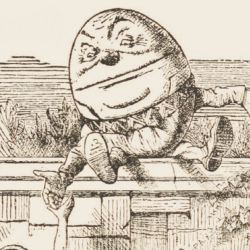
Credit: John Tenniel

“When I use a word,” Humpty Dumpty said in rather a scornful tone, “it means just what I choose it to mean — neither more nor less.” - Alice in Wonderland


Science is, above all, a methodology designed for discovering objective“truths” about the natural world. All lawyers and politicians speak quite highly of Truth, and all routinely claim that it is on their side, rather than their opponents’, however, the real function of legal and political debate is not to discover truth, but to win. And, whenever “winning” is the prime directive, Truth is always the first casualty in the battle..........To Read More....

The Age Of Stupid

By Frank Schnell — August 19, 2016

When, exactly, was the Age of Stupid? Was it when people practiced human sacrifice to placate the brutal gods they worshiped? Was it when people believed the Earth was flat and everything else in the universe revolved around them?  Or, was it when people thought that all diseases were due to an imbalance of the four humours and could be treated by bleeding the patient?

Maybe it was when they believed in witches and burned them alive at the stake for the on-lookers’ entertainment and spiritual enlightenment.  Or perhaps it occurred more recently when people took “comet pills” to protect themselves from cyanogen gas in the tail of Halley’s Comet, which they believed would envelope the Earth and cause mass extinction.

Surely, the Age of Stupid was in full flower when people believed in Piltdown man and perpetual motion machines, zero-threshold environmental toxins, and catastrophic anthropogenic global warming. Or it’s the Age of Stupid today.........To Read More....

Chemicals, Cancer and Common Sense

By Frank Schnell — April 15, 2016

Risk Estimation:  It would come as a surprise to most people to learn that so-called quantitative cancer risk assessments do not actually quantify true risk.  The actuarial risk calculated by insurance companies (e.g., the risk of dying in an auto accident), is based on actual data on the incidence of disease-, disaster- or accident-related mortality. 

However, actuarial data on disease incidence or mortality in humans resulting from very low exposures to chemicals in the environment simply do not exist. 

Instead, data from occupational studies of more heavily exposed humans are used, where available.  However, epidemiological studies seldom have the quantitative exposure data needed for a quantitative risk assessment.  To create a surrogate for this missing low-dose data, animals are exposed to very high doses of substances to guarantee that statistically reliable results are obtained. 

These animal results (or, much less often, the results from occupationally-exposed humans) are then extrapolated, using mathematical models incorporating numerous default assumptions, to humans exposed to very low environmental levels of the same substance.  The resulting cancer risk calculated by regulatory agencies is, of necessity, entirely theoretical and will vary greatly depending on the assumptions made and the models used in the assessment.  The limitations of quantitative risk assessment were clearly acknowledged in EPA's 1986 Guidelines for carcinogen risk assessment, as follows:

“The risk model used by EPA [i.e., the linearized multistage model] leads to a plausible upper limit to risk that is consistent with some proposed mechanisms of carcinogenesis.  Such an estimate, however, does not necessarily give a realistic prediction of the risk.  The true value of the risk is unknown, and may be as low as zero."  (U.S. E.P.A., 1986)      (emphasis added.)..........To Read More.....

War On Science: Bogus Human Carcinogens

By Frank Schnell — March 10, 2016

In the last 15 years, EPA has invented three bogus human carcinogens: dioxin, formaldehyde, and TCE.

Prior to the late 1990s, EPA’s cancer Risk Assessment Guidelines (CRAGs) required sufficient evidence of a cause-and-effect relationship in humans before a substance could be classified as a “known human carcinogen”.   However, during the late 1990s, EPA modified its CRAGs to allow itself to classify substances as known human carcinogens without sufficient epidemiological evidence to support such a decision.

The new CRAGs were specifically designed to enable the agency to classify the “celebrity” pollutant dioxin as a human carcinogen, using the agency’s speculative policies (e.g., the so-called TEF approach to the risk assessment of “dioxin-like” compounds) as surrogates for the missing evidence of carcinogenicity in humans.

Dioxin had been a “celebrity” pollutant ever since it came to public attention during the Vietnam War. The chemical’s status followed, not from the its known toxicity in humans (which was largely limited to chloracne, a serious skin condition associated with heavy exposures), but from its association with the second most divisive war in American history.  EPA’s determination to classify it as a human carcinogen had little to do with toxicology and everything to do with the politics of pollution............To Read More....


How Natural Variations Became Environmental Crises: The Word Game

 By Frank Schnell — February 16, 2016

In How Natural Variations Became Environmental Crises: The Numbers Racket, we looked at how officially safe levels of exposure gradually went from conservative, to ultra-conservative, to completely ridiculous.

Even before the manipulation of numbers became commonplace, the manipulation of words was a major tool in promoting fear about science and keeping it alive. Simple words in common usage, like risk, known, similar and equivalent were given esoteric, colloquial meanings that bore little resemblance to their definitions in Webster s Dictionary and of which the general public was completely unaware..

Thus, unbeknownst to the average citizen, EPA s so-called quantitative cancer risk assessments have never assessed the true risk of potentially carcinogenic exposures. In EPA s 1986 Risk Assessment Guidelines, the following, uncharacteristically honest, and seldom quoted (except by me) statement was made: The true risk is unknown and may be as low as zero. Obviously, if the true risk is unknown, then the risk that is supposedly quantified in EPA risk assessments is not the true risk.

Throughout my career as an ATSDR toxicologist, I routinely quoted the zero true risk statement in all of my toxicological evaluations for health assessments that addressed potential cancer hazards on site. And, it never failed to irritate agency management and even some of my colleagues......To Read More....

How Natural Variations Became Environmental Crises: The Numbers Racket

By Frank Schnell — February 15, 2016

George Washington may be the only popularly elected ruler in history who, when his supporters offered to crown him King, relinquished his power instead. Politically speaking, that was a very unnatural thing to do.

Historically, federal agencies have not surrendered their power, even after their congressional mandates were accomplished. Instead, they have invented new problems to solve, thereby justifying their continued existence.

The Environmental Protection Agency (EPA) was created by Congress in 1970 to write and enforce regulations designed to protect the environment and, by extension, human health. The Agency for Toxic Substances and Disease Registry (ATSDR), a sister agency of the Centers for Disease Control (CDC), was created by Congress ten years later (1980) as a non-regulatory public health information agency that analyzed the public health implications of environmental data provided by EPA and others, and wrote Public Health Assessments for concerned citizens at contaminated sites...........To Read More.....

Dose-Response, NOAELs and Hormesis

By Frank Schnell — January 22, 2016

In the 16th century, Paracelsus, the Father of Toxicology, established that All substances are poisons; there is none which is not a poison. The right dose differentiates a poison from a remedy.

The truth of this 500-year-old statement should be intuitively obvious to anyone who has ever taken aspirin for a headache. If you take too little, you will get no relief; if you take the right amount, your headache will go away; and, if you take too much, your ears will ring and your stomach will hurt.

Thus, dose alone determines whether a substance (aspirin in this example) will have an adverse effect (a poison), a beneficial effect (a remedy), or no effect at all.

One could describe most modern medications as judiciously applied poisons.........To Read More....

Dr. Frank Schnell, PhD, is a retired toxicologist for the Agency for Toxic Substances and Disease Registry, part of the CDC, in Atlanta, Georgia, and is a member of the American Council on Science and Health Scientific Advisory Panel.
 

Friday, November 2, 2018

Why Jack Bauer Never Went to the Bathroom

24 Hours And No Men's Room

By Josh Bloom — November 28, 2016
 
 For all of you who think that you're too refined to be rabid fans of 24, please go to PBS, where you can immerse yourself in such delights as "Farm to Table Family" or "Wai Lana Yoga."

While these shows are unquestionably enlightening to those with a more refined palate, the rest of us less-evolved types, who dwell in a different sociocultural universe, tend to have more pedestrian tastes. Rather than art museums and opera, we lean toward simpler pleasures, like professional wrestling and The Walking Dead. (Both are real, by the way.)

Just because I'm low class doesn't mean that I'm dumb, though. For example, the scientist in me has long wondered why, for eight seasons, encompassing a total of 192 hours (1), Jack Bauer never once had to use the men's room. I finally found out, thanks to a paper that was picked up by my news feed: Jack Bauer is not human, at least not entirely. His supernatural abilities can be attributed to genetic modification, and it wasn't even done by Monsanto or the Koch brothers.....To Read More...

My Take -  Josh sent this to me yesterday, and I got quite a chuckle out of it, and so too will most of my readers.  I've not posted the entire article because for some reason the pictures won't appear in my browser and I'm sure they're important to the article.  So please read this to the end - I loved the ending!!!!! 

OECD Economic Research Finds that Government Spending Harms Growth

November 28, 2016 by Dan Mitchell @ International Liberty

At the risk of understatement, I’m not a fan of the Organization for Economic Cooperation and Development. Perhaps reflecting the mindset of the European governments that dominate its membership, the Paris-based international bureaucracy has morphed into a cheerleader for statist policies.

All of which was just fine from the perspective of the Obama Administration, which doubtlessly appreciated the OECD’s partisan work to promote class warfare and pimp for wasteful Keynesian spending.

What is particularly irksome to me is the way the OECD often uses dishonest methodology to advance the cause of big government.
But my disdain for the leftist political appointees who run the OECD doesn’t prevent me from acknowledging that the professional economists who work for the institution occasionally generate good statistics and analysis.

For instance, I’ve cited two  examples (here and here) of OECD research showing that spending caps are only effective fiscal rule. And I praised another OECD study that admitted the beneficial impact of tax competition. I even listed several good example of OECD research on tax policy as part of a column that ripped the bureaucracy for some very shoddy work in favor of Obama’s redistribution agenda.

And now we have some more good research to add to that limited list. A new working paper by two economists at the OECD contains some remarkable findings about the negative impact of government spending on economic performance. If you’re pressed for time, here’s the key takeaway from their research.
Governments in the OECD spend on average about 40% of GDP on the provision of public goods, services and transfers. The sheer size of the public sector has prompted a large amount of research on the link between the size of government and economic growth. …This paper investigates empirically the effect of the size and the composition of public spending on long-term growth… The main findings that emerge from the analysis are…Larger governments are associated with lower long-term growth. Larger governments also slowdown the catch-up to the productivity frontier.
For those who want more information, the working paper is filled with useful information and analysis.

Here’s one of the charts from the study, showing how government spending is allocated in OECD nations.
The report also acknowledges that there’s a lot of preexisting research showing that government spending hinders economic growth.
There is a vast empirical literature investigating the relationship between the size of the government and economic growth (see Slemrod, 1995; Myles 2009; Bergh and Henrekson, 2011 for overviews). A review by Bergh and Henrekson (2011), based on papers published in peer reviewed journals after 2000, suggested a negative relationship in OECD countries. Likewise, a recent OECD study confirmed a negative relationship between the size of government and GDP growth (Fall and Fournier, 2015). …the link between the size of government and growth may vary with the income level and could be hump-shaped (Armey, 1995). A few studies have found support for the existence of a non-linear relationship between the size of government and growth (e.g. Vedder and Gallaway, 1998; Pevcin, 2004; Chen and Lee, 2005).
By the way, the reference to “hump-shaped” means that the OECD is even aware of the Rahn Curve.
The methodology in the paper is not ideal from my perspective. For all intents and purposes, the economists compare economic performance of the OECD’s big-government nations with the growth numbers from the OECD’s not-quite-as-big-government nations. But even with that limitation, the study generates some powerful results.
…the simulation assumes that in countries where the size of government is above the average level of countries in the bottom half of the sample, the government size will gradually converge to this level (36% of GDP). Similar to the spending mix reforms, this reform is phased in over 10 years. Such a reduction in the size of the government could increase long-term GDP by about 10%, with much larger effects in some countries with currently large or ineffective governments. …a reduction of the size of government has a positive, but moderate, effect on the income of the poor. The average disposable income also rises. However, the rich gain relatively more. Finally, in countries where the government is less effective (such as Italy) the growth effect dominates and a moderate reduction of the size of government would have a large growth effect, so that it would lift all boats.
And here’s a chart showing how much more growth would be possible if the countries with really-big government downsized their public sectors to the somewhat-big level.

Even with the methodology limitations I described, these results are astounding. Potential GDP gains of more than 30 percent for Greece and Italy. Gains of more than 20 percent for Slovenia, France, and Hungary. And more than 10 percent for Belgium, Czech Republic, Portugal, and Poland.
The working paper also looks at the composition of government spending. In other words, just as not all taxes are equally damaging, the same is true for spending programs.
The results from the estimation of the size of the government and the public spending mix illustrate that public spending matters for long-term growth…pension and subsidy spending [are] the two items with a significantly negative effect on growth. As each regression includes the size of government and one spending share, the estimates provide the effect of increasing this type of spending while decreasing spending on other items to keep the spending to GDP ratio unchanged… larger governments are in several specifications significantly and negatively associated with long-term growth. This is consistent with the literature… Larger governments can impede convergence (Table 8, columns 1 and 3), because they are associated with higher taxation that can discourage business investment including foreign investment and households to supply labour.
Pensions and subsidies seem to cause the most economic harm.
Reducing the share of pension spending in primary spending yields sizeable growth gains with no significant adverse effect on disposable income inequality. This reduction could be achieved by an increase in the effective retirement age or by cutting the replacement rate. …Cutting public subsidies boosts growth, as public subsidies…can distort the allocation of resources and undermine competition. …Education outcomes depend not only on education spending but also on the effectiveness of education policies, and the literature suggest the latter can be more important. Since the seminal work of Coleman (1966), a broad literature suggests that there is no clear link between education spending and education outcomes. …policies aimed at increasing education spending effectiveness can be more appropriate than an across-the-board rise of education spending. …It may be that, beyond a certain point, additional spending on investment has adverse effects, if poorly managed.
For those of you with statistical/econometric knowledge, here’s some relevant data from the study.

And you can match the numbers in Table 6 with these excerpts.
…pension spending reduces growth (Table 6, columns 2, 5, 7 and 10). Increasing the share of pension spending in primary spending by one percentage point (offset by a reduction in other spending) would decrease potential GDP by about 2%. …Public spending on subsidies also reduces growth (Table 6, columns 3, 5, 8 and 10). …increasing the share of public subsidies in primary spending by one percentage point would decrease potential GDP by about 7%.
If you’re not a stats wonk, these two charts may be more helpful and easy to understand.


What jumped out at me is how the normally sensible nation of Switzerland is very bad about subsidies. That’s a policy they obviously need to fix (along with the fact that they also have a wealth tax, which is very uncharacteristic for that country).

But I’m digressing.

Let’s return to the study. One of the interesting things about the working paper is that it notes that bad fiscal policy can be somewhat mitigated by having market-oriented policies in other areas, which is a point I always make when writing about Scandinavian nations.
…countries with a high level of public spending may also be characterised by features that partly offset the adverse growth effect of government size. …in Sweden the mix of growth-friendly structural policies…may have offset the adverse growth effect of a large government sector.
In other words, the moral of the story is that smaller government is good and free markets are good. Mix the two together and you have best of all worlds.

P.S. Even if the OECD published dozens of quality studies like this one, I would still argue that American taxpayers should no longer be forced to subsidize the Paris-based bureaucracy. And even if the OECD’s political types stopped pushing statist policies, I would still have the same view about ending handouts from American taxpayers. This has nothing to do with the fact that the bureaucrats once threatened to have me arrested and thrown in a Mexican jail. I simply don’t think taxpayers should fund international bureaucracies.

P.P.S. Other international bureaucracies, including the World Bank and European Central Bank, also have published good research about the negative effect of excessive government spending.

P.P.P.S. My general disdain for the OECD (notwithstanding my qualified praise today for their new study on spending) may be exceeded by my hostility for the International Monetary Fund. I’ve referred to the IMF as both “the Dumpster Fire of the Global Economy” and “the Dr. Kevorkian of Global Economic Policy.”

Judge Jeanine Slams Hillary Clinton and Jill Stein on Election Hypocrisy

“Hillary, now that Donald Trump is looking to help you heal, looking to help heal the nation, would it be fair to say, to use your own words, ‘It’s time to give Donald Trump his chance to lead?”

By Onan Coca November 28, 2016

Fox News’ Judge Jeanine Pirro delivered a haymaker of a monologue on Saturday night when she excoriated Green Party presidential candidate Jill Stein, and Democrat Party candidate Hillary Clinton for their stunning hypocrisy on free and fair elections. Stein is leading the charge in demanding a recount in the states of Wisconsin, Michigan, and Pennsylvania (all states won by Donald trump), even though the margin of victory was large enough to NOT trigger an automatic recount. Hypocritically, Stein isn’t seeking a recount in states where Clinton won by a slimmer margin than Trump did in these three rust belt states. To make matters worse, Clinton, who once mocked Trump for indicating he might not “accept” the election results if he lost, has now joined Stein in her efforts to upend a legal and fair election......To Read More...


Global View: After the Election by Peter Zeihan


I try to avoid commenting on U.S. politics – anything I say tends to anger at least one-third of the room. But from time to time the United States take a turn that elevates its internal issues to international import. Of late, evolutions in the American political system has taken such a turn. So here we go …

The American governing system isn’t small. U.S. local, state, and national governments are the country’s first-, second-, and third-largest employers. Combined, their staff is more than 22 million. So long as Americans disagree over how to do things, parallel structures are required to manage those disagreements in the context of the governmental apparatus. Those parallel structures are the Republicans and Democrats. With people constantly moving in and out of office at various levels, the parties need their own deep bench of support personnel to bulwark candidates-turned-mayors and representatives and senators and governors and presidents. The American parties are not traditionally tools of ideology, but tools of governance.

One, among many, outcomes is that various private interests get involved in building that bench of support. That way they can influence government decision-making both indirectly (via lobbyists) and directly (via elected officials and their staff). That takes money, and for decades the folks with the most money in the political system were those in the business community. The result was a somewhat revolving door of business leaders giving cash and staff to the parties to get people into government. When those people left government they returned to business to make more money. Some of that money then flowed back into influencing the political parties and government, and so the wheel turned. It was pretty rare for a stark-raving-mad politician to rise to the top. Business hates risk and likes continuity. Staffing choices reflected that.

Critics called this corrupt -- and they had a point. Throughout the 1990s a consensus built that there was too much money in politics. The campaign finance reform effort was designed to minimize, and ideally eliminate, large donations to political campaigns, and thus root-out the perceived corruption. This weakened the business community’s connection to the political process to the point that it really didn’t have a candidate in the 2016 presidential run. This is the first piece of the parties’ unravelling: the single-largest and most cohesive and most status-quo-vested wedge of the political system was shown the door.

The second piece was even more disruptive: technology. In the pre-PC and smartphone age your options for contributing to campaigns of any sort were limited. You could give your time, or you could write a check and send it via snail mail. Checks of $20 or less were barely worth the man hours required to process them, so not a lot of effort went into bushbeating. In 2000 the landscape started to shift. Electronic checks, online bill pay, and money-by-text steadily reduced processing costs to nearly zero, even as social media techs enabled fundraising campaigns to be spread by email, SMS, Facebook, and Twitter at negligible cost. There’s now room for the masses to play politics with their cash.

The third factor almost seems prosaic: redistricting. State legislatures dominated by single parties would redraw their congressional districts’ boundaries, excising or including this or that population to build up their party’s electoral presence in the House of Representatives. The majority of such districts are now “safe” seats.

This all makes American politics loud and messy.
  • Courtesy of redistricting, the real competition for most House seats is no longer at the general election, but instead at the primary level among party stalwarts. That pushes the debate from the center to the edges.
  • At those edges, single-issue-voter money comes hugely into play. While businesses are interested in stability and continuity, individuals have axes to grind. Most Americans find it sexier to donate to specific causes and issues than to political parties and general platforms.
  • Single-issue penetration into both party and government politics polarized the system away from the consensus-building required to get on with the business of governing, and into razor-sharp disputes on issues of principle. Disagreement didn’t lead to bargaining and compromise, but was instead perceived as treasonous or flat-out evil.
  • Social media’s presence in the news cycle enabled people with a lot of extra time to prat on endlessly about this or that issue, blissfully unmoored from social trends, economic developments, decorum, facts, or reality. Biased or even fake “news” -- much of it generated by folks outside of journalism -- is now par for the course.
In such an environment the parties are largely incapable of appealing to the political center (by definition the political center is made up of people who are not single-issue voters). The parties have devolved from being tools of governance to vehicles for narrowly defined ideologies. America has become a great place to have an argument, but without functional parties it is almost impossible to have a debate.

American political candidates now break along a simple line.

On one side are those who cater to the ideological extremes to harness the increasingly-radicalized party structure: people like Ted Cruz, Elizabeth Warren, Bernie Sanders, and Michele Bachmann. On the other are those who can exist independent of the party structure and run their own campaigns: the Bush family, the Clinton Foundation, Trump Inc., and even Barack Obama. For them the parties were useful in a supporting role, but all of them succeeded because of their independent wealth and/or gravitas. W. Bush won by coalescing the evangelicals into a voting block independent of the Republican Party. Hillary Clinton manipulated the Democratic Party machinery, not the other way around. Barack Obama’s popularity was built on a social media network that co-opted the Democrats; once he was in office his connections with “his” party were cool at best. Trump could not only self-fund, he succeeded despite the Republican party.

At first the Republican Party got the worst of these changes. As a rule the business community is pro-Republican, so campaign finance disproportionally impacted their bottom line. In a double-blow the Democratic Party’s coalition is a much broader sweep of the American electorate. Reduce transaction costs and the Democrats’ larger party base can funnel a larger number of small donations. Before 2010 the Republicans were always the party that could raise more money. That’s now flipped, and Democrats have been able to use their superior financial position to fund ever-larger campaigns.

The Democrat Party stalwarts looked at this turn of events and got very excited about the 2016 presidential race. As America’s leftists tell it, American conservatives are a bunch of old white rich dudes who lord over the world. Campaign finance largely ejected them from the election process, which stripped the Republican party down to its racist, sexist, homophobic dregs. Beating those dregs in a general election would be child’s play because every single minority group in the country combined with the liberal Millennials would be able to sweep the field, eliminate the Republican position in Congress, and usher in a socialist utopia.

The Democrats got it completely right. Except how blacks would vote. And gays. And Hispanics. And unions and Millennials and women. They were wrong about everything. As a result Trump captured every single swing state except Virginia, and several blue states to boot. The Republicans now control both the presidency and Congress for only the second time since World War II. Barring some truly impressive breakthroughs in geriatrics they’ll also control the Supreme Court for another couple of decades.

What is fundamentally revolutionary in my mind isn’t what has changed, but what hasn’t. The technology has changed, dispersing political power far and wide. The way money is raised has changed, enabling the issue of the moment to dominate the Internet and airwaves and national debate. The parties have changed to the point of near irrelevance. But what hasn’t changed is that most Americans are still centrists.

Fully 42% of women, 30% of Hispanics, 45% of Millennials, and 33% of Californians voted for Trump. On the other side, 41% of men, 34% of rural inhabitants, 45% of people without high school diplomas, 25% of Mormons, and 43% of Texans voted for Clinton. The American political center endures, it is just now completely unmoored from the political selection and reporting process. And so it will remain until the American political parties can regenerate themselves.

That will take a lot of soul-searching. I hear encouraging bits. For the Democrats who aren’t part of those single-party factions, it has really sunk in that every election of the past generation that their candidate lacked charisma, they’ve lost. All those single-issue voters just can’t deliver success, because their screaming pisses off left-leaning moderates (not to mention everyone else). And since all but a half dozen of the Senate seats that will be up for grabs in the 2018 bi-elections are held by Democrats, they’d best get a move on unless they want to risk a generational blow out. For the Republicans willing to stand up to Trump, there’s already a realization that a party led by those rebelling against the order can’t rebel against their own order. The Trump election is a one-shot deal.

So it isn’t as bad as it seems…in the United States anyway. In the meantime, things are looking horrible for the rest of the world. The United States is the country that guarantees global security, global trade, and global energy. There are no single-issue voters who are interested in global management. America’s bandwidth to understand -- much less discuss -- what is going on in the wider world is nil until such time that the American political parties can regenerate themselves. Until then, the superpower that makes the world work is simply absent.

Donald Trump’s Foreign Policy Team Takes Shape

Saying “more” and “no” are keys to success.

Roger Kaplan

In forming a conservative foreign policy leadership, you need to hear two words: “More” and “No.” m It appears these are the words President-elect Donald Trump wants to hear as he puts together the team that will defend the United States over the next years.   More defines our defense capability. You cannot have too many guns. You cannot have too many ships and planes and tanks.

Ronald Reagan did not win the long struggle against Soviet communism alone, of course; there was Lech Walesa and John Paul II, there were the freedom fighters in Budapest and Berlin, Cuba, Central America, the Hindu Kush, the savannahs and bush across Africa who resisted the totalitarian imperialism. Often they resisted successfully, with or without our help. Sometimes we let them down, misled them, betrayed them even, and we cannot forget these failures.

All great nations make terrible mistakes of statecraft. The betrayal and abandonment of South Vietnam was about as bad as it got. Ronald Reagan made some whoppers, but he kept remembering those two words. And applying them. Then he said four. “We win. They lose.”........Foggy Bottom is foreign territory; as used to be said, it would be well if there were an American interests section there........To Read More....

Twilight of the Green Follies

By Alex Alexiev November 2, 2018

For more than two and a half centuries, human kind has lived under an irreconcilable dichotomy – the benevolent revolution we call the enlightenment, and the inevitable reactionary counter-revolution that followed it – a dichotomy that has continued to our days.

The enlightenment introduced a number of revolutionary concepts that demolished the church dogma that had dominated the Middle Ages.  It established reason and empirical knowledge as the source of authority leading to the scientific revolution beginning with Copernicus and the heliocentric theory of the universe.  In government, the enlightenment brought about the radical idea of individual liberty with John Locke’s call for “life, liberty and property.“ The revolution reached its apotheosis in the late 18th century with the American Constitution and its idea of “inalienable rights” given to us by our Creator and of a government based on the consent of the governed. All of this was based on the unshakeable belief in progress driven by man and the Judeo-Christian civilization’s fundamental belief in the primacy of man over nature...........Read more

Saving America’s Retirement System and Providing Real Middle-Class Tax Relief

November 1, 2018 by Dan Mitchell @ International Liberty
 
President Trump thinks he can boost Republicans next Tuesday by promising a new round of tax relief for the middle class.

I’m skeptical of his sincerity, as noted in this segment from a recent interview, but I also warn that his proposed tax cut is impractical because Republicans have done a lousy job on spending. And I also point out that it is ironic that Trump is urging lower taxes for the middle class when his protectionist tariffs (trade taxes) are hurting the same people.


At first, I wasn’t going to bother writing about this topic for the simple reason that Trump isn’t serious (if he was, he wouldn’t have meekly allowed the big spenders to bust the spending caps).

But then I saw that Tom Giovanetti of the Institute for Policy Innovation wrote a column for the Wall Street Journal explaining how reforming Social Security would be great news for lower- and middle-income taxpayers.
…44% of Americans no longer pay any federal income tax at all, and many more pay very little. …On the other hand, low- and middle-income workers do send the government a large share of their earnings in the form of payroll taxes. That same family of four pays $12,240 at the 15.3% combined rate for Social Security and Medicare. If you want to cut taxes for middle-class and low-income workers, that’s where you have to do it. …instead of…a payroll-tax cut of 4% of income, why not redirect that same 4% into personal retirement accounts for every worker? …With no decline in disposable income, American workers would suddenly be investing for retirement at market rates in accounts they own and control, instead of relying on Congress to keep Social Security solvent.
Not only would personal retirement accounts be good for workers, they also would help deal with the looming entitlement crisis.
America’s entitlements are on a path to collapse, and few politicians—including Mr. Trump—have an appetite to do anything about it. When the crisis comes, no tax increase will be big enough to solve the problem. Knowing the U.S. government is eventually going to fudge its commitment to retirees, policy makers should at least give workers a fair chance to amass the savings they will need to support themselves. The back-door solution to the entitlement crisis is to make workers wealthy. Will you worry about Social Security’s solvency or a Medicare collapse if you have more than enough money in a real retirement account to buy a generous annuity and cover your health insurance?
At the risk of stating the obvious, this is the right approach. Both for workers and the country.
To be sure, I don’t think it’s likely since Trump opposes sensible entitlement reform. But Tom’s column at least provides a teaching moment.

I’m not sure when we’ll have a chance to address this simmering crisis. But if you’re wondering whether changes are necessary, check out this chart I put together earlier this year showing Social Security’s annual shortfall (adjusted for inflation, so we’re comparing apples-to-apples).


P.S. This video has more details on the benefits of personal retirement accounts.

P.P.S. And this video shows why the left’s plan to “fix” Social Security would be so destructive.

National Survey Finds 40% Believe Cancer Can Be Cured Without Medicine

By Hank Campbell — October 30, 2018 @ American Council on Science and Health

America may be the most science literate country in the world, we may be dominant in Nobel prizes and science output, and at least we are not France, but a new survey by Harris shows that we still have a long way to go.

The results reveal that 47 percent of those aged 18 to 37 have become convinced by efforts to promote alternatives to medicine and think they can cure cancer with food or supplements or ancient Chinese wisdom - and that population bump brings the average to 40 percent overall.

How did we get here?

Three ways.

First is that in 1994 President Clinton took alternatives to medicine away from U.S. Food and Drug Administration oversight by signing the Dietary Supplement Health and Education Act of 1994 - with a wave of the pen alternative companies could sell products making all kinds of suspect claims, as long as they noted that FDA had not evaluated their claims. Magic potions and useless placebos are now a $25 billion annual industry and an FDA which mandated that businesses spend an additional 14 million hours every year just to comply with new regulations on food labels for vending machines can't be bothered to tell companies to stop claiming turmeric will cure their disease.

Second is the manufactured belief promoted by trial lawyers and activist groups (and often the trial lawyers in activist groups) that companies are inherently evil. The recent judgment against Monsanto over a weedkiller that can't possibly harm humans is not a one-off, it was just a lucky case of a plaintiff arriving in a coastal city where the lawyer knew they'd have a friendly jury. Johnson & Johnson is routinely sued over baby powder and the belief that Teflon can be harmful and 3M knew it is still being perpetuated without evidence. (1)

Finally, the public are disenfranchised from critical thinking. America is the world's wealthiest country. Our poor people are often obese, have two televisions, and have more living space than a middle class country in France. Those are actually good things (yes, obesity is a public health problem, though it only requires cultural maturity to overcome the evolutionary inheritance of not knowing when our next meal would be, and therefore better than famine) but as a result of our success we have lost touch with science and technological reality. Today, only 2 percent of Americans are farmers and so people now know little about food and are easily scared by trial lawyers at Center for Food Safety or Center for Science in the Public Interest (insert Environmental Working Group or any of the others if you'd like) into believing our food supply is dangerous and evil "factory" farms are running small farmers into extinction (2) and growing science-y food that is less healthy than if a small farmer(!) grew it.

Food is food regardless of the process to grow it or the revenue of the grower, and our food is incredibly safe. We haven't had huge numbers of people die from organic foodborne illnesses like Europe has had. Not even at Chipotle, and they really tried. Our energy is affordable and clean. In 2003 while French young people protested American involvement in Iraq, 14,000 elderly people died in a heat wave because energy was too expensive to run air conditioning. In America, our energy emissions have dropped to such an extent we didn't even need a Clean Power Plan. The free market achieved what would have been the 2025 regulation target in 2017.

We don't know anyone with Polio in the U.S. today so some people think it was never a problem and that vaccines are a Big Pharma scam. No one remembers the 1918 Flu so people don't realize we only lose 50,000 people per year from the flu today because of vaccines and other advancements in public health.

But it isn't just people who want to believe the flu is a worse cold that undermine trust in science, 22 percent of cancer patients and survivors believe wacky stuff like that dietary changes, vitamins, or oxygen therapy will cure them, or did. The mortality rate among people who refuse to accept medical science over nonsense is 250 percent higher. See Steve Jobs who, like most believers in shamanism, was a wealthy coastal pseudo-intellectual.

Government does nothing to rein in the nonsense that these alternatives to medicine claim. We let doctors include alternatives as "adjuvants" to treatment, under the belief that positive thinking would help, and now almost half of young people believe the music therapy can replace the chemotherapy.

What has government done? Nothing good. While marijuana, "enzyme" therapy, and manipulating the chakras of patients is passed off as beneficial thanks to hands-off federal rules, they have demonized actual cancer patients who take opioids for pain. On the survey, commissioned by the American Society of Clinical Oncology, 40 percent of cancer patients reported having trouble getting pain medicine, while 73 percent said those restrictions were just fine, thanks to the government's high-profile war on pain patients.

NOTES:
(1) Even that is a problem for itself science created by being terrific. Thanks to advancements, we can now detect anything in anything, so it is trivial to "detect" some chemical in blood or urine or breast milk. Then lawyers just have to convince a jury it could be harmful. Given the survey results here, a critical thinking jury will become harder and harder to find.
(2) In reality, farming is dominated by 2.2 million small farms, nearly half of whom generate just enough revenue to pay their real estate taxes. If that is factory farming then having two children will get you called a "factory family."

Thursday, November 1, 2018

Wake up Democrats, our party is un-American

November 1, 2018 By Bob Just

I have been a Democrat since my youth, as were my parents before me. So of course, I understand “party loyalty.” But as a talk show host and columnist, I’m able to spend more time following my party than most Democrats can with their busy personal lives.  So when a Democrat candidate for United States Senate recently ran an ad referring to the “crazy Democrats” in our party, it didn’t surprise me.

A few years ago, I was so alarmed I called for a “Democrat Voter Strike,” hoping to bring our party leadership to their senses. But now things have gotten radically worse, and I urge Democrats to vote Republican and send a clear message to our leaders.   If this problem was temporary, or affecting only a few in leadership, I would still say vote Republican based on their disgraceful behavior during the Judge Kavanaugh hearings. But this has been going on for a long time – something younger Democrats need to know. And no matter what we hear in the media, our party’s current behavior was a problem long before Donald Trump.

In 2004 I ended a column called, “My Un-American Democratic Party” with the following words about the growing power of the “crazy Democrats” who increasingly control our party............. More

K-12: Walk Away

By Bruce Deitrick Price November 1, 2018

When Brandon Straka founded the WalkAway movement in May, hardly anyone imagined that several hundred thousand longtime Democrats could turn against the party of their family and friends. Although it's a big, difficult decision, many Walkaways made videos aggressively explaining their decisions. They often conclude: "I'll never vote Democrat the rest of my life."

What made these people walk away with such passion? Certainly, Trump's success and charisma explain a lot. The "lying media" are also a major factor. One woman attended a crowded Trump rally. When she reached home a half-hour later, CNN was showing a half-empty stadium where she had been standing. She knew that the place had been jammed. At that moment, she walked away from CNN.

Perhaps the most important factor is that leaders on the left, for many decades, became increasingly socialist/communist in their perspectives. The rank and file are more sophisticated now and realize that their party bosses walked away from them long ago............We need this exact same spirit in K-12. You're mad as hell and refuse to continue the same destructive relationship.

You know what the schools are doing to children: keeping them ignorant and illiterate.   You hate this. You don't want it being done in your name. Or with your taxes..................

In particular, walk away from so-called educators who see education as indoctrination, not enlightenment. That is John Dewey's malignant legacy.  We need to walk away from all that............. Read more.

Just let Kanye be Kanye

By Monica Showalter November 1, 2018

The mainstream press is reporting that Kanye West has abandoned conservatism and turned on Trump. Here is one of his tweets.
"My eyes are now wide open and now realize I've been used to spread messages I don't believe in.  I'm distancing my self from politics and completely focusing on being creative!!!"
Some conservatives are chagrined and angry, given that it comes off as a rebuke after an impressive gathering of young black conservative leaders in Washington, and the issue itself revolves around the design of a political slogan, "blexit," and a t-shirt. Leftists, meanwhile, are mocking and gleeful. What a wonderful comeuppance for conservatives, to think a black superstar could see anything out there the same way they do. More proof he's erratic and mentally ill........... Read more

My Take - Poor, poor baby!  Oodie booodie boo!  The poor little muff muff, was "used".   Exactly what messages was he being used to promote, and what didn't he believe in?  Who knows!  Now let's see a show of hands from the ranks of the sane of how many are surprised or shocked at his brand new loonism.  He's a loon, just like Rosanne, both are certifiable.  It's just good both of them impoded early, and we should thank both of them for being themselves as quickly as they did. 

The message to take away from this for the women in my reading audience - you're not married to him. 

As for conservatives being angry at Kanye - my 93 year old mother has a phrase that fits this scenario: "This falls under the category of who gives a s__t!"

A Humorous Look at Asset Forfeiture

October 31, 2018 by Dan Mitchell @ International Liberty
 
In the world of public policy, it’s very easy to make fun of politicians (especially Barack Obama, Donald Trump, Hillary Clinton, Bernie Sanders, and Elizabeth Warren).

And there are plenty of jokes about certain issues in the public arena, particularly the IRS, but also gun control and Brexit. And I have entire pages dedicated to libertarian humor and communism/socialism humor.

But some topics are so grim that’s it’s not easy to laugh about them. There’s nothing funny about the horror of Venezuela, for instance, though there are examples of dark humor from that unfortunate nation.

Another topic that doesn’t lend itself to laughs is the horrid practice of civil asset forfeiture. I’ve shared many nauseating stories about how governments literally steal property from people who have not been convicted of crimes (or, in many cases, have not even been accused of any crime).

Here’s the latest absurd example, this time from Michigan.
Nearly 400 people in Wayne County who were never charged with a crime still lost property to law enforcement agencies last year through a legal procedure called civil asset forfeiture… Altogether, there were 736 asset forfeiture proceedings in Michigan in 2017 during which someone lost property to the government despite never being charged with any crime; this happened 380 times in Wayne County. …Jarrett Skorup of the Mackinac Center for Public Policy, who co-authored a recent report on civil forfeiture, said…it’s likely that these forfeitures disproportionately affected low-income individuals, who are less able to afford an attorney or navigate the legal system to reclaim their property. Revenue obtained from forfeited property typically goes to the agency that seized the property.
Yes, you read correctly. The agency that steals the property gets to keep the money, which is why the disgusting practice of civil asset forfeiture is sometimes known as “policing for profit.”

If this sounds like the kind of behavior you’d find in a third-world banana republic, you’re right.

Anyhow, is there any way we can find mirth and amusement in this reprehensible practice?

Actually, courtesy of libertarian Reddit, there is.


Kudos to the clever person who left this comment. Maybe the bureaucrats finally understand what it feels like to have property arbitrarily seized.

I’m not quite ready to applaud the actual thief, however, since a speed trailer only notifies people how fast they’re traveling.

If that person wants my praise, go after speed-trap cameras like this hero.

P.S. There is an example of money-laundering humor, and it features a former President.

Does government really need to regulate everything?

By Greg Walcher

In high school and college, I competed in debate tournaments across the state and country. I clearly remember many occasions when a debate team’s plan would include abolishing some government program. Inevitably, the opponents would ask, “What will you replace it with?”

Only once did I hear any debater respond with, “Nothing at all. Government shouldn’t be doing that at all.” Everyone in the room was stunned, and that team lost.

Even today, most people find it hard to imagine abolishing anything. That’s why President Reagan once quipped that a government program is the closest thing to eternal life on this planet.

I couldn’t help reflecting on that a couple months ago, when the EPA released its new version of the “Clean Power Plan,” the Obama Administration’s thinly-veiled attempt to kill the coal industry. More than half the states sued, and the Supreme Court suspended the Obama plan as an unauthorized expansion of the agency’s authority under the Clean Air Act.

That was two and a half years ago, and after the election the Trump Administration withdrew the Obama plan. The entire discussion was in limbo for a long time thereafter. But now we have a new EPA and a new plan to debate. It’s called the “Affordable Clean Energy” rule.

A new Intergovernmental Panel on Climate Change “Special Report” says we must spend $2.4 trillion (!) per year for the next 17 years to replace fossil fuels with renewable energy, or humanity and our planet are doomed. But after all the scare stories and “tipping points” – and empty promises that China, India, Africa and the rest of the world would soon abandon coal, oil and natural gas for wind, solar and biofuels – the American public is growing increasingly skeptical of the fear-mongering. Many are not convinced we need a new carbon dioxide (CO2) rule at all.

Nevertheless, we always knew this new EPA initiative was coming.

The real debate stems from an earlier controversy, at the beginning of the Obama era, when the EPA declared that plant-fertilizing, life-giving, people and animal-emitting carbon dioxide is an unsafe pollutant that “endangers the health and welfare of all Americans.”

That “endangerment finding” was also widely challenged, because Congress never authorized the EPA to regulate the air we exhale as a “greenhouse gas.” Nevertheless, the Supreme Court backed the EPA’s authority to designate CO2 (which makes up about 4 one-hundredths of one percent of the atmosphere) as “dangerous,” if it concluded the risks of global climate change outweighed the trace gas’s benefits. Of course, the Obama EPA then determined that CO2 was unduly dangerous.

That ruling then formed the basis for the Clean Power Plan, a host of other regulations attacking coal, oil and natural gas use, and U.S. participation in the Paris climate treaty. Many observers were thus very guarded in their enthusiasm when President Trump withdrew from the Paris deal, and cancelled the Clean Power Plan. They realized that his new EPA has, so far, made no effort to revisit or reverse the “endangerment finding.”

That is problematic, because EPA probably cannot legally declare something to be a dangerous pollutant, but then decline to regulate it. So the concern is that if EPA does not reverse the “endangerment finding,” federal courts would eventually order a new “clean power plan” anyway.

That is why the EPA has released this new plan.

However, thankfully, the new plan is nothing like the original, an outright attack on the very existence of the coal industry. Instead, EPA now acknowledges that our most abundant and affordable energy source can be used without destroying anything.

Sadly, many political leaders on both sides still think big environmental problems require federal solutions, as opposed to letting individuals, businesses or even state and local governments address them, in cases where there actually is a problem and the proposed solution would actually fix the problem.

In any event, this new EPA approach proves federal “authority” doesn’t necessarily require heavy-handed dictates from Washington.

Global Energy Institute President Karen Harbert says the new plan at least calls for “a more collaborative process that fits within EPA’s statutory authority and will result in achievable progress through more practical, state-driven programs.”

As the Clean Air Act intended, EPA now says states can develop and enforce performance standards. States have broad flexibility to consider their unique circumstances; and one-size-fits-all federal regulations rarely succeed in environmental matters.

Pittsburgh’s pollution has nothing to do with Grand Junction, Colorado or Chicago, Illinois. What works in Miami will likely not work in Los Angeles. Local leaders are better arbiters, because they know the territory better than distant bureaucracies can.

That makes a state-based approach better by definition, even if carbon dioxide were a significant problem. In fact, manmade contributions notwithstanding, climate change is governed mostly by the sun and other natural forces. Nothing humans might do will prevent those forces from changing the climate again and again, as they have throughout Earth’s history.

Nevertheless, the new rules represent an improvement over the Obama approach.

The new plan is based on what can be achieved “inside the fence” of a power plant. We shouldn’t expect or demand that a Western Colorado rural utility stop generating power because of some dubious theory about polar bears dying off in Central Canada if the Earth might warm another degree.

But at least the new approach will encourage investment in upgraded electricity generation and pollution control technologies, because such improvements will no longer automatically trigger costly permitting requirements. The previous rule discouraged such investments, defeating its own purpose.

Finally, the new rules will no longer shut down existing power plants before their useful life is over, or their financing is paid off. Such waste drove average electricity rates up 60% in many areas under Obama – hurting factories, businesses, hospitals, schools, and families that were least able to pay.

Ironically, EPA estimates that U.S. CO2 emissions will continue to decline at about the same rate (roughly 33% between 2005 and 2030) under the new plan as under the Obama plan – or under no new regulation at all. In other words, our emissions are declining anyway, not because of government intrusion, but because of improving and changing technologies.

The new EPA plan is a significant improvement. Now, let’s also abolish the “endangerment finding” and replace it with – nothing at all.

Greg Walcher (www.GregWalcher.com) is president of the Natural Resources Group, author of Smoking Them Out: The Theft of the Environment and How to Take it Back, and a former head of the Colorado Department of Natural Resources.

A Bridge to Sell You

John Stossel Oct 31, 2018

"Libertarians believe that you should be as conservative or as liberal as you want to be as long as you don't want to force yourself on others," says Larry Sharpe, Libertarian candidate for governor of New York.  Sharpe is an unusual Libertarian candidate because he's doing well in some polls.  One found Sharpe getting 13 percent, and after people heard his campaign pitch, 25 percent. That would put him in second place, ahead of the Republican.  So of course the establishment shuts him out -- he and other third-party candidates weren't allowed in the one gubernatorial debate.

Sharpe wins fans by arguing that it would be good if individuals make their own decisions without government spending constantly getting in the way..........To Read More.....

If the Synagogue Shooter Were Muslim, the Media Would Be Defending Him

Posted by Daniel Greenfield 2 Comments Wednesday, October 31, 2018 @ Sultan Knish Blog
Two types of people plot attacks against Jewish synagogues and community centers: Nazis and Muslims.

In 1999, Buford O. Furrow, a white supremacist, opened fire at a Jewish Community Center in the Los Angeles area. He wounded three little boys, their teenage female counselor and an elderly female receptionist. He told the FBI that he wanted this to be "a wake-up call to America to kill Jews."

While Furrow was carrying out his attack, President William Jefferson Clinton was in the White House.

In 2000, Ali Hassan Abu Kamal and Mazin Assi attempted to firebomb a synagogue in New York.

“A bias-motivated attempt to firebomb a synagogue?” the New York Times wondered. “Or a misguided message critical of Israeli policies against Palestinians?”

In 2006, Naveed Afzal Haq used a teenage girl as a hostage to force his way into the Seattle Jewish Federation where he shot 6 women. The Muslim attacker shouted, “You Jews” at the non-Jewish marketing director and shot her in the stomach. The bookkeeper went into cardiac arrest, died at the scene, was revived and died again on the operating table and still lived to testify at Haq's trial.

"I want these Jews to get out,” Haq could be heard shouting on the phone.

The media attempted to portray Haq as mentally ill. The local alternative paper insisted that his “his anti-Semitic rhetoric” was just a “veneer” on “a man disturbed by feelings of inadequacy and rejection.”

In 2009, James Wenneker von Brunn, a white supremacist, opened fire at the Holocaust Museum in Washington D.C. His rhetoric, claiming that Obama was controlled by the Jews, closely echoed the more recent Squirrel Hill synagogue shooter’s rants about Trump being controlled by the Jews.

This would be one of two major anti-Semitic attacks by neo-Nazis during the Obama years.

That same year, another major anti-Semitic terror plot was broken up by the FBI. But this time the perpetrators were Muslims and the media coverage couldn’t have been more different.

“Look at the Jewish guy. You’re not smiling no more, you f___r. I hate those bastards. I hate those m______s. Those f____g Jewish bastards. I’d like to get one of those. I’d like to get a synagogue. Me. Yeah. Personally,” Abdul Rahman, also known as James Cromitie, had ranted.

The targets of the Muslim terrorists known as the Newburgh Four had been two synagogues. And the media took the side of the anti-Semitic terrorists.

"Newburgh Four: poor, black, and jailed under FBI 'entrapment' tactics," The Guardian had wept. NPR, The Nation, Mother Jones and BuzzFeed all wrote sympathetically of the synagogue terrorists.

Glenn Greenwald at The Intercept simpered over Cromitie as "an impoverished African-American Muslim convert" who "had never evinced any inclination to participate in a violent attack".

That’s quite a description of the man who had bragged, “With no hesitation, I will kill 10 Jews.”

HBO aired a documentary, The Newburgh Sting, supportive of the synagogue terrorists. It won a Peabody Award.

In 2011, Ahmed Ferhani was arrested after plotting to blow up “the biggest synagogue” in Manhattan. Along with Mohamed Mamdouh, he had considered dressing up as a Hassidic Jew and attacking a synagogue with a gun and a grenade.

“I intended to create chaos and send a message of intimidation and coercion to the Jewish population of New York City,” Ferhani admitted at his trial.

Ferhani was defended by Linda Sarsour and many on the Left. Just two years ago, The Nation headlined a sympathetic piece about the synagogue terrorist as, “A Muslim Man Was Ensnared in a Terror Plot by the NYPD—He Just Attempted Suicide”. The Huffington Post ran a post titled, “An Entrapped Muslim Man Just Attempted Suicide, But Does Anyone Care?”

Both media outlets have accused President Trump of somehow being complicit in the latest synagogue shooting when they are actually the ones who continue to be complicit in anti-Semitic violence.

“The Pittsburgh Synagogue Shooting Is the ​Inevitable Result of​ Trump’s Vile Nationalism,” The Nation shrieks. This is the same vile rag which has repeatedly defended Muslim synagogue terrorists.

In 2014, Frazier Glenn Miller, a white supremacist, opened fire at the Overland Park Jewish Community Center. He murdered three people. Afterward he shouted, “Heil Hitler”.

Miller had earlier stated, “I have a great deal of admiration Louis Farrakhan,” and admired Iran’s leader because, “he tells the truth about the Jews.”

The only thing he regretted is that all of his victims turned out not to be Jewish.

All this happened under Barack Obama. And Miller had expressed a certain implausible liking for Obama. Like Miller, Obama also had an affinity for Farrakhan, having posed with him, and for Iranian leaders.

There are two groups that plot terrorist attacks against Jewish synagogues and centers in America and Europe: Nazis and Muslims.

The media unequivocally condemns Nazis, but equivocates when the attackers are Muslims.

When a Nazi attacks a synagogue, the media blames Republicans. But when a Muslim attacks a synagogue, the media will claim that he was a mentally ill man entrapped by the FBI. Buford O. Furrow and Robert Bowers are monsters, but Abdul Rahman and Ahmed Ferhani are victims.

President Trump has never expressed an ounce of sympathy for Bowers. Instead he firmly demanded justice. “Anybody who does this deserves the death penalty. When people do this they should get the death penalty and they shouldn’t have to wait years and years. Now the lawyers are going to get involved and we’ll be ten years down the line. Anybody that does this to innocent people who are in temple or in church, should pay the ultimate price.”

It’s the media which has repeatedly expressed sympathy for synagogue terrorists.

The same media busy blaming the Squirrel Hill synagogue attack on Trump would have been defending the terrorist if his name had been Rahman instead of Robert.

And the media has two things in common with the Squirrel Hill synagogue shooter.

Robert Bowers hated Trump. And he hated the Jews in the Trump administration. “Trump is surrounded by kikes,” he complained.

The media responded to Bowers’ attack by going after Jews.

The Atlantic decided to publish an execrable blood libel by Franklin Foer which called for "shunning Trump’s Jewish enablers. Their money should be refused, their presence in synagogues not welcome." Julia Ioffe, who had previously been fired for a Trump incest tweet, but was hired anyway by GQ, accused Trump of being responsible for the synagogue shooting. But not before blaming pro-Israel Jews.

The media isn’t just exploiting the murder of Jews to attack Trump. It’s even sickeningly exploiting the murder of Jews to attack Jews.

That isn’t opposing anti-Semitism. It’s engaging in it.

When you oppose anti-Semitism, then you oppose the murder of Jews. By Nazis and by Muslims.

By anyone. Period.

The Left’s position on the murder of Jews is wholly politically opportunistic. It opposed the murder of Jews by Hitler, and supported the murder of Jews by Stalin. And now it opposes the murder of Jews by neo-Nazis and supports the murder of Jews by Islamic terrorists.

Its moral preening after the Squirrel Hill shootings is the posturing of a depraved movement.

The same journalists and activists lecturing on Trump’s complicity in the massacre were outraged when he cut funding to the Palestinian Authority terrorists who are being paid to murder Jews.

On a November four years ago, two Muslim terrorists entered a synagogue in Har Nof, Jerusalem.

They used axes, knives and a gun to murder four Rabbis, three of them Americans. Photos showed a floor covered in blood and torn prayer books.

The Popular Front for the Liberation of Palestine which took responsibility for the attack is popular on college campuses. Its signage is often displayed by campus hate groups like Students for Justice in Palestine. British leftist leader Jeremy Corbyn was photographed with the attack mastermind.

And the payments to the terrorists continued, paid for with foreign aid from the United States.

President Trump has called for ruthless action against the Muslim and Neo-Nazi murderers of Jews. If the media wants to sincerely oppose anti-Semitism, it could take a lesson from him.

Or it can go on exploiting the Neo-Nazi murder of Jews to promote the agenda of the Islamist murderers of Jews.


Daniel Greenfield is a Shillman Journalism Fellow at the David Horowitz Freedom Center. This article previously appeared at the Center's Front Page Magazine.

Click here to subscribe to my articles. And click here to support my work with a donation.

Thank you for reading.

Wednesday, October 31, 2018

The audacity of Obama’s lying

Brazenness is key. If you’re going to lie, don’t be shy


What makes a good liar? It’s a harder question to answer than you might think, partly because it’s a harder and more complex thing to accomplish than you might think.

Let me begin by acknowledging that I do not have a satisfactory answer to the question. Nevertheless, as an aficionado of the sport, I admire from afar expert practitioners. And I was reminded just a few days ago that we have in our midst a grand master of mendacity. In his speech in Milwaukee on Friday, Barack Obama demonstrated once again his effortless, masterly deployment of deceit.

Again, I do not say that we groundlings have been vouchsafed all the inner workings of the mechanism. But one thing is clear from Obama’s performance: brazenness is key. If you are going to lie, don’t be shy. Capitalise on the public’s inherent goodwill — and its poor memory.

Another useful gambit: accuse others, preferably in violent terms, of precisely that of which you are yourself guilty.......To Read More.....