Search This Blog

De Omnibus Dubitandum - Lux Veritas

Showing posts with label Mosquitoes. Show all posts

Wednesday, July 12, 2023

Why malaria returned to the USA

July 12, 2023 By Joe Alton, M.D.

What's the deadliest animal in the world?  A tiger?  A great white shark?  A poisonous snake?  Nope.  The most dangerous animal on Earth weighs about 2/1000 of a gram, is smaller than an M&M, and could be knocked silly by a raindrop.  It's the mosquito.

Mosquitoes, obviously, can't eat you the way a shark or tiger could.  They act as "vectors" for a number of diseases, one of which is malaria.  When a mosquito of the species Anopheles bites you, it extracts blood as a meal and leaves some of its saliva.  The saliva harbors any of a number of disease-causing organisms.  In the case of malaria, it's a single-celled parasite in the genus Plasmodium.  There were over 240 million cases of the disease (with 627,000 deaths) in 2020, almost all from mosquito bites.........To Read More....

My Take -As most of my readers know I owned a structural pest control company, and was heavily involved with my industry's affairs.  Many years ago I attended our National associations annual Legislative Day and listened to a lot of clabber from a panel of government experts from the EPA, the Dept. of Health, and some other agency about bed bug control, which was scourging the nation.  I got up and stated that the answer in 1946 was effective, inexpensive, readily available, easy to use chemistry, and if that's not the answer now there will be no answer.   Well, that was also true of malaria and yellow fever in America, in both cases the chemical was DDT. 

DDT no longer works on bed bugs, and our culture has been contaminated with lies about DDT, so it will never be returned to our arsenal, and we have a substantial arsenal of chemistry to fight mosquitoes.  But what happens when we begin to believe a malaria free society is our right, and not our responsibility?   We must not forget what brought us the life we enjoy, and it didn't come about by accident, or "all natural" solutions.  It came about because we effectively use large amounts of pesticides, and that's what saves lives.   Florida became heavily populated after WWII because of their intense mosquito control programs, and the use of pesticides. 

As I stated at that meeting, at the end of WWII the world's population was approximately two billion people, and it took thousands of years to get to that number.  In less that 75 years the world's population soared to 6.75 billion, and these products were so terrible, how did that happen?  

Pesticides are tools of mass survival, not destruction, and everything Rachel Carson said was either a lie, inaccurate, or speculation.

You may wish to review my DDT commentaries, my Rachel Carson file, and my entire DDT file.  


Thursday, April 7, 2022

Studies of Pre-Conceptual Science Will Not Rid Us of Lyme Disease!

By Rich Kozlovich

In the last two years the has come under attack for what can only be called scientific fraud and corruption over their positions and mandates regarding this pandemic.  But let's try and understand this.  This deep deep state infection didn't just start.  For years this infection has permeated the CDC right along with all these agencies, including, and especially the EPA, which needs to be abolished, all of whom are supposed to be paragons of good science. 

Years ago this article appeared in the Poughkeepsie Journal article, Lyme activist questions federal study of pesticides in private yards, saying:

"A leading local advocate in the fight against Lyme disease and other tick-borne diseases is calling a recent study by the U.S. Centers for Disease Control and Prevention “junk research” and a waste of taxpayer money. Jill Auerbach, chairwoman of the Hudson Valley Lyme Disease Association, come on the heels of a CDC study that suggests spraying individual properties with a pesticide does not reduce the rates of Lyme disease and other tick-borne illnesses in the people who live there.........Auerbach said the study should have been designed to include a larger neighborhood, rather than individual yards....."

Auerbach was absolutely correct in her assessment.  That money spent on this study was wasted research.  It is also clear to me that this study must have been conducted by those who really didn't understand how important widespread pesticide use is in order to impact pests, or more likely didn't care, and seems more like to me to be a case of "Pre-conceptual Science".  That's where you reach a conclusion before doing the research and then dismiss anything that disagrees with that conclusion.  Ergo, since you never see or hear anything that demonstrates your pre-conceived conclusion is wrong, it must be right.  


However - in the real world - making isolated pesticide applications will not resolve any pest problem if the surrounding areas are still filled with the target pest, and the consequences of ignoring the reality of pests and pesticides, cannot be ignored or dismissed.  In the real world people get sick and many die, in large numbers. 

Case Scenario One.

You are responsible for treating a twenty suite apartment building for roaches. Two of the apartment’s tenants refuse to allow you to treat their apartment and they both are filled with roaches.  What happens?  The other eighteen will still have a number of roaches each month when you return. Now, what if the numbers were reversed and only two suites were treated and the other eighteen left untreated. The migratory habits of roaches would bring them right back into the untreated suites in large numbers.  

Here's the numerical dynamics of German cockroaches.  If you have 1000 roaches in a structure and you only kill 90%, that leaves 100.  Half of them are female and half of them are pregnant.  At the end of 30 days you now have a numerical potential of 1010.  Obviously, there would be a whole lot more than just a few cockroaches in the treated suites in following month.

Now, let’s apply this real world situation and the problem of disease transmission. Let’s suppose roaches could transmit Lyme disease. What would give anyone reason to believe that the rate of disease would be reduced since the overall pest pressure from the surrounding environment would overwhelm any individual efforts, no matter how effective.

I think this statement is important to understanding what is going on behind the scenes: 

"Testing whether spraying reduces the risk of tick-borne disease is critical because people spend lots of money spraying their yards,” “These sprays can be toxic to wildlife, pets and people, and people expect a strong health benefit from doing so. The study’s finding … is very important in evaluating what works and what doesn’t. This was money well spent, in my opinion. "

That was a quote from Rick Ostfeld, disease ecologist at the Cary Institute of Ecosystem Studies, who also said he didn’t think the study was poorly designed, which is what I would you expect from “independent” activists.

Well it was poorly designed! That is, if you really wanted to know what the real impact pesticides have on ticks and the transmission of Lyme disease. However, if your goal was to give the impression that making pesticide applications are valueless for the control of Lyme disease – this piece of junk science was an anti-pesticide activist’s dream.

One more thing! Bifenthrin is a synthetic pyrethroid. All pests are starting to show serious resistance to this chemical class. When we lost organophosphates, due to EPA’s manipulation of the rules as outlined in the Food Quality Protection Act, this problem with ticks, Lyme disease and bed bugs became far more serious.   

Here is the reality of this article and what these grant chasers will not tell you. If you design a study that uses less effective chemistry in small areas that are isolated and surrounded by areas where no pesticide applications are made, but have large tick infestations, the conclusion will be forgone. They will kill some pests in the treated areas but those areas will quickly re-infest, and if that pest is a disease carrier the rate of transmission will remain the same as if no pesticides were applied. I could have told them that for free and saved the taxpayers a half a million dollars.

Case Scenario Two.

You're hired by the government, to control mosquitoes you absolutely know can carrying any number of deadly afflictions such as, malaria, dengue, West Nile virus, chikungunya, yellow fever, filariasis, tularemia, dirofilariasis, Japanese encephalitis, Saint Louis encephalitis, Western equine encephalitis, Eastern equine encephalitis, Venezuelan equine encephalitis, Ross River fever, Barmah Forest fever, La Crosse encephalitisZika fever, Keystone virus or Rift Valley fever, all of which can be amazingly deadly to large numbers of people, especially children.  

But the government decides that pesticides are so dangerous, you're only going to be allowed to make pesticide applications on one street and miss the next six blocks.  Would any rational person really expect to see positive results in thwarting disease transmission?  The answer is a resounding NO! Now double that insanity with a requirement you must use a pesticide that's the least effective because of false claims regarding safety.

In my opinion, any honest person who is familiar with pest control, pesticides, history, and with valid science, and reads this can only come to one conclusion. This study is nothing short of conclusions in search of data!

The reality is this. The answer to all these pest problems was effective, easy to use, inexpensive chemistry that was available to everyone. If that isn’t part of the answer there will be no answer and no amount research that leaves that component out will ever be anything but junk science.

Saturday, March 30, 2019

Meet the Mosquito With a Big Appetite—for Other Mosquitoes

By Ed Ricciuti

It sounds like classic cloak and dagger. A band of assassins is fielded to infiltrate and kill enemies that are spreading dangerous diseases among the general population. That’s the idea behind using mosquito against mosquito, a tactic described in a new article published this month in the Journal of Insect Science.

Scientists in Harris County, Texas—Houston is county seat—have come up with what could lead to a better way of producing, in their words, “lab-reared, native mosquito assassins,” Toxorhynchites rutilus septentrionalis, that prey on other mosquitoes, notably Aedes species, which spread human disease viruses such as dengue, Zika, chikungunya, and yellow fever. Previously, the tactic has been used infrequently, because it is relatively inefficient. For one, the predatory mosquitoes are not available commercially so must be raised in house. And it is difficult to produce enough of them in a laboratory to make a make a dent in disease vector numbers after release in the environment. But this new research may change all that............Instead of raising killer mosquitoes all together in batches.....has been inefficient.........when reared all together (the old way) Tx. rutilus larvae cannibalize one another, sharply reducing the output.

Larval Tx. rutilus voraciously hunt and gorge on the larvae of disease-vector mosquitoes sharing the same water. One of them can consume up to 5,000 prey larvae before it matures..........To Read More.... 

Saturday, October 6, 2018

Why Is HIV Not Spread By Mosquitos?

By Josh Bloom — October 2, 2018 @ American Council on Science and Health

Have you ever wondered why mosquito-transmitted infections were responsible for shutting down the first attempt to build the Panama Canal (rampant yellow fever) or are able to kill hundreds of thousands of children (malaria) each year in Africa, yet no one has ever been infected with HIV from a mosquito bite?

The answer lies in the nature of the mosquito, but even more so in the nature of HIV.

If you were around during the early days of AIDS, especially in the early 1980s, before the means of transmission was firmly established, AIDS was pure terror. People were worried about eating in restaurants in Greenwich Village, swimming in pools, and even having an infected kid in the same classroom with their children. Looking back it seems almost impossible that Ryan White, a 13-year old boy who contracted HIV from a  blood transfusion in 1984, would not be allowed to return to his school in Indiana because of parents' fear. Even as late as the 1990s the fear remained.

In 1991 Lakers' star Magic Johnson revealed he had contracted HIV and immediately retired. But in 1992 Johnson came out of retirement to play in the NBA All-Star Game. During a mid-court tribute to Johnson, all the players walked onto the floor to hug him - one at a time. The expressions on many of their faces were unmistakable: "I don't want to hug this guy." Other players told reporters off the record that they didn't want to guard him during the game.

Thanks to a greater understanding of the means of infection and (more so) very effective drugs to treat it, the fear of becoming infected has diminished. But the term "fear" would not be even remotely adequate to describe what might have happened if the virus, which can be transmitted from a tiny needle stick, could also be transmitted by mosquitos. After all, when you swat one on a wall you often see blood - someone else's blood. It is certainly plausible that HIV could have been a blood-borne infection.

But we got "lucky." It quickly became clear that mosquitos were not a vector for HIV. Otherwise, we would have seen massive numbers of infections in disparate groups of people rather than in two primary groups - gay men and IV drug users.

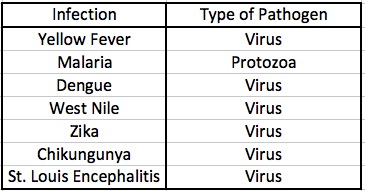
Many other infectious diseases are spread by mosquitos (Table 1), and they are mighty nasty. With one exception all of them are viruses. So, why not HIV?

Table 1. Some pathogens that are transmitted by mosquitos
There are a number of reasons why HIV cannot be spread by mosquitos.

HIV is "homeless" inside a mosquito. The property that makes the virus so dangerous to people - an affinity for human T-cells (1) in the blood - also makes it an unhappy guest inside the mosquitos, which do not contain human T-cells. HIV acts by penetrating T-cells and "hiding" inside. In the absence of hiding places, HIV is exposed to and broken down by the enzymes found in the gut of the mosquito.

Just because HIV cannot grow inside mosquitos doesn't mean that other viruses cannot (2). Yellow fever and Dengue can replicate in the gut of the mosquito can then be passed on via the saliva. The same holds true for Plasmodium, the causative pathogen in malaria.

Mosquitos inject saliva when they bite. Living Plasmodium, as well as viruses that replicate in the mosquito gut, make their way from the gut to the salivary glands. This is how these infectious diseases are transmitted. Since the HIV particles are degraded in the gut they do not make their way to the saliva and cannot be transmitted.

Furthermore, HIV is not terribly contagious, especially when compared to other viruses like influenza, measles, and norovirus, which require very few viral particles to cause infection. So even if a minuscule number of viruses survived the innards of the mosquito there would not be enough virus to start the infection.

It may sound strange to think that the world got "lucky" with HIV, especially considering that 35 million people have died of AIDS. But it could have been much worse. Before Saquinavir, the first successful anti-HIV drug was approved in 1995, the death rate from AIDS was 100%. If mosquitos transmitted HIV, the 14-year period between when HIV was first identified and the approval of effective medicines could have easily been a scene from a post-apocalyptic horror movie.

So it is more than a little ironic that the reason that HIV is so deadly is the same reason that it didn't spread all over the world out of control. Viruses are seriously fascinating.

NOTES:

(1) T-cells are a type of white blood cells. They are responsible for fighting infections. HIV binds to a receptor called CD4, which is found on the surface of the T-cell. This is the beginning of the process of infection.
(2) Some viruses simply won't replicate outside of the body while some do easily. This drives virologists insane. For example, herpes and influenza can easily be grown in cultured cells in a dish while it is notoriously difficult to grow hepatitis C and norovirus. It is important to be able to have viruses growing in cells because then you can add a potential drug to see if it stops the replication. This is called a cell-based assay, and is the cornerstone of pharmaceutical research. 
Tags: 
 

Tuesday, November 14, 2017

Why It Took Over 20 Years To Get Bacteria To Fight Mosquitoes - And Then Get EPA Approval

By Hank Campbell — November 8, 2017

A salmon that grows slightly faster than other salmon, an apple that doesn't start turning brown the minute you cut it into pieces and a way to use nature to keep mosquitoes from giving developing nations horrific diseases. What they all share in common is onerous scientific development, but in the case of the mosquito they don't share the onerous approval cycle.(1)

That is the struggle science faces in a regulatory environment that has increasingly put the precautionary principle over benefit, and government bodies that increasingly cater to environmental groups that regard science as some sort of corporate conspiracy.

Yet things look like they are improving. The Arctic Apple is shipping in the Midwest right now, the U.S. FDA set a record for approval of new useful products in a single year back in August, and now after decades of international scientific effort, a new mosquito biopesticide (a pesticide that uses natural bactera) has been approved. And it only took a year and a half to get a sign-off.

This technology is MosquitoMate and it targets mosquito species which spread, among other things, the Zika virus. Males of the species do not bite people, so they are perfectly safe from even the wackiest Frankenmosquito concerns about imbuing humans with science. The new approved biopesticide is males infected with a strain of the Wolbachia bacterium (naturally occurring and common in most insect species), when they mate with females the offspring do not survive. Most importantly, Wolbachia-infected mosquitoes can't carry the dengue virus.

One microbe stops the other. It's brilliant.

And a terrific way to reduce insect populations without the chemicals that environmental groups claim to be against. Yet this sort of boost for a natural process is exactly what activists oppose. They distrust chemistry, they distrust biology. They do, however, trust bracelets proven not to work.

Citronella candles are scant protection from Zika.


The company, MosquitoMate, Inc. was not alone in pursuing this technology. In 2012, NPR wrote about Australian Scott O'Neill, who had spent 20 years trying to develop it for commercial use. Mosquitoes won't just get the bacteria, the team had to inject it into the embryos manually. Then they had to wait a week to see if it took. Sometimes 18,000 embryos had no successful uptake.

The developers from the University of Kentucky are to be applauded for seeing this through. Science is hard. Navigating regulatory approval is even harder.

It is being allowed under a time-limited registration in California, Connecticut, Delaware, District of Columbia, Illinois, Indiana, Kentucky, Massachusetts, Maine, Maryland, Missouri, New Hampshire, New Jersey, Nevada, New York, Ohio, Pennsylvania, Rhode Island, Tennessee, Vermont, and West Virginia. The states will still need to register it so it will be interesting to see which do not. If you have read my book Science Left Behind, you can probably predict which states will simply run out the clock and fail to register these mosquitoes at all.

NOTE:

(1) Onerous despite the fact that there is obvious upside to farmed fish that grow faster because one popular salmon gets a gene from a similar salmon that just grows faster. Fish is healthy and faster farming means wild stocks won't be depleted. With apples, food waste will be reduced if apples don't look rotten. Less Dengue and Zika are obviously good. What they all share in common is controversy but no risk.

Wednesday, October 4, 2017

Genetically engineered bacteria—spread by mosquito sex—could spell the end of malaria

Scientists spent ten years developing the special bug.

Friday, September 8, 2017

Infectious Mosquitoes Are Turning Up in New Regions

By
A mounting number of citations on a popular disease-tracking website suggests that mosquitoes may be moving into new ecological niches with greater frequency.  The website, ProMED mail, has carried more than a dozen such reports since June, all involving mosquito species known to transmit human diseases.
 
Most reports have concerned the United States, where, for example, Aedes aegypti — the yellow fever mosquito, which also spreads Zika, dengue and chikungunya — has been turning up in counties in California and Nevada where it had never, or only rarely, been seen.  Other reports have noted mosquito species found for the first time on certain South Pacific islands, or in parts of Europe where harsh winters previously kept them at bay...........Aedes albopictus established itself in Italy and southern France, where it has spread chikungunya — a painful fever known as “bending up disease.” British health authorities now have more than 30 surveillance stations at ports, airports and truck stops, on guard against the mosquito.........To Read More....

Sunday, May 14, 2017

Study Finds Native North American Mosquito Can Transmit Zika

By Josh Lancette

A new study from researchers at the University of North Dakota found that Aedes vexans, a mosquito species indigenous to North America, has the capability to transmit Zika. This is the first native North American mosquito species shown to be able to transmit the virus. The results are published today in the Journal of Medical Entomology.

To test the capability of the species to become infected with the virus, the researchers used mosquitoes collected from North Dakota and Minnesota and fed them blood containing Zika virus. Some (about 3 percent) developed infections. Then, infected mosquitoes were tested to see if they could transmit the virus. Surprisingly, Ae. vexans had a higher transmission rate than Aedes aegypti, which was tested alongside Ae. vexans in the study and is the primary vector of Zika. ......To Read More....

Friday, January 27, 2017

Stopping A Bloodthirsty Killer

By Michael D. Shaw November 28, 2016 @ HealthNewsDigest.com
This HND piece focuses on the world's most dangerous animal (to humans). And that, of course, is the lowly mosquito, responsible for the deaths of more than 1 million people every year.  We go on to explain that this little fly is really a vector for the actual pathogens, and then go on to discuss the history of orgnaize3d efforts in mosquito abasement. As one of my friends—who lives in a mosquito-infested area of metro NYC—noted, "All but the most lunatic Greenies are on board with killing these miserable creatures."  Since we have already covered the tragedy of banning DDT, and what it did to Africa, that sordid aspect of this story wasn't included."  Mike Shaw
If it takes two or more victims for the perp to be considered a “serial killer,” what name would you give an animal responsible for the deaths of more than 1 million people every year? The short answer would be “mosquito.” The longer answer would be that these tiny flies (order Diptera; family Culicidae) themselves don’t do the killing. They are merely vectors for such baddies as…
  • Malaria—Caused by Plasmodium, transmitted via Anopheles
  • Yellow Fever—Caused by Flavivirus, transmitted via Aedes and Haemagogus
  • Zika Fever—Caused by Flavivirus, transmitted via Aedes
  • Filariasis—Caused by nematodes of the superfamily Filarioidea, transmitted via Culex
  • Dengue—Caused by four Flavivirus serotypes, transmitted via Aedes
  • West Nile Encephalitis—Caused by Flavivirus, primarily infecting birds, and transmitted via Culex
Fortunately, there have been organized efforts to combat mosquitoes since the early 1900s. Indeed, in the aftermath of the 1905 Yellow Fever outbreaks in New Orleans and Pensacola, FL, it was conclusively demonstrated that mosquito control could eliminate this disease. Other milestones in American mosquito control include:
  • 1912—New Jersey becomes the first state to authorize mosquito abatement districts
  • 1922—Large outbreak of dengue along Gulf Coast leads to Florida creating mosquito control districts
  • 1935—American Mosquito Control Association (AMCA) founded
  • 1990—Saint Louis encephalitis virus outbreak in Florida (226 human cases, 11 deaths)
  • 2000—West Nile Virus reported in 12 states
  • 2001—West Nile Virus reported in 27 states
AMCA Technical Advisor Joseph M. Conlon offered a few practical tips last summer during Mosquito Control Awareness Week…

Over the last few years, the U.S. has had increased cases of mosquito-borne illnesses such as the West Nile Virus. Furthermore, other exotic diseases such as Zika Virus, dengue fever, and Chikungunya threaten our shores. To ensure the safety of family, friends, and pets, it’s extremely important to make sure you’re taking the proper steps: first, reducing mosquito breeding through water management and source reduction, and second, reducing adult mosquito populations.”
Eliminating standing water is probably the most important thing to remember when preventing or controlling mosquito problems. Remember to irrigate lawns and gardens carefully to prevent water from standing for several days,” added Conlon.

AMCA reminds us of the THREE D’s of mosquito prevention: Drain, Dress, and Defend: Empty out water containers at least once per week; Wear long sleeves, long pants, and light-colored, loose-fitting clothing; Properly apply an approved repellent.

While most people think of California as a relatively arid location, the state is by no means free of mosquitoes, and its activities in this connection date back to the beginning of the 20th century. Early efforts in the state operated via subscription and donation. It was in 1915 that Governor (and later long-term US senator) Hiram Johnson signed the Mosquito Abatement Act, which provided for the formation, organization, and financing of mosquito abatement districts.

At present, the Mosquito and Vector Control Association of California comprises 64 member agencies, set up in five regions. Let’s take a brief look at one of those member agencies—the Compton Creek Mosquito Abatement District (Compton, CA).

Compton Creek’s founding dates way back to 1927, related to a devastating flood. Among its many outreach efforts, the agency offers a free program for students in 7th grade Life-Sciences classes. As you might expect, it focuses on mosquitoes—detailing anatomy, life cycle, habitat, food sources, disease transmission, and the role that students can play in helping to protect their communities from mosquito-borne diseases. In addition, its active Twitter feed keeps those in its district up-to-date.

I’ll give the last word to Micah Ali, President of the Compton Creek Mosquito Abatement District:

We are at the forefront of educating citizens, schools, individuals, and families about ways to guard against the risk of mosquito-borne illnesses like West Nile Virus and Zika, among other public health emergencies. Our work throughout the City of Compton and the County of Los Angeles is a model other cities and states should adopt, because we have an established record of—we have a proactive reputation for—saving lives through a combination of intelligence, planning, coordination, and action.”

Tuesday, December 1, 2015

Zica Virus: A New Emerging Disease ~ Lyme Disease cases in Pennsylvania top 10,000


Countries that have past or current evidence of Zica virus transmission (as of October 2015) Southern Hemisphere 11/28/15 reuters.com: by Jeb Blount – A link between a form of fetal brain damage and the mosquito-born zica virus has been confirmed by Brazilian health authorities on Saturday. The link between zica, first medically identified as a new disease half a century ago, and birth defects has never been made. The virus, endemic in parts Africa, South America, Southeast Asia and some Pacific Islands, has until now been blamed for symptoms such as fever, mild headache, skin rashes, joint pain and conjunctivitis, or “red eye.” .......There's more see the link below.....

zika-worldmap

Lyme Disease

Pennsylvania 11/28/15 outbreaknewstoday.com: by Robert Herriman – Pennsylvania continues to lead the nation in Lyme disease cases as the Commonwealth through Nov. 27 has reported more than 10,000 cases, about one-third of all cases in the US that have been reported to the Centers for Disease Control and Prevention (CDC) (31,479). This compares to 7,400 cases in 2014 and 5,900 in 2013. In April, Pennsylvania health officials reported for the first time the presence of the Lyme vector, the blacklegged (deer) tick, in all 67 counties. Lyme disease is a huge problem in the US and Pennsylvania, both medically and financially.....To Read More......