Editor's Note: I originally ran this in 2009. This article is 13 years old with some updates but it's as factually accurate and noteworthy now as it was then. I ran it again in 2014 and had planned to run it every year around Thanksgiving. I failed to remember. I hope to remember from now on. Best wishes to all! RK
“What is more frightening than any
particular policy or ideology is the widespread habit of disregarding facts.
Former House Majority Leader Dick Armey put it this way; "Demagoguery
beats data." Thomas Sowell
The pest control industry seems to be faced with the same problem. We're
constantly told how we have to restrict pesticide use. We are told we must find
alternatives to what we're using. We're told we must adopt “least toxic”
(whatever that means) pest control programs.
Why?
Because they claim that
pesticides may affect our health and the environment adversely. This
isn’t only from the environmental activists outside of government. It's
also the constant refrain from those environmental activists within
the Environmental Protection Agency (EPA).
It costs about three hundred
million dollars to bring a pesticide to market - are we to assume that
we don’t
know what all the potential effects these products may have on people
and the
environment? Actually - yes! We aren’t allowed to test people, so we
don’t
really know what any product will do, whether it's pesticides or
automobiles, until it is in common use. With pesticides, ultimately
the final testing ground will be agriculture.
Editor's Note: That 300 million figure is at least 25 years old and I have no doubt it's much, much higher now. RK
In years gone by the structural pest control industry used far more
liquid pesticides than we do now, and we were only using 4% of all the
pesticides manufactured, liquids only being a part of that percentage.
Four percent doesn’t make much money when the cost of
testing is so high. Therefore any pesticide manufactured must be
manufactured
for use on corn, tobacco, cotton, rice, wheat, soybeans, etc. or it
isn’t
manufactured. We've changed what we're using in structural pest control
dramatically over the last thirty years, we did so because of efficacy.
We shifted to a higher reliance to baits for cockroaches and ants
because of their effectiveness. However we must understand - if a
pesticide is used in structural pest control it is because it has been
used
profitably elsewhere and for some time. We get it last.
New technology in
structural pest control is usually old technology everywhere else where
pesticides are needed and used. So what must we conclude from that? If these
products have been used extensively, and for some time, then the effect on people and
the environment must absolutely be known to EPA.
So what then must we conclude from that? Logically we can only conclude they don’t care what the facts are. They've
apparently made up their minds to advocate the same view as the
environmental activists and are not going to let facts stand in the way. These "Sue and Settle"
lawsuits, which is nothing short of illegal collusion between
environmentalists and government bureaucrats, gives clear evidence of
that. Between regulators, activists, universities, researchers, self
serving
politicians, and a compliant media, they have managed to keep the
public
ignorant and frightened through “filtered facts” which has now given a
completely opposite view of what is actually occurring.
Their answer to any criticism is that we must adopt Integrated Pest Management (PM) or "green"
pest control, neither of which can be truly defined. Name one thing you know for sure
about IPM! Everybody has their own perception as to what it means, what
products can be used, what techniques should be used, where and when they
should be used if ever. This will always be debated because IPM is an “ideology,
not a methodology” and "green" is nothing short of neo-pagan mysticism.
If these products are so dangerous and EPA has the authority to remove products
that are harmful from the market, and they have traced the results of use of
these products over the years - why don’t they do it? They clearly have the
power and they certainly have the desire. So, why don’t they do it? It is quite
simple - the facts must not support such an action.
Why are they promoting IPM to the tune of tens thousands of dollars a year in the
form of grant money? Is it because there are no facts to support the
elimination of these products and no matter how many times they change the
rules(Food Quality Protection Act is one example along with re-registration requirements)
to make it impossible to use pesticides they still can’t find the
science to support the ban of pesticides, so they attempt to do it
through a
back door called IPM, organic or green pest control. And why IPM or
green pest control? Because if there's no alternative there's no
problem, so IPM and Green Pest Control are their alternatives.
The public is constantly told by the media that pesticides cause every
conceivable malady. When it is discovered they're wrong or the
facts were deliberately perverted -as in the Alar case - it's passed off as
journalism. The activists jump up and down swearing it was good journalism. The
media jumps up and down defending their right to say what they want no matter
what the real truth is, and no matter who is hurt as in the Alar case,
and refuse to publicly acknowledge their misconduct.
What are the facts regarding pesticides? There is no evidence that pesticides
have adversely effected the general health of the population! In fact, if you
compared the world before modern pesticides and today we find that we are
better fed and healthier than ever in this nation’s history or any other nation
that has adopted extensive pesticide use. Only the countries who are unable or
unwilling to adopt modern practices suffer the consequences of dystopia;
poverty, misery, disease, squalor, hunger, starvation and early death.
Think about this. At the end of WWII the world's population was around two billion people, and it took thousands of years for that to occur. In less than 100 years the world's population has soared to over seven billion people. If these products did all the things activists claim they do, how did that happen? Or perhaps we should be asking if these products are a major reason why we have the best fed healthiest population the world has ever know. The Sri Lanka message is clear, adopting the green agenda is a human disaster.
There has been a great deal of talk regarding trace amounts of chemicals
in our waters and land, and even trace amounts of over 200 manmade
chemicals in our bodies. So what? This must be a good thing since the
advent of
these products people are living longer and healthier lives. The
appearance of
chemicals has nothing to do with toxicity. It's the dose makes the
poison, not it's presence, and there are toxic chemicals necessary for
good health which appear in detectable trace amounts in our bodies.
Still we have educated individuals teaching (and being taught) in our
schools
and universities that manmade chemicals are the great evil and we need
to go
"green" or “all-natural” or “organic”. Whatever those terms mean! I
love the claim that things are "chemical free". Let's get our heads on
right about chemicals. The universe - including you - is made up of
chemicals!
Dr. Bruce Ames (a biochemistry professor at the University of
California) pointed out in 1987 that we ingest in our diet about 1.5 grams per
day of {natural} pesticides. Those foods contain 10,000 times more, by weight,
of {natural} pesticides than of man-made pesticide residues. More than 90% of
the pesticides in plants are produced {naturally} by the plants, which help
protect them from insects, mites, nematodes, bacteria, and fungi. Those natural
pesticides may make up 5% to 10% of a plant's dry weight, and nearly half of
them that were tested on experimental animals were carcinogenic. Americans
should therefore feel unconcerned about the harmless, infinitesimal traces of
synthetic chemicals to which they may be exposed. The highly publicized traces
of synthetic pesticides on fruits and vegetables worried some people so much
that they began to favor ``organically produced'' foods, thinking that they
would not contain any pesticides. Most people are not aware that organic
gardeners can legally use a great many pesticides, so long as they are not
man-made. They can use nicotine sulfate, rotenone, and pyrethrum (derived from
plants), or any poisons that occur naturally, such as lime, sulfur, borax,
cyanide, arsenic, and fluorine.
This apparently is OK because its “natural”. Chemicals
are chemicals and guess what - they all have chemical names. If I presented you the following menu
would you eat it? By the way, these foods are known carcinogens.
Cream of Mushroom Soup, Carrots, Cherry Tomatoes, Celery, Mixed Roasted
Nuts, Tossed Lettuce and Arugula with Basil-Mustard Vinaigrette, Roast Turkey,
Bread Stuffing (with onions, celery, black pepper & mushrooms), Cranberry
Sauce, Prime Rib of Beef with Parsley Sauce, Broccoli Spears, Baked Potato,
Sweet Potato, Pumpkin Pie, Apple Pie, Fresh Apples, Grapes, Mangos, Pears,
Pineapple, Red Wine, White Wine, Coffee, Tea., Jasmine Tea. (Source: American
Council on Science and Health)
Here are the chemicals that make up this natural meal.
For those that read the chemicals listed above you will
notice that some of them are repeated a number of times. I deliberately left
the list in that way because you are getting a multiple dose in the above
Thanksgiving meal.
Does that sound so bad now? It is unfortunate that so many in positions of
authority and responsibility continue to allow filtered facts to become the
conventional wisdom. More importantly it is impossible for any society to make
intelligent long term decisions when preconceived notions are allowed to
dictate what “facts” will be allowed to be presented. Then again, facts are
confusing and that certainly is the last thing the public needs, after all it
is the last thing the environmentalists and their minions want. It might
interfere with all those scares they are constantly presenting as eminent
disasters. That in turn would foul up contributions and then the greatest
disaster of them all would occur. They would have to go out and get real jobs.
All of this is disturbing, but what I find most disturbing is the unwillingness
of our industry's information deliverers - the trade journals and trade associations - to
stand up to these
people and publish the truth. When we fail to stand up and be counted
we're appeasers and enablers. Eventually that will turn us into
traitors to our own industry.
In the last two years the CDC has come under attack for what can only be called scientific fraud and corruption over their positions and mandates regarding this pandemic. But let's try and understand this. This deep deep state infection didn't just start. For years this infection has permeated the CDC right along with all these agencies, including, and especially the EPA, which needs to be abolished, all of whom are supposed to be paragons of good science.
"A leading local advocate in the fight against Lyme disease and other tick-borne
diseases is calling a recent study by the U.S. Centers for Disease Control and
Prevention “junk research” and a waste of taxpayer money. Jill Auerbach, chairwoman of the Hudson Valley Lyme Disease Association,
come on the heels of a CDC study that suggests spraying individual
properties with a pesticide does not reduce the rates of Lyme disease
and other tick-borne illnesses in the people who live there.........Auerbach said the study should have been designed to include a larger neighborhood, rather than individual yards....."
Auerbach was absolutely correct
in her assessment. That money spent on this
study was wasted research. It is also clear
to me that this study must have been conducted by those who really didn't
understand
how important widespread pesticide use is in order to impact pests, or
more likely didn't care, and seems more like to me to be a case of "Pre-conceptual Science".
That's where you reach a conclusion
before doing the research and then dismiss anything that disagrees with
that
conclusion. Ergo, since you never see or hear anything that
demonstrates your pre-conceived conclusion is wrong, it must be right.
However - in the real world -
making isolated pesticide applications will not resolve any pest problem
if the
surrounding areas are still filled with the target pest, and the consequences of ignoring the reality of pests and pesticides, cannot be ignored or dismissed. In the real world people get sick and many die, in large numbers.
Case Scenario One.
You are responsible for treating a twenty suite apartment
building for roaches. Two of the apartment’s tenants refuse to allow
you to treat their apartment and they both are filled with roaches. What happens? The other eighteen will still have a number of roaches each month when
you return. Now, what if the numbers were reversed and only two suites
were treated and the other eighteen left untreated. The migratory habits
of roaches would bring them right back into the untreated suites in
large numbers.
Here's the numerical dynamics of German
cockroaches. If you have 1000 roaches in a structure and you only kill
90%, that leaves 100. Half of them are female and half of them are
pregnant. At the end of 30 days you now have a numerical potential of
1010. Obviously, there would be a whole lot more than just a few
cockroaches in the treated suites in following month.
Now, let’s apply this real world situation and the problem of disease
transmission. Let’s suppose roaches could transmit Lyme disease.
What would give anyone reason to believe that the rate of disease would
be reduced since the overall pest pressure from the surrounding
environment would overwhelm any individual efforts, no matter how
effective.
I think this statement is important to understanding what is going on behind the scenes:
"Testing
whether spraying reduces the risk of tick-borne disease is critical
because people spend lots of money spraying their yards,” “These sprays
can be toxic to wildlife, pets and people, and people expect a strong
health benefit from doing so. The study’s finding … is very important in
evaluating what works and what doesn’t. This was money well spent, in
my opinion.
"
That was a quote from Rick Ostfeld, disease ecologist at
the Cary Institute of Ecosystem Studies, who also said he didn’t think
the study was poorly designed, which is what I would you expect from
“independent” activists.
Well it was poorly designed! That is, if
you really wanted to know what the real impact pesticides have on ticks
and the transmission of Lyme disease. However, if your goal was to
give the impression that making pesticide applications are valueless for
the control of Lyme disease – this piece of junk science was an
anti-pesticide activist’s dream.
One more thing! Bifenthrin is a synthetic pyrethroid. All pests are
starting to show serious resistance to this chemical class. When we
lost organophosphates, due to EPA’s manipulation of the rules as
outlined in the Food Quality Protection Act, this problem with ticks,
Lyme disease and bed bugs became far more serious.
Here is the reality of this article and what these grant chasers will
not tell you. If you design a study that uses less effective chemistry
in small areas that are isolated and surrounded by areas where no
pesticide applications are made, but have large tick infestations, the
conclusion will be forgone. They will kill some pests in the treated
areas but those areas will quickly re-infest, and if that pest is a
disease carrier the rate of transmission will remain the same as if no
pesticides were applied. I could have told them that for free and saved
the taxpayers a half a million dollars.
But
the government decides that pesticides are so dangerous, you're only
going to be allowed to make pesticide applications on one street and
miss the next six blocks. Would any rational person really expect to
see positive results in thwarting disease transmission? The answer is a
resounding NO! Now double that insanity with a requirement you must use a pesticide that's the least effective because of false claims regarding safety.
In my opinion, any honest person who is familiar
with pest control, pesticides, history, and with valid science, and reads this can only come to one conclusion. This
study is nothing short of conclusions in search of data!
The reality is this. The answer to all these pest problems was
effective, easy to use, inexpensive chemistry that was available to
everyone. If that isn’t part of the answer there will be no answer and
no amount research that leaves that component out will ever be anything
but junk science.
An endocrine disruptor (also called an “environmental estrogen”) is supposedly any one of a variety of chemicals that, at extremely low-level exposures, well below those considered safe by EPA and other regulatory authorities, disrupt the human or animal hormonal system to cause diseases or conditions such as development defects, infertility, obesity, Alzheimer’s, autism, cancer and others.
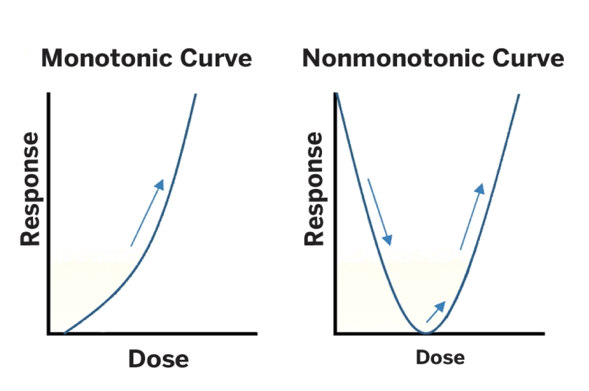
A key argument of those advancing this thesis is that standard laboratory tests fail to pick up on these hazards because the harmful effects of the endocrine disrupting chemicals or compounds, often called EDCs for short, vanish as the dose increases (though they may increase again as the dose is raised even higher). In other words, EDC advocates discard the proven toxicological principle that “the dose makes the poison,” i.e. that toxic effects of a substance increase as dose or exposure to the substance increases. In fact, they turn it on its head, saying that for this special class of chemicals, the reverse is true.
This contrast is illustrated in the graphs below. The standard dose response — seen in all toxicology to this point – is called a “monotonic” curve, meaning it is always moving in one direction, up or down. EDC advocates say that these special compounds produce a U-shaped or “non-monotonic” dose-response curve.(1)
It is important to note that the existence of the non-monotonic dose response which is key to the endocrine disrupter scare and is which is loudly advocated by a small group of activist scientists remains only a hypothesis and has never been scientifically validated. Twenty-two years after the EDC thesis was first advanced, not a single chemical has even been demonstrated to act non-monotonically that is, to cause harm at low doses but not at higher ones.
The standard dose response, seen in all toxicology, is “monotonic”: the greater the exposure, the greater the harm. The “non-monotonic” dose response claimed by EDC activists has never been demonstrated.
Useful concepts
Activists often (intentionally) try to confuse the public about endocrine disruptors on two key issues:
Low vs. high exposures. The endocrine disruptor scare is exclusively about low-dose or low-level exposures to chemicals in the environment. Activists often throw into the mix examples of harm caused by high-level exposures to chemicals.
Harm vs. mere effects. Activists often tout the results of studies that report chemicals caused some biological effect to occur vs. actual harm. Prior to being dubbed “endocrine disruptors” by the activists, substances that act like hormones to produce effects at small doses but no harms, were referred to in a more neutral terms as “endocrine modulators” by scientists.
The endocrine disruptor scare is about actual harm caused by low-level exposures to chemicals in the environment. More on these points below.
Dose makes the poison
Toxicology is the study of poisons. A basic principle of toxicology is “the dose makes the poison.” This means that any substance can produce poisonous, toxic or harmful effects if one is exposed to enough of it. Here are three variations of this principle.
Example: Ingesting too much arsenic can be fatal. Nonetheless, some arsenic can be safely ingested without any toxic effect.
Example: While we cannot live without drinking water, drinking too much water can cause death by upsetting the body’s electrolyte balance and fatally disturbing brain function.
Example: While inhaling too much carbon monoxide can cause death, the human body naturally produces a necessary but small amount of carbon monoxide.
There is no example in toxicology where any non-zero exposure to a substance causes harm. Every substance has a safe or no-effect exposure level.
Distinguishing between harmless biological effects and harmful or adverse effects.
A related principle to “the dose makes the poison” is the distinction between mere biological effects and actual harm following exposure to a substance. Mere exposure to a substance does not necessarily cause a harmful or toxic effect (i.e., the dose makes the poison). But all exposures cause biological effects. Drinking water, for example, causes biological effects, ranging from beneficial (if you are dehydrated), neutral (in case of normal hydration) or harmful (in case of overhydration). The mere occurrence of an effect does not imply that the effect was harmful or adverse.
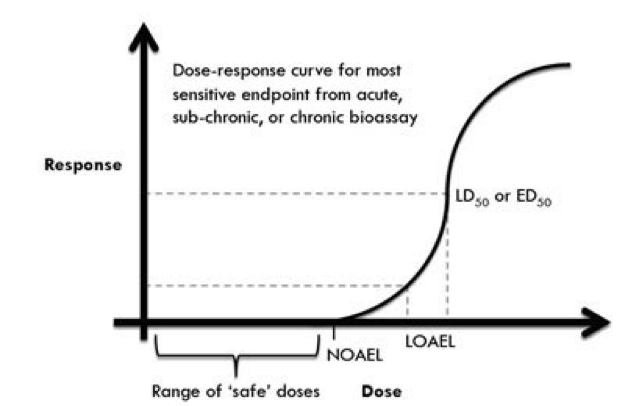
Dose-response. The relationship between exposures (or doses) and effects is called the “dose-response” relationship. It may be represented graphically by a dose-response graph or “curve” (See below). This curve illustrates some of the aforementioned concepts. The ‘no-observed-adverse-effect-level’ or NOAEL is the highest dose at which no biological effect is observed. The lowest-observed-adverse-effect is a point or range at which biological effects begin to be observed. (The LD50 is the point at which half the lab animals are outright killed by the dose it is not relevant to this discussion.)
It will be seen later that the “low-dose hypothesis” area of the endocrine disruptor scare involves doses at the NOAEL and below — the “hypothesis” being that any non-zero exposure to an endocrine disruptor can cause an adverse effect. The low-dose hypothesis, then, is contrary to everything that is has been observed in standard toxicology.
Natural versus synthetic endocrine modulators
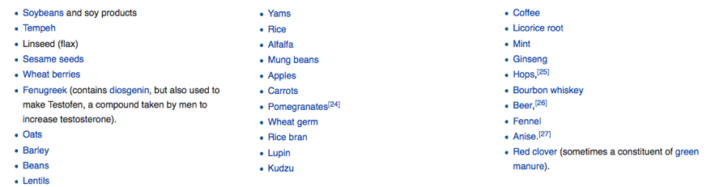
Many natural substances may also have hormone-like effects. Phytoestrogens, for example, are not produced by our endocrine system but are present in many of the vegetables and fruits that make up a healthy diet. Below is a list of some phytoestrogens.(2)(3)
One of the problems with the EDC scare as advanced by the activists is that they almost exclusively focus on made-made, synthetic chemicals, even though our exposure to so-called EDCs from natural sources, which are known to be safe and even healthy – are massively higher. Stephen Safe, a toxicologist at Texas A&M University, points out that “the total hormonal activity of the synthetic modulators we receive from industrial activity is 40 million times lower than that from the natural components of foods we eat.”(4) [Italics added]
Bisphenol A, or BPA, a substance used to harden plastics, and phthalates, substances that make them more flexible, have become a prime focus of EDC claims and have been removed from many household products as a result. But according to researchers at King’s College in the United Kingdom, their tests on laboratory animals showed that one natural estrogen found in plants “is 10 to 100 times as potent as bisphenol A. They also found that three different phthalates — the chemicals that caused the British dairy panic — produced no hormonal effects whatsoever.”(5)
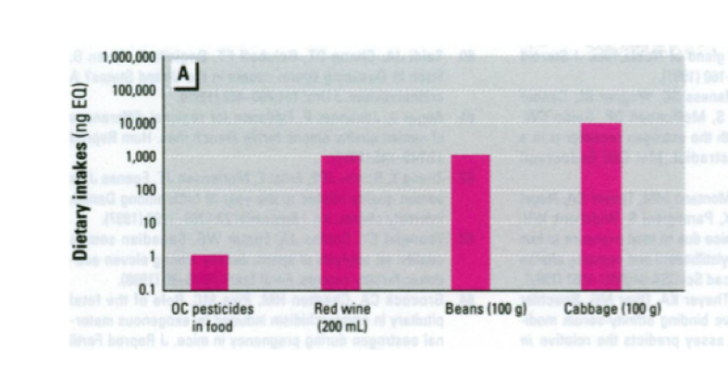
Red wine, beans and cabbage, for example, range from 1,000 to 10,000 times more active as endocrine modulators than organochlorine pesticide residues found in food.(6) The chart, below, shows that eating 100 grams (3.5 ounces) of cabbage provides an estrogen exposure 10,000 times greater than that from typical daily consumption of foods with organochlorine pesticide residues.
Origin the endocrine disruptor scare: Rise and fall of the cancer hypothesis
Rachel Carson dramatically alleged various harms to human health and the environment caused by industrial chemicals in her 1962 book “Silent Spring.”
In 1965, the Johnson administration expressed this concern by the creation of the Department of Environmental Health Sciences (DHES) housed within the National Institute of Health (NIH). In 1969, the DEHS was converted into an “institute” within the NIH called the National Institute for Environmental Health Sciences.
Also in 1965, the World Health Organization (WHO) established the International Agency for Research on Cancer (IARC). By 1970, IARC established its “Monogram Program” to evaluate chemicals and other agents for carcinogenic potential.
In 1970, President Nixon combined a number of ongoing federal environmental regulatory efforts occurring in separate federal agencies into one Environmental Protection Agency. One of EPA’s first major acts was to ban DDT, the insecticide of focus in Rachel Carson’s “Silent Spring.” DDT was banned despite an EPA administrative law judge concluding after seven months of hearings and 9,000 pages of testimony that there was no evidence that DDT had harmed humans or wildlife. The EPA administrator making the decision, William Ruckelshaus, did not attend a single moment of the DDT hearings and, according to his staff, did not even read the transcript. Later, Ruckelshaus became fundraiser for the Environmental Defense Fund, the activist group that led the charge to get DDT banned.
In the early 1970s, the Nixon administration launched its “war on cancer,” which in turn led to federal regulatory focus on the possibility that chemicals in the environment caused cancer. By 1974, NIEHS established a program to study the links between chemicals in the environment and cancer. In 1976, the Toxic Substances Control Act (TSCA) was enacted to enable EPA to regulate the use of chemicals. One of the driving forces behind TSCA was concern that chemicals in the environment caused cancer.
In 1978, the National Toxicology Program was formed within NIEHS to coordinate and lead toxicology programs in the federal government. NTP was made a permanent program in 1981.
So by the early 1980s, EPA, NIEHS/NTP and IARC were extensively involved in toxicology, with particular focus on trying to link chemicals in the environment to cancer.
But even by the time of TSCA (1976), scientists knew that it would be very difficult, if not practically impossible, to link chemicals in the environment or consumer products with cancer.
Absent strong epidemiological evidence, characterizations of a substance’s carcinogenic potential had to be based on laboratory animal tests that are very controversial and of unclear if not dubious relevance to humans.(7)
In 1990, molecular biologist Bruce Ames reported that naturally occurring chemicals (like those in raw and cooked food) are as likely to test positive for carcinogenicity in laboratory tests as synthetic chemicals (like pesticides). Since humans are exposed to much greater levels of the natural chemicals without apparent effect, exposure to the synthetic chemicals is not likely to be of any significance.(8)
A 1999 study, for example, reported that 85 percent of the chemicals and agents studied by NTP over the years exhibited either carcinogenic or anti-carcinogenic activity in laboratory animal tests.(9) This result is difficult if not impossible to reconcile with real-world exposures to chemicals and disease incidence.
Origin the endocrine disruptor scare: Rise of ‘endocrine disruptor’ controversy
The failure of the chemicals-cause-cancer hypothesis prompted activists to search for new ways to link industrial chemicals with adverse health and environmental consequences.
After a career as pharmacist, Theo Colborn earned a PhD in zoology in 1985 at age 58. She studied the effects of chemicals in the environment on Great Lakes wildlife. Colborn began working at the environmental activist group World Wildlife Fund in 1987 and then with the environmental activist sponsor, the W. Alton Jones Foundation, in 1990.(10)
In 1991, Colborn convened like-minded individuals under the auspices of the W. Alton Jones Foundation in the first of a series of conferences in Racine, WI that came to be known as “Wingspread.”(11) During that meeting, the term “endocrine disruption” was coined.(12) The Wingspread “Consensus Statement” concluded that chemicals in the environment, even at low doses, “can cause alterations of the developing immune system” such that “the potential exists for widespread immunotoxicity in humans and wildlife species because of the worldwide lack of appropriate standards.”(13)
It should be noted that, to the extent the issue of chemicals in the environment had been discussed among scientists prior to the first Wingspread conference, they were referred to more benignly as “endocrine modulators.” The Wingspread re-branding of potential “endocrine modulators” as “endocrine disruptors” was clearly meant produce alarm among an ignorant public.
On August 23 1994, the endocrine disruptor scare was reported in the New York Times in an article titled “Pesticides May Leave Legacy of Hormonal Chaos.” Referring to some wildlife populations, Colborn stated, “I’d say we are on a fast track to extinction… You would expect the same thing to happen to human populations.” A toxicologist from the American Council on Science and Health noted, “We suspect there is a lot of baloney here. On the other hand, to develop the hard science to refute it is going to be a formidable task.” The New York Times article concluded with “But for now the science simply does not know enough to say just how serious a threat they pose.” The article foreshadowed some of the endocrine disruptor claims to come including synergistic effects of combinations of endocrine disruptors, sperm count decline, endocrine disruptors in plastics and the low dose controversy.
It’s worthwhile to note this excerpt from the New York Times article:
But perhaps the greatest fears expressed about the effects of endocrine disruptors on humans have to do with sex and reproduction. The case of the Taiwanese boys may reflect the effects of high doses. But more insidious and threatening in the long run, say Dr. Colborn and others, may be the subtle effects of low doses in the womb. As was shown with the synthetic hormone DES, prescribed from 1948 to 1971 to prevent miscarriages, exposure of the fetus to endocrine disruptors can cause reproductive problems that do not become evident until many years later.
DES was a medication and so at best, an example of a high-dose effect consistent with traditional toxicology (i.e., the dose makes the poison). “DES is not only a potent estrogen, but it was administered at relatively high doses… In contrast synthetic environmental endocrine-disrupting compounds tend to be weakly active,” observed toxicologist Stephen Safe.(14)
In July 1995, the National Research Council (NRC) of the National Academy of Sciences formed a Committee on Hormonally Active Agents in the Environment to “critically review the literature on hormone-related toxicants in the literature…”(15) The Committee was formed by the Clinton administration under contracts from the EPA, Centers for Disease Control and Prevention and Department of Interior.(16)
The precise origin of this Committee is unknown but one can easily imagine that it was quietly lobbied for by endocrine disruptor advocates. The Executive Summary section of the report indicates it was “driven by considerable public interest.” The report’s Introduction section states, “In recent years, there has been increasing concern regarding [potential adverse human health effects of various environmental contaminants designated by some scientists as “endocrine disruptors” (Thomas and Colborn 1992; Colborn et al. 1993 ).”(17, 18) However, Theo Colborn’s name only appears once, for example, in the New York Times prior to the announcement of the formation of the NRC committee and that was in a letter to the editor.(19) While there are various other media stories quoting Colborn in national and local media between 1989 and 1995, it is not at all clear that this supports the notion of “considerable public interest” in or “increasing concern” for endocrine disruptors.
In March 1996, the book “Our Stolen Future: Are We Threatening Our Fertility, Intelligence and Survival A Scientific Detective Story” was published with Colborn as a co-author along with journalist Dianne Dumanoski and then-director of the W. Alton Jones Foundation and Wingspread Consensus Statement signatory, John Peterson Myers.
In its March 19, 1996 coverage of “Our Stolen Future,” the New York Times reported (as excerpted):
In a warning supported by allies who include Robert Redford and Vice President Al Gore, some environmentalists are asserting that humans and wildlife are facing a new and serious threat from synthetic chemicals/
But issues like declining sperm counts are a matter of heated dispute among experts…
But its message is controversial. Although some biologists agree that there is reason for concern about these chemicals, especially to certain populations of fish and birds, many others say there is no factual basis for the book’s alarms, several of which have been refuted by careful studies…
In a foreword, Mr. Gore compares it with “Silent Spring,” Rachel Carson’s classic 1962 book that set off a movement to ban DDT and other pesticides. He describes the new book as “critically important”…
But several leading scientists view such positions as premature at best. They say that the case for ridding the world of these chemicals seems fueled more by hyperbole than facts and that many of the claims of demonstrable harm, when examined, turn out to be a house of cards.
These scientists say they are not arbitrarily dismissing fears that trace amounts of synthetic chemicals might injure people and wildlife. But, they say, there is a difference between a hypothesis and convincing evidence.
“It’s hypothesis masked as fact,” said Michael A. Gallo, a professor of toxicology at the Robert Wood Johnson Medical School in New Brunswick, N.J.
This assessment was also shared by Dr. Bruce Ames, a professor of biochemistry and molecular biology at the University of California at Berkeley. “It’s a political movement and it’s based on lousy science,” said Dr. Ames, who was a member of a National Academy of Sciences panel that recently reported that pesticide residues in food were not an important cause of cancer.
Scientists agree that certain synthetic chemicals may mimic reproductive hormones. And, they say, there is no doubt that some of those chemicals, at certain times and places, have reached levels that adversely affect wildlife.
But, the question is, what, if any are the effects of minute amounts of these chemicals on humans? And that is where environmentalists like Dr. Colborn part company with many scientists.
One issue, scientists say, is that the amounts of the synthetic chemicals are so minuscule that they might be dwarfed by naturally occurring hormones in plants that have the same effects. Dr. Stephen Safe, a professor of toxicology at Texas A & M University, has calculated that synthetic chemicals contribute less than one one-thousandth of 1 percent of the amount of estrogenlike compounds that people consume in their diets…
Another possibility raised in the book is that endocrine-disrupting chemicals can cause parents to neglect or abuse their children.
“What about the breakdown of the family and frequent reports of child abuse and neglect?” the authors wrote. “If scientists have found evidence of careless parenting in contaminated bird colonies, do these chemicals have any role in similar phenomena among human parents? Reacting to reports of growing neglect and violence against children by their parents, some commentators have ventured that there must be something wrong with these people, some basic instincts seem to be missing.”
But Dr. Zahm of the cancer institute dismissed the argument that endocrine-disrupting chemicals in the environment could cause such a variety of ills as “a leap — in the quantum category.
“We shouldn’t go beyond what our data show,” she added.
In June 1996, just months after the widely publicized release of “Our Stolen Future,” a study was published by Tulane University researchers in the journal Science reporting that combinations of pesticides and other chemicals in the environment could be as much as 1,500 times more potent as so-called “endocrine disruptors” than the individual chemicals.(20) In an unusual move, Science also editorialized favorably about the new study.
In reaction to the Tulane study, EPA administrator Carol Browner stated, “The new study is the strongest evidence to date that combinations of estrogenic chemicals may be potent enough to significantly increase the risk of breast cancer, prostate cancer, birth defects and other major health concerns.” The head of EPA’s Office of Pesticides and Toxic Chemicals said, “I was astounded by the findings. I just can’t remember a time where I’ve seen data so persuasive… The results are very clean looking.”
In July 1996, Congress inscribed the notion of endocrine disruptors into federal law. The Food Quality Protection Act ordered EPA to set up a program for screening pesticides and other industrial chemicals for their ability to act as endocrine disruptors.(21) The legislative history indicates reliance on the Tulane study.(22)
The EPA program for screen endocrine disruptors is called the Endocrine Disruptor Screen Program (EDSP). As of May 2011, the EDSP had “not determined whether any chemical is a potential endocrine disruptor.” (23)
As of the present, EPA has evaluated 52 chemicals and reported the following results: evaluated based on Tier 1 screening, intended to identify whether a substance has the potential to have hormonal activity:(24)
There was no evidence for potential interaction with any of the endocrine pathways for 20 chemicals.
14 chemicals that showed potential interaction with one or more pathways, but EPA determined it enough information to conclude that they do not pose risks.
Of the remaining 18 chemicals, all 18 showed potential interaction with the thyroid pathway, 17 of them with the androgen pathway, and 14 also potentially interacted with the estrogen pathway. These chemicals are moving on to Tier 2 screening, intended to ascertain their effects in real-world systems.(25)
The Tulane Study is retracted because of scientific misconduct
To recap, the endocrine disruptor scare was launched for public consumption by “Our Stolen Future” in March 1996. About ten weeks later, a new study in a prestigious journal appeared to lend credibility to concerns about endocrine disruptors. One month after the study, the notion of endocrine disruptors had been enshrined in federal law.
By November 1996, four laboratories had tried but failed to replicate the Tulane findings – a highly unusual outcome in the controlled setting of laboratory research. In January 1997, Science printed a letter from scientists NIEHS, Texas A&M University and Duke University reporting the Tulane results could not be replicated. A month later, the highly regarded international science journal Nature published results from British researchers who could not replicate the Tulane findings.(26)
The Tulane researchers initially responded to critics by claiming special conditions in their laboratory. But “special conditions” are the stuff of magic, not science. Scientific findings are supposed to describe the world in general, not some special place.
In July 1997, the Tulane team finally threw in the towel and retracted their study. In a letter to Science they wrote, “We . . . have not been able to replicate our initial results . . . (and) others have been unable to reproduce the results we reported.”(27)
In 1999, the NRC Committee on Hormonally Active Agents in the Environment (the mysteriously formed Committee established in July 1995) issued its eponymous report. The Committee failed to confirm the hypothesis of “Our Stolen Future,” concluded that, “Although there is evidence of harmful health and ecological effects associated with exposure to high doses of chemicals known as hormonally active agents – or endocrine disruptors – little is understood about the harm posed by exposure to the substances at low concentrations, such as those that typically exist in the environment, says a new report from a National Research Council committee.” [Emphasis added]
Author’s Comment: The phrase “little is understood” is political/weasel language meant as a compromise between reality (i.e., there is no evidence that endocrine disruption occurs) and the needs/goals/threats of activists and their researcher allies (i.e., we’ll scream, bloody murder if you embarrass us by stating reality). This is obviously politics, not science.
The NRC Committee confirmed that the traditional dose-response relationship still held true for so-called “endocrine disruptors” i.e., harm is only observed at high doses/exposures. This conclusion, however, would just force activists to resort to claims about low doses/exposures causing harm (discussed below).
In October 2001, the Department of Health and Human Services’ Office of Research Integrity determined that the Tulane study results were produced by scientific misconduct: “Dr. Arnold committed scientific misconduct by intentionally falsifying the research results reported in Table 3 of a paper published in the journal Science and by providing falsified and fabricated materials to investigating officials at Tulane University in response to a request for original data to support the research results and conclusions reported in the Science paper. In addition, [the Public Health Service] finds that there is no original data or other corroborating evidence to support the research results and conclusions reported in the Science paper as a whole.”(28)
Theo Colborn favorably cited two of Arnold’s co-authors on the retracted Science paper, John McLachlan and Louis Guillette, in “Our Stolen Future.” Arnold, McLachlan and Guillette are also cited numerous times in the 1999 NRC report as are other of Arnold’s co-authors.
The Rise of the Low Dose Hypothesis
Recall that National Institute of Environmental Health Sciences (NIEHS) traces its roots back to the 1960s pesticide scare launched by Rachel Carson’s 1962 book “Silent Spring.” NIEHS has since been a hotbed for activist-researchers. Not only does NIEHS conduct its own “research”, it provides grants to extramural researchers. NIEHS also publishes its own journal, Environmental Health Perspectives, to spotlight research its activist editors desire. NIEHS has tried to come to the rescue of the endocrine disruptor scare at least twice in 2000 (low dose hypothesis conference, discussed below) and 2007 (consensus statement on BPA, discussed later).
After the NRC report failed to endorse the endocrine disruptor hypothesis and, by extension, the basis of the legally-mandated EPA Endocrine Disruptor Screening Program, the EPA requested the NIEHS and NTP to convene a group to evaluate “the scientific evidence on reported low-dose effects and dose-response relationships for endocrine disrupting chemicals in mammalian species that pertain to assessments of effects on human health.” The “review” of the Endocrine Disruptors Low Dose Peer Review Panel occurred on October 10-12, 2000.(29)
Keeping in mind the previously discussed distinction between mere biological effects and harms caused by exposure to chemicals, the two key conclusions of the NIEHS Panel to have great significance going forward were:
“Low-dose effects… were demonstrated in laboratory animals exposed to certain endocrine agents.”
Several studies provide credible evidence for low-dose effects of bisphenol A (BPA).
An NIEHS Panel conclusion that was equally significant but soft-pedaled was that, “The toxicological significance of many of these findings has not been determined.” The importance of this conclusion is a recognition that just because a chemical exposure produces a detectable/discernible biological effect, that does not mean that the biological effect is necessarily harmful.”
The NIEHS Panel’s low-dose and BPA conclusions were largely based on the research of University of Missouri professor and “Our Stolen Future” hero Frederick vom Saal.
Vom Saal claimed his experiments on laboratory mice showed that very low doses of some chemicals — thousands of times lower than then-extant safety standards — increased prostate weight in male mice and advanced puberty in female mice. But no other laboratory had been able to reproduce vom Saal’s work. Traditionally, reproducibility of experiments is necessary before results may be considered “scientific.”
Vom Saal all but guaranteed that his work will never be reproduced. His experiments involved a unique strain of mice that he inbred in his laboratory for about 20 years. His mice were genetically unique. When the mice stopped producing the results he wanted, he killed them. Without the same strain of mouse, vom Saal’s experiments could not be reproduced by others and his work could not be thoroughly evaluated.
When the NIEHS Panel asked the public to nominate studies to be reviewed, they had set clear ground rules that a study’s raw data had to be submitted to the panel as a prerequisite for the study to be considered. The NIEHS Panel wanted to subject the data from these studies to “independent analysis.”
Vom Saal’s studies were nominated, but he refused to submit his data. Inexplicably, the panel changed the ground rules to include vom Saal’s studies anyway.
The BPA controversy
Though BPA was mentioned in “Our Stolen Future,” it wasn’t until the 2000s that it became the poster child of the endocrine disruptor scare.
The 2000s witnessed a dramatic increase in the number of studies published on BPA. In 1990, the year before the first Wingspread conference, only 70 papers on BPA were published in the scientific literature that year. For 2001, the number published had increased to 294. By 2014, there had been over 800 studies on BPA published in the literature.(30) It is important to note that the volume of studies being published was caused by the vast amounts of federal grant money being dispensed to BPA researchers rather than any important results they were reporting.
By the mid-2000s, legislation and regulatory action against BPA began to crop up on state, city and foreign government levels. This activity occurred among conflicting government reports on BPA. Some highlights include the following:
In 2005, California became the first state to try to ban BPA from consumer products.(31) That bill having failed, San Francisco tried to ban BPA in 2006.(32)
None of this activity was slowed one bit by the 2007 report from the National Institute of Health Center for the Evaluation of risks to Reproduction that concluded that BPA had little to no effect on human health.(33)
In 2007, a so-called “expert panel” of NIEHS scientists, grantees, and collaborators issued the Chapel Hill consensus statement on potential health effects of exposure to BPA. The panel concluded that current levels of BPA in people are higher than what is needed to cause harm in animals, and that the safe dose established by the EPA needs to be lowered.(34) Notable panel members included Fred vom Saal (spotlighted in “Our Stolen Future” and excused from providing data to 2000 NIEHS low dose panel), Linda Birnbaum (current head of NIEHS), Louis Guillette (spotlighted in “Our Stolen Future” and co-author of retracted Tulane study), John McLachlan (spotlighted in “Our Stolen Future” and co-author of retracted Tulane study), John Peterson Myers (co-author of “Our Stolen Future”) and Ana Soto (“Spotlighted in Our Stolen Future”).
In 2010, Health Canada declared BPA to be a “toxic substance.”(35) But a WHO panel concluded the Health Canada action was premature.(36) In late 2010, however, the European Commission voted to ban BPA in baby bottles starting in 2011.(37) In October 2011, US industry announced BPA was no longer present in sippy bottles.(38) The FDA formalized the sippy bottle ban in July 2012.(39) In December 2012, Suffolk County, NY banned BPA from cash register receipts.(40)
In December 2014, the FDA reaffirmed that BPA is safe in food containers and cans.(41) In January 2015, the European Food Safe Authority concurred that BPA was unlikely to pose a risk to consumers.(42)
In April 2016, California announced it would require labeling of food container with BPA.(43)
In February 2018, the NIH and FDA released a report that concluded even “high” doses of BPA found in water bottles and other products had only “minimal effects.” And those effects could have been a coincidence.(44)
CLARITY on BPA
In 2012, NIEHS and the FDA started an “multipronged, consortium-based approach to optimize BPA-focused research investments to more effectively address data gaps and inform decision making.”(45)
CLARITY-BPA has two components:(46)
Core Study. A two-year guideline-compliant study of potential BPA toxicity in rats, which was conducted according to federal regulatory and statutory guidelines for toxicity testing (i.e., the Good Laboratory Practices standard).
Grantee Studies. Studies conducted by university researchers but testing a broader range of health endpoints, including genetic impacts, cardiovascular disease, obesity, and behavior. The Grantee Studies used animals raised in the same conditions and exposed to the same doses of BPA as the Core Study.
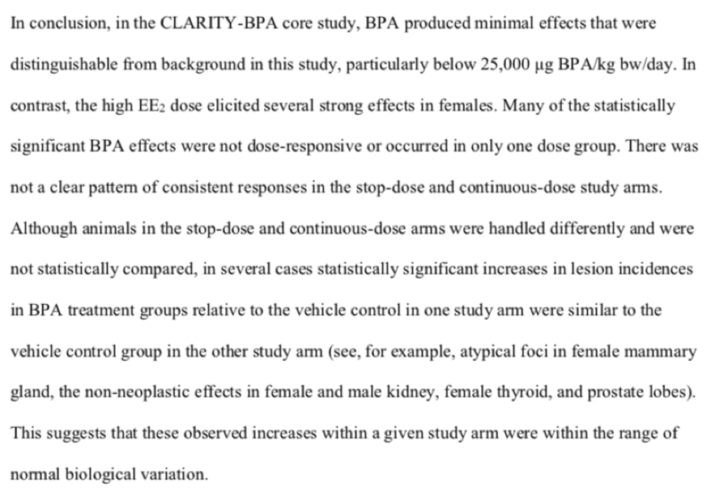
The draft Core Study was released for public comment in February 2018. The draft conclusion — that there are no discernible effects of BPA — is below:
In addition to the CORE study, 13 academic researchers received about $8 million in funding to participate in CLARITY. To avoid researcher bias, the academic researchers received coded animals so they would not know which BPA dose group any animal came from. They were then required to upload their raw data to a government database before the code could be broken and dose group details were disclosed to them. After disclosure the researchers were able to analyze their data.
While all thirteen academic researchers have completed their work, the results from only five of the thirteen researchers have been published since 2015. Consistent with the CORE study, no-to-minimal effects were reported in those studies.
Below are the 13 academic researchers, their areas of research for CLARITY.
The bolded academics have not published their results as of February 2019.
Obstructive voiding disorder – Fred vom Saal, University of Missouri
Testes function – Kim Boekelheide, Brown University
Ovarian dysfunction and abnormal hormone levels – Jodi Flaws, University of Illinois at Urbana-Champaign
Neurobehavioral effects – Heather Patisaul, North Carolina State University; Cheryl Rosenfeld, University of Missouri.
Immune dysfunction – Norbert Kaminski, Michigan State University
Metabolic disease – Andrew Greenberg and Beverly Rubin, Tufts University
Obesity – Nira Ben-Jonathan, University of Cincinnati
Cardiovascular effects – Scott Belcher, University of Cincinnati
Thyroid effects on brain and intestine – R. Thomas Zoeller, University of Massachusetts, Amherst
Mammary – Ana Soto, Tufts University
Uterus – Shuk Mei Ho, University of Cincinnati
Prostate – Gail Prins, University of Illinois at Chicago
The eight researchers who have not published their results have been critics of BPA in the past and should be motivated to publish their results if they indicated that BPA was not safe. But so far – just silence. It should be noted that academic researchers Fred vom Saal and Ana Soto were originally featured in “Our Stolen Future.”
The Grantee Studies data is scheduled to be released in August 2018. The final BPA-CLARITY report is scheduled to be released in August 2019.
The Sperm Count Controversy
In 1992, Danish research Niels Skakkebaek reported, “There has been a genuine decline in semen quality over the past 50 years. As male fertility is to some extent correlated with sperm count the results may reflect an overall reduction in male fertility. Citing three studies, including a 1990 study by John McLachlan (of retracted Tulane study infamy), Skakkebaek concluded his study with, “Whether estrogens or compounds with estrogen-like activity (as proposed by some) or other environmental or endogenous factors damage testicular function remains to be determined.”(47)
By 1993, Skakkebaek had fully subscribed to the endocrine disruptor scare in an article in The Lancet:, “We argue that the increasing incidence of reproductive abnormalities in the human male may be related to increased estrogen exposure in utero, and identify mechanisms by which this exposure could occur.”(48)
Theo Colborn embraced Skakkebaek’s claims in “Our Stolen Future.” Although Colborn noted that Skakkebaek’s claim “is still meeting with a skeptical response in parts of the medical community,” she dismissed the skepticism by comparing it to “similar disbelief at the first news that a dramatic hole had developed in the Earth’s protective ozone layer over Antarctica…”(49)
State of California researcher Shanna Swan joined the sperm count fray in 1997 with her 1997 study in Environmental Health Perspectives that claimed, “This analysis demonstrates that the decline in sperm density reported by [Skakkebaek in 1992] is not likely to be an artifact of bias, confounding or statistical analysis.” Swan declined to address the “cause(s) of the decline.”(50)
Swann tried to tie the alleged decline in sperm count with exposure to pesticides in a 2003 Environmental Health Perspectives study. She reported lower sperm counts among sperm donors in rural, agricultural Columbia, Missouri versus donors in more urban areas like Los Angeles and New York City.(51)
Swann and Skakkebaek have been at it ever since, constantly claiming that sperm counts are declining and that endocrine disruptors might be responsible.
Toxicologist Stephen Safe has been skeptical of the claims of Skakkebaek and Swan. In 2012, Safe wrote, “The initial endocrine disruptor hypothesis which suggested a link between in utero exposures to estrogens and decreased sperm counts is not supported by most studies but is still championed by Skakkebeck and some of his co-workers…”(52)
Safe added, “The claims and controversies regarding EDCs have continued for almost 20 years and there are no signs of resolution. It is noteworthy that two preeminent reproductive biologists who have made highly significant contributions to this field have developed skepticism on the claimed effects for BPA… In a commentary, Sharpe, a coauthor of the initial endocrine disruptor hypothesis, clearly answered in the affirmative the title of his highlight ‘Is it time to end concerns over the estrogenic effects of BPA?’”
Sharpe was Skakkebaek’s co-author on the initial 1992 study.
Maugh T, Chemical carcinogens: how dangerous are low doses? Science 06 Oct 1978: Vol. 202, Issue 4363, pp. 37-41. http://science.sciencemag.org/content/202/4363/370.
Ames B et al. Dietary Pesticides (99.99% all natural). Proc Natl Acad. Sci Vol. 87, pp.7777-7781, October 1990.
Crump K et al. Estimates of the proportion of chemicals that were carcinogenic or anticarcinogenic in bioassays conducted by the National Toxicology Program. Environ Health Perspect 1999 Jan;107(1):83-8.
“This project was supported by Contract No. CX 824040-01-0 between the National Academy of Sciences and the U.S. Environmental Protection Agency and the U.S. Centers for Disease Control and Prevention, and Cooperative Agreement No. 1445-CA09-96-0027 between the National Academy of Sciences and the National Biological Service of the U.S. Department of the Interior.” https://www.nap.edu/read/6029/chapter/1#ii
Thomas KB and T Colborn. Organochlorine endocrine disruptors in human tissue. Pp. 365-394 in Chemically Induced Alterations in Sexual Development: The Wildlife/Human Connection. T Colborn and C Clement, eds. Princeton NJ: Princeton Scientific Publishing.
Colborn T, FS vom Saal and AM Soto. Developmental effects of endocrine disrupting chemicals in wildlife and humans. Enviro Health Perspect 101(5):378-384 1993.
From the H. Rept. 104-669 – FOOD QUALITY PROTECTION ACT OF 1996 (https://www.congress.gov/104/crpt/hrpt669/CRPT-104hrpt669-pt1.pdf): “The Committee is aware of recent scientific reports indicating that some pesticides may imitate, enhance, or block the activity of hormones in humans and wildlife. For example, a linkage has been suggested between human exposure to chemicals that imitate estrogen and breast cancer. Since hormones govern fundamental bio- logical functions such as reproduction, growth, and metabolism in humans and other species, the Committee believes that it is important for EPA to obtain data about the potential hormone-disrupting effects of pesticides in order to make informed regulatory decisions under FIFRA. The Committee notes that the Agency has commissioned a report from the National Research Council to examine the issue more closely and identify data gaps that exists in current testing requirements. The Committee has reviewed and considered this issue and has determined that the EPA currently has sufficient authority to request information related to such effects. The Committee recognizes there are efforts ongoing to design and implement research to objectively assess and characterize the risk of endocrine disruptors on human health and the environment. Therefore, the Committee expects the Agency, within 4 years of the date of enactment of this Act, to evaluate the need for and, if necessary, to use its existing authorities under sections 3 and 4 of FIFRA to establish standards for data requirements, to determine whether a pesticide can disrupt hormonal activity. Collection and analysis of data specified in EPA standards related to disruption of hormonal activity should not delay reregistration eligibility decisions for pesticides first registered before 1984.
On November 20,
2014 Samantha Craggs of CBC
Newsposted an article titled,DDT repeal would do nothing to combat bedbugs, stating that experts say 'DDT
is going to have zero effect. All it’s going to do is a lot of damage'.
She goes on to state that:
“Local bed bug and environmental experts say DDT would do little to
curb the infestation.DDT or no DDT,
there is no magic chemical that will rid Hamilton of its bed bug problem.”
And they’re right!DDT will not do one thing to alleviate the
bed bug problem in this city or any other city in Canada, U.S or any other
place in the world where DDT was used for this purpose.But that’s not the real issue here!Which is what I intend to explore.
“he wants the province to take “a closer
look” at repealing the 40-year ban on DDT, or other powerful chemicals on a
limited basis if they'll help eradicate bed bugs in Hamilton”.
What triggered his concerns? Well, I think we can reasonably assume there's nothing like a good epidemic to get things started.
This Canadian city
is in the midst of a “bed bug epidemic since 2006, public health officials say, calls
to the city have increased about 600 per cent. CityHousing Hamilton will spend
$1 million this year alone battling the problem.”If you read this article will notice there’s
an opportunity for their reading public to vote on whether or not the ban on DDT
should be lifted in some way asking “Should
DDT ban be repealed to fight Hamilton bed bugs?” In spite of the fact that I absolutely
know DDT will not end their bed bug problem I voted yes to lift that ban along
with 466 others.Of that number 238
(50.96%) voted yes, 198 voted no (42.4%) and 31 (6.64%) didn’t know.
The number that
really strikes out at me is how many who didn’t know whether or not the ban
should be lifted.Remember - this is in
Canada - where anti-pesticide activists have dominated the process with
legislation and rank propaganda from the media, and yet over 6% “didn’t know”.I think that’s an important statistic in
viewing the public’s concerns about pesticides and the impact they make in the
lives of western societies.Between
those who want ban lifted and those who don’t know that number comes to 57.6%
of Canada’s population who aren't moved by the anti-pesticide claims of the environmental movement
and their minions in the media and government, at least in a Canadian city
that’s been so badly plagued.
The article goes on to quote local pest control operator Roger
Burley, president of Aanteater Pest Control in Hamilton as saying:
“going back to old pesticides won’t fix it,
particularly DDT”........“Bed bugs are resistant to DDT and most other pesticides that used to
treat it.“DDT is really dangerous, and
it’s really not effective against bed bugs anyway,” he said. “I’d love to have a silver bullet that would
wipe them right out, but it’s not DDT.”
The article continues to quote him saying “every chemical that used to
kill bed bugs wouldn’t work anymore”, and claims that bed bugs are “immune” to
a chemical classification known as organophosphates, which would include
Dursban, Diazinon and others.He
continues being quoted saying:
“Every 10 years, we have to find something new to
kill them”, and “they’ve mutated so much.
The chemicals we use now are not even related to those chemicals, and we’re
actually having some success.”
The only thing Burley said that was correct was that DDT
won’t kill bed bugs and we’re having some success - after that he became lost
in the green fever swamps.Resistance
isn’t mutation and they are not resistant to organophosphates, and there’s some
argument as to whether or not they’ve developed some resistance to carbamates,
which are both still used in countries other than the United States.Those who have studied the efficacy of
propoxur (commonly known as Baygon), a carbamate, claim it’s still
effective.
In point of fact those two chemical
classifications were what replaced DDT in the 1950’s when bed bugs became resistant to DDT. Organophosphates and carbamates were so effective we didn’t have bed bug problems again for almost 60 years.The reality is this - carbamates and organophosphates were so effective against bed bugs we were protecting society from this plague without even being aware of it.
An
insect that plagued humanity all through human history until
modern pesticide chemistry was introduced in the 1940’s with DDT.
EPA created a
whole new set of regulations based on risk “assumptions” and added testing after
15 years of use.They managed to side
step science in order to create de-facto bans through use of economics and
unscientific demands, thereby avoiding all the messy legal problems they would
encounter if they actually attempted to ban these chemicals. FQPA
created such an economic hardship the primary registrants simply refused to
meet their demands and made a business decision to pull their registrations.
But environmentalists understand the real issue here, and
it isn’t just about bed bugs. It's all about lifting the ban on DDT that would be far reaching. The article goes on to say:
“a local environmentalist and chemical
scientist say thinking about bringing back powerful and banned chemicals
is a bad idea.”
There is the real
issue in a nut shell.If DDT’s ban is
lifted then there will be serious efforts to do what this newly elected
official wants to do when he uttered the
most frightening words no green activist ever wants to hear:“I
need to take a closer look at the science, but there are chemical solutions and
I’d like to revisit that”. The raw emotion created by Rachel Carson’s
fallacious diatribe in her successful "science fiction" book Silent Spring against chemical pesticides is long past, and any honest scientific
effort to revisit all these laws and regulations used since 1972 to eliminate
these life saving products from the marketplace would devastate their
movement.
Of course any article about DDT must include claims that
it was banned “because of its impact on
wildlife, particularly bird populations”, and that it’s“persistent and it
bio-accumulates, and it does some not-so-nice things".All are either fallacious or
misleading.
Bird populations were never so high in North America until
the extensive use of DDT, and that includes the Bald Eagle, which increased
during the DDT years.Carson’s claim
about how the poor robin was going to disappear was not only wrong she was
deliberately lying.Carson was a
science writer for the U.S. Fish and Wildlife Service and absolutely had to
know that in 1960 there were “12
times more robins, 21 times more cowbirds, 38 times more blackbirds, 131 times
more grackles, etc. compared to 1941 numbers. The claims about bird
shell thinning was a lie based on studies that deliberately eliminated calcium
from the test bird’s diets. Carson had
to know all of that and deliberately lied.
“The theory is that
if a fish eats a large number of crustaceans, the fish will have a higher
concentration of DDT than any one crustacean, and the duck that eats many fish,
and the hawk that eats many ducks, will have higher and higher concentrations
of DDT. To ``prove'' this, propagandists analyzed the DDT levels in hawk brains
(where they are highest) and duck fat, which has levels lower than hawk brain
but higher than fish muscle. In fact, if one compares the level in muscle from
crustacean, fish, duck, and hawk, there is no biomagnification at all. In fact,
most of the DDT in fish comes through the gills; most DDT in food passes
through the gut and is eliminated.”
As for the persistence argument: “Dr. Edwards can cite more than 140 articles demonstrating breakdown
of DDT. In one experiment, a large amount of DDT was added to sea water in a
glass container, which was closed and suspended in the ocean. After 38 days,
92% of the DDT and its metabolites was gone. The persistence myth was based
partly on inaccurate measurements by gas-liquid chromatography. Many substances
interfere with the analysis, including PCBs in fluorescent light ballasts or in
the plastic tubing within the instrument. GLC, for example, ``showed'' five
kinds of chlorinated hydrocarbon insecticides in soil samples, even though none
existed until 30 years after the samples were sealed.
Even if the bioaccumulation argument was valid we have to
ask ourselves - where was the predicted devastation? Who were devastated?What animals were devastated?Since we’re living longer and healthier lives
than any time in human history we must ask where's the predicted devastation? We know that DDT did not then, and does not
now, cause cancer, nor do the other pesticides that took its place.
Scientists – if that’s what you choose to call them –
have been going along with this propaganda for decades because it’s profitable,
and as the years have gone by I have discovered these people are incapable of
ramping up the moral fiber to be the rock in the current.
What must really concern the greenies is the fact these
other council members aren’t taking a strong stand against the new guy’s desire
to review the science on pesticide bans saying:
“the notion “needs to be assessed
by public health officials, who can separate politics from science and conclude
the best practices accordingly.Another
member is “open to forwarding a motion to the province” saying“The
province needs to understand the severity of this problem, and if we keep
hammering away with what we should be doing and what we can try, they might
have to take a look at that”.Even
one who is opposed says, “He's
not a fan of the DDT option, but he admires Green's commitment to the issue".
He goes further stating “I welcome councillor-elect Green to this very
important discussion table.”"His
advocacy is welcomed."
This
is after decades of indoctrination by the activists, the media, academia
and bureaucrats. As for claims about DDT being linked to all
sorts of afflictions. "Linked to" is a
weasel word for some professional’s opinion when in reality they don’t
have a clue….but they make all the right noises.
As for my voting on that poll to restore DDT in spite of knowing it
will have no direct positive impact on this city’s bed bug population – we need
to understand the ban on DDT is foundational to the green movement.If that’s overturned their foundation of sand
will start to crumble and eventually everything they have promoted will be
called into question.