Search This Blog

De Omnibus Dubitandum - Lux Veritas

Showing posts with label Cronyism. Show all posts

Wednesday, April 2, 2025

Front-Door Cronyism and Back-Door Cronyism

March 26, 2025 by Dan Mitchell @ International Liberty

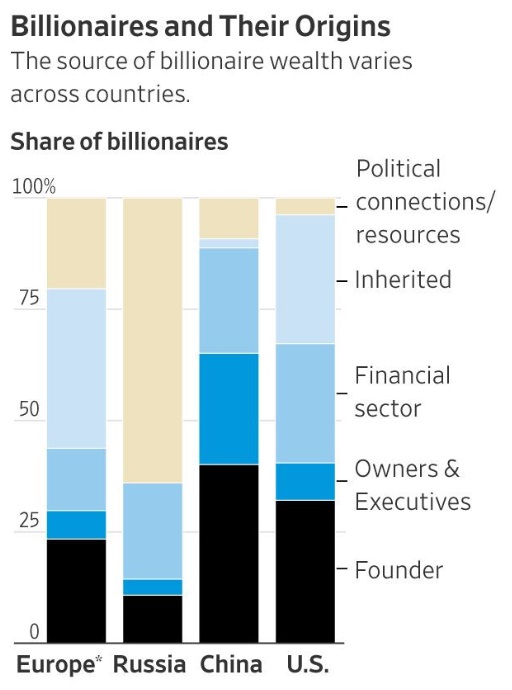
Three years ago, I shared two charts, one from the Wall Street Journal and one from the Economist, showing how rich people became rich in various nations.


The main purpose of that column was to show – as depicted in the WSJ‘s chart -that cronyism was the main way that Russian billionaires amassed wealth, unlike in the United States.

And that led me to write that, “Russia’s ‘oligarchs’ are not like the self-made billionaires that we’re fortunate to have in the United States.”

Interestingly, the two charts showed that China’s billionaires did not rely on political connections.

But that didn’t seem right, So I wrote in a postscript that, “my gut instinct is that cronyism is a much bigger problem in China’s economy that we see in the data from the WSJ and the Economist.”

Well, my instincts may have been correct according a new article for Foreign Policy by James Palmer.

He starts by describing how attitudes toward wealth sort of changed after the horrors of Maoism.

…every billionaire’s fortune is built upon a thin foundation: the goodwill of the CCP. At every turn, the ultra-rich, especially since Xi took power, are reminded that their wealth exists at the sufferance of the party—and that it could all be taken away. …Even after the abandonment of Maoism, the CCP has never been entirely comfortable with the wealthy. In the 1980s, Chinese leader Deng Xiaoping stated that it was fine for “a few” households and regions to “get rich first,” but he said it about peasants, not billionaires, and added that the rich had an obligation to lift up the poor. …Culturally, though, China embraced wealth from the 1980s on with the eagerness of a starving man falling on a banquet. …After two generations of deprivation and revolutionary austerity, the coming of money, and all the possibilities of money, seemed miraculous.

But Palmer explains that it is well nigh impossible to get rich in China without government favoritism in the beginning…or government exploitation later on (what could be called front-door cronyism or back-door cronyism).

In 2002, the CCP reversed its previous policy of shutting out entrepreneurs, who were previously seen as politically suspect. This didn’t lead to businesspeople flocking to the party but instead saw party members flowing into business, where their existing connections proved a serious advantage. Even as private initiative was celebrated, it depended on government backing. …The loans they needed…often came in turn from government-run banks, in a cycle of mutual profit. Officials welcomed GDP growth for their careers and bribes for themselves. …Yet unlike the legal firewalls and political pull enjoyed by U.S. billionaires, none of this success came with security. The newly wealthy were caught in a bind; their wealth let them buy off local officials, and eventually eclipse them, but as their fame grew, they attracted the attention of higher-ranking officials who demanded their own share of the pie. …It was impossible to rise cleanly: Even if your original business was honest, protecting it required not just bribery but participation in networks of mutual vice. …the authorities also regularly harvested them. Which billionaires fell was a matter of arrogance and chance… a ranking of the ultra-wealthy put together by British analyst Rupert Hoogewerf since 1999, became known as the “fattened pig list,” with the joke being that so many of its most prominent members were then picked for slaughter by the party.

Given some of his comments about billionaires in general, I think it’s safe to assume that the author is not a libertarian or conservative.

But he seems to recognize that America’s more laissez-faire approach is better than China’s government-centric approach.

In an era of unchecked billionaire power in the West, it might be tempting to think China has found a better way. But the tools of party power used against the ultra-wealthy are employed more frequently and more cruelly against the poor and powerless… And one class of the ultra-wealthy remains genuinely untouchable: the family members of party leaders. …the wealth of the party, like the power of the party, remains unquestioned.

I’ll close by once again stating that it is great that China engaged in partial economic reform starting more than 40 years ago. Severe poverty is no longer a problem and the nation’s economy is much bigger, which are impressive achievements.

But I’m worried about back-sliding toward more government (a global problem!). I very much hope that China engages in another wave of pro-market reform and can eventually join the club of rich, market-friendly countries.

P.S. Sadly (and unsurprisingly), the OECD and IMF are urging China to adopt bad policy.

Monday, August 2, 2021

U.S. vs. China: You Don’t Beat Cronyism with Cronyism

August 1, 2021 by Dan Mitchell @ International Liberty

Editor's Note:  While both Dan Mitchell and I are in harmony saying China's not the economic dynamo so many think, and much of what he says here I think is of value, however,  I think comparing Japan with the United States is silly, and I don't agree with him on what he calls Trump's failure on trade agreements.  There's a difference between decisions on trade based on economics versus politics.  Otherwise, I think this is an interesting piece. RK)

China is not going to surpass the United States as the world’s dominant economy.

As I first wrote back in 2010, China is a paper tiger. Yes, there was some pro-market reform last century, which helped reduce mass poverty, but China only took modest steps in the right direction.

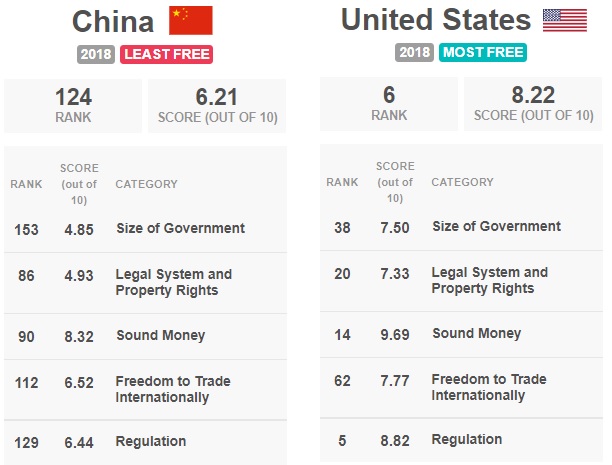
According to the latest edition of Economic Freedom of the World, China scores just 6.21, which places it 124th out of 162 nations.


Is that better than a score of 3.69, which is where China was in 1990?

Yes, of course.

But does that score indicate that China will become richer than the United States, which has a current score of 8.22 (the world’s 6th-highest level of economic liberty)?

Of course not.

My answer might change of China engaged in more economic liberalization, as I have urged. But it seems the opposite is happening and China is backsliding toward more state control.


And that means the United States almost surely will remain far more prosperous.

(While Joe Biden is doing his best to drag economic policy in the wrong direction, but it would takes decades of far-worse policy to bring the U.S. down to the level of France (#58) or Greece (#92), much less all the way down to being on par with China).

But some people must not be very familiar with data about China and its economy.

For instance, President Trump’s former top trade official, Robert Lighthizer, wrote that the United States should copy China’s cronyism in a column in the New York Times.

I’m not joking. Mr. Lighthizer openly embraces industrial policy and protectionism.


…we need a multifaceted long-term strategy. …Our strategy must include…an industrial policy that includes subsidies to foster the development of the most advanced science and technology…and a robust plan to combat China’s unfair trade practices. …The Senate legislation would achieve some of what is needed. It calls for $200 billion to bolster scientific and technological innovation, $52 billion to rebuild our capacity to make semiconductors, and a supply-chain resiliency program… The House should perfect the provisions of the Senate bill that restructure and enhance federal support for science and innovation and strip out those that weaken our trade laws and encourage Chinese imports.

Geesh, no wonder Trump’s trade policy was such a disaster.

Lighthizer not only doesn’t understand economics, he also doesn’t know history.

Adam Thierer of the Mercatus Center points out that the current angst about China is a repeat verse of a song we heard over and over again in the late 1980s.

Back then, everyone though Japan was on the verge of overtaking the United States, ostensibly because that nation had wise politicians and bureaucrats who knew how to pick winners and losers.

Thierer’s article tells us what really happened.


In 1949, the Japanese government created the Ministry of International Trade and Industry (MITI) to work with other government bodies (especially the Bank of Japan) to devise plans for industrial sectors in which they hoped to make advances. Although not as heavy-handed as Chinese planning authorities are today, MITI came to have enormous influence over private-sector research and investment decisions during the next five decades. The organization used a variety of the same policy levers that Chinese officials do today, with a particular focus on trade management and industrial policy investments in sectors perceived to be “strategic” for future economic advance. …By the late 1970s…, U.S. officials and market analysts came to view MITI with a combination of reverence and revulsion, believing that it had concocted an industrial policy cocktail that was fueling Japan’s success at the expense of American companies and interests. …By the end of the 1980s, fears about “Japan Inc.” had reached a fever pitch. …Just as Japan phobia was reaching its zenith in the early 1990s, Japan’s fortunes began taking a turn for the worse. The Japanese stock market crashed in 1990… Japan suffered a brutal economic downturn that became known as the Lost Decade, which really lasted almost two decades. …by the late 1990s many scholars came to view most Japanese industrial policy initiatives as a costly bust.

Amen.

I wrote that Japan was a “basket case” back in 2013. A bit of hyperbole, to be sure, but I was trying to drive home the point that the nation’s politicians have made some costly mistakes.


Not just industrial policy, but also tax increases, Keynesian spending, and other forms of intervention.

No wonder the country has gone downhill in terms of competitiveness.

But let’s not focus too much on Japan (which, despite all my grousing, still ranks #20 for economic liberty).

For purposes of today’s column, the main points are 1) that China is no threat to overtake the United States, and 2) that copying that nation’s industrial policy would be a mistake.

P.S. If China wants to pursue industrial policy and other forms of cronyism, that’s a mistake that mostly hurts the Chinese people. To the extent such policies are designed to subsidize exports (as Lighthizer argues), the best response is to utilize the World Trade Organization, not to copy China’s misguided interventionism.

Tuesday, September 4, 2018

The Hidden Tax of Cronyism

August 30, 2018 by Dan Mitchell @ International Liberty
 
I don’t like it when poor people receive handouts from government, though not because I think they’re being grifters. I mostly view them as victims who are vulnerable to getting trapped in the quicksand of government dependency.


The people I despise are the rich people who manipulate the levers of power to get undeserved goodies. These well-heeled sleazeballs generally have the brains and ability to earn money honestly, but they decide it’s more lucrative to steal money from ordinary people, using government as the middleman.

That’s the moral argument for separation of business and state. But there’s also an economic argument against government cronyism.
There’s a very interesting new study from the World Bank that estimates the impact of government favoritism in Ukraine. Here’s how the authors define the problem.
Rent seeking is the manipulation of public institutions to obtain…income…without the creation of new wealth. …Rent seeking is sometimes legal. …In Ukraine, rent seeking includes the award of public resources to companies through tax exemptions, direct subsidies and procurement contracts to connected companies that cannot be justified in terms of the economic benefits to society as a whole. The rent seeking activities provide a basis for the existence of so-called “crony capitalism” ….Crony capitalism allows politically connected businesses to enjoy benefits that other companies cannot access. It allows politically connected businesses to create barriers to entry in those sectors where they operate. As a result, crony capitalism allocates resources inefficiently, restricts competition, increases economic costs and limits economic opportunity. …This paper estimates the economic cost of crony capitalism in Ukraine.
They start with the challenge of trying to measure cronyism.
If we are to assess the impact of crony capitalism in Ukraine, we must first define political connection and distinguish politically-connected firms from non-connected firms. …We use two approaches to identify politically connected firms. The first approach is based on publicly available information on the ownership and control of businesses by politically exposed persons. …A PEP is a person who has been entrusted with prominent public functions, including senior politicians and party officials, senior government, judicial or military officials, and senior executives of state-owned corporations. …The second approach is…to include companies that are not formally controlled by PEPs, but enjoy a political connection through an oligarch or a business group they belong to. …Between half a percent and 2 percent of the total number of firms in Ukraine are politically connected. However, politically connected firms controlled over 20 percent of the total turnover of all Ukrainian companies.
Here are some of their empirical results.
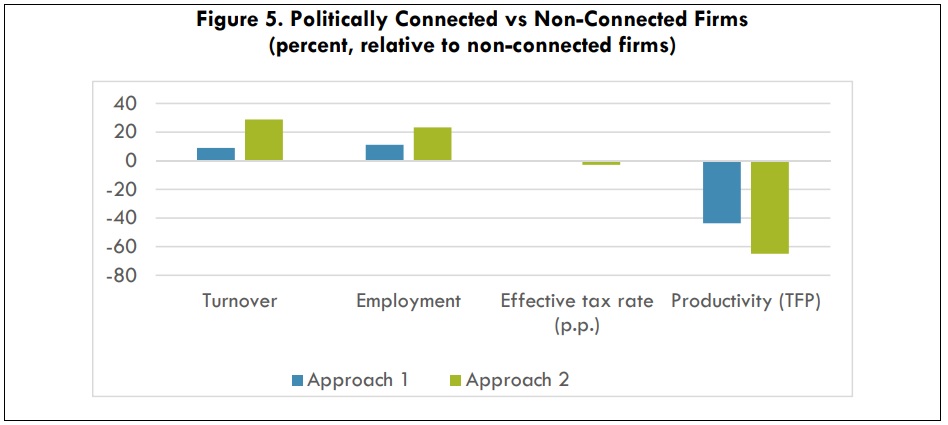
The economic performance of politically-connected firms in Ukraine is significantly different from that of their non-connected peers. …Politically-connected firms are larger than their non-connected peers. …Politically-connected firms pay a lower effective tax rate. …Politically-connected firms are less productive. Politically-connected firms have a negative Total Factor Productivity (TFP) gap compared to non-connected firms. …This indicates that there could be a potentially large pay-off from policies that promote competition. …Politically-connected firms grow slower than non-connected firms. …Such firms tend to have better access to rents and less incentives to compete. …The politically-connected firms reap the benefits from preferential treatment when interacting with the state and limiting market competition.
The bottom line, as illustrated by this chart, is that cronyism promotes and protects inefficiency. And when an economy is less productive, that results in lower incomes and diminished living standards.


Sadly, this isn’t just a problem in developing and transition nations.

Cronyism exists wherever governments have a lot of power, and that includes the United States.
The federal government has myriad policies that tilt the playing field in favor of connected companies. The purpose of policies such as ethanol handouts, the Export-Import Bank, protectionism, tax favoritism, bailouts, subsidies, and green energy is to provide unearned wealth to the friends of politicians.

Here’s a recent example of how Obamacare is a vehicle for cronyism, as explained by the Wall Street Journal.
Big business feasts on big government, and ObamaCare has been a bonanza for companies that have figured out how to exploit it. …Ohio contracts with five managed-care organizations (MCOs) to administer Medicaid benefits, four of which outsource their drug benefits management to CVS Caremark… CVS appears to be billing the state for far more than what it is paying pharmacies, driving up taxpayer costs. …CVS is also attempting to drive independent pharmacists out of business and expand its retail market share. …Ohio’s Medicaid enrollment has swelled by more than half to 21.4% of the state population, driven in large part by ObamaCare’s expansion to people earning up to 133% of the poverty line. …In the last three years, Ohio has lost 164 independent pharmacies while CVS has added 68. …States ostensibly have an incentive to curb their Medicaid spending… Yet many may be turning a blind eye because they can pass on the bills to the federal government, which picks up 63% of the costs for Ohio’s pre-ObamaCare population and 94% for the expansion population.
But cronyism isn’t just enabled by bad policies from Washington.
State governments also are guilty of favoritism, even when the feds aren’t involved. Consider the oleaginous handouts for Foxconn in Wisconsin.
…the Foxconn deal is a condemnable example of corporate welfare in its most egregious form. …Wisconsin could end up delivering $3 billion in tax credits to Foxconn. …If the jobs target of 13,000 is met, Wisconsin taxpayers will pay $219,000 per job. If only 3,000 jobs are created, they will pay $587,000 per job in the form of a $1.7 billion tax credit. …Who wins? The politicians. Who loses? Fiscal sanity and those footing the bill for political pet projects.
And the goodies for Foxconn are just the tip of the iceberg.
States and cities dole out billions of dollars every year to attract businesses through cash grants, tax breaks, and new infrastructure. …The search for Amazon’s second headquarters (HQ2), for instance, has left around 230 state and local governments genuflecting before the altar of the Seattle-based tech deity, offering tributes amounting, in several cases, to billions of dollars. …The cost of these kind of incentives is astoundingly high — there is little research that points to their success.
As I’ve previously argued, the pro-growth way for governments to compete is having low tax rates for everyone.
…the most effective solution is the simplest. New Hampshire is a dark horse candidate to receive HQ2, and its pitch is entirely reasonable: Low tax rates for every business, across the board. That approach removes the incentive to attract businesses through what amounts to legal, nonsensical bribery.
Let’s close with this visual from libertarian Reddit. It’s simple, but a very accurate summary of how the real world operates.


P.S. Elizabeth Warren wants to turn all big companies into cronyist entities.
P.P.S. American taxpayers are subsidizing cronyism in Ukraine.

Wednesday, January 24, 2018

I’m Happy when Amazon and other Big Companies Prosper – Assuming Profits Are from Capitalism rather than Cronyism

January 23, 2018 by Dan Mitchell  @ International Liberty

I explained back in 2013 that there is a big difference between being pro-market and being pro-business.

Pro-market is a belief in genuine free enterprise, which means companies succeed of fail solely on the basis of whether they produce goods and services that consumers like.

Pro-business, by contrast, is a concept that opens the door to inefficient and corrupt cronyism, such as bailouts and subsidies.

It basically means big business and big government get in bed together. And that’s going to mean bad news for taxpayers and consumers.

Washington specializes in this kind of cronyism. The Export-Import Bank, ethanol handouts, TARP, and Obamacare bailouts for big insurance firms are a few of my least-favorite examples.

But state politicians also like giving money to rich insiders.
A report in the Washington Post reveals how states are engaged in a bidding war to attract Amazon’s big new facility, dubbed HQ2.
Maryland Gov. Larry Hogan (R) will offer more than $3 billion in tax breaks and grants and about $2 billion in transportation upgrades to persuade Amazon.com to bring its second headquarters and up to 50,000 jobs to Montgomery County. …It appears to be the second-most generous set of inducements among the 20 locations on Amazon’s shortlist. Of the offerings whose details have become public, either through government or local media accounts, only New Jersey’s is larger, at $7 billion.
Richard Florida, a professor at the University of Toronto, explains to CNN why this approach is troubling.
…there’s one part of Amazon’s HQ2 competition that is deeply disturbing — pitting city against city in a wasteful and economically unproductive bidding war for tax and other incentives. As one of the world’s most valuable companies, Amazon does not need — and should not be going after — taxpayer dollars… While Amazon may have the deck stacked in picking its HQ2 location, the mayors and elected leaders of these cities owe it to their tax payers and citizens to ensure they are not on the hook for hundreds of millions and in some cases as much as $7 billion in incentives to one of the world’s most valuable companies and richest men. …The truly progressive thing to do is to forge a pact to not give Amazon a penny in tax incentives or other handouts, thereby forcing the company to make its decision based on merit.
It’s not just a problem with Amazon.

Here’s are excerpts from a column in the L.A. Times on crony capitalism for Apple and other large firms.
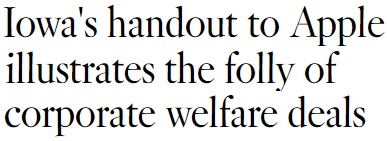
State and local officials in Iowa have been working hard to rationalize their handout of more than $208 million in tax benefits to Apple, one of the world’s richest companies, for a data facility that will host 50 permanent jobs. …the Apple deal shows the shortcomings of all such corporate handouts, nationwide. State and local governments seldom perform cost-benefit studies to determine their value — except in retrospect, when the money already has been paid out. They seldom explain why some industries should be favored over others — think about the film production incentives offered by Michigan, Louisiana, Georgia and, yes, Iowa, which never panned out as profit-makers for the states. …the handouts allow big companies to pit state against state and city against city in a competition that benefits corporate shareholders almost exclusively. Bizarrely, this process has been explicitly endorsed by Donald Trump. …politicians continue to shovel out the benefits, hoping to steer their economies in new directions and perhaps acquire a reputation for vision. Nevada was so eager to land a big battery factory from Tesla Motors’ Elon Musk that it offered him twice what Musk was seeking from the five states competing for the project. (In Las Vegas, this is known as “leaving money on the table.”) Wisconsin Gov. Scott Walker gave a big incentive deal to a furniture factory even though it was laying off half its workforce. He followed up last month with an astronomical $3-billion handout to electronics manufacturer Foxconn for a factory likely to employ a fraction of the workforce it forecasts.
And here’s an editorial from Wisconsin about a bit of cronyism from the land of cheese.
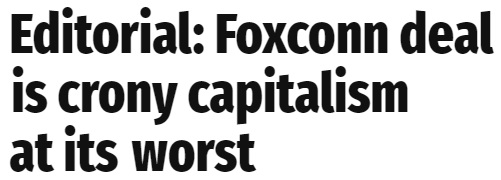
The Foxconn deal…should be opposed by Democrats and Republicans, liberals and conservatives. There are no partisan nor ideological “sides” in this debate. The division is between those who want to create jobs in a smart and responsible way that yields long-term benefits and those who propose to throw money at corporations that play states and nations against one another. The Foxconn deal represents the worst form of crony capitalism — an agreement to transfer billions of dollars in taxpayer funds to a foreign corporation. …Walker offered the company a massive giveaway — discussions included a commitment to hand the Taiwanese corporation nearly $3 billion in taxpayer funds (if it meets hazy investment and employment goals), at least $150 million in sales tax exemptions…the Legislative Fiscal Bureau, which analyzes bills with budget implications…pointed out that Foxconn would receive at least $1.35 billion and possibly as much as $2.9 billion in tax incentive payments even if it didn’t owe any Wisconsin tax… This is a horrible deal.
Let’s now circle back to Amazon and consider how it gets preferential treatment from the Post Office.
I don’t feel guilty ordering most of my family’s household goods on Amazon. …But when a mail truck pulls up filled to the top with Amazon boxes for my neighbors and me, I do feel some guilt. Like many close observers of the shipping business, I know a secret about the federal government’s relationship with Amazon: The U.S. Postal Service delivers the company’s boxes well below its own costs. Like an accelerant added to a fire, this subsidy is speeding up the collapse of traditional retailers in the U.S. and providing an unfair advantage for Amazon. …First-class mail effectively subsidizes the national network, and the packages get a free ride. An April analysis from Citigroup estimates that if costs were fairly allocated, on average parcels would cost $1.46 more to deliver. It is as if every Amazon box comes with a dollar or two stapled to the packing slip—a gift card from Uncle Sam. Amazon is big enough to take full advantage of “postal injection,” and that has tipped the scales in the internet giant’s favor. …around two-thirds of Amazon’s domestic deliveries are made by the Postal Service. It’s as if Amazon gets a subsidized space on every mail truck.
In this last example, the real problem is that we’ve fallen behind other nations and still have a government-run postal system.

The way to avoid perverse subsidies is privatization. That way Amazon deliveries will be based on market prices and we won’t have to worry about a tilted playing field.

And that last point is critical.

Yes, cronyism and corporate welfare is an economic issue. It is bad for long-run growth when political favors distort the allocation of capital.

But an unlevel playing field is also a moral issue. It’s simply not fair or not right for politicians to give their buddies special advantages.

And it’s both economically harmful and morally harmful to create a system where the business community views Washington as a handy source of unearned wealth.

For what it’s worth, I also think it should be a legal issue. For those of us who believe in the rule of law, a key principle is that everyone should be treated equally. Heck, that principle is enshrined in the Constitution.

So I’ve always wondered why courts haven’t rejected special deals for specific companies because of the equal-protection clause?

Then again, maybe I shouldn’t wonder. After all, the Supreme Court twisted itself into a pretzel to miraculously rationalize Obamacare.

But none of this changes the fact that it’s time to wean big business off corporate welfare.

P.S. Just in case you harbor unwarranted sympathy for big companies, remember that these are the folks who are often keen to undermine support for the entire capitalist system.

Monday, January 22, 2018

Achievement Charity

By Michael Bertolone January 22, 2018

A common complaint heard from “diverse” employment candidates is that there are few people who “look like me” in the organization. It has been fifty-plus years since Dr. Martin Luther King’s I have a dream speech, and now the equal opportunity gold standard is apparently the “look like” test. It’s a sad commentary that in the 21st Century we are as tribalized and Balkanized as ever, thanks in no small measure to the diversity industry.

The U.S. Justice Department is preparing to investigate Harvard University regarding affirmative action in college admissions. Unfortunately, it has exclusively centered upon the classification of race, to the exclusion of gender and social class. Specifically, this investigation centers on alleged discrimination against Asians in Harvard University’s admissions process.

To effectively combat discrimination in all forms and live up to the true promise of the Fourteenth Amendment, all three major offenders must be attacked: affirmative action, as well as nepotism and cronyism...........The evidence is clear. Affirmative action, nepotism, and cronyism lower the selection standards of whatever they touch. In a highly-competitive global market, we can no longer afford the appearance of “achievement charity”, as the late sociologist Martin L. Gross once pointed out. The sooner the ‘inclusion through exclusion’ game ends, the better...... To Read More.....
 
My Take - There will always be corruption in the work place. Nepotism and cronyism is now and will always be with us. That's just human nature and no amount of legislation can fix it. As we've seen with all these different affirmative action schemes - it just makes it worse. 

 The thing that needs to be done is just get government out of the way and let people hire whomever they choose. Will that hurt some? Of course, but those groups such as Italians, Jews, and Asians who came here and were discriminated against didn't sit and whine to the government. They stated their own businesses, educated their children, worked hard in their communities and most importantly - they maintained strong family ties. That's the solution, not government interference controlled by a bunch of bureaucrats, which is in reality cronyism by favored groups imposed by government.

As for nepotism? Take a look at all the children and grandchildren who are Hollywood stars and those in Washington DC who come from political families - and tell me there's no nepotism among them. Taking care of family is a biological imperative - get over it!

Friday, August 25, 2017

To Fight Cronyism, Let’s Have Separation of Business and State

August 24, 2017 by Dan Mitchell @ International Liberty
 
In my 30-plus years in Washington, I’ve lived through some very bad pieces of legislation.
But the most depressing experience was probably the TARP bailout. In part, it was depressing because bad government policy created the conditions for the crisis, so it was frustrating to see the crowd in Washington blame capitalism (in effect, a repeat of what happened in the 1930s).

Far more depressing, however, was the policy response. Thanks largely to the influence of Treasury Secretary Hank Paulson, the Bush Administration decided to bail out the big firms on Wall Street rather than use “FDIC resolution,” which would have bailed out depositors but at least shut down big institutions that were insolvent.

In other words, TARP was pure cronyism. Wall Street firms had “invested” in Washington by giving lots of contributions to politicians and TARP was their payoff.

With this background, you’ll understand why I asserted in this interview that the dissolution of two business advisory councils is the silver lining to the black cloud of Charlottesville.


Since that was just one segment of a longer interview and I didn’t get a chance to elaborate, here are some excerpts from an article in Harvard Business Review by Robert Litan and Ian Hathaway about the connection between anemic productivity numbers (which I wrote about last week) and cronyism.
Baumol’s writing raises the possibility that U.S. productivity is low because would-be entrepreneurs are focused on the wrong kind of work. In a 1990 paper, “Entrepreneurship: Productive, Unproductive, and Destructive,” Baumol argued that the level of entrepreneurial ambition in a country is essentially fixed over time, and that what determines a nation’s entrepreneurial output is the incentive structure that governs and directs entrepreneurial efforts between “productive” and “unproductive” endeavors. Most people think of entrepreneurship as being the “productive” kind, as Baumol referred to it, where the companies that founders launch commercialize something new or better, benefiting society and themselves in the process. A sizable body of research establishes that these “Schumpeterian” entrepreneurs, those that are “creatively destroying” the old in favor of the new, are critical for breakthrough innovations and rapid advances in productivity and standards of living. Baumol was worried, however, by a very different sort of entrepreneur: the “unproductive” ones, who exploit special relationships with the government to construct regulatory moats, secure public spending for their own benefit, or bend specific rules to their will, in the process stifling competition to create advantage for their firms. Economists call this rent-seeking behavior.
That’s the theory.

What about evidence? Well, Obamacare could be considered a case study since it basically was a giveaway to big pharmaceutical firms and big health insurance companies.

But the authors look at the issue more broadly to see if there is an economy-wide problem.
Do we…see a rise in unproductive entrepreneurship, as Baumol theorized? …James Bessen of Boston University has provided suggestive evidence that rent-seeking behavior has been increasing. In a 2016 paper Bessen demonstrates that, since 2000, “political factors” account for a substantial part of the increase in corporate profits. This occurs through expanded regulation that favors incumbent firms. Similarly, economists Jeffrey Brown and Jiekun Huang of the University of Illinois have found that companies that have executives with close ties to key policy makers have abnormally high stock returns.
This is very depressing.

I don’t want companies to do well because the CEOs cozy up to politicians. If entrepreneurs and corporations are going to be rolling in money, I want that to happen because they are providing valued goods and services to consumers.

I wrote about Bessen’s research last year. It’s very unsettling to think that companies make more money because of political connections than they do from research and development.

There are two reasons this is troubling.

First, it means slower growth because government intervention is undermining the efficient allocation of labor and capital that occurs with productive entrepreneurship.

Second, cronyism is very corrosive because people equate business with capitalism, so their support for capitalism declines when they see companies getting special favors.

I wish ordinary people understood that big business and free enterprise are not the same thing.

Though I fully understand their disdain for certain big companies. Consider the way a select handful of big companies use the Export-Import Bank to obtain undeserved profits. How about the way big agri-businesses rip off consumers with the ethanol scam. Don’t forget H&R Block is trying to get the IRS to drive competitors out of the market. Big Sugar also gets a sweet deal by investing in politicians. Another example is the way major electronics firms enriched themselves by getting Washington to ban incandescent light bulbs. Needless to say, we can’t overlook Obama’s corrupt green-energy programs that fattened the wallets of well-connected donors. And General Motors became Government Motors thanks to politicians fleecing ordinary Americans.

The bottom line is that it’s time to save capitalism from the rent seekers in the business community.