Ben Shapiro
Posted: Jul 01, 2020
Today, the nostrum goes, it is not enough for Americans to be not racist. They must be "anti-racist." This woke terminology has infused our lexicon. Sen. Elizabeth Warren (D-Mass.), recently declared from the well of the Senate: "Being race-conscious is not enough. It never was. We must be anti-racists." What, pray tell, is the difference between being against racism and being anti-racist? Ibram X. Kendi, author of "How to Be An Antiracist," provides an answer: Racism is no longer to be defined as the belief that someone is inferior based on race. Instead, racism is to be defined as the belief that any group differences can be attributed to anything other than racism. Thus, any system that ends with different outcomes must be racist. Indeed, Kendi contends, "Racism itself is institutional, structural, and systemic."............
Now the woke army has targeted corporations. Corporations are, by nature, risk-averse; they seek merely profit and lack of controversy. The hard left has targeted them as the weakest link in the chain of free speech: If corporations can be bullied into pulling their money from social media networks, those social media networks can be bullied into restricting their free-speech cultures. Remove advertising bucks from Instagram and watch as Instagram censors those the woke want censored.
Indeed, such a campaign is now front and center in the culture wars: Major corporations from Coca-Cola to Target have stopped advertising on social media networks, citing the need for more "hate speech" regulation on those platforms.
Obviously, those who target corporations will not be satisfied until all non-woke speech is limited or banned; corporations will be unpleasantly surprised when those they have been seeking to appease turn on them as remnants of the evil system. But corporations have neither the principle nor the will to deny the demands of the loudest and the most militant.........To Read More...
Showing posts with label Corporations. Show all posts
Showing posts with label Corporations. Show all posts
Thursday, July 2, 2020

Wednesday, January 24, 2018
I’m Happy when Amazon and other Big Companies Prosper – Assuming Profits Are from Capitalism rather than Cronyism
January 23, 2018 by Dan Mitchell @ International Liberty
I explained back in 2013 that there is a big difference between being pro-market and being pro-business.
Pro-market is a belief in genuine free enterprise, which means companies succeed of fail solely on the basis of whether they produce goods and services that consumers like.
 Pro-business, by contrast, is a concept that opens the door to inefficient and corrupt cronyism, such as bailouts and subsidies.
It basically means big business and big government get in bed together. And that’s going to mean bad news for taxpayers and consumers.
Washington specializes in this kind of cronyism. The Export-Import Bank, ethanol handouts, TARP, and Obamacare bailouts for big insurance firms are a few of my least-favorite examples.
But state politicians also like giving money to rich insiders.
A report in the Washington Post reveals how states are engaged in a bidding war to attract Amazon’s big new facility, dubbed HQ2.
Here’s are excerpts from a column in the L.A. Times on crony capitalism for Apple and other large firms.
The way to avoid perverse subsidies is privatization. That way Amazon deliveries will be based on market prices and we won’t have to worry about a tilted playing field.
And that last point is critical.
Yes, cronyism and corporate welfare is an economic issue. It is bad for long-run growth when political favors distort the allocation of capital.
 But an unlevel playing field is also a moral issue. It’s simply not fair or not right for politicians to give their buddies special advantages.
And it’s both economically harmful and morally harmful to create a system where the business community views Washington as a handy source of unearned wealth.
For what it’s worth, I also think it should be a legal issue. For those of us who believe in the rule of law, a key principle is that everyone should be treated equally. Heck, that principle is enshrined in the Constitution.
So I’ve always wondered why courts haven’t rejected special deals for specific companies because of the equal-protection clause?
Then again, maybe I shouldn’t wonder. After all, the Supreme Court twisted itself into a pretzel to miraculously rationalize Obamacare.
But none of this changes the fact that it’s time to wean big business off corporate welfare.
P.S. Just in case you harbor unwarranted sympathy for big companies, remember that these are the folks who are often keen to undermine support for the entire capitalist system.
Pro-market is a belief in genuine free enterprise, which means companies succeed of fail solely on the basis of whether they produce goods and services that consumers like.
Pro-business, by contrast, is a concept that opens the door to inefficient and corrupt cronyism, such as bailouts and subsidies.It basically means big business and big government get in bed together. And that’s going to mean bad news for taxpayers and consumers.
Washington specializes in this kind of cronyism. The Export-Import Bank, ethanol handouts, TARP, and Obamacare bailouts for big insurance firms are a few of my least-favorite examples.
But state politicians also like giving money to rich insiders.
A report in the Washington Post reveals how states are engaged in a bidding war to attract Amazon’s big new facility, dubbed HQ2.
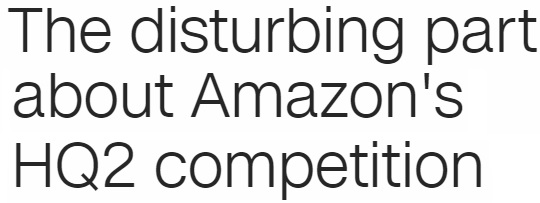
Richard Florida, a professor at the University of Toronto, explains to CNN why this approach is troubling.Maryland Gov. Larry Hogan (R) will offer more than $3 billion in tax breaks and grants and about $2 billion in transportation upgrades to persuade Amazon.com to bring its second headquarters and up to 50,000 jobs to Montgomery County. …It appears to be the second-most generous set of inducements among the 20 locations on Amazon’s shortlist. Of the offerings whose details have become public, either through government or local media accounts, only New Jersey’s is larger, at $7 billion.

It’s not just a problem with Amazon.…there’s one part of Amazon’s HQ2 competition that is deeply disturbing — pitting city against city in a wasteful and economically unproductive bidding war for tax and other incentives. As one of the world’s most valuable companies, Amazon does not need — and should not be going after — taxpayer dollars… While Amazon may have the deck stacked in picking its HQ2 location, the mayors and elected leaders of these cities owe it to their tax payers and citizens to ensure they are not on the hook for hundreds of millions and in some cases as much as $7 billion in incentives to one of the world’s most valuable companies and richest men. …The truly progressive thing to do is to forge a pact to not give Amazon a penny in tax incentives or other handouts, thereby forcing the company to make its decision based on merit.
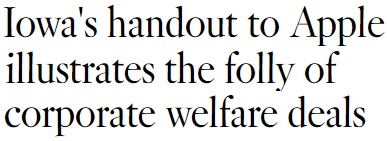
Here’s are excerpts from a column in the L.A. Times on crony capitalism for Apple and other large firms.
And here’s an editorial from Wisconsin about a bit of cronyism from the land of cheese.State and local officials in Iowa have been working hard to rationalize their handout of more than $208 million in tax benefits to Apple, one of the world’s richest companies, for a data facility that will host 50 permanent jobs. …the Apple deal shows the shortcomings of all such corporate handouts, nationwide. State and local governments seldom perform cost-benefit studies to determine their value — except in retrospect, when the money already has been paid out. They seldom explain why some industries should be favored over others — think about the film production incentives offered by Michigan, Louisiana, Georgia and, yes, Iowa, which never panned out as profit-makers for the states. …the handouts allow big companies to pit state against state and city against city in a competition that benefits corporate shareholders almost exclusively. Bizarrely, this process has been explicitly endorsed by Donald Trump. …politicians continue to shovel out the benefits, hoping to steer their economies in new directions and perhaps acquire a reputation for vision. Nevada was so eager to land a big battery factory from Tesla Motors’ Elon Musk that it offered him twice what Musk was seeking from the five states competing for the project. (In Las Vegas, this is known as “leaving money on the table.”) Wisconsin Gov. Scott Walker gave a big incentive deal to a furniture factory even though it was laying off half its workforce. He followed up last month with an astronomical $3-billion handout to electronics manufacturer Foxconn for a factory likely to employ a fraction of the workforce it forecasts.
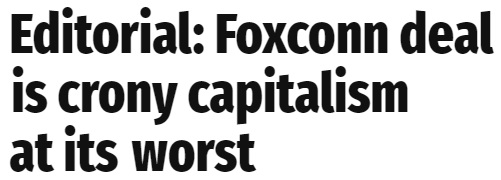
Let’s now circle back to Amazon and consider how it gets preferential treatment from the Post Office.The Foxconn deal…should be opposed by Democrats and Republicans, liberals and conservatives. There are no partisan nor ideological “sides” in this debate. The division is between those who want to create jobs in a smart and responsible way that yields long-term benefits and those who propose to throw money at corporations that play states and nations against one another. The Foxconn deal represents the worst form of crony capitalism — an agreement to transfer billions of dollars in taxpayer funds to a foreign corporation. …Walker offered the company a massive giveaway — discussions included a commitment to hand the Taiwanese corporation nearly $3 billion in taxpayer funds (if it meets hazy investment and employment goals), at least $150 million in sales tax exemptions…the Legislative Fiscal Bureau, which analyzes bills with budget implications…pointed out that Foxconn would receive at least $1.35 billion and possibly as much as $2.9 billion in tax incentive payments even if it didn’t owe any Wisconsin tax… This is a horrible deal.
I don’t feel guilty ordering most of my family’s household goods on Amazon. …But when a mail truck pulls up filled to the top with Amazon boxes for my neighbors and me, I do feel some guilt. Like many close observers of the shipping business, I know a secret about the federal government’s relationship with Amazon: The U.S. Postal Service delivers the company’s boxes well below its own costs. Like an accelerant added to a fire, this subsidy is speeding up the collapse of traditional retailers in the U.S. and providing an unfair advantage for Amazon. …First-class mail effectively subsidizes the national network, and the packages get a free ride. An April analysis from Citigroup estimates that if costs were fairly allocated, on average parcels would cost $1.46 more to deliver. It is as if every Amazon box comes with a dollar or two stapled to the packing slip—a gift card from Uncle Sam. Amazon is big enough to take full advantage of “postal injection,” and that has tipped the scales in the internet giant’s favor. …around two-thirds of Amazon’s domestic deliveries are made by the Postal Service. It’s as if Amazon gets a subsidized space on every mail truck.In this last example, the real problem is that we’ve fallen behind other nations and still have a government-run postal system.
The way to avoid perverse subsidies is privatization. That way Amazon deliveries will be based on market prices and we won’t have to worry about a tilted playing field.
And that last point is critical.
Yes, cronyism and corporate welfare is an economic issue. It is bad for long-run growth when political favors distort the allocation of capital.
But an unlevel playing field is also a moral issue. It’s simply not fair or not right for politicians to give their buddies special advantages.And it’s both economically harmful and morally harmful to create a system where the business community views Washington as a handy source of unearned wealth.
For what it’s worth, I also think it should be a legal issue. For those of us who believe in the rule of law, a key principle is that everyone should be treated equally. Heck, that principle is enshrined in the Constitution.
So I’ve always wondered why courts haven’t rejected special deals for specific companies because of the equal-protection clause?
Then again, maybe I shouldn’t wonder. After all, the Supreme Court twisted itself into a pretzel to miraculously rationalize Obamacare.
But none of this changes the fact that it’s time to wean big business off corporate welfare.
P.S. Just in case you harbor unwarranted sympathy for big companies, remember that these are the folks who are often keen to undermine support for the entire capitalist system.
Monday, December 4, 2017
New Research on the Benefits of Lower Corporate Tax Rates
December 3, 2017 by Dan Mitchell
As part of yesterday’s column about the comparatively tiny – and temporary – tax cut in the Republican tax reform plan, I quoted a leftist columnist for US News & World Report, who argued that there should be a big tax increase (including a big tax hike on middle-income taxpayers) and that such a tax hike would not hurt the economy.
 Today, I want to address the latter argument about taxes and economic growth. When this topic arises, I normally cite both public-finance theory and empirical research to make the case that taxes do impact economic performance, and I try to always stress that not all taxes are created equal.
And if the focus is corporate taxation, I usually share my primer on the issue, and then link to research from Australia, Canada, Germany, and the United Kingdom.
But maybe it will be more persuasive to look at some new academic evidence from a study on U.S. corporate taxes by Professor Eric Ohrn (forthcoming in the American Economic Journal).
If you don’t want to dwell on the details, the paper’s abstract tells you the highlights. Simply stated, a lower corporate rate translates into more investment and less debt.
Here’s the problem Professor Ohrn identified.
It turns out that even modest differences in tax rates can have a big impact.
And since it’s good to have more investment and good to have less debt, both these findings re very positive.

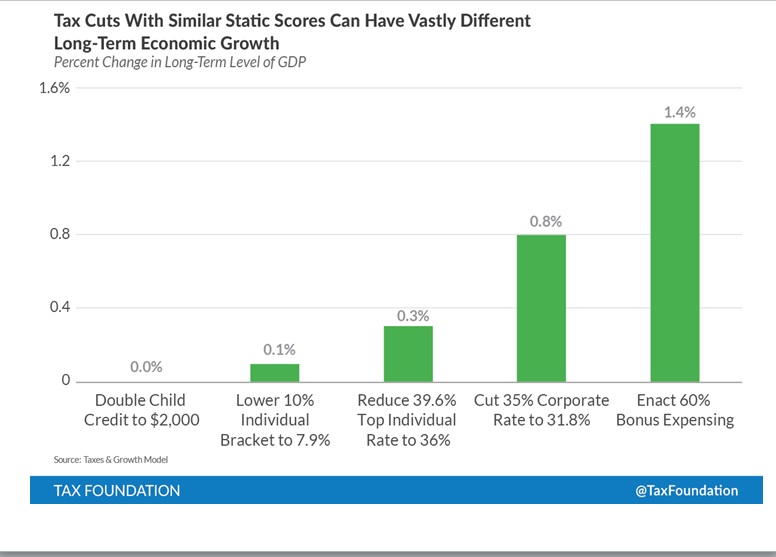
Interestingly, the benefits of fixing depreciation laws (by moving in the direction of expensing) are quite similar to the benefits of lowering the corporate tax rates.
Unless you have the bizarre mindset of some statists who think all output belongs to the state.
Anyhow, back to regularly scheduled programming.
We’re now at a critical point in the battle for tax reform. The House passed its version and now the Senate has passed its version. The good news is that there’s strong agreement on Capitol Hill to slash the corporate tax rate.
This latest study underscores why that reform will boost investment. And remember, when investment increases, that translates into higher wages for workers.
As part of yesterday’s column about the comparatively tiny – and temporary – tax cut in the Republican tax reform plan, I quoted a leftist columnist for US News & World Report, who argued that there should be a big tax increase (including a big tax hike on middle-income taxpayers) and that such a tax hike would not hurt the economy.
And if the focus is corporate taxation, I usually share my primer on the issue, and then link to research from Australia, Canada, Germany, and the United Kingdom.
But maybe it will be more persuasive to look at some new academic evidence from a study on U.S. corporate taxes by Professor Eric Ohrn (forthcoming in the American Economic Journal).
If you don’t want to dwell on the details, the paper’s abstract tells you the highlights. Simply stated, a lower corporate rate translates into more investment and less debt.
I exploit quasi-experimental variation created by the Domestic Production Activities Deduction, a corporate tax expenditure created in 2005. A one percentage point reduction in tax rates increases investment by 4.7 percent of installed capital, increases payouts by 0.3 percent of sales, and decreases debt by 5.3 percent of total assets. These estimates suggest that lower corporate tax rates and faster accelerated depreciation each stimulate a similar increase in investment, per dollar in lost revenue.But hopefully there will be interest in some of the details from the study.
Here’s the problem Professor Ohrn identified.
…relatively little empirical work has been able to directly estimate the effects of a reduction in the corporate income tax rate on business activity. This study provides new evidence on these effects.His evidence is based on the fact lawmakers created a lower tax rate for America-based manufacturing (a.k.a., the domestic production activities deduction, or DPAD).
In 2005, when the DPAD was implemented, firms could deduct 3 percent of manufacturing income. This rate was scaled to 6 percent in 2007 and 9 percent in 2010, where it remains today. As a result of the policy, after 2010, firms that derive all of their income from domestic manufacturing activities and face the top statutory corporate income tax rate have a 3.15 (= 0.09 × 35 percent) percentage point lower effective tax rate than firms with no domestic manufacturing activities. …I use data provided by the IRS Statistics of Income (SOI) Division. The SOI publishes the aggregate annual dollar values of the DPAD and Net Taxable Income for corporations in 75 unique industries and all businesses in 12 asset-classes (firm size bins).And what did he find as he looked at the difference between firms with lower tax rates and higher tax rates?
It turns out that even modest differences in tax rates can have a big impact.
I find that the DPAD has a large effect on corporate behavior. A one percentage point reduction in the effective corporate income tax rate via the DPAD increases investment by 4.7 percent of installed capital, increases payouts by 0.3 percent of revenues, and decreases debt usage by 5.3 percent of total assets. …corporations respond strongly to the DPAD, and corporate income tax rate cuts more generally, by increasing investment and payouts and decreasing debt usage. The average firm does not report more taxable income per dollar of asset, suggesting that any increases in revenue generated by corporate tax rate reductions are the product of real effects such as investment but not decreased avoidance activity.Here are a couple of charts from the study. The dark blue line represents companies with lower tax rates and the dashed line represents the ones with higher tax rates.
And since it’s good to have more investment and good to have less debt, both these findings re very positive.

Interestingly, the benefits of fixing depreciation laws (by moving in the direction of expensing) are quite similar to the benefits of lowering the corporate tax rates.
…a dollar spent by the government stimulates virtually the same amount of investment whether it is used to reduce corporate tax rates or accelerate depreciation expenses.I hate to digress, but I can’t resist pointing out that I’m irked by the language about “a dollar spent by the government.” Professor Ohrn certainly seems to be a rigorous and capable economist, but he has a bit of a moral blind spot. If the federal government adopts a policy that allows a business to keep more of the money it earns, that is not “a dollar spent” by government.
Unless you have the bizarre mindset of some statists who think all output belongs to the state.
Anyhow, back to regularly scheduled programming.
We’re now at a critical point in the battle for tax reform. The House passed its version and now the Senate has passed its version. The good news is that there’s strong agreement on Capitol Hill to slash the corporate tax rate.
This latest study underscores why that reform will boost investment. And remember, when investment increases, that translates into higher wages for workers.
Monday, January 30, 2017
Shutting Down the Liberal Leech
By Tom Trinko
Have you ever noticed how liberals always think that everyone else's money is theirs? Liberal CEOs of companies like Starbucks aren't content with contributing some of their own massive salaries to the political causes they like; they have to use their shareholders' money, too.
The Starbucks CEO said that backing the redefinition of marriage to suit the whims of the 2% of Americans who are gay wasn't an economic decision. He admitted that even though it hurt the company, he'd decided that the morality he liked should be backed........... Read more
Have you ever noticed how liberals always think that everyone else's money is theirs? Liberal CEOs of companies like Starbucks aren't content with contributing some of their own massive salaries to the political causes they like; they have to use their shareholders' money, too.
The Starbucks CEO said that backing the redefinition of marriage to suit the whims of the 2% of Americans who are gay wasn't an economic decision. He admitted that even though it hurt the company, he'd decided that the morality he liked should be backed........... Read more
Sunday, June 26, 2011
This is a Test!
Dear All,
I have linked an article below for your perusal...Is this article factual? Is this article logical? Is this article filled with logical fallacies? If so, can you find the logical fallacies in this article? If there are logical fallacies in this article, can you develop an intellectual response to these accusations?
I think this guy is a bit of a loon, but he has interesting stuff on his site, and I like reading this stuff in order to keep my mind alert. I would also like to add....he is “right on” occasionally, causing me to adjust my perspective. Also I read the articles on his site because I don't find as many issues presented as interestingly elsewhere, and he is prolific....daily!
You must read the other side if you wish to develop the intellectual responses to their attacks. It also makes recognizing logical fallacies easier. The more we do this the more we find that the patterns of argumentation repeat over and over again. The same logical fallacies are used over and over again. The key is spotting them; once that happens the response will follow easily.
There is one caveat though. We have to read. The answers cannot come if we don’t have the information tucked away in our brain. These kinds of exercises merely train our minds to utilize what is there; if it is there.
We have to read. Both sides!
The other thing that we will learn is that both sides leave stuff out. Find out what that stuff is and why it has been left out and an honest hearted person will have the answer. Get the history…the complete history….. of any issue and you will have the answer.
Rich Kozlovich
Corporations are psychopaths - with zero degrees of empathy
Saturday, June 25, 2011 by: Kaitlyn Moore
(NaturalNews) Corporations play a big role in our day-to-day activities and they are constantly making decisions that have a profound effect on our daily lives. For example: a corporation makes the decision to empty its chemical vats into a nearby river - the water supply is poisoned and residents of the adjacent town fall sick; or a corporation makes the decision to cut costs to increase profits and initiates a round of layoffs - the community that was formed around the corporation is decimated. We have often been appalled, angry, and go on rants about the evil of corporations but according to Simon Baron Cohen- evil is not the issue.
Answer to the Test
###
I have linked an article below for your perusal...Is this article factual? Is this article logical? Is this article filled with logical fallacies? If so, can you find the logical fallacies in this article? If there are logical fallacies in this article, can you develop an intellectual response to these accusations?
I think this guy is a bit of a loon, but he has interesting stuff on his site, and I like reading this stuff in order to keep my mind alert. I would also like to add....he is “right on” occasionally, causing me to adjust my perspective. Also I read the articles on his site because I don't find as many issues presented as interestingly elsewhere, and he is prolific....daily!
You must read the other side if you wish to develop the intellectual responses to their attacks. It also makes recognizing logical fallacies easier. The more we do this the more we find that the patterns of argumentation repeat over and over again. The same logical fallacies are used over and over again. The key is spotting them; once that happens the response will follow easily.
There is one caveat though. We have to read. The answers cannot come if we don’t have the information tucked away in our brain. These kinds of exercises merely train our minds to utilize what is there; if it is there.
We have to read. Both sides!
The other thing that we will learn is that both sides leave stuff out. Find out what that stuff is and why it has been left out and an honest hearted person will have the answer. Get the history…the complete history….. of any issue and you will have the answer.
Rich Kozlovich
Corporations are psychopaths - with zero degrees of empathy
Saturday, June 25, 2011 by: Kaitlyn Moore
(NaturalNews) Corporations play a big role in our day-to-day activities and they are constantly making decisions that have a profound effect on our daily lives. For example: a corporation makes the decision to empty its chemical vats into a nearby river - the water supply is poisoned and residents of the adjacent town fall sick; or a corporation makes the decision to cut costs to increase profits and initiates a round of layoffs - the community that was formed around the corporation is decimated. We have often been appalled, angry, and go on rants about the evil of corporations but according to Simon Baron Cohen- evil is not the issue.
Answer to the Test
###
Subscribe to:
Posts (Atom)