How progressive reforms helped level a historic part of black Detroit
Howard Husock June 4, 2021 @ City Journal
The United States recently marked the 100th anniversary of the 1921 Greenwood Massacre in Tulsa, Oklahoma. The newfound attention, including from the president,
to the destruction of Tulsa’s “Black Wall Street” reminds us that
thriving, dynamic black communities existed in America long before the
War on Poverty or the civil rights legislation of the 1960s. But
Greenwood was not the only African-American neighborhood that would be
leveled: consider the DeSoto-Carr section of St. Louis, parts of
Chicago’s Bronzeville, Cedar-Central in Cleveland—and Black Bottom in Detroit.
These neighborhoods, however, did not fall to racist mobs. They were
the victims instead of progressive reforms: above all, urban renewal, as
authorized by the National Housing Act of 1949,
which provided funds to clear neighborhoods and replace them with
public housing towers. The law made available “federal advances, loans,
and grants to localities to assist slum clearance and urban
redevelopment,” leading to the construction of 850,000 new public
housing apartments. In Detroit’s Black Bottom, once home to 140,000
black residents, the process became known as “Negro removal”—as evoked
by “Why I Sing the Blues” by Aretha Franklin, whose father, C. L. Franklin, ran the New Bethel Baptist Church, one of the Black Bottom buildings demolished.
Like the Greenwood Massacre, Black Bottom and its history
have received fresh interest. In 2015, a young African-American
community organizer, PG Watkins, established the Black Bottom Archives.
Watkins is at work recording the oral histories of those who once lived
in the neighborhood. A onetime social studies teacher at a charter
school, Jamon Jordan, who heads the Detroit chapter of the Association
for the Study of African American Life and History, has set up a
successful business, the Black Scroll Network,
which gives guided tours of the few remaining buildings. His clients
include former Black Bottom residents as well as college students. He
tells them a well-researched story of loss—of homes, businesses,
churches, and mutual-aid groups.
 |
| In
Black Bottom and elsewhere, urban renewal and public housing helped
wipe out hubs of black-owned businesses and self-help institutions.
(GRANGER) |
Black Bottom—named by the area’s early French residents for its dark
farm soil—“was not destroyed by the Ku Klux Klan and lynching,” says
Jordan. “It was destroyed because the federal and city governments
colluded to wipe it out without almost any compensation.” As happened in
many other black neighborhoods, urban renewal and public housing helped
wipe out a hub of black-owned businesses and self-help institutions, a
community that fostered homeownership and wealth accumulation—goods that
contemporary American blacks have struggled to achieve.
If the 1949 Housing Act led directly to the
death of Black Bottom and its adjoining neighborhoods, the previous
decades of reform—when progressives developed federal tools to demolish
what they termed slums and replace them with modernist, top-down
plans—laid the groundwork. Neighborhood residents didn’t lead these
crusades. Indeed, as sociologists Peter Rossi and Robert Dentler have written,
the public-policy modernists faced local opposition. “The community was
viewed by Negroes as an almost ideal residential location and far from
blighted or deteriorated,” they observe of a Chicago neighborhood
similar to Black Bottom. “For Negroes from every class level . . . the
importance ascribed by whites to renewal seemed only a flimsy excuse . .
. [R]enewal plans were seen as directed specifically against Negroes.”
The origins of the idea of slum clearance date to journalist Jacob Riis, who photographed New York’s Lower East Side in How the Other Half Lives. Conspicuously, his work never included residents’ thoughts about their own neighborhood. Riis’s biographer,
Tom Buk-Swienty, labeled him as among the “writers who wrote about the
slums focused primarily on suffering and squalor.” As Buk-Swienty noted,
however, “there was more to the slums than abject poverty. Hundreds of
thousands of families lived relatively normal lives. They worked,
although usually under deplorable conditions, paid rent, fed their
children and had hopes and dreams for the future. For a large number of
immigrants . . . life in the tenements was an improvement on their old
lives, offering a more dignified existence.” In an insight that would
remain elusive to later Riis-inspired housing reformers, Buk-Swienty
maintained that “poverty was not a life sentence, as many writers,
including Riis, at times, seemed to want readers to believe.”
The most direct link to the destruction of Black Bottom involves the
progressive movement and its latter-day federal incarnations: Franklin
Delano Roosevelt’s New Deal and Harry Truman’s Fair Deal. Upset by slum
conditions that they knew only at a distance, two well-educated members
of the upper middle class—Columbia University faculty member Edith Elmer
Wood and Cornell architecture student Catherine Bauer—supplied the
intellectual framework for these programs.
For Wood, the physical condition of poor neighborhoods—some of which,
including Black Bottom, still included homes with outdoor privies—was
the only relevant concern. The idea that communities of private,
low-cost, low-income housing—with their local businesses and property
owners and dense networks of social and religious institutions—could be
way stations to upward mobility and could see their prospects improve as
U.S. prosperity improved never occurred to her. In a 1934 paper, “A Century of the Housing Problem,”
and in other writings, Wood led the charge against slums and the
private housing industry itself. Her work would shape New Deal housing
policy. “The housing problem is an inevitable feature of our modern
industrial civilization and does not tend to solve itself,” she wrote.
“Supply and demand do not reach it, because the cost of new housing and
the distribution of income are such that approximately two thirds of the
population cannot present an effective demand for new housing. And
while some of the older housing is acceptable enough, a great deal is
shockingly inadequate. . . . There are housing conditions across the
United States which cannot be tolerated in civilized communities.”
If Wood provided the theory, Catherine Bauer offered the blueprints.
In the late 1920s, she was living a Bohemian lifestyle in Greenwich
Village, before turning her sights toward housing reform. Bauer was
enthralled with modernist architecture, and the idea that it should
replace existing low-rent housing. She envisioned a modernist workers’
housing utopia. Photography and architecture dominated her profoundly
influential 1934 book, Modern Housing.
But her written message was even more ambitious—and radical—than
Wood’s. “The need to remove housing from private hands was the principal
message of Modern Housing,” writes architectural historian
Barbara Penner, in the foreword to a 2020 edition of the book. Frank
Lloyd Wright, who liked Bauer personally, called her “Communist
Catherine.” As Bauer wrote in the depths of the Depression, when housing
construction of all kinds was at a standstill, there “is no getting
around the fact that modern housing and much of the framework of
contemporary Western society are mutually antipathetic. The premises
underlying the most successful and forward-pointing housing developments
are not the premises of capitalism, of inviolate private property, of
entrenched nationalism, of class distinction.” Not only the physical
conditions but also the very idea of a poor neighborhood such as Black
Bottom were anathema to Bauer, who believed that private construction
would fail to provide decent housing for most people. Modern Housing promoted Le Corbusier–style social housing as a more advanced approach.
Roosevelt took office a year after Modern Housing was
published, soon breaking ground on the first public housing in the
United States. That included the Brewster Homes, which replaced a small
portion of Black Bottom. First Lady Eleanor Roosevelt, who had pushed
for blacks to be included in public housing, spoke at the Brewster Homes
groundbreaking
in September 1935. When the project opened in 1938, it became America’s
first public housing project built for African-Americans.
But Black Bottom’s fate was not yet sealed. At the same time that
Wood and Bauer were laying the groundwork for public housing, the
neighborhood was being transformed. Black Bottom was long an immigrant
neighborhood—successively German, Irish, Italian, and Jewish. But even
in the pre–Civil War era, it was a beachhead for a small number of
blacks, such as William Lambert,
the Trenton, New Jersey-born son of a freed slave who arrived in
Detroit as a steamship cabin boy and went on to build a successful
tailoring and dry-cleaning business on the neighborhood’s St. Antoine
Street. He was an active leader in the Underground Railroad, shepherding
fugitives across the nearby Canadian border to Windsor, Ontario, and
corresponding with leading abolitionists, including William Lloyd
Garrison. His Saint Matthew’s Episcopal church remained a community
institution until Black Bottom and Paradise Valley, an adjoining
neighborhood, were cleared.
The neighborhood’s heyday as a black community began in earnest in
the years after World War I, when Henry Ford’s famous offer of a $5-a-day factory wage drew Southerners, including blacks, to Detroit. That appeal grew in 1941, when President Roosevelt lifted a ban
against blacks working in defense industries, including the converted
auto plants. Black Bottom and Paradise Valley, on the city’s East Side,
adjoined its downtown, bounded by Gratiot Avenue, Brush Street, Vernor
Highway, and the Grand Trunk Railroad tracks. Both neighborhoods grew
increasingly populated.
Race, and racism, doubtless played a role in
Black Bottom’s development—and its eventual demolition. The era of
Black Bottom’s growth, notes Jamon Jordan, coincided with a period in
which private deed restrictions still commonly barred the sale or rental
of homes to blacks. The Supreme Court would not declare these unconstitutional
until 1948. Meantime, the federal government’s move into the private
housing market brought with it not only long-term government-insured
mortgages but also the denial of such insurance for loans made in areas
where the Federal Housing Administration concluded that blacks were
likely to move. By assuming that whites would then flee, the agency
deemed such areas high-risk—and drew red lines around them on maps. Thus
it was that the Roosevelt administration, not private banks, began the
now-infamous practice of “redlining.” As Richard Rothstein explains in The Color of Money,
this policy made ownership far more difficult to attain for potential
black home buyers. Government involvement in the private housing market,
which served to institutionalize racism, meant that blacks in Detroit
had to squeeze into Black Bottom.
Nonetheless, business and civic life thrived in Black Bottom and Paradise Valley. The Michigan Chronicle, Detroit’s African-American newspaper, says that black Detroiters had “created their own utopia
in Black Bottom and Paradise Valley, where hundreds of businesses,
churches, nightclubs, clubs, hotels, barbershops, and beauty salons were
owned by African-Americans.” Residents included Motown records founder
Berry Gordy Jr. and “Detroit Red”—later known as Malcolm X. Along such
lost streets as St. Antoine, Hastings, and Adams Avenue, estimates
Jordan, stood no fewer than 350 black-owned businesses. They included
the Jesse Faithful and L’il Soul Food restaurants, the Busy Bee Cafe,
the Wolverine Barbershop, tailor and shoe-repair shops, the Chronicle,
the black-owned Hardin drugstore, and the Paradise Bowl, a 20-alley
bowling facility part-owned by heavyweight boxing champion Joe Louis,
who had lived in Black Bottom after his family moved north from Alabama
and kept an office in the neighborhood.
Black Bottom was home to entertainment spots, including the Forest
Club, owned by one of the city’s wealthiest African-Americans, Sunnie Wilson.
Major blues singers, big bands, and jazz artists—Duke Ellington, Billy
Eckstine, Pearl Bailey, Ella Fitzgerald, and Count Basie—regularly
performed in the bars and clubs of Paradise Valley’s entertainment
district. They might have stayed in Black Bottom’s Gotham Hotel,
considered the best black hotel in the country, or in the Mark Twain
Hotel, owned by Wilson. Both were listed in the now-famous Green Book guide to places where blacks could safely stay when travelling.
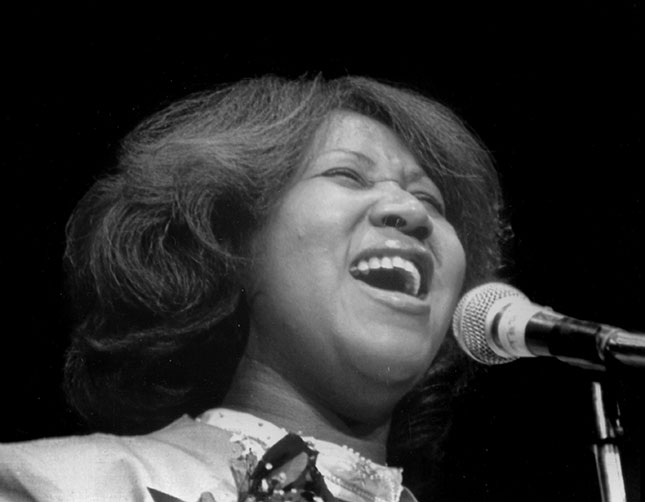 |
| Aretha
Franklin performing at a 1980 benefit for her father, Reverend C. L.
Franklin, long-time pastor of New Bethel Baptist Church, once located in
Black Bottom (Leni Sinclair/ Michael Ochs Archives/Getty Images) |
Jordan also points to the presence of mutual-aid associations. The
Phyllis Wheatley Home for Aged Colored Ladies helped elderly widows. The
Detroit Housewives League, sister organization of the Booker T.
Washington Business Association, organized boycotts of white businesses
that would not hire blacks and urged Black Bottom residents to patronize
black-owned stores. The Urban League’s Detroit branch—which relatively
affluent blacks established to help newcomers from the rural South
adjust to city life—had its office in Black Bottom. And, of course,
houses of worship were abundant: Catholic and Lutheran churches from
when the immigrant neighborhood had been Irish, Italian, Polish, and
German; and black churches, most famously New Bethel Baptist, headed by
the Mississippi-born reverend C. L. Franklin, whose daughter Aretha was
already on her way to stardom when the church had to relocate.
Finally, there were black property owners of single- and multifamily
homes. Notwithstanding the conventional view that outside landlords
owned “slum” housing, black Detroit boasted plenty of homeowners. Census
data from 1950 show that in predominantly black Detroit neighborhoods,
28.1 percent of residences were owner-occupied. Many of those homes also
had rental apartments, so they were sources of wealth accumulation.
Many tenants, in turn, rented out rooms to boarders, both to pay their
rent and to accumulate savings of their own. Such property owning was a
route to upward mobility, in contrast with the public housing that would
replace the neighborhood—in which private ownership is, by definition,
impossible.
A proximate cause for the decision of
Detroit’s civic leaders to clear Black Bottom came in 1943, when a
fierce race riot wracked the city. A year earlier, the advent of one of
the earliest public housing projects, built in response to the needs of
defense workers new to Detroit, had stoked tensions. Named for the black
abolitionist Sojourner Truth, the project was located in the mostly
white, blue-collar Seven Mile-Fenelon neighborhood, adjacent to an
existing black neighborhood, Conant Gardens. In 1942, after the first
black families moved in, a wave of violence
followed. These black residents were defense workers, and Jordan
explains the reaction, aside from its racist motivations, as a
post-Depression hangover: whites wanted to be sure that, upon their
return from war, they would still have jobs. The fact that blacks were
both being permitted to work in wartime factories and live in
government-supported housing fueled fear and anger.
Then, in June 1943, groups of whites and blacks fought each other on
Belle Isle, and from there, sparked by rumors of other racial incidents,
the violence spread into Detroit proper. White mobs attacked, looted,
and burned residences and businesses in Black Bottom. “This was a true
race riot,” observes Jordan. “Whites were fighting only with blacks, and
blacks were fighting only with whites.” According to the Detroit Historical Society, nine whites and 25 blacks died in the 1943 riot, including 17 blacks killed by police.
Detroit resolved not to attempt to rebuild and incrementally improve
Black Bottom. Blacks, not whites, were viewed as violent instigators,
with Black Bottom and Paradise Valley their epicenter. In 1944,
real-estate developer Eugene Greenhut proposed the neighborhoods’
demolition. The idea found favor with Detroit mayor Edward Jeffries.
“This area,” Jeffries wrote in 1946,
should “be acquired by the city and completely cleared of all buildings
thereon. . . . The area [should] then be re-planned, with the object in
mind of disposing of as much as possible to private enterprise for
redevelopment for housing and incidental commercial purposes after
providing sufficient space for parks, playgrounds, schools and other
public uses.”
It was a vision of modernist planning, but it stalled for lack of
funds and might have languished permanently were it not for the National
Housing Act of 1949. Washington funds would make possible both the
clearance of Black Bottom and the construction of six high-rise public
housing towers, known as the Frederick Douglass Apartments, which,
combined with an older project, became the Brewster-Douglass Homes.
The plan suited the purposes of two seemingly disparate groups: postwar
progressives in the Truman administration, convinced that public
housing would provide the “safe and sanitary” conditions that too many
Americans lacked; and Detroit’s Republican mayor Albert Cobo, elected in
1950, whose racially charged campaign, following the Supreme Court’s
1948 decision to strike down deed restrictions, included promises to
maintain white neighborhoods as white. The Michigan Chronicle
characterized Cobo’s election as “one of the most vicious campaigns of
race-baiting and playing upon the prejudices of all segments of the
Detroit population.”
But progressive housing policy did what even a race-baiting mayor
might never have achieved. Because Black Bottom was such a concentrated
neighborhood, Jordan says, “it was so easy to just wipe it out.”
Business owners, for the most part, received no compensation because, he
notes, they owned only their stores, not the land. Renters got nothing
but a chance to live in public housing.
 |
| The
area that was once Black Bottom, in present-day Detroit (© Romain
Blanquart/Detroit Free Press/ZUMAPRESS.com/Alamy Stock Photo) |
“Public housing,” observes Jordan, in an understatement, “was
problematic.” True, it initially provided better physical accommodations
for those relocated. “A significant number of people clamored to be on
the list.” But “after years living there, all you would have would be
rent receipts.” Referring to the FHA’s redlining, Jordan says,
“African-Americans would get the projects, whites would become
homeowners. And property ownership is the way to accumulate wealth in
America.”
Contemporary black–white wealth disparities confirm that observation.
In Detroit and across America, blacks continue to live in public and
government-subsidized housing disproportionately to their share of the
total population. Of some 5 million units
of subsidized housing in the U.S.—including all public
housing—African-Americans occupy 39 percent, more than three times their
percentage of the U.S. population (12.3 percent). Tenants, on average,
occupy subsidized housing for 12 years. These projects offer little
springboard for upward mobility. Women head 79 percent of
subsidized-housing households, while only 4 percent of such households
are headed by two adults with children. One gets priority for public
housing based on income; the higher incomes of two-parent families tend
not to qualify. If a second breadwinner joins a public housing
household, the rent, set at 30 percent of income, rises.
Without public housing, one can imagine a
different history unfolding for Black Bottom. As black Detroiters became
wealthier and the city’s auto plants boomed, black institutions might
have renovated and otherwise improved historically black neighborhoods.
Small-business owners might have expanded their firms and built wealth.
Had the government not been so heavily involved in the mortgage market,
competing banks might have sought out, not shut out, potential black
home buyers.
Instead, Black Bottom and Paradise Valley were cleared. The
Brewster-Douglass high-rises opened. By 2014, the project’s six towers
had decayed to the point that they were demolished; Black Bottom, in
effect, was cleared again. The nearby original site of Paradise Valley,
cleared by 1956, lay fallow for years—a large, empty lot where a
thriving neighborhood once stood. Ultimately, Detroit civic leaders, led
by United Auto Workers president Walter Reuther, pursued the
construction of the Lafayette Park apartments, an upper-middle-class
complex designed by pioneer modernist architect Ludwig Mies van der
Rohe. Housing reformers got their way: clearance, followed by the
anti-urbanism of modernist architecture, both in Lafayette Park and in
the Brewster-Douglass Homes. A vital piece of black Detroit was swept
away.
Howard Husock is an adjunct scholar at the American Enterprise Institute, a contributing editor of City Journal, and the author of the forthcoming The Poor Side of Town: And Why We Need It (Encounter Books, September 2021).
Top Photo: Detroit, circa 1955: thriving, dynamic black
communities existed in America long before the War on Poverty or the
civil rights legislation of the 1960s. (Three Lions/Hulton Archive/Getty
Images)
City Journal is a
publication of the Manhattan Institute for Policy Research (MI), a
leading free-market think tank. Are you interested in supporting the
magazine? As a 501(c)(3) nonprofit, donations in support of MI and City Journal are fully tax-deductible as provided by law (EIN #13-2912529). SUPPORT